How to Grow and Care for a Toad Lily in Your Garden
Toad lily care starts with the right species and a moist woodland site. Get practical advice on planting, watering, pots, propagation, and common problems.
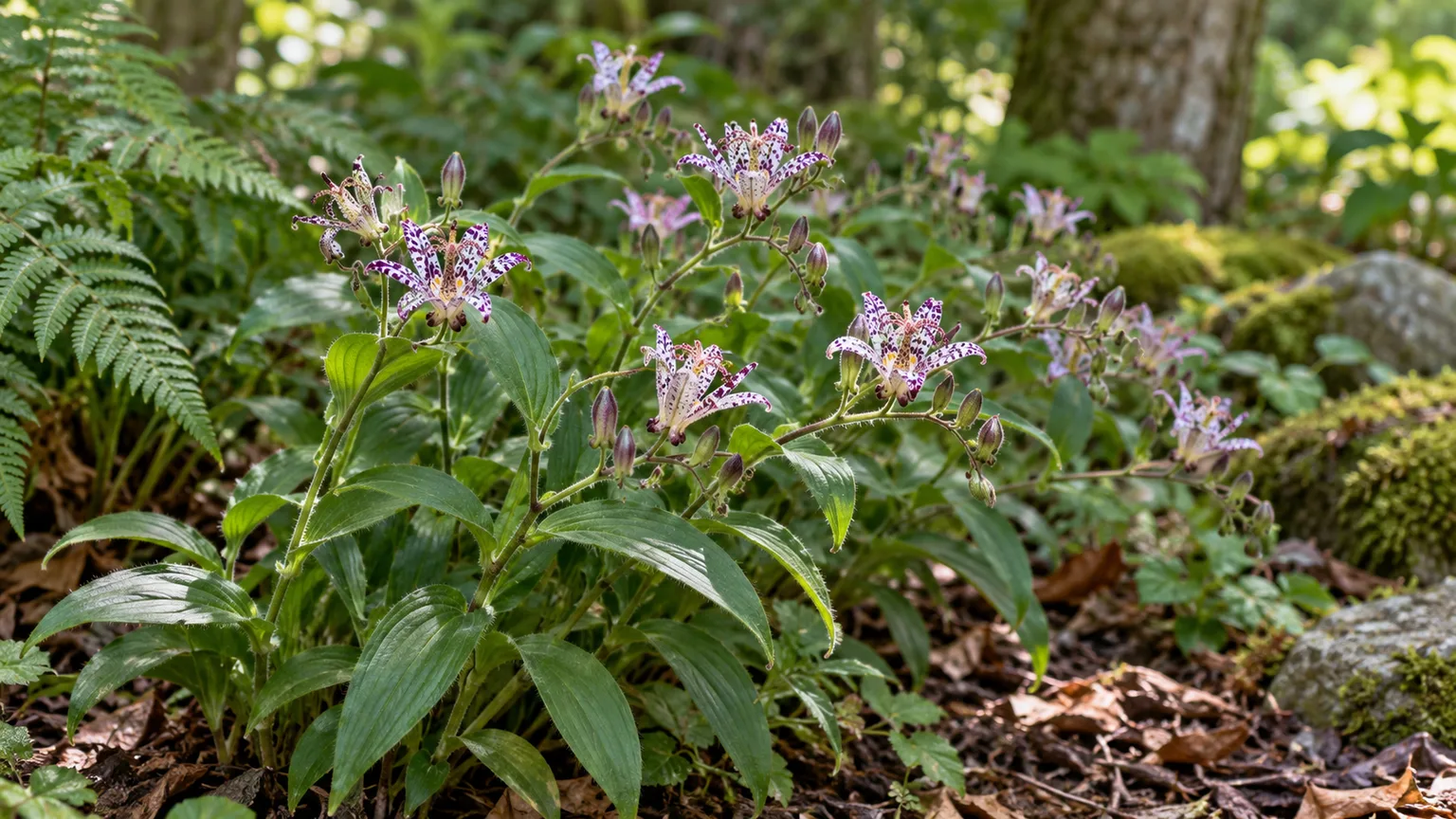
Toad lily is a shade-garden perennial for the moment when spring flowers are gone and late-summer borders start to thin out. Its small, orchid-like blooms—usually white or pale purple with dark spots—open along arching stems, so you notice the detail best from a path or seating area rather than across a large lawn. A plant that is often sold simply as “toad lily” can be Tricyrtis hirta, a hybrid, or another species, however, and those plants do not all have the same spread or cold tolerance.
For the best chance of flowers, start by identifying the plant on its nursery label, then match it to a sheltered, shaded site where the soil stays evenly moist and drains after rain. The main balancing act is simple: prevent the root zone from drying during summer bud formation, but do not leave the rhizomes sitting in water.
Which Toad Lily Is in Your Garden?
Toad lily is the common name for Tricyrtis, a genus of East Asian herbaceous perennials in the lily family. The common garden species T. hirta is also called hairy or Japanese toad lily; it has soft, hairy stems and leaves arranged alternately up the stem. Its flowers are generally small and spotted, and its clumping rhizomes expand gradually rather than racing across the bed. The University of Wisconsin–Madison Extension describes T. hirta as a late-emerging perennial that commonly reaches about 12 to 36 inches and is hardy to Zone 4 in its Wisconsin guidance.
The genus is more varied than that familiar profile suggests. Some plants sold under a species name may be hybrids, and T. formosana can spread more assertively by underground rhizomes than a clump-forming T. hirta. NC State Extension’s profile for T. formosana describes a plant that spreads by rhizomes and prefers open shade, while Wisconsin Extension notes that T. hirta and T. formosana cross readily and that many hybrids are more vigorous than either parent. Ask the nursery for the botanical name and cultivar, and keep the label; “toad lily” alone is not enough to plan mature width or winter protection.
The flowers are also easy to misjudge from a distance. They are typically about an inch across, with six similar-looking tepals and a protruding crown of stamens and styles; look closely and the spots, color, and shape become much more visible. The RHS plant profile for T. hirta describes a deciduous perennial with white, purple-spotted flowers in late summer and autumn, while Wisconsin Extension reports that the bloom window may last about three weeks or end sooner with a hard frost. Bees and other insects visit the flowers, and the small blooms reward close viewing.
Find the Right Shade and Sheltered Spot
Choose partial shade or bright open shade for the most reliable combination of foliage and flowers. A site with a few hours of gentle morning sun can work in a cool climate if its soil does not dry out, but hot afternoon sun can scorch leaves and stress buds, particularly in regions with humid heat or intense summer light. In a hot-summer garden, favor dappled light or full shade with ambient brightness rather than a western-facing wall or a spot under a roof overhang.
“Full shade” does not always mean a dark, dry corner. A bed under a dense evergreen canopy or beside a foundation may receive little rain and have heavy root competition, even though direct sun is absent. Toad lily is a poor choice for a site where you cannot supply summer water; if the root zone dries while buds form, the plant may brown, go dormant early, or skip flowering.
Shelter matters because many toad lilies flower late. A position near a fence, shrub, or woodland edge can protect tall stems from wind and help late blooms avoid an early frost, while still leaving enough air around the foliage. The RHS cultivation profile recommends a sheltered position in full or partial shade, and Wisconsin Extension notes that light frost protection can extend the show when flowers are open.
Prepare Soil That Holds Moisture Without Staying Wet
Toad lily roots do best in humus-rich soil that stays evenly moist but drains freely. Before planting, loosen a broad area rather than making a small, amended pocket in hard clay; a sharply different soil texture in one hole can hold water around the roots. Blend mature compost or leaf mold into the bed to improve organic matter, but do not add a layer of pure compost or bury the crown under a deep mound.
Check drainage before you plant. After a soaking rain, the bed should not remain puddled for hours or smell sour; in heavy soil, use a raised border or choose a naturally better-drained position instead of trying to fix chronic saturation with frequent amendments. If the soil is sandy and dries quickly, compost plus a light organic mulch can slow moisture loss, but you will still need to monitor the root zone through hot spells.
A slightly acidic soil is often recommended for cultivated selections, but a pH adjustment is not the first step unless a soil test shows a real problem. The more important conditions are organic matter, consistent moisture, and oxygen around the roots. The RHS profile lists T. hirta for moist but well-drained soil across several soil textures, while Gardenia’s profile for ‘Miyazaki Hybrids’ similarly emphasizes rich, evenly moist, well-drained ground.
Plant Nursery Starts in Spring
Plant container-grown toad lilies in spring after the ground can be worked, giving the roots a full growing season to settle before winter. Spring planting also makes it easier to track emergence and water consistently during establishment. A practical guide from Gardening Know How likewise favors early-spring division and moist, humus-rich soil that does not stay soggy. If a plant arrives late in the season, keep it watered in its pot and follow local nursery or extension advice about whether planting or overwintering the container is safer in your climate.
Set the plant at the same depth it grew in its nursery pot, spread the roots gently, and refill with the prepared soil. Water slowly to settle soil around the roots, then add an inch or two of leaf mold or shredded leaves without pressing mulch against the crown. For multiple plants, leave enough room for mature width and airflow; common T. hirta is often sold for a roughly 1- to 2-foot spread, but hybrids can grow larger, so defer to the cultivar label.
Do not bury a dormant plant deeply because it has not emerged yet. Toad lilies are late to break dormancy in spring, so a bare patch in April does not necessarily mean the plant failed. Mark the planting spot and wait until the soil warms before disturbing it or planting an aggressive groundcover directly over the crown.
Water Before the Leaves Brown
During the first growing season, water deeply whenever the upper few inches of soil begin to dry. Once established, rainfall may be enough in a cool, humid climate, but plants under trees, beside walls, or in containers often need supplemental water through summer. Check the soil rather than watering by a fixed calendar: moisture should reach the root zone, while excess water should be able to drain away.
The leaves give useful clues, but they are not a perfect moisture meter. Brown edges and premature dieback commonly follow drought or hot, dry exposure, and insufficient moisture during bud formation can reduce bloom. If the soil is already wet, do not respond to brown leaves with more water; first rule out poor drainage, root damage, or leaf disease.
A layer of leaf mold or fine bark mulch helps slow evaporation, especially beneath trees that intercept rainfall. Keep mulch loose and a little clear of stems so the crown can breathe and you can notice slugs. Wisconsin Extension links dry conditions with spotted or brown leaf margins, early dormancy, and poor bloom. The specialist growers at Plant Delights Nursery also note that container plants need closer moisture checks than in-ground clumps.
Feed Lightly and Mulch With Restraint
A fertile, organic soil usually needs no elaborate feeding schedule. Add a thin top-dressing of finished compost in spring if the bed is low in organic matter or the plant has grown poorly; avoid applying fertilizer to dry soil, and do not assume that extra nitrogen will create more flowers. Excess fertilizer can push soft leafy growth at the expense of a balanced, sturdy clump.
If you choose a packaged fertilizer, use a general-purpose product according to its label and the results of a soil test rather than repeating an arbitrary half-strength liquid feed. There is no reliable universal dose for every soil, cultivar, or container. If leaves are pale or growth is weak, check moisture, root competition, light, and drainage first, because fertilizer cannot correct a site that dries out or stays waterlogged.
Use mulch to moderate soil moisture and temperature, not to cover the plant. A shallow layer of shredded leaves or composted bark is enough; replenish it as it decomposes and keep it away from the crown. In a wet autumn, pull back excess material so slugs have fewer damp hiding places and the stems remain visible.
Follow the Plant’s Seasonal Rhythm
Toad lilies emerge later than many perennials, often in late spring, then build leafy stems through summer before flowering toward the end of the season. Mark the clump in fall so you do not accidentally dig into it in spring, and avoid deciding it is dead because neighboring hostas or ferns have already leafed out. The plant may look quiet for several weeks while soil temperatures catch up.
During spring growth, maintain a clear mulch ring and inspect tender shoots for slug damage. In summer, keep the root zone evenly moist as stems lengthen and buds develop; in a long dry spell, water before the soil pulls away from the plant or the leaf edges crisp. By late summer and fall, enjoy the flowers close up and note when your own cultivar opens, because flowering time shifts with latitude, exposure, and weather.
After flowering, let the stems remain until they yellow or die back naturally. The old foliage helps you see where the clump is while it is still present, and the plant’s next season’s growth bud develops below ground. Deadheading is optional for tidiness; it is not a reliable way to trigger a second flush. Cut dead stems back near the soil once the plant has finished for the year, then remove diseased debris rather than leaving it in the bed.
Choose a Cultivar for Size, Color, and Hardiness
If you are new to the genus, start with a clearly labeled T. hirta or a well-described cultivar from a local nursery. The label should identify the plant and give mature height, spread, and hardiness guidance; those details matter more than a flower photo because toad lilies vary widely in habit and climate tolerance. The cited zone ranges are guides, not guarantees, and the hardiness of a hybrid may not match either parent.
| Selection | What to look for | Planning note |
|---|---|---|
| Tricyrtis hirta | Hairy stems, spotted white to pale-purple flowers, a generally clumping habit | Wisconsin Extension describes this species as hardy to Zone 4; verify local performance and the exact nursery label. |
| ‘Miyazaki’ or ‘Miyazaki Hybrids’ | A lower, arching plant with a generous late-season flower display | The name may refer to a seed strain or hybrid grouping rather than one identical clone; Gardenia describes the selection at about 2 to 3 feet tall. |
| ‘Albomarginata’ | Green leaves edged in cream and purple-spotted flowers | Choose it for foliage contrast as well as flowers; allow for an arching outline. |
| ‘Tojen’ | Larger foliage and pale flowers with less spotting than typical forms | This is a hybrid selection; check its local hardiness and mature width rather than assuming it behaves like species T. hirta. |
| T. formosana | Upright stems and purple-spotted flowers, often with a more vigorous spread | NC State notes that it spreads by rhizomes and prefers open shade; give it room and monitor the edge of the planting. |
The cultivar notes from Wisconsin Extension and Gardenia are useful starting points, not promises that every plant sold under a similar name will look identical. Nursery labels can be imprecise in a genus with many hybrids, so ask whether the plant is a clumper or runner and whether it has overwintered locally. If you garden near the edge of a plant’s hardiness range, prioritize a proven local selection over an unusual variety with uncertain parentage.
Grow Toad Lily in a Container
A pot is useful when your garden soil is dry, your shade bed is crowded, or you want to bring the flowers to a path or patio. Choose a container with several unobstructed drainage holes and enough depth for the roots and rhizomes; a pot only slightly wider than the nursery root ball can become dry and root-bound quickly. Use a moisture-retentive, high-quality potting mix amended with compost, not dense garden soil that may compact in a container.
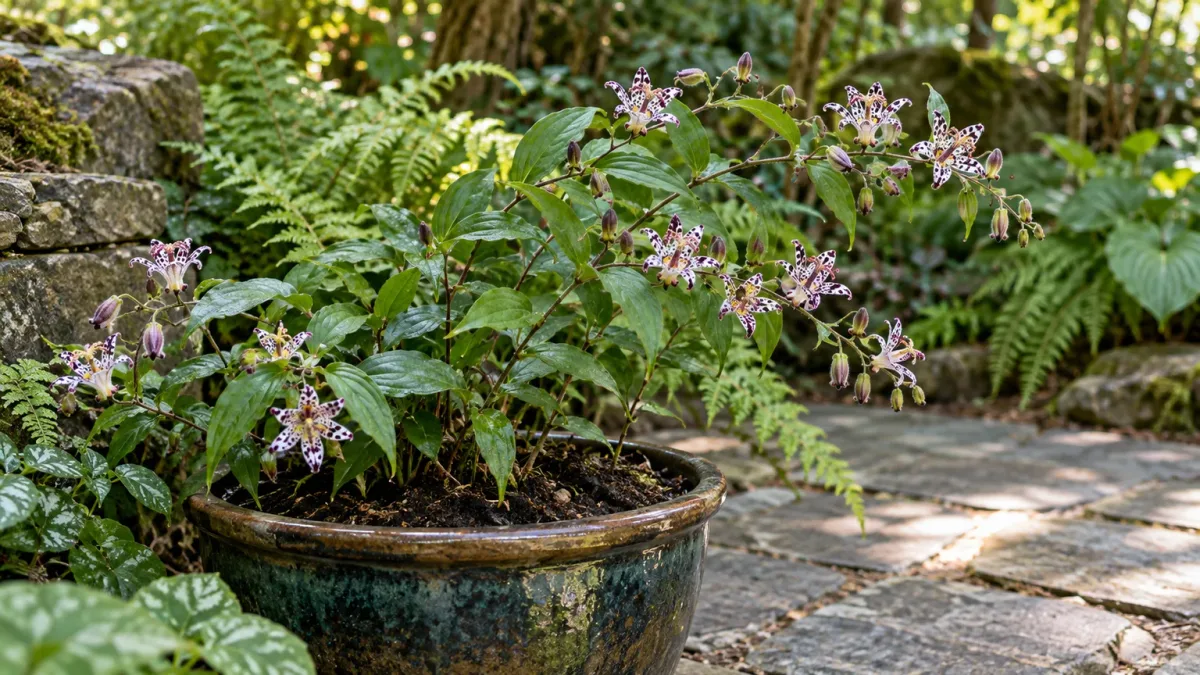
Place the pot in bright shade or gentle morning sun, then check it more often than an in-ground plant. Container mix can dry out quickly in wind and heat even when the surrounding garden feels damp. Water until excess drains from the bottom, empty any saucer, and check the mix again before it becomes completely dry.
In cold climates, a container’s roots experience colder temperatures than roots in the ground. Move it to a sheltered, unheated location or insulate the pot if the cultivar is only marginally hardy in your area, while keeping the mix just barely moist during dormancy. Repot or divide when the rhizomes crowd the pot or water no longer penetrates evenly, preferably in early spring before vigorous growth.
Divide an Established Clump
Divide a healthy clump in early spring as new shoots begin to show, before stems are tall and brittle. Water the plant the day before if the soil is dry, then lift a manageable section with a fork or spade and shake or rinse away enough soil to see the rhizomes. Use a clean, sharp knife to separate divisions, making sure each piece has healthy roots and at least one visible growth bud.
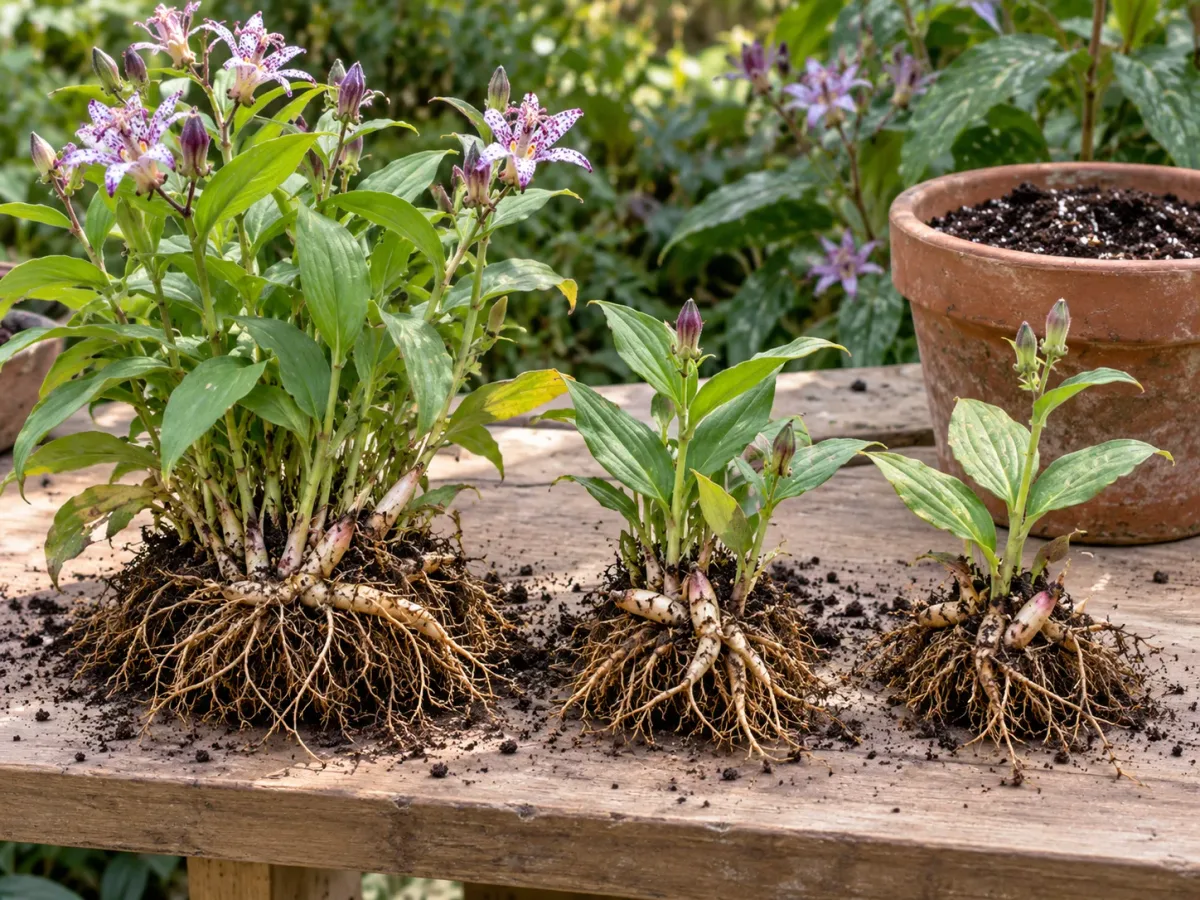
That bud matters. A toad lily stem lives for one season, while the next season’s shoot is already represented by an underground growth point; a root fragment without that bud may not produce a new stem. Wisconsin Extension recommends spring division for cultivars, and Plant Delights makes the same practical caution about including an underground growth bud when dividing tricyrtis.
Replant each division at its former depth, firm soil gently around it, water well, and keep it evenly moist while it reestablishes. A small division may spend its first season rebuilding roots and foliage before it blooms. Divide only when you want more plants or the clump is crowded; routine annual division is unnecessary and can delay a mature display.
Start New Plants From Seed or Cuttings
Seed is a good option when you want more plants and do not need them to match a named cultivar. Collect mature seed capsules as they dry and begin to split, then sow the tiny seeds on the surface of a clean seed-starting mix rather than burying them. Keep the pot evenly moist in a protected, bright location; fresh seed is easiest to handle, while stored seed may need moist cold stratification before it germinates.
Seedlings can vary because nearby Tricyrtis may cross-pollinate, so they may not retain a parent plant’s flower color or habit. The RHS recommends sowing seed as soon as it is ripe and overwintering the containers in a cold frame; Wisconsin Extension notes that fresh seed should be used or moist-stratified for about three months. Germination and flowering take patience, so buy a named cultivar if its exact traits matter to you.
Stem cuttings are another way to clone a plant, though division is usually simpler for a small home garden. In early summer, before flower buds develop, take a healthy stem section with a leaf node and place the bare lower section in moist propagation mix; keep humidity steady without letting the medium turn soggy. Plant Delights describes summer stem cuttings as a practical method and notes that new growth can form at the leaf axil, but success depends on healthy material and careful moisture control.
Troubleshoot Browning, Wilting, and Missing Blooms
When a toad lily looks wrong, check the soil at root depth before changing the light or adding fertilizer. A dry surface can hide wet soil beneath mulch, and a plant under a tree may be both shaded and thirsty because the canopy diverts rain. Make one correction at a time and watch new growth; damaged leaves rarely turn green again, so judge recovery by the next leaves and buds.
Brown edges or premature dieback
Crisp brown edges on otherwise healthy leaves often point to moisture stress, hot exposure, or wind. Feel the soil a few inches down: if it is dry, water slowly and add a light mulch; if it is saturated, improve drainage or move the plant rather than watering more. A sudden early fade after a dry summer can also mean the plant has gone dormant before it had enough energy to bloom.
Spots that enlarge, appear on multiple leaves, or persist while soil moisture is adequate may have another cause. Remove badly affected leaves, clear fallen material, water at the base, and improve air movement around the stems. Wisconsin Extension identifies anthracnose leaf spot as a possible disease and recommends reducing overhead irrigation and removing symptomatic debris; if a problem keeps returning, ask a local extension office to confirm the diagnosis before treating it as a fungus.
Healthy leaves but few flowers
If foliage is lush but flowers are scarce, look at light, moisture, plant age, and timing before feeding. Deep, dim shade can support foliage while limiting bloom for some selections; drought during summer bud development can also prevent a good show. A newly planted or recently divided clump may need time to establish, and a fall that turns cold early can shorten the flower window before buds fully open.
Make the next season’s adjustment early: move a container to brighter filtered light, water consistently from summer onward, and keep the plant sheltered from hot afternoon sun. Do not cut the stems back in summer to “force” flowers; each stem’s buds are part of that season’s growth. If a mature clump is healthy but performs poorly for several years, compare the label with its actual site needs or choose a locally successful cultivar.
Manage Slugs, Rabbits, and Leaf Disease
Slugs and snails may chew the tender shoots as they emerge in spring, especially where mulch, boards, or dense groundcovers keep the soil damp. Inspect at dusk or after rain, clear hiding places around the crown, and use barriers or hand-picking where practical. The RHS lists slugs as a pest of T. hirta, while Wisconsin Extension notes that young growth can be damaged even though toad lilies usually have few serious pest problems.
Rabbits may also browse new leaves or flower buds; deer generally show less interest, but no plant is deer-proof in every garden. Protect a small clump with a physical barrier if browsing is repeated instead of assuming a cultivar is immune. If flowers become mottled in an unusual way or leaf lesions spread, photograph the plant and ask a local extension service to help distinguish disease from natural cultivar markings.
The word “lily” is not a safe way to identify pet toxicity. The ASPCA entry for lily identifies Lilium species as toxic to cats; that entry does not establish that Tricyrtis has the same risk, and a missing listing would not prove it safe to chew. If a cat or dog eats any part of an unidentified ornamental, remove the plant from reach and call a veterinarian or animal poison service with the botanical name and a photo; do not wait for symptoms to appear before asking for guidance.
Place Flowers Where You Can See Them
Toad lily makes more sense as a close-viewing plant than as a distant mass of color. Put it along a shaded path, near a bench, at the front or middle of a moist border, or in a raised bed where its small flowers are at eye level. Wisconsin Extension lists ferns, hostas, astilbe, hellebores, lungwort, and anemones as compatible shade companions; combine plants that share moisture needs but leave enough space to see and inspect the toad lily stems.
Avoid using it as a filler beneath a thirsty tree where roots monopolize water, or where vigorous groundcovers will cover its late-emerging shoots. A good arrangement lets spring foliage plants occupy the bed early and gives the toad lily room to emerge later. Plant Delights also emphasizes close viewing for the detailed flowers, which is why a path edge often serves the plant better than the back of a deep border.
Conclusion
For reliable toad lily care, match the exact Tricyrtis to your climate, give it sheltered shade, and keep its root zone moist without letting water stand around the rhizomes. Plant nursery starts in spring, wait patiently for late emergence, watch moisture as summer buds develop, and divide in early spring only when you have a reason and can retain a growth bud. With those basics in place, the plant can provide unusually detailed late-season flowers in a part of the garden where many perennials are already winding down.