Thanksgiving vs. Christmas Cactus: Key Differences
Learn to distinguish Thanksgiving and Christmas cactus by stem edges, flowers, and bloom timing, plus what retail labels miss and how to encourage seasonal buds.
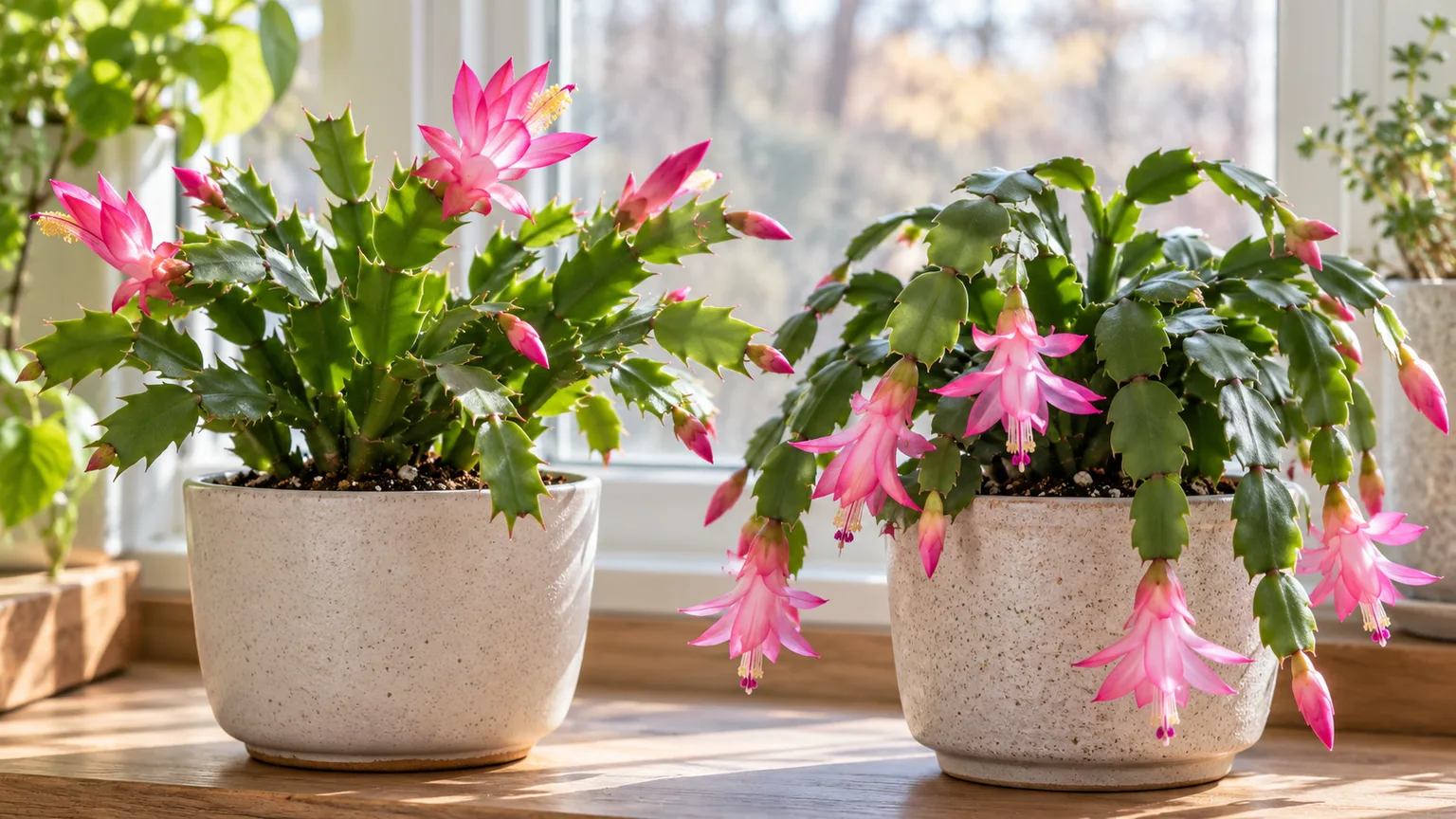
The quickest way to tell a Thanksgiving cactus from a Christmas cactus is to inspect the flat stem segments: Thanksgiving cactus segments have pointed, claw-like teeth along the edges; Christmas cactus segments have rounded scallops. If the plant is flowering, check the flower as a second clue: Thanksgiving cactus blooms are often held more upright and have yellow anthers, while true Christmas cactus flowers tend to droop and have purplish-brown anthers. The calendar is less dependable because growers can shift bloom time and many retail plants are hybrids or carry loose common-name labels.
These holiday plants look similar because they belong to the same close group of Brazilian forest cacti. They are not desert cacti, and their flattened “leaves” are actually stem segments called cladodes. Once you know which details to trust, you can identify an unflowered plant, make sense of a misleading tag, and give either type essentially the same year-round care.
The fast answer: check the segment edges first
Choose a mature stem segment and look at its side margins, not just the very end. A Thanksgiving type has a few distinct pointed projections on each side, making the segment resemble a crab claw. A Christmas type has smooth, rounded notches that look more like soft waves than teeth. The contrast is clearest on firm, fully grown segments; tiny new growth can look less pronounced.
If the plant is in flower, use the bloom to confirm your first impression. Thanksgiving cactus flowers are elongated and usually angle outward or upward from the tip; Christmas cactus flowers typically hang lower from the arching stems. Color alone does not help much: both can produce pink, red, white, orange, or purple-toned blooms, depending on cultivar. NC State Extension describes these two checks—cladode margins and flower structures—as useful identification features, while also warning that hybrid plants can show some overlap (NC State Extension).
A date on the calendar is a supporting clue, not a verdict. Thanksgiving types often flower in late autumn, and Christmas types generally flower later, but artificial lighting, temperature, greenhouse scheduling, and hybrid ancestry can shift the display. If the stem margin and flower agree, you can be reasonably confident; if they disagree, call it a holiday cactus or a Thanksgiving-leaning/Christmas-leaning hybrid rather than forcing a precise label.
Compare the visible traits side by side
| Clue | Thanksgiving cactus | Christmas cactus |
|---|---|---|
| Typical botanical name | Schlumbergera truncata | Schlumbergera × buckleyi |
| Mature segment edge | Pointed teeth or claw-like projections | Rounded scallops, without sharp points |
| Flower position | More upright or held outward | Usually hangs from the segment tip |
| Anthers | Commonly yellow | Often pink, purple, or brownish-purple |
| Typical bloom period | Late fall, often near Thanksgiving | Winter, often December into January or later |
| How much to trust the tag | Low; common names are used loosely | Low; flowering stock may be a hybrid or labeled broadly |
Treat each row as a pattern, not an identification test with a guaranteed result. A plant grown from a hybrid or selected cultivar can combine traits, and flower angle changes as a bloom opens or a stem arches. The segment margin is usually the best first clue because it remains visible when flowers are absent and is less affected by the room’s temperature or lighting schedule.
1. Stem-segment margins and tips
The green, flattened parts that look like leaves are the plant’s photosynthetic stems. Botanists often call them cladodes. On S. truncata, the margin usually has two or more pointed projections, especially near the terminal segment. That sharper outline explains common names such as crab cactus and crab-claw cactus. On S. × buckleyi, the edge is generally smooth and scalloped, with rounded lobes instead of obvious claws.
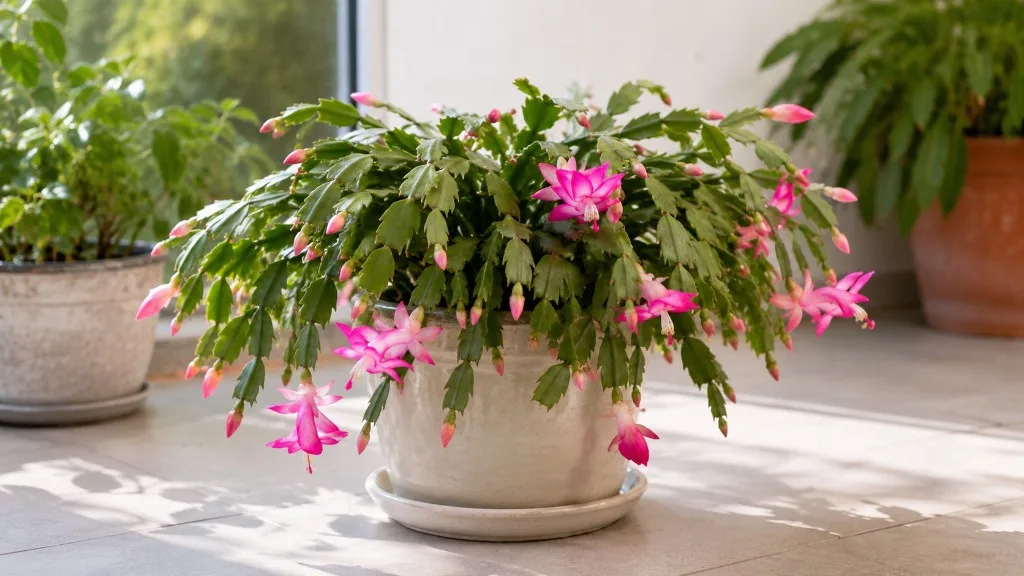
Hold the pot still and turn it toward the light so you can follow the edge of one segment from its base to its tip. Don’t judge from a distant view of the whole plant: cascading stems overlap, and a shadow can make a rounded notch look sharp. Look at several mature segments on different branches. If most show consistent teeth, the plant is likely a Thanksgiving type; if most are rounded, it is more likely a Christmas type.
This is a good example of why the word “leaf” can be a little misleading in plant listings. The leaf-like segment is a flattened stem joint, so it has no ordinary leaf blade or petiole to inspect. NC State’s Plant Toolbox describes the Thanksgiving cactus as an epiphytic succulent with flattened, segmented, spineless green stems and pointed projections; its profile for Christmas cactus describes rounded marginal notches (Thanksgiving cactus profile; Christmas cactus profile).
2. Flower direction, shape, and anthers
A flower can settle a close comparison, especially when the plant is at peak bloom. Thanksgiving cactus flowers are long and tubular, with the petals and tube arranged asymmetrically; the flower points outward or slightly upward from the stem tip. The anthers—the pollen-bearing tips at the end of the stamens—are typically yellow. On a Christmas cactus, the tubular flower usually hangs down from the branch, and its anthers are often pinkish to purplish brown.
Check several fresh flowers rather than a single fading bloom. A flower that is opening, wilting, or viewed from below can look more upright or more symmetrical than it is. Petal color is not a reliable way to identify the plant, and hybrid cultivars can blur anther-color patterns. Use flower direction and anthers as confirmation after checking the segment edges, not as a substitute for them.
Flowering is also a temporary identification window. If you receive a plant as a gift after it has finished blooming, the old flowers may be gone before you think to check them. Take a clear photo of an open bloom alongside a segment while it is flowering; the image gives you a useful record without disturbing the plant or removing a flower.
3. Growth habit and bloom timing
Both plants can form a bushy crown of jointed segments and eventually cascade over a pot or hanging basket. A Thanksgiving cactus may look more upright when young, while a Christmas cactus can have a particularly pendulous habit, but container shape, pruning, age, and light all influence the silhouette. Branch posture is a supporting clue only; don’t identify a plant by whether it is tall, compact, or trailing.
In the Northern Hemisphere, Thanksgiving cactus commonly flowers in late fall, while Christmas cactus usually follows in winter. NC State’s Plant Toolbox lists S. truncata as a late-November bloomer and S. × buckleyi as flowering from December into February. Those are typical windows, not fixed deadlines. Indoor plants respond to night length and temperature, and a commercial grower may manage those conditions so a crop is ready earlier than its natural schedule would suggest.
If a plant flowers in November, that makes a Thanksgiving type more plausible, but it does not prove it. A plant that blooms in December could still be a Thanksgiving cactus grown under a later schedule or a hybrid with mixed traits. When the stem shape points one way and the date another, trust the stem shape more and keep the date as context.
Identify a holiday cactus when it is not blooming
Start with the mature cladode margin. If it has sharp, claw-like points, record “Thanksgiving type”; if the edge has smooth, rounded scallops, record “Christmas type.” Then check the terminal segment and several branches for the same pattern. A phone photo in indirect daylight can help you zoom in on the edge without bending or tearing the stems.
Next, inspect the whole plant for context. A densely branched plant with many new segments may have been pruned or grown under brighter conditions; a loose plant may simply need more light. Neither shape proves which holiday group it belongs to. The same caution applies to a pot label: it can tell you what the grower intended to sell, but common names are often used for the whole group of seasonal Schlumbergera hybrids.
If the evidence is mixed, choose a description that fits the uncertainty. “Holiday cactus, likely Thanksgiving type” is more useful than a false certainty, especially if your main goal is to care for it. Keep a record of the segment edges, then add flower angle and anther color the next time it blooms. Those independent traits together give a more dependable identification than one clue by itself.
Why the tag and flowering date can mislead you
Holiday cacti are sold when shoppers are looking for seasonal color, not always with a botanically precise label. A store may use “Christmas cactus” as a familiar umbrella name for a flowering Schlumbergera, even when the stem edges look like S. truncata. Plants can also be sold before their flowers open, which removes the clue many shoppers expect to use. A display label that says “Thanksgiving cactus” is helpful, but the plant itself is the better evidence.
Breeding adds another layer. NC State Extension notes that the holiday cacti in cultivation include hybrids and that some traits can bleed across; the NC State Plant Toolbox likewise describes the familiar Christmas cactus as a hybrid between S. russelliana and S. truncata. A mixed-looking segment does not mean the plant is unhealthy or mislabeled on purpose. It may simply reflect the history of the cultivar and the way common names are applied in retail.
Flower timing can be managed in production. Long uninterrupted nights and cooler fall temperatures help many holiday cacti set buds, so a greenhouse can steer when a crop flowers. A home plant experiences a different day length, room temperature, and nighttime lighting; even moving it from a brightly lit shop into a warm living room changes its environment. The safest conclusion is that the flower date suggests a group, while the stem and flower structures reveal more.
What the botanical names actually mean
The Thanksgiving cactus is commonly identified as Schlumbergera truncata. A true Christmas cactus is often listed as Schlumbergera × buckleyi, a cultivated hybrid associated with S. russelliana and S. truncata. Older articles and plant labels may use other names, including S. bridgesii, and everyday “Christmas cactus” may refer to a broader assortment of hybrids rather than one carefully identified cultivar.
That naming variation is why a Latin name on a tag is useful but not infallible. The multiplication sign in S. × buckleyi indicates hybrid status; it does not mean every plant sold as “Christmas cactus” has been checked against a botanical description. If you are collecting cultivars or need a precise species record, buy from a specialist grower who can explain the plant’s parentage. For ordinary indoor care, the visible growth form and seasonal response matter more than settling every historical synonym.
It also helps to separate “what the plant is called” from “what traits it shows.” A nursery can call a plant a Christmas cactus for convenience, while a gardener can accurately observe pointed segment teeth and yellow anthers. Describing what you see is not arguing with the label; it gives you more information than the label alone.
Check for an Easter cactus before you decide
A third holiday plant can complicate the comparison: Easter cactus, commonly called Hatiora gaertneri and also known in older references as Rhipsalidopsis gaertneri. It belongs to a different genus from Thanksgiving and Christmas cacti and usually flowers in spring. Its starrier flowers and rounded segment edges with tiny bristles around the tip can help separate it from the two Schlumbergera types.

The Easter cactus is often easier to recognize when it flowers, but timing is still not absolute. A plant may bloom outside the date suggested by its common name if its light and temperature have been controlled. The NC State Plant Toolbox lists Rhipsalidopsis gaertneri among the plants often confused with S. truncata and S. × buckleyi, which is a useful reminder to inspect both the segments and flowers instead of relying on a holiday label.
For a quick three-way check, look at the stem margin first. Pointed teeth suggest Thanksgiving cactus; rounded, smooth scallops suggest a Christmas type; rounded segments with tiny bristle-like points, paired with spring flowers, suggest Easter cactus. If you are still unsure, keep the broader “holiday cactus” name until you have a clear photo of the blooms.
Do Thanksgiving and Christmas cacti need different care?
For most home growers, no major care change is needed once you know which one you have. Both are tropical or subtropical forest cacti that grow attached to trees or rocks in nature, rather than desert plants adapted to baked, bone-dry soil. Their flattened stems tolerate some drying, but they generally appreciate an airy potting mix, bright filtered light, and more regular moisture than a desert cactus.
The practical difference is usually the timing of bud preparation, not a different weekly watering routine. Thanksgiving types tend to begin their natural display earlier; Christmas types tend to flower later. Cultivars and hybrids vary, so use the plant’s actual growth and bud development to make seasonal adjustments rather than following a rigid calendar for the name on its tag.
Light, water, soil, and temperature through the year
Give the plant bright, indirect light for steady growth. A spot near an east-facing window or a few feet back from strong southern or western sun often works; harsh midday rays can scorch or bleach the flattened stems. Outdoors in warm weather, use dappled shade and bring the plant inside before cold conditions threaten it. NC State Extension notes that these forest cacti do not respond like desert cacti and should be protected from direct sun.
Use a free-draining mix that holds a little moisture but lets excess water escape. A commercial cactus mix amended with fine bark or another airy component can work, as can a high-quality houseplant mix made more open with perlite. Choose a pot with drainage holes. Water thoroughly when the upper layer of mix has begun to dry, then empty the saucer; don’t keep the roots sitting in water, and don’t wait for the entire root ball to become dusty and dry every time.
Check the soil rather than following a fixed “once a week” schedule. A small pot in a warm, bright room dries faster than a large pot in cool, dim conditions. During active growth, the plant may use more water; after flowering and in a cooler, lower-light rest period, it may use less. The goal is a slight dry-down between waterings with oxygen still reaching the roots, not constant saturation and not prolonged drought.
Keep temperatures moderate and avoid sudden swings, especially while buds are forming. Average indoor warmth suits growth; cooler nights can help trigger flowers in autumn. The plants can tolerate ordinary household humidity, but very dry air, a radiator, or a cold draft may stress buds. Don’t compensate for dry air by leaving the potting mix waterlogged.
How to encourage buds without stressing the plant
Holiday cacti respond to the seasonal combination of longer nights and cooler conditions. If you want to encourage flowering, begin several weeks before your desired display window, typically in early fall for a late-fall or winter bloom. Provide bright daytime light and a long, uninterrupted dark period at night; artificial light from a room or street-facing window can interrupt the signal. NC State’s Christmas cactus profile recommends at least 13 uninterrupted hours of darkness during the bud-setting period, while horticultural guidance commonly gives a range around 12 to 14 hours (NC State Plant Toolbox; Epic Gardening).
A cooler night environment can reinforce the signal, but keep the plant safely above cold-damage conditions. A spare bright room that is naturally cooler at night is better than placing the cactus outdoors in a frost risk or exposing it to an abrupt temperature plunge. Do not move a plant back and forth every day; a stable routine is easier for it to respond to and easier for you to maintain.
Keep watering steady while buds form. The plant should not sit soggy, but deliberately drought-stressing it can cause shriveling and bud loss rather than a better display. Stop moving it once buds are visible, and avoid rotating it repeatedly to chase a perfect angle. Farmers’ Almanac and Epic Gardening both describe the role of uninterrupted darkness and cooler nights, with Farmers’ Almanac giving six to eight weeks as a practical preparation window. Treat that as a starting range rather than a guarantee; cultivar and home conditions still matter.
What to do if buds drop after a move
A few dropped buds after transport are common and do not automatically mean the plant is dying. The move from a greenhouse or shop to a home can change temperature, light, humidity, and watering all at once. Drafts from an outside door, a hot vent, a bright sunny window, a dim new room, or a sudden shift in how wet the mix stays can all add stress during the most sensitive part of flowering.
Choose a bright spot away from direct hot sun, heating vents, and cold drafts, then let the plant settle. Check the potting mix before watering: if it is still damp, wait; if it has dried noticeably, water thoroughly and let it drain. Don’t fertilize a plant simply because buds fell, repot it during active flowering, or move it through several locations in search of a quick fix.
If buds continue to drop, look for a pattern rather than changing every care variable. Is the room warmer at night than before? Does the plant get artificial light after dark? Does the pot remain wet for days? Fix the likely stressor first and keep other conditions steady for a week or two. A plant with healthy green segments can recover and flower again in a later season even if this display is smaller.
What to check before buying a holiday cactus
If you want a true Christmas-type plant, ask the seller for the botanical name and look for the rounded, smooth segment scallops associated with S. × buckleyi. If you want the sharper crab-claw silhouette of a Thanksgiving type, look for pointed marginal teeth. When flowers are open, check the flower angle and anthers too. A common name printed on a decorative sleeve is the weakest clue of the three.
Choose a plant with firm green segments and no sour smell from the potting mix. A few naturally dropped segments can happen during handling, but a plant with mushy stems, wet compacted soil, or widespread yellowing may have been stressed. If buying online, request a clear close-up of the segment edges and ask whether the plant is a species, a named cultivar, or a hybrid; a bloom photo alone may not show the details you need.
Do not reject a healthy plant just because its label and segment shape seem inconsistent. Many growers and sellers use “holiday cactus” broadly, and the plant can still be beautiful and easy to grow. Buy it for the traits you can confirm, then keep your own record of when it blooms and what its segments look like.
Conclusion
For a fast identification, inspect the edges of several mature stem segments: pointed teeth indicate a Thanksgiving type, while rounded scallops point to a Christmas type. If flowers are present, compare their direction and anthers; use bloom timing only as a final supporting clue because indoor conditions, grower scheduling, and hybrid ancestry can shift it.
The name on a pot may be broad or imprecise, but the care does not need to be complicated. Give either holiday cactus bright filtered light, an airy mix, sensible watering, and a stable fall routine with long nights if you want to encourage buds. If the plant shows mixed traits, keep the accurate broad label “holiday cactus” and enjoy the flowers instead of forcing a certainty the evidence cannot support.