How to Grow and Care for Sweet Woodruff
Sweet woodruff is easy in a woodland garden but can spread fast. Get clear planting, seasonal care, propagation, and containment advice for your climate.
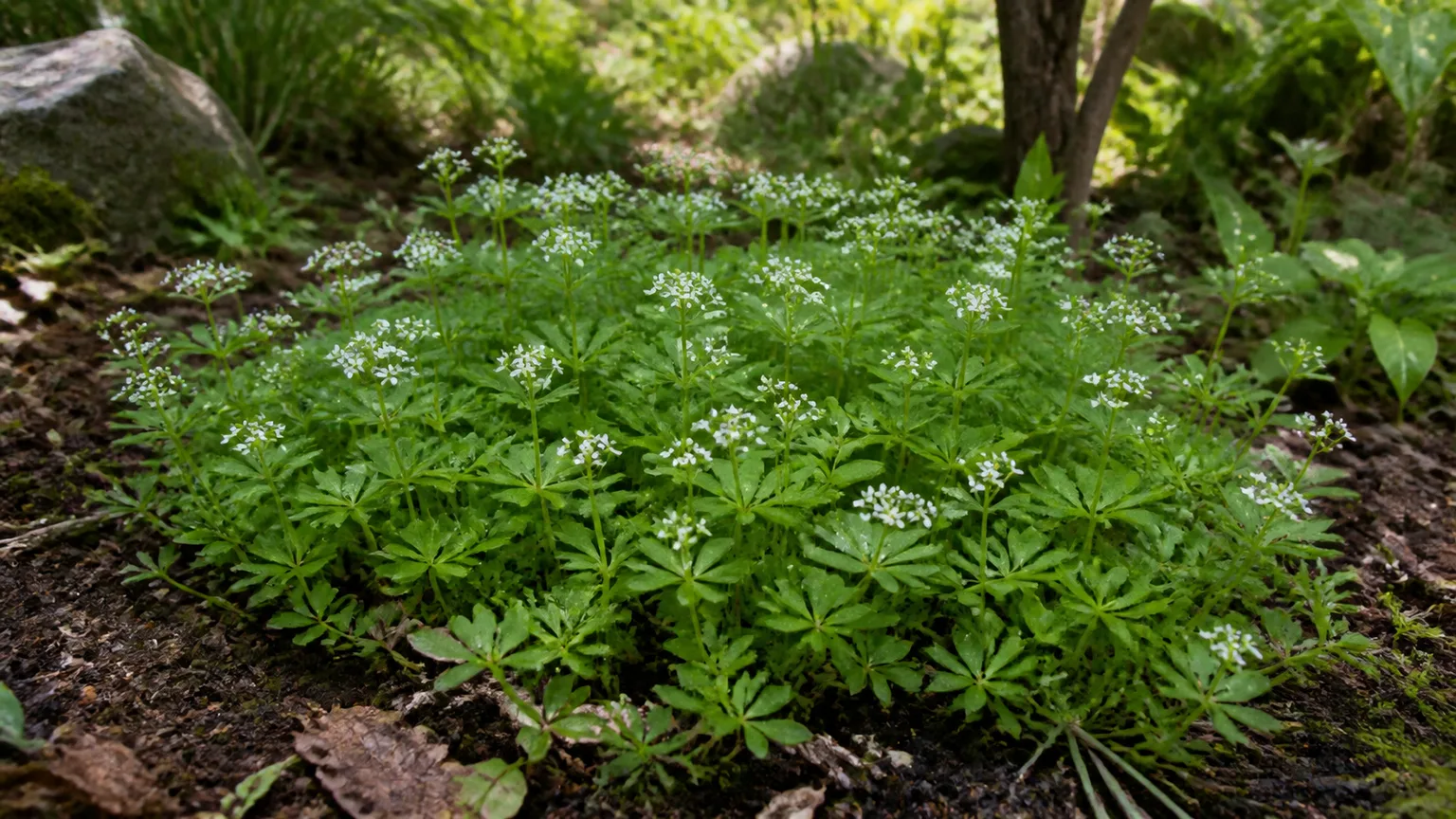
Sweet woodruff (Galium odoratum) is at its best beneath deciduous trees, along a shaded path, or at the edge of a woodland bed: a low carpet of bright green whorled leaves, dotted with small white flowers in spring. Its leaves develop a sweet, hay-like scent as they dry, and the plant fills difficult shady ground where lawn grass often struggles. The same creeping rhizomes that make it useful as a groundcover can also carry it through a border, so the right first decision is not how to fertilize it; it is whether you want a plant that will spread in that particular spot.
Give it shade or dappled light, soil that stays reasonably moist but drains well, and room to form a patch. In a contained woodland bed, sweet woodruff is a forgiving perennial. In a hot, dry, sunny border—or next to small plants you want to keep separate—it is a poor fit. This guide covers the choice of site, seasonal care, bloom, propagation, and practical ways to contain or remove a patch.
Sweet Woodruff at a Glance
| Growing factor | What to provide | What to watch |
|---|---|---|
| Light | Part shade to full shade; dappled light is a useful middle ground | Strong sun plus dry soil can scorch or stress leaves |
| Soil | Moist, fertile, well-drained soil | Standing water and compacted soil can thin a patch |
| Water | Regular checks during establishment; water in prolonged dry spells | Dry summer conditions can trigger temporary dormancy |
| Mature form | Usually about 6–12 inches tall, spreading as a mat | Width is not fixed; rhizomes can move beyond the original planting |
| Flowers | Small white clusters, usually in spring | Bloom timing shifts with climate and canopy leaf-out |
| Propagation | Divide rhizomes in spring or fall; seed is slower | Seedlings may appear beyond the intended edge |
| Winter behavior | Often dies back in cold climates and returns in spring | A bare winter patch does not necessarily mean the plant died |
| Best use | Woodland floor, shaded path edge, under shrubs | Check local spread guidance before planting near natural areas |
Extension profiles commonly describe sweet woodruff as a low perennial that spreads by rhizomes and seed. Mature dimensions vary by site and reference: the plant may stay near a 6-inch carpet in lean conditions or form a much wider mat where moisture and fertility are favorable. Treat a nursery’s spacing as an establishment plan, not a promise that the patch will stop there. (NC State Extension, University of Wisconsin–Madison Extension)
Identify the Plant Before You Plant It
Sweet woodruff belongs to the bedstraw genus Galium. It is a herbaceous perennial in the coffee family, Rubiaceae, native across parts of Europe, North Africa, and Asia. The stems are slender and roughly square in cross-section; narrow leaves radiate in whorls around them, often appearing as six to eight leaflets at each node. In spring, tiny four-petaled white flowers gather above the foliage. The foliage is deciduous in colder climates, so it should not be mistaken for an evergreen groundcover. (NC State Extension, RHS)
Confirm the botanical name when buying. “Bedstraw” can refer to other Galium species, including native plants and the annual cleavers (Galium aparine), whose hooked stems cling to clothing. Sweet woodruff has smooth, whorled foliage and a tidy, low habit when young; it is not the sticky, scrambling weed many gardeners mean when they complain about bedstraw. Correct identification matters both for responsible planting and for deciding whether an existing patch is the ornamental species you intended to keep.
Choose a Site That Fits Your Climate
Sweet woodruff is a cool- to mild-climate woodland plant, but hardiness references do not give one universal edge. Gardening Know How lists USDA zones 4–8, Gardenista lists 5–9, and Wisconsin Extension reports a wider range of 4a–9b from its regional experience. Those numbers describe winter survival more reliably than summer performance. In warm regions, shade, soil moisture, and protection from afternoon heat matter more than the upper zone number alone. (Gardening Know How, Gardenista, Wisconsin Extension)
Before planting, look at the spot at midday in late spring or summer, not just in early spring before trees leaf out. A site under deciduous trees can receive bright spring light, then become shaded as the canopy fills. That seasonal change suits woodruff. A narrow strip beside a west-facing wall may look shaded in the morning but bake in afternoon heat; there, leaves may scorch and the plant may stall unless the soil remains cool and moist.
Light: Deep Shade to Dappled Sun
The safest default is partial to full shade, especially in regions with hot summers. Dappled light beneath open tree branches often gives enough energy for a thicker carpet and a better flower display without the stress of strong midday sun. In cooler climates, it can tolerate more light if the soil does not dry out. The RHS describes it in sun or dappled shade but warns that strong sun can scorch foliage; South Dakota State Extension similarly notes that sunnier sites need more water. (RHS, South Dakota State University Extension)
Full shade is not automatically a problem. Expect slower fill and possibly fewer flowers, but the plant can still make a useful foliage carpet. If your patch is thin, first check whether the ground is dry beneath the tree canopy: tree roots can absorb rain before it reaches a shallow-rooted groundcover. Moving into brighter light is not the only solution, and it can make the problem worse in hot weather.
Soil: Moisture Without Standing Water
Aim for soil that holds moisture without remaining saturated. Sweet woodruff grows well in humus-rich woodland soil and can adapt to clay, loam, or sandy ground if drainage and watering are handled appropriately. Some regional guides favor slightly acidic soil, but the RHS profile lists a broad pH tolerance, including neutral and alkaline conditions. Do not add sulfur or lime simply because a generic plant chart says “acidic”; test the soil first and correct a measured problem rather than chasing an exact number. (South Dakota State University Extension, RHS)
In heavy, compacted ground, loosen the planting area and blend in organic matter across the bed rather than making a small, rich pocket. A pocket can act like a basin, collecting water around the roots. In fast-draining soil, a thin leaf-mold or compost mulch can reduce moisture swings. Keep mulch off the stems and crown, and avoid building a thick layer that buries young growth.
Planting and Spacing for a Healthy Patch
Plant nursery clumps in spring or early fall when the ground is workable and temperatures are moderate. Water the pot before planting, loosen circling roots gently, and set the crown level with the soil surface. Backfill, firm lightly, and water deeply so soil settles around the roots. If the site is very dry beneath a mature tree, water the planting area before and after planting; the root competition there may be stronger than it appears at the surface.
For a patch that fills steadily, space plants roughly 10–12 inches apart. Wisconsin Extension recommends about a foot; closer spacing gives faster visual cover but also makes a dense mat sooner. Leave a deliberate buffer between sweet woodruff and delicate spring bulbs, small woodland ephemerals, or slow clump-forming perennials. The groundcover can close around them and compete for moisture even if it does not shade them out. If you want a naturalized carpet, let the spacing be generous and accept a slower first season; if you need a crisp border, choose a containment method before roots begin to travel. (Wisconsin Extension)
After planting, label one edge of the patch or mark its intended boundary on a garden plan. This small habit makes spring maintenance easier: you can tell whether new stems are filling the planned footprint or crossing it. Early intervention is much simpler than trying to reconstruct a border after several years of growth.
Watering Through Establishment and Summer
Keep new divisions and nursery starts evenly moist while they establish, usually through their first growing season. “Moist” means the root zone is cool and damp when checked, not glossy with standing water. Water slowly at the soil line so moisture reaches the roots; a quick sprinkle that only wets the leaves will not carry a planting through a dry spell. Once the patch is established in a shaded, humus-rich site, rainfall may be enough much of the year.
During a long hot or rainless stretch, check the soil under the foliage. If the top inch or two is dry and leaves begin to droop, water thoroughly and reassess after the soil drains. In dry shade beneath trees, the surface may look mulched while the root zone remains dry because canopy interception and tree roots compete for water. NC State Extension notes that summer drought can push woodruff into dormancy; if the leaves brown or disappear after a dry period, restore reasonable moisture and wait for cooler conditions before assuming the patch is dead. (NC State Extension)
Conversely, do not compensate for shade with excessive irrigation. Sweet woodruff does not want permanently soggy soil. In poorly drained ground, repeated watering can leave roots oxygen-starved and encourage a sparse, unhealthy patch. Adjust based on soil feel and weather, not a fixed weekly calendar.
Spring Flowers and the Foliage Season
Sweet woodruff usually flowers in spring, with small white, star-like blooms held just above the whorled leaves. In many temperate gardens the display arrives in mid- to late spring, but local weather and when the overhead canopy leafs out shift the date. The bloom is a delicate ground-level haze rather than a tall, showy floral display. Plant it where the white flowers can be seen close up: beside a path, at the front of a shaded border, or against darker foliage. (RHS, South Dakota State University Extension)
The foliage remains the main feature after flowering. In places with cold winters it may die back, then send up fresh leaves early in spring; in mild climates it can hold foliage longer but still slow or thin during heat or drought. If flowers are sparse, check the site rather than reaching first for fertilizer. Dense shade, young plants, recent division, or summer stress can all reduce bloom. Give a new patch time to settle, maintain moderate moisture, and avoid moving it just because its first season is quiet.
Propagating by Division
Division is the quickest, most dependable way to make more plants or thin a patch. Spring, as fresh growth emerges, is a forgiving time because the divisions can root before summer heat. Early fall can also work where there is enough time for roots to settle before freezing. Wisconsin Extension identifies spring division as the easiest method, while the RHS also lists autumn or early spring for rhizome division. (Wisconsin Extension, RHS)
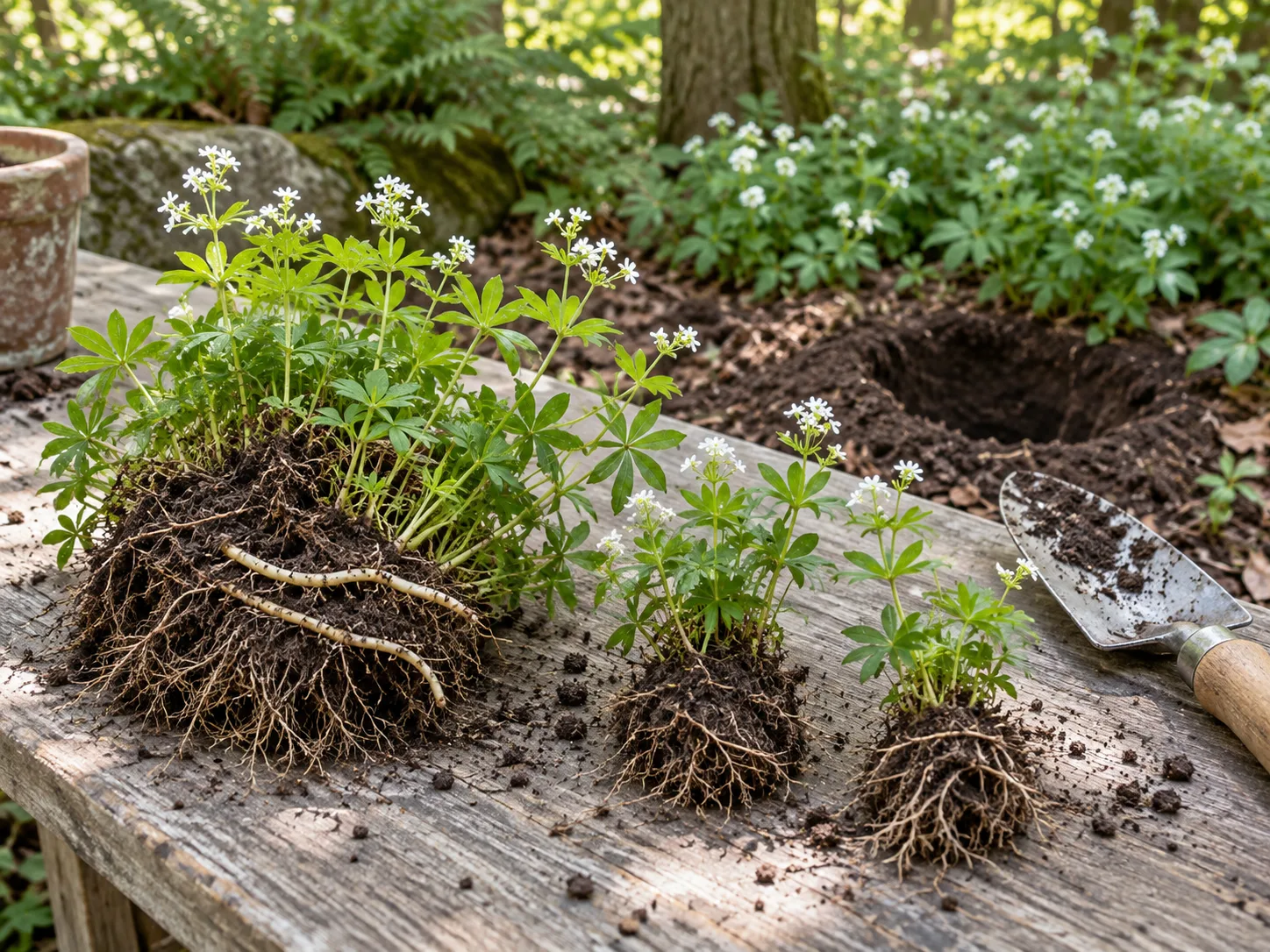
Water the patch the day before if the soil is dry. Use a spade or fork to lift a small section with both foliage and rooted rhizomes, then tease it into pieces. Each division needs roots attached and several live stems or growth points; a loose stem without a rooted section may wilt before it establishes. Replant at the original depth, water thoroughly, and keep the soil evenly moist while new roots form. If moving a division in warm weather, hold it in shade and keep roots damp during the move rather than leaving them exposed on the ground.
You can also use division as routine containment. Each spring, lift the advancing edge, keep the rooted pieces you want, and remove the excess before it blends into neighboring plants. Do not toss unwanted live rhizomes into a cool, damp compost pile where they can survive. Dry them thoroughly or dispose of them according to local green-waste guidance.
Growing Sweet Woodruff From Seed
Seed is useful when you want many plants or prefer to establish a patch gradually, but it is slower and less predictable than division. Let flowers set seed and collect ripe seed as it matures in summer, or sow it in place in late summer as soon as it is ripe. Mark the sowing area because seedlings are small and can be mistaken for weeds. A thin covering of soil or leaf mold helps keep the seed from drying, while a gently moist seedbed supports germination.
Spring-sown seed may germinate slowly or unevenly. A cold, moist period can improve uniformity, so gardeners starting seed indoors can use cold stratification before sowing and then keep the medium cool and consistently damp rather than warm and wet. Do not discard a tray after a few weeks; germination can take patience. Once seedlings are large enough to handle, grow them on in shade and transplant when roots hold a small plug together. (Wisconsin Extension)
Seedlings do not give you immediate groundcover, and self-sown plants may appear outside the parent patch. If spread is a concern, remove flower heads before seed ripens and use division only when you want new starts. If your goal is quick, faithful expansion of a patch, a rooted division is usually the more efficient choice.
Control Rhizomes and Volunteer Seedlings
Sweet woodruff is not a plant to call harmlessly “well behaved” everywhere. Its rhizomes spread at or near the soil surface, and seeds can start new plants. In cool, dry shade or less fertile soil it may expand slowly; in moist, fertile ground, it can become a dense carpet that pushes into adjacent planting. University of Wisconsin Extension describes it as aggressive under ideal conditions and notes that it is considered invasive in Oregon. That is a regional warning, not a prediction that every garden will see the same behavior. The Oregon Department of Agriculture’s current noxious-weed profile page does not list G. odoratum by that name, illustrating why an “invasive” description and a formal noxious-weed designation are not interchangeable. Check local and state guidance before planting near natural areas, and do not interpret absence from a regulated list as proof a plant cannot escape. (Wisconsin Extension, Oregon Department of Agriculture)
Containment Before Planting
The easiest control is choosing a boundary the plant cannot cross unnoticed. Plant sweet woodruff in a defined woodland bed, under a shrub canopy, or in a wide container with drainage holes. A container limits rhizomes to the pot but does not eliminate maintenance: stems can spill over the rim, seed can land outside, and the root mass eventually fills the container. Divide the pot when growth slows or roots circle densely, and deadhead if nearby garden beds must remain free of seedlings.
In an open bed, use a physical edging that extends below the soil surface and inspect the line each spring. Because rhizomes are shallow, edging can help, but the boundary is only as good as its installation and upkeep; stems may creep over the top and fragments can travel with moved soil. Do not put woodruff beside aggressive groundcovers such as lily-of-the-valley and expect a stable mix. Two fast spreaders can merge into a mat that is difficult to edit. (South Dakota State University Extension)
Removing an Established Patch
For a small patch, water the soil lightly the day before, then loosen it with a garden fork and lift the mat in sections. Follow the pale, shallow rhizomes outward from the visible stems; pulling only the foliage often leaves pieces behind, and those pieces can regrow. Sift through the loosened soil for fragments, especially along the perimeter and around other plants you are keeping. Work when neighboring perennials are visible so you can avoid damaging their roots.
For a large patch, do not expect one quick pass to solve it. Remove as much root material as practical, then revisit the area through the growing season and pull or dig new shoots while they are small. Smothering may suppress growth if the site can be covered long enough, but rhizomes can persist under a short-lived cover or emerge around its edges. Avoid broad herbicide use in a mixed shade bed; if chemical control is being considered, identify the plant positively, read the current product label, and ask a local Extension office about a method that will not injure desired plants. Wisconsin Extension notes that the fragile stems can break when pulled, leaving roots behind, so persistence matters more than force. (Wisconsin Extension)
Routine Care, Dormancy, and Winter
Established sweet woodruff needs little fertilizer in a reasonably fertile bed. If growth is weak, first check drainage, root competition, drought, and light. A thin annual layer of compost or leaf mold is usually a more measured correction than repeated high-nitrogen feeding, which may encourage leafy spread without solving the site problem. Routine pruning is unnecessary. You can shear a large patch lightly after flowering if it looks untidy, but avoid cutting so low that you scalp the rhizomes or expose the soil to summer heat.
In colder regions, the foliage often dies back in winter; that is its normal herbaceous cycle. Leave the patch in place, mark its boundary, and allow spring growth to return. A light leaf mulch can protect exposed soil in severe winter conditions, but do not bury crowns under a heavy, wet layer. In warmer climates, the plant may stay green longer and then brown or disappear temporarily in summer heat. If the rhizomes are firm and the bed has not been waterlogged, maintain moderate moisture and wait for cooler weather before replacing the plant. (Wisconsin Extension, NC State Extension)
Pests, Diseases, and Common Setbacks
Sweet woodruff is generally low maintenance and has few serious pest problems. The most likely visible issue is powdery mildew: a white, dusty coating on leaves, often worse where the patch is crowded and air circulation is poor. Thin a dense section, water at soil level when practical, and remove badly affected leaves rather than spraying automatically. South Dakota State Extension recommends spacing and avoiding overhead watering as preventive steps. (South Dakota State University Extension)
Brown, limp foliage can point to very different causes. On a sunny, dry edge, scorch and drought are plausible; in a low, soggy bed, roots may be struggling from poor drainage. Yellowing after a cold winter may simply be old foliage dying back. Read the pattern: crisp leaves on the exposed edge suggest heat or dryness, while soft decline across a persistently wet patch calls for better drainage. Change one condition at a time and watch new growth; damaged leaves will not turn green again.
Fragrance, Harvesting, and Coumarin Caution
The plant’s scent becomes more noticeable as cut foliage dries, which is why sweet woodruff has traditionally been used in potpourri and sachets. If you want to dry a small amount, harvest a few healthy stems after flowering, keep them in a well-ventilated shaded place, and store fully dry material in a sealed container. This is a fragrance use, not a reason to cut back a whole patch; removing too much foliage at once can weaken a young planting.
Sweet woodruff contains coumarin, a naturally occurring aromatic compound also found in other plants. Traditional food and beverage uses do not establish a safe amount for a home-harvested batch: research on dried sweet woodruff reports seasonal changes in coumarin and related compounds, so garden-grown material does not have one standardized concentration. The German Federal Institute for Risk Assessment notes that coumarin can damage the liver at sufficiently high exposure and sets a tolerable daily intake for long-term exposure. For a garden-care guide, the prudent choice is to enjoy the scent as an ornamental or potpourri plant and not treat it as a medicinal remedy or freely measured food ingredient. (Seasonal variation of phenylpropanoids in air-dried leaves of Galium odoratum, BfR — German Federal Institute for Risk Assessment, Penn State Extension)
Design Partners and When to Choose Another Groundcover
Sweet woodruff works best as a low, fine-textured layer beneath larger plants. Broad-leaved hostas, ferns, hellebores, and bleeding hearts give the bed height and contrasting leaf shapes; the woodruff fills the open ground around them. It also suits a shaded path edge where its flowers can be seen at close range. The RHS lists groundcover and underplanting as uses, while Wisconsin Extension suggests woodland edges and shade beneath shrubs. (RHS, Wisconsin Extension)
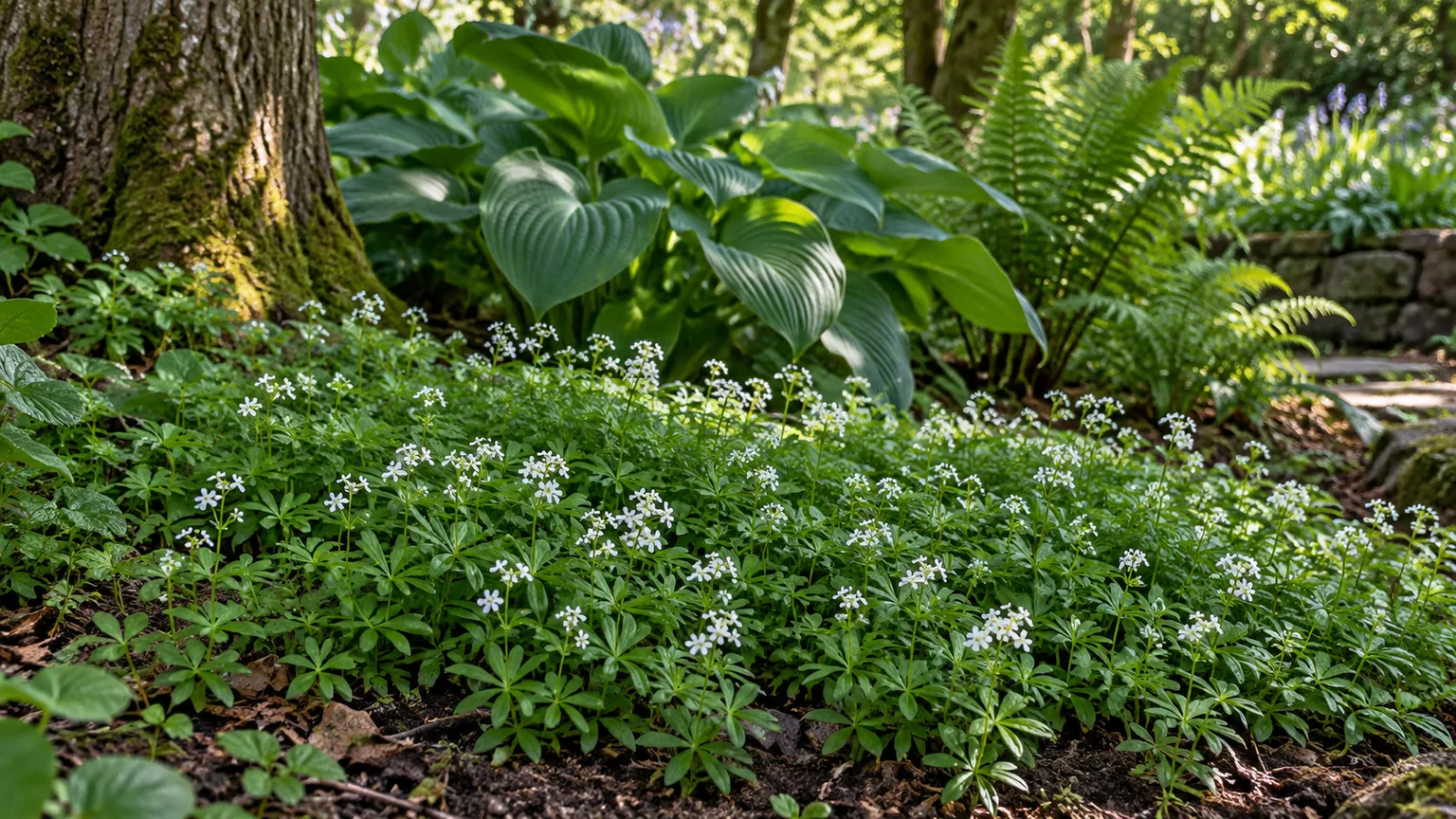
Leave space around small spring bulbs and delicate woodland plants that need light at soil level. A dense mat may hide emerging foliage and make later digging difficult. If you want an evergreen carpet, have a sunny, dry bed, or need a groundcover that stays exactly within a narrow strip, choose a different plant. Gardenista highlights the ornamental value in woodland settings, and recent horticulture coverage also recommends it for shaded path settings—but any placement advice should be balanced against your local spread risk and willingness to edge it. (Gardenista, Gardening Know How)
Conclusion
Sweet woodruff is a useful spring-flowering groundcover when you can offer shade, reasonable moisture, and a clear boundary. Plant it where a spreading mat is an advantage, water new clumps and summer-dry soil, and divide rooted sections in spring or early fall when you want to expand or thin the patch. Let the foliage die back naturally in cold weather, and judge summer browning against heat, dryness, and drainage before replacing the plant.
The key to successful sweet woodruff care is matching its vigor to the site. In a woodland bed with larger companion plants, its whorled leaves and small white flowers can soften bare ground with little routine attention. Along a sensitive natural area or a border of small plants, use a container, maintain an inspected edge, or select a less spreading alternative.