How to Clear a Clogged Shower Drain With a Drain Snake
Learn how to snake a shower drain safely: remove the cover, guide a hand auger past the trap, pull out hair, and test the flow without forcing the cable.
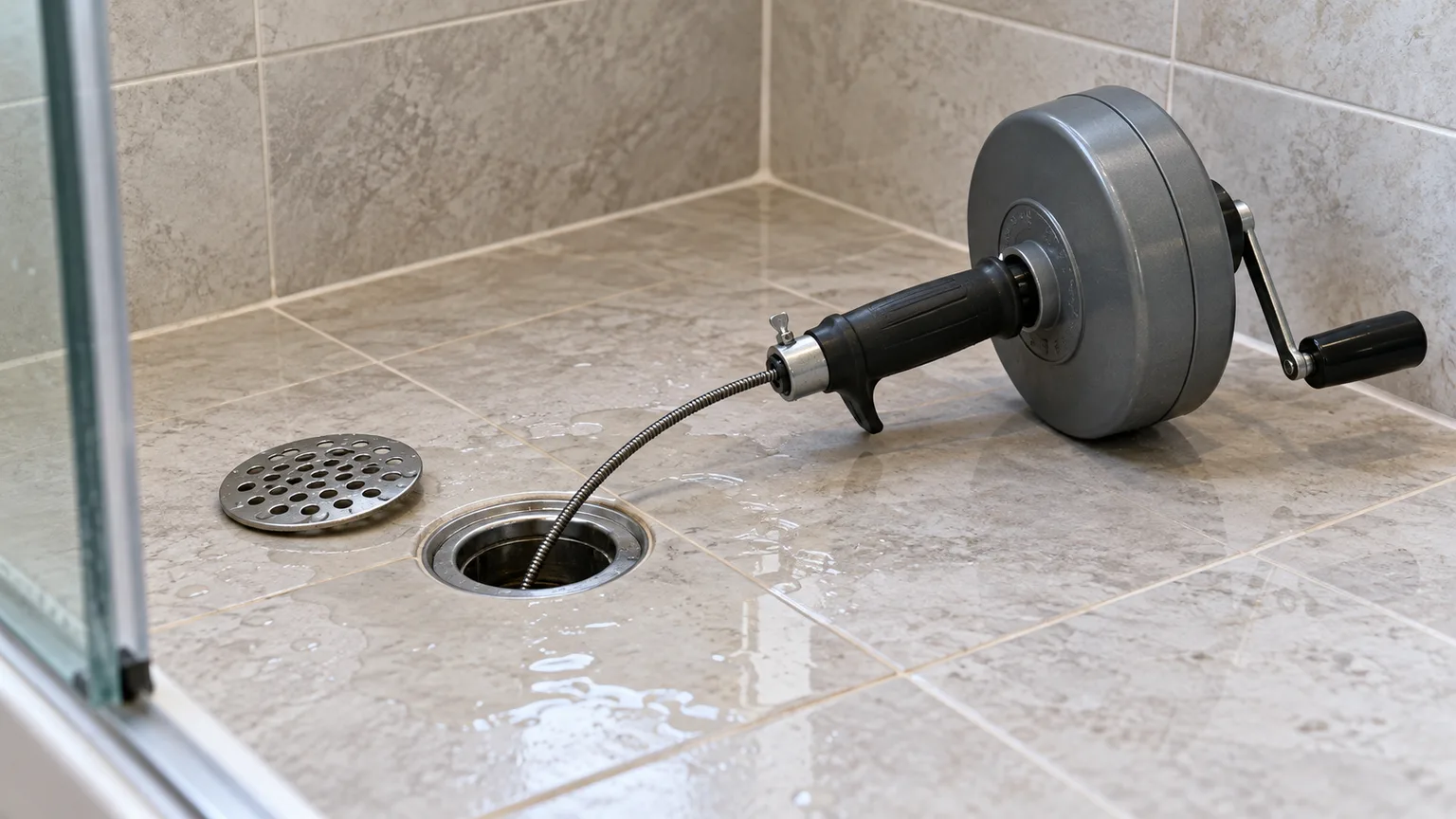
If water is pooling around your feet, a compact manual drain snake can often retrieve the hair and soap residue slowing the shower. The trick is to treat resistance as information: a cable can meet the trap’s turn before it reaches the clog, so pushing harder is not automatically the answer.
For a typical fixture-level clog, remove the strainer, use a small hand-crank auger that fits the drain, feed short lengths while rotating, and withdraw the cable to bring debris back out. Stop if the cable kinks, the cover will not come off without force, multiple fixtures are backing up, or the blockage does not improve after a careful pass.
Is a drain snake right for this shower clog?
A hand snake is a reasonable first tool when one shower drains slowly or holds water while nearby sinks, tubs, and toilets behave normally. Shower clogs commonly collect close to the opening, where shed hair catches on rough surfaces and combines with soap residue; a small cable can reach that buildup and either hook it or break it apart.
The pattern matters more than the amount of standing water. If a single shower is slow, start at its grate. If several fixtures gurgle or back up together, the obstruction may be farther along the shared branch or building drain, where a short hand auger may be ineffective and an attempted DIY fix can make a mess.
When a hand auger fits the job
Choose a manual auger for a likely local blockage that you can access through the shower opening. A light hand-crank model gives you feedback: you can feel the cable turn, meet a bend, and stop before adding more force. That control is valuable in a small fixture drain, where a larger powered machine is more tool than the job calls for.
A snake is less useful for a hard object, a damaged or collapsed pipe, mineral scale, or a blockage deep in a shared line. It may also fail to remove a coating that has narrowed the pipe rather than a wad that the tip can snag. If you pull back only a little residue and the flow remains poor, do not assume that feeding all 25 feet into the drain is the next safe step.
When to stop and call a plumber
Call a plumber if water rises in a tub or toilet when the shower runs, more than one drain is slow, sewage-colored water comes back through the shower, or the clog returns soon after clearing. Those symptoms point beyond an isolated hair wad and may require access to a larger branch or cleanout.
Stop sooner if the cable will not turn, kinks near the drain, repeatedly springs back, or seems caught in a way gentle reverse rotation cannot release. A stuck cable can damage the drain fitting or leave steel in the line. If you have poured a chemical drain opener into standing water, do not put your face over the drain or plunge and snake through the liquid; follow the product label and tell a plumber what was used before anyone works on the pipe.
Choose a snake that fits the drain
Use a compact hand-crank drum auger with a flexible cable and a small retrieving or corkscrew end. Check the manufacturer’s drain-size guidance and the cable diameter before buying or borrowing one. For example, Milwaukee lists its 25-foot hand auger with a quarter-inch cable for drains from one-half inch to two inches in diameter, which includes many household fixture drains; that is a specification for that tool, not a guarantee that its cable suits every shower fitting or clog. (Milwaukee Tool’s 25-ft hand auger specifications)
A longer cable is not inherently better. A 25-foot length provides reach, but most hair clogs are much closer than that. If you feed more cable only because water still drains slowly, you can send the tip past a local snag, loop it in a line, or reach plumbing you cannot see or assess.
Hand crank vs. hair-removal tool vs. powered auger
A plastic barbed hair-removal strip is inexpensive and useful for hair sitting immediately below a removable strainer. It is not a substitute for a drum auger if the clog is past the trap or the narrow strip cannot reach it. Use it gently and discard it after use; pulling it back through a tight opening can scatter wet debris.
A small hand-crank auger is the better choice for a reachable clog beyond the top of the drain. The drum contains cable and helps limit mess, while the crank lets you control rotation. This Old House’s plumber-led guide distinguishes a manual snake for small household drains from powered machines for harder or deeper stoppages, and notes that a standard hand snake is not the same tool as a protected closet auger for a toilet. (This Old House’s drain-snaking guide)
An electric drain machine can injure an inexperienced operator or damage a small fixture line if the cable binds or is used with the wrong head. Use a powered tool only when its manufacturer specifically rates it for that drain and you understand the instructions; for a typical shower hair clog, a manual auger gives you a more appropriate level of control. Never use a toilet auger in a shower. Its protective bend and head are built for a toilet’s porcelain trap, not the shower drain.
Tools and prep that prevent a mess
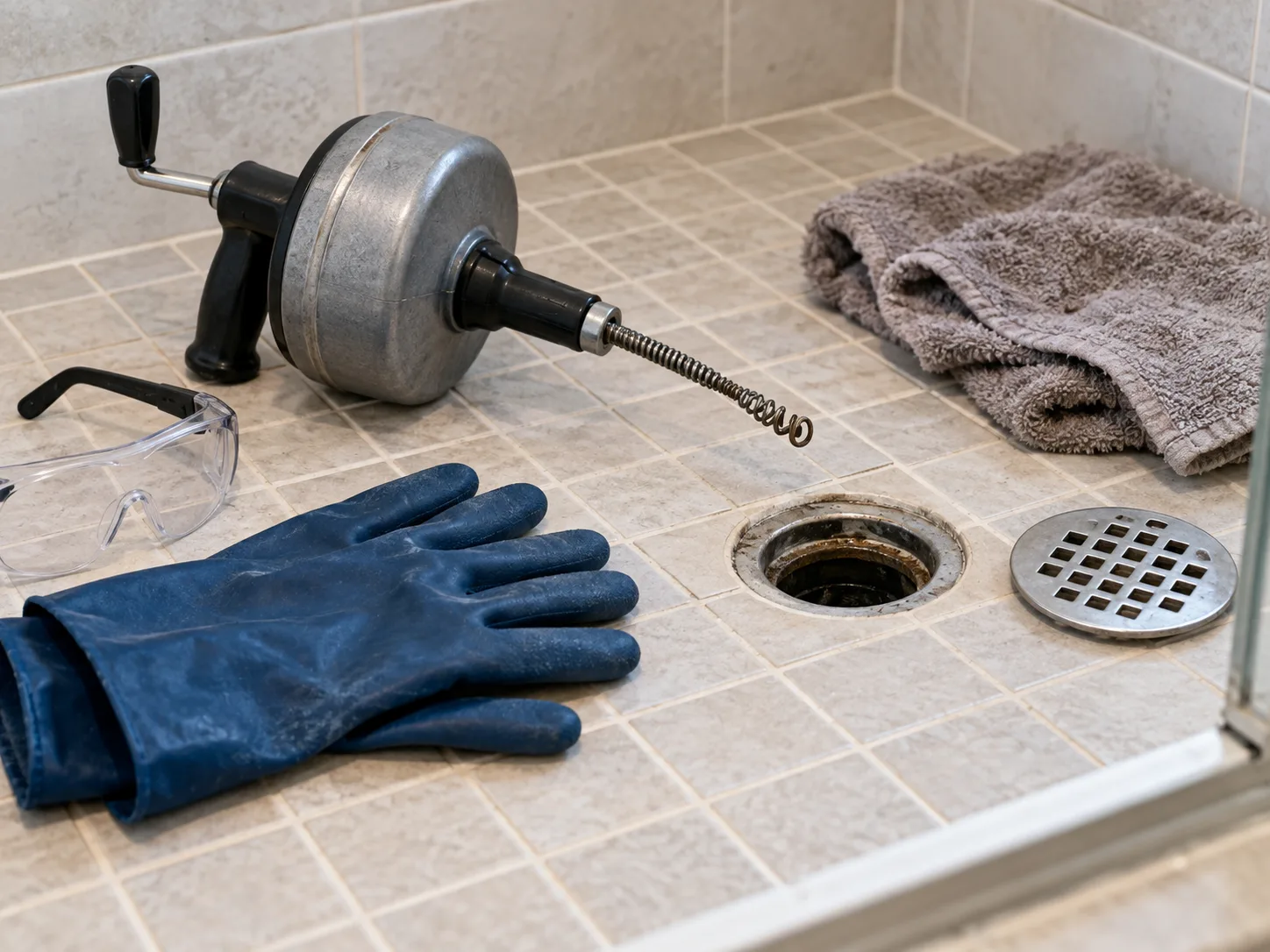
Gather the auger, a screwdriver that fits the grate screw, work gloves, eye protection, a towel, a small bucket, and a trash bag before you begin. A flashlight helps you see whether the cable is entering the pipe or snagging on the drain fitting. Keep children and pets away from the work area, and wear shoes with a nonslip sole because the shower floor may be wet. Lowe’s drain-snaking guide warns that an auger tip can puncture thin cleaning gloves and that cable tension can release around pipe bends, so use eye protection, secure hand protection, and keep your hands clear of any rotating cable. (Lowe’s drain-snake guide)
If you have used a chemical drain opener, pause. A product trapped in a blocked drain can splash onto skin or eyes when a cable or plunger disturbs it; do not mix cleaners or improvise a neutralizing mixture. Follow the label’s instructions, and if the liquid remains pooled or you are unsure how to handle it, leave the drain alone and call a plumber. Mention the product before work starts.
Lay a towel outside the shower to protect the floor and set a bucket nearby for the removed grate and debris. Do not run water to “check” the drain while the opening is exposed and the snake is still inserted. This reduces splashing and keeps the cable from being washed deeper while you are not controlling it.
Step 1: Clear standing water and remove the cover
If there is only a shallow pool, bail out enough water to see the drain. Use a cup or a small container rather than reaching into murky water; the goal is a visible opening, not a completely dry shower. A clear view makes it easier to feed the cable down the drain instead of around the outside edge of the fitting.
Look at the grate before removing it. Many covers have one or two visible screws; others lift out or twist free. Use the correctly sized screwdriver and keep the screws in a safe place. If the cover resists, check for a hidden screw or locking mechanism rather than prying against tile or applying force to a sealed fitting. Some shower drain assemblies have parts that should not be removed casually.
Once the grate is off, lift out accessible hair and rinse the grate separately. This simple step can restore flow if the clog is caught at the top, and it prevents a snake from dragging a wad through small grate openings. Keep the removed parts together so reassembly is straightforward.
Step 2: Feed the cable without forcing it
Put on gloves and eye protection, then extend only a short amount of cable from the drum. Follow the tool’s instructions for setting its cable lock; on many hand augers, the lock prevents the cable from sliding while you crank. Keep the drum stable and the exposed cable short enough that it does not whip or buckle.
Guide the tip straight into the opening and rotate the handle slowly as you feed. Advance a few inches, pause, and let the cable find the pipe’s direction. If it stops, ease off the forward pressure and keep a gentle rotation; do not jab, hammer, or crank rapidly. This Old House also advises a gradual approach rather than ramming the obstruction, especially when plumbing may be delicate.
Tell a pipe bend from a clog
The cable may stop shortly after entering the drain because the trap bends beneath the shower. That first resistance does not prove you have found the hair blockage. A bend often feels smooth but persistent: with slow rotation and light pressure, the cable may gradually turn and move onward. A clog may feel springy, fuzzy, or grabby as the tip catches material, but feel alone is not a perfect diagnosis.
Use a simple rule: rotate and guide through gentle resistance; stop at resistance that makes the cable kink, buckle, or refuse to turn. If the cable keeps hitting the same spot, withdraw a few inches, reset the angle, and try again gently. Do not twist the cable hard against the drain shoe or force it past a trap bend. If it will not navigate with careful movement, you may have the wrong cable, an unusual drain fitting, or a problem that calls for a plumber.
Step 3: Work the hair clog and pull it out
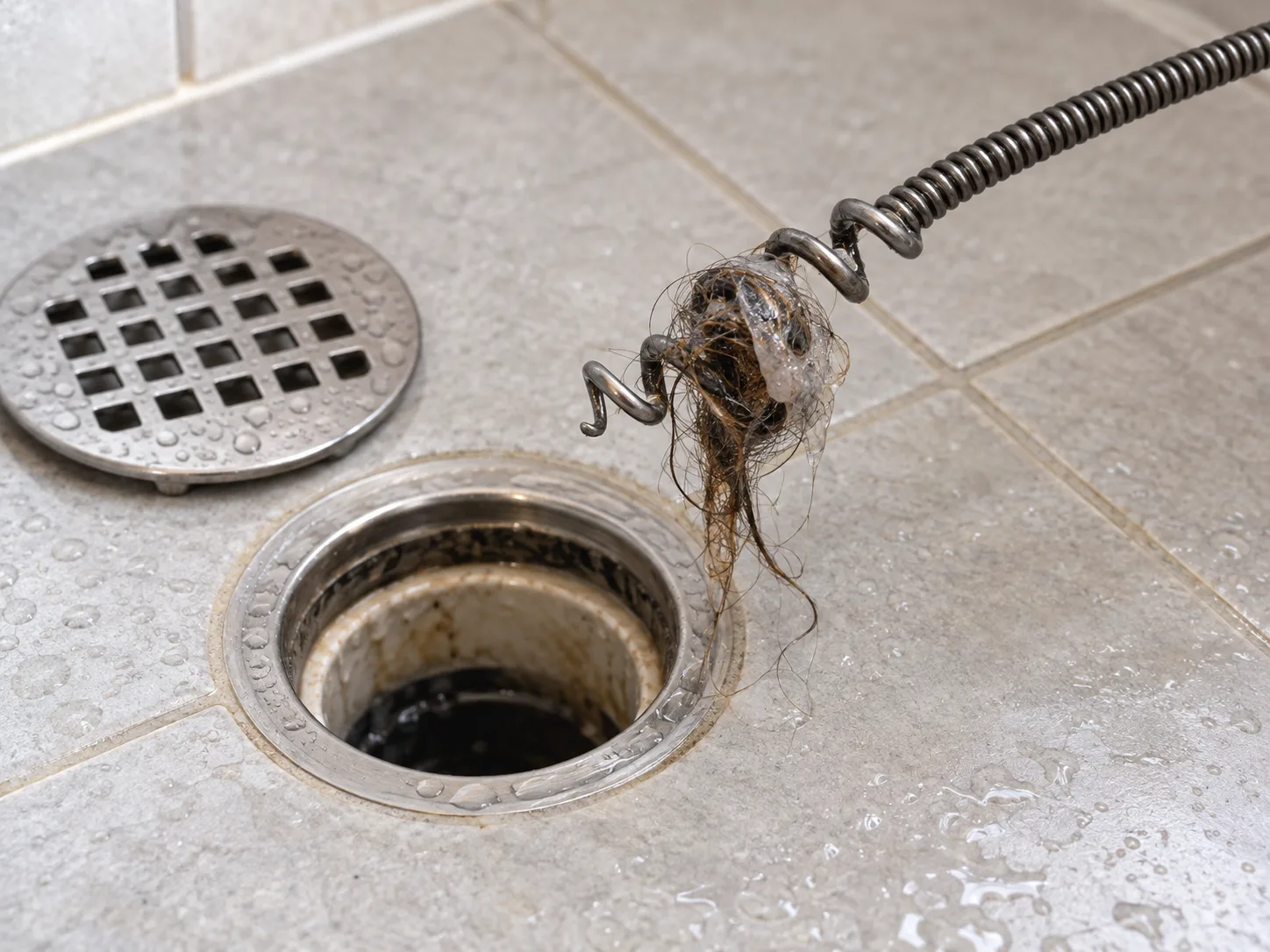
When the cable advances and then catches, keep it locked at that length and turn the handle slowly. The tip may wind into hair so you can lift it out, or it may poke through and loosen a soft obstruction. Use short turns and controlled pressure; the goal is to engage the clog, not drive the cable as far as possible.
After a few turns, pull back slightly to see whether the cable has caught anything. If it grips, withdraw slowly while continuing to turn in the tool’s recommended direction. Keep the drum close to the opening and guide the cable with gloved hands, never a bare hand. The end can be sharp, and a cable that twists under load can scrape or wrap around a hand.
If the clog does not catch, retract a few inches and try a small change in angle or rotation. A hair mass can be off-center, so one pass may skim by it. Avoid vigorous back-and-forth sawing; it can push debris deeper, unseat the cable, or scrape the drain fitting without improving flow.
Expect to make more than one careful pass. Remove hair from the tip over the bucket or trash bag after each withdrawal instead of pushing it back through the grate. A small amount of soap residue on the cable is normal; a large volume of sludge, foul water, or material that resembles sewage is a reason to stop and reassess.
Step 4: Flush and test the drain
After removing the cable, wipe it clean according to its manufacturer’s care instructions. Pulling a damp cable into its drum without cleaning and drying it can leave residue inside the tool and encourage corrosion. Wash your gloves and hands after handling the cable and debris.
Start the flow test with a small, steady stream of water. Watch the drain opening for a minute or two. If the water disappears without rising, increase the flow briefly and confirm that it continues to drain. There is no need to fill the shower pan to the curb to test a local drain clog; a controlled test shows whether water backs up while limiting the cleanup if it does.
If the water slows again, stop the flow and give the drain a second careful pass only if the cable advanced freely and the symptoms remain isolated to that shower. Remove what the tip retrieves, then retest. Do not cover a still-slow drain with the grate and call the job done; a partial opening often means some hair or residue remains.
Once flow is steady, clean the grate, return it to its original position, and replace the screw without overtightening. Check that the cover sits flush and does not wobble. A screw tightened too hard can strip its threads or make the next cleaning difficult.
Troubleshooting: the cable will not advance or the drain stays slow
A cable that will not go down may be hitting the trap turn, the side of the drain fitting, or a stopper component. First confirm that the grate is fully removed and that the cable tip points down the opening. Then shorten the exposed cable, ease back slightly, rotate slowly, and try a gentle change in angle. If the cable kinks or the fitting moves, stop rather than using more force.
A cable that advances but brings back nothing may have passed through the hair mass instead of hooking it. Withdraw partway, adjust the angle, and make one more measured attempt. If the cable meets an immovable stop or repeatedly comes back clean, the obstruction may not be hair, may be beyond the reach of a hand tool, or may involve a damaged pipe.
If water flows better but not normally, do not keep feeding the cable blindly. It may have opened a narrow path while leaving buildup behind, or the cause may be elsewhere, such as a second fixture draining into the same branch. Confirm whether nearby drains are normal and observe a short, controlled flow test. A second careful pass is reasonable for a local hair clog; repeated failure is a sign to stop.
For a cable stuck in the drain, stop cranking forward. Release the lock only as the tool instructs, reverse gently to relieve tension, and withdraw in small increments while keeping the cable aligned. Do not pull hard enough to bend the drain grate or fitting. If gentle reverse motion does not free it, call a plumber and tell them what tool and cable length are in the pipe.
Mistakes that can damage a drain or make a mess
The most common mistake is interpreting every stop as the clog and forcing the cable through it. The trap itself creates a turn, and a small auger should pass it with patient rotation rather than brute strength. If the cable starts to coil, bend outside the drain, or spring back, stop and reset.
A second mistake is using the wrong tool. A toilet auger has a shape meant to protect toilet porcelain, while a thin plastic hair strip has limited reach and strength. A large powered machine or a drill attached to a hand cable can add speed and torque the cable or tool was not designed to tolerate. Use a drill only when the specific manufacturer says that model supports drill operation and explains how to do it.
Do not snake through standing chemical cleaner or combine products because the drain remains slow. A cable can bring trapped liquid back toward the opening. If chemical opener has already been poured in, treat the pipe as a potential splash hazard, follow its label, and tell a professional what is in the drain.
Finally, do not use boiling water as a cure-all. A hand auger clears or retrieves an obstruction mechanically; very hot water will not pull out a hair mass, and the drain’s materials and prior chemical use may be unknown. Use an ordinary controlled flush after the cable is removed unless the fixture or product maker gives you a specific different instruction.
When recurring clogs point to a bigger problem
One shower that slows gradually and yields a clear bundle of hair is a different case from several drains that back up at once. If a nearby tub or sink gurgles when the shower runs, or a toilet water level changes, the blockage may be in a shared branch or farther downstream. A hand snake from one shower opening is not a reliable way to diagnose that system.
Pay attention to how quickly the clog returns. A drain that clears but slows again within days may have remaining buildup, a recurring source of hair, a poor-fitting strainer, or a pipe condition that needs inspection. Repeatedly sending the cable farther into the line without knowing which condition applies risks turning uncertainty into damage.
Get professional help when two or more fixtures are affected, wastewater backs up, there is a persistent sewer-like odor, the shower will not drain after one or two careful manual attempts, or the cable cannot pass the trap without force. A plumber can select a cable and access point suited to the line and determine whether the obstruction is in the fixture drain, branch line, or a larger building drain. A visit is also the safer choice if the drain cover or assembly is unfamiliar and removal could compromise a sealed connection.
Prevent the next hair clog
Place a removable hair catcher over or inside the drain if your fixture supports one. Empty it after showers before hair dries onto the mesh, and clean the grate when you notice strands collecting around its edges. This prevents the most common clog material from entering the pipe and is easier than relying on a calendar-based snaking routine.
If several people use the shower, check the strainer more often; the right interval depends on how much hair it collects, not on a universal monthly schedule. A quick look while cleaning the shower is enough to tell whether the screen needs attention. Keep the strainer seated correctly so it catches hair without creating a trip edge or blocking water more than intended.
At the first sign of slower drainage, remove visible hair at the surface and monitor the next shower. Catching the change early means you may only need to clean the cover or use a simple hair-removal strip. If the slowdown continues, use a manual auger before the drain becomes completely blocked, provided the symptoms remain limited to that fixture.
Conclusion
To clear a clogged shower drain with a snake, remove the cover, choose a compact hand-crank auger that fits the drain, and feed short lengths while rotating gently. Treat the trap’s turn as a navigation point rather than a reason to shove, pull debris out when the cable catches it, and test flow with a small stream before reinstalling the grate.
Stop if the cable buckles, the clog resists a careful pass, chemical cleaner is sitting in the drain, or other fixtures are backing up. Those are signs that more force or more cable is not the right next step. A hair catcher and occasional grate cleaning can keep the next clog near the surface, where it is easier to remove.