How to Grow and Care for Little-Leaf Linden
Little-leaf linden is a handsome shade tree, but it grows large. Get realistic size guidance, site-selection advice, planting steps, and pest troubleshooting.

Little-leaf linden (Tilia cordata), also called littleleaf linden or small-leaved lime, is a deciduous shade tree with a tidy pyramidal-to-oval crown, glossy heart-shaped leaves, and fragrant early-summer flowers. The name refers to its foliage, not its eventual size: a typical tree can reach about 50 to 70 feet tall and 30 to 50 feet wide, depending on cultivar and growing conditions.
That scale is the first care decision. Give it room for a broad crown and roots, and it can become a handsome, long-lived landscape tree with dense shade and flowers valuable to pollinators.
Plant it in a narrow, salty strip beside pavement or beneath wires, and the same tree may struggle or quickly outgrow the site. Choose the location before buying the tree; watering and pruning cannot make a large linden into a small one.
Is Little-Leaf Linden Right for Your Site?
Little-leaf linden works best as a lawn specimen, park tree, or broad-canopied shade tree where the crown can develop naturally. It tolerates a range of soil textures and is used in urban landscapes, but tolerance has limits: restricted rooting space, reflected heat, drought, compaction, and road salt can still produce slow growth, scorched leaves, or instability. North Carolina State Extension notes that it is often planted in street settings that are too difficult for it, despite its frequent use as an ornamental tree.
Before you commit, look up and down. Check the mature spread against the house, driveway, overhead wires, sidewalks, septic components, and neighboring trees; allow the canopy to grow without repeated cutting back.
Also consider what sits below it. The dense shade that makes a good summer refuge eventually changes what you can grow beneath the crown, and anything parked or placed under the tree could be exposed to sticky aphid honeydew in some years.
Mature size and planting space
Reliable references place the species in a range rather than at one exact mature size. The Morton Arboretum’s profile gives 60 to 70 feet in height and 30 to 40 feet in width; Virginia Tech lists 70 by 40 feet, while North Carolina State Extension gives 50 to 60 feet tall and up to 50 feet wide. These differences reflect how trees and selections develop across sites, not a promise that a particular yard will hold the tree to the smallest figure.
For layout, assume a mature crown at least 40 feet across and be comfortable with the possibility of a larger tree. A narrow cultivar may reduce spread but still reach several stories in height. If your available space cannot accommodate the crown without repeated reduction, choose a naturally smaller species suited to the site instead of relying on pruning to keep a linden undersized.
Flowers, fruit, and seasonal cleanup
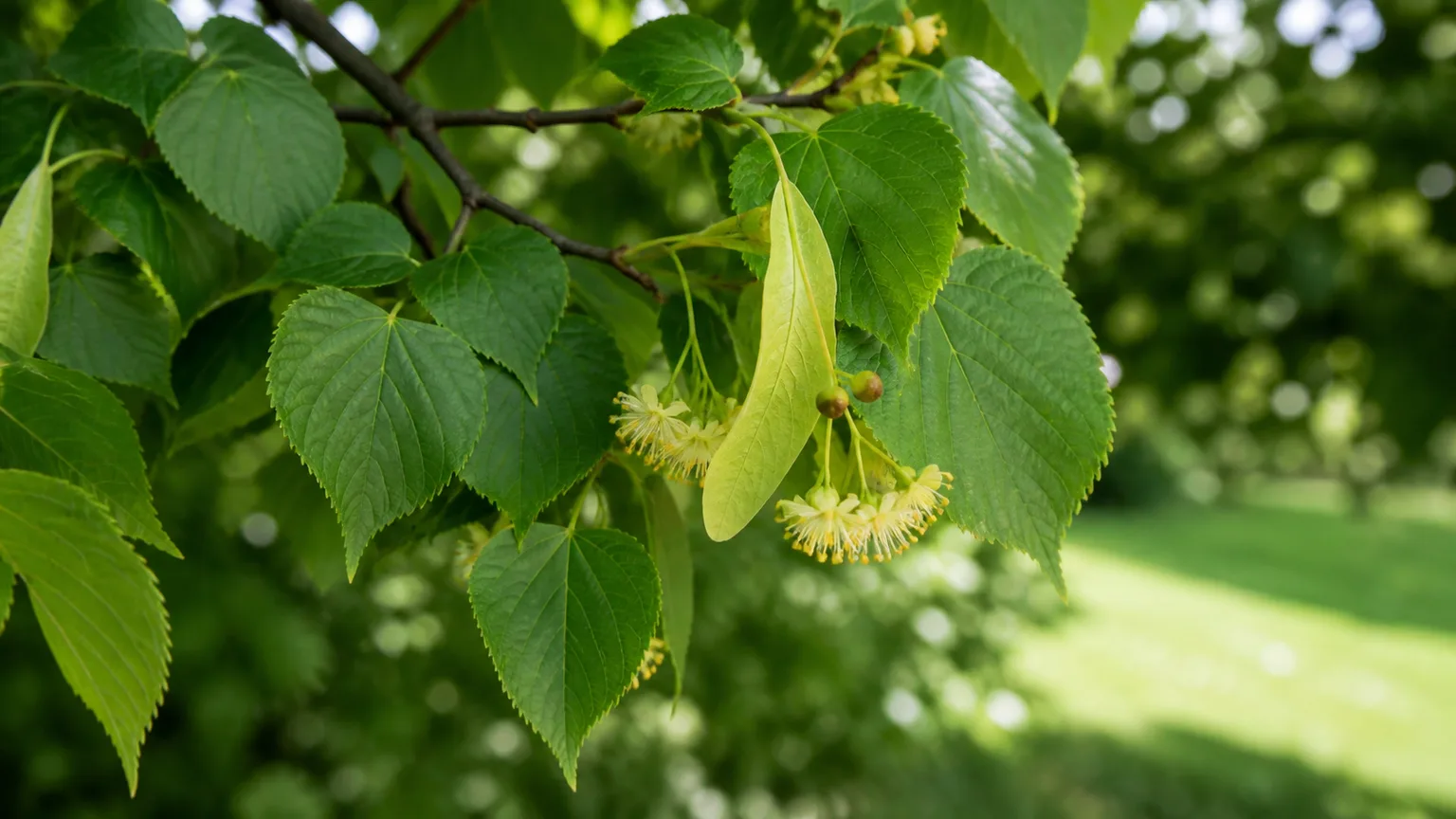
The leaves are alternate, glossy, and typically 1.5 to 3 inches long, with serrated edges and an uneven, heart-shaped base. In summer, the tree produces fragrant creamy-yellow flower clusters attached to a long, leaflike bract; small round nutlets follow.
The flowers supply nectar to bees and other pollinators, and the foliage turns yellow in autumn. The RHS plant profile describes the midsummer flowers and yellow fall color, while NC State notes their wildlife value.
The tree is not evergreen, so expect leaf drop in autumn and small fruits as the season advances. Flowers and seed structures can add minor litter, but sticky surfaces under the canopy are more often an aphid issue than a normal feature of the flowers. If you plan to place a bench, vehicle, or patio dining set beneath the tree, weigh the shade and pollinator value against that occasional cleanup before planting.
Where to Plant a Little-Leaf Linden
Choose a site with full sun for the strongest flowering and a well-formed crown, or partial shade if that is what the garden offers. In shade, the tree can still grow, but expect a less vigorous or less symmetrical canopy. Look for deep soil that can hold moisture without staying saturated; a young tree needs regular attention during dry spells even though an established linden can manage ordinary short dry periods better than a newly planted one.
Little-leaf linden accepts several soil textures and a broad pH range, but that should not be confused with tolerance for every urban condition. A tree in a broad, uncompacted lawn may do well near a town street; the same species in a tiny pavement cut surrounded by salt and reflected heat may become stressed.
The RHS recommends moist but well-drained soil and shelter from cold winds. Prioritize rooting room and drainage over adjusting the soil with amendments.
Sun, soil, drainage, and climate
| Site factor | Good fit | Avoid or reconsider |
|---|---|---|
| Light | Full sun; partial shade is acceptable | Deep shade where a dense, balanced crown is the goal |
| Soil | Moist, fertile, well-drained loam; clay or sandy sites can work if drainage and moisture are suitable | Persistently waterlogged ground or very shallow, compacted fill |
| Space | Open lawn, park-like yard, or wide planting area | Tight planting strip, overhead wires, or a spot that requires regular crown reduction |
| Exposure | Some shelter from strong, drying winds while young | Salt spray and a hot, dry, restricted root zone |
Cold-hardiness listings vary across horticultural references and cultivars. Virginia Tech lists Zones 3 to 8, and NC State’s plant record lists zones 3b through 7b; local nursery selection and microclimate still matter, especially near the warm or cold edge of a tree’s range. In a hot-summer climate, pay particular attention to deep soil, establishment watering, and protection from road salt or reflected pavement heat rather than assuming the hardiness zone alone guarantees success.
How to Plant It for Strong Roots
Plant a container-grown or balled-and-burlapped tree in spring or fall when the soil is workable and temperatures are mild. In a cold region, spring planting gives roots a full growing season before winter; in a region with hot summers and mild winters, fall planting can reduce heat stress while roots establish.
Avoid planting into frozen, saturated, or baking-hot soil. Select healthy nursery stock with a straight trunk, living buds, and a root system that is not tightly circling the pot.
The two details that make the most difference at planting are hole depth and root flare. A tree placed too deep can struggle for years because the trunk base and structural roots are buried. Find the point where the trunk widens into its first major roots before you set the tree; nursery media may cover this flare, so brush away excess potting mix to locate it rather than trusting the top of the container as the final grade.
Root flare, planting hole, mulch, and staking
Dig a hole two to three times as wide as the root ball, with sloping or roughened sides, but no deeper than the distance from the root flare to the bottom of the ball. Set the tree on firm, undisturbed soil so the flare sits at or slightly above surrounding grade.
If roots circle the outside of the container root ball, loosen or selectively cut those roots before planting; do not leave a tight root mat wrapped around the trunk. Backfill with the native soil you removed, water to settle it, and do not add a concentrated fertilizer layer to the bottom of the hole.
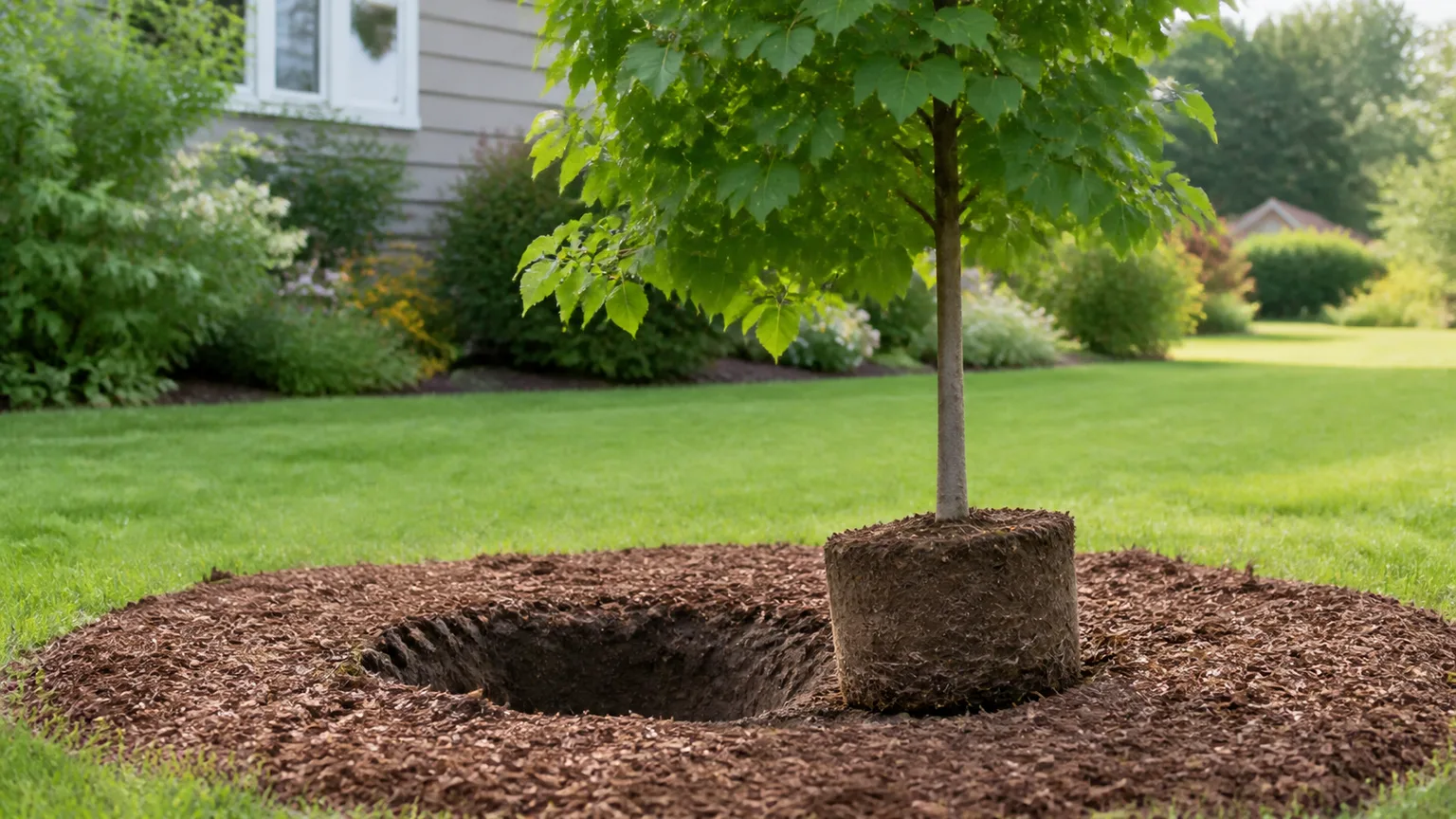
Apply about 2 to 3 inches of organic mulch over a broad ring to moderate soil temperature and slow moisture loss. Leave a clear gap around the trunk and keep the root flare visible; piling mulch against the bark traps moisture, hides planting depth, and can encourage trunk problems. Mow carefully and keep string trimmers away from the trunk, since bark wounds can become entry points for decay.
Stake only if the root ball rocks, the site is exposed, or the tree cannot remain upright on its own. Use flexible ties low enough to support the trunk while allowing some movement, and check them during the season.
Remove them once the tree stands firmly; permanent staking can rub bark and limit trunk development. The BBC Gardeners’ World planting guide also recommends staking during early establishment and watering through dry periods.
Watering and Fertilizing by Age
During the first growing season, check moisture in the root ball and nearby soil every few days in hot or windy weather, then less often when conditions are cool or rainy. Water slowly and deeply when the root ball is beginning to dry, rather than giving frequent shallow sprinkles that wet only the surface. The amount and interval depend on root-ball size, soil texture, rainfall, and heat; a calendar schedule is a starting reminder, not a substitute for checking the soil.
Continue watching the tree through the next couple of growing seasons, especially during extended drought. As roots spread into surrounding soil, shift watering outward from the trunk toward the expanding root zone.
Once established, a linden in a suitable site generally needs supplemental irrigation only during prolonged dry weather, but urban trees in compacted or restricted soil may need more frequent help. Avoid keeping the root zone saturated: wilting in wet soil can indicate poor drainage or root trouble rather than thirst.
Fertilizer is not routine care for a healthy little-leaf linden. If shoots are growing normally and the canopy looks healthy, leave it alone.
Yellow leaves, small leaves, or slow growth can result from planting depth, drought, compaction, saturated soil, pests, or root damage, so adding nitrogen without diagnosing the cause can worsen imbalance and encourage aphids. If a soil test or local extension diagnosis shows a nutrient deficiency, follow that recommendation and product label rather than guessing at a dose.
Pruning for Structure, Not Size
An established little-leaf linden usually needs little routine pruning beyond dead, damaged, crossing, or poorly attached branches. Prune to preserve the tree’s natural pyramidal-to-oval form and maintain clearance, not to force it into a space that is too small. Small corrective cuts made while the tree is young are easier for the tree to close over and can prevent a weak fork from becoming a large future hazard.
Late winter during dormancy is a practical time to assess branch structure, though remove a hazardous broken limb as soon as it can be done safely. Make clean cuts just outside the branch collar, the slight swelling where the branch joins its parent limb.
Do not leave long stubs or cut flush into the trunk. The Penn State Extension pruning guide explains why retaining the branch collar helps a tree respond to pruning and why topping creates weak regrowth and decay risks.
Training a young tree without topping
During the first several years, look for one dominant central leader and well-spaced side branches. If two upright stems compete to become the trunk, gradually reduce or remove the weaker one while it is still small; avoid stripping the lower trunk of all branches at once, because young foliage helps build roots and trunk. Remove basal shoots if you want a single-trunk form, cutting them close to their origin without damaging the root collar.
Never top a linden to control its height. Heading back large limbs leaves large wounds and often triggers dense, weakly attached shoots that recreate the height problem while making the crown more vulnerable to breakage. Lindens can be pollarded or pleached in formal landscapes, but these are planned training systems that require repeated skilled pruning from an early stage.
They are not quick fixes for an overgrown shade tree. If major limbs overhang a roof or public space, hire an insured, qualified arborist rather than climbing or cutting large branches yourself.
Choose a Cultivar That Fits
Named cultivars are selected for form, size, or nursery consistency, but “narrow” and “compact” are relative terms. The table uses the mature dimensions published by The Morton Arboretum; verify the selection and expected size with a local nursery because climate, rootstock, and site conditions affect growth.
| Cultivar | Published form or size | Best reason to consider it |
|---|---|---|
| ‘Greenspire’ | Neat pyramid; about 50 feet tall | A central leader and consistent shape for a large yard or broad parkway |
| ‘Corzam’ (Corinthian®) | Narrow pyramid; about 45 feet tall by 15 feet wide | A narrower crown where horizontal space is more limited, though overhead clearance is still essential |
| ‘Chancellor’ | Upright when young; about 50 feet tall | A somewhat shorter selection than the species, still large at maturity |
| ‘Halka’ (Summer Sprite®) | Rounded; about 20 feet tall by 15 feet wide | The genuinely smaller option in this group for a more constrained garden |
| ‘Baileyi’ (Shamrock®) | Open crown; about 50 feet tall by 30 feet wide | A less dense canopy than ‘Greenspire’ |
If a small tree is the actual requirement, ‘Halka’ deserves closer consideration than the usual ‘Greenspire’, but confirm its availability and regional performance. Do not rely on a label such as “urban tolerant” to solve a site with inadequate soil volume or road salt. In areas with heavy Japanese beetle pressure, ask a local arborist, extension office, or nursery whether linden is a sensible choice before planting; severe feeding can leave a large tree with heavily skeletonized foliage.
Pests, Diseases, and Leaf Problems
Little-leaf linden is not immune to pests, but many visible issues are cosmetic and do not require treatment. Inspect the whole tree before acting: note whether damage is on a few leaves or the entire crown, whether it appeared suddenly, and whether the soil has been unusually dry or wet. A phone photo of both leaf surfaces, the branch tips, and the trunk flare can help a local extension office distinguish insects from drought or disease.
Aphids, Japanese beetles, and other damage
Aphids feed on tender growth and excrete honeydew, a sugary liquid that drips onto cars, paving, or furniture and may support dark sooty mold. The sticky coating is not the tree “bleeding.” Check leaf undersides and young shoots; lady beetles and other natural enemies often reduce aphid numbers without intervention.
If honeydew is bothersome, first assess whether the infestation is severe and whether the tree is otherwise healthy. Avoid broad-spectrum insecticides during flowering, when pollinators are visiting, and do not spray a mature canopy without professional advice.
Japanese beetles chew between leaf veins, leaving a lacy or skeletonized appearance. A few damaged leaves are not usually a reason to treat a large tree, but repeated heavy defoliation can weaken it.
NC State warns that severe infestations can cause substantial damage; if beetles are common locally, consider that risk in the plant-selection decision rather than assuming you can reach the canopy later. Aphids, scale insects, leaf miners, gall mites, and spider mites can also occur, with spider mites more likely in hot, dry conditions.
Brown leaf edges in hot weather often point to water stress, wind, salt, or restricted roots, not automatically to a disease. Powdery mildew and leaf spots can occur, while serious diseases such as Verticillium wilt are less common but potentially severe. Check soil moisture, drainage, root flare, and recent weather before treating.
If one side of the crown wilts, branches die back progressively, or decline continues despite correcting water stress, seek a diagnostic opinion instead of applying fungicide by guesswork. Cornell University’s NYS IPM overview summarizes common linden pests and explains how aphid honeydew can lead to sooty mold.
Propagating Little-Leaf Linden
For a landscape tree, buying a correctly identified nursery-grown tree is usually the most predictable route. Many named selections are propagated vegetatively so the young tree retains the cultivar’s particular shape; NC State lists grafting as the common propagation strategy, and the RHS describes seed stratification and chip budding. A seed-grown tree may vary from its parent and is not a dependable way to reproduce ‘Greenspire’ or another named selection.
Seed propagation is possible if you are patient and willing to accept uncertain results. Collect mature nutlets after they develop, clean them, and sow in a labeled pot or nursery bed outdoors so they experience seasonal conditions; germination can be slow or uneven because the seed coat and dormancy make timing unpredictable.
Keep the medium lightly moist, protect the container from rodents, and do not discard the pot after one season just because nothing has emerged. Once seedlings are large enough to handle, grow them on until their roots and stems are sturdy before transplanting to a permanent site.
Softwood or semi-hardwood cuttings and grafting can preserve selected traits, but success depends on timing, rooting conditions, and compatible rootstock. If you need a particular cultivar, buy from a reputable nursery instead of relying on an unverified cutting. That small upfront choice saves years of waiting for a seedling that may not have the form or size you intended.
Conclusion
Little-leaf linden is a strong choice when you have room for a large deciduous tree and want summer shade, fragrant flowers, and a structured crown. Its everyday care is straightforward once established: plant into well-drained soil with the root flare visible, water through establishment and extended drought, mulch without covering the trunk, and prune selectively rather than cutting back the canopy.
The best way to avoid problems is to choose the site and cultivar before planting. Measure for the mature tree, account for salt and rooting space, and be honest about whether a 40-foot-or-wider crown fits your yard. A linden planted where it can mature is far easier to care for than one continually pruned to fit the wrong place.



