The Best Types of Hardscape Materials for Your Yard
Choose hardscape materials for patios, paths, driveways, and walls with a clear comparison of durability, drainage, maintenance, accessibility, and trade-offs.
“Best” depends on where the surface goes and how you expect it to work. A smooth patio that moves dining chairs easily has different requirements from a winding garden path, a driveway, or a retaining wall holding back wet soil.
The useful comparison is not just brick versus stone versus concrete. It is the finished surface plus its base, joints, edge restraints, grade, and drainage route. Match that system to traffic, climate, soil, accessibility, and the upkeep you will actually do, and the material choice becomes much easier.
Choose for the job, not just the sample
Hardscape is the built, nonliving part of a landscape: paving, decks, steps, walls, edging, and similar structures. Plants, lawns, and mulch are softscape. The distinction matters because the hard surface changes how people move through a yard and where rainfall goes; the surrounding planting has to make sense with both.
Start with four questions. What will travel over the surface—bare feet, dining chairs, a wheelbarrow, a wheelchair, a car? Does rain need to soak in, drain away from a building, or be captured elsewhere? Will the site freeze, bake in afternoon sun, collect leaf litter, or sit below roof runoff? Finally, do you want a surface that can be lifted and repaired one unit at a time, or would you rather maintain a continuous slab or deck?
These questions expose trade-offs that a color sample cannot. A stone that looks perfect in the showroom may be too irregular for a level dining area; loose gravel may drain freely but resist a rolling cart. Fine Gardening’s paving-material guide likewise treats stone, pavers, and concrete as choices with different design and construction behavior, rather than interchangeable finishes.
Hardscape materials at a glance
Use this table to narrow the field, not to substitute for a site plan. The “watch for” column describes the issue most likely to change whether a material suits your project.
| Material | Often a good fit for | Main strengths | Watch for |
|---|---|---|---|
| Concrete pavers | Patios, paths, some driveways | Many shapes and colors; individual units can be reset or replaced | Base, joints, and edge restraint control performance; ordinary joints are not automatically permeable |
| Clay paving brick | Traditional paths, patios, borders | Warm color, repeatable patterns, repairable units | Specify paving brick for the expected weather and traffic; salvage brick needs inspection |
| Natural stone | Patios, steps, garden paths, walls | Distinctive texture and color; local stone can tie into the landscape | Thickness, cleft, surface texture, weight, and cost vary by stone and quarry |
| Poured concrete | Accessible routes, simple patios, utility areas | Continuous, firm surface; can be shaped and finished in several ways | Cracking and drainage details are hard to hide or change after pouring |
| Gravel or crushed aggregate | Informal paths, secondary seating, drainage-friendly zones | Water passes through the surface; comparatively simple to renew | Needs a stable base, edging, and regular grooming; some grades are hard to roll over |
| Exterior tile or porcelain pavers | Contemporary patios and covered or open terraces | Precise sizes and finishes; easy-to-clean options exist | Must be rated for exterior exposure and installed with the right substrate, drainage, and wet traction |
| Wood or composite decking | Elevated or uneven sites, door-height transitions | Creates a raised, warm-feeling outdoor floor | Requires sound framing and ventilation; wood upkeep and composite heat/finish vary by product |
No row is a guarantee about cost or service life. Regional availability, thickness, finish, quarry, soil, labor, site access, climate, and construction method can shift the installed result more than the material name does.
Concrete pavers: flexible and repairable
Concrete pavers are separate manufactured units laid over a prepared base, usually with joints and edge restraint. They suit patios and paths when you want a regular pattern, predictable dimensions, and the option to lift a few units later if a utility line needs access or the surface settles.
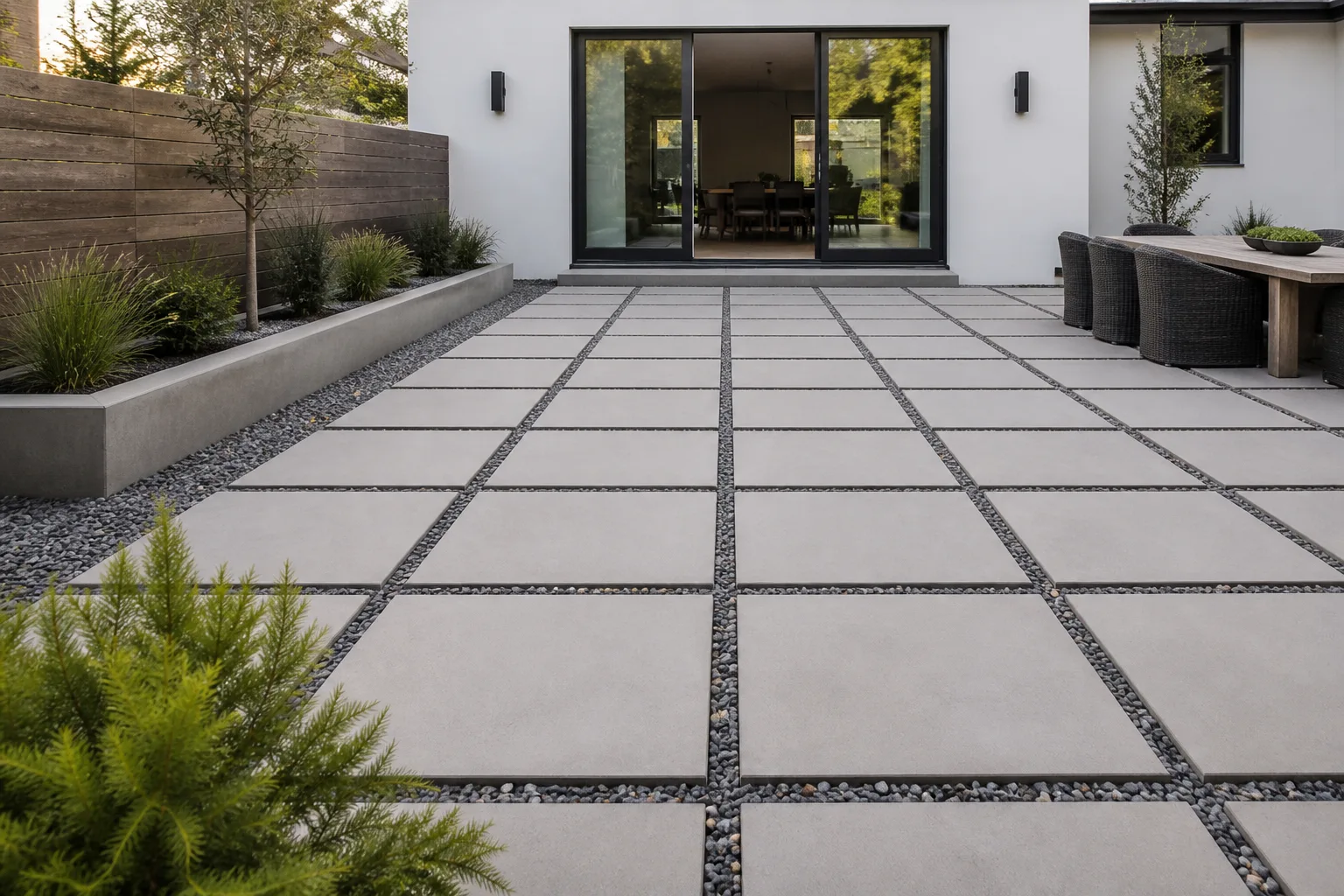
The range is broad: small brick-like units can create a traditional herringbone pattern, while large rectangles make a quieter, more modern grid. That range does not make every paver appropriate for every job. Ask whether the specific unit and system are intended for foot traffic, a driveway, or a commercial/heavier load; product shape, thickness, laying pattern, base, and edge restraint work together.
The Gardenista overview of concrete pavers notes their flexibility in shape and color and their relative ease of replacement, while also flagging staining and freeze-thaw exposure as considerations. For a homeowner, the repair advantage is practical: a correctly built modular surface lets a contractor lift, correct, and relay a small area. It does not mean the repair is invisible—new units can differ in color, and a poor base can cause the same low spot to return.

Concrete units can be used in a permeable system, but the word “paver” alone does not promise infiltration. Ordinary pavers laid tightly with fine joint sand over a compacted conventional base may shed water nearly like a solid surface. For a designed permeable pavement, the joint aggregate, bedding course, open-graded stone reservoir, subgrade, and overflow route all have to be specified; Penn State Extension explains that these systems depend on a prepared subsurface, and the EPA’s permeable-pavement fact sheet describes the stone base that temporarily stores water below the surface.
Clay brick: color and pattern with a specification check
Clay paving brick gives a path or patio a fine-grained scale and a familiar red, brown, buff, or variegated palette. The units can be laid in running bond, basket weave, herringbone, or a border pattern, and individual bricks can usually be lifted for repair. Reclaimed brick can add appealing variation, but age and appearance do not prove that it can withstand outdoor paving conditions.
Check the product’s intended application before buying. The ASTM specification distinguishes paving brick for pedestrian/light traffic from heavy-vehicular paving brick; the relevant ASTM C902 standard addresses pedestrian and light-traffic paving brick. Ask the supplier for the exact product specification and whether its weather class fits your exposure, especially where saturated units may freeze. Ordinary wall brick, indoor brick, or unknown salvage may have different absorption, strength, dimensions, or wear behavior.
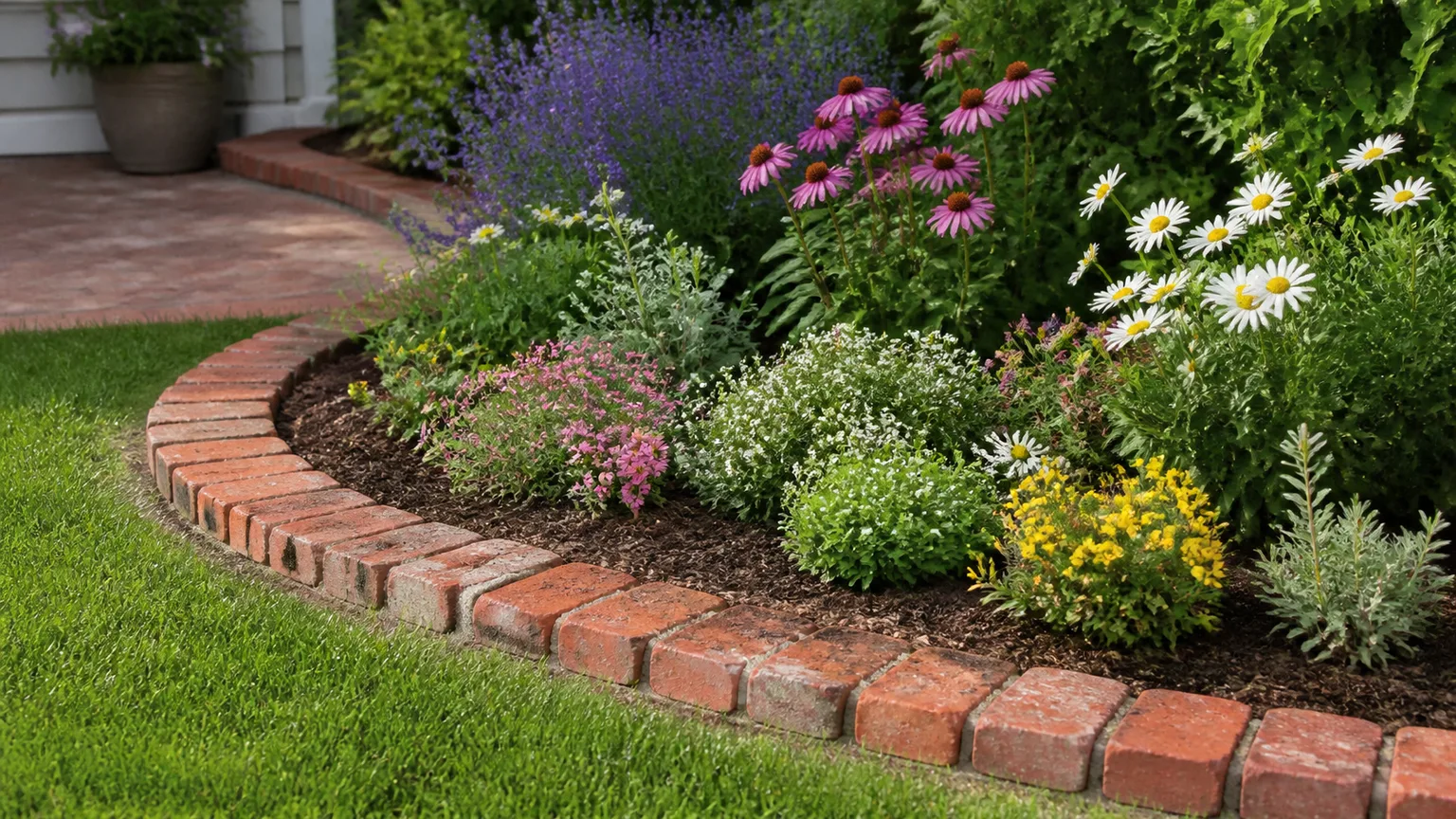
Brick is modular but not maintenance-free. Sanded joints may need replenishing, mortar joints are less flexible than a dry-laid system, and surface variation can create unevenness if bricks are mixed without sorting. In a small space, a restrained brick border can connect paving to a garden bed without making the whole yard feel formal; a brick edging image can also show how the unit works at the planting boundary.
Natural stone: texture, variation, and weight
Natural stone includes flagstone, bluestone, limestone, granite, slate, sandstone, and other locally quarried material. “Flagstone” describes a flat paving use, not one specific rock. A stone’s density, cleft, finish, thickness, color, and weathering behavior vary by geology and source, so compare actual samples from the same lot when color consistency matters.
Irregular pieces create a relaxed path or terrace with broad joints that can hold gravel, sand, or planting. Cut rectangular units feel more formal and make furniture easier to arrange. The shape affects more than style: thin or uneven pieces need appropriate support, while heavy slabs increase delivery and handling costs. For a stable walking route, keep the top faces reasonably even and avoid narrow gaps that catch cane tips, chair legs, or wheels.
Natural stone can make a strong, long-lasting surface when the selected stone and installation match the exposure, but there is no universal “stone is indestructible” rule. Some finishes polish or become slick when wet; some stones stain or change color; some thin pieces crack over weak support. Request a sample, ask how the surface handles wet conditions, and verify the supplier’s use recommendation for patios, steps, pools, or vehicle loads.

Poured concrete: a continuous surface
Poured concrete works where a firm, continuous surface is valuable: a straightforward patio, utility area, or route that should be easy to roll across. It can be broom-finished, exposed-aggregate, colored, scored, or stamped. A textured finish may improve grip compared with polished smooth concrete, though the actual surface and maintenance still matter when wet, shaded, or affected by algae.
Its biggest advantage—one broad surface—is also its main repair limitation. Concrete can crack as the ground moves, shrinkage occurs, roots grow, or water freezes in vulnerable conditions. Control joints guide where some cracking happens; they do not make a slab immune to cracks. Repairs can remain visible because matching the old color and finish is difficult, and lifting a single section to reach buried services usually means cutting or breaking the slab.
Grade and joints need to be decided before the truck arrives. A concrete patio should direct runoff away from buildings and toward an appropriate outlet or landscape area; do not rely on a perfectly flat pour. If the desired look is a rigid surface with a more repairable layout, compare poured concrete with concrete pavers rather than assuming a decorative stamp offers the same maintenance options.
Gravel and loose aggregate: permeable, with boundaries
“Gravel” covers materials that behave differently. Rounded pea gravel shifts and rolls underfoot; angular crushed stone tends to lock together better; decomposed granite or similar fines can compact into a firmer path when the grading and installation are right. A decorative pebble layer over bare soil is not the same thing as a built gravel patio with a compacted base and defined edges.
Loose aggregate is a useful choice for informal secondary paths, seating areas, or planting edges when the site benefits from a surface that drains through itself. It is relatively easy to top up or reshape. It also migrates: stones reach lawns, shoes, and drains; leaf litter is awkward to remove; weeds can root in accumulated debris or soil; and a wheel or stroller can sink into coarse or rounded stone.
Choose the stone size and shape for the user, not just the color. For a garden path used by a wheeled cart, compacted fines or a stabilizing grid may be more comfortable than loose pea gravel, but each grid system has its own fill and base requirements. Firm edging is essential where loose aggregate meets lawn, paving, or a sloped bed; without it, the material spreads and the path narrows.
Outdoor tile and porcelain pavers: precise but detail-sensitive
Outdoor porcelain pavers offer consistent dimensions and a crisp, contemporary finish. They may work well on a professionally designed terrace, rooftop, or patio, including pedestal-supported systems in applications where that assembly is appropriate. Do not assume an indoor floor tile or a thin decorative slab can simply be placed outdoors or carry furniture and foot traffic without the correct support.
Ask the manufacturer to confirm exterior suitability for the exact climate and installation method. The Tile Council of North America’s exterior guidance says exterior installations must account for weather exposure, drainage, substrate and setting materials, and temperature movement; interior methods are not automatically suitable outside. It also recommends checking that tile is rated by its manufacturer for exterior use and that water can drain from the assembly.
Wet traction is a separate question from whether the tile is strong. Compare product-specific wet-use data and surface texture, especially around pools, outdoor kitchens, and steps. Verify the installation detail, edge restraint or mortar system, drainage layer, movement joints, and repair method before ordering a full pallet; an elegant sample cannot reveal whether a failed assembly will be simple to fix.
Wood and composite decking: a raised outdoor floor
Decking is hardscape too, although it solves a different problem from paving. It can create a level outdoor area above a slope, uneven ground, or a door threshold, and it can preserve a lighter visual footprint where a large ground-level slab would feel heavy. Wood boards have a natural grain and can be refinished, but their upkeep depends on species, exposure, finish, ventilation, and the construction details below the boards.
Composite boards combine plastic with wood fiber or other ingredients, but formulations and performance vary by manufacturer. They can reduce some routine staining and splintering tasks compared with wood, yet they may heat in direct sun, show scratches, fade, or require the brand’s specific cleaning products. Ask for a full-size sample and warranty terms, and compare recycled content and end-of-life options product by product rather than assuming every composite is equally sustainable.
Do not treat deck boards as structure. Framing, footings, guardrails, stairs, ledger attachment, water shedding, and local building rules govern safety; elevated decks and structural work deserve qualified design and inspection. If the yard is mostly level and chairs need to roll smoothly, paving may be simpler. If grades or the house threshold make excavation awkward, a deck may avoid a large retaining cut.
Match materials to the project
The same material can be excellent in one place and frustrating a few feet away. Choose by the task and the people who use it, then refine the color and pattern.
Patios and outdoor dining
For dining chairs, grills, and frequent foot traffic, prioritize a firm, even surface that is easy to sweep. Concrete pavers, suitable natural stone, paving brick, poured concrete, and exterior porcelain systems can all work when specified and installed for the conditions. If the area is shaded and leaf-heavy, a fine joint or smooth pale slab may need more frequent cleaning than a textured, forgiving surface.
Gravel can make a relaxed, budget-conscious sitting area, but test it with the actual furniture. Chair legs can sink or catch, and serving carts do not roll well over every grade. A hybrid layout—solid paving beneath the table with gravel or planting at the perimeter—keeps the high-use zone functional while reducing the amount of continuous hard surface.
Garden paths, steps, and slopes
A path needs predictable footing. On a level, informal route, compacted crushed aggregate or broad stepping stones may blend into planting; where people carry tools, visit after rain, or use mobility aids, select a firmer continuous or tightly fitted surface and keep transitions low. Oregon State University Extension recommends permeable materials for patios and walkways where appropriate, while also identifying site grading as another way to route runoff into planted landscape features.
On a slope, do not ask a loose surface to do the work of stairs or a retaining structure. Use appropriately built steps, landings, and edge restraint, with drainage that will not wash base aggregate out from beneath them. Keep a path wide enough for its real use, and check that gates, downspouts, tree roots, and utilities will not force a sharp turn or unstable edge.
Driveways and service areas
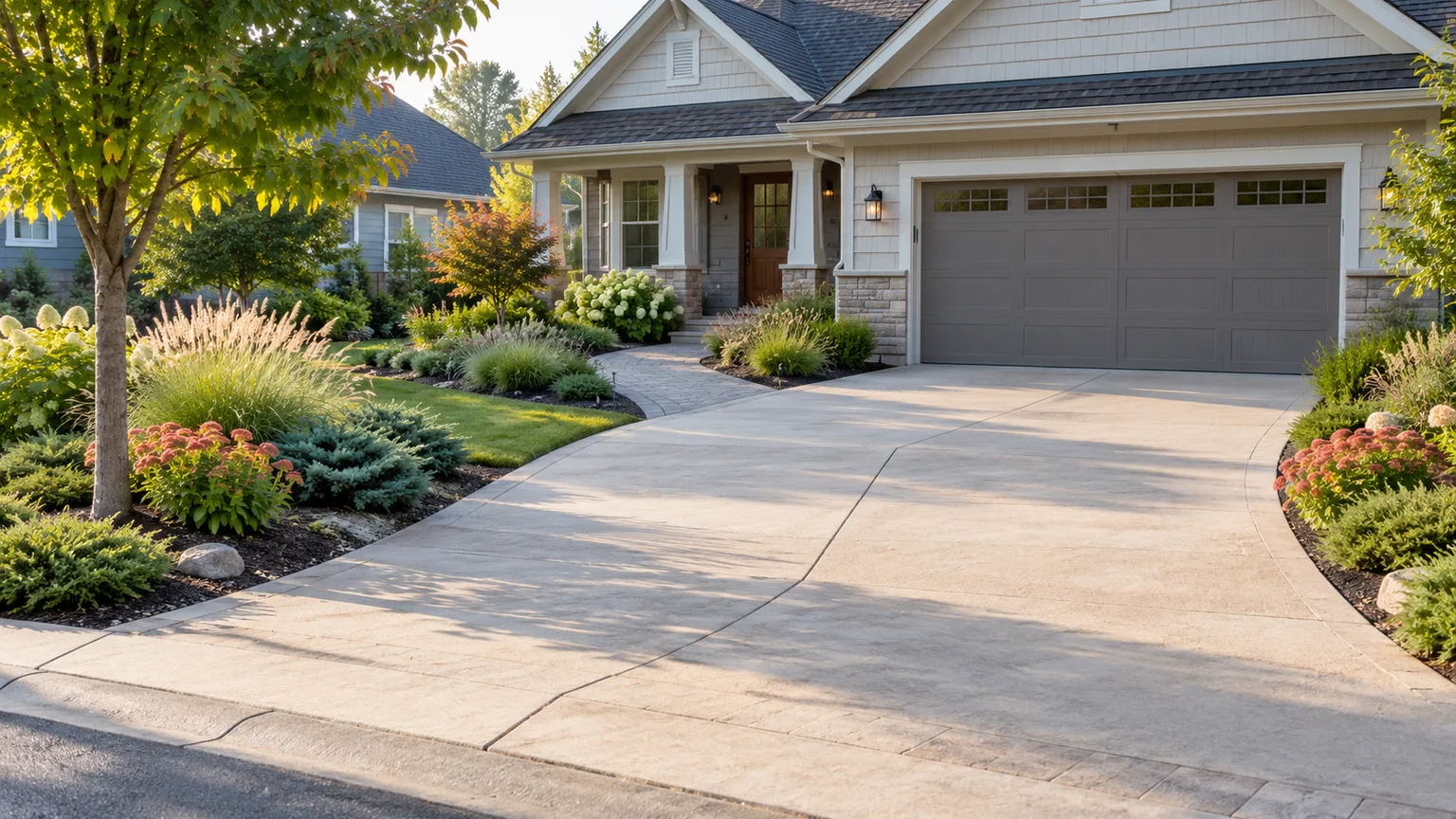
Vehicle surfaces need a system designed for vehicle weight, not simply a paver that looks thick. The base depth, subgrade condition, paver or brick specification, pattern, joint material, edge restraint, and drainage all affect performance. A pedestrian flagstone slab or patio tile is not a safe substitute for a vehicle-rated product just because it is made of stone.
Permeable pavers can be useful for parking, but they require design for the expected load and stormwater behavior. Pennsylvania State Extension documents that pervious systems can fail if traffic exceeds their design; their porous-paving guide illustrates why “permeable” describes an engineered assembly, not a decorative gap pattern. Bring the intended vehicle, turning movements, and any heavy delivery access into the supplier conversation before choosing units.
Edging and retaining walls
Edging keeps gravel, planting soil, lawn, and paving in their places. Brick, stone, metal, timber, or manufactured concrete units can all work, but choose a height and anchor appropriate to the material and the pressure behind it. A thin plastic strip may define a flower bed; it is not a substitute for a structural retaining system.
Retaining walls hold back soil and water, so the choice is about structure as much as appearance. Soil type, wall height and geometry, surcharge from a driveway or building, drainage behind the wall, footing, and local permit rules can determine what is safe. Ask a qualified landscape contractor or engineer when a wall supports a slope, building, driveway, or other load, or when water has no clear route away.
Make drainage part of the material decision
Permeability is a property of the whole installation. Gravel lets water move between stones, and specially designed porous concrete or open-joint pavers can route rain into a stone reservoir below; conventional concrete, tight mortar joints, compacted soil, and even a paver patio with closed joints can still send runoff across the surface. EPA guidance describes permeable pavement as a surface that lets rain or snowmelt pass through to underlying gravel and soil layers.
That does not mean every yard should infiltrate runoff everywhere. Compacted clay, shallow bedrock, a high water table, contaminated soil, steep slopes, or water near a foundation can make infiltration unsuitable or require an underdrain and controlled outlet. Penn State Extension notes that permeable systems rely on a carefully prepared subsurface, sometimes with storage, piping, or basins; its home stormwater guidance advises getting professional help for complex runoff problems.
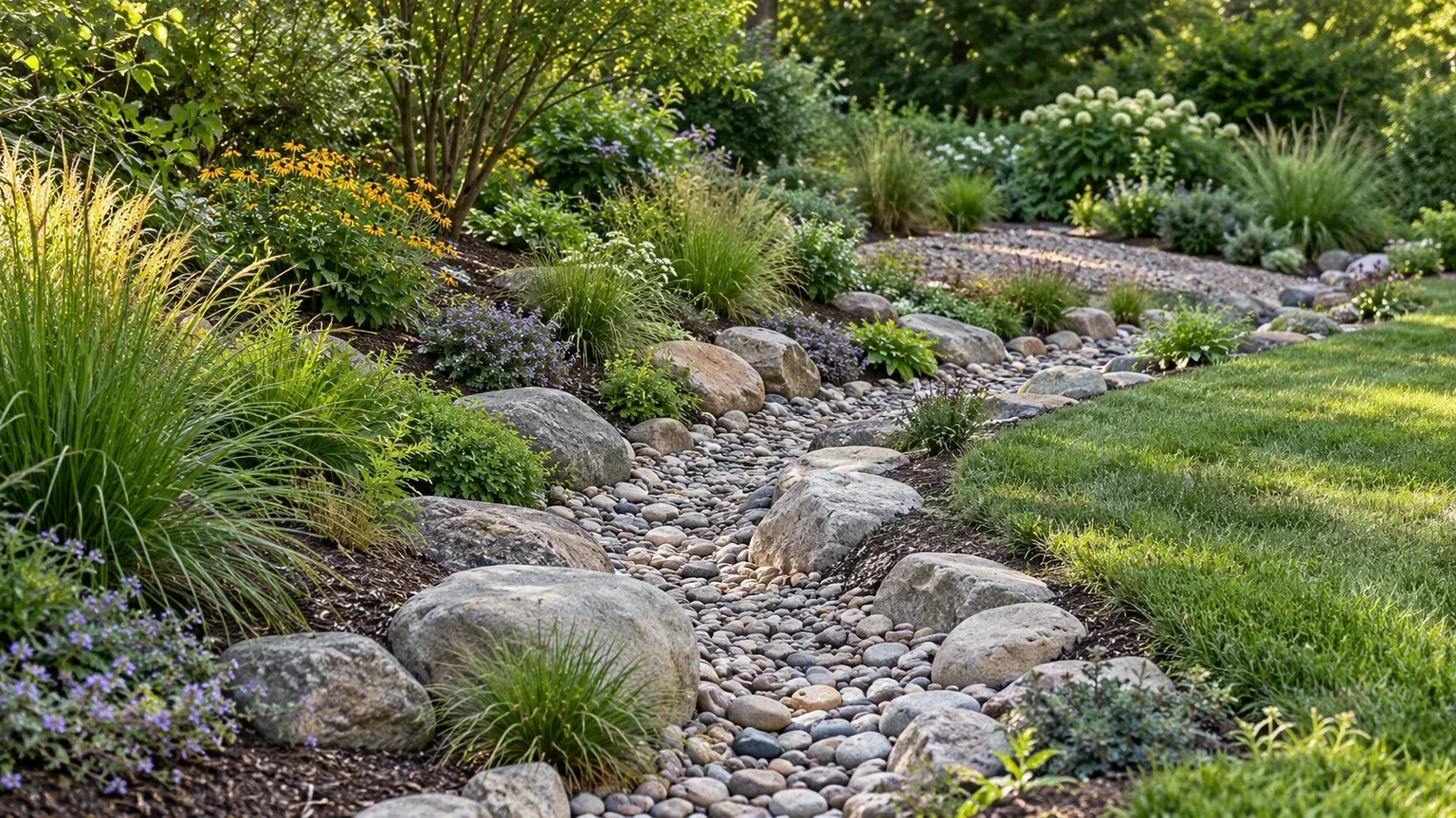
For ordinary hardscape, first map where rain currently collects and where roof downspouts discharge. Keep water moving away from the house and neighboring property, and do not send it toward a basement, retaining wall, septic system, or public right-of-way without checking local rules. A swale, rain garden, dry creek, or planted bed can complement paving when designed to receive runoff rather than serving as an improvised fix for a bad grade.
Compare the full cost and future upkeep
Material price is only one line in the project. Ask every bidder to separate demolition and hauling, excavation, base and bedding, drainage, edging, surface units, cuts and waste, delivery, labor, sealing, and cleanup. A low-cost gravel quote may omit edging and replenishment; an expensive stone sample may need less fabrication if local sizes fit the layout. Compare equivalent scopes rather than price per square foot of product.
Think through the first repair, not just the installation day. Can a damaged unit be replaced from retained stock? Will new material match an aged surface? Can leaves be blown or swept without scattering the joint fill? Does a stain require sealing, and is that sealer compatible with the finish? Which product warranties exclude freeze-thaw, deicing salts, heavy loads, or standing water? Record the manufacturer, color, product code, and installation method before the leftover pavers disappear.
Reuse and local sourcing can reduce hauling and give a yard a coherent regional character, but condition and transport still matter. Penn State Master Gardeners describe using salvaged concrete (“urbanite”), local materials, and reused hardscape as ways to reduce material waste in their article on carbon-conscious garden hardscaping. Inspect reclaimed pieces for contamination, inconsistent thickness, sharp edges, and enough sound units to complete repairs; reclaimed does not automatically mean suitable.
A practical order for making the choice
- Draw the use area and access route. Mark doors, gates, steps, utilities, trees, drains, downspouts, and where furniture or vehicles will go. Measure the surface and note the slope; the route to get material into the yard can affect labor and equipment costs.
- Set performance limits. Write down expected loads, wheeled access, wet use, sun exposure, freeze-thaw conditions, and how often you are willing to sweep, weed, wash, seal, or top up. If mobility or fall risk matters, prioritize stable footing and wet traction over texture alone.
- Decide where water should go. Identify low points and a safe outlet or planted receiving area. Ask whether infiltration is appropriate for the soil and site; for a permeable system, request its cross-section, base specification, overflow plan, and maintenance instructions.
- Shortlist two or three systems. Compare, for example, concrete pavers with gravel joints, paving brick over a compacted base, and poured concrete with planned joints. Do not compare a finished paver system against a surface-only slab estimate.
- Take samples home and request written specifications. View each in morning and afternoon light, wet it, set it beside the house, and walk on it in the footwear you actually use. Confirm product application, size, finish, freeze-thaw suitability where relevant, load rating, maintenance requirements, and what the installer guarantees.
The Oregon State Extension paver-installation guide is useful for understanding the sequence beneath brick, concrete, or stone pavers: layout, excavation, base, edge restraints, bedding, joints, and maintenance. Use it to ask informed questions; conditions such as soil, vehicle loads, frost, codes, and drainage can change the correct design, so do not copy a generic base depth onto every site.
Conclusion
The best hardscape material is the one that fits the way you use the space and the conditions beneath it. Concrete pavers offer repairable variety; brick adds a patterned, warm surface when the product is rated for paving; natural stone brings texture and variation; poured concrete creates a firm continuous plane; gravel offers a permeable, informal finish; exterior tile rewards careful detailing; and wood or composite decking can solve elevation and grade changes.
Before choosing color, settle the load, water route, footing, base, edge, climate, and maintenance questions. Then compare samples and complete installed bids for two or three systems. That sequence prevents a beautiful surface from becoming the wrong answer for the yard.