What Is a Garden Arbor? Uses, Types, and Design Basics
Learn what a garden arbor is, how it differs from a trellis or pergola, and how to size, site, plant, and maintain one that suits your yard with confidence.
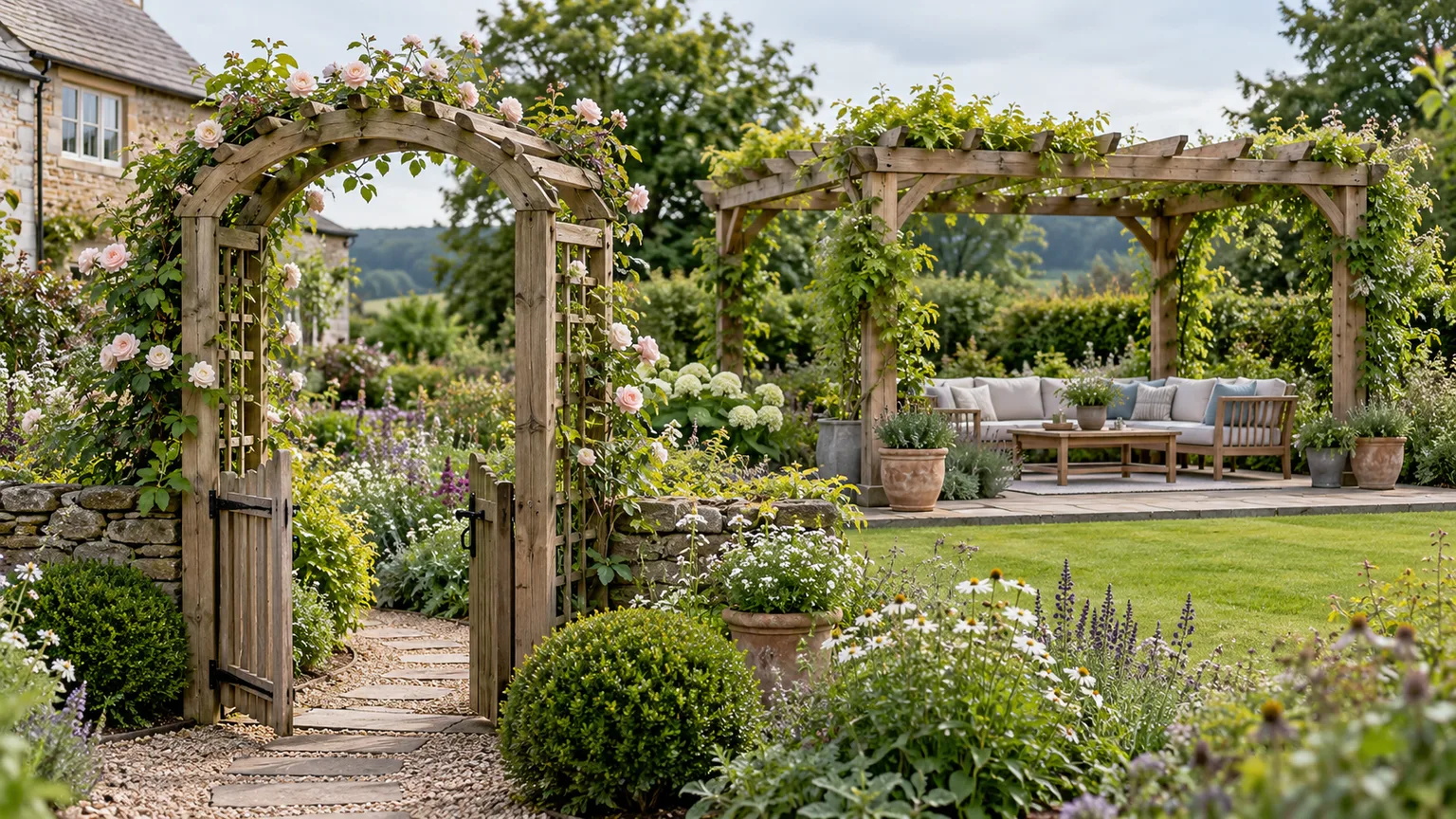
A garden arbor is a small outdoor frame that marks a passage, frames a view, or creates a sheltered spot to pause. It usually has two upright sides joined by an open top; the top may curve into an arch or use flat crosspieces, and lattice may give climbing plants a place to grow. In ordinary garden language, “arbor” can mean anything from a simple metal arch over a gate to a leafy wooden nook with a bench.
That range is why it helps to define the job before shopping. An arbor can make an entrance feel like a destination, carry roses or grapes across a short path, or give a small garden a vertical focal point.
It is not automatically a roof, a privacy screen, or a strong support for a heavy vine. Its size, materials, anchoring, and the plant you choose determine what it can do safely.
The practical definition of an arbor
In a contemporary yard, an arbor is a compact structure that you pass under or sit beside. A basic model has two posts and an open arch or short lattice roof; a more enclosed version adds trellis panels along the sides. Some traditional garden arbors include a seat beneath a leafy canopy, while many products sold today are simply entry arches without room for seating.
The word has never mapped to one completely fixed shape. University of Florida IFAS Extension notes that garden structures have been misidentified and their names have shifted across regions and time.
It describes a traditional arbor as a small, vine-covered shelter and distinguishes it from a trellis, which is principally a plant-support frame; in modern catalogs, “arbor,” “arch,” and “trellis arch” can overlap. For planning, look at the actual dimensions and frame rather than relying on the label. University of Florida IFAS Extension
A useful mental picture is a garden doorway. You approach it, pass under it, and arrive in a different area or at a framed view. A tunnel-like run of repeated arches can stretch that transition into a short passage, but if you need a broad structure over a patio or a long route, you may be thinking about a pergola instead.
What an arbor can do in a garden
An arbor works best when it solves a small spatial problem. It can make a bare gate feel intentional, give vines a defined route, make a transition between garden “rooms” easier to read, or create a small, seasonal patch of filtered shade. The structure earns its footprint when it improves how people move or how the garden is seen, not simply because an arch looks attractive in a product photo.
Think about both sides of the frame. From the approach, the arbor can draw the eye toward a bench, a flowering bed, or a distant tree; from underneath, it can create a sense of entry without closing off light. A well-placed structure can also screen one narrow sightline, but an open frame does not provide dependable privacy until the plants fill in—and even then, deciduous vines may leave the view open in winter.
Frame an entrance or short path
At a gate between a lawn and a vegetable garden, an arbor makes the crossing visible before a visitor reaches it. Along a side-yard path, it can soften a fence line or connect two planting areas. That transition is especially helpful in a small yard: one clear vertical element adds depth without taking up the same ground area as a bed, hedge, or shed.
Before installation, walk the route while carrying what normally travels there. A path that works for one person may feel cramped when you bring a wheelbarrow, stroller, garden cart, or bins through the gate. Keep the uprights outside the usable path, maintain comfortable head clearance under the lowest beam, and check whether a sagging or overgrown vine could reduce that clearance later.
Support flowers, fruit, or vegetables
An arbor can turn vertical growth into a feature. Climbing roses, clematis, honeysuckle, and grapes are common choices, while a light annual vine can give a new frame quicker seasonal coverage. For an edible garden, a tunnel made from repeated arch supports can carry crops such as cucumbers above a walkway; the frame then becomes both a passage and a way to use vertical space.
Fruit-bearing vines need more than a decorative shape. Texas A&M AgriLife Extension describes grape arbors as landscape accents, passageways, and shade structures, and its home-arbor guidance treats training and pruning as ongoing parts of the project. The details in that publication are specific to Texas and grapes, but the broader lesson applies: choose the species and variety for your climate, decide whether you will prune and harvest it, and provide a frame built for the mature plant rather than the small pot you buy today. Texas A&M AgriLife Extension
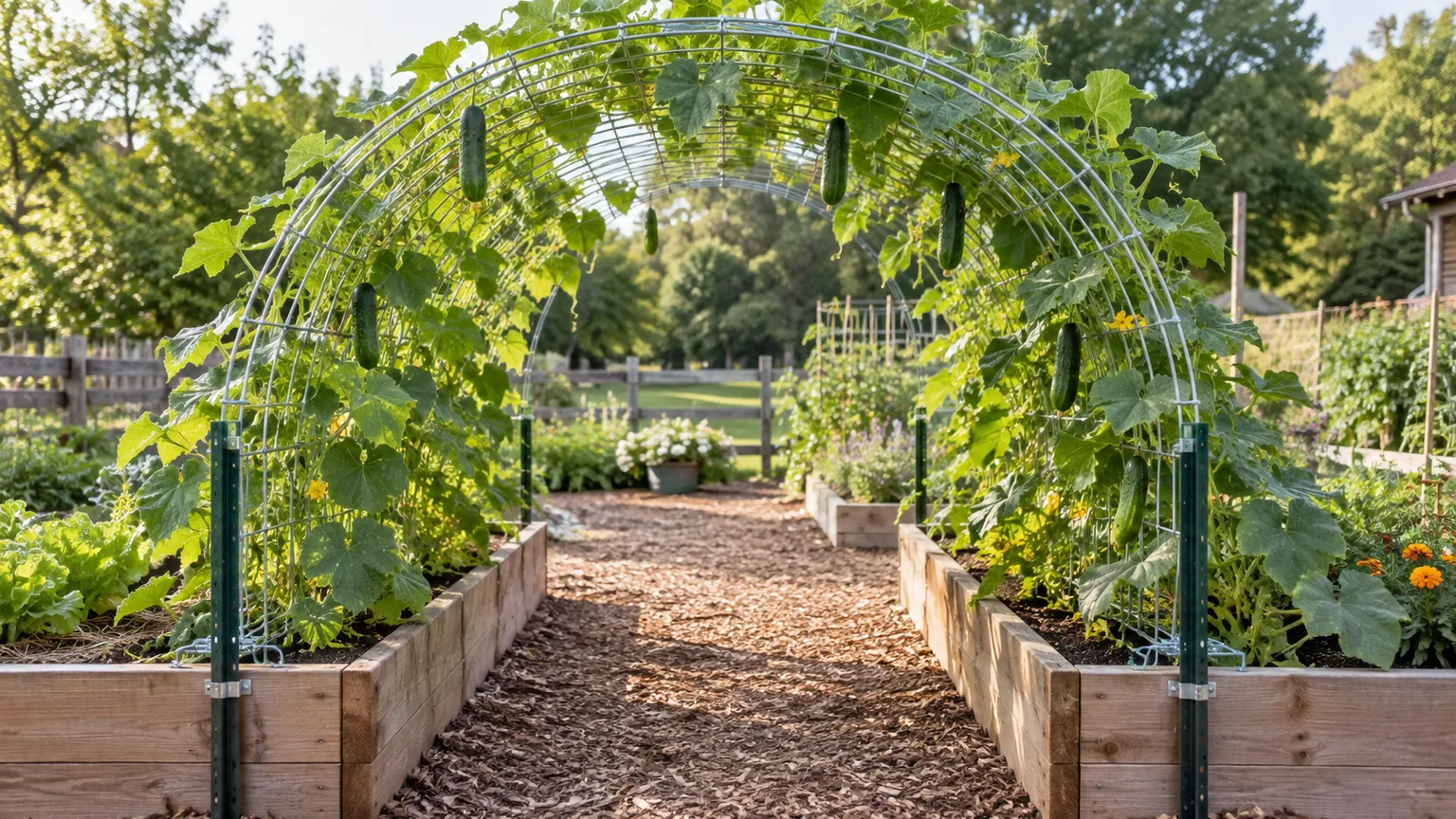
A light annual crop and a woody perennial are not interchangeable loads. A young vine may be easy to guide, but years of stems, foliage, rain, fruit, and occasional snow can add weight and catch wind. If a product’s instructions do not identify it as suitable for mature climbing plants, use it for a small, light climber or choose a sturdier frame whose capacity is documented.
Create a small pause or frame a view
Some arbors are deep enough to hold a bench or pair of seats; others are designed only to walk beneath. If sitting is part of the plan, use a tape measure or a full-size cardboard outline to check the bench, legroom, and approach. A narrow entry arch can look like a seat nook in a catalog photograph while having too little depth to sit comfortably.
An arbor can also frame something you already like. Position it so the opening centers a tree, a birdbath, or a view down the garden, rather than setting it where the posts block the view.
In that role, the frame needs no dense planting to be useful. A restrained vine or pair of container plants at the base may be easier to maintain and keep the view open.
Arbor vs. arch, trellis, pergola, and gazebo
The names overlap, but the structures usually have different jobs. An arch describes a curved opening, while an arbor usually describes a small walk-through frame or sheltered garden feature.
A trellis is mainly a lattice or grid that supports plants; it may be flat against a wall, freestanding, or built into the sides of an arbor. A pergola is generally a longer or larger framework of posts and open overhead beams, and a gazebo is a roofed place to sit or gather.
| Structure | Common garden job | What to expect overhead |
|---|---|---|
| Arbor | Mark a gate, frame a short path, support a vine, or shelter a small seat | A short open arch or lattice top; shape varies |
| Arch | Create a curved gateway or visual frame | Usually an open curve, sometimes with a short grid |
| Trellis | Give a climber a lattice to grip or tie to | Usually no substantial overhead cover |
| Pergola | Define a patio, seating area, or longer walkway | Repeated open beams over a wider or longer footprint |
| Gazebo | Provide a destination for sitting or gathering | A distinct roof that offers more shelter than open lattice |
University of Florida IFAS Extension uses a similar functional distinction, while also cautioning that garden terminology varies. A tunnel arbor can resemble a narrow pergola, and a manufacturer may call a walk-through plant support an “arbor trellis.
” Treat these names as useful shorthand, not universal building categories. If a contractor, HOA, or permit office needs to know what you are planning, give them the footprint, height, roof type, attachment, and intended use. University of Florida IFAS Extension
The Garden Club of Denver offers a handy design analogy: picture an arbor as a doorway and a pergola as a hall. It is a way to think about circulation, not a strict rule; a long tunnel arbor can behave like a pergola, and a narrow pergola can frame an entrance. Garden Club of Denver garden-history note
The biggest practical difference is often scale and shelter. The Royal Horticultural Society describes the familiar pergola as an open-topped canopy for a walkway or outdoor eating area. A compact arbor is usually too small to function as an outdoor room, and its open top will not keep rain off.
Better Homes & Gardens’ gazebo examples show the contrasting role: a garden destination with a full roof and space for furniture. Choose the frame based on what you need people to do there, not the name printed on the box. RHS pergola guidance Better Homes & Gardens gazebo ideas
If you want a deeper comparison of the two most easily confused forms, see our arbor vs. pergola guide.
Size the arbor around its real job
There is no single width or height that makes an arbor correct for every yard. Start with the clear opening you need, then compare it with the full outside dimensions of the kit or plan.
The space between the posts is the passage; the distance from the outside of one post to the outside of the other includes the structure itself. Those measurements are not interchangeable, and product photos often make a narrow opening look roomier than it is.
For a path or gate, measure its existing width at the tightest point and decide what needs to pass through: people, a cart, bins, or mowing equipment. Mark the post locations with stakes or buckets, then walk through the proposed opening.
Include head clearance for the tallest regular user and account for the lowest crosspiece, not just the highest point of a curved arch. Allow additional room for plant growth so the frame does not become a thorny bottleneck.
For a bench arbor, measure the seat and the space needed to approach and sit down. For a view-framing arch, stand at the main viewpoint and check whether the frame draws attention to the view or hides it.
For an edible tunnel, repeat the arch at intervals that still let you reach the plants, prune, pick, and carry produce. A structure that is difficult to tend will usually become overgrown, no matter how attractive it looked on installation day.
Choose a location that works year-round
Place the arbor where it improves movement or sightlines, not in the middle of a convenient path just because there is room there. A gate, a bend, the transition from lawn to beds, or the end of a short walk often provides a clear purpose. Check the location from indoors too: an arbor visible through a kitchen window can add a focal point through more of the year than one hidden behind a shed.
Light and water matter when the frame will carry plants. Note how much direct sun reaches the planting zone and whether the soil dries quickly beside a paved path or foundation.
A vine trained overhead may shade the plants below, but its roots still need suitable soil and water. Avoid siting a plant-supported arbor where roof runoff, a downspout, or a narrow drainage swale keeps the base wet; constant dampness can shorten the life of wood and stress some climbers.
Think about exposed weather. An open yard or windy hill can make a leafy frame catch more wind than an unplanted arch.
In a snowy climate, foliage and snow can add seasonal load to the overhead members; in a hot climate, the direction of afternoon sun determines whether filtered shade lands where you stand. Decide whether the frame should remain a light visual accent in winter or carry evergreen growth that will keep catching wind through the cold season.
Select a material and construction style
Wood suits a natural garden and can be cut or repaired with common carpentry tools. It needs ongoing inspection for soft spots, splitting, loose joints, and water held at the base, especially where the posts contact soil. A factory finish may delay weathering, but it does not remove the need to follow the maker’s care instructions or replace a deteriorated structural member.
Metal can offer slim lines and open visibility, which is useful in a small space. Check the coating, fasteners, welds, and manufacturer’s plant-load guidance; thin ornamental metal may be intended to hold a light vine rather than a mature woody climber.
Scratches or damaged finishes can become corrosion points, and a metal frame can become hot in direct sun. A small footprint does not tell you how strong it is, so assess the actual construction.
Vinyl and composite kits can reduce some routine finish work, but they still rely on connectors and anchoring, and not every model is meant to support plant weight. Compare the specific warranty, assembly details, material limitations, and replacement-part availability. Avoid assuming that a “maintenance-free” label means a structure is storm-proof or that a lighter frame can carry whatever grows over it.
Match the style to nearby materials without copying the house literally. A simple painted arch can suit a cottage garden; a clean-lined metal frame can recede in a contemporary courtyard; a substantial timber structure can sit comfortably beside a fence or raised beds. Repeating one finish or color nearby helps the arbor feel intentional, while an oversized ornate design can dominate a small garden before the plants have even grown.
Match climbing plants to the frame
Start with the plant, then check whether the arbor offers the right kind of support. Compare the mature height and spread with the frame, confirm the plant suits your hardiness zone and sun exposure, and consider how often it needs pruning. A plant described as “climbing” may still need regular ties or a finer grid to grow well across a thick beam.
The RHS recommends vigorous roses, some clematis, honeysuckle, and other climbers for pergolas, while noting that vigorous growth may need restriction and shoots often need to be tied onto supports. That guidance describes pergolas, which are generally larger than arbors, so use it to understand plant behavior—not as proof that every small arch can carry the same vine. For a lighter arbor, a compact or less vigorous climber may be more manageable than a plant that is ideal for a substantial frame. Royal Horticultural Society pergola guidance
Know how the climber grips
Twining plants wrap their stems around a support; tendril climbers reach for thin wires or narrow lattice; scrambling roses and similar plants need their canes guided and tied; clinging vines attach to surfaces with specialized roots or pads. A smooth, thick post may give tendrils nothing to grasp, while a close mesh can make pruning awkward. Add wires or a small trellis panel only if the structure can accept them and the plant benefits from that support.
Keep ties loose enough to avoid cutting into expanding stems, and check them as the vine grows. Train a few main shoots along the intended route instead of packing every gap with multiple plants.
This helps preserve the opening, reduces tangles at head height, and makes inspection easier. If a label warns of invasive behavior in your region, pick another plant; an arbor is not a reason to introduce a climber that will be difficult to contain.
Understand shade, privacy, and rain protection
An arbor’s shade is local and depends on the roof pattern, sun angle, season, and density of its foliage. A bare open lattice may cast thin bands rather than a cool, continuous shadow. Once a vine covers the top, it can filter more light, but the patch moves as the sun moves and may disappear when a deciduous plant loses its leaves.
That makes an arbor useful for a short rest or a path crossing, but less dependable for a dining table that needs shade all afternoon. The RHS describes a pergola as an open canopy that can add shade; the same basic limitation applies more strongly to the smaller roof of an arbor. If reliable shade is the main goal, first observe the sun at the hours you use the garden, then compare the arbor with a pergola, umbrella, canopy, or roofed gazebo.
An open lattice also will not block rain. Adding fabric, a rigid cover, or dense evergreen foliage changes more than appearance: it changes wind exposure, snow or water loads, drainage, and the strength required of the frame.
Use only a cover approved for the structure or have a larger alteration assessed by a qualified professional. A screen of vines can soften one view, but privacy takes time to establish and depends on keeping the plant healthy and trimmed.
Anchor the frame and treat attachments carefully
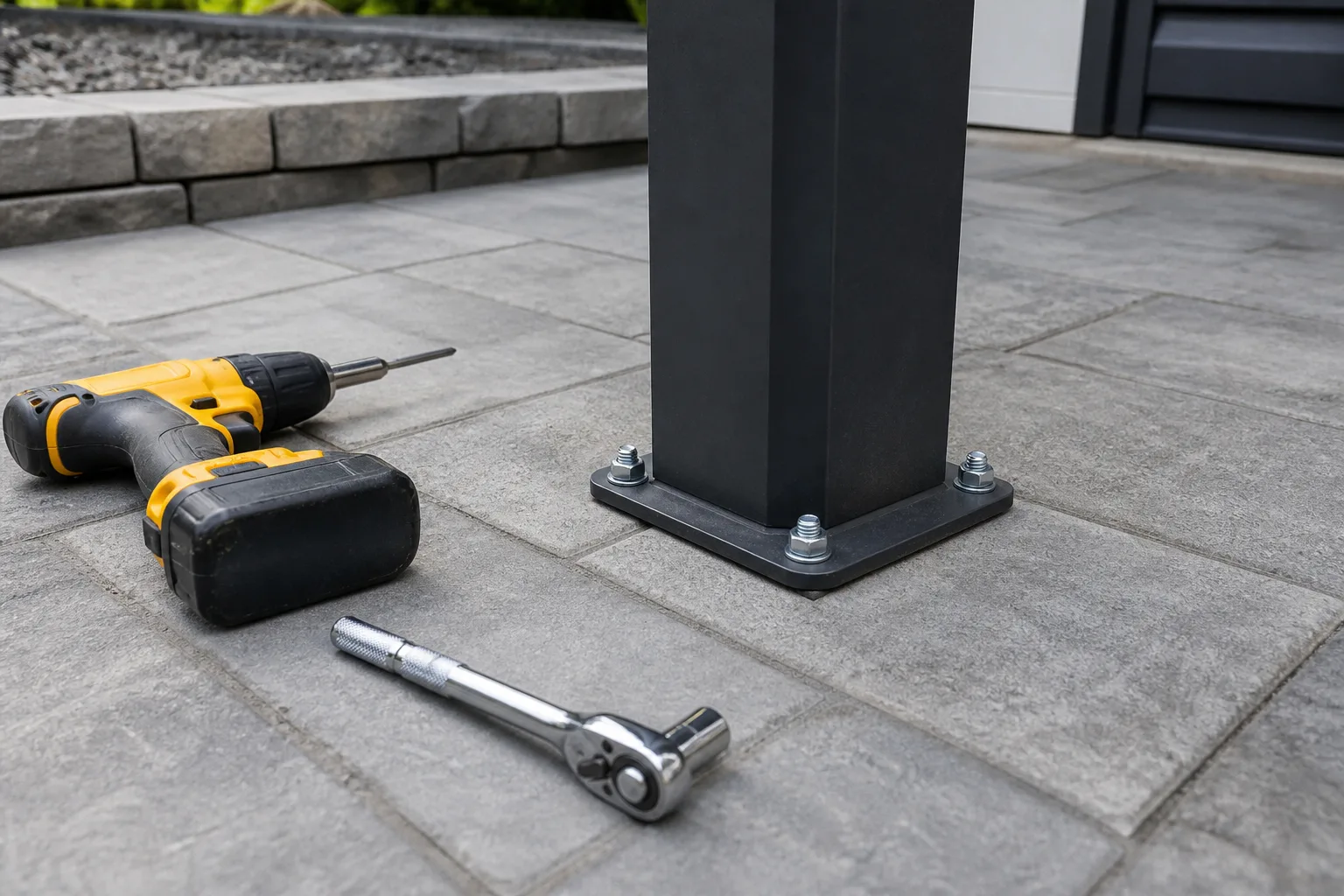
A small arbor is still tall and narrow enough to sway or tip if it is not secured appropriately. The correct footing depends on the soil, climate, frame dimensions, wind exposure, surface below, and the weight the structure will carry.
Follow the kit’s installation instructions; do not replace specified anchors or connectors with whatever happens to be in the shed. If you cannot determine how the frame is meant to resist movement, ask the manufacturer before adding a heavy plant or overhead cover.
A freestanding frame is often simpler to plan because its posts can be positioned independently of a house or fence. Attaching one to a fence does not automatically make it stable: many fences are built to mark a boundary, not take the added forces from a tall, vine-covered frame.
A house attachment raises questions about framing, waterproofing, and load transfer. Do not fasten through siding by guesswork; use a tested detail or consult a qualified builder when the connection is structural.
Before digging, check what lies underground and arrange utility locating through the local service. Confirm property setbacks, easements, and any local permit or HOA rules before buying a kit, especially if the structure will be large, covered, or attached. Requirements vary by location, and a small label on a box does not establish an exemption.
Choose between a kit, custom build, and another structure
A kit makes sense when its dimensions fit your site, its instructions match your surface, and its stated plant or cover limits match your plan. Compare the clear opening, outside footprint, assembled height, anchoring hardware, material, and replacement parts. Read the instructions before purchase; some kits assume soil, while others require a solid base and specified anchors.
A custom build can solve an awkward slope, unusual path width, or specific style, but it transfers more responsibility to you or the builder. The load depends on more than the posts: connections, overhead members, footings, soil, wind, snow, and future plant growth all matter. If the structure will support a vigorous woody vine, sit above a heavily used walk, attach to a building, or carry a cover, use plans appropriate to that purpose and local conditions rather than improvising from a decorative kit.
Sometimes a trellis or freestanding plant support is the better answer. If your only goal is to grow a vine against a wall, a properly installed wall trellis may take less space and avoid a walk-through opening.
If the goal is a narrow arch over a gate, a light arch with a restrained plant can work well. If you want a sheltered gathering spot, compare a pergola or gazebo; an arbor cannot become a room simply by adding a bench.
Maintain the arbor as plants mature
Inspect the structure at least seasonally and after a strong storm. Look at the feet, fasteners, joints, and top members for looseness, rust, rot, splits, movement, or a change in lean.
A frame that has started to shift should not carry more vine growth until you know why it moved. Address a failing connector or post early rather than waiting for the overhead section to become difficult to reach.
Prune with the structure in mind. Keep the passage open, move thorny stems away from face level, and avoid letting shoots block a latch or rub against a roof or gutter.
Train growth along the sides before allowing it across the top, and remove dead, tangled, or damaged material so the frame remains visible for inspection. The RHS notes that overgrown climbers on pergolas may need renovation and that some plants need support wires and ties; a smaller arbor benefits from the same habit of guiding growth instead of letting it accumulate unchecked.
A plant may eventually outgrow the structure even if it was a good choice when young. If the arbor bows or loosens, reduce the vine load only if you can do so safely, stop adding new growth, and follow the maker’s guidance or consult a professional about repair.
Never stand beneath a visibly unstable structure to prune it. Sometimes the soundest long-term choice is to remove a vigorous plant and replace it with a smaller climber that suits the frame.
Avoid the mistakes that make an arbor disappoint
The first common mistake is buying by photograph instead of by measurement. A product can look generous in a wide garden image but have a narrow passage once the posts, brackets, and mature foliage are included. Mark its footprint on the ground, check the walkway with the gear you use, and compare both the inside opening and the outside dimensions.
The second is expecting an open framework to provide a full roof, strong privacy, or instant shade. Those results depend on the chosen form and how plants mature, and they may change between seasons. If your main need is rain cover or dependable shade, choose a structure designed for that job rather than trying to convert a light arch later.
The third is choosing a climber for its flowers without considering how it grows. A heavy, vigorous vine on a lightweight arch can become a maintenance and stability problem; a tendril plant on a thick bare post may never attach well. Check the plant’s growth habit and mature size, the support requirements, local suitability, and the frame’s documented capacity before planting.
Finally, do not let an attractive finish distract from the base and connections. A garden structure needs to remain stable after the plant adds foliage and wind resistance, and site work may involve utilities, boundaries, or local rules. Confirm those details before digging or fastening anything to a fence or house.
Conclusion
An arbor is most useful as a garden threshold, short walk-through, vine support, framed view, or small sheltered pause. It shares features with arches, trellises, and pergolas, but the practical distinction is usually scale and purpose: an arbor marks a passage or compact spot, while a pergola covers a longer route or larger outdoor area. A gazebo offers a more substantial roofed place to sit.
Before choosing one, measure the passage and the full footprint, decide what must pass underneath, and match the plant’s mature growth to the frame’s actual strength. Check shade at the time of day you will use it, follow the anchoring instructions, and plan for pruning and inspection. With those decisions made first, the arbor can shape the garden for years instead of becoming a cramped, overgrown arch you have to work around.