How to Stake Indoor Plants Safely Without Damaging Stems
Learn how to stake indoor plants with a cane, cage, hoop, trellis, or moss pole, and install it without constricting stems or injuring established roots.

Staking a houseplant gives a leaning or top-heavy stem a stable point to rest against, but the right support depends on why the plant is leaning and how it grows. A bamboo cane can steady one tall stem; a trellis spreads out a vine; a moss pole gives a climbing plant a textured surface to meet aerial roots.
Start by checking the plant, not shopping for a pole. A stake can prevent a healthy stem from flopping or snapping, but it will not correct weak light, root trouble, or a pot that is too unstable to carry the plant’s weight.
Diagnose why the plant is leaning before adding a stake
A plant that tips after putting on a large leaf or flower may simply need mechanical support. A stem that has always grown at an angle toward a window may be reaching for light, while a plant that suddenly slumps with soft, yellowing leaves may have wet or damaged roots. Those problems call for different first steps.
Look at the newest growth and at the base of the plant. Long gaps between new leaves, smaller new leaves, and a pronounced lean toward the brightest window suggest a light issue; the University of Georgia Cooperative Extension lists long internodes and smaller new leaves among signs that an indoor plant needs more light (UGA Cooperative Extension). If the potting mix is soggy, the base is soft, or the root ball shifts in the pot, check drainage and roots before adding weight overhead.
Support is appropriate when the stem is healthy but cannot hold its own shape, when a heavy flower stalk bows, or when a climbing plant needs a route upward. It is also useful when you want to keep a vine away from a walkway or guide it across a compact trellis. If you correct light or moisture first, wait for the plant to stabilize before forcing a permanent new shape.
Match the support to the plant’s growth habit
Choose the structure for the job, not for the word “stake” on its label. University sources list bamboo stakes, moss sticks, trellises, and sphagnum-covered boards as options for Monstera; each works because it offers a stable surface, but only a moss-covered support creates a damp, textured place where aerial roots may attach (Penn State Extension; Wisconsin Horticulture, University of Wisconsin–Madison).
| Plant or problem | Start with | Why it fits | Main trade-off |
|---|---|---|---|
| One upright stem that bows | Single cane or smooth stake | Supports the stem at one or more points | The stake must be anchored without piercing the main root mass |
| Several stems splaying outward | Three stakes with a loose twine ring, or a plant cage | Holds the outer canopy without tying every stem upright | A cage can be awkward to remove once stems weave through it |
| Light vine you want to display in a shape | Wire hoop or small trellis | Gives several places to guide flexible growth | It trains the route; it does not make a weak pot stable |
| A climbing aroid with aerial roots | Moss pole, board, or firm trellis | Gives the main stem a vertical path; damp moss can invite root contact | Moss needs checking; a dry pole still supports physically but may not root in |
| Orchid flower spike | Thin stake with a soft clip | Supports the spike without bending the whole plant | Reposition clips as the spike lengthens |
Think about the result as well as the plant. A trailing pothos can remain in a hanging basket; choose a trellis to guide a vine across a plane or a pole to train a climber upward.
A cane props a single upright stem
Use a cane when one stem is tall, top-heavy, or temporarily weak but does not need a climbing surface. Bamboo, a smooth hardwood dowel, or a coated metal plant stake can work if it is rigid enough for the plant and has no sharp edges. The best stake is often the simplest one that carries the load without changing how the plant grows.
A straight support suits a cane-form plant such as a young dracaena, a tall flowering stem, or a plant whose crown leans after new growth. It is also a temporary prop for a climbing plant while you decide whether a trellis or pole is worth maintaining. If the stem already stands upright, do not add a stake just because one came in the nursery pot.
Frames and poles support a different shape
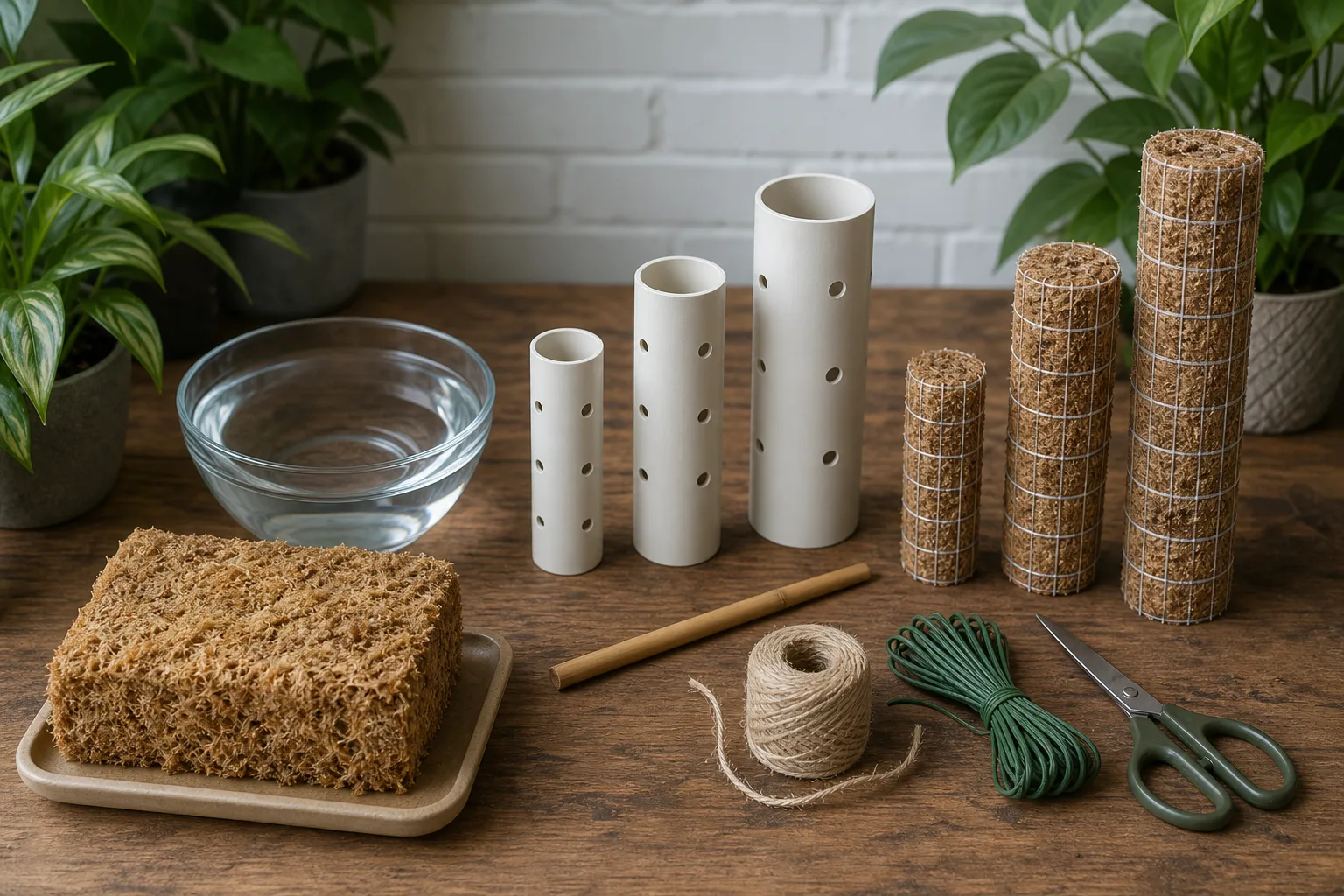
Use a hoop or trellis when the vine should curve or spread, and use a cage or ring system when several stems need shared support from the outside. Use a moss or coir pole when a climber should travel vertically; the pole itself is the structural part, while a moist, textured moss surface is an optional attachment surface for aerial roots. In other words, structural support and root attachment are related but not identical benefits.
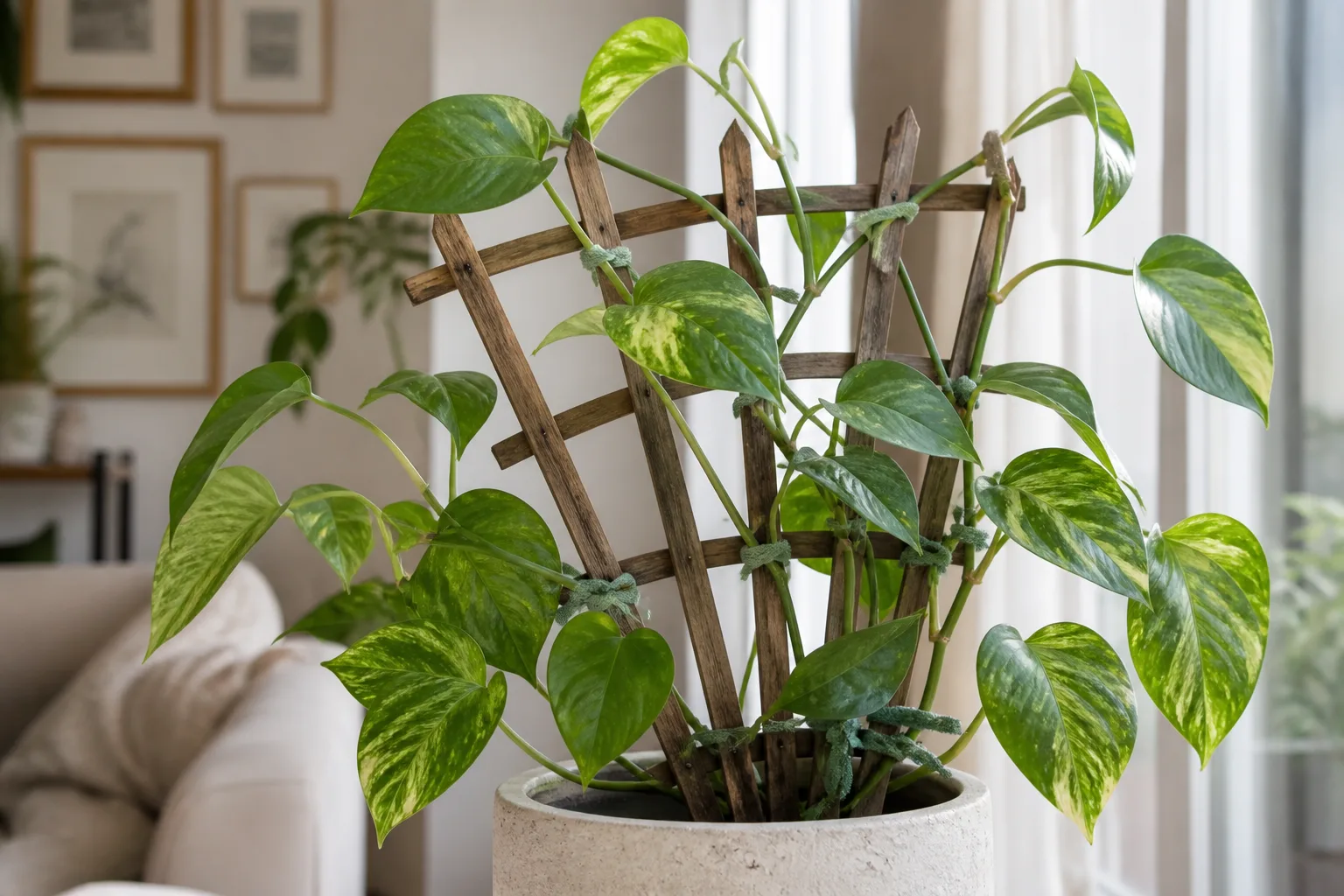
A trellis stays comparatively low maintenance because it does not need watering, but the vine usually remains attached with ties. A sphagnum pole takes more upkeep because the moss can dry; the RHS advises that climbers need suitable initial support and careful tying-in, and it warns that tight or metallic ties can cut into stems as they thicken (RHS guidance on tying in climbers). Choose the moss pole only if you are willing to check the moss and keep the support stable as the plant gains height.
Choose plant-safe materials and ties
Use clean supports with smooth surfaces and a base wide or long enough to hold in the potting mix. A stake can be bamboo, a purpose-made coated metal rod, or a sound wooden dowel; a hoop can be vinyl-coated wire intended for plant use; a trellis can be bamboo, coated metal, or another rigid material that will not splinter. Wash and dry a reused support before it goes into a different pot, especially if the previous plant had pests or a disease problem.
Avoid thin bare wire against stems, sharp cut ends, brittle plastic that can snap, rusty metal, and scrap wood with an unknown coating. A material used in the root zone should not flake or shed residue when wet. If you bend your own wire support, smooth the ends and keep them away from the stem; cut wire can scratch hands, roots, and leaves while you install it.
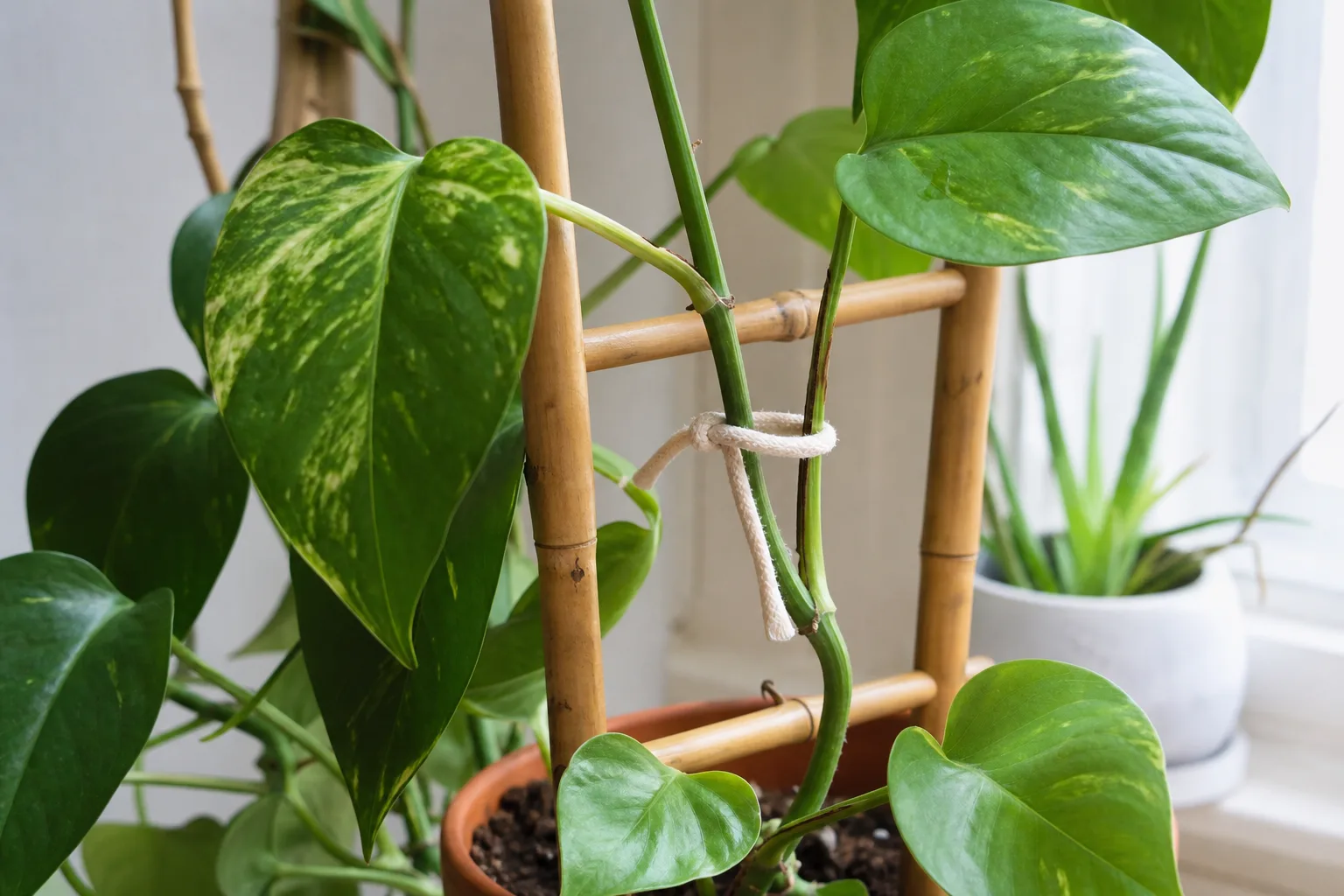
For ties, choose soft plant tape, reusable hook-and-loop garden ties, wide fabric strips, or soft garden twine. The RHS specifically recommends ties long enough to leave room for the stem to thicken and advises against wire or metal ties because they can constrict a growing stem. Avoid fishing line, twist ties with a sharp metal core, zip ties, and narrow string pulled taut: they can cut into the plant before you notice the damage.
Pick the timing before roots and stems are trapped
The easiest time to set a permanent pole or trellis is while repotting, before the root ball is back in the container. Put the support in first, hold it where it will sit, add mix around its base, then position the plant so its main stem faces the support. This makes it easier to give the support a deep anchor without pushing it through established roots.
You do not have to repot a healthy plant just to add a small cane. If the mix is loose and you can see a clear route near the inside edge of the pot, lower the stake slowly and stop if you meet firm resistance. Never hammer, twist, or force a support down through roots; use a lighter external frame, wait for the next repot, or choose a surface-mounted trellis if there is no safe path.
Install early enough that the stem is still flexible, but do not bend it into a new position in one session just because the support is ready. Young growth is easier to guide than a stiff, mature stem, yet the plant should still set the direction. If the stem has been leaning for months, support it where it naturally rests and adjust the angle gradually as new growth appears.
How to stake one tall stem step by step
First identify the section of stem that needs support and where the plant is balanced in the pot. Choose a stake that reaches from deep in the mix to a point above the part that bows; for most plants, the supported stem should extend beyond the highest tie, not hang over it like a lever. Avoid a stake so tall that the pot becomes a sail or the support overwhelms a small plant.
Set the stake beside the stem, toward the back or less visible side, and lower it into the mix slowly. If it stops against a solid root, pull it back and try a small shift toward the pot wall rather than pushing harder. Once anchored, hold the pot and nudge the stake gently; slight flex is normal, but rocking at the soil line means the base is not stable enough yet.
Bring the stem to the support without pulling the plant upright by force. Place one loose tie below the bend and another above it if the stem needs two points of control; add more only if a long section still swings. The RHS suggests placing the tie just above a leaf or side shoot so it does not slide down a vertical support, and a figure-eight loop creates a buffer between a heavier stem and its support (RHS tie-in guide).
How to steady a top-heavy or multi-stem plant
A plant that leans as a whole may need a different fix from a single bowed stem. If the root ball is loose or the pot is very small, a stake may keep one stem straight while the container still tips; use a wider, heavier pot at the next appropriate repot, or place the nursery pot inside a stable cachepot that can be emptied after watering. Keep drainage holes clear and do not pack stones around the roots to add weight.
For several stems that fan outward, use a small cage or a three-stake frame with a loose circle of twine around its outside. Set the supports around the root ball rather than through its center, then let the foliage rest against the frame so each branch can keep a natural curve. The cage should contain the canopy, not compress it into a bundle.
A ring, a few stakes with twine, or a plant cage can support multi-stem growth; choose a frame you can remove without dragging mature stems through it. If the plant has a heavy crown and a shallow pot, solve pot stability at the same time as stem support.
How to train a vine on a hoop or trellis
A trellis or hoop gives a flexible vine a route, not a rigid shape it must follow. Position the frame first, then guide one healthy stem at a time in a broad curve; do not wrap brittle stems tightly around a hoop or cross several vines into a knot. For a wire loop with two legs, keep the support smooth and put the legs near the pot edge so you avoid the densest roots.
On a flat trellis, spread the stems instead of fastening every leaf stalk. Leave the leaves free to turn toward light and tie the stem to a rung or side rail where it will not slip. A low, compact plant may need only a few ties; a longer vine may need several points so a heavy section does not pull away from the frame.
Revisit the direction as the plant grows. If new growth is heading away from the frame, redirect only the flexible tip or add a new tie point rather than tightening old ties until the stem is forced flat. Epic Gardening’s 2025 overview likewise distinguishes a broad trellis from a moss pole and a simple bamboo stick, emphasizing that support choice should follow the growth form (Epic Gardening’s support guide).
How to attach a climber to a moss or coir pole
A moss pole suits a climbing plant whose stem produces aerial roots and whose owner wants those roots to contact a textured surface. Penn State Extension lists moss sticks, trellises, bamboo stakes, and sphagnum-covered boards as suitable Monstera supports; Wisconsin Horticulture recommends a firm moss-covered support for the climbing plant and notes that aerial roots can attach when the surface stays moist (Penn State Extension; University of Wisconsin–Madison Extension). A plain stake can still carry the plant’s weight, but it will not provide the same moist rooting surface.
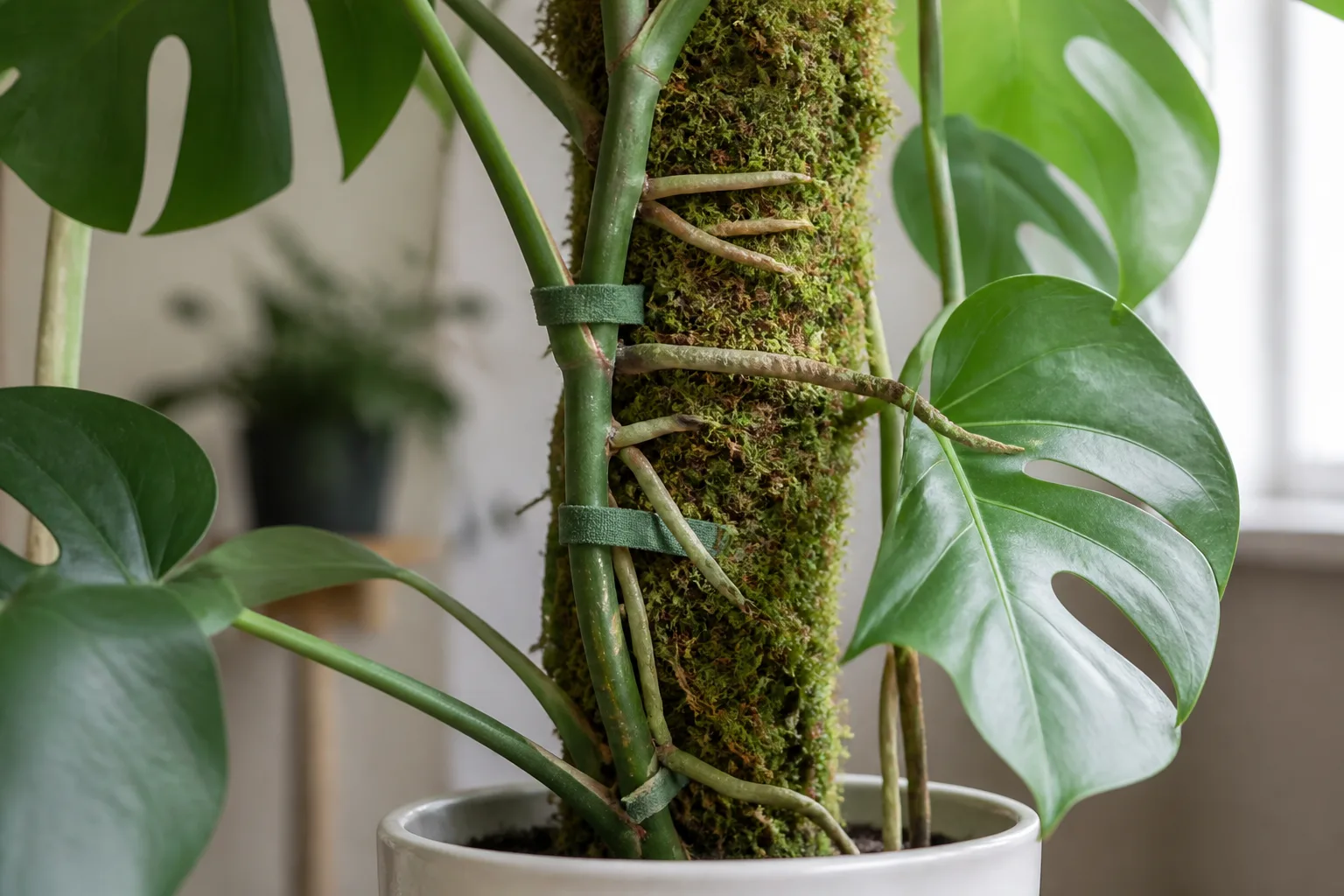
Put the pole behind the main stem, on the side where the nodes and aerial roots can reach it. Tie the stem loosely near a node; do not tie the leaf petiole, which is the stalk between the stem and leaf blade. Guide a nearby aerial root gently toward the moss, but do not snap it, staple it, bury it in a tight wrap, or force it to attach.
Keep sphagnum moss lightly and evenly damp if you want roots to explore it, checking the pole itself rather than watering the pot whenever the moss dries. A moss pole that is dry can still give physical support, but the roots may not anchor into it; a pole kept soggy can add moisture to an already wet pot. Coir is durable and textured but generally gives roots less moisture to find than sphagnum. Gardening Know How describes the same practical distinction: the moss surface needs periodic moisture and the vine should be secured loosely while it establishes (Gardening Know How’s moss-pole guide).
Place the support and keep the pot stable
Think of the whole setup as a lever. A tall support and a heavy, wide canopy create more tipping force above a small, light pot, so the support itself must be secure and the container must be broad or heavy enough for the plant. If the plant rocks when nudged, shorten the support, move it closer to the stem, use a more stable outer pot, or wait until repotting so the base can be anchored properly.
Place a stake near the rim only if the stem’s position and root ball allow it. A stake too far from the stem can pull it sideways, while a center stake can pass through dense roots; test the base before tying the plant to it.
For a wall trellis, keep the frame away from heat vents, doorways, and places where the pot can be bumped. Leave space to reach behind the plant to water, inspect pests, and loosen ties. If you rent or do not want holes in the wall, use a freestanding trellis that is anchored by the pot rather than adhesive clips that may fail under a heavy vine.
Tie the stem without squeezing it
Tie the main stem or the appropriate supporting cane, not the leaf petiole. A petiole needs to move so the leaf can face available light; pinning it to a pole can make the leaf twist or sit at an unnatural angle. On a climbing aroid, tie the vine’s stem near a node and leave the aerial roots and leaf stalks clear.
Make a loose loop with a little space for growth. The plant should touch the support without being clamped against it, and the tie should not leave an indentation when you slide a finger under it. For a heavier stem, a figure-eight tie separates the plant from the stake and reduces rubbing; for a light, flexible stem, a simple soft loop may be enough. The RHS recommends regular checks and loosening ties that have become tight.
Avoid fastening the tender growing tip. Place the tie on firm stem tissue, just above a leaf joint or side shoot so it cannot slip; if a loop will not stay loose, use a wider tie rather than a tighter knot.
Check and adjust the support as the plant grows
A stake is a small maintenance task, not a one-time installation. Check it whenever you water or groom the plant: look for a loose base, a tie that is digging in, a stem rubbing against an edge, or a new shoot that has grown beyond the supported area. Untie and refasten rather than adding a second tight tie over an old one.
During active growth, new leaves and stems may change the plant’s balance. Add a tie only where the new section needs guidance; do not bind every internode to the pole or cage. If an aerial root has attached, you can loosen the nearby tie gradually, but leave support in place if the stem still swings or the root has not anchored securely.
Review the setup when repotting, when the plant is moved to a brighter or darker spot, and when a support is extended. A pole extension should connect securely to the original support and should not turn a small container into a tall, tippy tower. If the plant outgrows the pot or structure, prune or shorten growth, choose a heavier pot when appropriate, or replace the support at repotting instead of stacking unstable pieces.
What to do if a stem has already bent or broken
A stem that is bent is not always broken. If the tissue is still connected, leaves remain firm, and the bend is not crushed, support the stem in the position it naturally wants to rest; do not pull it straight in one hard motion. A loose splint can reduce further movement while the plant continues growing, but a severe crease may remain visible even if the top survives.
Support a bent but intact stem
Place a straight splint beside the bent section, then attach it above and below the kink with two soft ties. The splint should prevent the stem from folding further, not force it into a perfectly upright position; leave the damaged spot visible so you can check for darkening, softness, or worsening collapse. If it is a vine, the healthy upper section may be rooted later if the kink fails, provided it has viable nodes.
Do not tape a wet wound closed or wrap the full stem tightly. Keep the plant in stable light and water according to its normal soil needs while you watch the damage; adding extra water or fertilizer will not knit a crushed stem back together. If the bend is minor and growth continues above it, let the support do the least possible work.
Handle a fully split stem as a cutting or pruning job
A fully severed stem is unlikely to become a reliable structural connection simply because you tape it to a stake. For a node-bearing vine such as pothos or many philodendrons, make a clean cut through ragged tissue and decide whether the top section is worth propagating; keep the rooted lower portion supported while it produces replacement growth. For a plant with a single crown or unusual cane, identify where new growth can emerge before cutting, because not every species branches in the same way.
Remove the support only if doing so will not pull on the remaining stem or roots. If a heavy top has already fallen, check for a cracked pot, loosened root ball, or a support that was never anchored deeply enough. Fix the cause before reattaching healthy stems, and discard soft, rotting tissue rather than burying it under ties.
When staking will not solve the underlying problem
Staking changes the plant’s position, not the conditions that produced weak growth. If new stems are unusually long between leaves, the plant is stretching toward light; improve the light gradually and rotate the pot, then support the stem only if it still needs help. The UGA Cooperative Extension’s indoor-plant guidance treats elongated internodes and smaller new leaves as warning signs of inadequate light, so a stake alone would hide the symptom while leaving the cause unchanged.
A persistently wet mix, sour smell, soft stem base, or loose root ball points to a root-zone problem. Check drainage and roots before adding a tall, heavy support, because the extra leverage can make an unstable plant tip or pull loose from the pot. If the root system is failing, a stake may hold foliage in place for a few days but it cannot restore damaged roots.
Do not stake a plant simply because it is a climber. Pothos, philodendron, and Monstera can be grown trailing or trained upward; a hanging basket is a valid choice if that is the look you want. Likewise, a compact plant that stands well needs no support, and an unhealthy or recently stressed specimen is better served by correcting its care before you reshape it.
Common support mistakes to avoid
The most common mistake is pushing a stake straight down as if every pot were empty. Established roots can fill the container, and a sharp stake driven blindly into the center can cut them; install during repotting or move slowly around the edge and stop at resistance. If the support cannot be inserted safely, use an external frame or wait rather than forcing the issue.
Another mistake is tying a petiole or leaf to a stake. That might make the plant look upright in the moment, but it restrains the part that needs to orient the leaf and can damage the joint. Tie a stem to a support, leave the petioles free, and check the loop as the stem thickens.
Finally, do not expect a narrow stake to stabilize a lightweight pot, or a dry coir pole to behave like a moist sphagnum pole. The container, root ball, stem, and support work as one system; if the pot tips or the support wobbles, improve the base instead of tightening the plant ties. Support should guide healthy growth, not conceal a setup that is still unstable.
Conclusion
The safest way to stake indoor plants is to diagnose the lean first, match the support to the plant’s growth habit, and install it without forcing roots or stems. Use a cane for one upright stem, a frame for several stems or a shaped vine, and a moss pole only when a climbing plant and your maintenance routine make its moist surface useful.
Set the support while repotting whenever you can, tie the stem loosely with soft material, keep leaf petioles free, and check the setup as new growth changes the balance. If the plant is leaning because of weak light, wet roots, or a tipping pot, correct that cause before relying on a stake.



