How to Prune Hibiscus the Right Way
Learn how to prune hibiscus by type: when to cut tropical, hardy, swamp, and Rose of Sharon hibiscus, where to cut, and how to avoid lost blooms.
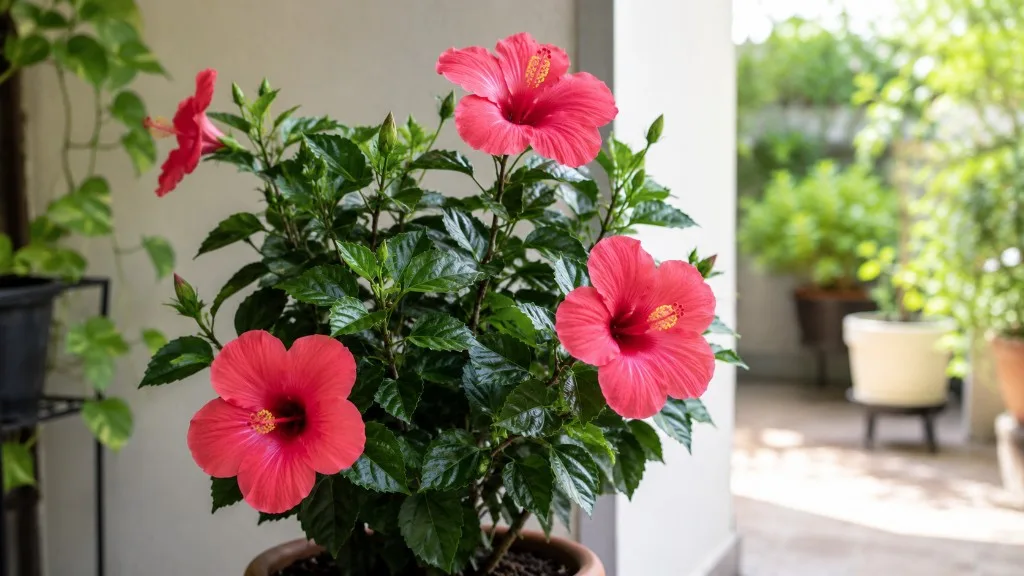
The right way to prune hibiscus starts with one question: which hibiscus do you have? A tropical Chinese hibiscus in a patio pot needs selective spring shaping, while hardy rose mallow can lose its entire top growth in winter and be cut back close to the ground. Rose of Sharon is a woody shrub with a different structure again.
Use this quick guide before you pick up your shears:
| Hibiscus type | Main pruning window | What to do |
|---|---|---|
| Tropical or Chinese hibiscus (Hibiscus rosa-sinensis) | Late winter or spring, after cold risk has passed | Remove dead wood, then shorten selected live stems by about one-third |
| Hardy hibiscus or rose mallow (H. moscheutos hybrids) | Late winter or early spring; fall cleanup is also possible after dieback | Remove old dead canes to about 3–6 inches, or leave taller stems for stem-nesting bees |
| Swamp hibiscus (H. coccineus and related rosemallows) | After full dormancy or just before spring growth | Remove dead top growth; pinch young shoots only if you need a fuller plant |
| Rose of Sharon (H. syriacus) | Late winter or early spring for structure and size | Thin and shorten selectively; do not treat it like a root-crown perennial |
Pruning can increase branching and create more places for future flower buds, but it is not a way to force instant flowers. Every live stem you shorten loses some current buds, and a severe cut can delay the first bloom flush while the plant rebuilds its canopy.
Start by Identifying Your Hibiscus Type
“Hibiscus” is a large group rather than one pruning profile. Clemson Cooperative Extension lists tropical Chinese hibiscus, perennial rose mallow, scarlet rose mallow, cotton rose mallow, swamp rose mallow, and Rose of Sharon as distinct plants with different winter behavior and pruning needs (Clemson Cooperative Extension). If a plant label is vague, use its leaves, stems, and winter habit as clues, then confirm the cultivar before making a hard cut.

Tropical or Chinese Hibiscus
Tropical hibiscus usually has glossy, dark green leaves and flexible woody stems. The flowers may be single or double and can be red, pink, yellow, orange, salmon, peach, or bicolored. Hibiscus rosa-sinensis stays evergreen in frost-free climates but is cold-sensitive; Clemson recommends bringing it inside when nighttime temperatures fall into the lower 50s °F if it is being overwintered as a container plant.
Tropical hibiscus is the type most likely to need a true shaping prune. It blooms on new growth, so spring cuts can stimulate side branches, but the plant still needs enough healthy leaves and warm, bright conditions to respond well. If yours spent winter indoors in low light, correct the light and watering first, then prune once it begins active growth rather than cutting a severely stressed plant on a calendar date.
Hardy Rose Mallow and Swamp Hibiscus
Hardy hibiscus and swamp hibiscus are generally deciduous or herbaceous perennials. Their stems may look substantial in summer, but the top growth can die back completely after frost while the crown remains alive underground. NC State Extension describes rose mallow as a wet-soil-tolerant perennial that resprouts from the root system and flowers on new growth (NC State Extension Plant Toolbox).
That dieback changes the job. You are not shortening a living evergreen canopy by one-third; you are removing dead canes so new shoots have room to emerge. The plant can be cut to short stubs after dormancy, but leaving some hollow stems through winter supports stem-nesting bees. NC State recommends leaving dead stems 12–24 inches tall when possible, then cutting them later and keeping the cut stems in a quiet garden spot.
Woody Rose of Sharon
Rose of Sharon is a woody deciduous shrub, not the same thing as a hardy dinner-plate hibiscus that disappears to the soil line. It develops a permanent framework of branches and can be grown as a multi-stem shrub or trained with a single trunk. Clemson places Hibiscus syriacus in USDA Zones 5–9 and notes that some cultivars can produce seedlings from seed capsules.
Use thinning and selective shortening to preserve its structure. If your goal is fewer seedlings, remove spent flowers before capsules mature; if your goal is size control, work in late winter or early spring while the branch structure is visible. A Rose of Sharon that needs major renovation deserves staged cuts over more than one season rather than a one-day shearing job.
Choose the Timing by Type and Climate
For a healthy tropical hibiscus, the safest major pruning window is late winter or spring after the danger of damaging cold has passed and before the main growth flush. New wounds and tender regrowth are more vulnerable to cold, so a warm calendar month is less important than your actual last-frost pattern and nighttime temperatures.
Fall is more complicated. A potted tropical hibiscus can receive a light trim before it moves indoors if the plant has outgrown its space, but heavy fall pruning removes leaves just as indoor light declines and can trigger weak, stretched regrowth. Make the major shape cuts in late winter unless you need a modest size reduction to move or store the plant.
Hardy and swamp hibiscus can be cleaned up in late fall after the foliage has yellowed and the stems are clearly dormant or in late winter before vigorous new shoots emerge. If you do not yet know whether the crown is dormant or dead, wait: hardy hibiscus is often late to appear in spring. Almanac likewise describes hardy hibiscus as a plant that dies to the ground in winter and regrows in spring, while tropical Chinese hibiscus needs container protection in cold climates (The Old Farmer’s Almanac).
Inspect Plant Health Before You Make a Cut
Walk around the plant and decide what problem the pruning is meant to solve. A tropical hibiscus that is healthy but lopsided needs selective shaping; a plant with brittle stems, cold injury, or dieback needs cleanup; a plant with long, pale growth may need more light before it needs more cutting.
Start with the three Ds: dead, damaged, and diseased. Then mark branches that cross, rub, point into the center, or extend far beyond the plant’s intended outline. Do not remove healthy interior branches simply because the shrub looks dense from one angle. Hibiscus needs leaves to power recovery, and over-opening the canopy can expose the remaining stems to heat and sun stress.
Check the root zone too. If the soil is bone-dry, the plant is wilted, or the pot stays waterlogged, postpone major shaping until moisture is stable. Pruning is a stress, not a substitute for correcting poor drainage, weak light, cold exposure, root problems, or a pest outbreak.
Prepare Pruners and Make a Simple Plan
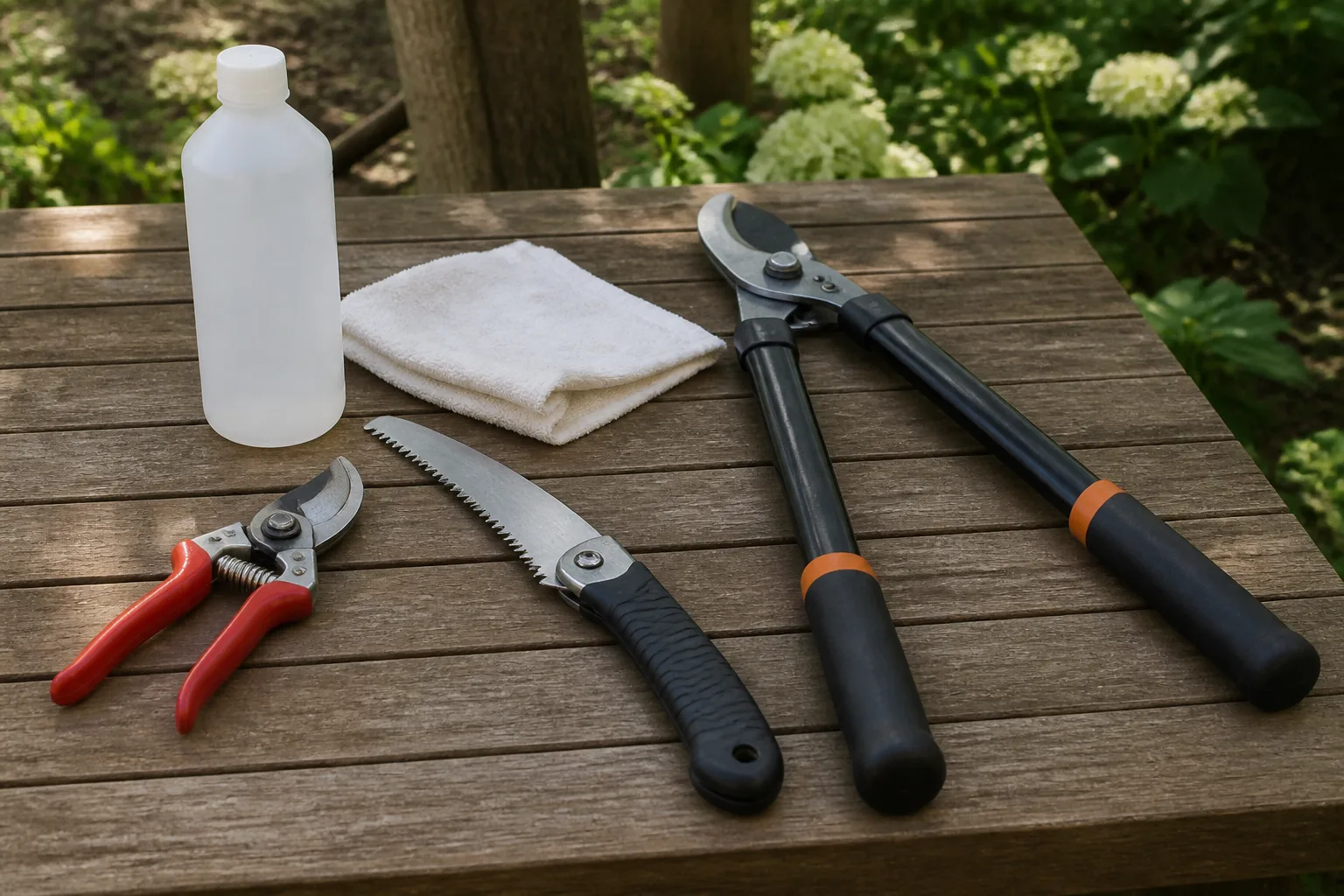
Use sharp bypass pruners for pencil-thin stems, loppers for branches too thick for a clean hand-pruner cut, and a pruning saw for anything that would be crushed or torn. Most container tropical hibiscus can be handled with hand pruners; hardy plants with dead, woody canes may be easier to clean with loppers.
Clean sap, soil, and plant debris from the blades before disinfecting them. UF/IFAS explains that cleaning and disinfecting are separate steps because organic residue reduces disinfectant effectiveness; a 70%–100% alcohol wipe or dip is an immediate option for smooth blades (UF/IFAS Gardening Solutions). Alcohol is flammable, so keep it away from heat and let the blade dry before cutting.
Before the first cut, choose your target shape and a stopping point. For an established tropical plant, a conservative plan is to remove the three Ds and crossing stems, then shorten only the longest or most awkward live branches. You can always make a second pass; you cannot put a cut stem back.
Remove Dead, Damaged, or Diseased Wood First
Make the first cut on a stem that is unmistakably dead, broken, or diseased—not on the tallest healthy branch. Dead wood is brittle and dry; living wood bends slightly and often has green tissue under the bark. On a questionable branch, lightly scratch a small area of bark with your fingernail. Green tissue suggests life, while brown, dry tissue indicates that you should continue checking farther down the stem.
Cut a dead stem back to healthy tissue or to its point of origin. For a broken branch, find the cleanest point below the split rather than leaving a ragged stub. On a woody branch, avoid cutting flush against the trunk or parent limb; preserve the slightly swollen branch collar where one branch joins another.
If a stem shows spreading lesions, soft rot, or suspicious dieback, cut below the affected section and disinfect the blade before touching another branch or plant. Clemson notes that hibiscus can suffer from leaf spots, blights, rust, and canker, and recommends cleaning up infected foliage and plant debris as part of disease management. Do not strip a stressed plant bare in an attempt to “prune out” a problem you have not identified.
Make the Correct Cut Above a Node
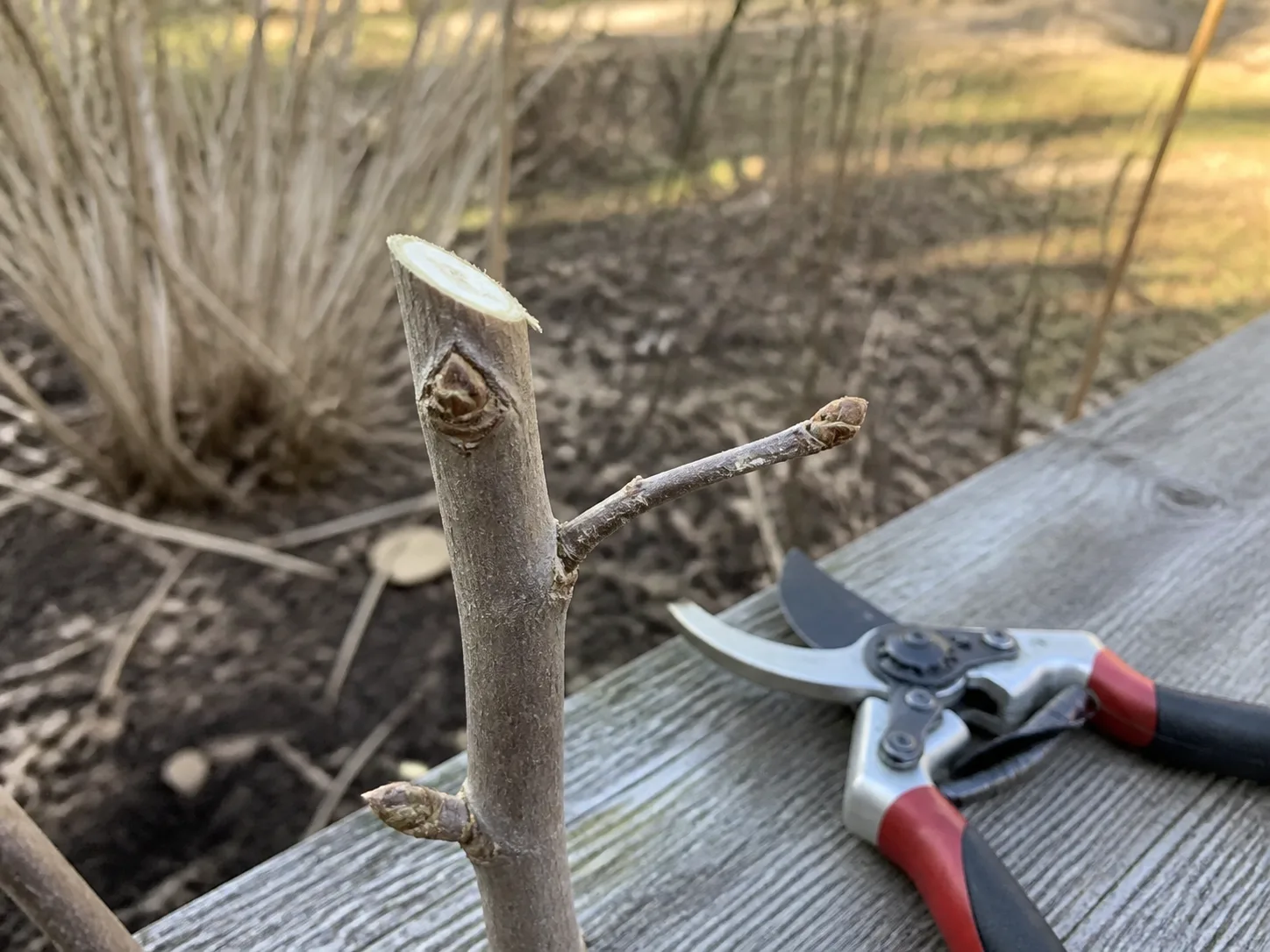
A node is the point where a leaf, bud, or side shoot joins the stem. On a bare stem it may look like a small bump or ring. For a live tropical stem, choose a healthy node that faces outward, then cut about 1/4 inch above it at roughly a 45-degree angle. The new shoot is more likely to grow into open space instead of straight into the center of the shrub.
Gardening Know How recommends using outward-facing nodes to keep growth open and adjusting the cut direction to influence the next branch (Gardening Know How). Do not make every cut toward the outside mechanically; if a branch is leaning out of bounds, an inward-facing node may help redirect it, but use that option sparingly so you do not build a crowded center.
Avoid two opposite errors: a long bare stub and a cut so close that the node is damaged. The final cut should leave a short, clean margin above the node. For large woody branches, cut just outside the branch collar rather than using a heading cut that leaves a thick, dead end.
Prune Tropical Hibiscus Step by Step
Tropical hibiscus usually responds best to selective shaping, not an automatic haircut. Clemson recommends cutting old wood back by about one-third in spring, and the same conservative depth is a useful starting point for an established, vigorous plant (Clemson’s Chinese hibiscus guidance).
- Remove dead and damaged stems. Work back to healthy tissue or the branch collar, then stop and reassess the plant.
- Thin conflicts. Remove one of two crossing or rubbing branches at its origin, choosing the branch with the better direction and stronger placement.
- Shorten the longest live stems. Find an outward-facing node roughly one-third of the way down each selected stem and cut just above it.
- Keep the canopy uneven in length. Do not cut every branch to the same height; slight variation creates a more natural framework and avoids a dense line of shoots.
- Pause before a second pass. Look from all sides and remove only the stems that still make the plant unbalanced or congested.
The first cut should not be “remove one-third of everything.” It should be the removal of the clearest dead or damaged stem. On the next pass, choose live cuts by direction and spacing. This preserves more leaves, limits bloom delay, and makes it easier to see whether the plant actually needs additional work.
Rejuvenate an Old, Leggy Tropical Plant Carefully
A neglected tropical hibiscus can sometimes tolerate a stronger spring reduction, but reserve that for a genuinely old, sparse plant with enough healthy roots and a long warm growing season ahead. Epic Gardening notes that tropical hibiscus can become leggy and that cutting back by about one-third usually encourages fuller growth; it also stresses that different types need different timing and treatment (Epic Gardening).
For a very leggy plant, remove one or two of the oldest, least productive branches at their base, then shorten the remaining long stems above outward-facing nodes. If more reduction is still needed, stage it over a second growth cycle. A severe cut can delay the first flowers for weeks or months because the plant must rebuild branches before it can carry a full set of buds.
Do not hard-prune a tropical hibiscus that is newly repotted, drought-stressed, severely pest-damaged, or being moved into a darker indoor location. Stabilize the growing conditions first. A smaller, healthy plant usually recovers more reliably than a dramatically reduced plant with weak roots and little light.
Cut Back Hardy Hibiscus and Swamp Hibiscus
Once hardy or swamp hibiscus has fully died back, cut the old canes to about 3–6 inches above the soil in late winter or early spring. Clemson gives that range for rose mallow and explains that perennial hibiscus freezes back and produces new growth from the crown. Cutting the old stems is mainly a cleanup and access job; the plant is not relying on those dead canes to carry next season’s flowers.
You can also clean up in fall after the foliage has yellowed and the stems are clearly dormant. Leaving the dead structure through winter has benefits, though. It protects visual interest, gives small wildlife cover, and provides hollow stems for stem-nesting bees. If pollinator habitat matters in your garden, leave 12–24-inch stems standing, then cut them during spring cleanup and place the cut sections somewhere dry and out of the way.
Do not dig up a hardy hibiscus because nothing is visible in early spring. NC State describes rose mallow as a plant that may be late to emerge, especially after a cold winter. Wait until your region is well into the growing season before deciding that a dormant crown has failed.
Prune Rose of Sharon Without Losing Next Year’s Flowers
Rose of Sharon needs a woody-shrub approach. In late winter or early spring, remove dead, broken, crossing, or inward-growing branches, then shorten a few long shoots above outward-facing buds. Keep the permanent framework and avoid cutting every branch to the same height, which creates a dense tuft of weak regrowth.
If the shrub is too large, use thinning cuts—removing selected branches at the base or back to a well-positioned side branch—instead of shearing the whole surface. This preserves light and air through the canopy and keeps the plant’s natural outline. For a badly neglected specimen, remove a portion of the oldest stems this year and continue the renovation next season.
Some Rose of Sharon cultivars produce seed capsules readily. Deadheading or removing spent flowers before capsules mature can reduce volunteer seedlings, but it is separate from structural pruning. If you prune while buds are swelling, expect fewer flowers; if size and structure are the priority, accept that trade and make the cuts before the spring growth flush.
Use Pinching and Deadheading for Gentle Control
Pinching is the lightest form of pruning. When new hardy-hibiscus shoots are about 6 inches tall, pinching the growing tip can encourage branching and a shorter, fuller plant. Epic Gardening describes the same principle for deciduous hibiscus and notes that pinching again around 12 inches can delay flowering if done too late; stop once buds begin forming.
For tropical hibiscus, pinch only the soft tips that are stretching beyond the shape you want. Tip pruning is useful on a young plant or a container specimen, but it should not replace better light. Long, pale internodes are a light problem first.
Deadheading removes a spent flower or seed-forming structure; it does not mean cutting an entire branch. Snip the flower stalk back to the first healthy leaf or bud when the plant is actively flowering. Clemson recommends removing old flowers before seedheads form and notes that pruning a perennial hibiscus back by one-third after a flush can encourage reblooming. Deadheading keeps the plant tidy and can reduce unwanted seedlings, but it is optional on a plant that drops its own flowers cleanly.
Train Hibiscus Into a Small Tree
A tropical hibiscus can be trained into a standard or small tree form, but it takes repeated selection rather than one dramatic cut. Start with a vigorous plant that has one straight main stem and enough height to support the canopy you want. If the plant is already weak or badly branched, keep it as a shrub.
Choose the trunk and remove competing lower shoots gradually. Once the trunk reaches the desired height, shorten the upper branches above outward-facing nodes so they branch into a rounded canopy. Keep two or three well-spaced shoots near the top, and remove new shoots that appear below the canopy while they are small.
Recheck the form every few weeks during active growth. Do not strip the trunk and top at once if the plant needs substantial leaf area to recover. A balanced tree form is a maintenance project, not proof that the plant should be cut harder each spring.
Care for Hibiscus After Pruning
Water the root zone deeply when the top layer of soil begins to dry, then allow excess water to drain. Tropical hibiscus in a hot container may need frequent checks, while a dormant hardy hibiscus needs far less attention. The goal is steady moisture during active growth, not a permanently soggy pot.
Return the plant to bright light appropriate for its type and shelter fresh tropical regrowth from cold nights. A hardy hibiscus can remain outdoors in its suitable climate, but a tropical container plant should not be put back outside until cold risk has passed; acclimate it to stronger light gradually if it spent winter indoors.
Wait for new growth before resuming regular fertilizer, and follow the product label rather than adding a strong dose to compensate for the cut. Clemson emphasizes that hibiscus flowering improves with sun, moisture, and fertile soil, while pruning alone cannot replace those conditions. Keep mulch around an outdoor plant’s root zone, but do not pile it against the stems.
Common Hibiscus Pruning Mistakes to Avoid
- Pruning by calendar alone: Frost and growth stage matter more than a fixed date.
- Treating every hibiscus as tropical: Hardy rose mallow may need only dead-cane removal, while tropical hibiscus needs live-branch shaping.
- Removing one-third from every stem automatically: The one-third guideline is a conservative starting point for healthy tropical growth, not a command to erase the canopy.
- Shearing a round shell: Flat-topped or tightly sheared hibiscus often responds with dense, poorly directed shoots.
- Cutting without a node: A stem cut at a random midpoint may die back farther than expected; choose a healthy bud or leaf node.
- Making flush cuts or leaving long stubs: Preserve branch collars on woody stems and leave a short margin above live nodes.
- Using dull or dirty blades: Crushing and pathogen transfer make recovery harder. Clean first, then disinfect when disease is suspected.
- Pruning stressed plants aggressively: Fix light, water, cold, root, or pest problems before committing to a major reduction.
- Fertilizing heavily immediately after a hard cut: New growth needs time and suitable conditions; excess fertilizer does not replace roots or leaves.
Troubleshoot Slow Recovery or Few Blooms
If a hardy hibiscus has not emerged, check the crown gently for firmness and wait longer before disturbing it. Late emergence is normal for many rose mallows, especially after a cold spring. Once shoots appear, full sun and steady moisture matter more than repeated tip cuts.
If a tropical hibiscus stays bare below a cut, look at the cut depth, temperature, and light. A branch cut below all viable nodes may need to regrow from lower wood; cold damage can kill back more tissue after pruning; and a dim indoor position can produce weak shoots. Scratch-test farther down the stem, remove only confirmed dead tissue, and give the plant bright light and stable moisture.
If the plant grows leaves but produces few flowers, do not immediately prune again. Check whether it receives enough direct light, whether the soil swings from bone-dry to saturated, and whether aphids, whiteflies, or mealybugs are clustered on new growth or buds. UF/IFAS recommends scouting those pests and cautions against using malathion on hibiscus (UF/IFAS hibiscus guidance).
Finally, separate a normal bloom delay from a failed recovery. A healthy plant often needs a full new branch flush after a hard cut before flowering returns. If stems continue to blacken, the root zone smells sour, or the plant declines despite suitable light and moisture, stop pruning and seek a local extension diagnosis; the underlying issue may be disease or root damage rather than canopy shape.
Conclusion
Pruning hibiscus well is less about cutting to a magic percentage than matching the cut to the plant’s identity and season. Identify tropical, hardy, swamp, or Rose of Sharon hibiscus first; make cleanup cuts on dead or damaged wood; then shorten healthy tropical stems above outward-facing nodes in late winter or spring.
Keep the reduction conservative on living tropical growth, allow hardy hibiscus to die back naturally, and leave some dormant stems when you want to support stem-nesting bees. Clean tools, stable moisture, bright light, and patience after pruning will do more for next season’s flowers than a harder haircut.