How to Grow and Care for Annabelle Hydrangea
Learn Annabelle hydrangea care with practical guidance on light, soil, watering, new-wood pruning, flop support, propagation, winter mulch, and bloom fixes.
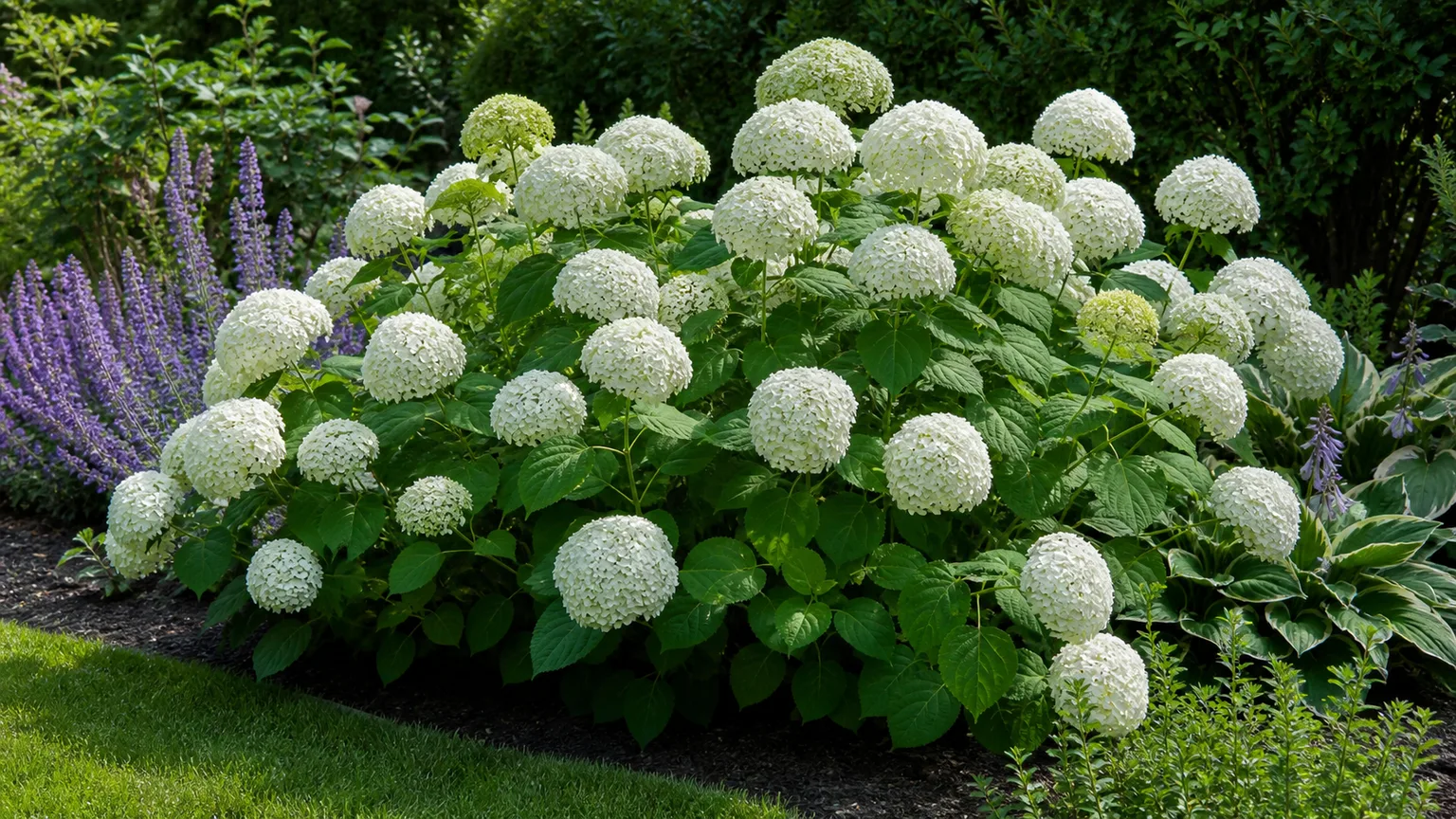
Annabelle (Hydrangea arborescens ‘Annabelle’) is the smooth hydrangea cultivar that turned a modest native shrub into a summer snowball. The rounded white heads can reach 8 to 12 inches across, bloom on new wood, and forgive late-winter pruning in a way bigleaf hydrangeas never will. That forgiveness is real — but it is not a license to ignore site, water, or stem strength. Annabelle’s biggest headache is not winter bud loss. It is flopping: oversized flower heads on fast, flexible stems after hard pruning, heat, or a dry spell.
If you want a reliable white hydrangea for a border, foundation, woodland edge, or rain garden, Annabelle still belongs on the short list. Match morning sun and steady root moisture to your climate, prune with a purpose instead of automatically cutting to the ground, and support the shrub before the heads open fully. Do that and you get the display people plant it for — without the face-plant after the first summer storm.
Is Annabelle Hydrangea Right for Your Yard?
Annabelle fits gardeners who want large white blooms without soil-pH games. Unlike bigleaf hydrangeas (H. macrophylla), smooth hydrangea flower color does not shift blue or pink with acidity. The heads stay white, then age green and tan. That makes Annabelle predictable in mixed beds where you cannot micromanage soil chemistry.
The shrub is cold-hardy and blooms on current-season growth, which solves the “winter killed my buds” problem that haunts old-wood types. Missouri Botanical Garden lists USDA zones 3 to 9, with a rounded habit typically 3 to 5 feet tall and 4 to 6 feet wide. NC State Extension notes tolerance for clay, wet soil, shallow rocky soil, erosion, and black walnut — a useful trait near juglone-sensitive plants.
Annabelle is a poor choice when you need a tight evergreen hedge, a dry-slope xeriscape plant, or a guaranteed upright shrub with zero support. NC State explicitly describes ‘Annabelle’ as having white flowers on weak, floppy stems that need staking or support. If you refuse to prune thoughtfully or add discreet support in a wet year, choose a sturdier smooth hydrangea cultivar such as Incrediball or plan for a more natural, relaxed shape.
Annabelle Hydrangea at a Glance
| Feature | What to expect |
|---|---|
| Botanical name | Hydrangea arborescens ‘Annabelle’ |
| Common names | Annabelle hydrangea, smooth hydrangea |
| Type | Deciduous flowering shrub |
| Mature size | 3–5 ft tall, 4–6 ft wide |
| Hardiness | USDA zones 3–9 |
| Bloom time | June through September, sometimes with fall repeat |
| Flower color | White, aging green then tan (not pH-dependent) |
| Sun | Part shade ideal; full sun only with consistent moisture |
| Soil | Moist, well-drained; adapts from clay to sandy loam |
| Pruning | Late winter or early spring; blooms on new wood |
| Wildlife | Pollinator-friendly; host for hydrangea sphinx moth |
| Pet safety | Toxic to dogs, cats, and horses (ASPCA) |
What Makes Annabelle Different From Other Hydrangeas
Smooth hydrangea is a native eastern U.S. shrub of moist wooded slopes, ravines, and streambanks. The species carries small fertile flowers in flattened clusters with only a few showy sterile florets at the margin. ‘Annabelle’ is different because breeders selected a plant with mostly sterile, snowball-like heads far larger than the species norm.
That flower form is the trade. Sterile heads are showy but heavy. They do not need pollination to persist, yet they still pull water on hot afternoons. Stems that grew quickly after a hard cut have not lignified enough to carry the weight. Panicle hydrangeas (H. paniculata) offer stiffer architecture and cone-shaped blooms. Bigleaf types offer color shifting but bloom on old wood in most cultivars. Annabelle sits in the middle: easy bloom timing, dramatic white heads, softer stems.
Where Annabelle Came From
‘Annabelle’ is a naturally occurring cultivar discovered near Anna, Illinois, and introduced widely in the 1960s after decades of regional appreciation. Illinois Extension traces its story from a wild find to one of the most planted hydrangeas in North America. Knowing the origin matters practically: this is not a tight Asian woodland species. It wants air, moisture, and room — closer to a native edge plant than a formal boxwood ball.
Choose Light, Soil, and Spacing That Match Your Climate
Site selection does more for Annabelle than any single fertilizer application. The Missouri Botanical Garden describes easy culture in average, medium-moisture, well-drained soils in part shade, with full sun tolerated only when moisture stays consistent. NC State recommends neutral to acidic, well-drained soils in partial shade, again allowing full sun with reliable water.
Morning Sun and Afternoon Shade
A dependable starting point is morning sun with afternoon protection, especially in the South and on west-facing walls. Cooler zones (roughly 3–5) can often provide more direct sun if the root zone stays evenly moist through summer. Deep shade produces leaves but fewer and smaller flower heads because the plant lacks the energy to build large corymbs.
Before you dig, watch the bed across a full day in growing season. Dappled shade under high deciduous trees can work if the canopy is not so dense that understory stays dim all afternoon. Reflected heat from pavement or light-colored siding counts as extra sun — plan for more water or a slight setback from the wall.
Soil prep: loosen a wide planting area, not just the hole. Mix compost into backfill on heavy clay to improve structure, but avoid creating a bathtub where water pools. Annabelle tolerates clay and seasonal wetness better than many shrubs — NC State tags it for rain gardens — yet chronic saturation still invites root stress and leaf spot.
Spacing: allow at least 4 to 6 feet between plant centers at maturity. Crowding reduces airflow, makes flop worse when neighbors lean together, and complicates pruning at the base. Along a foundation, set the shrub far enough out that eaves do not dump dry shade on one side and flood the crown on the other.

Plant and Establish an Annabelle Hydrangea the Right Way
Spring and fall are the usual planting windows in temperate climates, avoiding the worst heat of midsummer when possible. If you must plant in summer, shade the root zone lightly for the first two weeks and water deeply twice weekly until the plant stops wilting by midday.
Dig a hole as deep as the root ball and two to three times wider. Set the plant so the top of the root ball sits level with or slightly above grade — never bury the crown. Backfill, firm gently to remove large air pockets, and water slowly until the soil settles. A 2- to 3-inch organic mulch ring (shredded bark, pine straw, or leaf mold) conserves moisture; keep mulch several inches away from the stems.
First-year care is about root establishment, not maximum flower size. It is fine if bloom is modest the first season. Water when the top 2 to 3 inches of soil dry out. Skip heavy feeding until you see steady new growth. If the nursery plant was flowering heavily in a small pot, pinch or remove oversized buds the first spring so energy goes to roots and stems.
Containers are possible in large pots with drainage holes, but treat them as high-maintenance. Roots freeze faster and dry faster. Use a quality potting mix, not garden soil, and plan to shelter or insulate the container in zone 5 and colder. Annabelle in pots is a patio experiment, not a set-and-forget shrub.
Water Deeply and Mulch the Root Zone
Annabelle is not drought tolerant once the heads enlarge. Missouri Botanical Garden notes foliage declines considerably in dry conditions. NC State warns that after heavy rain, stems supporting large clusters bend and droop — a reminder that water swings affect both roots and architecture.
Watering rule: soak the root zone, not the leaves. Run a hose slowly at the base until moisture penetrates 8 to 12 inches, then let the surface dry slightly before the next soak. In hot southern summers, that may mean two to three deep waterings per week on sandy soil; in cooler climates with mulch, once weekly may suffice after establishment.
Afternoon wilt on a hot day does not always mean drought. Check soil at knuckle depth first. If it is moist and the plant recovers overnight, you are seeing heat transpiration, not a watering crisis. If it stays wilted into the next morning, investigate roots, compaction, or recent hard pruning that produced weak shoots.
Refresh mulch in spring and add a winter layer in cold zones, pulling it back from direct stem contact in April. Mulch moderates soil temperature and slows evaporation; it cannot fix a bed that drains poorly.

Feed Lightly and Only When the Soil Needs Help
Annabelle rarely needs heavy feeding in improved garden soil. If leaves are pale across the whole shrub and growth is stunted, soil test before applying fertilizer. Excess nitrogen produces lush leaves and softer, flop-prone stems with heads that age quickly.
When a test shows need, apply a balanced slow-release shrub fertilizer or compost top-dress in early spring as new growth begins — not repeatedly through summer. Organic options such as composted manure or fish emulsion at label rates can work on depleted soils. Stop feeding by midsummer so wood can harden before fall.
Lime or sulfur to change bloom color is pointless here. Soil pH does not shift Annabelle’s white flowers. Focus on structure and moisture instead.
When and How to Prune Annabelle Hydrangea
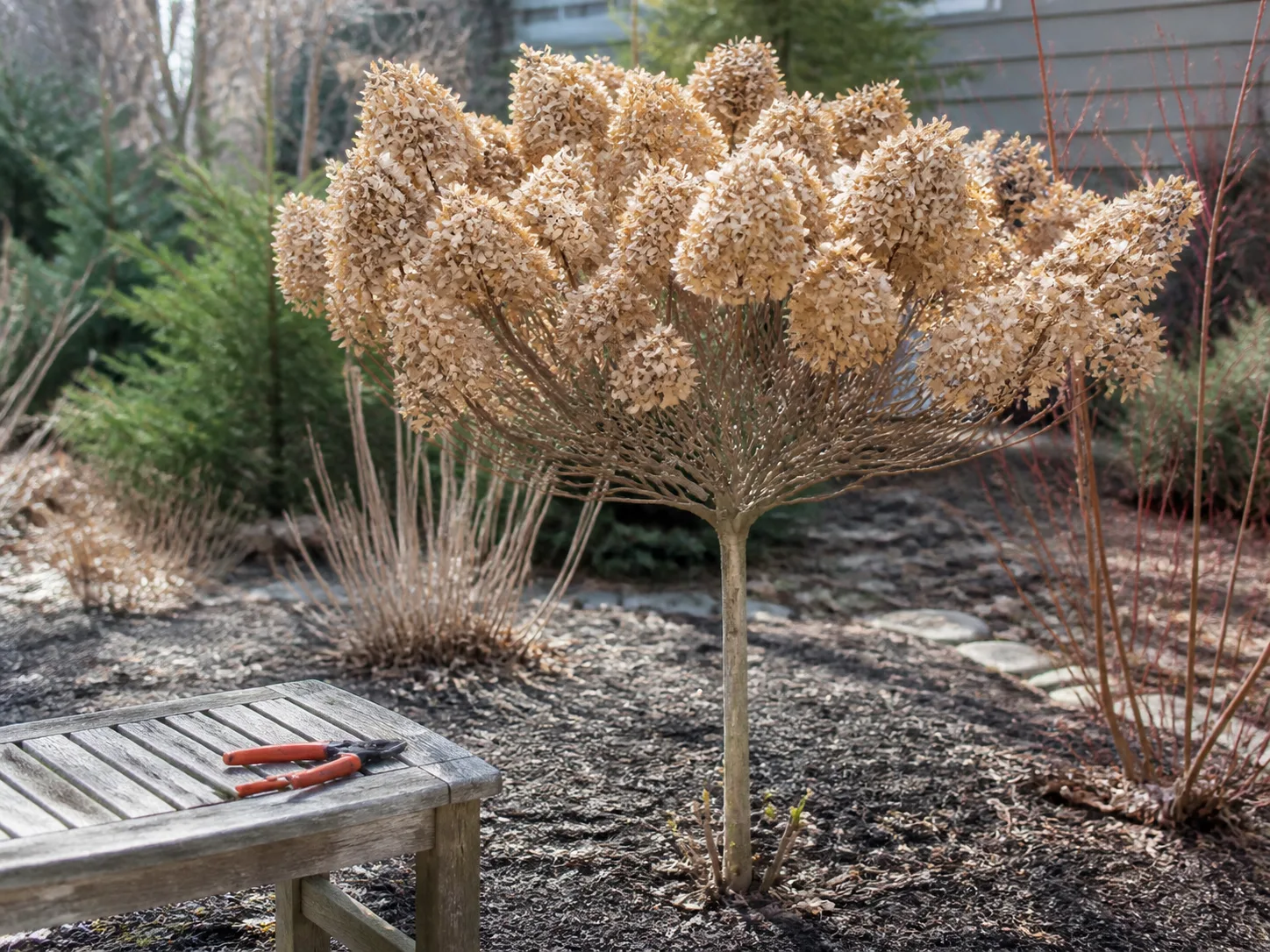
Annabelle blooms on new wood — flower buds form on stems that grow in the current season. That means late-winter or early-spring pruning is safe, unlike bigleaf types where the same timing removes last year’s buds. The RHS hydrangea growing guide groups smooth and panicle types as those that can be cut back hard before growth starts.
Pruning calendar:
- Late winter to early spring (best window): remove dead, damaged, and crossing wood; shorten or thin remaining stems; optionally remove last year’s flower heads if still attached.
- Late fall (optional): remove faded tan heads for tidiness, or leave them for winter interest and bird perch structure.
- After new growth emerges in spring: avoid hard cuts — you remove this season’s flowering wood.
- Summer: deadhead for appearance or a possible light rebloom in warm regions; do not shear the whole shrub.
Sterilize bypass pruners between cuts when removing diseased wood. Make cuts just above outward-facing buds so new growth opens the center.
Hard Cut Versus Framework Pruning
You will see two schools of advice: cut to the ground every year, or leave 18 to 24 inches of older framework. Both work because Annabelle blooms on new wood. They do not produce the same plant.
| Approach | Result | Best when |
|---|---|---|
| Hard cut (near ground) | Many vigorous new shoots; often largest individual heads; stems tend to be flexible | You want maximum flower size and accept flop risk or plan to stake |
| Framework prune (12–24 in) | Slightly smaller heads on thicker stems; more upright habit | You want less staking and a denser shrub |
| Light tidy only | Natural shape; oldest stems eventually weaken | Established plant in a casual border |
NC State notes that treating smooth hydrangea like a perennial — cutting close to the ground — produces very large clusters on stems that bend after rain. Missouri Botanical Garden similarly recommends cutting back close to the ground to revitalize, while noting weakened stems should be removed in early spring if you skip annual hard pruning.
Practical rule: if your Annabelle face-planted last July, stop cutting every stem to the ground. Leave a framework of 15 to 20 strong stems, remove the thinnest shoots at the base, and thin crowded interior branches. Re-evaluate after one season.
Keep Heavy Flower Heads Upright
Flopping is a structural problem, not a mystery disease. Large sterile heads + soft new stems + rain or irrigation splash = horizontal hydrangea. Fix it with prevention, not afternoon panic watering alone.
Prevention checklist:
- Prune to a framework instead of ground level every year.
- Site in bright morning sun so stems lignify; deep shade weakens wood.
- Avoid excess nitrogen that pushes soft growth.
- Install support before bloom — a grow-through ring, link stakes, or a low cage of green metal hoops set in early June.
- Water deeply but consistently; alternate drought and flood weakens roots and turgor.
If the shrub already flopped after a storm, lift stems gently, reset the support, and water at the base if soil is dry. Do not yank upright and tie tightly in one bundle — that bruises stems and snaps them in the next wind.
Newer smooth hydrangea cultivars (Incrediball, Invincibelle Spirit) were bred for stronger stems with similar white or pink heads. If flop defeats you every year in a high-visibility bed, swapping cultivars may be less work than annual staking.
Deadhead, Cut, and Dry the Blooms
Annabelle flowers open greenish white, mature bright white, then fade green, tan, and parchment by fall. Green aging heads are normal — not a sign you need to acidify soil.
Deadheading spent blooms for neatness: cut just below the head to the first strong pair of leaves. In warm climates, a light cut after the first flush can encourage a smaller second bloom in late summer. Do not remove so much stem that you strip the plant of photosynthetic leaves during heat.
Cut flowers: harvest when heads have turned slightly green and feel papery — they last longer in a vase than freshly opened white clusters. Strip leaves below the water line and recut stems under water.
Dried flowers: hang small bundles upside down in a cool, dark, airy space, or dry upright in a vase with a little water allowed to evaporate. The tan winter heads on the shrub also provide off-season structure if you skip fall cleanup.
Propagate Annabelle Hydrangea From Cuttings or Layering
Annabelle clones true from vegetative propagation. NC State Extension lists layering, seed, and stem cuttings as recommended strategies; home gardeners usually choose cuttings or layering.
Softwood cuttings in late spring to early summer give the fastest results. Take 4- to 6-inch nonflowering shoots, cut below a node, remove lower leaves, and insert into moist, airy propagation mix. Bright indirect light and a humidity cover improve success. Our guide to propagating hydrangeas walks through soil versus water rooting, wilting fixes, and hardening off.

Simple layering is even easier when a low branch reaches near soil. Wound the underside, peg it into the ground, and wait for roots before severing. Layer in spring; transplant the new plant in fall or the following spring.
Check plant tags before propagating named patented cultivars for sale. Personal garden use is usually fine; commercial cloning may not be.
Overwinter and Protect Roots in Cold Climates
Because Annabelle flowers on new wood, winter bud loss on old stems is not the main bloom risk. Root survival and crown health are. Missouri Botanical Garden notes plants may die to the ground in harsh winters yet resprout and bloom on new shoots — alarming but often recoverable.
Apply 2 to 3 inches of mulch over the root zone after the ground chills in late fall. Avoid piling mulch against the crown and never wrap the shrub in plastic — that traps moisture and encourages rot.
Container plants need insulation (bubble wrap pots, move to an unheated garage, or bury pots to the rim) in zones colder than the plant’s comfort. In spring, remove excess mulch from the crown and prune out any dead wood you missed in late winter.
Manage Pests, Diseases, and Pet Safety
Annabelle is relatively trouble-free but not immune. NC State and Missouri Botanical Garden list bud blight, bacterial wilt, leaf spots, mold, rust, and powdery mildew, plus aphids, mites, scale, and nematodes. Most outbreaks tie to wet foliage, poor airflow, or stressed plants.
Hydrangea leaftier (larva of a small moth) ties leaves together with silk; distorted foliage and reduced flowering follow. Remove affected leaves when you see them. Organic Btk (Bacillus thuringiensis var. kurstaki) applied to new foliage in spring can prevent caterpillar damage if leaftiers are chronic in your yard — follow label directions.
Powdery mildew shows as white coating on leaves in humid, crowded plantings. Increase spacing, prune for airflow, and avoid overhead irrigation. Severe cases may warrant a labeled fungicide; fix culture first.
Pet safety: the ASPCA lists hydrangeas as toxic to dogs, cats, and horses, containing cyanogenic glycosides that can cause vomiting, depression, and diarrhea if significant plant material is eaten. Severity depends on dose and animal size. Fence or supervise curious chewers; do not assume “landscape safe” means “pet safe.”
Troubleshoot Drooping, Leaf, and Bloom Problems
Use this order before you change everything at once.
Drooping in afternoon heat: check soil moisture at root depth. Dry soil → deep soak. Wet soil → improve drainage, reduce irrigation, inspect for root rot. Temporary afternoon wilt on moist soil often needs shade or support, not more water. See also our hydrangea heat wilt guide for the diagnostic split between thirst and heat.
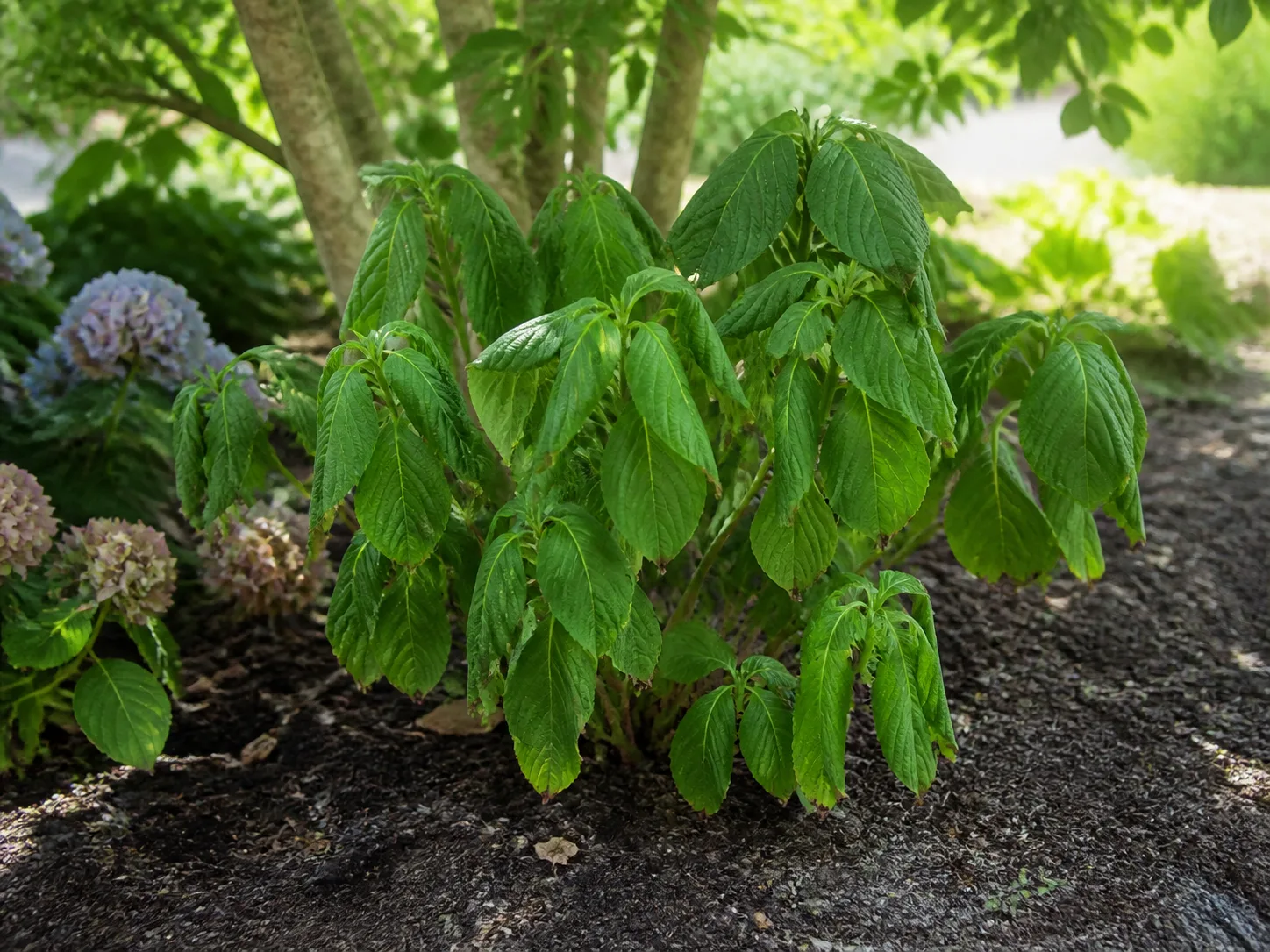
No flowers: confirm the plant gets at least a few hours of direct morning sun, was not pruned after spring growth began, and did not suffer late frost on new shoots. Excess shade and excess nitrogen are common causes. Severe winter dieback to the crown may delay bloom until recovery growth strengthens.
Brown leaf edges: usually drought, wind desiccation, salt injury, or root damage — not a mysterious fungus on the first pass. Correct water and exposure before spraying.
Yellow leaves: older bottom leaves yellow naturally. Widespread yellowing with wet soil suggests root suffocation; with dry soil, drought stress; with pale new growth, possible nutrient lack — test soil rather than guessing.
Green flowers: normal aging on white cultivars. If the entire head stays green from opening, cool weather or cultivar quirks may be involved — still not a pH problem on Annabelle.
Fewer, smaller heads after years of hard pruning: rebuild structure with framework pruning, improve sun, and feed lightly only if tests indicate need.
Conclusion
Annabelle hydrangea succeeds when you treat it as a moisture-loving native shrub with stadium-sized flowers on stems that need respect. Give it morning sun, soil that drains yet holds water, and deep watering during establishment and bloom. Prune in late winter with a plan: framework stems for strength, hard cuts only when you accept the flop trade-off. Support the shrub before heads open, propagate from cuttings if you want more plants, and mulch roots — not crowns — through winter.
The payoff is one of the most reliable white summer shrubs in zones 3 through 9: pollinator value, rain-garden usefulness, black walnut tolerance, and flowers that work fresh or dried. Get the structure right and Annabelle stops being the plant that lies down every July — and becomes the one you actually planned the border around.