How to Grow and Care for a Paperbark Maple Tree
Learn how to grow a paperbark maple, from choosing a site and planting depth to watering, pruning, natural bark peeling, and realistic growth expectations.

Paperbark maple (Acer griseum) earns its place in a garden through a sequence of seasonal details: three-part leaves in summer, sometimes red-orange foliage in fall, and cinnamon-colored bark that curls away from mature trunks and branches in winter. It is a slow-growing deciduous tree, so its lasting value comes from choosing a site that suits the tree you will have years from now—not trying to hurry it with fertilizer or repeated pruning.
The care itself is straightforward once the roots are established. Give the tree room for its eventual canopy, plant it with the root flare visible, keep young roots evenly moist without leaving them in saturated soil, and let the bark exfoliate on its own.
At a glance: size, growth, and four-season interest
Paperbark maple is a small ornamental maple from central China. University references commonly describe a mature height around 20 to 30 feet; estimates for spread vary more, from about 10 feet in one Virginia Tech profile to 15 to 25 feet in North Carolina State Extension and Oregon State references. Use the wider local estimate when planning a permanent site, especially if you want to avoid removing lower limbs or shearing the canopy later. North Carolina State Extension, Virginia Cooperative Extension at Virginia Tech, and Oregon State University Landscape Plants describe the species’ size, form, and growth.
The rate is patient rather than dramatic: Virginia Tech describes growth at about 12 inches or less per year. That is a long-term average, not a promise that each branch will lengthen a foot annually. Transplant recovery, weather, light, and root conditions can all change what you see in a particular year. A healthy tree may spend energy extending roots before it adds much visible canopy.
Hardiness references are not perfectly uniform. Oregon State lists the species as hardy to USDA Zone 4, while Virginia Tech and Illinois Extension list Zones 5 through 7. Treat that as a cue to check local performance, not as a guaranteed range: minimum winter temperature alone does not capture summer heat, drying wind, rainfall, or drainage. Oregon State University, Virginia Cooperative Extension, and University of Illinois Extension publish different zone guidance.
Its bark is the most dependable ornamental feature, but it is not instant. Young bark can look relatively plain; as trunks and branches mature, the cinnamon to reddish-brown outer layers peel in papery curls and reveal smoother bark below. The branching habit may be a single trunk or several stems, depending on nursery training and the specimen you buy. Inspect the actual tree if you have a strong preference for one form.
Choose the right site before planting
Treat the listed mature size as a design measurement, not a vague maximum. A 20- to 30-foot tree with a broad, rounded or oval crown needs a spot where branches can expand without continual conflict with a wall, overhead line, driveway, or narrow path. Stand where you expect to view it in winter: the distinctive bark is easiest to appreciate when the trunk is visible against a simple background, rather than hidden behind evergreen screening.
The species suits a specimen position, a mixed border with enough overhead room, or a small garden that can spare a real tree-sized footprint. It is also used near patios, but account for the eventual spread and keep the root zone out of repeated digging and paving work. If a small space only works by keeping the tree tightly clipped, choose a naturally smaller plant instead.
Sun and shade: match the exposure to your climate
Paperbark maple grows in full sun to partial shade. In a cooler summer climate, a brighter position can support denser growth and better fall display; where afternoons are hot or windy, light shade and shelter can reduce exposure stress. The RHS advises a sheltered position in sun or light shade for larger maples, while NC State lists full sun to partial shade for this species. RHS Growing Guide
Do not confuse “tolerates shade” with “will thrive in deep shade.” A site under a dense evergreen canopy may have competing roots, less available moisture, and a muted fall show. Watch the pattern across the day, including reflected heat from paving and wind funneling between buildings. The right position is bright enough for steady growth but not so exposed that a young tree repeatedly dries out.
Soil is flexible, with one non-negotiable: drainage. The tree can grow in sand, loam, or clay and tolerates a range of pH, but it performs best where the root zone stays moist while excess water drains away. Oregon State University notes its adaptability to varied soils, including clay, and preference for moist, well-drained conditions. If water still stands in the planting area the day after rain, fix the drainage or select a different location; adding compost to the planting hole will not turn a persistently wet site into a suitable one.
Prepare the soil and plant at the right depth
Plant while the tree is dormant or weather is cool enough to limit stress, with workable soil and no frozen ground. RHS guidance for larger maples recommends planting from early autumn through winter; NC State notes that container-grown and balled-and-burlapped paperbark maples transplant well in spring. In practice, use the season that gives you cool conditions and time to water consistently: early fall can work in mild regions, while spring may be safer where winter arrives quickly or the site stays wet. Avoid planting during hot, drying weather if you cannot keep up with irrigation.
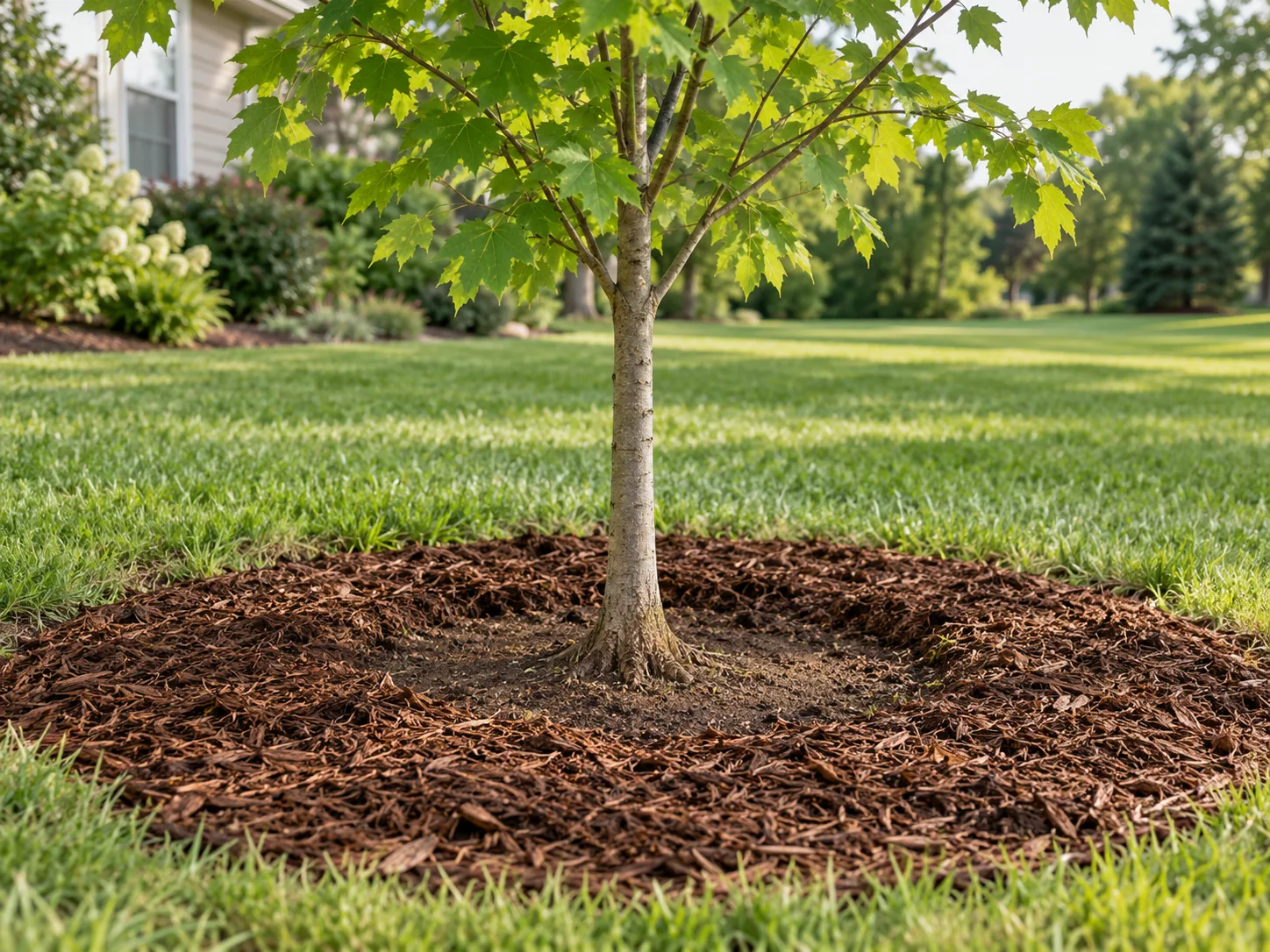
Before digging, check for buried utilities and confirm where the trunk widens into the top roots. That widening is the root flare. It should finish at or slightly above the surrounding grade, not disappear underground. University of Maryland Extension explains that a buried flare can hold moisture against trunk tissue and make root problems harder to detect. University of Maryland Extension
Dig a broad, shallow hole rather than a narrow pit. Set the root ball on firm soil so it cannot settle, and make the hole wide enough for the roots to expand into loosened surrounding ground. Backfill with the soil you removed; avoid creating a pocket of unusually rich potting mix that encourages roots to remain inside the hole instead of entering native soil. The University of Saskatchewan’s tree-planting guide gives a useful step sequence and stresses planting depth, root flare, and aftercare. University of Saskatchewan Gardening
Set container-grown or balled-and-burlapped stock carefully
For a container tree, slide the root ball out and look for roots circling the outside or crossing the trunk. Loosen manageable circling roots; if the root mass is severely congested, ask the nursery or a certified arborist how to correct it before planting. Do not assume the potting-soil surface marks the true flare—nursery stock is sometimes buried too deeply in its container. Gently uncover the upper roots so you can set the tree by its root flare instead.
For balled-and-burlapped stock, keep the root ball intact while moving it, set it at the correct height, then remove twine and as much accessible wrapping from the upper ball as the planting method allows. Large stock may need careful handling; do not lift a heavy tree by the trunk. The root ball should stay supported and centered, and the trunk should be upright before you backfill.
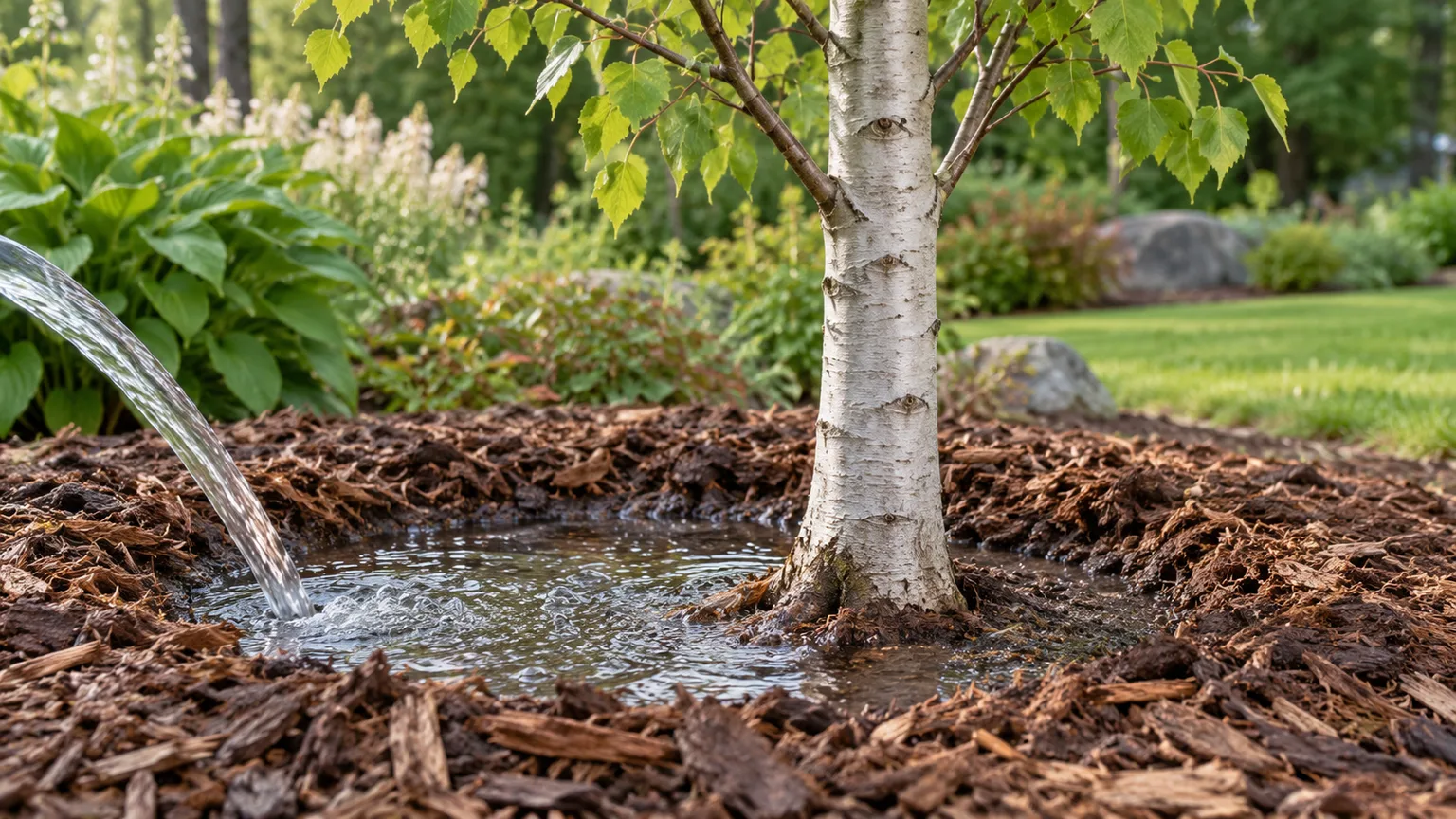
Water slowly after planting to settle soil around the roots. Staking is usually unnecessary if the root ball is stable; use flexible ties only when wind or an unstable root ball makes support necessary, and remove them once the tree can stand securely. The goal is to stabilize the root ball without immobilizing the trunk indefinitely.
Water a new tree by checking the root zone
The first few growing seasons matter more than a rigid weekly schedule. Keep the original root ball and the adjacent soil evenly moist while roots move outward, especially during hot, dry or windy weather. The RHS recommends watering as needed through dry spells during the first two years, particularly for trees planted in spring or later in the season. RHS
Check moisture before adding water. Feel the soil a few inches below the surface at the root ball’s edge; if it is still damp and cool, wait. If it is dry, water slowly over the root zone so moisture reaches the depth of the roots instead of running off the surface. Heavy clay may need a slower application and a longer interval between waterings than sandy soil. Rainfall, temperature, wind, tree size, and drainage all change the interval, so a calendar alone is a poor guide.
As the tree establishes, gradually reduce supplemental watering rather than stopping after the first flush of new leaves. During a prolonged drought, even an established tree may benefit from a deep soak. Conversely, do not keep watering just because a leaf has browned: saturated soil can deprive roots of oxygen and create symptoms that look like drought stress. If soil stays wet, pause irrigation and address drainage before assuming the tree needs more water.
Mulch and feed without forcing growth
Spread an organic mulch in a broad, shallow ring over the root zone to reduce weeds and slow moisture loss. Keep it about 2 to 4 inches deep and leave a clear buffer around the trunk and visible root flare; mulch piled against bark holds moisture where it does not belong and can hide the tree’s base. A wide “donut” is useful; a mound against the trunk is not. University of Maryland Extension explains the importance of keeping mulch away from the root flare.
Paperbark maple’s slow growth is a species trait, not a signal to apply more fertilizer. If the tree is planted correctly and produces normal leaves, do not feed it just to force faster height. Established landscape trees rarely need routine fertilizer; improve the soil surface with a thin layer of compost beneath mulch if organic matter is low, and use a soil test before treating a suspected nutrient deficiency. Virginia Tech characterizes the species as relatively carefree, and the RHS guidance notes that trees growing in open ground rarely need feeding.
Let the bark peel naturally; do not clean it up
The copper, cinnamon, or reddish-brown bark is supposed to curl and exfoliate. It may begin on older stems before it becomes conspicuous across the trunk, and the timing varies with the tree’s age, growth, and conditions. Virginia Tech notes that bark appearance and the extent of exfoliation differ from tree to tree; most branches about half an inch across and larger may show the trait. Virginia Cooperative Extension
Do not pull, scrape, or peel attached bark to make the tree look older. The tree is already shedding naturally; forcing it can expose living tissue and create an injury. A small amount of loose papery bark is not a cleanup problem. If you see a new wound, a long crack, sap oozing, or bark loss paired with canopy decline, inspect for mechanical damage, drought, or another stress rather than assuming it is ornamental exfoliation.
Savvy Gardening’s overview of trees with peeling bark makes a helpful distinction: some species shed bark naturally, while damage-related bark loss may occur with other symptoms. For paperbark maple, the tree’s characteristic cinnamon curls are normal when the surrounding trunk and crown remain sound. Savvy Gardening
Prune to establish structure, then mostly leave it alone
Choose a single-trunk or multi-stem form while the tree is young, based on the plant you bought and the way you want to view its bark. A single central leader creates a classic small tree; multiple stems can make a broad, sculptural specimen. Do not remove several healthy leaders simply because one form seems more “correct.” The long-term structure and space available matter more than a universal training rule.
For routine care, remove broken, dead, crossing, or badly placed branches and keep cuts modest. Maples can bleed sap when cut at the wrong time. Prune when the tree is fully dormant, or follow a local extension’s timing; the RHS gives late fall through winter for larger maples, and BBC Gardeners’ World also recommends the dormant period for removing damaged branches. BBC Gardeners’ World
Make a clean cut just outside the branch collar rather than leaving a long stub or cutting flush to the trunk. Avoid topping, shortening the whole canopy, or removing substantial live branches to make a slow-growing specimen fit a site that is too small. If a major limb is over a roof or has a weak attachment, ask a qualified arborist to assess it instead of making a large cut from a ladder.
Expect variable fall color and a slow, graceful canopy
The three leaflets help distinguish paperbark maple from familiar five-lobed maples, while the underside can look paler or gray-green. Spring flowers are small and not the tree’s main show. Its fall color can range from modest russet or red-brown to a strong red-orange, and it may arrive later than the color on neighboring maples. Virginia Tech describes the display as variable by year, tree, and location; University of Illinois Extension likewise notes that autumn color may be dull or russet. University of Illinois Extension
Choose this tree primarily for its bark, graceful outline, and seasonal texture—not as a guaranteed annual source of brilliant red foliage. A shaded planting site, summer stress, and local weather can all affect what you see. The slow canopy also gives the tree room to remain a focal point without quickly overwhelming a small property, but it does not make the mature footprint negligible.
Propagate from seed only if you can wait and experiment
For most home gardeners, buying a nursery-grown plant is the practical route. Paperbark maple is slow to grow and difficult to propagate consistently; Virginia Tech notes both traits as reasons plants can cost more than common maples. Virginia Cooperative Extension
Seeds are winged samaras, but collecting one does not guarantee a seedling. A more important obstacle than a universal sowing recipe is that many paperbark maple seeds are hollow or otherwise not viable; the Morton Arboretum notes that seedlings are seldom a problem because most seed is not viable, and the International Dendrology Society describes seed collection and germination as difficult. If you want to experiment, use fresh seed and a reputable species-specific propagation protocol, label the sowing date, and treat it as a long project rather than a shortcut to a mature tree. Seed-grown trees may also vary from the parent in form and ornamental traits. The Morton Arboretum, International Dendrology Society
NC State lists seed and stem cuttings as propagation strategies and notes that young stems are easiest to root, but rooting a cutting still requires appropriate timing and conditions. Commercial propagation is often more reliable than a casual home attempt. Choose an established nursery specimen if you want a predictable shape, known size, and a tree that can be planted into the landscape soon.
Diagnose common problems before treating them
Paperbark maple is generally considered a low-problem tree, but “low problem” does not mean immune to stress. North Carolina State Extension reports no significant recurring insect or disease problems, while University of Illinois Extension lists potential concerns such as drought injury, waterlogging, root rot, wilt, and some pests. These are possibilities to investigate, not a checklist of inevitable diseases. North Carolina State Extension, University of Illinois Extension
Start with the growing conditions before reaching for a pesticide or fertilizer. Check how recently the tree was planted, soil moisture several inches down, whether water drains after rain, mulch depth, root-flare visibility, and whether the symptoms affect one branch or the whole crown. A tree with stress symptoms can be harmed by a well-meant extra treatment if the actual issue is the opposite—for example, more water when roots are already in saturated soil.
Leaf scorch or early leaf drop
Brown, crisp leaf edges can follow heat, dry soil, wind, or root stress; early leaf drop can also reflect a difficult transplant season. Test the root zone before changing irrigation. If it is dry, water deeply and protect the soil with a correctly placed mulch ring; if it is persistently wet, stop adding water and improve drainage. Repeated scorch despite suitable moisture deserves a closer look at planting depth, root condition, and exposure.
Normal bark exfoliation versus injury
Normal peeling occurs in thin, curling sheets of coppery or reddish bark on the trunk and mature branches. It does not usually leave an expanding raw wound or coincide with sudden dieback. Look for mower or string-trimmer injury near the base, cracking, oozing, a patch of dead bark, or a branch that is declining above the affected area. If damage circles much of the trunk or the canopy is thinning, consult a local Extension office or certified arborist; avoid sealing the bark or stripping off more material.
Use the tree where its mature form can be seen
Paperbark maple works best where people can notice the trunk in more than one season. A place near a walk, patio, or window can make the winter bark visible, while a bed of lower plants can leave the base unobstructed. Keep grass and string trimmers away from the trunk, and avoid dense groundcover that hides the flare or makes moisture checks difficult.
Its slower growth can make it useful where a fast-growing shade tree would soon dominate, but it is not a substitute for a shrub or a permanent container tree. The species is generally planted in the ground and may be trained as bonsai by experienced growers; ordinary indoor conditions are not a suitable permanent home for a landscape maple. Give it outdoor seasonal conditions and enough soil volume for a long-lived woody tree.
How long does a paperbark maple live?
A paperbark maple can be a long-term landscape tree, but a specific lifespan is difficult to promise because site, establishment, and injury matter more than a single published average. The International Dendrology Society documented a tree grown from seed collected in 1901 that was still alive at Highdown when described in its 2020 yearbook; that is evidence of longevity potential, not a guarantee or an average for every garden. International Dendrology Society
The best way to give it a chance at a long life is to solve the site and planting questions first. A correctly sized location, visible root flare, sound drainage, careful watering while roots establish, and restrained pruning do more for the future tree than trying to force faster growth. The payoff builds slowly: a rounded canopy, changing leaves, and bark that becomes more striking as the tree matures.
Conclusion
Grow paperbark maple for its enduring bark and refined shape, and plan around its slow pace. Before planting, confirm that the mature canopy fits, choose sun or light shade with shelter, and make sure the soil drains even if it is clay. Set the root flare at grade, keep the young root zone moist but not waterlogged, mulch broadly without covering the trunk, and prune only when structure or damage calls for it.
The most realistic expectation is also the simplest: Acer griseum takes time to become the tree shown in mature garden photographs, and fall color varies from year to year. Give it the right site and leave its natural bark alone; patience is part of the care plan.



