Austrian Pine Care: What to Know Before Planting
Austrian pine needs full sun, drainage, and ample room. Learn how to plant, water, prune, and spot disease—and when another conifer is the better choice.
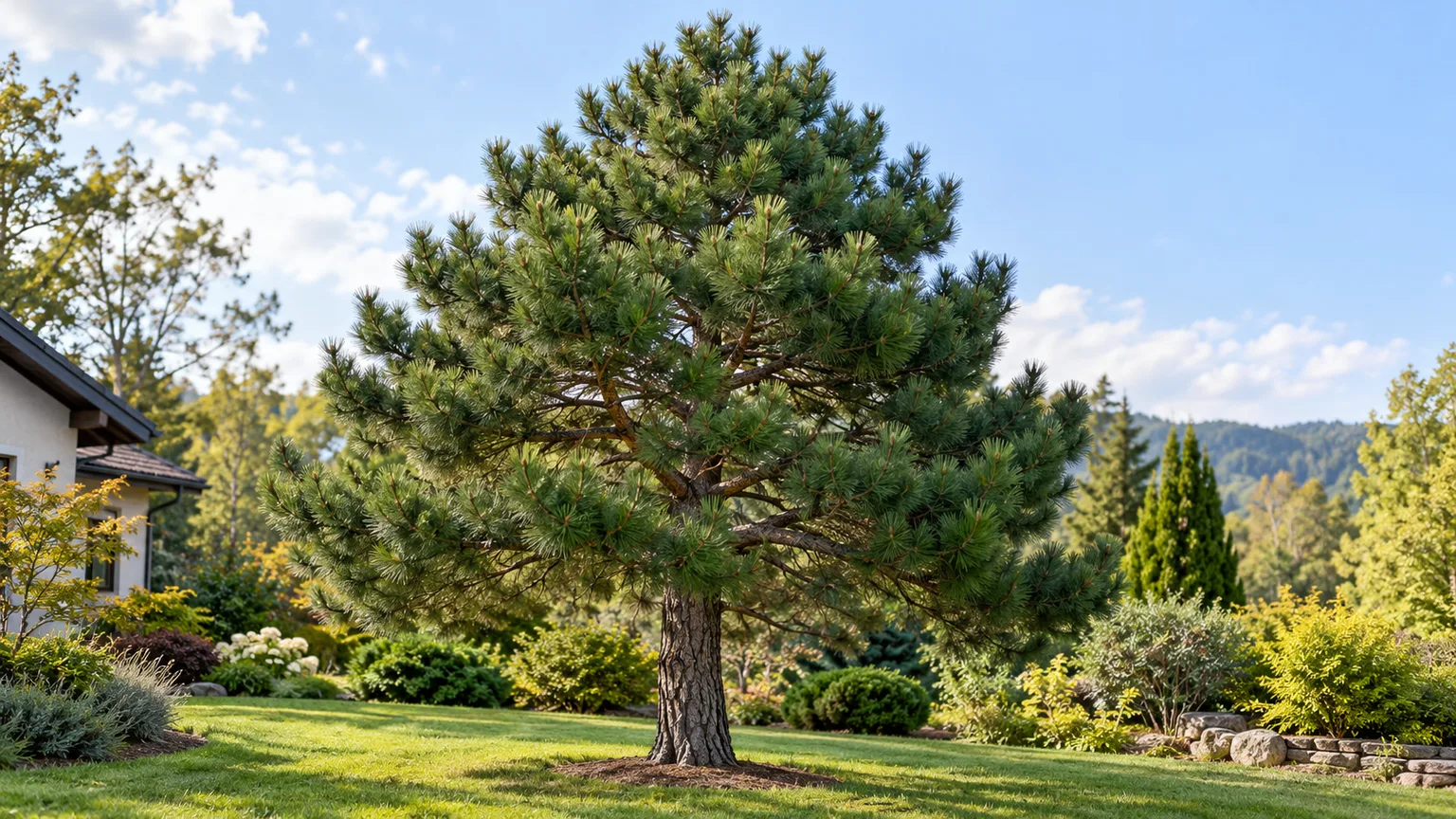
Austrian pine (Pinus nigra), also called Austrian black pine or European black pine, is a substantial evergreen with long, dark needles and a strong, spreading crown. It tolerates city conditions and a range of soils, but that toughness can obscure the main question: whether the tree is a good fit for your region. In parts of the Midwest, arboretum and extension guidance now discourages new plantings because Austrian pine is vulnerable to serious needle and shoot diseases.
If the tree is already in your yard, good care means reducing stress and checking symptoms early. If you are shopping for one, confirm the local disease outlook and reserve enough room for the mature crown before you buy. The species’ broad adaptation is useful, but it does not make every site or climate suitable.
| At a glance | Austrian pine |
|---|---|
| Botanical name | Pinus nigra |
| Mature size | Commonly about 40–60 feet tall and 20–40 feet wide; forms vary |
| Light | Full sun, roughly six or more hours of direct light |
| Soil | Broad tolerance; drainage matters more than a narrow pH target |
| Water | Keep the root ball evenly moist while establishing; established trees tolerate some drought |
| Main caution | Local risk of Diplodia tip blight, Dothistroma needle blight, and pests varies |
Size and hardiness figures vary among profiles, cultivars, and growing regions. North Carolina State Extension lists the species for USDA Zones 4a–7b, while plant profiles may show a different lower zone limit; use your local extension service’s regional recommendation rather than treating one zone label as a guarantee. North Carolina State Extension and Morton Arboretum both emphasize the tree’s large mature scale and need for an appropriate site.
Is Austrian Pine the Right Tree for Your Yard?
Austrian pine can make sense where you need a large evergreen screen, a windbreak during its younger years, or a year-round specimen that can tolerate urban exposure. Its dense, dark foliage creates a steady backdrop, and its tolerance of salt, dry conditions, and varied soil has made it useful in challenging landscapes. Those are real advantages, especially in a cool, relatively dry region where local professionals still recommend the species.
The trade-off is that an Austrian pine can be difficult to keep attractive if disease pressure is high. Diplodia tip blight, Dothistroma needle blight, pine wilt nematode, and insect pests can disfigure or kill trees; a site with recurring needle disease or prolonged warm, wet weather may be a poor bet. The Morton Arboretum no longer recommends Austrian pine for the Midwest because of its insect and disease susceptibility. That is a regional recommendation, not a universal ban, so check with your county extension office or a certified arborist in your own area before planting.
Use a short decision test. Identify the tree’s mature footprint on a landscape plan, ask whether Austrian pine is currently recommended locally, and consider whether you can tolerate needle cleanup and occasional professional diagnosis. If you need a narrow evergreen, a low-maintenance replacement, or a tree for a humid disease-prone site, choose another species before investing in a large nursery tree.
How to Identify Austrian Pine
The species is a medium to large conifer with stiff dark-green needles carried in bundles of two. Needles are often around 4 to 6 inches long, though length can vary. Its cones are oval, brown, and usually about 2 to 3 inches long. The bark matures to dark gray or brown-black plates separated by deep furrows, one of the most visible traits on an older specimen. Virginia Cooperative Extension describes the crown as densely conical when young, becoming more irregular and flat-topped with age.
That change in shape matters when you evaluate a young tree. A nursery specimen may look compact and symmetrical, but the mature crown spreads and broadens; lower limbs can eventually shade a wide area, and an aging tree may lose some lower branches. Do not choose the planting location from the tree’s current pot or burlapped size.
Common names can cause confusion. “Black pine” is used for more than one pine, and labels may describe a regional form or a cultivar rather than the species as a whole. Check the botanical name on the nursery tag. A named dwarf selection can have a very different mature profile from a seed-grown Austrian pine, but it retains the species’ basic environmental and disease considerations.
Climate and Hardiness: A Local Choice
Austrian pine is native across parts of central and southern Europe and the Mediterranean region, but a tree’s native range does not translate into a simple climate formula for a home garden. It can tolerate cold winters and dry periods once established, yet warm humid summers, long wet spells, poor airflow, and repeated drought stress can increase disease problems. The local pattern of pathogens and the condition of nearby pines matter as much as a broad hardiness-zone number.
Hardiness zones describe average annual extreme winter temperatures; they do not measure summer humidity, soil drainage, or a local outbreak of Diplodia. Even the published zone range varies by source. For example, North Carolina State Extension lists zones 4a through 7b, while other regional guides include zone 3. Treat those ranges as a starting point, then ask a local extension educator whether the species is recommended in your county and whether recent disease pressure changes that advice.
Planting next to a mature, declining pine deserves extra caution. Several needle and shoot pathogens persist in infected plant material, and wet weather can move spores onto susceptible tissue. A nursery tree that looks healthy on purchase day is not protected from a poor regional match. Local suitability is the first care decision because no watering or pruning routine can make a chronically susceptible tree a low-risk choice.
Choose a Site With Sun, Airflow, and Room
Give Austrian pine full sun, ideally six or more hours of direct light. Open exposure helps the crown dry after rain and supports a dense, balanced canopy. Avoid a low pocket where cool, moist air settles, a site where sprinklers regularly wet the needles, or a tight planting between buildings and other conifers. Poor airflow does not automatically cause disease, but it can make a susceptible tree’s environment less forgiving.
Before planting, map the full canopy width and nearby infrastructure. Keep it away from rooflines, overhead wires, foundations, septic areas, and narrow driveways. Think about how broad limbs and shade will affect paths, understory plants, and neighboring trees in 15 or 30 years. If a tree service will eventually need to access the crown, consider that too; the cost and difficulty of treating or removing a large conifer rise with height and proximity to structures.
Account for Mature Size
For the species, plan for a crown commonly 20 to 40 feet wide and a height around 40 to 60 feet. A narrow cultivar changes the footprint but not the need to check the plant’s specific mature dimensions. For a screen, space plants according to their expected adult spread and local disease guidance. Planting several Austrian pines tightly together may give faster visual coverage, but it also reduces air movement and can make inspection, pruning, and later removal harder.
If you cannot give the tree this room, do not plan to solve the problem by topping or repeatedly shearing it. Pines do not reliably regrow from old bare wood in the way many broadleaf shrubs can. Choose a naturally narrow cultivar or a different evergreen that fits the site without structural pruning.
Soil and Drainage
Austrian pine tolerates a broad range of soil textures and pH, but it does not benefit from roots sitting in waterlogged ground. A deep, well-drained soil gives the root system room to establish. Clay is not an automatic disqualifier if the site drains adequately, and sandy soil is not automatically ideal if it dries so quickly that a new tree repeatedly wilts. Avoid a compacted planting strip where water pools after rain or where construction fill has left a shallow, sealed basin.
Test drainage before buying a large specimen: after a soaking rain, note whether water remains around the proposed planting site. If the ground stays saturated for a long time, select a different site or another species that tolerates wet conditions; adding a small amount of sand or peat to the planting hole will not repair a poorly drained yard. Keep the backfill soil close to the native soil instead of creating a richly amended pocket that roots may not readily leave.
The tree does not need routine acidification or fertilizer just because it is a pine. Extension profiles describe tolerance across acidic, neutral, and alkaline soils. A soil test is the useful next step if growth is unusually weak or needles show a pattern consistent with a nutrient problem; do not diagnose a deficiency from browning alone.
Plant Austrian Pine Correctly
Plant when the soil is workable and the weather is moderate, avoiding frozen ground, waterlogged soil, or a heat wave that will make establishment difficult. In many temperate regions, spring or early fall gives roots time to grow before severe heat or cold. Handle the root ball gently, keep it from drying while you work, and set the tree upright without pulling it by the trunk.

Set the Root Flare at Grade
Find the point where the first structural roots leave the trunk before you dig. Nursery stock can have extra soil or mulch hiding this root flare, so remove only loose material until you can see the transition. Dig a broad, saucer-shaped hole no deeper than the measured root ball; the root flare should sit at the surrounding soil grade or slightly above it after settling. A hole that is too deep can bury the flare and leave the tree unstable or short of oxygen.
Make the hole several times wider than the root ball if the soil allows, loosening the sides so roots can move outward. Place the tree, turn the best-looking side toward the main viewing angle, and backfill with the excavated soil. Remove container sides and inspect for circling or girdling roots; correct only obvious defects with clean cuts rather than stripping away healthy roots. If the root ball is balled and burlapped, follow local arboricultural guidance for removing binding materials without letting the ball fall apart. Fine Gardening’s tree-planting guide explains why correct flare placement and root inspection support establishment.
Water slowly after backfilling so soil settles against the roots. Make a shallow watering berm at the edge of the root ball if needed, then spread a 2- to 3-inch layer of organic mulch over the root zone. Keep mulch a few inches away from the trunk and do not build a volcano against the bark. Mulch that touches the trunk holds moisture against the stem and hides damage.
Water Through Establishment
A new tree needs reliable moisture while roots extend beyond the original nursery ball. Water thoroughly at planting, then check the root ball and surrounding soil before watering again. The surface can look dry while the center of a dense container root ball is still wet—or the nursery mix can dry out while the heavier clay around it remains damp. Feel the soil several inches down near both the root ball and the edge of the planting hole instead of relying on a calendar alone.
When the root zone is drying, apply water slowly enough to soak it rather than running off the surface. During hot, windy weather or a dry spell, check more often; after steady rain, wait. Continue monitoring through the first growing season and beyond if the tree was planted large, the soil is sandy, or drought continues. This soil-check approach avoids both the competitor-style mistake of applying one weekly volume to every yard and the opposite mistake of letting a newly planted pine dry out.
Ongoing Watering, Mulch, and Fertilizer
Once established, Austrian pine can tolerate some drought, but “drought tolerant” does not mean immune to drought stress. Give young trees supplemental water during extended dry periods and water an older tree during an unusually long drought if the root zone is dry. Deep, occasional irrigation over the root zone is generally more useful than frequent shallow splashes. Direct irrigation to the soil; sprinklers that repeatedly wet the needles can favor needle diseases in susceptible settings.
Maintain a flat mulch layer over the root zone, refreshing it only as it breaks down. Keep grass and weeds from competing close to a young trunk, but avoid digging deeply beneath an older canopy where surface roots may be present. Do not pile soil, decorative stones, or excess mulch against the trunk. Mulch regulates soil moisture and temperature; it does not compensate for a low, poorly drained planting site.
Routine fertilizer is usually unnecessary. Fast nitrogen-driven shoot growth is not a cure for a stressed tree and can leave tender growth vulnerable to disease. If a soil test or a qualified diagnosis identifies a nutrient issue, use the measured recommendation rather than guessing. Protecting roots, maintaining water during establishment, and avoiding trunk injury are more valuable than an annual fertilizer schedule.
For winter, a healthy landscape tree in a suitable hardiness range typically needs no elaborate wrapping. Water before the ground freezes if autumn has been unusually dry, and continue to keep heavy snow from breaking vulnerable young branches when it can be done safely from the ground. Container-grown dwarf cultivars are different: their root balls freeze faster than roots in the earth, so use a substantial outdoor container and shelter or insulate the pot during severe cold. A full-size Austrian pine is not a sensible long-term container tree.
Pruning Without Creating New Problems
Austrian pine needs little routine pruning. Remove dead, broken, crossing, or confirmed diseased branches, and make cuts just outside the branch collar rather than flush to the trunk. If you want more clearance over a path, remove lower limbs gradually while they are still small enough to prune safely; do not strip off a large share of the live crown at once. A mature tree over a house, road, or utility line is a job for a qualified arborist.
Timing depends on the reason for pruning. For general structural work, choose a dry period and avoid cutting during wet weather. When a disease such as Diplodia is suspected, sanitation matters: prune below the visibly affected section, clean or disinfect tools between cuts, and remove infected material according to local disposal rules. University of Wisconsin Extension advises cutting several inches below obvious infection and disinfecting tools between cuts; an arborist can confirm how much wood should be removed.
Do not top the tree to control height or shear it into a hedge. Pines generally do not replace lost growth from old, needle-free wood, so hard cuts can leave permanent gaps. If a location demands regular size control, the species is a poor match; replace it with a plant whose natural mature form fits.
Diagnose Browning Before Treating
Brown needles can signal disease, but browning alone is not a diagnosis. Start by asking which needles are affected, where symptoms begin, and whether the change is uniform or banded. Check whether new shoots are short or curled, whether there is resin around buds or branch junctions, and whether symptoms are concentrated low in the canopy. Photograph the whole tree and a close-up, then ask a local extension diagnostic service or arborist if the pattern is unclear.
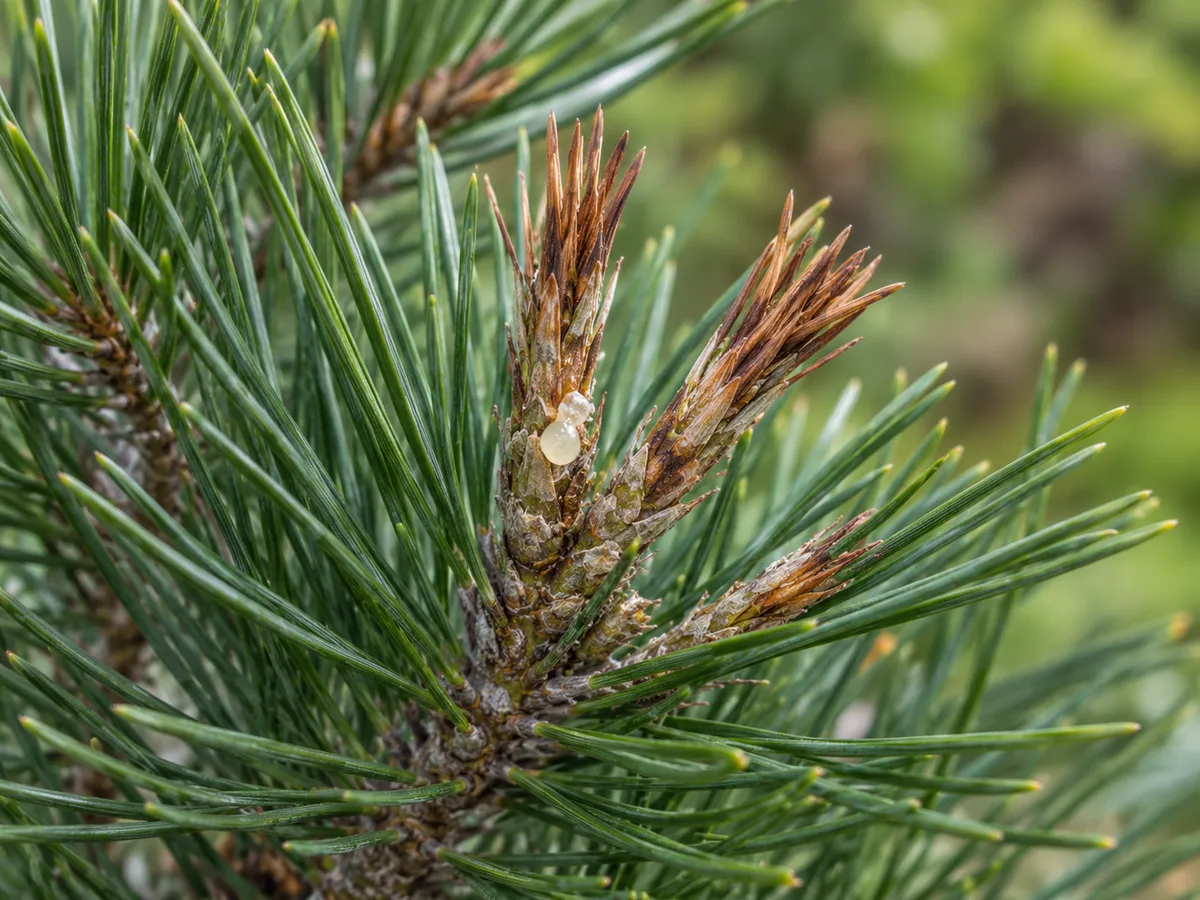
Shoot-tip browning and resin can be consistent with Diplodia, but look-alike problems require local diagnosis.
Diplodia Tip Blight
Diplodia tip blight, historically also called Sphaeropsis tip blight, is a major Austrian pine disease in some regions. It often affects stressed or mature trees. Infected spring shoots may stop expanding, curl, turn yellow-brown, and die before the new needles reach full length. Resinous cankers may form at shoot bases, and tiny black fruiting structures can occur beneath needle sheaths or on cones. Symptoms often appear first on scattered lower branches, but the pattern can vary. University of Maine Cooperative Extension and Wisconsin Extension describe these signs and emphasize tree stress and infected plant material in disease management.
Do not assume every dead shoot is Diplodia. Frost injury, drought, root damage, insects, and other fungi can also kill branch tips. If the tree is valuable or symptoms are spreading, have the diagnosis confirmed before considering fungicide. Preventative products work only when correctly timed to susceptible new growth, may require repeated applications, and do not restore branches already killed. A qualified arborist can determine whether treatment is practical for a large tree and whether local rules permit it.
For light, confirmed infection, remove affected shoots in dry weather and disinfect tools between cuts; dispose of infected material rather than leaving it beneath the tree. Improve the conditions you can control: correct planting depth, reduce drought stress, avoid unnecessary wounds, and give the canopy room. If most of the crown is declining or the tree is a hazard, replacement may be more realistic than trying to reverse advanced decline.
Dothistroma Needle Blight and Other Causes
Dothistroma needle blight tends to show on older needles, often lower in the crown. Look for reddish-brown bands or spots encircling a needle, with a brown tip and a green base; repeated infection can leave bare interior branches. The pathogen is favored by wet periods, and Austrian pine is among the pines that can be badly affected. University of Minnesota Extension notes that laboratory testing may be needed to distinguish Dothistroma from other needle blights. Avoid overhead irrigation, improve airflow through appropriate spacing, and consult local extension guidance before using any fungicide.
Normal seasonal needle drop looks different: older inner needles turn yellow more uniformly and shed, often in fall, while the newest growth remains green. Pines retain needles for a limited number of seasons, so some interior shedding is expected. Brown bands, premature loss across several years of needles, short new shoots, or expanding bare sections deserve closer inspection. Winter injury, salt spray, drought, and root problems can also cause discoloration. If symptoms appear on multiple trees or progress quickly, a diagnostic lab is more reliable than a photo-based guess.
Pests to Watch
Inspect Austrian pine periodically for unusual resin, holes, webbing, clusters of larvae, or sudden branch decline. Zimmerman pine moth larvae can injure trunks and branch unions, and pitch masses around branch junctions are a clue worth showing to an extension specialist. Sawfly larvae can consume needles in groups; identify the insect before treating because caterpillar-like larvae on pines are not all the same pest. Pine wilt nematode is another serious regional concern and may cause rapid decline, but it cannot be confirmed from a single symptom.
Avoid broad insecticide spraying as a first response. Many pests are seasonal, and the right management depends on the insect stage, tree size, and local rules. If a mature pine is losing branches, producing heavy resin, or declining rapidly, ask an arborist or extension diagnostic service to inspect it. A label-approved treatment, where appropriate, must be matched to the pest and applied at the correct time; a spray on the foliage will not fix root injury, drought, or a fungal canker.
Cultivars, Alternatives, and Replacement Choices
Austrian pine cultivars can change the tree’s form substantially. ‘Arnold Sentinel’ is narrow and upright compared with the species; ‘Hornibrookiana’ is a dwarf, spreading mound. North Carolina State Extension lists additional selections such as ‘Globosa’ and ‘Pyramidalis’, though availability and mature dimensions vary by nursery. The Royal Horticultural Society describes ‘Hornibrookiana’ as a slow-growing dwarf that can reach roughly 0.5–1 meter tall and 1.5–2.5 meters wide over 20–50 years. Verify the cultivar’s mature size from a regional source before purchase rather than trusting a small pot label. RHS plant profile
A dwarf form can work in a rock garden or a large container with excellent drainage, but containers need more frequent moisture checks and winter root protection. They also limit long-term size only when the cultivar itself is naturally compact; repeated root pruning or aggressive shearing is not a substitute for choosing the correct plant. Named cultivars are commonly propagated by grafting or other vegetative methods because seed-grown offspring may not retain the selected form.
If local disease pressure makes Austrian pine a poor choice, ask for alternatives matched to the purpose and site, not just a similar silhouette. Depending on the region, recommendations may include red pine, Scots pine, Korean pine, Swiss stone pine, a locally adapted spruce, or an arborvitae cultivar. Their soil, moisture, wildlife, and climate needs differ; some alternatives tolerate dry soil but not wet ground. Wisconsin Extension lists several replacements for diseased Austrian pines, with a caution that some are intolerant of poorly drained sites. A local forester or extension office can narrow the list to species that are both suitable and currently recommended where you live.
Propagating From Seed
You can grow the species from seed, but it is a slow way to produce a landscape tree and will not reliably reproduce a named cultivar. Collect mature brown cones, allow them to dry until scales open, then extract the seeds. Pine seed germination varies by seed lot and may benefit from a period of cold, moist stratification; follow guidance from a regional forestry or extension source for the exact seed provenance and timing. Sow shallowly in a freely draining seed-starting mix, keep the medium evenly moist rather than saturated, and give seedlings bright light once they emerge.
Keep seedlings protected from drying, weeds, and severe winter exposure while they are small. A seed-grown pine can take several years to reach a sturdy transplant size, and young seedlings are especially vulnerable to inconsistent moisture. For a dependable landscape tree or a specific cultivar, buying nursery stock is usually more practical. Before planting any seedling in the ground, confirm the same regional suitability and mature-space requirements that apply to a purchased tree.
Conclusion
Austrian pine rewards the right site with dense evergreen structure, urban tolerance, and some drought resilience after establishment. It asks for full sun, well-drained soil, careful planting depth, a large footprint, and steady attention to regional disease pressure. The most useful action is to check local recommendations before planting; once the tree is in place, monitor root-zone moisture, keep mulch off the trunk, and investigate patterned needle or shoot damage before treating it.
If the tree is already established, you do not need to panic over every fallen inner needle. Compare the new growth with older needles, look for bands, resin, and short or curling shoots, and get a professional diagnosis if decline is progressing. If you are choosing a new evergreen for a disease-prone area or a constrained yard, a locally recommended alternative is often the more dependable long-term investment.



