How to Grow and Care for Natal Plum in Warm Climates
Grow Natal plum as a coastal hedge, container shrub, or edible garden plant with guidance on watering, cultivars, pruning, fruit safety, and winter care.
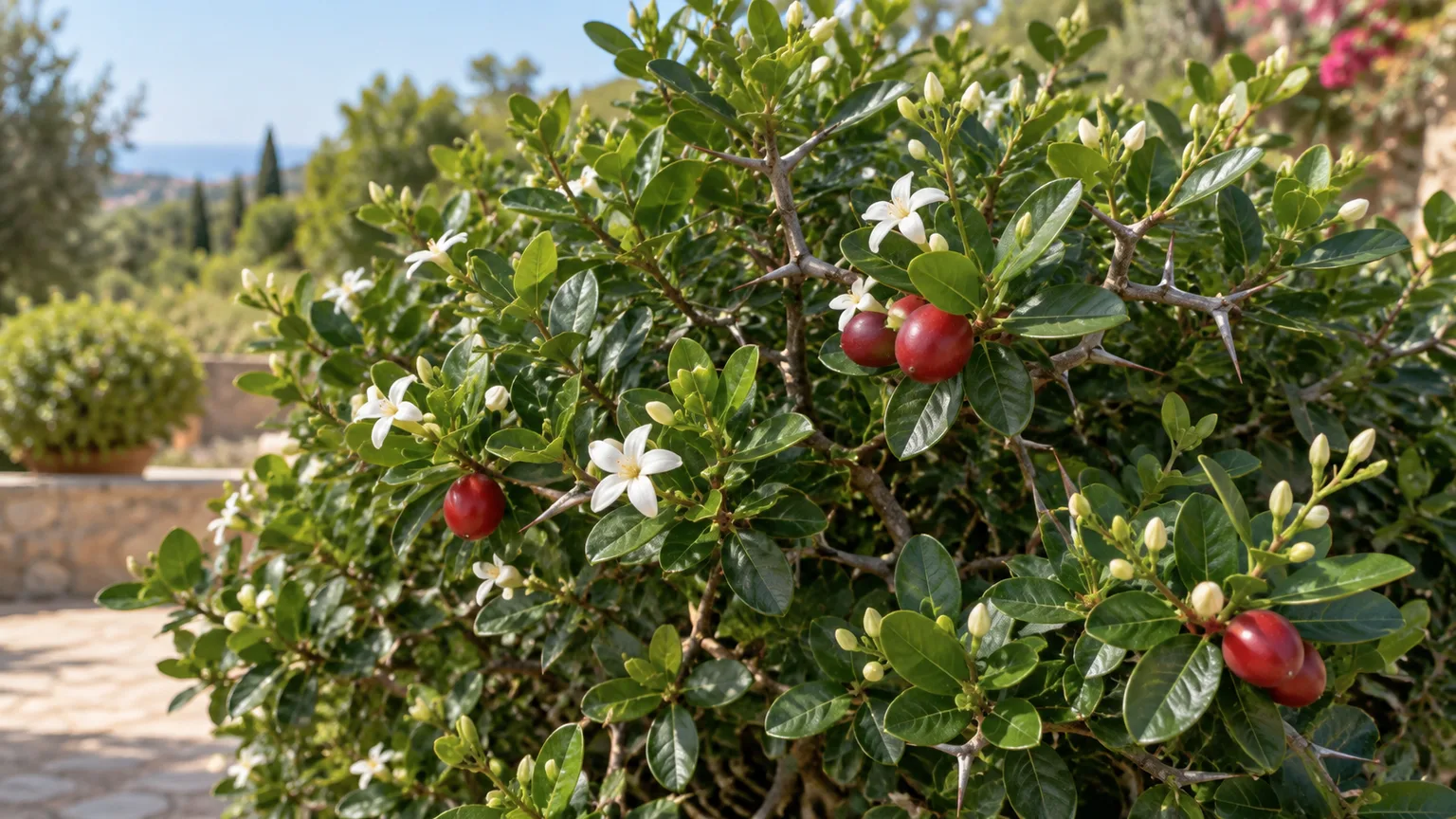
Natal plum (Carissa macrocarpa) is a glossy evergreen shrub from southern Africa with fragrant white flowers, edible ripe fruit, and sharp forked spines. It can make a salt-tolerant hedge, a low groundcover, or a container specimen, but the right choice depends on winter temperatures and how close people will pass the plant.
The care is straightforward once you solve three things at the start: give it a warm site, let water drain away, and leave room for its thorns. A fixed weekly watering schedule or routine heavy feeding usually causes more trouble than it prevents. This guide covers planting, pruning, fruiting, overwintering, propagation, and the important distinction between ripe fruit and the plant’s latex-bearing sap.
Is Natal plum right for your climate and garden?
Natal plum is best outdoors where winters are mild and frost is rare. UF/IFAS Extension lists USDA hardiness zones 9B through 11B, while NC State describes the shrub as thriving in zones 9 and 10; Oregon State’s profile cautions that it is a tropical plant and gives a conservative zone 10 rating. Those ranges are not a promise that every zone 9 yard is safe: a sheltered coastal courtyard and an exposed low spot can experience very different winter temperatures. (UF/IFAS Extension; NC State Extension; Oregon State University)
Use the local minimum temperature and frost pattern, not just the zone number, to decide whether to plant in the ground. In a frost-prone zone 9 garden, choose a protected spot against a warm wall or grow a compact cultivar in a movable container; in colder regions, treat it as a summer patio plant that needs bright, frost-free winter quarters. A container makes cold protection possible, but it does not turn Natal plum into a low-light indoor plant.
The shrub is often sold as a small landscape plant, yet its mature size is variable. NC State reports that plants are typically 5 to 7 feet tall but can reach 30 feet, while UF/IFAS gives a broad 2-to-20-foot range; cultivar, climate, age, and repeated pruning all change the result. Plan for a woody shrub that can spread, rather than assuming the nursery pot’s compact size is permanent. (NC State Extension; UF/IFAS Extension)
Pick a cultivar and site before planting
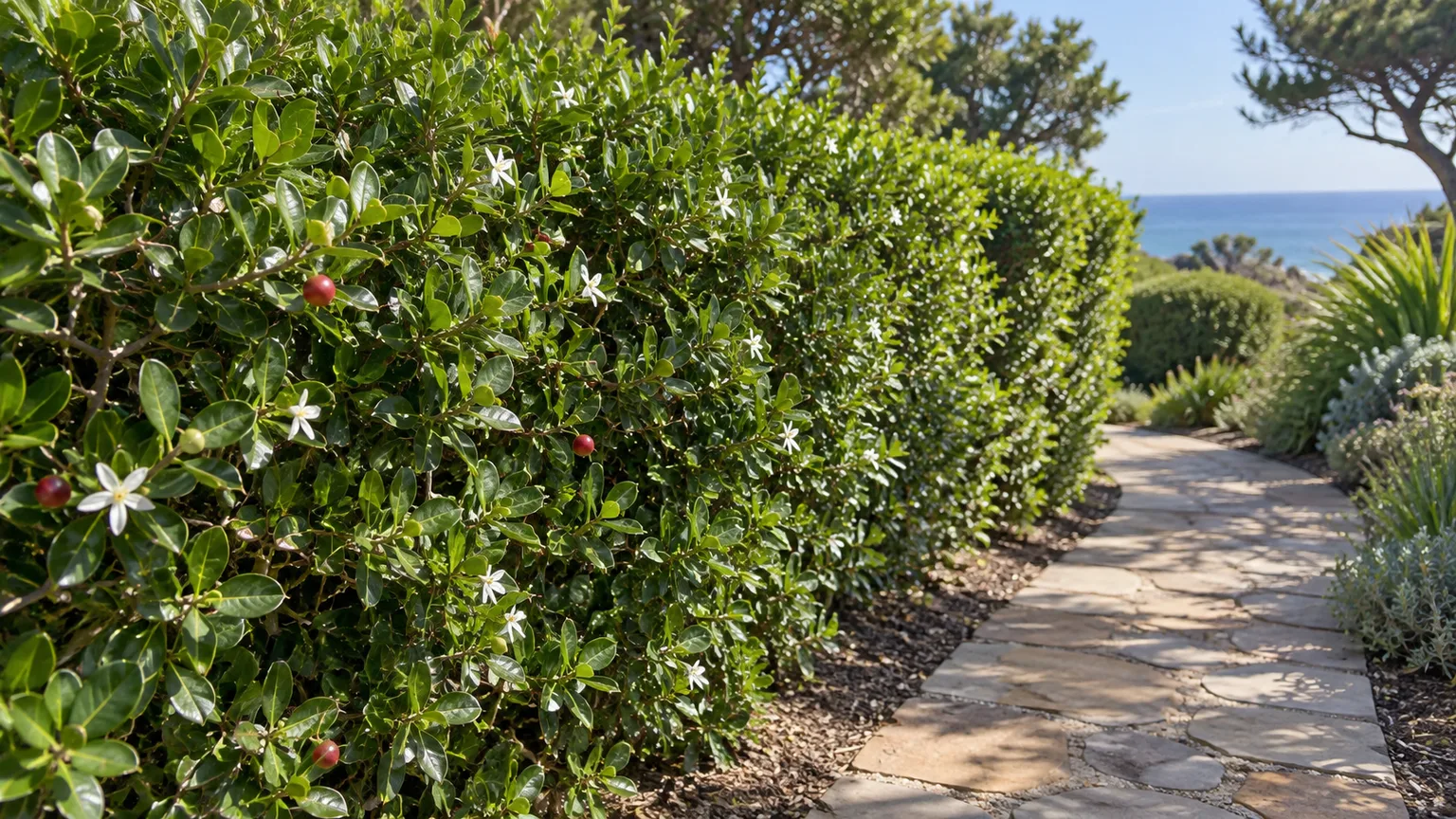
Choose a form that suits the job before buying. Upright types can make a dense defensive screen, while spreading dwarf forms such as ‘Green Carpet’ are more useful as groundcover; ‘Boxwood Beauty’ is compact, ‘Fancy’ is noted for larger fruit, and ‘Variegata’ has cream or yellow markings. Cultivar descriptions vary among references and nurseries, so confirm the mature dimensions on the plant label and ask whether the selection is thornless, less thorny, or simply has spines hidden among its leaves. (NC State Extension; Oregon State University)
Do not select Natal plum solely because you want fruit. It is an evergreen ornamental first: individual plants can flower without setting a heavy crop, and fruit quality and yield differ from plant to plant. If harvest matters, buy a named fruiting selection from a nursery that can describe its performance locally instead of relying on a generic landscape shrub.
Give the shrub sun and safe spacing
Full sun produces the best flowering and fruiting; light shade is tolerated, especially in very hot sites, but dense shade tends to leave a looser shrub with fewer blooms. Aim for at least six hours of direct sun when the site allows it. In a hot inland climate, morning sun with some afternoon relief can be a sensible compromise, but do not tuck the plant into a dark side yard and expect a compact, productive hedge. (NC State Extension; Gardening Know How)
Make the spines part of the site plan. Keep an ordinary thorny selection back from paths, doors, play areas, and outdoor seating, and avoid putting it where someone must reach through the canopy to open a gate or pick up a ball. A hedge below a window or along an outer boundary can use the plant’s dense, thorny growth as a barrier, but a narrow planting strip beside a busy walkway is a poor fit even if the light is perfect.
Spacing depends on whether you want plants to knit together quickly or to develop as separate shrubs. UF/IFAS lists 36 to 60 inches between plants; PlantZAfrica recommends 1 meter for a dense hedge in its native growing context. Use the wider end for a screen with room to mature, and the closer end only when the cultivar and pruning plan support it; crowded plants dry more slowly and are harder to inspect or trim safely. (UF/IFAS Extension; PlantZAfrica / SANBI)
Build drainage into the soil
Natal plum tolerates sandy, alkaline, and even some clay soils, but that broad tolerance does not mean it accepts a persistently wet root zone. UF/IFAS says the shrub grows in a range of soil textures when drainage is adequate and specifically warns that roots can rot in poorly drained soil. Coastal wind and salt spray are usually less of a concern than water that sits around the roots after rain. (UF/IFAS Extension; Oregon State University)
Before planting into heavy ground, check how quickly water disappears from a test hole after rain or irrigation. If water stands for hours, plant on a broad raised mound or in a raised bed rather than filling one small hole with loose potting mix; an amended pocket surrounded by dense clay can act like a basin. In a container, use a coarse, free-draining potting mix and a pot with open drainage holes, not a decorative cachepot that keeps the root ball standing in water.
There is no need to chase a precise pH unless a soil test or a persistent nutrient problem gives you a reason. The shrub grows across a fairly broad range, and adding compost to improve structure is more useful than making an arbitrary pH adjustment. Keep mulch a few inches away from the main stems so the crown stays airy and the spines remain visible when you work around the plant.
Plant at the right depth
Plant in a mild part of the growing season when the shrub has time to establish before cold weather or the harshest heat. In frost-free parts of zones 9 and warmer, UF/IFAS lists year-round planting windows; elsewhere, wait until the soil is warm and the risk of frost has passed. Buying a smaller healthy plant is often easier than moving a large thorny specimen later. (UF/IFAS Extension)
Water the nursery pot before planting, then set the root ball so its top sits level with the surrounding soil. Backfill with the excavated soil, firm it lightly to remove large air pockets, and water slowly enough to settle the soil without leaving a puddle. If the roots circle the pot, loosen only the outer layer; do not wrestle the thorny branches while trying to tear apart the whole root ball.
For a hedge, mark the full line and spacing before digging so you do not end up with plants leaning into a path. A drip line or soaker hose is easier to manage than reaching through a thorny canopy with a watering wand, and it keeps water at the root zone. Mulch the root area after planting, but keep the stem bases clear and leave enough access to inspect the plant as it grows.
Water by establishment stage
Water a newly planted shrub deeply enough to wet the root ball and surrounding soil, then check moisture before watering again. During the first growing season, the original nursery mix can dry at a different rate from the garden soil around it, so probe both; a dry surface does not always mean the root ball is dry. In hot, windy weather, check more often, but let actual soil moisture—not a weekly calendar—decide when to water.
Once the roots have moved into surrounding soil, Natal plum is drought tolerant and may need little or no supplemental irrigation in a normal rainy season. That does not mean it benefits from repeated drought stress: during a long hot spell, a deep drink is more useful than frequent shallow sprinkling. UF/IFAS notes that established plants require no additional irrigation under its Florida landscape guidance, while practical horticulture sources emphasize checking the soil and avoiding overwatering. (UF/IFAS Extension; Plantophiles)
Containers need more attention because a smaller volume of mix heats and dries faster than garden soil. Lift the pot or check a few inches below the surface; if it feels light and the mix is dry at root depth, water until it runs from the drainage holes and empty any saucer. If the soil is still cool and damp, wait. A shrub that is yellowing or limp in wet mix should not receive another automatic drink.
Fertilize lightly, if needed
An established in-ground Natal plum often grows without routine feeding, particularly in ordinary garden soil. If the shrub has pale new growth or weak growth after you have ruled out poor drainage, frost damage, and deep shade, test the soil before adding nutrients. A light application of a balanced landscape fertilizer in spring is a reasonable starting point only when the label rate and soil conditions support it; heavy nitrogen can push leafy shoots at the expense of flowers and compact form. (Gardening Know How; Plantophiles)
For a container plant, follow the fertilizer label for woody shrubs or fruiting ornamentals and feed during active growth rather than on a fixed year-round schedule. Do not combine several products, use a strong dose to “force” fruit, or assume a phosphorus-heavy fertilizer will solve poor fruit set. Pollination, sunlight, plant maturity, and cultivar can matter more than extra fertilizer.
Prune with the spines in mind
Natal plum takes shaping well, but its stout forked spines make every pruning decision slower and riskier than it is on a soft hedge. Put on thick gloves, long sleeves, eye protection, and sturdy trousers; use long-handled bypass loppers for interior stems and keep your face and forearms out of the branch line. Do not prune barefoot or in short sleeves, and do not reach blindly into a dense plant to find a cut.
Remove dead, broken, crossing, or badly misplaced branches first. If you are shaping a hedge, prune after the main bloom flush in your area so you do not immediately remove the growth that could flower or fruit; in warm climates where blooms appear on and off through the year, accept that frequent shearing trades flowers and harvest for a tidier outline. UF/IFAS advises removing no more than the top third of the shrub at a time and shaping the top narrower than the base so lower foliage receives light. (UF/IFAS Extension)
Shape the canopy without shading its base
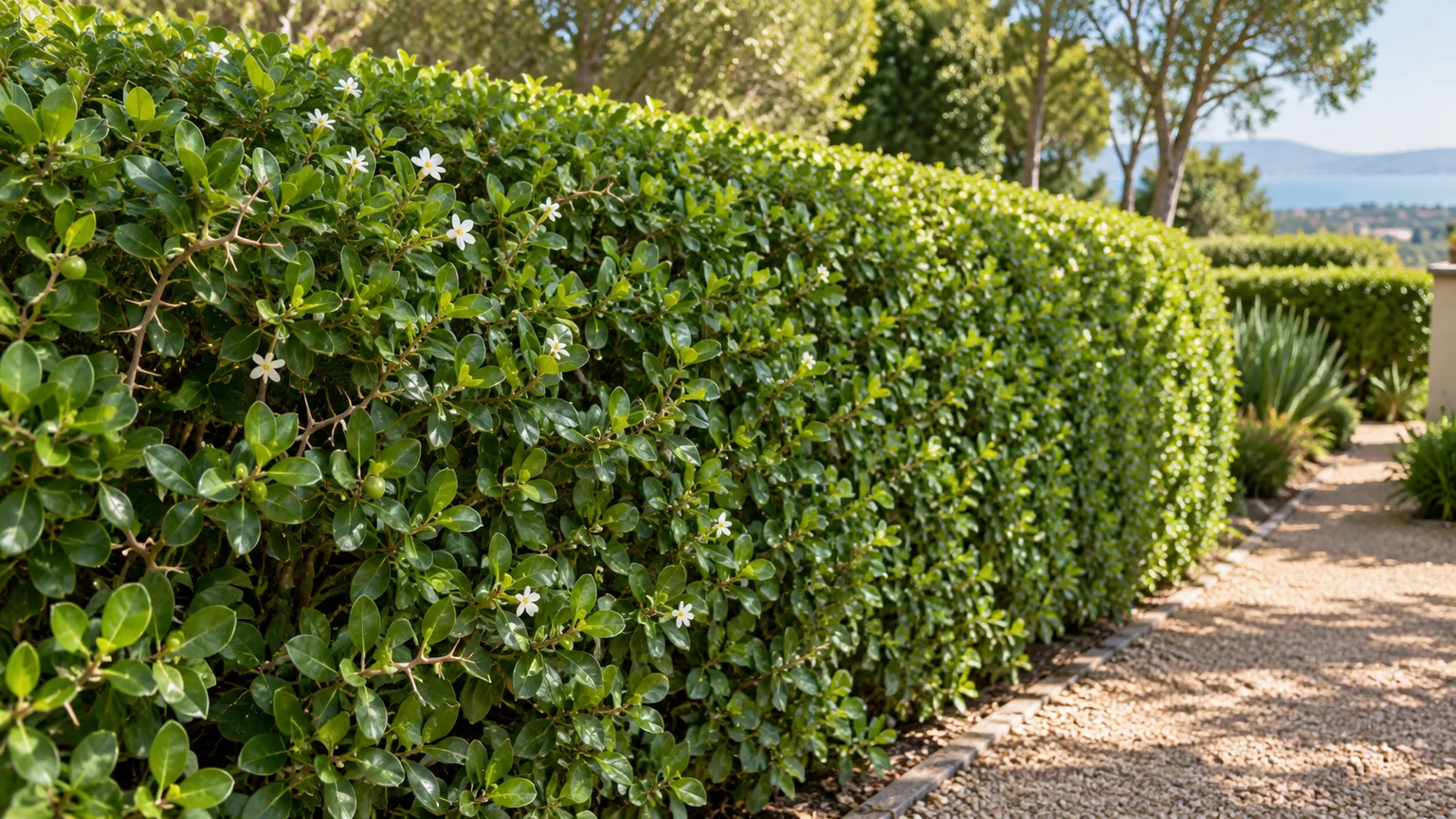
Use selective cuts rather than repeatedly shaving the outside into a hard, dense shell. A hedge that is wider at the top can shade its lower branches, leaving a bare interior that is difficult to rejuvenate without exposing the woody framework. A slight taper—broader at the bottom than at the top—lets sunlight reach lower leaves and keeps the hedge fuller from ground to crown.
Do not try to convert a very overgrown shrub into a tiny ball in one session. Spread major size reduction over more than one growing season, removing dead wood and a portion of the oldest or most intrusive stems each time. For a dwarf cultivar, watch for vigorous upright shoots that outgrow the low form and remove them while small; check the plant label before treating all cultivars as naturally compact.
Understand flowering and fruit set
The white five-petaled flowers are fragrant and may appear over a long season in warm climates. NC State describes year-round flowering, while the South African National Biodiversity Institute notes a spring-to-midsummer flowering season in its native range; local temperature, cultivar, light, and pruning shift the calendar. A shrub with few blooms usually needs more sun or less aggressive shearing before it needs more fertilizer. (NC State Extension; PlantZAfrica / SANBI)
Fruit set is not guaranteed just because flowers appear. Purdue’s Fruits of Warm Climates notes that some plants may be functionally male or self-infertile, and that apparently unproductive plants have set fruit after cross-pollination. If a mature, sunny shrub blooms well but produces few berries over multiple seasons, ask a local nursery whether your cultivar needs compatible pollen and consider planting a second genetically distinct selection nearby; do not expect an immature plant or a heavily clipped hedge to crop heavily. (Purdue University, Fruits of Warm Climates)
Harvest only fully ripe fruit
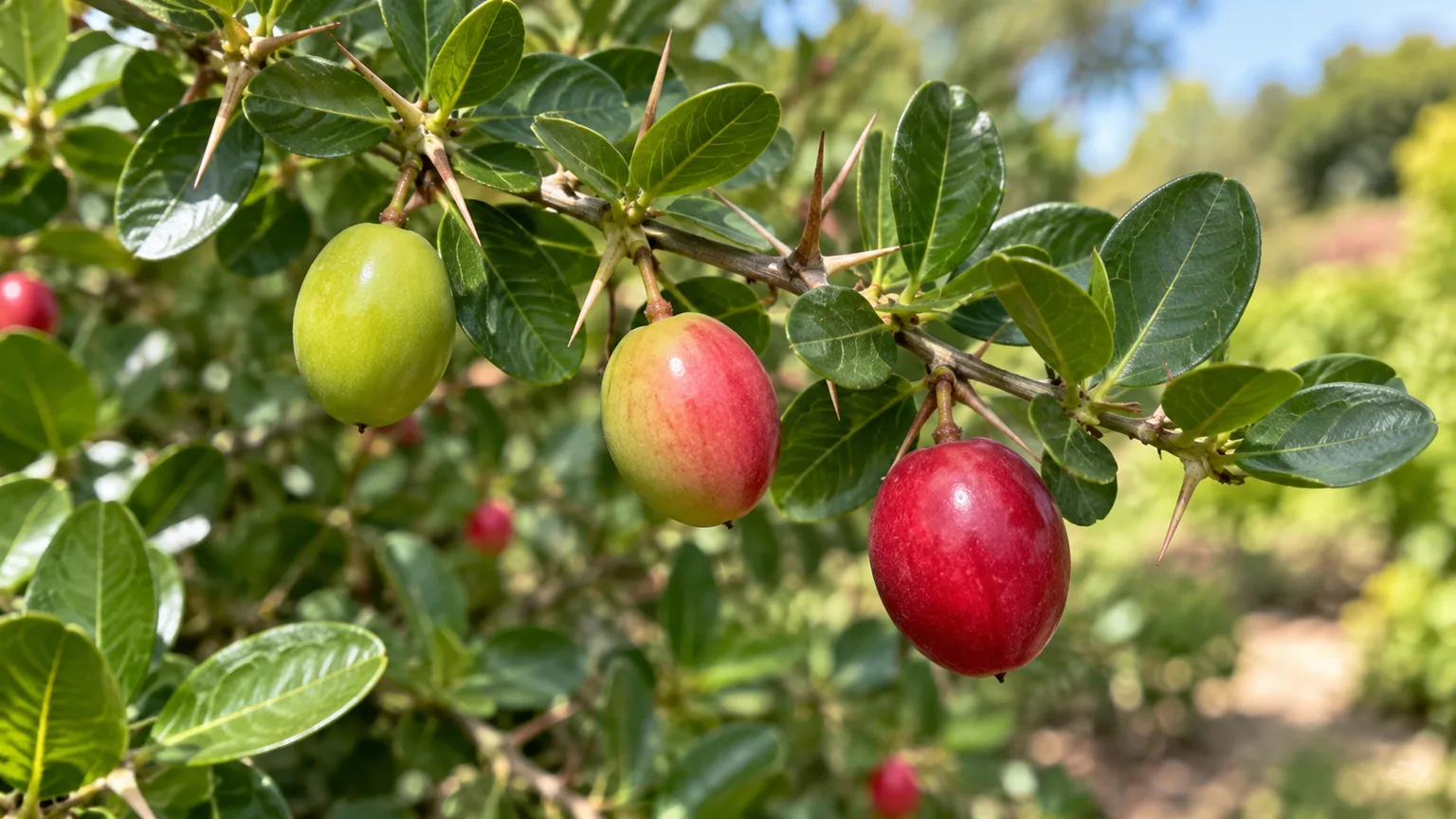
Natal plum fruits do not necessarily ripen all at once. The change from green to red is a useful first cue, but for eating, wait until a fruit is fully red to dark crimson or reddish-purple and yields slightly when pressed. Purdue’s fruit monograph describes ripe fruit as dark red and slightly soft, while NC State says fruit ripens to a reddish-purple hue and is edible when ripe; green fruit is described in the Purdue account as rich in latex. Do not taste a green or partly colored fruit to “test” it. (Purdue University, Fruits of Warm Climates; NC State Extension)
| Fruit stage | What you see or feel | What to do |
|---|---|---|
| Immature | Green, firm fruit | Leave it on the shrub; do not eat it. |
| Developing | Color is changing but fruit is still firm | Wait and check again later. |
| Ripe | Even deep red to crimson or reddish-purple; slightly soft | Pick gently and use promptly, or refrigerate. |
The ripe fruit is described as cranberry- or raspberry-like and can be eaten fresh or cooked into jam, jelly, sauce, pies, or preserves. Cut stems carefully and avoid snapping thorny branches while picking; a small basket and long-handled pruning snips can keep hands away from the spines. If you have any doubt about the plant’s identity or the fruit’s maturity, leave it alone rather than relying on color alone. (Purdue University, Fruits of Warm Climates; UF/IFAS Extension)
Grow Natal plum in a container
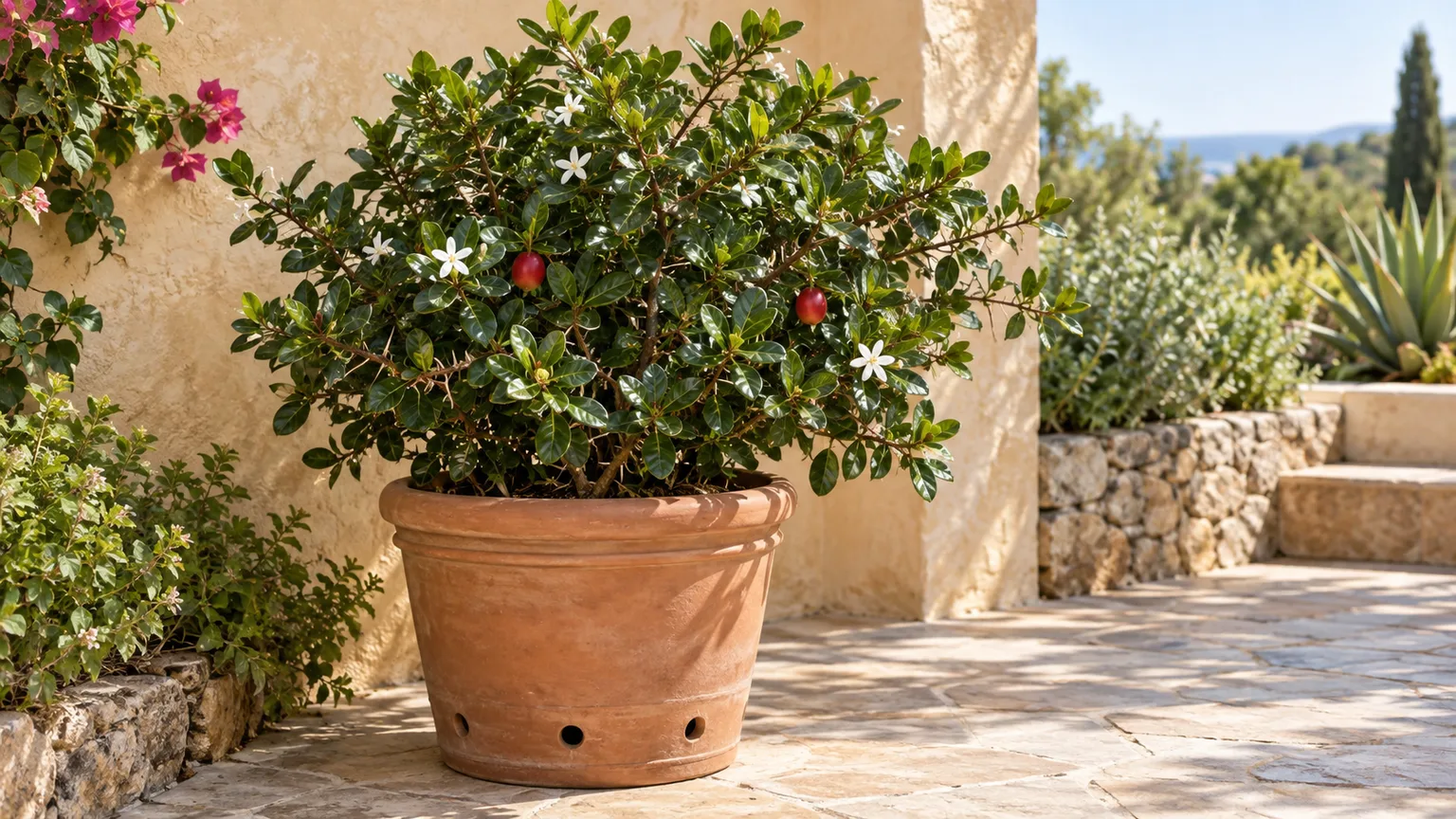
A container is useful when winter frost is a risk or when you want a compact ‘Boxwood Beauty’ or ‘Nana’ near a sunny patio. Use a heavy pot with several drainage holes, only a little wider than the root ball at first, and a coarse potting mix that drains freely. An oversized pot holds more wet mix than a small root system can use, so move up gradually when roots circle the pot or emerge from drainage holes rather than planting a young shrub directly into a very large tub.
Place the pot where the plant receives several hours of direct sun and where branches will not snag people walking past. A patio container can still grow into a thorny shrub; do not position it at a doorway, beside a chair, or where a child would grab the stems for support. Rotate the pot occasionally if light is one-sided, but avoid repeatedly moving it between deep shade and intense sun.
Container soil can dry quickly in wind and heat but stay wet for days in cool weather. Check moisture in the root zone and adjust to the season; the plant uses less water while growth slows in a cool, bright room than it does on a hot summer patio. Repot only when root crowding or poor drainage makes it necessary, and refresh the mix rather than fertilizing a compacted, waterlogged root ball.
Move it before frost
Move the pot to a bright, frost-free place before a cold night is forecast, not after leaves have turned dark or stems have been injured. Oregon State describes the species as tropical and reports that it is grown outdoors only in summer in regions beyond its safe hardiness range; UF/IFAS gives a warmer current zone range than some older references. Together, those accounts support a conservative rule: use the zone as a first screen, then protect a container from frost because its roots chill faster than roots in the ground. (Oregon State University; UF/IFAS Extension)
Keep the winter location bright, water less often as growth slows, and do not fertilize heavily while the shrub is resting. Before bringing it inside, inspect leaf undersides and branch forks for scale or other hitchhiking pests, and rinse the foliage if needed. Acclimate it back outdoors over several days in spring so tender growth is not suddenly exposed to full sun, dry wind, and cool nights.
Propagate from seed, layering, or cuttings
Choose the method based on whether you want a genetically similar plant or simply another shrub. A seed-grown plant can vary from its parent in size, thorniness, and fruiting, while a cutting or a layered branch is a clone and is the better route for keeping a named cultivar. NC State lists seed and layering as propagation strategies, and horticultural references also describe cuttings; published sources differ on how easy cuttings are, so take several rather than expecting every one to root. (NC State Extension; Florgeous)
For seed, collect fully ripe fruit, remove the pulp, and sow fresh seeds in a clean, free-draining seed mix. Cover them lightly, keep the mix evenly moist rather than saturated, and place the tray somewhere warm and bright; Purdue reports germination in about two weeks, although seedlings grow slowly at first and can take time to become sturdy landscape plants. Protect tiny seedlings from cold and excess water, and do not assume every seedling will match the parent’s form. (Purdue University, Fruits of Warm Climates)
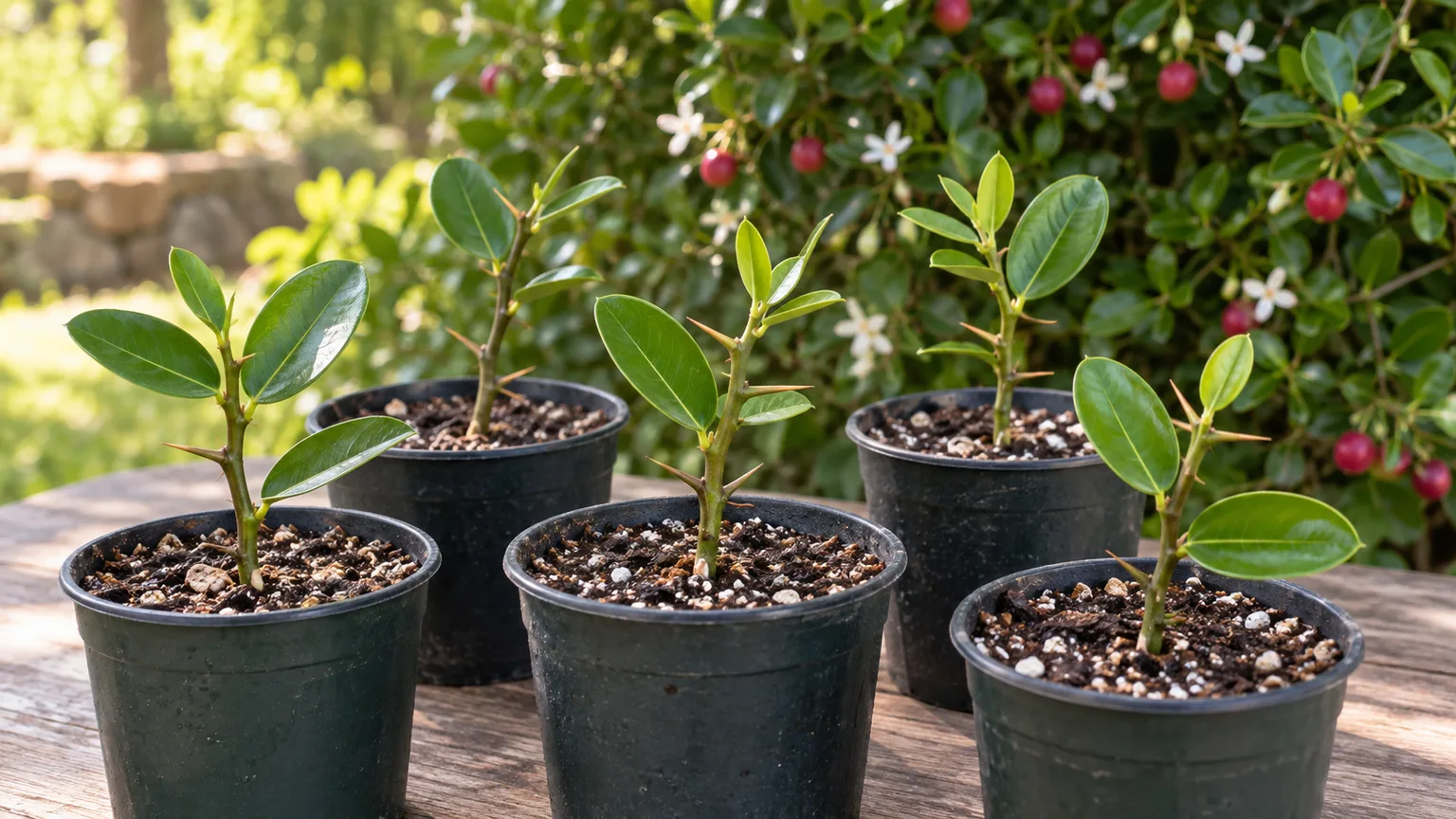
For a cutting, select a healthy semi-ripe shoot during active growth, take several short tip sections with a clean blade, and remove leaves from the portion that will sit below the mix. Set them in a small pot of airy propagation medium, keep the mix lightly moist, and provide warm bright shade while roots form; a sealed, soggy pot is more likely to rot than to help. If a low branch can be bent to the soil without forcing it, layering is another option: pin a small wounded section under the mix while it remains attached, then separate it only after it has rooted. (Florgeous; PlantZAfrica / SANBI)
Check for pests, disease, and root problems
Natal plum is generally resilient, but “low maintenance” does not mean trouble-free. UF/IFAS lists Florida red scale and foliar bacterial problems, along with root rot in poorly drained soil; NC State reports no known common pests or diseases. The difference may reflect region and growing conditions, so inspect the plant rather than assuming a yellow leaf is either harmless or a specific disease. (UF/IFAS Extension; NC State Extension)
Look at the undersides of leaves and along stems for small scale insects, sticky residue, or clusters of aphids. Isolate a potted plant if a pest is spreading, identify the insect before treatment, and use only a product labeled for that pest and ornamental plant; protect pollinators and follow the label. If spotted leaves appear after prolonged leaf wetness, improve airflow and avoid frequent overhead irrigation before reaching for a fungicide.
Diagnose yellowing and wilt before watering
Yellow leaves and drooping growth can follow both dry soil and roots that have stayed wet too long. Touch the soil at root depth, check whether water drains from the pot, and look for a recent cold snap before adding water. If the soil is soggy or the container smells sour, move it out of standing water, confirm the drainage holes are open, and inspect roots only if the plant continues to decline; soft dark roots and a persistently wet mix point toward root damage, not thirst.
If the root zone is genuinely dry, water slowly until the whole root ball is wet and then let excess drain. If only a few older leaves yellow while new growth remains firm and green, monitor the pattern rather than cutting or feeding immediately. A branch damaged by frost may also lose leaves or die back; wait until spring growth shows the boundary of living wood before pruning hard.
Handle fruit and sap with a clear safety boundary
Only the fully ripe fruit is food. NC State Extension marks the plant’s toxicity as low, identifies sap or juice as the relevant plant part, and says ingesting large amounts may cause minor symptoms such as vomiting or diarrhea; it describes the ripe fruit as edible. It says the toxic principle is unidentified and only tentatively suggests a glycoside, so do not try to estimate a safe amount of sap. Purdue’s fruit monograph says green fruit is rich in latex and recommends eating fruit only when it is fully ripe, dark red, and slightly soft. (NC State Extension; Purdue University, Fruits of Warm Climates)
There is a real source disagreement about the latex: PlantZAfrica/SANBI describes the plant’s milky latex as non-toxic, while NC State advises caution about ingesting sap or juice. NC State identifies sap/juice—not the ripe fruit—as the part of concern; its entry does not separately classify leaves or stems as food, so keep all non-fruit parts out of the mouth. Do not eat green or partly ripe fruit, and keep pruning debris and fruiting branches away from children who may chew plant material. (PlantZAfrica / SANBI; NC State Extension)
ASPCA lists Natal plum under the synonym Carissa grandiflora as non-toxic to dogs, cats, and horses, but that animal listing does not establish human safety or remove the risk of thorn punctures. If someone has swallowed sap or an unripe fruit, identify the plant and contact Poison Control in the U.S. at 1-800-222-1222 or use its online tool; elsewhere, contact the local poison center. For an animal exposure, call a veterinarian or animal poison service if symptoms appear or the amount is uncertain. (ASPCA Animal Poison Control; Poison Control)
Conclusion
Natal plum is a strong choice for a warm, sunny garden when you want a dense evergreen shrub that tolerates coastal exposure and can be shaped as a hedge or groundcover. Give it draining soil, water it by root-zone moisture while it establishes, choose a cultivar that fits the space, and keep thorny branches away from everyday traffic. If you grow it for fruit, wait for berries to become fully red and slightly soft, and keep the sap and unripe fruit out of the mouth; in colder climates, a well-lit movable container is the safer way to keep the plant.