Crassula perforata Care for Compact, Colorful Growth
Learn Crassula perforata care, from safe sun acclimation and gritty soil to seasonal watering, root-rot prevention, pruning, and reliable stem propagation.
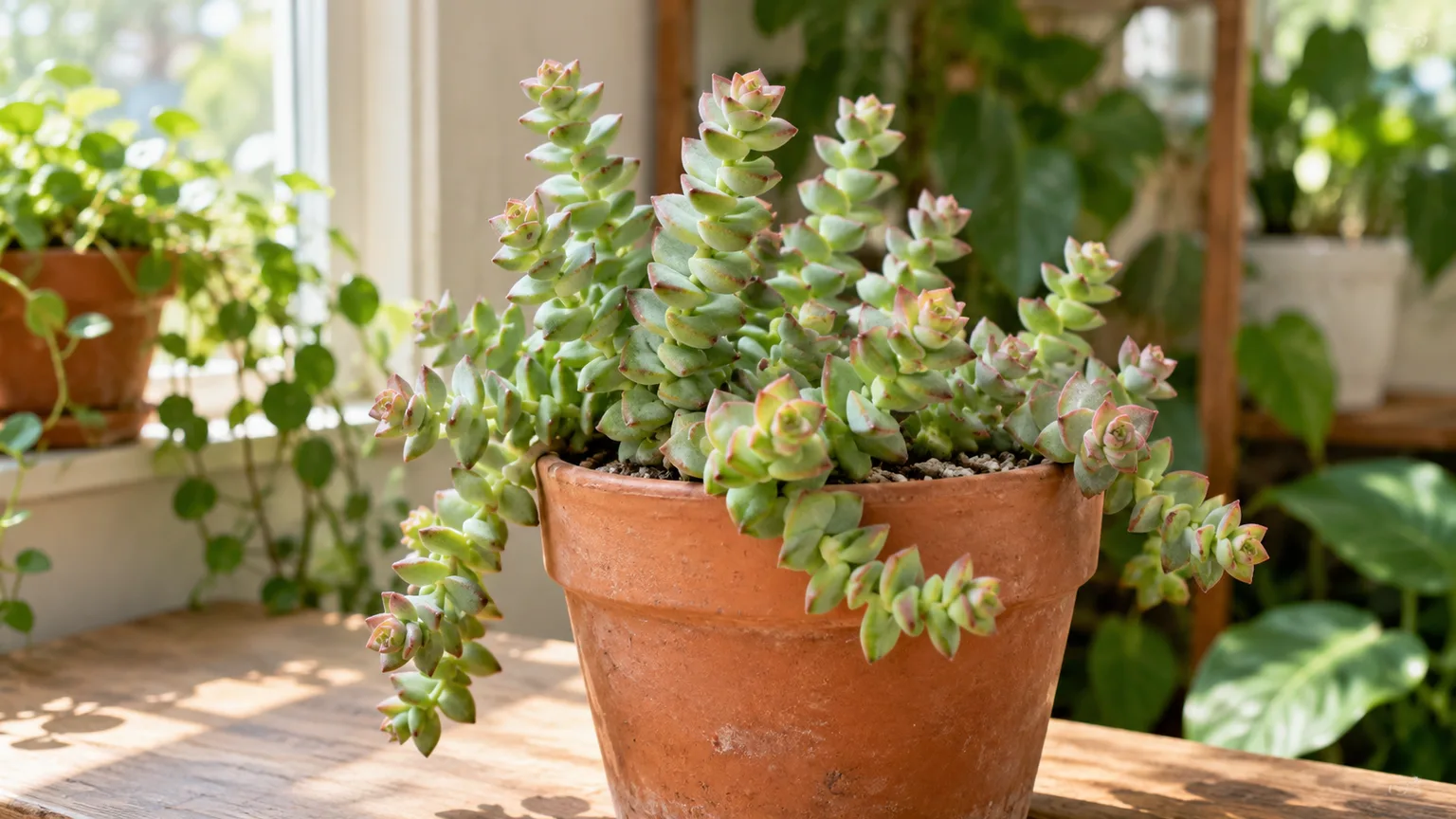
String of buttons can look tidy and upright when young, then lean and drape as its stems lengthen. That shift is normal; widely spaced leaves, soft stems, or sudden leaf loss are clues to investigate. The reliable routine is simple: give it a bright place, use a fast-draining mix in a pot with a hole, and water thoroughly only after the root zone dries.
The details matter more than a calendar. A plant beside a cool winter window uses water differently from one outdoors in summer heat, and a tightly packed decorative pot dries differently from an open terracotta pot. This guide shows you how to read those conditions and adjust without overcorrecting.
Identify Crassula perforata before choosing a care routine
The common name string of buttons refers to the stacked look of the leaves: paired, fleshy, gray-green blades clasp the stem and spiral around it. Strong light can bring out rose or red margins, while low light tends to produce looser spacing and longer, weaker stems. Mature stems usually grow upright at first and then lean or trail, so an orderly cascade is not the same thing as etiolation.
Check the botanical name on the nursery label before applying advice for “string of buttons.” That common name is also used for other Crassula, including C. rupestris subsp. marnierana, so a plant sold under the same name may not have exactly the same leaf shape or habit. PlantZAfrica’s profile of C. perforata subsp. kougaensis describes a distinct cliff-hanging subspecies with tightly packed, opposite leaves; it also documents how this plant’s form fits its exposed sandstone habitat. Treat that field profile as context for the species, not as proof that every cultivated selection has identical dimensions or cold tolerance. (PlantZAfrica)
Garden profiles describe the familiar form as a South African succulent with gray-green triangular leaves, rosy margins, small pale flowers, and stems that can spill over a pot as the plant matures. (Gardenia’s plant profile) It is grown for foliage and form, not because it needs constant pruning or frequent watering. The plant’s stored water helps it tolerate dry spells; it does not make saturated soil safe.
Give it bright light and acclimate it gradually
Indoors, choose the brightest window you can provide, with several hours of strong natural light if possible. An east-facing window offers gentler morning sun; a south- or west-facing window can work well in the Northern Hemisphere, but may need a sheer curtain or a little distance from the glass during scorching afternoons. In the Southern Hemisphere, reverse those directions. Rotate the pot occasionally so one side does not lean toward the light.
If the leaves remain compact and the stems stay firm, the position is probably working. Internodes—the bare stretches between leaf pairs—getting longer, a plant bending toward the window, or new growth losing its stacked form point to insufficient light. Increase brightness over days rather than moving a shade-grown plant straight into hot sun. A grow light can help when a window is dim, but follow the fixture’s distance and duration guidance; placing a light extremely close can heat or bleach the foliage.
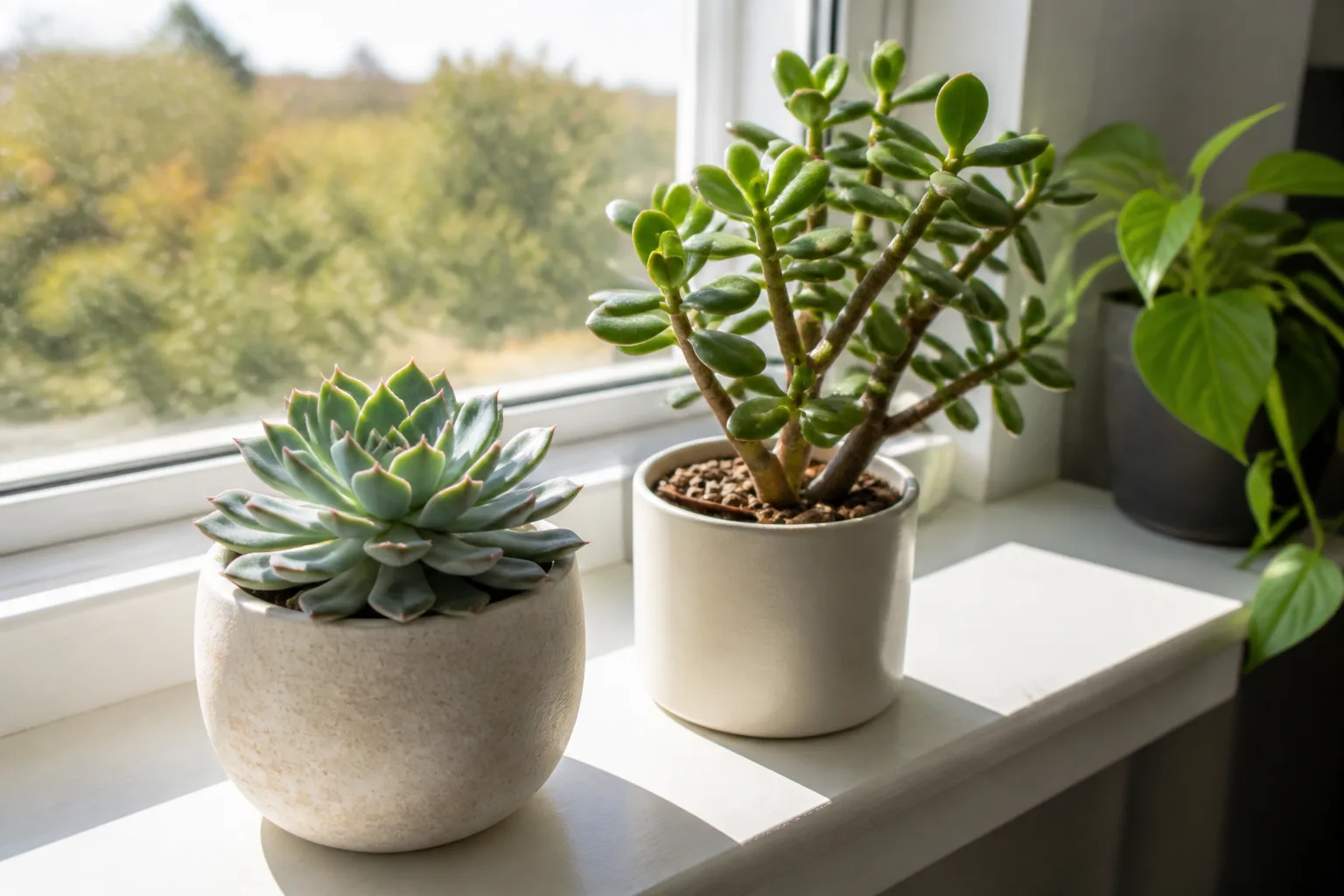
Introduce direct sun in small steps
Plants raised indoors, under shade cloth, or in a greenhouse have not necessarily adapted to outdoor ultraviolet intensity and heat. West Virginia University Extension recommends starting succulents in shade outdoors and moving them toward brighter conditions gradually; its general guidance also emphasizes a bright window and slow transitions. (WVU Extension’s succulent guide) In practice, start with bright shade for a few days, then add a short period of morning sun. Increase exposure only if the leaves remain healthy, and pause the transition during a heat wave.
Pink edges are not a requirement to chase. They can deepen with more light, but color also varies with the plant and its growing conditions. Tan, pale, or dry patches on the side facing the sun are more consistent with sunburn than attractive red edging; scorched tissue will not turn green again. Move the pot to bright shade and protect new growth while it adjusts. Do not respond to scorch by putting the plant in a dark corner, because the resulting low light can stretch the stems.
Use airy soil in a pot with a drain hole
A useful mix lets water wet the roots, then drain and dry before the next watering. Start with one part commercial cactus-and-succulent mix and one part pumice or perlite by volume. If the bagged mix contains a lot of fine peat and stays wet for many days, add more mineral material; if it dries almost immediately in a hot, breezy spot, retain a little more organic mix. These are starting proportions, not a universal formula.
Use a container with an unobstructed drainage hole. A glazed decorative pot can work if it has a hole and the mix dries at a reasonable pace; unglazed terracotta is helpful in humid rooms or for growers who tend to water too often because it loses moisture through its sides. Conversely, terracotta may dry too quickly in a hot, dry patio. A drainage hole is more dependable than a gravel layer at the bottom of a pot without one: water still needs an exit, and a stone layer does not correct a waterlogged root zone.
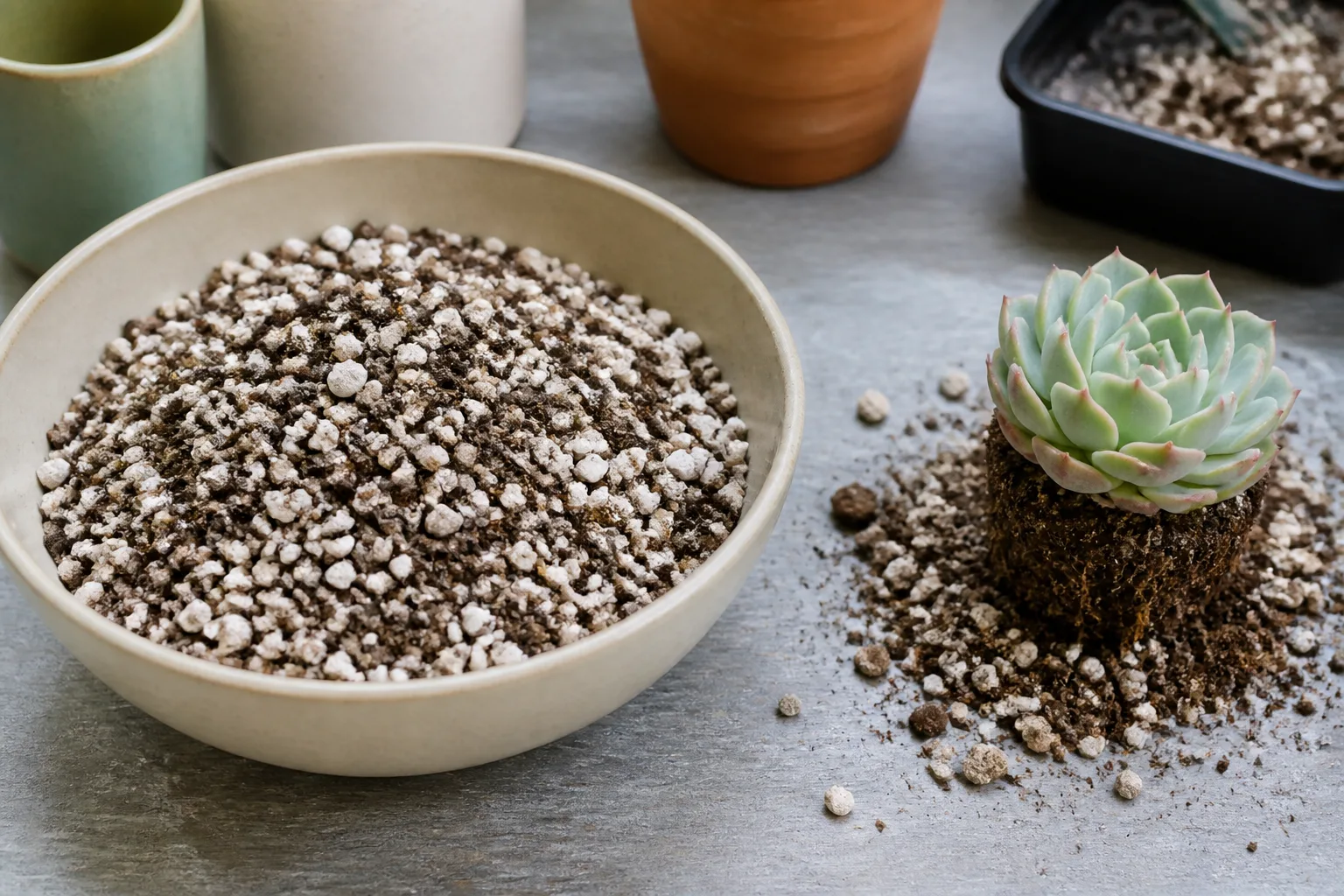
A pot that is only slightly wider than the root ball reduces the volume of mix that remains wet after watering. If the stems drape, choose a heavier pot or place the nursery pot inside a stable cachepot, then remove it to water and let it drain completely before returning it. Never leave the plant sitting in water collected in a saucer.
Water deeply only after the mix dries
There is no dependable “every Sunday” interval for every string of buttons. Water use changes with light, temperature, humidity, pot material, pot size, and root health. Check the mix instead: push a clean wooden skewer toward the lower half of the pot or feel the mix through the drainage hole. If it still feels cool or damp, wait. If it is dry through the root zone and the stems or leaves are beginning to lose firmness, it is time to water.
When watering, pour slowly over the soil until water runs from the drainage hole. Let the pot finish draining; empty the saucer or outer pot. Do not give frequent small sips. They wet only part of the root ball, encourage uneven root growth, and make it difficult to know whether the deeper soil has dried. Keep water from pooling in the leaf joints when possible, especially in cool rooms with weak airflow.
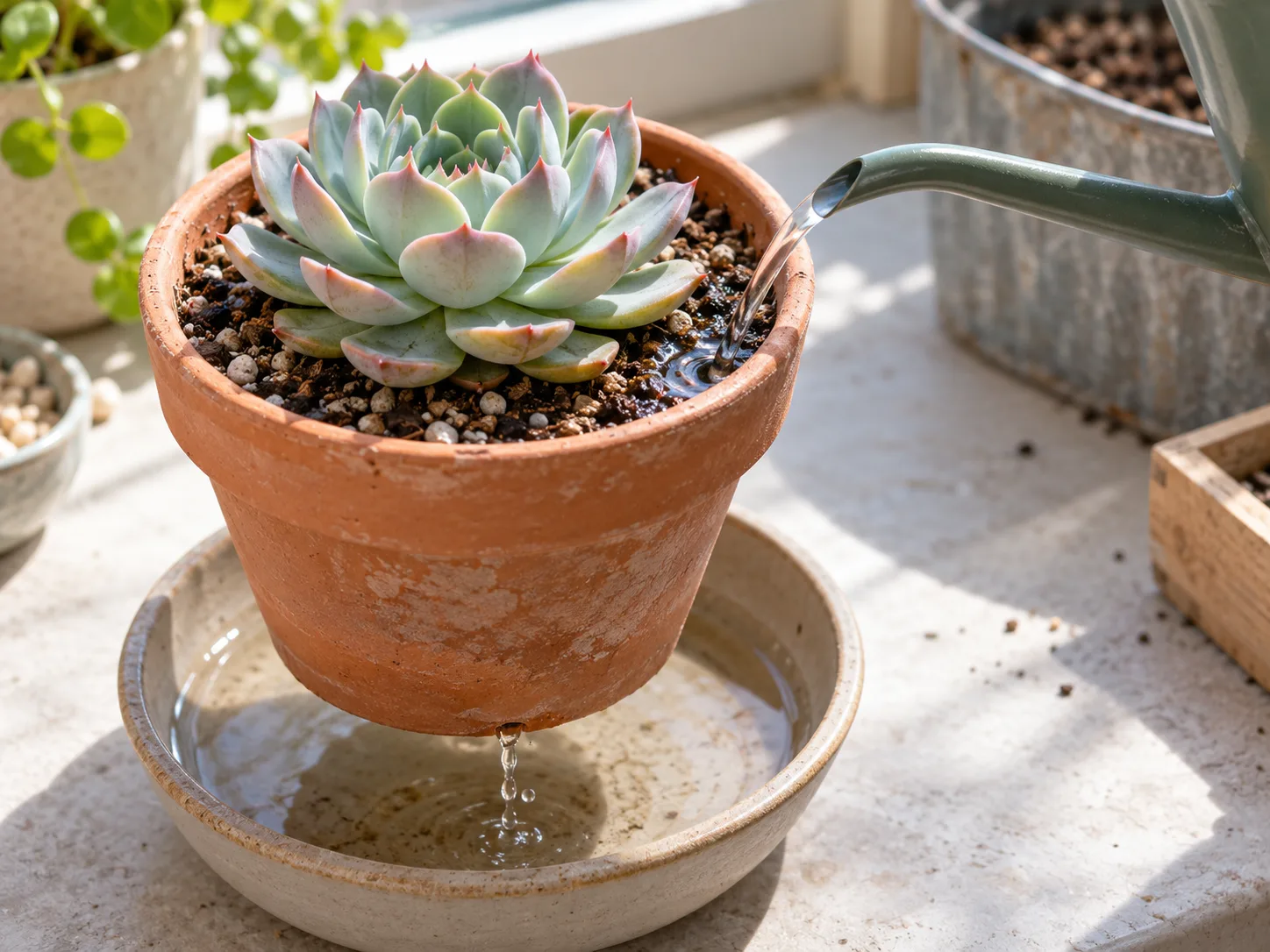
During warm, bright growth, the pot may dry sooner and need water more often. In winter or a dim room, growth slows and a wet pot can remain wet much longer, so extend the interval. A specialist grower’s account notes that climate changes the interval substantially and uses soil dryness rather than a fixed schedule as the final check. (Succulent Plant Care’s species guide) Use any seasonal schedule you see online only as a reminder to inspect, not as an instruction to water.
Read leaf texture and soil together
Slightly deflated or wrinkled leaves can mean the plant has used its stored water, but the symptom alone is not enough to diagnose thirst. If the mix is dry and the stems are firm, give a full watering and check the plant again over the next few days. Leaves may take time to plump; a limp old leaf will not always recover fully.
If leaves are soft, translucent, yellowing, or mushy while the mix is still wet, adding water is the wrong move. Check for a blocked drainage hole and inspect the roots if the plant is declining. A plant can show shriveling above ground while losing water uptake to damaged roots, so “wrinkled means thirsty” is unsafe unless you have also checked the soil. WVU Extension describes watering succulents thoroughly, then waiting for the growing medium to dry; the soil-and-leaf check is how to make that general rule work in your particular pot. (WVU Extension)
Keep it warm and move it before frost
String of buttons is best treated as a frost-sensitive container succulent. Published plant profiles give different hardiness ranges, and exposure, moisture, wind, and how long cold lasts all affect injury. If your outdoor forecast approaches freezing, move a potted specimen under cover or indoors rather than testing a label’s lower limit. For in-ground plants in a frost-free region, protect them from prolonged cold rain as well as cold air; chilly, wet soil is a harder combination than a brief dry spell.
A sunny outdoor patio can suit the plant during warm months, but bring it in before the first frost and inspect for hitchhiking insects. Indoors, keep it away from cold drafts and leaves pressed against winter glass. Normal room conditions are usually adequate; a dramatic day-night temperature difference is not needed for basic care. When moving it back outside in spring, acclimate it to sun again even if it lived outdoors the previous season, because winter growth under a window or porch roof may have reduced its tolerance.
Feed lightly only during active growth
This succulent can grow in lean, gritty soil, so fertilizer is optional. If the plant is making new leaves in spring or summer and has not been repotted in fresh mix, use a balanced or succulent fertilizer at a conservative dilution, following the product label. One light feeding during active growth is a reasonable starting point; stop if growth is weak, the mix is salty or crusted, or the plant is stressed from cold, rot, or sun damage.
More fertilizer will not repair low light, poor drainage, or a damaged root system. High nitrogen feeding can push soft growth that is less compact, while repeated feeding in a small pot can leave excess salts behind. If you are uncertain, skip the feed. The plant’s health depends far more on light, drainage, and a measured wet-dry cycle than on regular fertilizer.
Prune for shape without stripping the plant
Prune when a stem is badly stretched, damaged, crossing awkwardly, or simply longer than you want. Use clean, sharp scissors or snips and cut just above a leaf pair or branching point. Remove only a portion of the healthy plant at a time; taking off most of the foliage in one session reduces its energy reserves. Save firm, healthy cuttings for propagation, and discard sections that are black, soft, or visibly infested.
Older lower leaves may dry and fall as stems lengthen. That gradual change is different from several healthy leaves dropping at once. Clear dry leaves from the soil surface so they do not trap moisture or conceal pests. If you want a fuller container, root several healthy tips and add them back once established instead of repeatedly pinching every stem. Pruning changes the plant’s outline; it cannot make already-stretched internodes shrink, so better light is needed to keep future growth tighter.
Propagate stem cuttings for reliable new plants
Stem cuttings are the most straightforward way to make another string of buttons. Choose a firm, actively growing tip about 3 to 4 inches long, ideally with several leaf pairs. Cut below a node with a clean blade, remove leaves from the lowest inch, and set the cutting aside until the cut end is dry and sealed. Thin stems may callus quickly in dry air; a thicker cutting or a humid room may need longer. The key is a dry, healed cut, not a rigid number of hours.
Set the base into barely moist, gritty succulent mix, deep enough to stand upright without burying the lower leaves. Place it in bright indirect light, not baking sun. Avoid keeping the mix constantly wet or misting the leaves on a schedule; the cutting has little root capacity at first and can rot if its base remains soggy. Once it resists a very gentle tug or begins producing new growth, resume a cautious version of the parent plant’s soak-and-dry routine. Rooting may take several weeks, and a cutting that has not grown yet is not automatically dead if it remains firm.
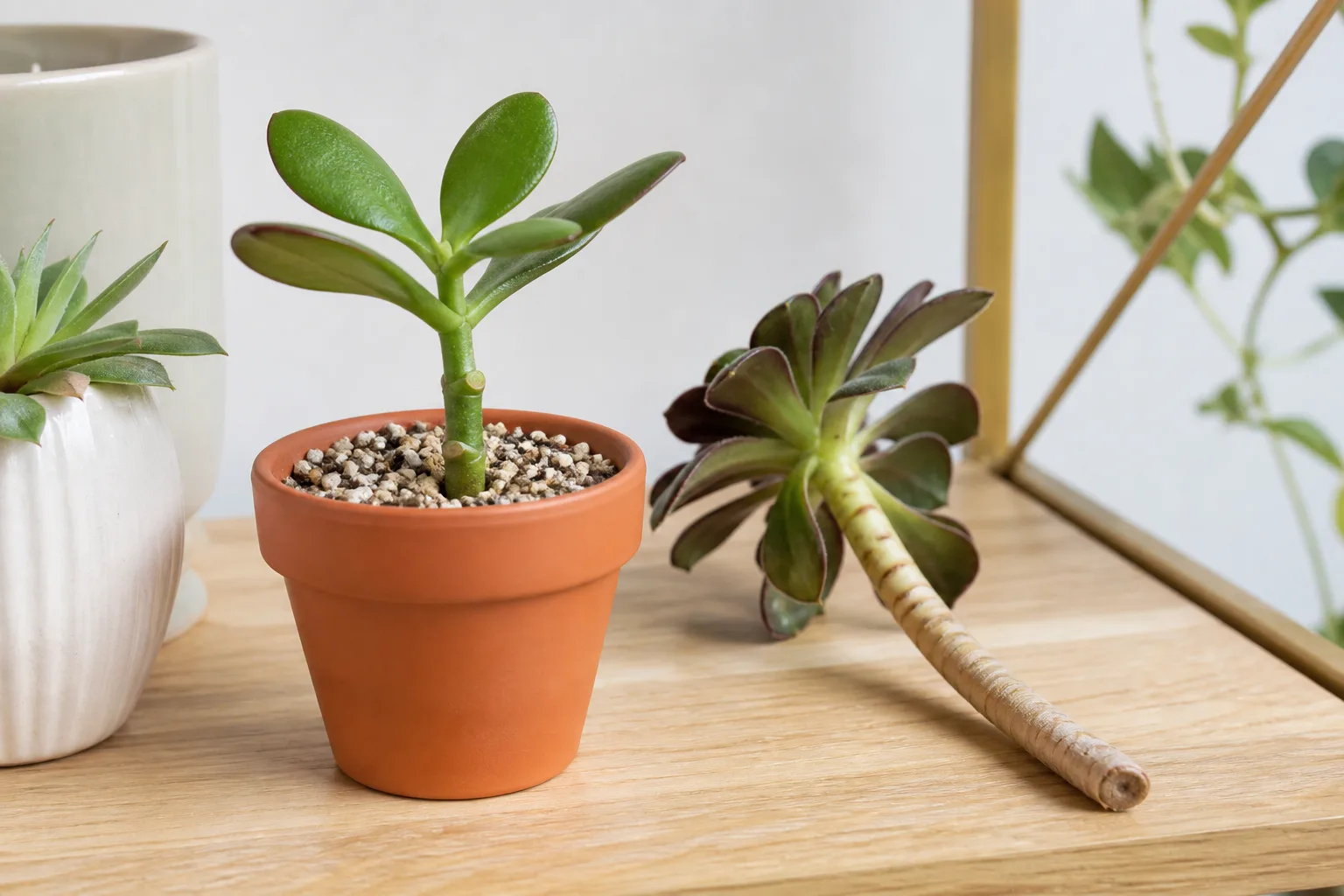
West Virginia University Extension’s general succulent propagation guidance recommends clean cuts, callusing, a porous medium, and sparing water while roots develop. (WVU Extension) The species-specific guidance from Succulents and Sunshine also identifies stem cuttings, offsets, and leaves as options, but the leaf needs to detach cleanly for the best chance of success. (Succulents and Sunshine’s Crassula perforata profile) Because the leaves clasp the stem, a broken leaf often lacks the intact base needed to produce a new plant. If you want to experiment, take more than one clean leaf and keep the parent plant’s main stems intact; use a stem cutting when you need a dependable result.
Repot only when the roots or mix need it
Repot when roots densely fill the pot, the plant dries unusually fast despite appropriate conditions, the mix has collapsed into a dense mass, or you need to remove root rot or pests. A crowded surface or a few roots peeking from one hole is not automatically an emergency. This species can live in the same pot for a long time if the mix remains open and the plant is stable.
Choose a pot one size larger at most, with a drainage hole, and use fresh dry succulent mix. Ease the root ball out without pulling on the fragile stems; support the plant at its base and lift the pot away. Trim only dead, black, or mushy roots with clean scissors. Let damaged roots dry before replanting, then wait several days before the first watering so cut roots can seal. If you repot solely because a stem is long, prune or propagate instead—extra soil around healthy roots creates no benefit.
Identify pests before choosing a treatment
Inspect leaf joints and the undersides of stems for white cottony mealybugs, fixed tan or brown scale, fine webbing, stippling, or clusters of soft-bodied aphids. A sticky residue or black sooty coating can appear where sap-feeding insects have been feeding. Isolate a new or infested plant, examine nearby pots, and remove dead leaves that hide pests. Root mealybugs are harder to spot; look for white deposits around roots when you unpot a declining specimen.
The Missouri Botanical Garden notes that mealybugs and scale weaken succulents by sucking plant sap, and that spider mites can cause fine webbing and small brown stipples. Its integrated approach prioritizes inspection, isolation, and cultural care; it also warns that alcohol or insecticidal soap may damage some succulent surfaces, so test a small area first and follow the product label. (Missouri Botanical Garden’s succulent pest guide) Do not coat the whole plant with neem or alcohol before confirming a pest: the wrong treatment can injure waxy leaves while leaving the cause unresolved.
For a small infestation, remove visible insects with a damp cotton swab or a gentle rinse while covering the soil. Let the plant dry with good airflow. If the problem persists, choose a labeled treatment that names the pest and is appropriate for the plant, test a discreet leaf first, and repeat only as the label directs. Fungus gnats around the pot usually signal persistently damp mix; correcting the wet conditions matters more than spraying the leaves.
Troubleshoot stretching, leaf drop, scorch, and rot
Use the pattern and timing of symptoms rather than reacting to one leaf. Longer gaps between leaves usually point to inadequate light, especially when the whole stem leans toward a window. Increase light gradually, then prune and root the healthy tips if you want to restore a compact silhouette. Old stems may remain sparse even after new growth improves.
A few dried leaves at the base can be normal as stems mature, but sudden leaf drop after a move suggests a sharp change in light, temperature, or watering. Patchy bleached or tan marks on the sun-facing side suggest sunburn; move the plant into bright shade and let damaged tissue remain until it dries. Brown, translucent, or mushy leaves combined with a wet pot point toward excessive moisture or rot. Remove dead tissue, improve drainage, and investigate the roots rather than feeding or watering to “help” a plant that is already wet.
Separate thirst from root damage
Use a two-part check before watering: first, assess soil moisture deep in the pot; second, feel whether the stems and leaves are firm or collapsing. Dry mix plus deflated leaves supports a careful deep watering. Wet mix plus soft or translucent leaves means stop watering and inspect drainage and roots. Dry mix plus healthy, firm leaves means the plant can wait. Wet mix plus firm leaves calls for patience and better airflow, not another drink.
If rot has reached the stem base, save any firm green upper sections before the damage spreads. Cut well above all discolored tissue, clean the blade between cuts, and treat the healthy tips as new cuttings. Discard rotted material rather than putting it into a shared propagation tray. If you remove the plant from its pot and the roots are largely sound, replace the old mix and correct the drainage; if the roots are brown and soft, prune them back before repotting. The goal is to remove the cause and preserve healthy tissue, not to force the original shape to recover.
Keep the plant out of reach of pets that chew
Plant-safety labels for succulents are not always species-specific, and common names can refer to more than one plant. The ASPCA explains that its plant database is not all-inclusive and that eating any plant material can cause gastrointestinal upset in dogs and cats. (ASPCA’s plant-safety guidance) Keep string of buttons where a pet or young child cannot chew it, and retain the nursery label so the plant can be identified. If an animal eats part of it, contact a veterinarian or animal poison service for advice rather than relying on a broad online label or trying a home treatment.
Choose indoor, patio, and garden placements
As a houseplant, string of buttons is easiest to manage in a bright window, a stable pot, and a room with ordinary airflow. Avoid a closed terrarium: the cramped, humid environment can keep the mix wet and make it hard to provide enough light without heating the glass. A hanging planter can show off mature trailing stems, but choose one with drainage and make sure the basket is secure before the plant becomes heavier.
Outdoors, use a patio container in warm months or a sunny, sharply drained rock-garden spot where frost is uncommon. Do not plant it beside thirsty companions that need frequent irrigation. A mixed succulent container is attractive only when every plant can tolerate the same light and drying cycle; a small rosette that needs more frequent water may not be a good long-term match. Gardenia lists containers, hanging baskets, rock gardens, and ground cover among common uses for this species, but its performance still depends on drainage and local climate. (Gardenia) In a cold-winter region, a movable pot is the simplest way to keep it outdoors in summer and protect it indoors before frost.
Conclusion
For healthy string of buttons, start with the pot and the light, then let the plant’s actual drying rate set the watering interval. A bright position keeps new growth compact; a gritty mix and open drainage protect the roots; and a stem cutting gives you a practical way to reshape an overgrown plant while making a backup. Change one condition at a time so you can see whether the plant responds.
When a problem appears, read the leaves alongside the soil. Firm leaves in dry mix, soft leaves in wet mix, and a stretched stem each call for a different response. That small check is more useful than watering by the week, applying fertilizer to a stressed plant, or moving it straight into intense sun.



