How to Grow and Care for American Wintergreen Plants
Grow wintergreen (Gaultheria procumbens) in acidic soil with filtered light and steady moisture; learn why fruit may be sparse and how to winter a pot.
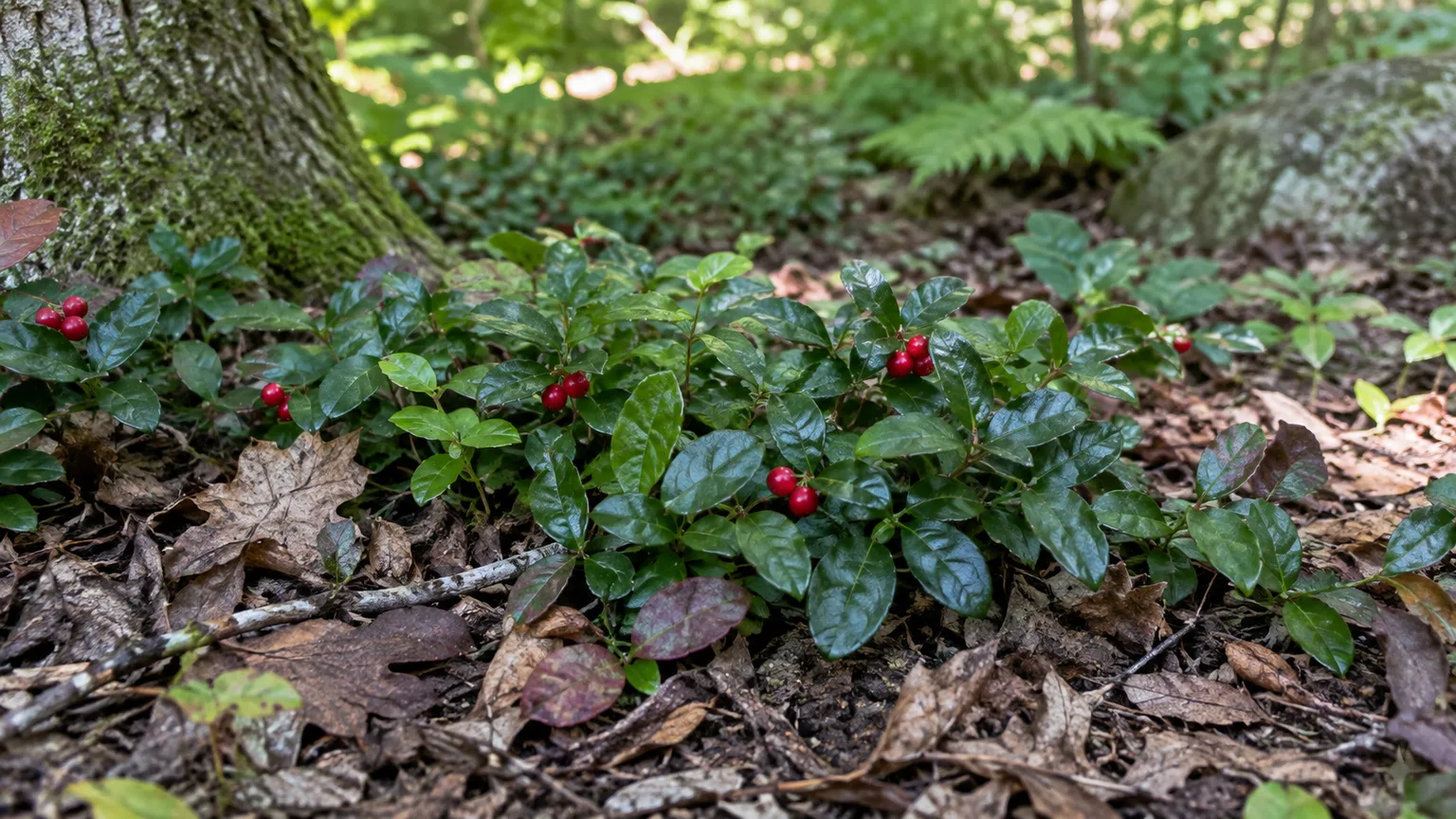
The wintergreen that makes a low, glossy groundcover with red fruits is American wintergreen, Gaultheria procumbens. It grows best where the soil stays cool, acidic, and lightly moist, with enough organic matter to hold water but enough drainage to keep its shallow roots from sitting wet. A partly shaded woodland edge is usually easier to manage than a hot, dry bed or a warm living room.
This is a slow, creeping native shrub, not a culinary mint and not winterberry holly. Give it the right soil and time, and its evergreen leaves, small summer flowers, and persistent fruit can bring detail to the ground layer when many other plants have gone dormant. The trade-off is patience: it does not fill a large area quickly, and shade tolerance does not guarantee a heavy crop of berries.
| Care decision | Practical starting point |
|---|---|
| Light | Dappled or partial shade; a little more filtered light can support flowering and fruiting |
| Soil | Acidic, humusy, and moist but well-drained; a pH around 4.5–6.0 is a useful target |
| Water | Keep new plants evenly moist; established plants can handle brief dry spells but not repeated drought |
| Spacing | About 10–14 inches apart for a planting that may eventually knit together |
| Feeding | Usually none; top-dress with a thin layer of leaf mold or compost |
| Growth | Low and creeping, typically several inches tall; spreads slowly by rhizomes |
| Winter | Hardy in cold climates in the ground; insulate pots because container roots are more exposed |
Identify the wintergreen you are growing
The botanical name on the label is the most reliable way to confirm the plant. Gaultheria procumbens is native to eastern North America and is sold as American wintergreen, eastern teaberry, checkerberry, boxberry, or creeping wintergreen. It has a low, prostrate habit, small leathery oval leaves clustered along trailing stems, and tiny white-to-pink bell-shaped flowers near the leaf bases. Its bright red, berry-like fruit is technically a fleshy calyx around a capsule, rather than a conventional berry. NC State Extension’s profile and the USDA Forest Service species review describe this creeping, rhizomatous form and its fruit.
Common names can mislead. Gaultheria shallon is salal, a larger Pacific Northwest shrub; spotted wintergreen is Chimaphila maculata; winterberry holly is Ilex verticillata, a deciduous shrub in an entirely different family. These are not interchangeable plants, and their growing needs, fruit, and safety profiles differ. If the plant is intended for a shaded groundcover, look for G. procumbens on the nursery tag instead of relying on a holiday display label that says only “wintergreen.”
Decide whether your site suits this woodland groundcover
Wintergreen is a good fit for a cool woodland border, the open edge of a shrub bed, a rock garden with acidic soil, or a container that can remain outdoors. It is not a fast erosion-control plant or a universal solution for dry shade. The Native Plant Trust describes it as slow-growing and notes that it can be outcompeted by more aggressive groundcovers; that is a useful expectation to set before you buy a flat of small starts. Native Plant Trust
Its natural range spans cold parts of eastern Canada and the United States, and horticultural references generally place it in roughly USDA Zones 3–7, with specific limits varying by source and cultivar. Oregon State University lists it as hardy to Zone 3, while local extension data includes zones 3a through 7b. In a warmer climate, a cool, protected microclimate matters more than a zone number alone: morning light, afternoon shade, reliable moisture, and protection from hot reflected heat improve the odds. Oregon State University’s landscape profile
Before planting, check three things: whether nearby soil is acidic, whether water drains after rain, and whether tree roots or aggressive groundcovers will crowd this shallow-rooted plant. Existing blueberries, mountain laurel, or other acid-loving woodland plants can suggest the bed is suitable, but they do not replace a pH test. If your site is alkaline, very dry, or dominated by vigorous grass, a container with an acidic mix may be more realistic than repeated amendments in the ground.
Choose light for healthy leaves and reliable fruiting
Dappled shade or partial shade is the best starting point. Wintergreen tolerates deep shade, but a plant that merely survives beneath a dense canopy may flower or fruit sparingly. The USDA Forest Service review notes that fruiting commonly occurs in openings and that the species can be abundant under intermediate light; this helps explain why a bright woodland edge can produce more ornamental fruit than the darkest corner of a garden. USDA Forest Service
Aim for filtered light, morning sun, or a few hours of gentle direct light rather than scorching afternoon sun. In a cooler northern site with consistently moist soil, the plant may take more sun; in a warmer or drier yard, afternoon shade reduces stress. Watch the leaves through summer: persistent bleaching, crisp margins, or dry patches on the exposed side suggest too much direct sun or inadequate moisture. Sparse flowers in a very dark bed may call for a modest increase in light, not an abrupt move into full sun.
Prepare acidic soil that still drains freely
Soil chemistry is often the make-or-break decision. NC State Extension categorizes the plant for acid soil, and the USDA Forest Service review reports an optimum pH of about 4.5–6.0. The same review records populations across a wider range, which shows that a plant can occur outside its preferred range; it does not mean that a neutral or alkaline garden bed will support consistently vigorous growth. NC State Extension USDA Forest Service
Use a soil test before trying to lower pH. A test helps distinguish alkaline soil from symptoms caused by drought, compaction, or root damage, and it gives you a starting point for any recommended amendment. Do not add elemental sulfur, acidic fertilizer, or large quantities of peat by guesswork: overcorrection can create a new problem, and soil treatments work differently depending on texture and buffering capacity. If your soil is clearly alkaline and changing the whole bed is impractical, plant wintergreen in a wide, freely draining container using a mix sold for acid-loving plants.
The texture should resemble a woodland floor: organic matter mixed through a soil that drains after rain. A thin layer of leaf mold can add organic material without burying the crown. Avoid planting in a low pocket where water stands for days. “Moist” and “wet” are not synonyms—wintergreen handles moist ground and some dry spells, but stagnant water deprives roots of oxygen and invites decline.
Plant shallowly and give a slow grower room
Plant in spring or early fall when temperatures are moderate and you can keep the root ball from drying during establishment. Water the nursery pot first, then loosen the outside of a tightly circling root ball gently. Set the top of the root ball level with the surrounding soil; do not bury the stems or mound soil over the crown. Because the roots are shallow, planting deeply does not make wintergreen more secure—it puts the growing points in a wetter, less aerated layer.
Space young plants about 10–14 inches apart if you want them to grow together as a groundcover. That spacing appears in the NC State Extension profile; Oregon State gives roughly a foot between starts. Tighter planting costs more and does not change the species’ growth rate, while wider spacing leaves more open soil to weed until the rhizomes slowly branch. Leave room for neighboring plants and mark the bed edge so you can see where the colony is going. NC State Extension Oregon State University
After planting, water thoroughly and apply a light mulch of shredded leaves or leaf mold. Keep mulch off the leaf crowns. During the first growing season, check the soil more often than you would for an established patch; a small root ball in a new bed can dry even when the surrounding woodland soil looks damp.
Water to keep the root zone evenly moist
There is no dependable “once a week” schedule for every garden. Rainfall, shade, soil texture, temperature, and the plant’s stage of establishment all change how quickly the root zone dries. During the first season, check beneath the mulch every few days during dry weather. If the soil at root depth feels dry, water slowly enough to wet the root ball and nearby soil; if it still feels cool and moist, wait.
Once established, wintergreen can tolerate occasional dry conditions, but repeated summer drought may cause leaf drop, brown margins, weak flowering, or a stalled patch. A shallow root system can dry quickly beneath trees that compete for water, so do not assume that woodland plants are automatically watered by the canopy. On the other hand, frequent shallow sprinkling can keep the surface wet without replenishing deeper soil and may encourage shallow roots. A less frequent, thorough soak is usually more useful than daily surface misting when the ground has actually dried.
Containers dry faster than woodland beds. Check a pot with a finger or lift it to assess weight, and water when the upper layer begins to dry while the root zone remains slightly damp. Make sure excess water drains away; do not let the pot stand in a full saucer. In winter, check moisture during mild spells because evergreen leaves continue losing water, even when growth is slow.
Mulch lightly and skip routine heavy feeding
In a natural setting, fallen leaves break down above the roots and help maintain a cool, organic surface. A thin annual layer of shredded leaves or leaf mold recreates that condition and suppresses some weeds without smothering the plant. Keep the material loose and shallow, especially where stems emerge. A thick wet mulch piled against the foliage can hide rot, trap moisture at the crown, and make it harder to see whether the patch is establishing.
Routine high-nitrogen fertilizer is usually unnecessary. Wintergreen is adapted to nutrient-poor woodland soils, and excess feeding can encourage soft foliage without correcting unsuitable pH, poor drainage, or drought. If a soil test identifies a deficiency, follow its recommendation for the bed rather than applying a general fertilizer by habit. Otherwise, focus on drainage, organic matter, and moisture; a light leaf-mold top-dressing is a better match for the plant’s setting than a heavy feeding schedule.
Understand flowers, pollination, and berry set
Wintergreen’s small white or pale-pink flowers hang beneath the leaves in late spring or summer, with timing shifting by region. Their low position makes them easy to miss, especially when the plant is growing in a thick groundcover. After flowering, the conspicuous red fruits develop and may persist through winter into spring if wildlife does not eat them first. The USDA Forest Service describes flowering from late May into September depending on location and notes that leaves usually persist through winter. USDA Forest Service
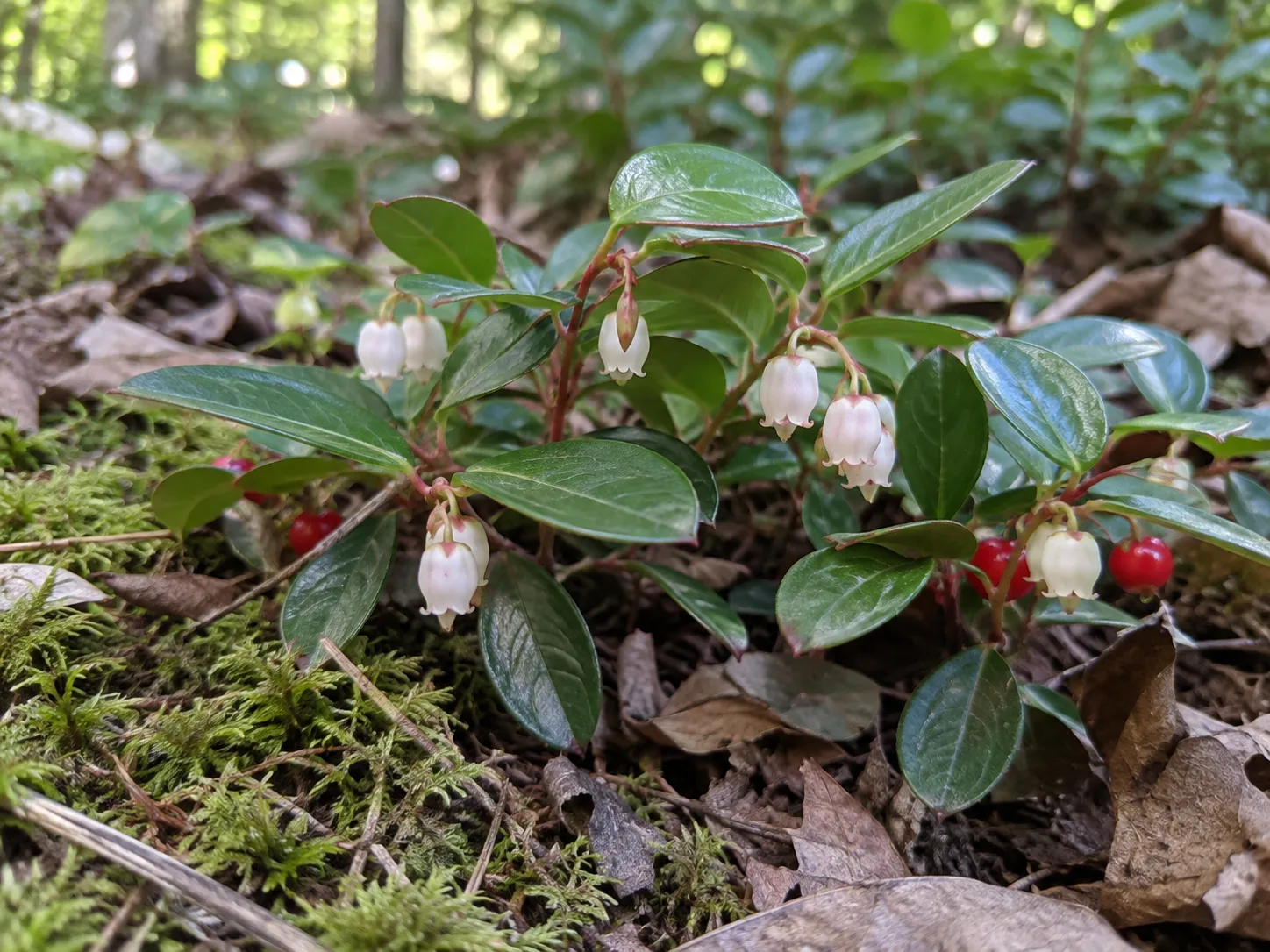
No berries does not automatically mean you need to buy a second plant. Start by checking whether the plant is mature enough to flower, whether it received any filtered light, and whether drought or a late hard freeze may have interrupted growth. A research study on G. procumbens found no consistent difference in fruit and seed set between pollinator-excluded plants and controls at the studied sites, so visible bee activity is not the only useful diagnostic. That result is not a guarantee that every cultivar or garden will fruit; cultivar behavior and local conditions can vary. Study of pollination and fruit production in Gaultheria procumbens
The practical order is to improve light modestly if the planting is very dark, stabilize moisture during flowering and fruit development, and give the patch time to mature. Avoid heavy pruning before fruit forms, and do not expect a young, stressed, newly transplanted start to look like a nursery pot covered in berries. If flowers appear but fruit repeatedly fails, compare the plant’s light, moisture, winter conditions, and cultivar label before assuming a pollination problem.
Grow wintergreen in a container or as a gift plant
A container is useful when the garden soil is alkaline, the planting area is small, or you want to display wintergreen on a shaded porch. Choose a wide pot with drainage holes, use an acidic, moisture-retentive but free-draining mix, and avoid a container much larger than the root ball. A wide, shallow vessel suits the creeping habit better than a narrow, deep pot. Check moisture regularly because exposed containers heat and dry faster than the ground.
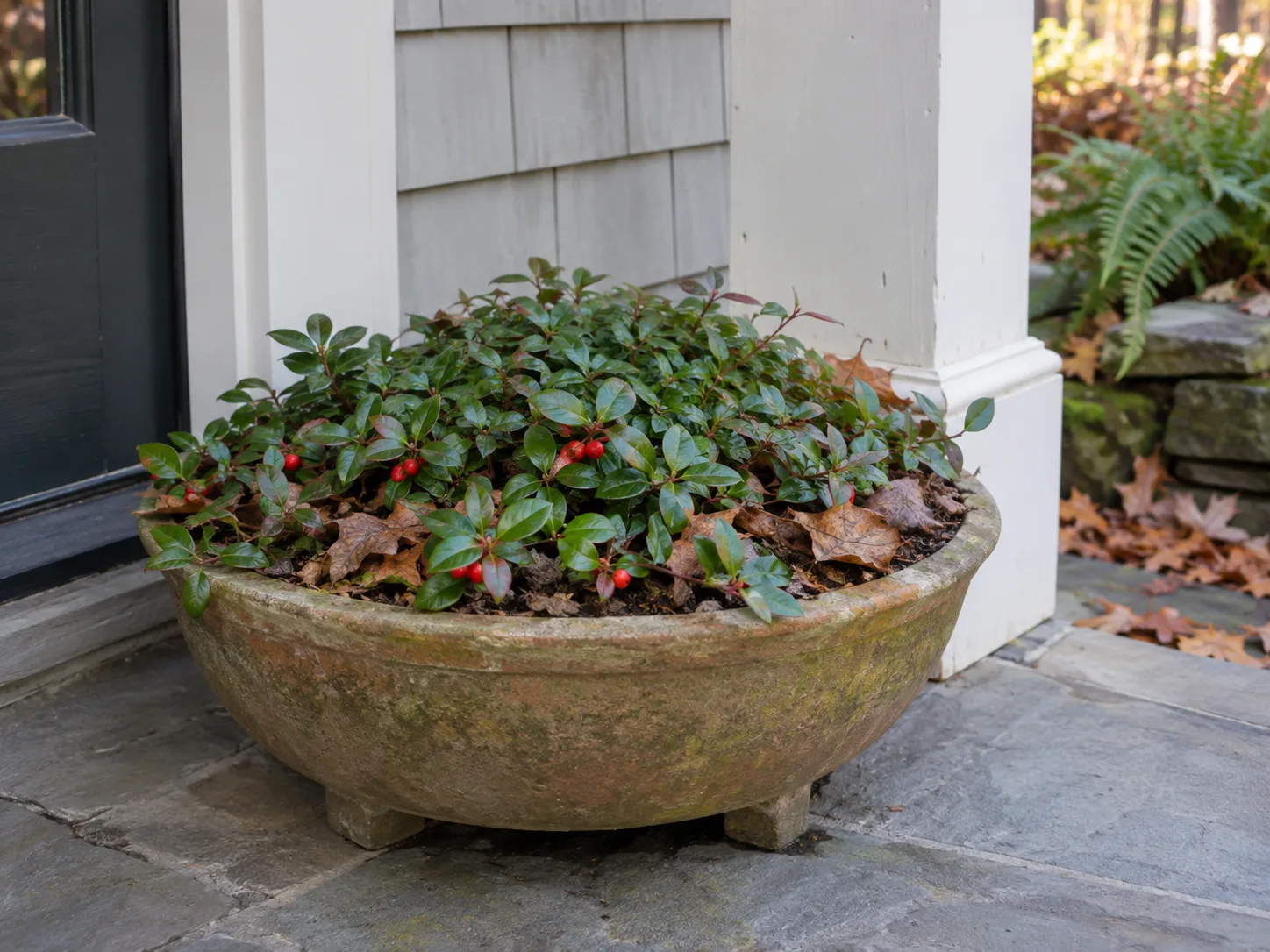
The plant is often sold as a holiday gift because its red fruits and glossy foliage look festive. Treat it as a hardy outdoor shrublet temporarily brought inside, not a long-term warm-room houseplant. Keep it in the coolest bright spot available, away from radiators and dry air, and water enough to prevent the root ball from drying without leaving it saturated. After the display, return it outdoors gradually when local weather allows; sudden shifts from heated indoor air to freezing wind can shock foliage and roots.
For a container that stays outside year-round, protect the roots more than the foliage. A plant in the ground benefits from the insulating soil around it, while a pot is exposed to cold on all sides and can freeze and thaw repeatedly. In cold climates, group pots against a sheltered wall, mulch around the container, or sink the pot into the ground for winter. Keep drainage holes open and do not wrap the foliage airtight.
Protect evergreen foliage through winter
Wintergreen keeps its leaves in cold weather, though foliage may turn bronze, red, or purplish as temperatures fall. That seasonal color is not automatically damage. If leaves remain firm and the plant resumes growth in spring, a reddish cast is often a normal response to cold and reduced light rather than a reason to fertilize or prune.
The main winter risks are wind exposure, drying, and freeze-thaw stress in containers. Before the ground freezes, water an outdoor pot if its mix is dry, then insulate the pot or move it to a protected outdoor location. Do not bring it into a heated room for the entire winter; wintergreen is a cold-hardy perennial whose seasonal rhythm is part of its care. In the ground, a modest leaf mulch is usually enough, and removing every fallen leaf defeats the woodland-floor conditions the plant uses.
Prune minimally and manage rhizomatous spread
Wintergreen needs little shaping. In early spring, remove dead or badly damaged leaves and stems with clean snips, taking care not to cut into healthy creeping stems or disturb shallow roots. It is not necessary to shear the planting or remove every brown leaf. Extensive pruning can remove the flowers or fruiting growth you hoped to keep, while natural seasonal reddening does not call for a cutback.
The plant spreads by creeping rhizomes and can form small colonies, but its growth is slow compared with aggressive groundcovers. Let it expand at its own pace rather than crowding it with fast runners. To keep it within a defined bed, lift or cut a rooted rhizome at the edge and replant or remove that section. Weed carefully by hand; deep hoeing can sever the shallow network that supports the colony. USDA Forest Service
Propagate by rooted divisions or seed
The simplest home method is to separate a rooted section of rhizome. In spring, find a creeping stem that has formed roots and at least one healthy leaf cluster, loosen the surrounding soil with a hand fork, and lift a small section without tearing away all its roots. Replant it at the same shallow depth in acidic, moist soil, water it in, and keep the spot evenly moist while it re-establishes. Avoid taking divisions from wild plants; buy nursery stock or propagate from plants you own where local rules permit.
Seed is possible but slower and less predictable for a gardener who wants a small groundcover patch. Fine Gardening lists fall sowing in a cold frame alongside semi-ripe cuttings and spring rooted suckers as propagation options. For a home planting, a rooted division or nursery-grown plant gives a clearer start because it already has a stem-and-root connection. Named cultivars may be patented or otherwise protected, so check the plant tag and applicable rules before propagating a named selection for sale. Fine Gardening’s Gaultheria guide Royal Horticultural Society
Troubleshoot yellow leaves, weak growth, and missing berries
Read the plant and its soil together before changing several care factors at once. Yellowing in a wet bed points first to drainage or root stress; yellowing in dry soil may reflect drought, especially under a tree whose roots compete for water. Pale growth in alkaline soil can also indicate nutrient availability problems. Test pH, inspect drainage, and check root-zone moisture before adding fertilizer, acidifier, or more water.
If the patch barely expands, remember that slow growth is normal. It may also be crowded by grass or another groundcover, planted too deeply, or set in full shade with little usable light. Remove competitors gently, uncover buried crowns, and correct the site in small steps. A plant that has been in the ground only one season may still be establishing rather than failing.
Sparse or absent fruit has several possible explanations: a young plant has not flowered, deep shade limits bloom, drought stressed the plant during the growing season, or a cultivar differs from the species. If leaves look healthy but the plant has no flowers, inspect light first. If flowers formed but fruit did not, keep soil moisture steady and avoid removing spent flowers; allow a full season to assess whether the change helped.
Watch for pests and diseases without over-treating
Wintergreen is not usually a high-maintenance pest plant, but aphids or thrips may feed on tender growth, and fungal leaf spots or mildew can occur. First improve the conditions around the foliage: give plants enough spacing for airflow, remove badly affected debris, and water at soil level rather than routinely wetting leaves. A few insects on a small patch rarely justify an immediate pesticide application.
If a pest population is increasing, identify it before treating. A strong water stream can dislodge some aphids, while insecticidal soap is appropriate only when its label permits use on the plant and pest in question; test a small area and follow the label. Do not use a broad-spectrum pesticide merely because leaves are spotted. Persistent decline is more often solved by fixing soil pH, drainage, or water stress than by spraying without a diagnosis. Native Plant Trust NC State Extension
Handle berries and wintergreen oil with care
Wintergreen’s peppermint-like scent comes from aromatic compounds associated with methyl salicylate. The concentrated essential oil is not equivalent to a few ornamental fruits: MedlinePlus warns that methyl salicylate can be poisonous in large amounts, and the Merck Veterinary Manual notes that oil of wintergreen is highly concentrated in this compound. Do not distill the plant at home, apply concentrated oil, or use a homemade tea as a medicinal treatment. MedlinePlus Merck Veterinary Manual
Authorities differ in how they discuss the fruit: NC State Extension and Native Plant Trust describe the fruit as edible, while the RHS labels it ornamental and advises against eating it. Because wintergreen is easy to confuse with other red-fruited plants and a nursery ornamental may have an uncertain growing history, the prudent garden advice is not to eat berries unless you can positively identify the species and have reliable guidance for the intended use. Keep the plant and its fruit away from small children who may sample garden plants. NC State Extension Native Plant Trust RHS
Do not infer pet safety from the plant’s culinary history. The ASPCA notes that its plant database is not all-inclusive and that eating plant material can cause gastrointestinal upset even with plants listed as non-toxic. If a pet chews wintergreen or you are unsure what was eaten, contact a veterinarian or animal poison-control service with the botanical name and any product label; concentrated oil exposure is a different and more serious concern than simply smelling a garden plant. ASPCA Poison Control
Conclusion
For a healthy patch of wintergreen, start with the soil and the site: confirm you have Gaultheria procumbens, test for acidic conditions, provide dappled light, and keep the shallow root zone moist without leaving it waterlogged. Plant starts at grade and give them space and time; this is a slow woodland groundcover, not a quick carpet. More light can help flowering and fruiting, but summer heat and drought can undo that gain.
Treat a potted holiday specimen as an outdoor perennial after its brief indoor display, protect container roots during winter, and troubleshoot yellow leaves or sparse berries by checking moisture, drainage, light, and pH in that order. With those conditions in place, wintergreen can provide subtle evergreen structure, seasonal leaf color, small flowers, and red fruit in a part of the garden that often needs a patient, low-growing plant.