How to Grow & Care for Rabbit's Foot Fern
Rabbit's foot fern care made practical: keep fuzzy rhizomes on top, water by pot weight, boost humidity, and avoid the burying mistake that causes rot.
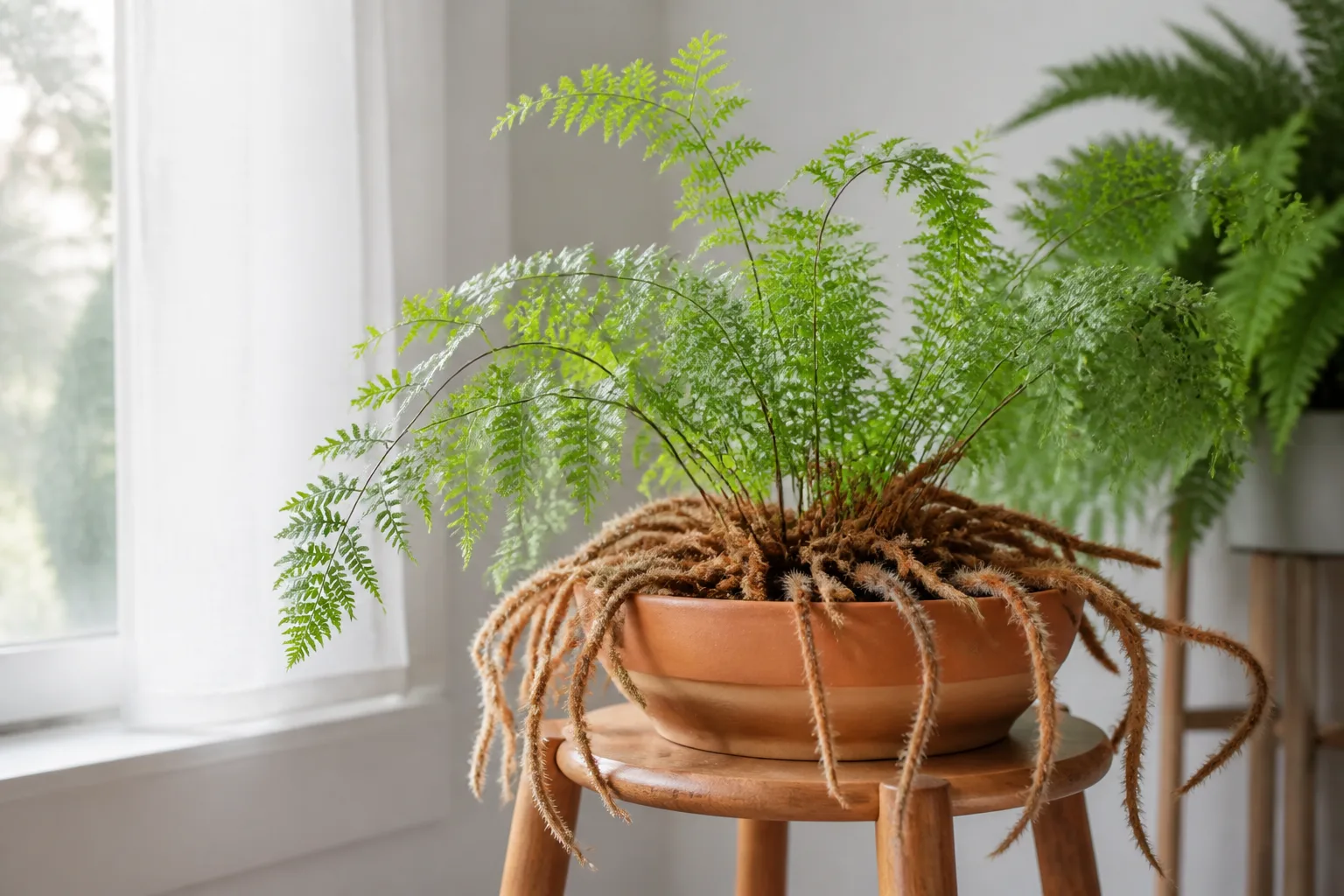
Rabbit’s foot fern (Davallia fejeensis, often still sold as Davallia solida var. fejeensis) is the houseplant people buy for the roots. Lacy green fronds are lovely, but the show is the fuzzy, fur-covered rhizomes that creep over the pot rim and dangle like rabbit paws. That unusual anatomy is not decorative trivia — it is the care manual. Davallia species are epiphytic ferns native to Fiji and the Caroline Islands. In the wild they anchor to tree bark and rock crevices, drawing moisture from humid air and rain while their rhizomes stay exposed. Treat rabbit’s foot fern like a terrestrial fern buried in deep potting mix and you will rot the rhizomes, dry the “feet,” and wonder why the fronds crisp overnight.
The good news: NC State Extension notes rabbit’s foot fern is more tolerant of low humidity than many ferns — but it still looks dramatically better with real humidity, and the rhizomes must never go bone dry. This guide covers species ID, whether your room can support the plant, and the light, watering, humidity, soil, feeding, potting, propagation, outdoor summer use, winter rest, and troubleshooting steps that keep Davallia lush for a decade or more. When fronds fail, you get a first-action order — not a vague loop of “mist more.”
For broader fern context, see the indoor fern care guide and types of fern roundup. For epiphytic cousins with similar rhizome logic, compare blue star fern and staghorn fern.
Rabbit’s Foot Fern Quick Reference
Use this table as a checkpoint before you change three variables at once. Epiphytic ferns punish stacked mistakes.
| Factor | Indoor target | First sign you missed it |
|---|---|---|
| Light | Bright indirect; gentle morning sun OK on porch | Bleached or scorched fronds = too much sun; sparse pale growth = too dim |
| Water | Moist mix; top ½ inch dry between soakings; rhizomes never bone dry | Crispy rhizome tips; limp fronds with light dry pot |
| Humidity | 50–60%+ near foliage; higher is better | Brown frond edges with “correct” soil moisture |
| Rhizomes | Mostly on top of mix; cascade freely | Mushy buried rhizomes; crown rot smell |
| Soil | Peaty, moisture-retentive, free-draining | Soggy smell, black mush at crown |
| Temperature | Above 55–60°F year-round; avoid cold drafts | Below ~50°F damages fronds |
| Fertilizer | Dilute liquid every 2–3 weeks in active growth; reduce Oct–Mar | Pale stunted fronds after stable moisture |
| Repotting | Every 2–3 years; shallow wide pots | Plant outgrows basket aesthetically before it “needs” space |
| Pets | NC State tags non-toxic for cats and dogs | Do not confuse with toxic asparagus “fern” |
| Outdoor zones | USDA 10–12 for year-round planting | Patio OK above ~60°F; bring in before chill |
What You Are Actually Growing (Davallia fejeensis and Lookalikes)
Rabbit’s foot fern is the common name for Davallia fejeensis, a tropical evergreen fern in the Davalliaceae family (sometimes listed under Polypodiaceae in older references). The genus honors Swiss botanist Edmond Davall. The species epithet fejeensis means “of Fiji,” where the plant is native alongside the Caroline Islands. Missouri Botanical Garden describes it as an epiphytic evergreen with hairy-scaled surface rhizomes that grow over and down pot sides, plus broad green fronds that are 3- or 4-pinnate — meaning finely divided, lacy foliage on fronds that can reach roughly 18–24 inches in cultivation per NC State.
Nursery tags still swap between Davallia fejeensis and Davallia solida var. fejeensis. Treat them as the same rabbit’s foot fern unless your supplier specifies a different Davallia species. Mature size in pots is typically 6–36 inches tall and 12–40 inches wide depending on container and age — plants become more attractive with time and should be infrequently divided, per MBG culture notes.
Why the Fuzzy Rhizomes Are the Whole Game
Unlike Boston or maidenhair ferns that draw most moisture through roots in soil, rabbit’s foot fern’s exposed rhizomes absorb atmospheric humidity and rainfall in nature. NC State Extension states plainly that rhizomes creeping over the medium and spilling from the pot are normal — that is how the plant grows. New fronds emerge from rhizome tips as fiddleheads unfurl.
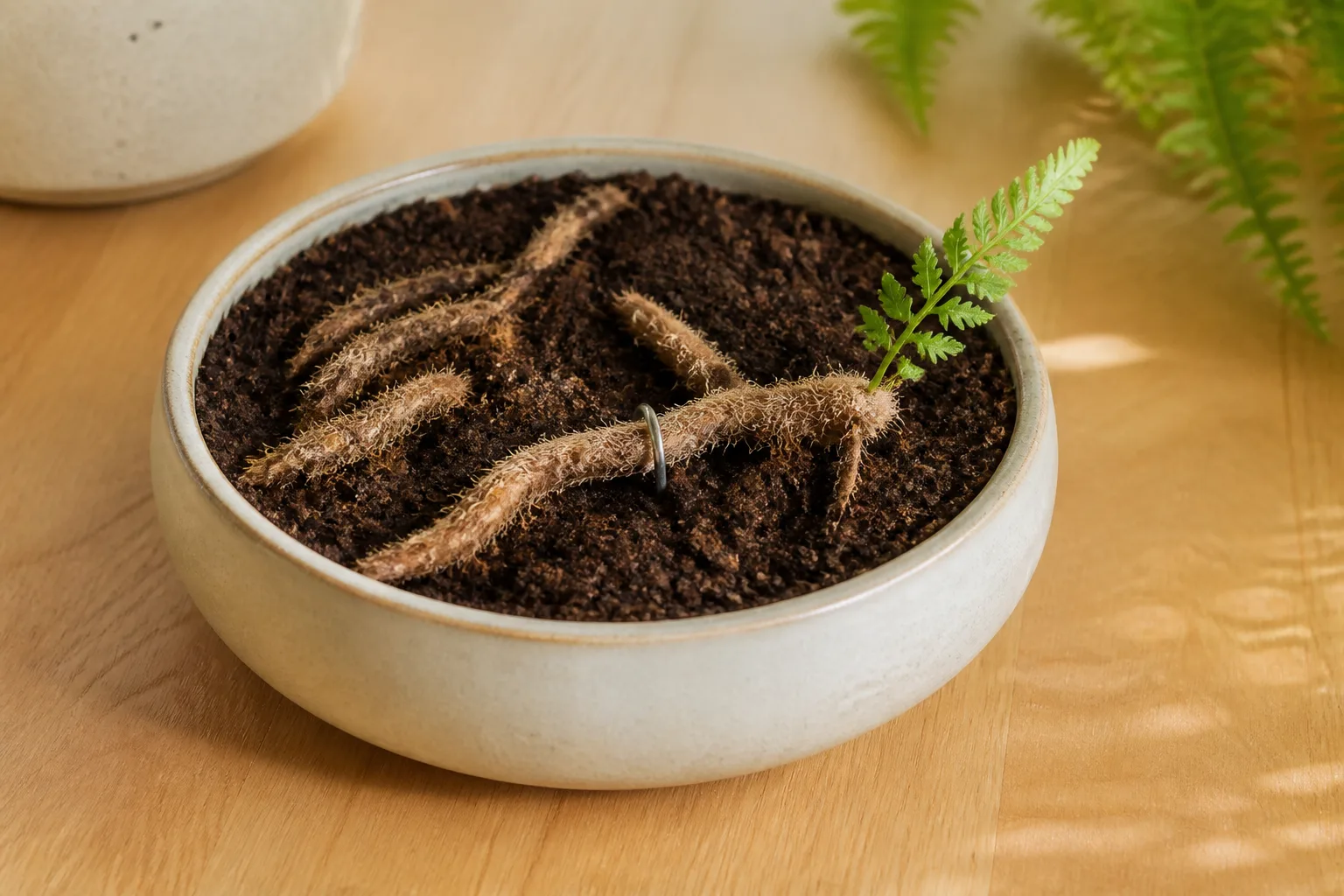
The critical care rule: do not bury most rhizomes under potting mix. Some older sections may root into the surface — that is fine. But when growers “tidy” by pushing fuzzy feet under soil to fit a cover pot, rhizomes suffocate, rot, and stop supplying the fronds. Clemson HGIC’s indoor fern guidance warns against burying creeping rhizomes on Davallia for exactly this reason. If you remember one thing from this page: surface rhizomes, moist air, moist — not soggy — mix.
Rabbit’s Foot, Hare’s Foot, and Squirrel’s Foot Compared
Only a few Davallia species appear regularly in cultivation. All share fuzzy rhizomes and similar care, but size and texture differ:
| Species | Common name(s) | Frond / habit notes |
|---|---|---|
| D. fejeensis (D. solida var. fejeensis) | Rabbit’s foot fern | Most common; lacy fronds to ~18 in.; fine fuzzy rhizomes |
| D. canariensis | Hare’s foot fern | Larger, coarser trailing rhizomes; wider spread to ~40 in. |
| D. trichomanoides | Squirrel’s foot fern | Shorter fronds (~6 in.); smaller exposed rhizomes |
| D. fejeensis ‘Dwarf Ripple’ | Miniature rabbit’s foot | Finely cut fronds; 6–18 in. tall per NC State |
Cultivar ‘Plumosa’ — noted by MBG — has narrow, feather-like pinnae. Delicate forms generally need more consistent moisture than thicker-frond relatives. For a terrestrial fern with similar humidity hunger but no surface rhizomes, compare Boston fern care or maidenhair fern indoors.
Is Rabbit’s Foot Fern Right for Your Home?
Rabbit’s foot fern is moderate maintenance, not beginner-proof. It is easier than maidenhair in average humidity — NC State explicitly ranks it more low-humidity tolerant than many ferns — but it is not a snake plant. You need a bright spot without hot afternoon sun, willingness to check soil moisture and pot weight regularly, and either a humidifier, steamy bathroom, or pebble tray in heated winter air.
Good fits: Plant lovers who want a conversation-piece hanging basket, growers who already run a humidifier for tropicals, bright east-facing rooms, covered patios in warm months.
Poor fits: Dim interior corners, desks under dry AC vents, homes where you water on a fixed monthly calendar, anyone who cannot tolerate rhizomes crawling over furniture.
If your room fails the humidity test, start with blue star fern — another epiphyte with fuzzy rhizomes that forgives drier air better — before you conclude you cannot grow Davallia.
Light Requirements for Rabbit’s Foot Fern
Rabbit’s foot fern wants bright indirect light or dappled partial shade — the same filtered brightness it gets on tree branches in the wild. Indoors, an east-facing window or north-facing window is ideal. A few feet back from a south or west window also works if you verify fronds are not bleaching.
Direct sun scorches delicate pinnae and can brown rhizome tips. Morning sun on a shaded patio is the outdoor exception; harsh midday rays are not. RHS lists part shade for Davallia solida var. fejeensis. Artificial grow lights work well — aim for gentle, diffuse intensity rather than spotlighting the rhizomes.
Signs of too much light: Pale washed-out fronds, brown spots on rhizomes, crispy patches on sun-facing pinnae. Signs of too little: Sparse, weak, overly pale growth with long gaps between frond clusters. Move incrementally; ferns do not appreciate sudden jumps from dim corner to south sill.
Watering: Soil Moisture and Rhizome Hydration
Watering rabbit’s foot fern means watering two zones: the potting mix and the exposed rhizomes.
For soil, NC State Extension recommends keeping the mixture moist but allowing the top ½ inch to dry between waterings. Lift the pot: if it feels light for its size, soak until a little water drains, then empty the saucer. Never leave the pot standing in water. In active growth (roughly spring through early fall), that may mean watering every 4–7 days indoors — faster in hanging baskets in dry air, slower in cool humid rooms.
For rhizomes, do not let them go bone dry. In dry homes, lightly mist or dribble water over exposed feet every few days, or move the plant to higher humidity. Savvy Gardening’s long-term growers run water over rhizomes at the sink during each soak — a practical habit that matches how epiphytes drink.
Winter semi-dormancy (roughly October–March): Growth slows. Reduce watering frequency slightly — soil should stay lightly moist, not constantly saturated. Fronds may shed a few older pinnae; that is normal if new growth continues.
Overwatering produces yellow limp fronds, sour soil smell, and mushy rhizomes — especially when feet were buried. Underwatering shows as dry, shriveled rhizome tips and crisp frond edges with a light pot.
Humidity, Temperature, and Winter Rest
Rabbit’s foot fern tolerates average indoor humidity better than maidenhair or classic Boston types, but it still performs best at roughly 50–60% relative humidity or higher. Brown frond tips with moist soil almost always mean dry air, not thirst.
Humidity hierarchy (most to least effective):
- Cool-mist humidifier within a few feet of the plant — best winter fix.
- Bright bathroom that steams regularly — excellent if light is adequate.
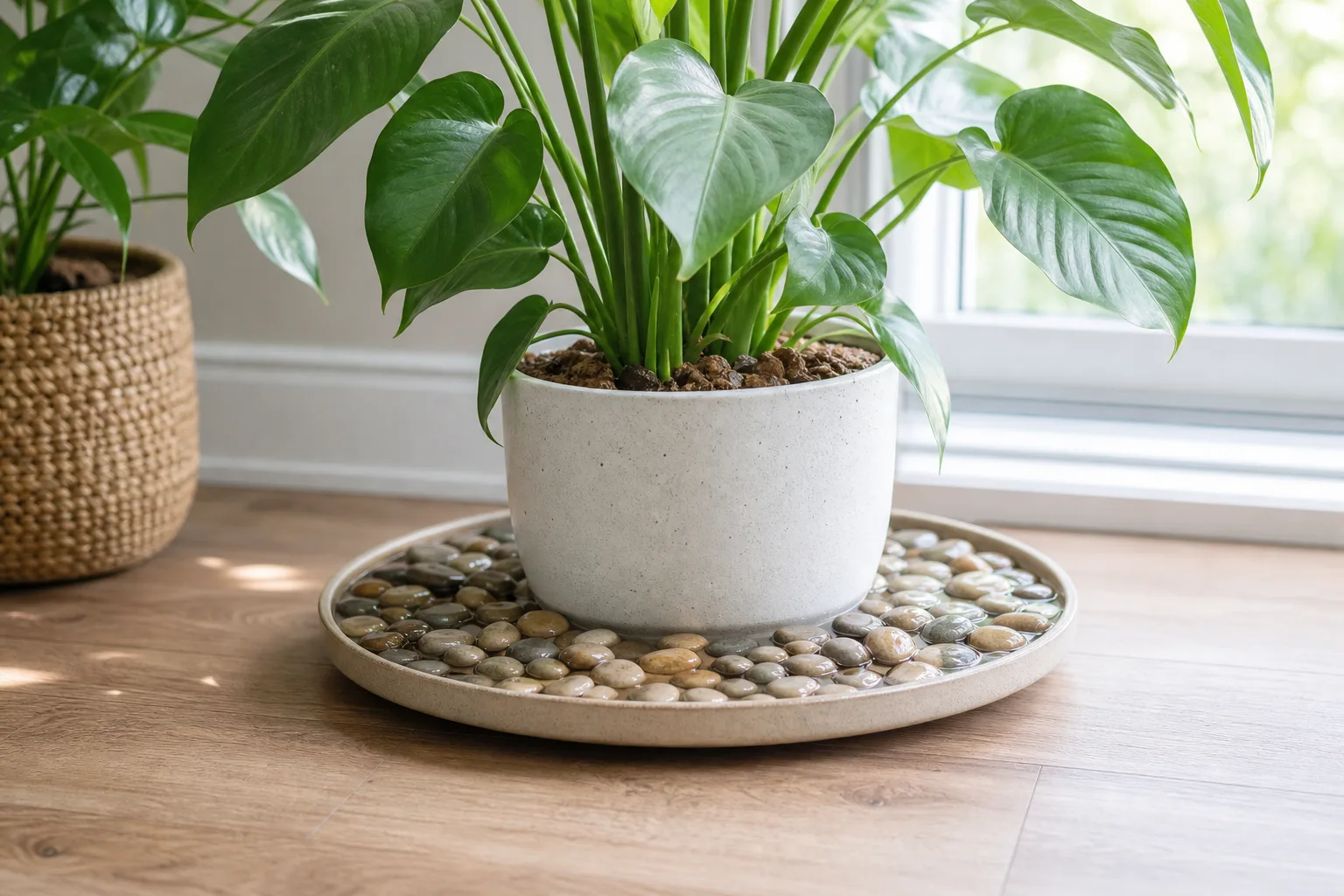
- Pebble tray under the pot — pot base on stones above water, not submerged.
- Grouping with other tropicals — modest local boost.
- Misting rhizomes — helpful supplement, not a substitute for dry-room humidity.
Keep temperatures above 55°F minimum per NC State; MBG and most growers target 60–75°F day-to-day with avoidance of cold drafts and hot heating vents. Below ~50°F, fronds damage quickly.
From late fall through early spring, treat the plant as semi-dormant: slightly less water, no heavy feeding, and acceptance of slower frond production. Do not panic-prune healthy green growth.
Soil, Fertilizer, and Annual Salt Flush
Use a peat-based or coir-based houseplant mix with plenty of organic matter and good drainage. Rabbit’s foot fern enjoys slightly acidic conditions that peat naturally provides. It dislikes waterlogged crowns but is less drainage-obsessed than succulents — the goal is moisture-retentive yet airy mix, not straight garden soil.
Feed with dilute balanced liquid fertilizer every two to three weeks during active growth, following label rates at half strength if your water is hard. Skip or reduce feeding October through March. Pale, stunted fronds after moisture and light are stable may indicate hunger; tip burn after heavy feeding indicates excess.
Annual salt flush: Once a year — spring is ideal — soak the root ball thoroughly with plain water several times to leach accumulated fertilizer salts. Let excess drain fully. This prevents brown tips that mimic humidity problems and addresses a maintenance step many generic fern articles mention without sequencing.
Potting, Repotting, and Display Options
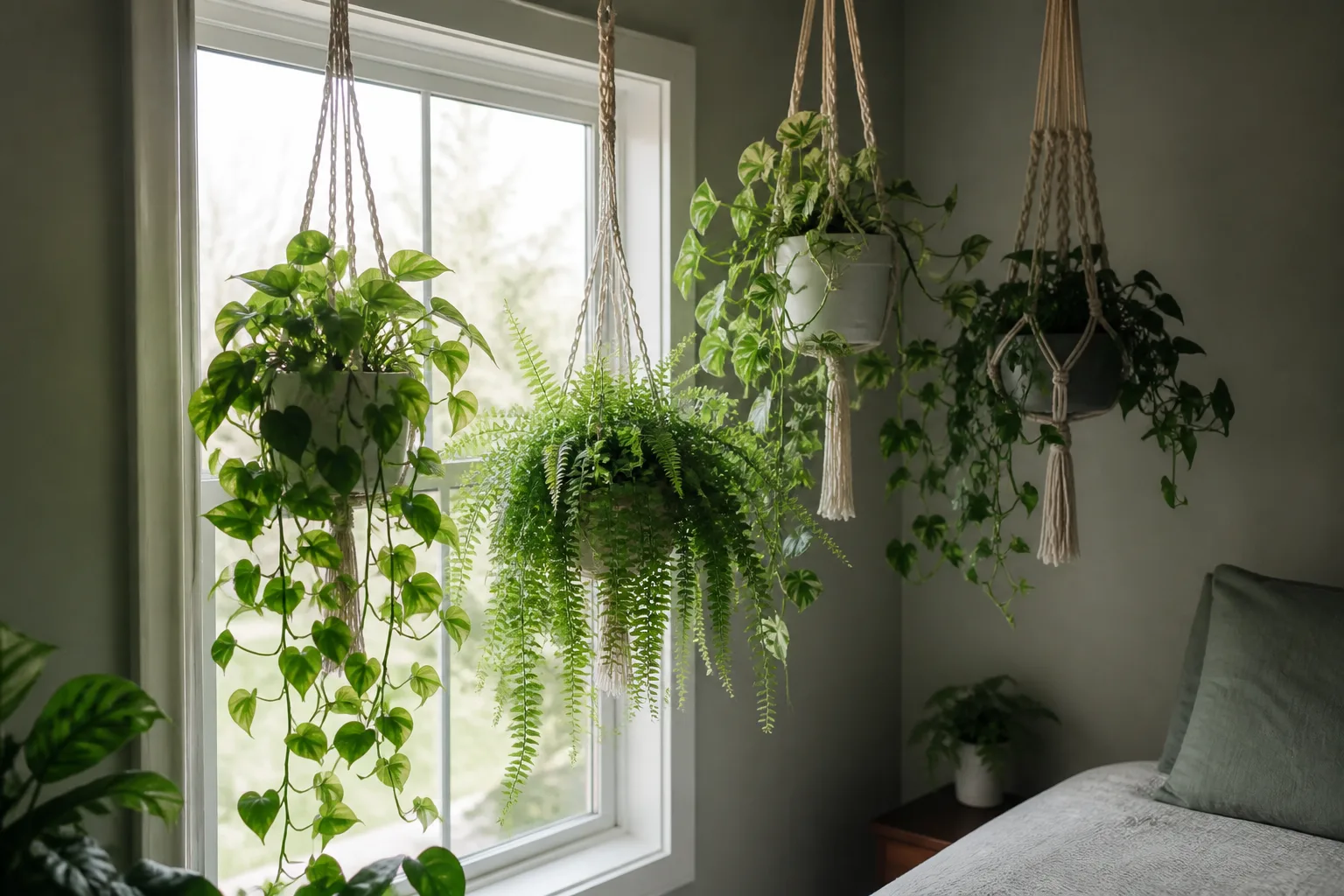
Rabbit’s foot fern shines in shallow, wide pots or moss-lined wire hanging baskets that let rhizomes cascade. Deep narrow pots bury feet and hold excess wet soil the roots never use. Drainage holes are mandatory.
Potting method: Lay the root ball in fresh mix, position rhizomes on the surface, and pin new sections with a U-shaped wire loop or hairpin if they slide. It is acceptable for some rhizomes to root into the top layer — not to disappear under an inch of mix.
Repot every two to three years, or when mix breaks down and water runs straight through dry pockets. MBG advises infrequent division — plants look better with age. Repot during the cooler dormant window (winter) if possible, though spring works when you water carefully afterward. Water the day before repotting; ease the root ball out with a knife around the edge rather than yanking fuzzy rhizomes.
Remove dead fronds at the base with clean scissors. No other pruning is required — and never cut healthy rhizomes unless propagating.
Propagating Rabbit’s Foot Fern from Rhizome Cuttings
Division and rhizome cuttings are the reliable propagation paths. Spore sowing is possible but slow — skip it unless you enjoy botanical experiments.
Rhizome cutting method (NC State Extension):
- With sterilized sharp pruners, cut a 2–3 inch rhizome section with one or two fronds still attached.
- Lay the cutting on moist peat-based mix in a small shallow pot; pin with a wire loop.
- Enclose in a clear bag or humidity dome in bright indirect light.
- Keep mix moist and air humid. When new fronds emerge, roots are established — pot normally.
Division: On a mature plant, split the root mass into two sections with healthy rhizomes and fronds each. Pot separately. Best on older specimens with plenty of viable feet.
Summer Outdoors and Overwintering Indoors
Rabbit’s foot fern is not practical for in-ground garden soil — it is an epiphyte, not a border perennial. You can, however, move potted plants to a shaded patio, porch, or deck when nights stay above ~60°F. Avoid direct afternoon sun, wind tunnels, and rain that leaves the pot waterlogged for days.
Before frost threatens, bring plants indoors. Expect some frond shedding after the transition — increase humidity, do not overwater, and remove only clearly dead foliage. In USDA zones 10–12, outdoor culture in frost-free humid shade is possible; everywhere colder, it is a houseplant.
Pests, Diseases, and Root Rot
Monitor for common houseplant pests: scale, mealybugs, spider mites, whiteflies, and aphids. Early detection matters on thin fronds. Start with horticultural oil or insecticidal soap on a test patch — rabbit’s foot fern is sensitive to chemical burn from harsh pesticides, tobacco smoke, and scented candles. MBG also lists botrytis and aerial blights in humid stagnant air; improve airflow if gray mold appears on damaged tissue.
Root and rhizome rot follows overwatering and — most often indoors — burying rhizomes. Remember: these plants do not draw all moisture from soil. Mushy brown rhizomes with sour smell require trimming dead tissue, repotting into fresh mix with feet on top, and drier conditions — not more water “to help it recover.”
Troubleshooting Common Problems
Work through fixes in order: light → water/rhizome moisture → humidity → pests → feed before repotting.
| Symptom | Likely cause | First action |
|---|---|---|
| Crispy brown frond tips | Low humidity | Hygrometer at foliage; run humidifier |
| Scorched patches | Direct sun | Move back; filter west/south glass |
| Brown spots after spraying | Chemical burn | Rinse fronds; stop scented products nearby |
| Yellow limp fronds | Overwatering / rot | Check rhizomes; repot if mushy |
| Dry shriveled rhizomes | Underwatering / dry air | Soak pot; mist feet; add humidity |
| Pale stunted fronds | Low light or hunger | Brighten spot; dilute feed if stable |
| Webbing, stippling | Spider mites | Rinse; raise humidity; isolate |
Scorched, Crispy, or Chemically Burned Fronds
Fern pinnae are thin and reactive. Direct sun bleaches and crisps tissue within days. Household air pollutants — tobacco smoke, aerosols, scented candles — cause spotting even with “good” care. Pesticide sprays burn fronds; use oils sparingly and never in hot sun.
First actions: move to bright indirect light, rinse foliage with lukewarm water, stop chemical sprays, and increase humidity while the plant pushes new fronds from healthy rhizomes. Old damaged pinnae will not green up — snip them.
Limp, Yellow, Pale, or Stunted Fronds
Limp with wet heavy pot: overwatering or buried rotting rhizomes. Unpot, inspect feet, repot with surface rhizomes, water less until new growth firms.
Yellow with brown tips, moist soil: humidity too low — classic false “underwatering” loop.
Pale and stunted with good moisture: often too little light or nutrient deficiency after years in depleted mix. Brighten gradually; feed lightly in spring or refresh soil.
Pet Safety and Lookalike Warnings
NC State Extension tags Davallia fejeensis as non-toxic for cats and dogs (and notes rabbit and deer resistance outdoors — unrelated to the common name). That makes rabbit’s foot fern a strong choice for pet-friendly homes with two caveats: eating any plant can cause mild stomach upset, and chewed fronds look terrible.
Do not confuse rabbit’s foot fern with asparagus fern (Asparagus setaceus), which is toxic and not a true fern. Verify botanical names on tags. For more pet-safe fern options, see Boston fern — also ASPCA-listed non-toxic — and the types of fern guide.
Conclusion
Rabbit’s foot fern rewards growers who respect its epiphytic anatomy: fuzzy rhizomes on display, moist air, bright indirect light, and watering keyed to pot weight plus never-dry feet. It is more forgiving than maidenhair in average homes, but burying the rhizomes, blasting it with afternoon sun, or letting winter air desiccate the cascade will still kill an otherwise tough plant.
Start with a shallow basket or wide pot, run a humidifier through heating season, flush salts each spring, and propagate when the feet outgrow the rim — division keeps specimens vigorous for ten years or more with good rhythm. Bookmark the indoor fern care guide for cluster context, and treat every fuzzy rhizome as a humidity sensor: when the feet look plump and the fronds stay lacy, you have Davallia dialed in.