Golden Chain Tree Care: Growing Laburnum Well
Grow Laburnum successfully with practical advice on cultivar choice, sunlight, watering, pruning, flower problems, and safe seed-pod cleanup.
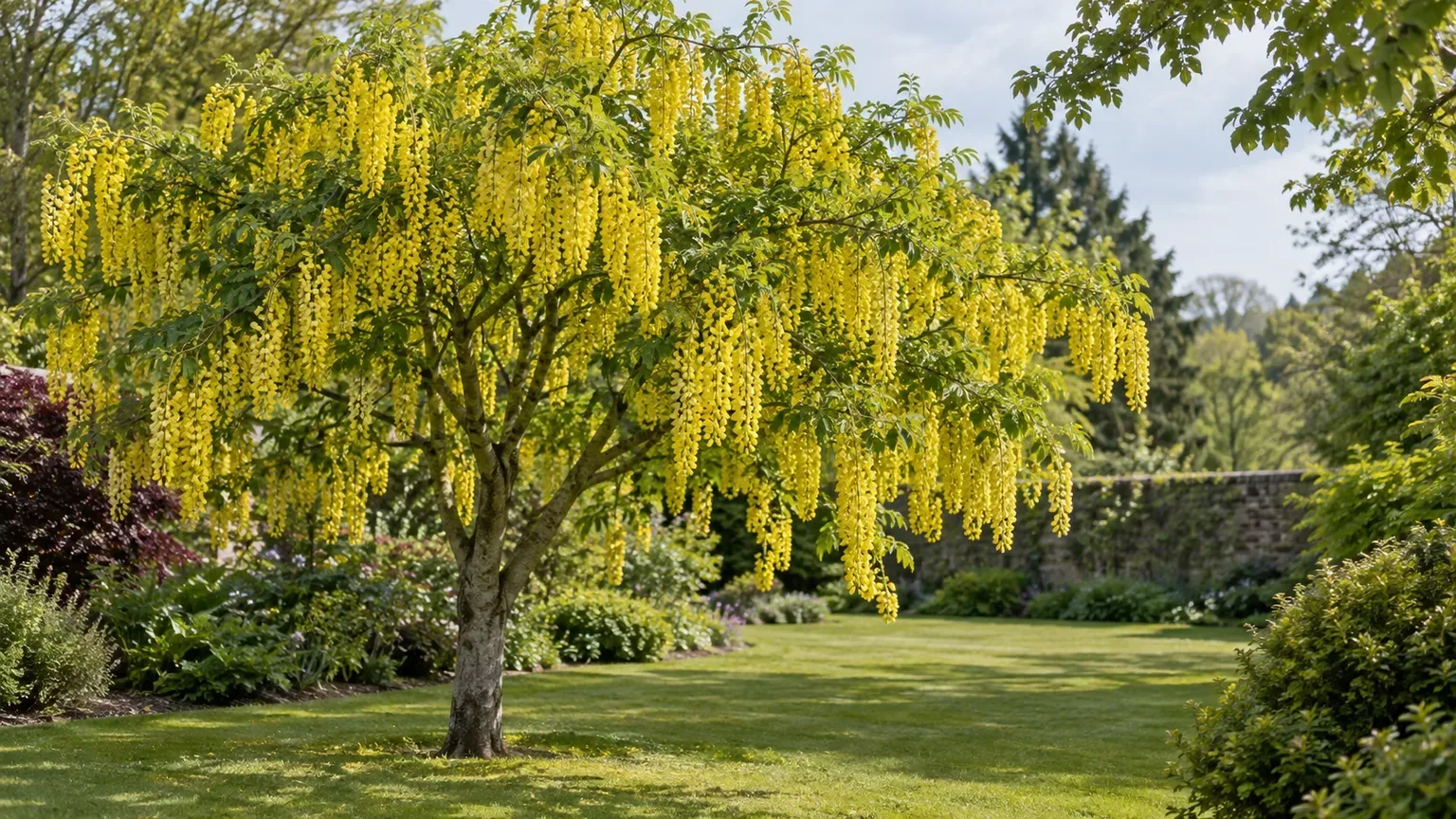
Golden chain tree, or Laburnum, earns its place through one brief but spectacular late-spring display: long, pendulous clusters of yellow pea-shaped flowers that hang like tassels from a small deciduous tree. It is not a carefree choice for every yard. Laburnum performs best where summers are not persistently hot and humid, the soil drains freely, and fallen pods can be kept away from curious children, pets, or grazing animals.
The most reliable care plan starts before you buy. Confirm that the plant is a Laburnum rather than the similarly named golden rain tree, choose a cultivar suited to the space, and put it in a cool, well-drained site with some protection from harsh afternoon heat. Once established, it usually needs less attention than the attention-grabbing flowers suggest: consistent water while young, little or no routine fertilizer, restrained pruning, and a deliberate plan for seed pods.
Is Golden Chain Tree a Good Fit for Your Garden?
Laburnum is a small ornamental tree or large shrub in the legume family, Fabaceae. Depending on species and cultivar, it may reach roughly 15 to 30 feet tall and broad, so it is not a miniature specimen even when sold as a young tree. Its best-known feature is the flower show, not year-round structure: after bloom, the green trifoliate foliage is attractive but comparatively understated, and the tree has little fall color.
Climate is the first go-or-no-go decision. Extension references commonly place golden chain tree in USDA Zones 5 to 7, but a zone number describes average winter lows; it does not tell you whether a site has a long, humid summer. North Carolina State Extension says Laburnum struggles with deep-South heat and humidity, while Virginia Tech recommends afternoon shade because heat-stressed trees are more likely to develop pest problems. A cool-summer garden in Zone 7 may be a better fit than a hot, humid garden in the same zone.
Choose another flowering tree if your summers are reliably hot, your planting spot stays wet, or your household cannot keep children and animals from sampling plant material. A well-sited golden chain tree can be a memorable specimen, but trying to overcome a poor climate with extra water or fertilizer will not make it thrive. NC State Extension’s Laburnum profile and Virginia Cooperative Extension’s goldenchain profile both emphasize matching the tree to moderate conditions and drainage.
Identify Laburnum Before You Buy
The common name can be confusing. Golden chain tree usually refers to Laburnum anagyroides or the hybrid Laburnum × watereri; both have three-leaflet compound leaves and yellow pea flowers in dangling racemes. Each raceme is an unbranched flower cluster, so the bloom hangs in a distinct chain from a branch. Depending on the plant and growing conditions, clusters are often several inches long and can exceed a foot on selected hybrids.
Do not confuse Laburnum with the golden rain tree, Koelreuteria paniculata. The names overlap in nursery and common-name lists, but the trees are unrelated. Laburnum blooms in pendulous chains and later forms flat beanlike pods; golden rain tree has broad, branching flower panicles and papery lantern-like seed capsules. Check the botanical name on the plant label rather than relying on a sales tag that says only “golden rain.” Kew’s Plants of the World Online recognizes Laburnum × watereri as a hybrid of L. alpinum and L. anagyroides, which helps clarify what the hybrid name means.
Flowering usually occurs in late spring, often around May or June in North American gardens, but the calendar shifts with latitude, elevation, and spring weather. A late frost can shorten the display by damaging open flowers or buds; an unusually warm spell can also make the flowers fade faster. Treat any month range as a local estimate, not a promise printed on a nursery tag.
Choose a Cultivar for Flowers, Form, and Seed Set
Most gardeners looking for the classic golden-chain effect encounter Laburnum × watereri ‘Vossii’. It combines traits from its two parent species and is valued for especially long flower racemes. Virginia Tech calls ‘Vossii’ a long-flowered cultivar and recommends buying it for its showier display; the RHS lists it as a broad-crowned deciduous tree that can reach about 4 to 8 meters in both height and spread. Confirm the named cultivar and expected local size before purchasing because nursery labels sometimes shorten the botanical name.
Other selections are sold for upright or narrower growth, but availability and mature dimensions vary by region. A narrow form can fit a tight planting strip more easily than a broad-crowned tree, yet “columnar” does not mean small, and it does not remove the tree’s climate or toxicity limitations. Ask for the cultivar name, mature height and spread, and whether it is grafted; compare those details with the site rather than selecting by the current pot size.
Why ‘Vossii’ Is the Common Landscape Choice
‘Vossii’ is often described as producing fewer pods or seeds than common laburnum, which can reduce litter and the amount of seed to manage. Do not translate “fewer” into “seedless.” Seed set can vary, and even a low-pod tree should be inspected after flowering; if pods appear where children, pets, or livestock can reach them, remove them while they are small and dispose of them securely. Virginia Tech’s profile notes the cultivar’s unusually long flowers, while the USDA Forest Service’s Woody Plant Seed Manual documents that ‘Vossii’ seed production is reduced rather than a reason to assume no seed is possible.
The tree is also sold as a trained arch or pergola specimen. Those forms can make the flowers easier to see, but training requires a stable support and occasional selective pruning; it does not change the plant’s mature root needs or make the pods safe. Buy a trained tree only if you are willing to maintain its framework and can reach it safely for inspection.
Choose a Site That Matches Its Climate Limits
Golden chain tree needs open space for a rounded crown and a root zone that does not stay saturated. Set it away from persistent downspouts, low spots, and compacted lawn areas where rainwater collects. Before planting, watch the site after a heavy shower; if puddles remain well after nearby ground has drained, improve the whole planting area or choose a different location instead of digging a deeper hole that could act like a sump.
Think about the tree’s appearance outside bloom as well. It is a seasonal focal point for a small lawn, border, or garden edge, but the canopy will shade nearby plants as it matures. Leave room to walk around it and reach the crown for pruning and pod checks. Avoid planting directly over a path or children’s play space if falling flowers and pods would create a recurring cleanup or access problem.
Balance Sunlight With Summer Heat
Light guidance can sound contradictory because climate matters. NC State Extension says common laburnum grows in full sun and tolerates partial shade; Virginia Tech advises afternoon shade for the hybrid because specimens in full sun can become stressed in hot settings. Both can be right: in a cool-summer location, morning-to-afternoon sun may support flowering, while in a warmer region filtered light or shade during the hottest hours can reduce heat stress.
Use the hottest part of the day as your decision point. If a west-facing wall radiates heat, reflected sun can make a nominally partial-shade site feel much hotter than an open east-facing border. A location with morning sun and bright afternoon shade is a sensible starting point where summers are warm; a cooler coastal or northern garden can offer more sun if the roots remain moist but not waterlogged. Do not plant in deep shade expecting a heavy bloom display, because reduced light can limit flowers.
Protect Roots With Well-Drained Soil
Laburnum tolerates a range of soil textures and pH, but drainage is the essential condition. A moderately fertile loam that holds some moisture without staying soggy is ideal. Heavy clay is not automatically disqualifying if water moves through it, but compacted clay in a low spot is a poor match; sandy ground may drain quickly enough that a newly planted tree needs closer watering during dry weather.
Do not add lime, sulfur, or an “acid-loving” fertilizer just because a product label seems to fit a broadleaf flowering tree. Soil pH does not need a special correction unless a soil test identifies a real problem. If the site needs improvement, loosen a broad planting area and incorporate modest organic matter across it rather than enriching only the hole; a highly amended pocket can hold water differently from surrounding soil and discourage roots from moving outward.
Plant Laburnum for a Stable Start
Plant container-grown or balled-and-burlapped Laburnum when the soil is workable and cool enough to limit transplant stress, usually in spring or early fall depending on local climate. Avoid planting immediately before a heat wave or while the ground is frozen. Handle the root ball rather than lifting the tree by its trunk, and keep roots shaded and damp until the planting hole is ready.
Dig a hole two to three times as wide as the root ball but no deeper than its height. Set the root flare at or slightly above the finished soil grade; burying the flare keeps the trunk base wet and can lead to decline. Backfill with the excavated soil, firm it gently to remove large air pockets, and water slowly to settle the soil. Apply a modest mulch ring to conserve moisture, keeping the mulch a few inches away from the trunk.
A Simple Planting Sequence
- Check drainage and mature clearance. Confirm the location drains after rain and has room for the selected cultivar’s full crown.
- Find the root flare. Remove excess potting mix from the top of the root ball until the first structural roots are visible; do not plant the nursery mix mound at grade.
- Correct circling roots. Loosen small circling roots at the outside of a container root ball. If a large root wraps around the trunk, ask the nursery or an arborist to assess it before planting.
- Set the tree level. Place the flare at or slightly above grade, rotate the best side toward the view, and backfill without burying the trunk.
- Water and support only as needed. Soak the root zone after planting. Stake a young tree only if wind or an unstable root ball makes support necessary, and remove or adjust ties once the tree stands firmly on its own.
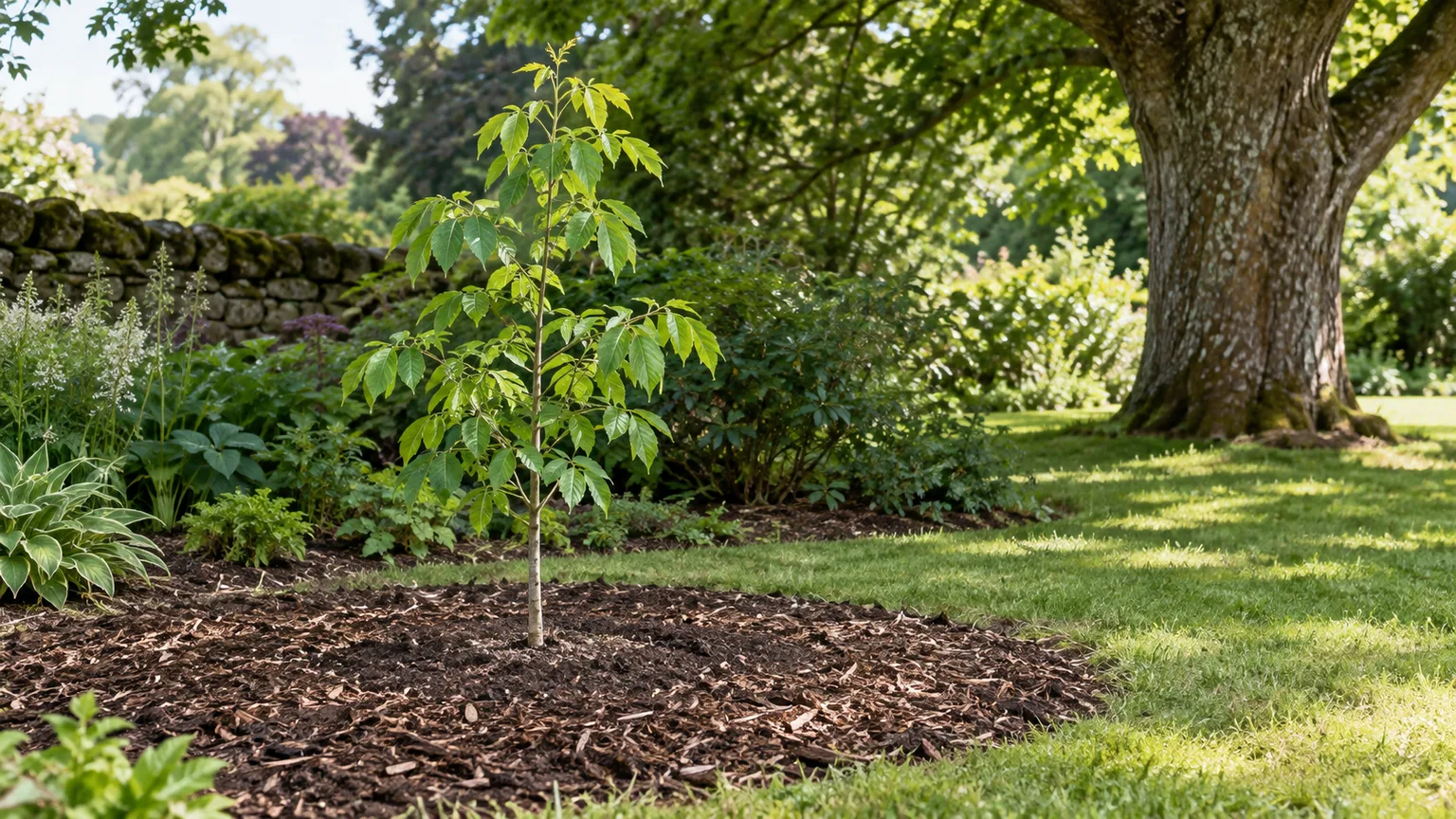
Water again when the upper few inches begin to dry during the first growing season, checking the original root ball as well as the surrounding soil. Nursery mix and native soil can dry at different rates, so a damp surface is not a reliable signal by itself. A stake should prevent the root ball from rocking, not hold the trunk rigidly; ties left tight for years can girdle a growing stem.
Water and Feed Only as the Tree Needs
An established golden chain tree can tolerate short dry periods, but a young tree needs consistent moisture while new roots expand. Water deeply at the root zone rather than giving frequent, shallow sprinkles that wet only the surface. During dry spells, probe the soil a few inches down before watering; if it is still moist, wait, and if it is dry, soak slowly enough that water penetrates rather than running off.
The safest routine is responsive rather than calendar-based. A tree in well-drained sandy soil may need water sooner than one in loam, while a shaded site may stay moist longer than a hot exposed site. Reduce supplemental watering in cool, rainy weather and never keep the root zone saturated. Yellowing leaves accompanied by wilt can signal root trouble in wet ground just as easily as drought, so check moisture before adding more water.
Routine fertilizer is rarely the first answer for poor growth. Laburnum belongs to the legume family, and feeding a tree that is otherwise healthy may encourage soft growth without fixing heat, drainage, root, or light problems. If leaves are pale or growth is weak, first confirm the tree is established, inspect drainage, and use a soil test before applying nutrients. Compost can be used as a thin surface mulch, but keep it away from the trunk and avoid repeated high-nitrogen applications.
Prune Lightly Without Sacrificing Flowers
Start structural pruning while the tree is young, when small cuts can correct competing leaders, crossing branches, or an awkward low limb. Choose one main leader if you want a single-trunk specimen, then remove only obvious competitors and retain well-spaced scaffold branches. A multi-stemmed form can also work in a garden, but decide on that structure early rather than repeatedly cutting large branches to force a new shape.
Laburnum needs little routine pruning once its framework is established. For light shaping, the practical window is after flowering, while you can still see which branches carried the bloom; pruning earlier can remove the buds that would have flowered in spring. Horticulture.co.uk’s Laburnum growing guide advises avoiding spring and early summer pruning because wounds can bleed, and the RHS profile places ‘Vossii’ in light pruning group 1. Remove dead, broken, or hazardous limbs when needed, but use clean tools and avoid large cuts unless you have a clear reason.
Do not make a hard annual cut to “encourage vigorous growth” or more flowers. Severe pruning can remove flowering wood, distort the natural crown, and create large wounds on a tree that does not need constant shaping. If an old specimen is overgrown or has a structural defect, consult a qualified arborist rather than topping it; topping does not create a sound framework and may produce weakly attached regrowth.
Handle Seed Pods and Toxicity With a Plan
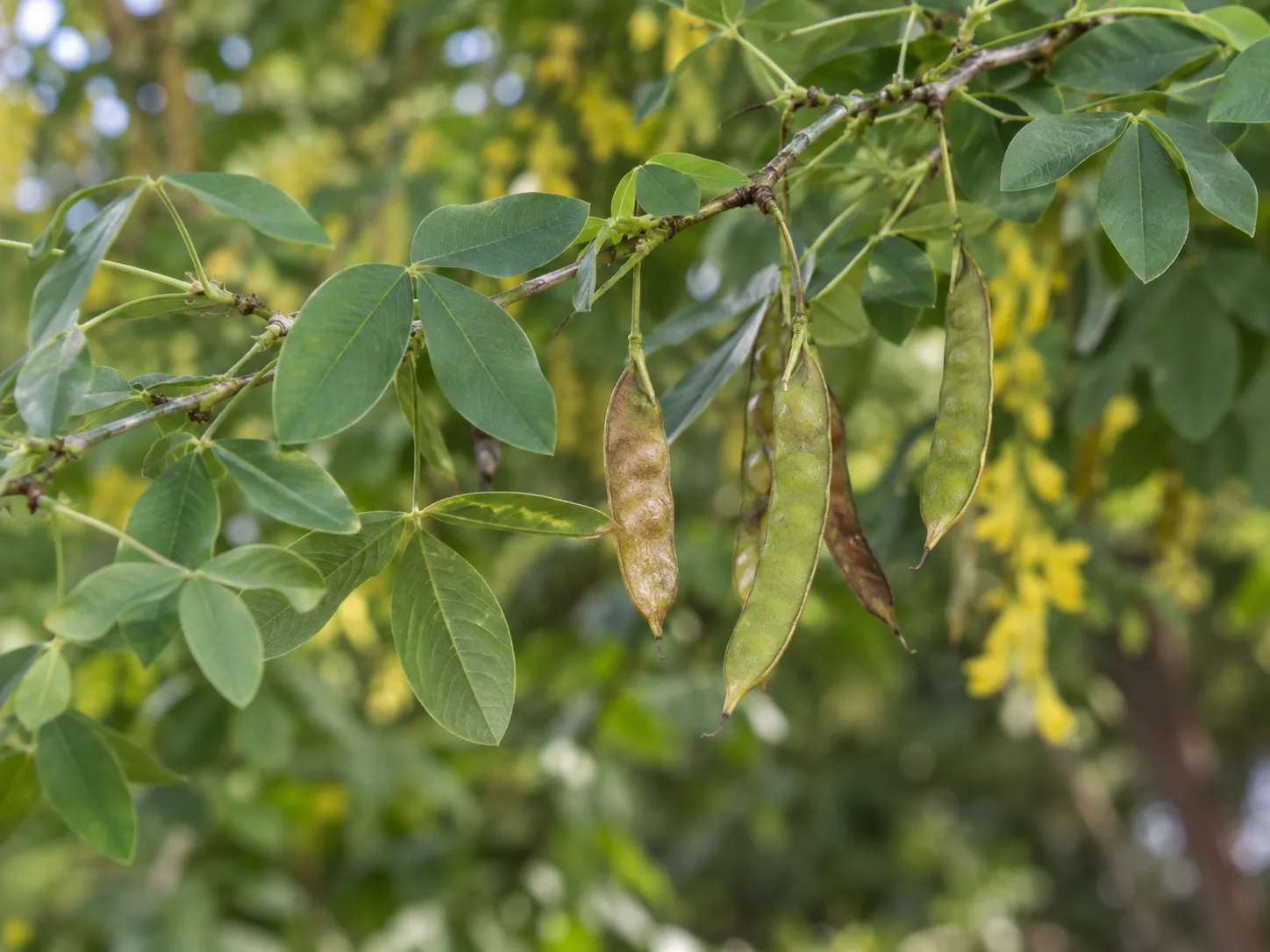
After flowering, Laburnum can form long, flattened legume pods containing hard seeds. The seed contains cytisine, an alkaloid; university and veterinary references identify the pods and seeds, as well as other plant parts, as poisonous if eaten. The seeds are the part that most deserves attention because a pod can be mistaken for a familiar edible pea or bean by a child or animal. Cornell lists Laburnum among plants toxic to humans and several livestock and companion species, while Pet Poison Helpline identifies ingestion of leaves, bark, flowers, legumes, or seeds as a pet concern.
The presence of a toxic plant is a placement and supervision issue, not a reason to panic at the sight of a tree. The cited warnings focus on ingestion; casual contact with intact foliage is not the same exposure as eating pods or seeds. Still, wear gloves when pruning or removing pods, keep hands away from your face while working, and wash them afterward. Avoid using plant parts in food, tea, crafts intended for mouthing, or home remedies.
Practical Safety for People and Animals
If the tree is near a play area, fence, or pet run, decide whether you can reliably inspect it after flowering and collect developing pods. Remove pods early, before they dry and split, using gloves and long-handled pruners if the branch is within safe reach. Place the material directly into a closed yard-waste bag; do not leave it on the lawn, compost where animals can forage, or toss it into a pasture. For a tall tree, use a professional rather than climbing or reaching over a fence.
A ‘Vossii’ selection may set fewer pods, but it still belongs in the same safety category. Look for pods every year instead of assuming the cultivar label guarantees no seed. Keep fallen flowers, leaves, and pruning debris out of areas where livestock graze, and supervise pets around dropped plant material. A dog or horse that can roam beneath the canopy may make another ornamental tree the better choice even if the garden climate is suitable.
If a person may have swallowed any Laburnum part, contact Poison Control promptly in the United States at 1-800-222-1222 or use its online service; elsewhere, contact the local poison center or emergency service. Do not wait for symptoms or try to induce vomiting. If a pet or farm animal may have eaten it, call a veterinarian or veterinary poison service and identify the plant; the Pet Poison Helpline’s golden chain tree page lists its current contact options. Poison Control likewise advises immediate expert guidance when ingestion is suspected, not a wait-and-see approach (National Capital Poison Center).
Manage Winter, Containers, and Propagation Realistically
In a suitable climate, established Laburnum generally overwinters outdoors without elaborate protection. A newly planted tree benefits from an even root-zone mulch layer, but keep mulch off the trunk and do not wrap every tree automatically; trunk wrap is useful only for a specific exposure or damage risk. Avoid late-season fertilizer that pushes tender growth, and water a young tree during a dry autumn before the ground freezes.
Long-term container growing is a compromise. A pot restricts the root system, dries faster than garden soil, and can become unstable as the crown grows. Narrow or dwarf selections may be grown in a large, heavy container for a limited period, but Laburnum is best treated as an in-ground tree; if you need a permanent potted specimen, choose a plant whose mature size and root habit are suited to container culture.
For a named cultivar, buying a correctly labeled nursery plant is usually the best route. Seed-grown trees may not come true to the parent, and handling seeds adds a preventable exposure risk; named forms are often propagated vegetatively or grafted. Some Laburnum can be grown from cuttings by experienced propagators, but rooting success is not guaranteed for a home gardener. Ask the nursery how the specific cultivar was propagated and avoid saving or sowing pods unless you have a deliberate, controlled propagation plan.
Diagnose Poor Bloom, Yellow Leaves, and Pests
A new or recently transplanted tree may need time to settle before it flowers heavily. First confirm the plant is receiving enough light for its climate and that it has not suffered a late frost, summer heat stress, drought, or prolonged wet soil. If a tree blooms less after pruning, the cuts may have removed flowering wood; wait through another growing cycle before adding fertilizer or making more cuts.
Yellowing and wilting deserve a moisture check before any treatment. In dry soil, give the root zone a deep soak and monitor the next several days; in soggy ground, stop routine irrigation and address drainage. If decline continues, inspect leaves and twigs for a pattern of damage, and ask a local extension office to identify a pest or disease before applying a pesticide. NC State Extension lists twig blight, canker, leaf spot, aphids, and mealybugs as possible problems, with twig blight uncommon but potentially serious.
Check the Site Before Reaching for Fertilizer
| What you notice | Check first | A sensible next step |
|---|---|---|
| Few or no flowers on a young tree | Age, transplant stress, and cultivar | Give the root system time; confirm the cultivar label |
| Buds or open flowers damaged after a cold night | Late spring frost | Wait for healthy new growth; avoid pruning living wood immediately |
| Sparse bloom with healthy foliage | Light and recent pruning | Improve light only if the climate permits; prune after bloom next time |
| Yellow leaves with soft, wilted growth | Wet root zone and drainage | Let soil drain; correct the site before changing fertilizer |
| Scorched margins during hot weather | Afternoon heat and drought | Add temporary root-zone moisture and assess whether afternoon shade is needed |
| Sticky leaves or clustered insects | Aphids or another pest | Identify the insect and use the least disruptive control appropriate to its scale |
Do not diagnose every yellow leaf as root rot or every lack of flowers as a nutrient shortage. A few older leaves may yellow as part of normal seasonal change, while whole-branch dieback, persistent wilt, or dark mushy roots warrants faster investigation. Take a photo of the whole tree and a close-up of affected leaves, note recent watering and weather, and share that record with an extension office or arborist if the cause remains unclear.
Conclusion
Golden chain tree is worth growing when your site offers a moderate climate, free-draining soil, and enough room for a small tree whose flowers arrive for a short spring show. Choose a named cultivar for the crown size and flower display you want, give it afternoon protection in hot conditions, plant with the root flare visible, and water by checking the root zone rather than following a rigid schedule.
Keep pruning modest and time shaping after bloom. Most of all, treat pods and seeds as an ongoing garden-management issue: ‘Vossii’ may produce fewer, but no cultivar label replaces inspection and safe cleanup. If your summer climate is consistently hot or animals and children cannot be kept from fallen plant material, select a different flowering tree before planting rather than trying to solve a poor fit after the canopy is established.