24 Modern Gate Designs for Driveways and Gardens
Explore 24 modern gate designs for driveways, front entries, and gardens, plus practical guidance on privacy, materials, swing clearance, and security.
A modern gate can be a quiet continuation of a fence or the feature that gives an entrance its identity. The strongest designs usually rely on a few clear decisions—material, spacing, proportion, and how the gate moves—rather than decorative hardware piled onto an unrelated fence.
Before you save inspiration photos, decide what the gate must accomplish. A side-yard gate that keeps a dog in has different needs from a driveway entrance that should screen parked cars, and a garden gate can be deliberately open to keep a path visible. The ideas below pair style with a practical use so you can adapt them to your house, opening, and landscape.
Decide what the gate must do before choosing a style
Write down the gate’s primary job in one sentence: mark an entrance, create privacy, contain a pet, discourage casual access, or control a driveway. Then list the secondary needs, such as keeping a view open, passing a wheelbarrow, or making room for a vehicle to turn. If several jobs compete, prioritize the one that would make the wrong design frustrating every day.
Also distinguish a pedestrian gate from a driveway gate. A garden gate should be comfortable to open while carrying tools and wide enough for the equipment you actually bring through; a driveway gate has to clear vehicles and leave safe waiting space without blocking a sidewalk or road. Local rules, property lines, easements, and neighborhood restrictions can affect where and how a gate may swing, so confirm those before settling on a layout.
24 modern gate designs to adapt to your home
Treat these as design directions, not ready-made specifications. A gate’s span, frame, post, hinge, latch, and foundation must be designed for its actual size, weight, wind exposure, and use.
Clean-lined contemporary gates
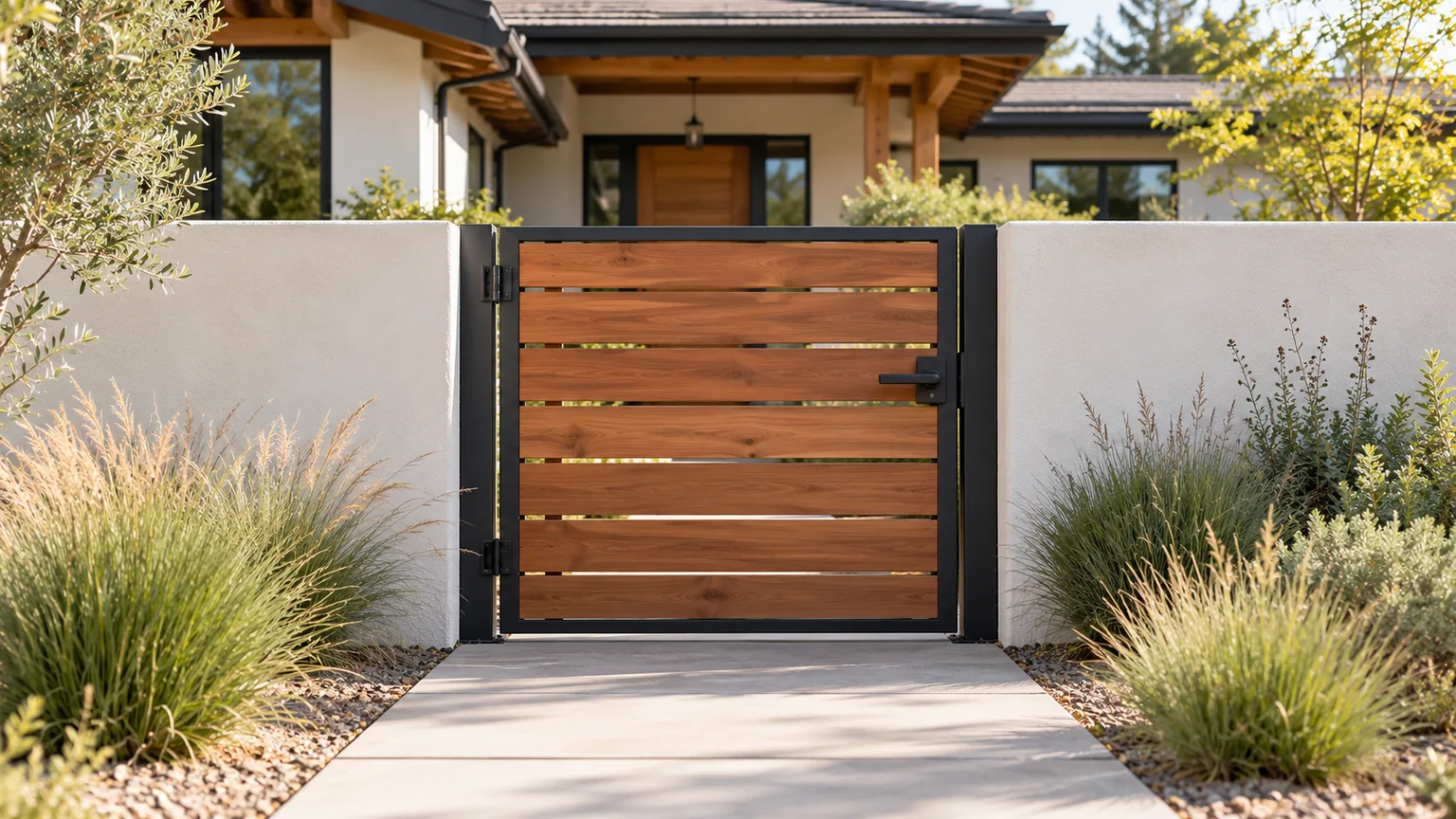
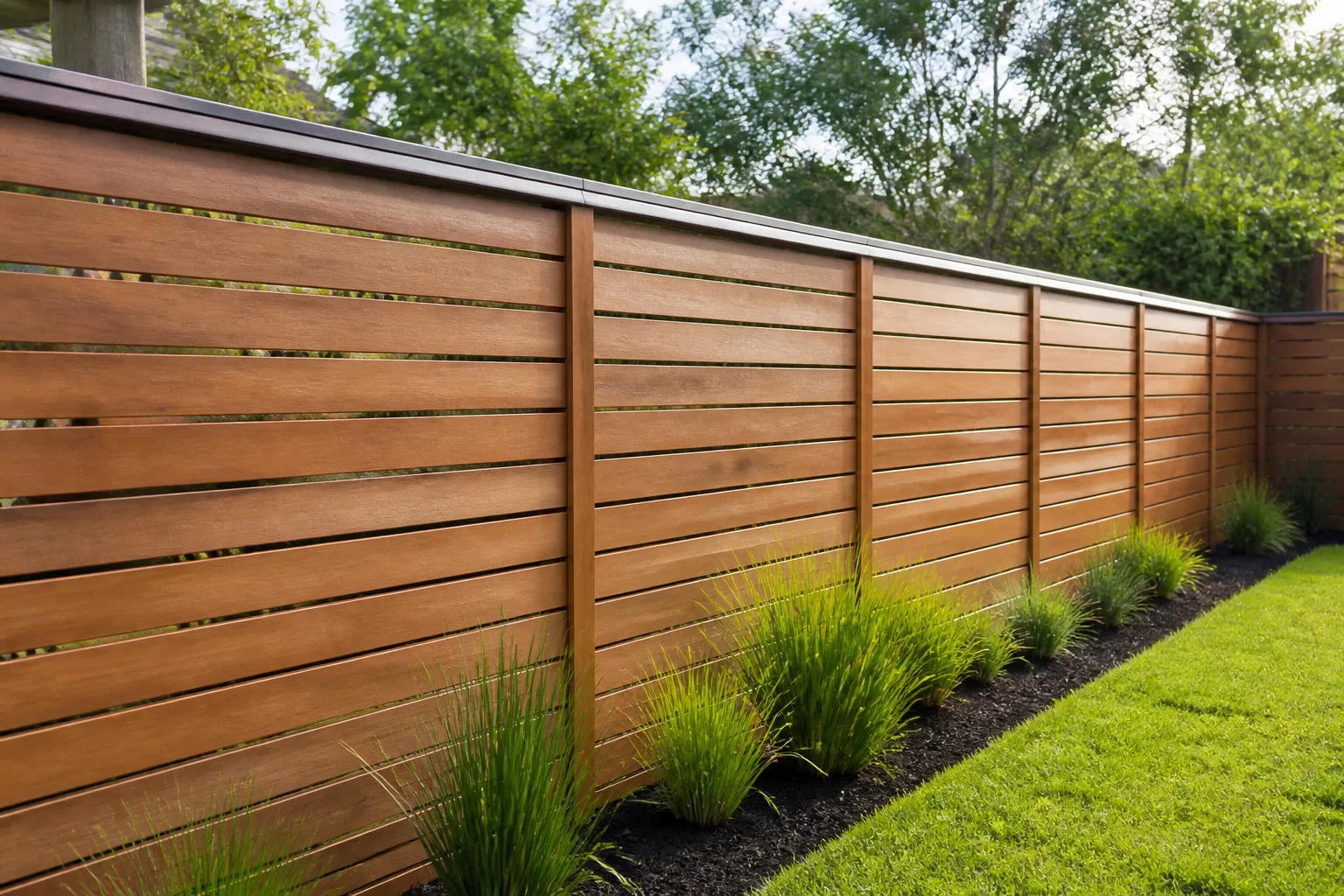
1. Horizontal cedar slats in a charcoal frame. Warm wood keeps a simple steel frame from feeling stark, while long boards reinforce the horizontal lines of a modern façade. Choose open spacing when you want filtered views; closer boards add screening but make the gate heavier and more solid-looking.
2. Slim vertical metal pickets. Narrow bars create a crisp rhythm and preserve sightlines toward planting or a front walk. The style works best when the spacing and top line repeat elsewhere in the fence; it offers little privacy, so use it when openness matters more than screening.
3. A flush gate that disappears into the fence. Continue the same board direction, color, and spacing across the gate so the entry reads as one calm plane. This is especially effective in a narrow side yard, but the latch and hinge still need a reliable reveal and access for adjustment.
4. A vertical-slat privacy screen with small gaps. Closely spaced boards reduce direct views without creating a completely blank panel. Check the view from both sides and consider the direction of the slats: angled or offset gaps can screen a seated viewpoint while preserving some daylight and airflow.
5. A perforated metal panel. Laser-cut or punched openings add a precise pattern while keeping more visual depth than a solid door. Repeating one geometric motif in a single gate bay is often enough; a busy pattern across both the gate and fence can compete with the architecture.

6. One patterned panel in an otherwise plain gate. Keep the frame and most of the infill restrained, then use a single cutout or mesh insert as the focal point. The contrast is easier to live with than a highly detailed gate across the full width of a driveway.
Wood-forward and mixed-material gates
7. Cedar boards set inside a welded steel frame. This combination separates the structural outline from the warm infill and can make a simple pedestrian gate feel finished. Specify exterior-rated hardware and keep wood edges from sitting in wet soil or against masonry where they cannot dry quickly.
8. A board-and-batten gate with modern proportions. Narrow vertical battens over a flat backing give a familiar construction a cleaner, more architectural profile. Use consistent reveals and simple black or stainless hardware; oversized trim can push the result toward a traditional farmhouse look instead.
9. Alternating board widths for a measured rhythm. A repeated wide-narrow-wide pattern adds texture without requiring an ornamental panel. Keep the pattern symmetrical around the latch or center seam so the gate looks intentional when closed, and make sure the frame—not the decorative boards—carries the load.
10. A weathered-wood gate against dark metal. Silvery, naturally weathered boards can soften a dark fence and blend into a mature garden. Weathering is not the same as rot resistance: select sound material, allow drainage and ventilation, and be prepared for the wood’s color to change unevenly over time.
11. A woven-metal insert with a timber border. Mesh or woven wire adds a finer texture than bars and leaves air moving through the opening. It is useful where you want a lighter-looking enclosure, though the wire aperture, edges, and bottom gap must match the containment job rather than just the desired appearance.
12. A two-tone gate with a narrow accent rail. A small stripe of cedar, bronze, or another finish can connect a dark gate to wood trim, a porch ceiling, or a front door. Treat the accent as a repeated color cue instead of introducing a third material that has no other role in the yard.
Color, shape, and architectural gates
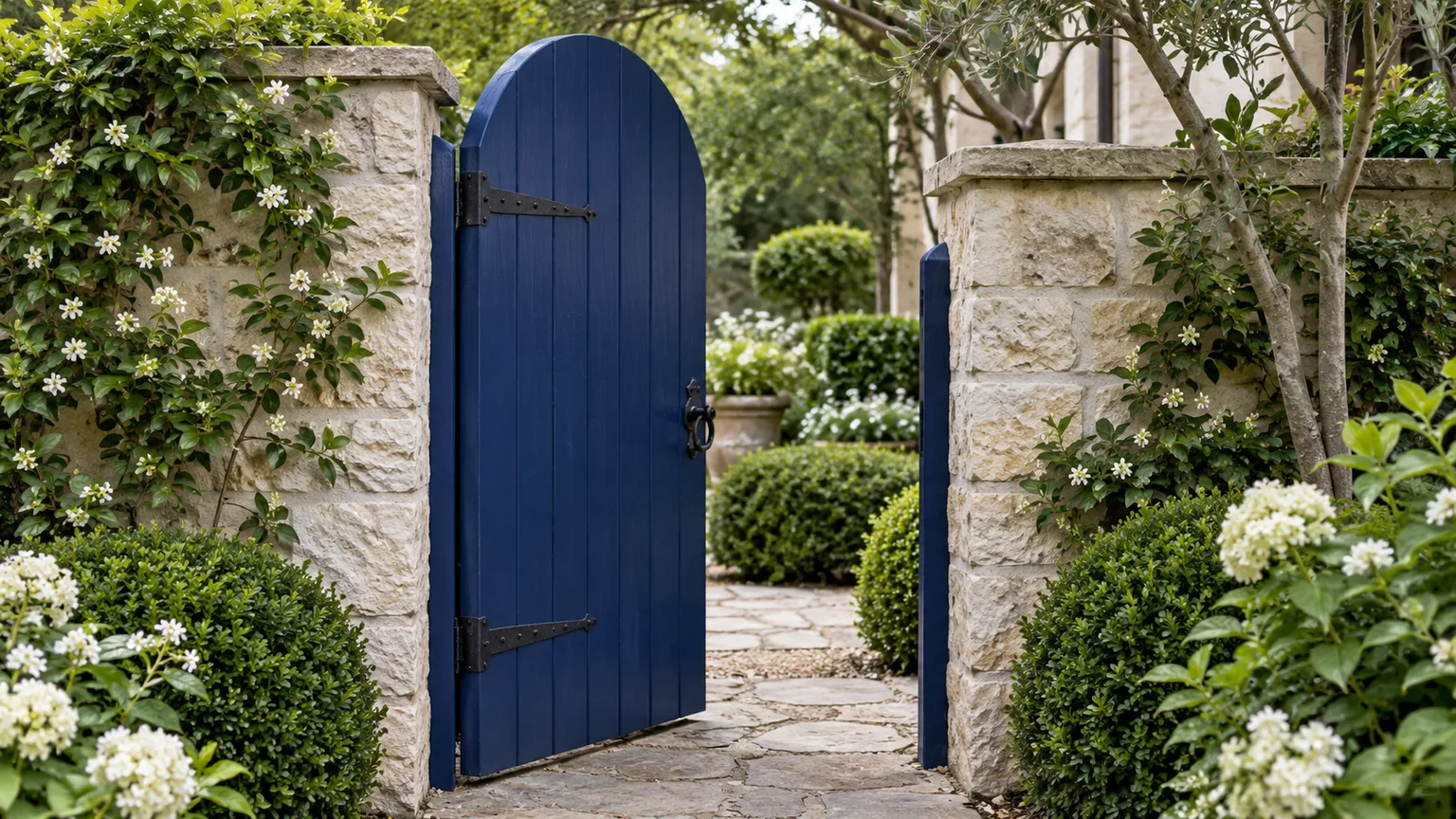
13. A cobalt-blue arched garden gate. A saturated color turns a modest opening into a clear focal point, especially against pale masonry or evergreen foliage. Repeat the hue once in a nearby planter or door detail, then keep the surrounding planting simpler so the gate remains legible.
14. A deep-green gate in a leafy boundary. Green paint can visually recede into hedges while still giving a crisp frame to the opening. It is a useful option when the goal is a defined entrance without a high-contrast feature; test the color outdoors because shade, sun, and surrounding foliage shift how it reads.
15. A shallow curved top that echoes a nearby arch. A gentle curve can relate a gate to an arched window, porch opening, or garden path without copying every architectural detail. Use one repeatable curve and simple infill; a dramatic shape needs enough height and space around it to avoid looking squeezed into the fence.
16. A quiet timber grid inspired by screens. A clean square or rectangular grid brings pattern and partial views while keeping the overall form spare. Use sturdy exterior joinery and a frame sized for the gate’s span; delicate-looking grid pieces can become difficult to maintain if they are too thin or tightly detailed.
17. A gate framed by masonry piers. Stone, brick, or stucco piers make an entry feel anchored and can tie a gate to the house’s foundation or exterior walls. Scale the piers to the opening instead of making them larger by default, and coordinate the gate hardware and nearby path so the entrance does not feel like an isolated monument.
18. A concealed entry in a continuous wall. Matching the gate to a stucco wall or board fence makes the opening subtle, which suits a side passage or service area. The design depends on a visible enough latch and a durable hinge arrangement; avoid a “hidden” detail that makes everyday access confusing or hard to maintain.
Driveway and backyard gate configurations
19. A balanced double-leaf driveway gate. Two leaves can create a symmetrical arrival and are often easier to accommodate than one very wide hinged panel. Confirm that each side has an unobstructed swing arc and that the center meeting point can latch reliably as the posts and ground move with seasons.
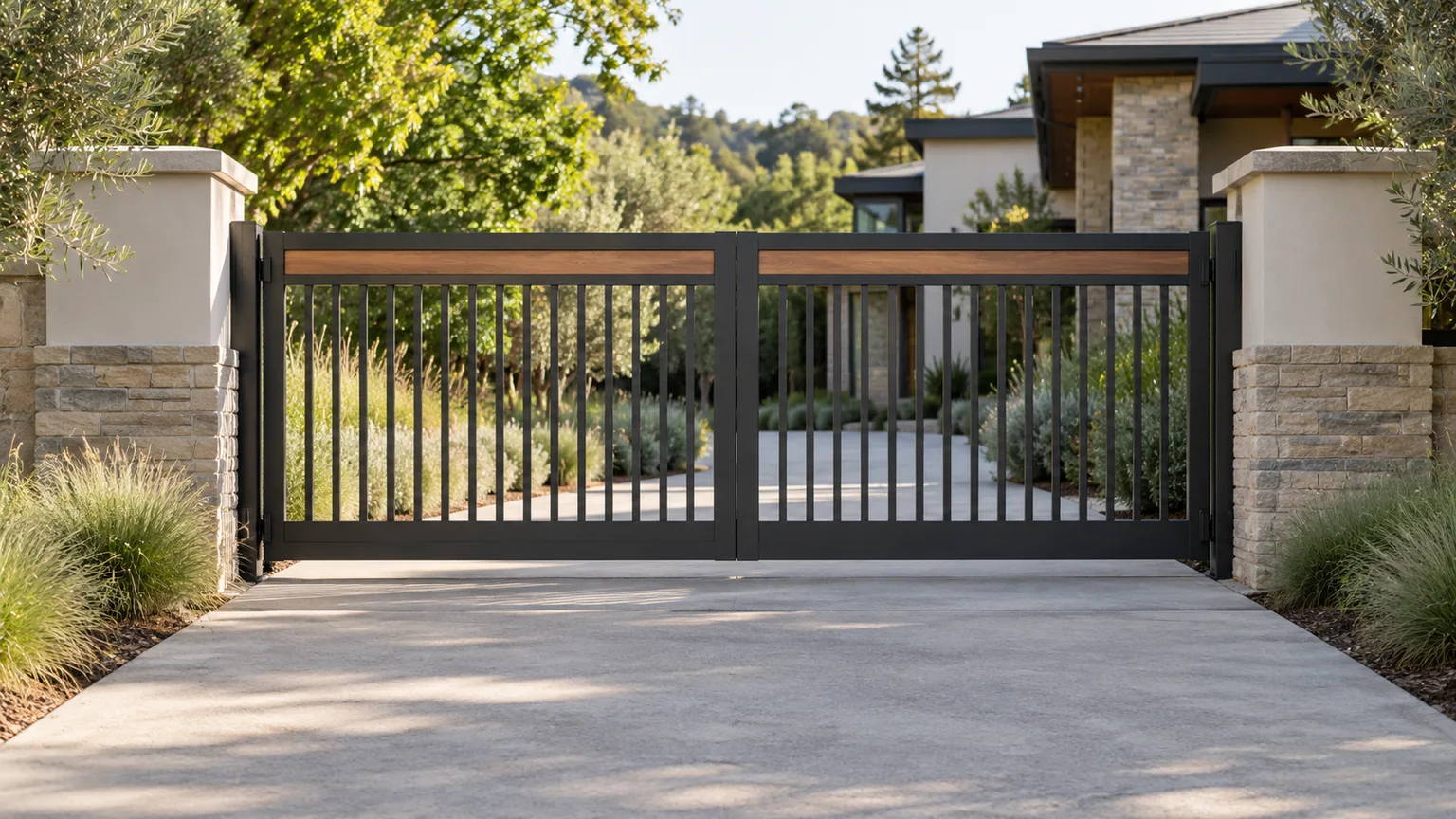
20. A single sliding gate with horizontal infill. Sliding movement keeps a wide leaf out of the driveway’s turning area, which can help on compact lots. It needs a clear run beside the opening and a suitable support system; a beautiful panel is not useful if a tree, wall, slope, or parked car blocks its travel.
21. A cantilever gate with no ground track across the drive. The gate is carried by rollers at one side instead of rolling on a track across the pavement. That can avoid debris in a ground track, but the counterbalance tail takes extra side room and the posts and foundation must support the full assembly.
22. A separate walk-through gate beside the vehicle entrance. A pedestrian opening avoids moving the whole driveway gate for a person on foot. Repeating its material and latch finish makes the pair feel designed together, while keeping the small gate independently operable simplifies daily use.
23. A matching gate-and-fence set with one contrasting feature. Use one consistent infill, frame color, or board rhythm through the boundary, then change only a post cap, handle, or entry panel. Better Homes & Gardens’ garden-gate and arbor galleries show how repeating a fence or house detail can help a threshold feel connected to its setting (garden gate design examples, arbors with gates).
24. A gate beneath a light arbor or pergola frame. An overhead frame gives a garden entrance a sense of arrival and can support a carefully chosen climber. Keep vines, lights, and hanging objects away from the gate’s moving hardware, and use a structurally designed arbor rather than asking a light decorative arch to carry a heavy gate.
Choose a material for the look and maintenance you want
Wood offers warmth and is easy to finish in a range of colors, but it needs construction details that shed water. Lift the bottom edge above soil and paving where practical, protect end grain, use exterior-rated fasteners, and leave room for periodic cleaning or refinishing. A heavy solid wood gate also needs hardware and posts sized for the weight rather than borrowed from a lightweight garden gate.
Steel can support slim frames and crisp patterns, and it can be finished to coordinate with dark window frames or metal railings. Ask how the steel is protected against corrosion, inspect cut edges and welded joints, and avoid assuming every black finish has the same durability. Aluminum can reduce weight and resists rusting differently from untreated steel, but the system’s section sizes and connections still need to suit the span and loading.
Composite and vinyl can reduce routine painting, though color, heat exposure, expansion, and the look of the surface vary by product. Masonry is a strong visual partner for a gate but usually belongs in the post or wall, not in a moving leaf. A useful rule is to choose one main material, one supporting material, and one small accent; more can work, but every finish should appear somewhere else in the composition.
Choose between a swing gate and a sliding gate
A swing gate is often the simpler choice for a pedestrian entrance or a driveway with plenty of clear room. It needs space for the leaf to travel, firm hinge posts, and ground that does not rise into its path. Snow, leaves, uneven paving, and a sloped driveway can change how easily it operates, so check the whole swing arc rather than measuring only the opening.
A sliding gate moves parallel to the fence, keeping the travel area clear in front of and behind the opening. In exchange, it needs a long unobstructed run and a level or specifically engineered track system. A cantilever arrangement avoids a track across the driveway but needs more structure and a tail beyond the opening. This table is a first filter, not a substitute for site-specific design:
| Site condition | Often worth comparing first | Main constraint to check |
|---|---|---|
| Wide, level driveway with room to swing | Double swing | Clear arc, post strength, and where vehicles wait |
| Short approach or tight turning area | Sliding | Side runback and room for the gate to park |
| Frequent leaves, grit, or snow at ground level | Cantilever sliding | Counterbalance space and engineered support |
| Narrow pedestrian passage | Single hinged gate | Door swing, latch reach, and usable passage width |
| Sloped or irregular paving | Site-specific design | Grade change, clearance, drainage, and track details |
Balance privacy, visibility, and airflow
Solid infill gives the most screening, but it also creates a heavier visual wall and catches more wind than an open pattern. Before selecting a fully closed driveway gate, consider what it hides from inside the property, whether it blocks a useful view, and whether the posts and gate are designed for the added wind exposure. The same closed surface can make a small front yard feel secure or boxed in, depending on its height, color, and surrounding planting.
If you want privacy without a blank face, combine solid lower boards with open upper slats, use a perforated panel, or angle louvers to screen a particular view. A well-placed trellis or hedge can soften the boundary, but it will not provide immediate year-round screening in every climate. Make the gate itself do the essential work, then treat planting as a living layer that can mature over time.
Match the gate to your home and fence
Repeat one or two architectural cues rather than forcing an exact match. A horizontal-slatted gate can relate to long siding lines; narrow vertical bars can echo window muntins or porch railings; a simple arch can pick up a doorway curve. Matching the fence’s infill and finish creates continuity, while a controlled contrast—warm wood against dark metal, for instance—helps the gate read as an entrance.
Think about both sides of the gate. The view from the street may favor a tidy composition and clear address access, while the garden-facing side may need a finished frame and a latch that is easy to reach. If the fence is already in place, bring a finish sample to it in morning and afternoon light; a stain or paint chip can look quite different against mature foliage, masonry, and shade.
Landscape the entry without crowding the gate
Use the path to make the destination clear. A straight walk gives a direct, formal approach; a slight curve can reveal the garden gradually, but should not force a visitor to sidestep a gate leaf. Garden Design describes a gate as a portal that marks a transition, and its pathway guide discusses how repetition, proportion, and a focal point can help make a route feel intentional (garden portal ideas, path design). Better Homes & Gardens’ gated-arbor examples pair thresholds with paths and planting, while its gate gallery illustrates how the boundary can frame an outdoor room (gated arbor ideas). Treat these as design references, not prescriptions: choose a path width and surface that fit your household and equipment.
Keep plants far enough from hinges, tracks, latches, and sensors that mature growth cannot jam or conceal them. Place larger shrubs beyond the gate’s swing zone and leave clearance for pruning and repairs. At a driveway, avoid tall planting that blocks a driver’s sightline at the street; at a garden entrance, use lower plants near the latch and taller forms farther back to frame rather than hide the opening.
Measure the opening and its clearances
Measure the opening at the top, middle, and bottom, since posts can lean and old fences are not always square. Record the narrowest usable width, the post-to-post distance, finished ground level, and any change in slope. For a replacement, measure the existing leaf and hardware too, but do not assume the old arrangement was safe or correctly sized.
Then map movement on the ground. For a hinged gate, mark the full swing arc and note paths, steps, planting beds, parked cars, and public access. For a sliding gate, measure the side runback and identify anything that could obstruct it, including a downspout, meter, tree trunk, or fence corner. Decide whether a wheelbarrow, mower, bins, or mobility equipment must pass through before you choose the opening width.
If you are in the United States and will dig new posts, contact 811 before digging so underground utility lines can be marked; wait for the marking process to be complete before excavation. Other countries have their own utility-location services. A quick sketch with dimensions, swing or slide direction, photos of both sides, and the location of nearby services makes a contractor conversation more productive.
Add automation only with safety in mind
Automation changes a gate into powered moving equipment. Entrapment, crushing, and pinch points deserve as much attention as remotes and keypads. The U.S. Consumer Product Safety Commission describes its role in the voluntary ANSI/UL 325 standard and related mandatory safety rules for residential garage-door operators, and the standard also covers gate operators (CPSC gate-operator information). Use a qualified installer who can identify the current requirements for your gate and jurisdiction, install the required safety devices, and explain how to test and maintain them.
Do not let a child play near a moving gate or treat a keypad as a substitute for safe access. Keep people clear while it moves, test the operator and protective devices on the schedule in the manufacturer’s manual, and know how to release the mechanism during a power outage. If the gate drags, reverses unpredictably, or fails to stop as designed, stop using automatic operation and have it inspected rather than disabling a sensor.
Plan installation, local checks, and long-term care
Permit requirements and property restrictions depend on location, height, placement, and gate type. Before ordering a custom gate, check with the local building or planning department and review any easement, shared-property, or community rules that apply. Ask the installer to explain what is included in the quote: posts and footings, removal of an old gate, hardware, finish, track or operator, electrical work, drainage adjustments, and cleanup. Comparing the same scope is more useful than comparing two headline prices.
A well-designed gate should be easy to inspect. Once or twice a year—and after a storm—look for loose fasteners, movement at posts, cracked or peeling finish, corrosion at joints, binding hinges, track debris, and vegetation growing into moving parts. Follow the material and operator manufacturers’ maintenance instructions; do not oil, paint, or adjust components if the product manual calls for a different treatment.
Use this shortlist to choose your gate
Narrow the options with five questions: Is this a pedestrian or vehicle opening? Do you need privacy, a view, or both? Does the site make swing or slide movement easier? Which material can you maintain? What architectural detail should the gate repeat? The answers should leave you with two or three designs that work before you spend time choosing a specific color or handle.
Next, mark the opening and movement path, check local requirements, and decide what must pass through the gate. If the project is powered, include safe operation and professional installation in the initial design. This sequence helps keep an attractive gate from becoming an expensive obstacle that scrapes the ground, blocks circulation, or looks disconnected from the house.
Conclusion
The best modern gate is the one that looks at home and works smoothly in its actual setting. Start with the gate’s job and movement, choose a material and privacy level that suit the site, then use color, pattern, or an arbor to give the entrance character. Measure before you order, verify local requirements, and plan safe installation so the finished threshold feels intentional every time you use it.