How to Get Rid of Grasshoppers in the Garden Safely
Learn how to get rid of grasshoppers in the garden: spot nymphs early, protect young crops, and choose targeted controls that limit harm to beneficial insects.
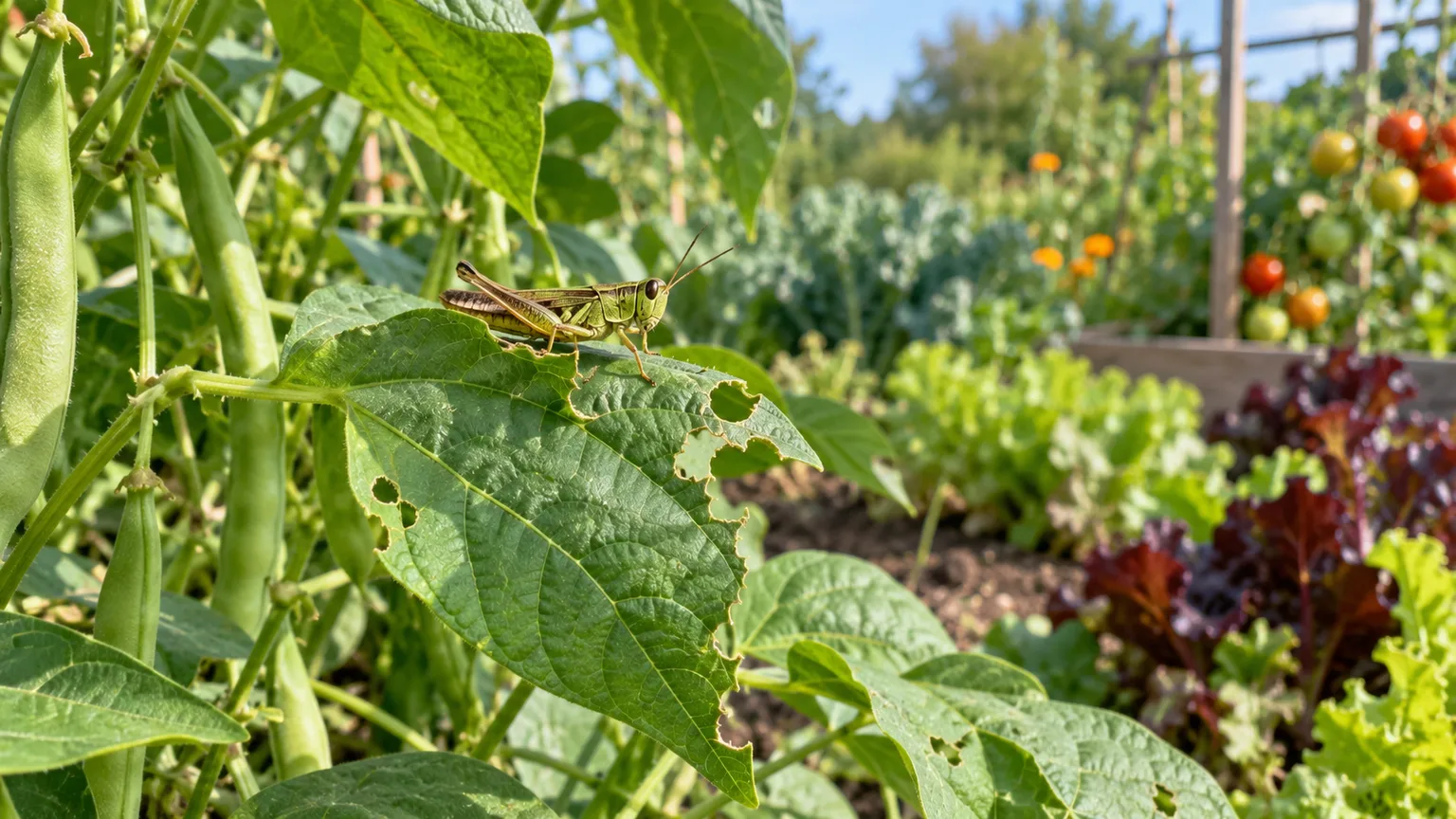
To control grasshoppers, protect vulnerable plants now and focus population control on small, clustered nymphs before they grow wings and disperse. In a small garden, that usually means checking the plants, hand-removing a few insects, and fitting a barrier over seedlings; a yard-wide spray is rarely the best first move. When adults are arriving from nearby fields or rangeland, a single homeowner may not be able to control the source population, so prevention and coordinated local advice matter.
Start with the right response for the damage
A few grasshoppers do not automatically require treatment. Grasshoppers are part of the food web, and their numbers fluctuate; if you see one insect but no fresh damage, take a photo, inspect again tomorrow, and leave the garden alone in the meantime. A healthy established plant can tolerate some leaf chewing, while a seedling, transplant, or crop you need to harvest may warrant a quicker protective step.
Use the pattern over several days to set your threshold. Mark a few representative plants or photograph the same leaves each morning. If new holes keep appearing, growing points are being eaten, or seedlings are disappearing faster than they can establish, add protection. If damage stops, avoid escalating simply because a grasshopper is still present.
| What you see | Best next move |
|---|---|
| One or two insects and little new damage | Monitor, then hand-remove if feeding continues |
| Small wingless hoppers clustered on the garden edge | Cover high-value crops and act early on the source edge |
| Fresh damage across multiple beds with flying adults | Protect the most valuable crops; ask local extension about area-wide options |
| Chewing but no grasshoppers on repeat checks | Confirm the pest before treating; caterpillars, beetles, and slugs need different plans |
Confirm grasshoppers are causing the feeding
Grasshoppers have short antennae, strong enlarged hind legs, and chewing mouthparts. They often jump or fly when disturbed. Their feeding can leave irregular holes or missing sections along leaf edges, but damaged foliage alone cannot identify the culprit; many chewing insects create similar marks. Look under leaves and through nearby grass at more than one time of day, and check whether an insect is actually feeding on the affected plants.
The crops most often favored include young lettuce, beans, corn, carrots, onions, and some annual flowers. Squash and tomato foliage are often less attractive, but preferences vary by species and pressure. During a large migration, grasshoppers may feed on plants they normally avoid. A UC IPM grasshopper guide and Colorado State University Extension’s garden-control overview describe both this variation and the limits of identifying damage by plant alone.
Read the life stage before choosing a method
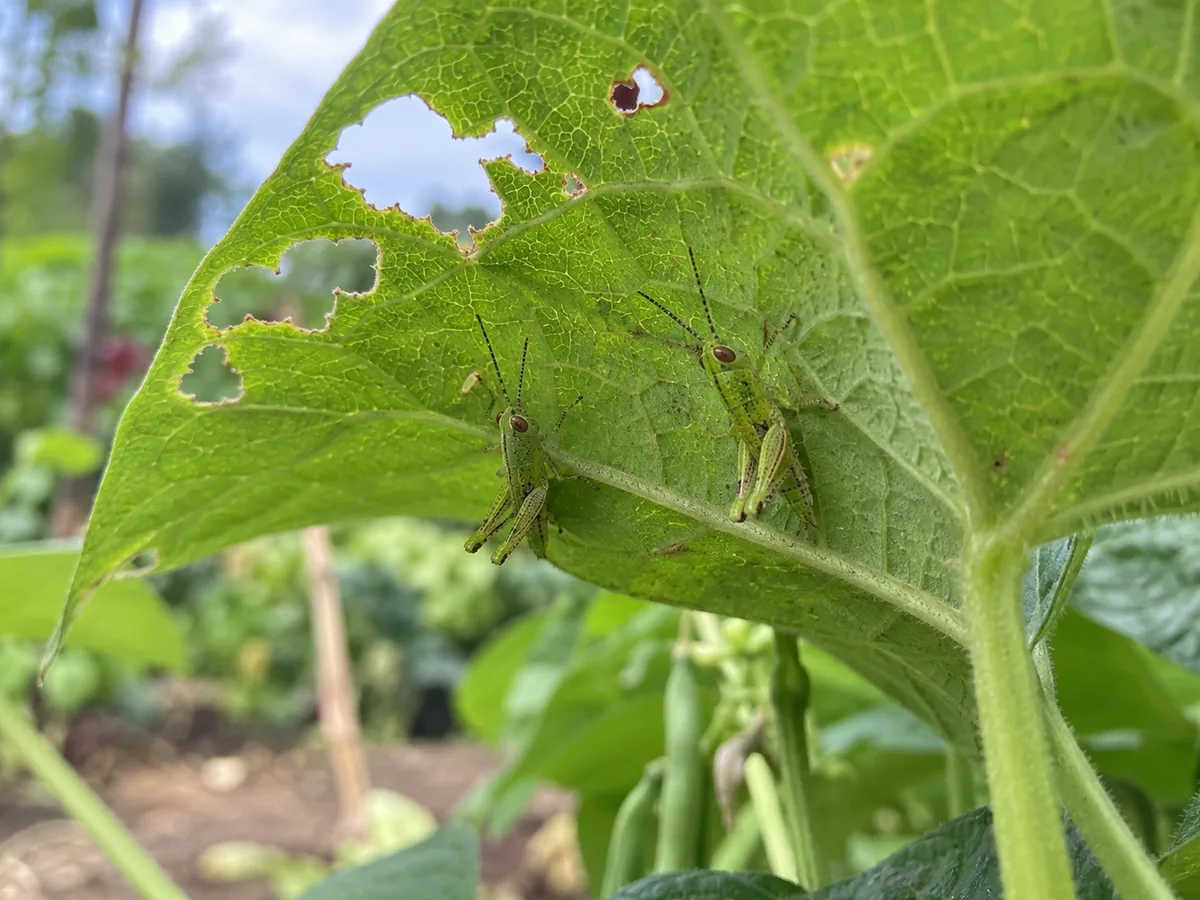
Young grasshoppers, called nymphs, look like smaller versions of adults but lack full wings. As they molt, wing pads develop; once they can fly, they can move between yards and escape a treatment area. The Utah State University Extension guide notes that grasshoppers pass through several nymph stages and that mobility rises as wing development advances. The exact timing depends on species, elevation, and spring temperatures, so watch for the insects rather than relying on a fixed calendar date.
Small clusters of wingless nymphs are the best opportunity for a home gardener to act. Adults are harder to catch, can arrive from outside the property, and may not remain on treated plants long enough for a contact product to work. This is why a treatment that seemed effective against a young local group may fail once the population begins moving.
Why timing matters more than a stronger spray
Most grasshoppers lay eggs in soil, often in relatively undisturbed ground near fields, roadsides, ditches, and grassy margins. In many regions, eggs hatch as soil warms in spring; nymphs then feed nearby and gradually disperse. The Colorado State University Extension life-cycle summary describes the egg stage and multiple molts, while UC IPM notes that egg beds are commonly outside cultivated gardens and that many species have one generation per year.
Weather and local habitat influence both survival and when insects arrive. A warm spring can bring an earlier hatch in one region, while a cool or wet period may delay it or reduce survival. There is no reliable nationwide “spray in May” rule. Check your garden edges weekly in spring, increase checks when tiny wingless hoppers appear, and protect crops before you see widespread adult feeding.
The broader setting matters too. A small garden can remove a handful of nymphs, but it cannot prevent insects from flying in from a large neighboring area. Utah State Extension emphasizes early, broad-area suppression when possible; for a home gardener, this means asking neighbors or local extension for help if several properties are affected rather than repeatedly spraying one bed.
What to do today when plants are being eaten
Start with the two tasks that immediately reduce damage: remove the insects you can reach and shield the plants that matter most. Check seedlings and leaf undersides, then gently shake or hand-pick a small number into a container of soapy water. A hand net can help in an open bed, but avoid swinging through flowering plants where you could injure pollinators or beneficial insects. Repeat checks over the next few days because new nymphs may continue to emerge or move in.
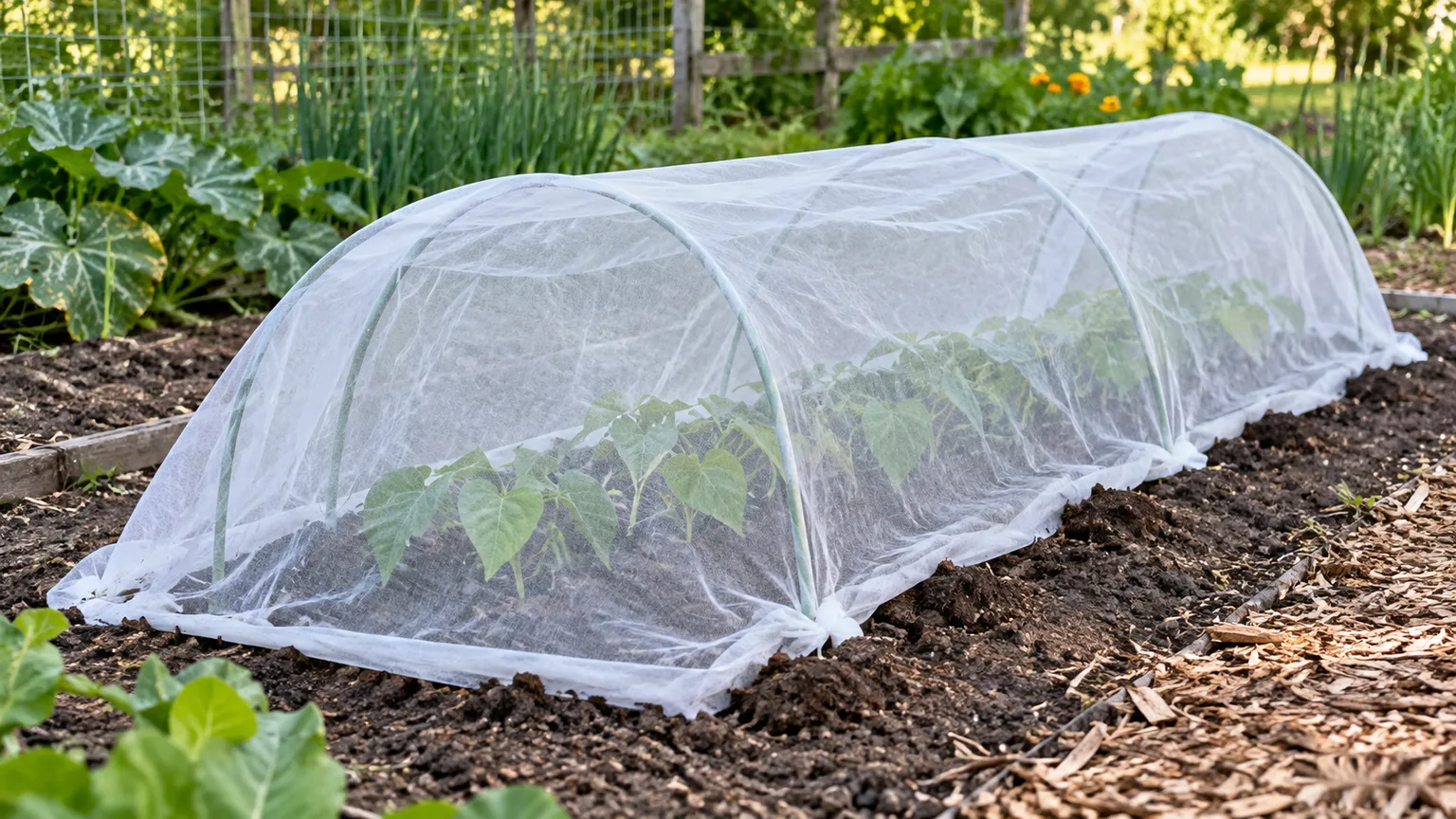
Next, cover a compact crop bed or individual plants with fine insect mesh. If grasshoppers are already inside the cover, they can keep feeding in the protected space; inspect first and remove them before closing the edges. Prioritize young transplants and crops with fresh, expanding damage instead of trying to cover every established ornamental in the yard.
If you find groups of small hoppers in a ditch, pasture, or open field beyond your property, do not apply a pesticide to land you do not own or control. Photograph the location and contact the land manager, cooperative extension office, or local agriculture department. A targeted neighborhood response while insects are young can be more useful than a late treatment after they have dispersed.
Protect crops with a well-fitted row cover
A floating row cover is often the most dependable nonchemical option for a small vegetable bed because it blocks access rather than trying to repel a mobile insect. A practical grasshopper guide includes row covers among its outbreak-protection methods, and university IPM guidance also lists protective covers for limited populations. Covers are most useful when installed before grasshoppers settle in or after you have carefully inspected and cleared the plants.
Set up the barrier without trapping pests
Use fine, durable mesh or insect screen over hoops so the material does not rest directly on tender leaves. Secure every edge with soil, boards, clips, or weights; a loose gap at ground level is an entrance. If a bed has regular heavy pressure, metal window screening or a rigid screen enclosure may hold up better than thin cloth. UC IPM cautions that hungry grasshoppers can chew through some cloth or plastic covers, so treat any barrier as a protective layer to inspect, not an impenetrable wall.
Check under the cover after installation and after gardening work. Remove any hoppers that were already inside, close openings promptly, and watch for tears where stems press against the mesh. Covers can raise temperature and humidity, so vent or remove them during hot weather if the crop is overheating. For crops that need insect pollination, uncover when flowers open or provide the pollination the crop requires; do not assume a cover can remain sealed through bloom without affecting fruit set.
Manage the garden edge without making things worse
Grasshopper management at the edge is not one-size-fits-all. In some recurring migration sites, UC IPM describes keeping a green border of tall grass or other lush plants as a trap crop, then protecting the main vegetables and targeting the border if necessary. The point is to keep a deliberate alternative feeding strip green and separate from the crop, not to let weeds spread through the beds.
Other extension guidance discusses mowing a low strip to reduce the movement of young, walking nymphs from nearby vegetation. These strategies address different situations: a green trap border may divert feeding when insects routinely approach a garden, while a low buffer may interrupt movement of young nymphs from a source area. Neither is a universal fix. If you choose a trap crop, do not mow or let it dry while it is holding grasshoppers; abruptly removing the food can push insects into the garden. If adults are already flying over the border, neither strip will stop them.
Remove grassy weeds within crop beds and keep young plants accessible for inspection. Avoid tilling the entire yard just because grasshopper eggs are laid in soil. Egg pods are patchy and may be in undisturbed land beyond the vegetable garden; unnecessary tillage can disrupt soil structure and other organisms without reaching the source. If you already cultivate an annual bed for a crop-related reason, late-season soil disturbance may expose some egg pods, but it should not be treated as guaranteed control.
Support predators, but do not expect them to stop an outbreak
Birds, robber flies, blister beetles, and other predators consume grasshoppers or their eggs. A diverse garden with nesting cover, water, and flowering plants can support wildlife, and the RHS guidance on managing garden pests without chemicals recommends monitoring and supporting beneficial organisms as parts of integrated pest management. These practices build resilience; they do not promise that birds will clear a sudden migration.
Chickens and other poultry may eat grasshoppers, but they can scratch seedlings, disturb mulch, and damage vegetables. If you keep poultry, supervise short foraging periods in a fenced area after protecting young crops. Do not release nonnative predators or collect wild insects for introduction. Preserve predator habitat while using barriers and monitoring for the immediate crop problem.
Consider biological bait only when the timing fits
Some grasshopper baits contain Nosema locustae, a naturally occurring protozoan used as a biological control. Grasshoppers must consume the bait, and the pathogen acts slowly; it is not a knockdown treatment for adults already stripping leaves. Colorado State and Utah State Extension describe it as an option aimed at young grasshoppers, while UC IPM notes that it affects only certain species and may be unsuitable for some home-garden situations.
Before buying a bait, confirm that the product is currently available and labeled for the target grasshopper, the site, and any edible crops you grow. Follow its storage, application, and reapplication directions. Rain or irrigation can reduce bait performance, but reapply only as the label permits. “Biological” does not mean immediate, universally effective, or automatically appropriate for every garden.
Are vinegar, garlic, and flour reliable controls?
Do not count on vinegar as a grasshopper treatment. Household vinegar is acidic and can injure foliage; diluting it does not establish that it will repel grasshoppers or protect a crop. Spraying a vinegar mixture on or near plants can create new damage while leaving the insects free to return. The RHS cautions that homemade sprays and untested mixtures can scorch plants or affect other organisms, so a food ingredient is not automatically a safe pesticide.
Garlic sprays and flour dusting are also unreliable as a primary plan. A garlic extract may affect some insects under specific conditions, but that does not prove a homemade mixture will deter mobile grasshoppers in an outdoor bed. A review of garlic pest-control claims discusses why results depend on the target pest and preparation; do not generalize results for one insect to another. Flour can wash off, and no simple dusting schedule will protect plants through rain, irrigation, or new growth.
If you experiment with any non-labeled homemade mixture, test a small area first and wait for signs of leaf injury, but the better use of time is usually a physical barrier and repeated scouting. Do not mix vinegar, soaps, oils, garlic, or other household products with a registered pesticide. That can damage plants, create an unsafe mixture, and make it impossible to follow the product label correctly.
When a pesticide may be justified
A labeled product may be worth considering when feeding is severe, valuable crops are at immediate risk, and hand removal or barriers cannot protect enough plants. For a home garden, targeted baits or localized edge treatments may expose fewer non-target insects than spraying every leaf, but the trade-off depends on the exact formulation and where it is applied. UC IPM warns that several spray products used against grasshoppers can be highly toxic to bees, natural enemies, and aquatic life; a bait is not risk-free simply because it is more localized.
Before treatment, identify the insect and look for young nymphs. If most insects can fly, a spray may kill individuals that are present while more arrive later. A product that is not labeled for the crop, site, or pest should not be used there. Product names and active ingredients do not tell you whether a formulation is permitted for lettuce, beans, a home garden, or use near water.
Read the label for the exact crop and site
Read the entire current label before opening the container. Confirm that it lists grasshoppers, the exact edible crop or ornamental site, where the product may be applied, required protective equipment, application interval, preharvest interval, reentry period, and restrictions for pollinators or water. Labels differ among formulations, even when a brand name is similar. Follow the local label and extension advice; never increase a rate, shorten an interval, or treat a flowering crop based on a recipe from another garden.
Keep people and pets away as the label directs, store pesticides in their original containers, and dispose of leftovers according to local instructions. If the label is unclear, the crop is not listed, or the infestation spans several yards, stop and ask a local extension specialist or licensed applicator rather than improvising. Utah State Extension stresses that products and crop registrations differ and that the applicator is responsible for correct use.
A practical plan from spring through fall
Before hatch: Note where adults fed late in the previous season and inspect nearby weedy or undisturbed edges as spring warms. Plan row covers for seedlings, repair mesh, and coordinate with neighbors if several gardens had damage. This is preparation, not a reason to spray a dormant garden.
When the first nymphs appear: Check the edge vegetation and tender crops several times a week. Remove small groups, close crop covers, and decide whether a persistent trap strip or a low buffer fits the direction and stage of movement. Ask your extension office about any locally suitable biological bait while insects are still small.
When adults arrive: Protect the crops you most need to save, keep monitoring, and do not expect a single backyard spray to stop migration. If crop losses are mounting across properties, request area-wide advice. Some damage may be unavoidable during a regional outbreak; preserving the most vulnerable beds can be a more realistic goal than trying to make every outdoor space grasshopper-free.
After the season: Record when damage began, which edge it came from, which crops were affected, and what actually reduced feeding. A Colorado State University Extension overview notes that late-season numbers can help anticipate problems the following year. Use those observations to start checking earlier next season rather than repeating a treatment that did not work.
Common mistakes that waste time or harm the garden
The first mistake is waiting until adults are everywhere, then expecting a home remedy to reverse the damage. A second is applying a broad spray because holes look severe without confirming what is feeding. Grasshoppers, beetles, slugs, and caterpillars require different approaches, and an unnecessary treatment can kill predators or pollinators while leaving the real pest untouched.
Another common error is covering a plant after insects have already settled inside the mesh. The cover then protects the pest as well as the crop. Inspect first, seal edges, and check frequently. Avoid leaving a cover over a flowering crop without considering pollination and heat, and do not assume thin fabric will withstand a high-pressure migration.
Finally, do not treat every “natural” recipe as harmless or every green border as helpful. Vinegar may scorch leaves; soaps and oils can affect non-target insects; an unmaintained trap crop may become a source of insects; and a broad pesticide may injure the same beneficial species you are trying to attract. Choose one method that matches the life stage, monitor the result, and change course if the evidence in your garden says it is not working.
When to involve neighbors or local extension
Ask for local help when grasshoppers are coming from a shared field, pasture, ditch, or vacant lot; when multiple households are losing crops; or when you are unsure whether a bait or pesticide is legal for your crop. Extension staff can interpret local hatch timing, identify likely species, and advise whether an area-wide response is realistic. In some states, agricultural agencies also coordinate large-scale management on public or rangeland areas.
A photo of the insect beside a ruler, a record of when nymphs appeared, and a map or description of the direction they are moving can make that conversation more useful. If the insects are adults that fly off as you approach, say so; that detail changes the expected success of sprays and baits. Bring the pesticide label if you need help interpreting a product’s crop or site restrictions.
Conclusion
The most reliable grasshopper plan is early, targeted, and realistic: confirm the insect, protect seedlings with a secure barrier, remove small groups, and focus on young nymphs before they become mobile adults. Manage the garden edge according to how insects are arriving, support natural predators without expecting them to solve an outbreak, and treat biological or chemical products as conditional tools rather than guarantees.
If adults are migrating from beyond your property, repeated sprays and pantry mixtures are unlikely to provide lasting relief. Protect the crops that matter most, record what happens, and involve neighbors or local extension when the source is shared. That approach can reduce damage while avoiding unnecessary harm to plants, pollinators, and other garden wildlife.