11 Best Trees That Grow in Shade
Find 11 trees that grow in shade, from small understory choices to towering hardwoods. Compare light, soil, mature size, regional fit, and trade-offs.
A shady yard can support a long-lived tree, but “tolerates shade” is not the same as “grows quickly in darkness.” A tree may persist for years beneath a canopy while adding little height, producing few flowers or fruits, and waiting for a natural opening in the upper branches. The right choice depends on how much light reaches the site, how dry the soil becomes, and whether you have room for a small understory tree or a future giant.
Use this list as a shortlist, not a guarantee. The University of Illinois Extension tree selector distinguishes full-shade choices such as American hornbeam, Canadian hemlock, American hop-hornbeam, and pawpaw from the much longer list suited to partial sun or shade.University of Illinois Extension That distinction matters: the latter trees may cope with dappled light but disappoint in a dark corner beneath a dense evergreen canopy.
What “shade” means before you choose a tree
In garden language, full shade usually means a site receives little direct sun—often no more than about three hours—while still getting ambient or filtered daylight. Dappled shade is brighter: small moving patches of sun pass through a canopy. Deep shade under a solid roof, dense conifers, or a north-facing wall can be much darker. It is useful to observe the site in spring, summer, and fall because leafless deciduous trees let in far more light before they leaf out.
Shade also describes light, not water. Soil under a mature maple or beech may be dry because established roots intercept rainfall, while shade beside a north wall may stay cool and damp. Before selecting a tree, check whether the ground drains after a heavy rain, whether the soil dries within a few days, how much direct sun reaches leaves in midsummer, and how close the planting spot is to trunks, paving, wires, and buildings.
Finally, decide what “for years” means for your yard. A seedling can survive in an understory for a long time without becoming a quick shade canopy. A small tree can be the better long-term answer when the space is narrow, while a beech, bigleaf maple, or sugar maple needs enough room for a large mature crown and roots. If the site is nearly lightless, choose a shrub or woodland groundcover instead of forcing a tree into conditions where it cannot maintain healthy growth.
Quick picks: match the tree to the site
| Site or goal | Strong candidates | The trade-off to know |
|---|---|---|
| Cool, moist woodland | American hornbeam, eastern hemlock, American hop-hornbeam, pawpaw | Existing roots can still make establishment difficult |
| Small residential space | American hornbeam, common hoptree, Japanese maple, pagoda dogwood | These provide a smaller canopy, not deep whole-yard shade |
| Evergreen structure | Eastern hemlock or Japanese yew | Hemlock needs a cool, moist setting; yew is poisonous if eaten |
| Edible fruit | Pawpaw | Fruit set needs pollination between genetically distinct trees and more light helps production |
| Western woodland or large property | Bigleaf maple | Native to the Pacific Coast and far too large for many yards |
| Dry shade beneath established trees | American hop-hornbeam or a well-sited hoptree | “Dry-tolerant” does not mean a new tree can go unwatered |
No row in the table is a substitute for checking your regional tree list. A plant’s hardiness zone indicates cold survival, not its tolerance of heat, humidity, drought, local pests, or competition from existing trees. University of Illinois Extension’s selector is especially useful because it separates full-shade exposure from partial sun and shade instead of treating those conditions as interchangeable.University of Illinois Extension
American beech (Fagus grandifolia)
American beech is a handsome native canopy tree with smooth gray bark, dense branching, and bronze-gold fall foliage. It is notably shade-tolerant when young and can persist beneath taller trees. In a landscape, though, its eventual size—not just its seedling tolerance—should drive the decision: this is a broad, long-lived tree for a spacious property, not a compact understory accent beside a foundation.
Choose it where the soil is reasonably deep and moisture-retentive, the crown has room to spread, and you are comfortable leaving a natural leaf layer beneath it. Beech roots are close to the surface, so the area may be difficult to dig or replant later. The tree’s shade tolerance lets it establish as an understory tree; it does not make it a quick way to create shade under another mature tree. If the intended spot already contains big roots, plant at the canopy edge where light and water are less contested.
American hornbeam (Carpinus caroliniana)
For many ordinary yards, American hornbeam is the most balanced choice on this list. Also called musclewood or blue beech, it is a small, slow-growing native tree with a rounded crown and a sculptural trunk whose ridges resemble flexed muscles. University of Illinois Extension includes it among both full-shade and partial-shade selections, a useful distinction when the site has less light than a typical flowering-tree border.University of Illinois Extension
It is a sensible pick for woodland edges, courtyards, and smaller properties where a full-size canopy tree would crowd a house. The best results usually come in moist, well-drained soil rather than waterlogged ground. Its modest pace is a strength if you want a tree that stays in scale, but a weakness if you expect it to cast substantial shade within a few seasons. Let the tree grow into its natural form; repeated hard pruning removes the layered structure that makes it attractive.
Bigleaf maple (Acer macrophyllum)
Bigleaf maple belongs on a shade-tree list only with a clear regional caveat: it is native to the Pacific Coast, where it grows in moist forests and can become a massive canopy tree. The name refers to its exceptionally large, lobed leaves. Young trees can grow in the shade of taller forest trees, and a mature maple can eventually shade a broad area, but the space, water, and root spread required are substantial.
Consider it in a large western garden that can accommodate a forest tree and has adequate moisture through dry summers. Do not treat it as a universal replacement for an eastern maple; a species adapted to Pacific maritime conditions may struggle where summers are hot, dry, or sharply continental. It is also a poor fit for a narrow planting strip, small urban lot, or site where roots will be restricted. If the attraction is simply oversized foliage, choose a smaller tree suited to your local climate rather than buying a bigleaf maple by name alone.
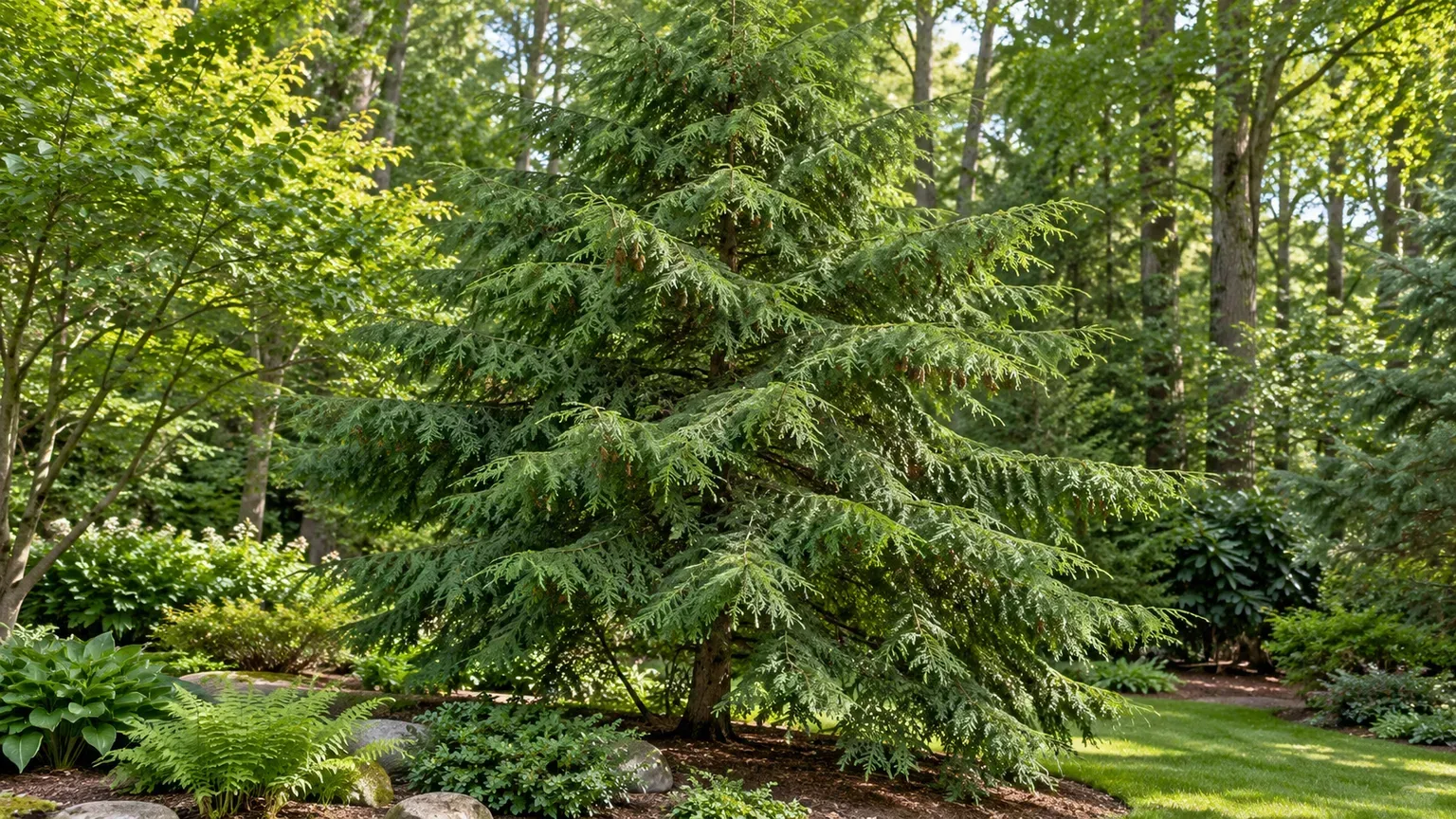
Eastern hemlock (Tsuga canadensis)
Eastern hemlock is the standout when you want evergreen foliage in a cool, shaded woodland. Its fine needles and graceful, layered branches hold color year-round, and the species can remain in the understory for years before a canopy opening allows faster growth. Extension sources list Canadian hemlock among trees suited to both full shade and partial sun or shade.University of Illinois Extension2
That does not make it a universal evergreen. Hemlock performs best where summers are not excessively hot and dry and the soil stays evenly moist but drains well. A windy, reflected-heat site beside pavement can be much tougher than shaded forest soil. The species also faces hemlock woolly adelgid in parts of its range, so check local extension or forestry guidance before planting; pest pressure and management options vary by region. Choose a locally appropriate alternative when the tree is already under serious pressure nearby.
American hop-hornbeam (Ostrya virginiana)
American hop-hornbeam, also called ironwood, is a native understory tree whose small stature and tough wood make it a practical choice where a giant maple would overwhelm the property. Its leaves turn yellow in autumn, and papery clusters of fruit resemble hops. University of Illinois Extension lists it among its full-shade trees, while the USDA Forest Service describes the species as an understory tree in eastern hardwood forests.University of Illinois Extension3
It is a strong candidate for a naturalistic garden with light shade and well-drained soil, including places where you want a modest tree to live under a taller canopy. Expect steady rather than dramatic growth. Avoid planting it into a compacted pit or a permanently saturated hollow, and do not mistake tolerance of woodland shade for a willingness to compete with a wall of established roots during its first summers. Giving a young plant a little more light at the edge of the canopy can improve its growth without turning the site into full sun.
Common hoptree (Ptelea trifoliata)
Common hoptree is a small native tree or large shrub, useful when you need a compact, informal shape rather than a tall shade canopy. Its three-part leaves, clusters of small flowers, and papery winged fruits give it seasonal interest. It can tolerate a range of light and soil conditions, but flowering and fruiting generally improve when it receives more light than a deep forest interior provides.
This is a good option for a woodland edge, a naturalized border, or a dry-to-average site where a large tree would be impractical. Crushed foliage has a strong, distinctive odor, so place it where that will not be an everyday nuisance. Check the mature width as well as height: a multi-stemmed plant may occupy more lateral room than its small-tree label suggests. If the goal is a neat, high-canopy form over a patio, hoptree is likely the wrong silhouette.
Japanese maple (Acer palmatum)
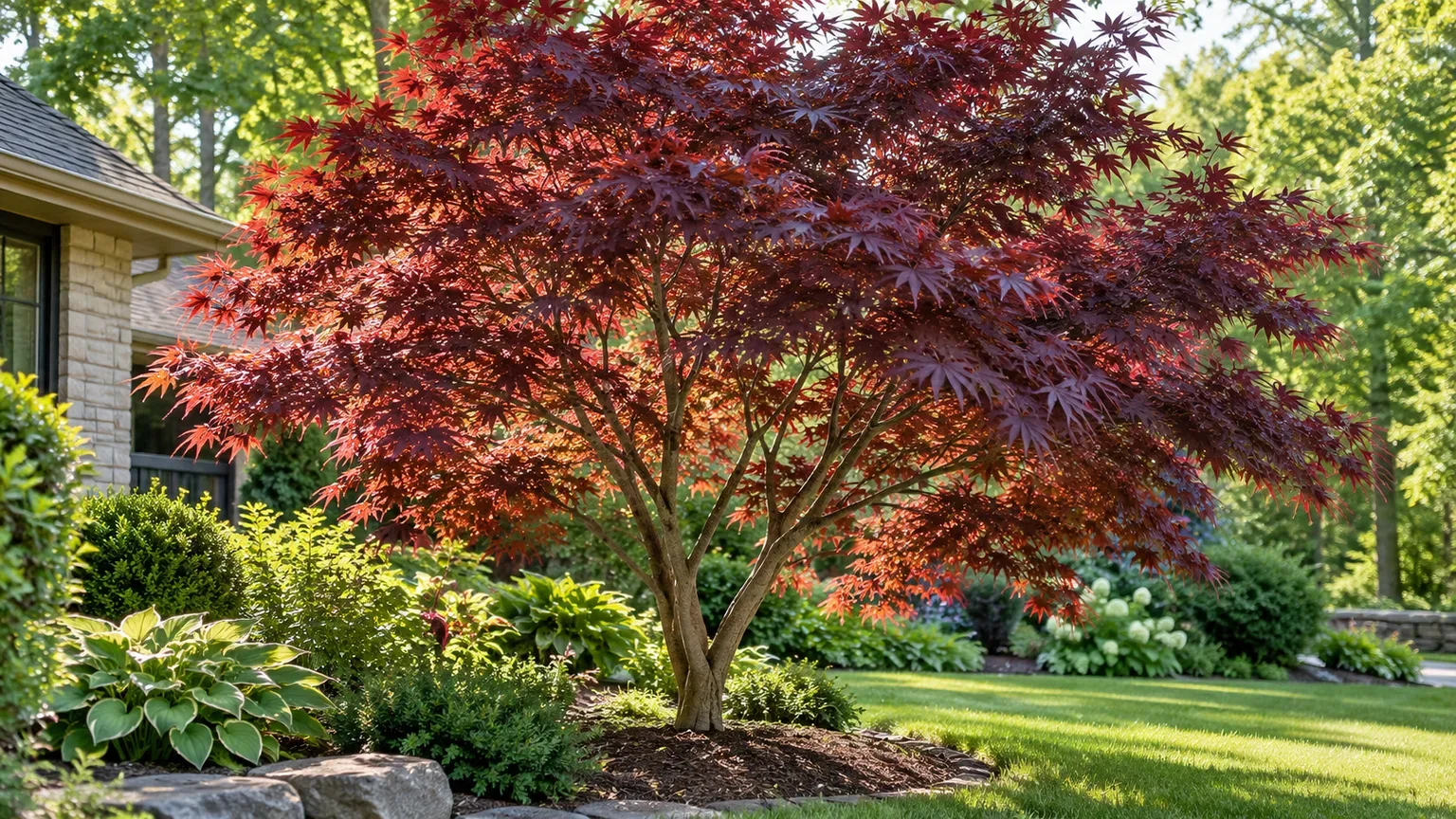
Japanese maple is best known for its refined size, elegant branching, and leaf colors that range from green to gold, red, and burgundy. It is one of the easiest choices to place in a small shaded garden because many cultivars stay much smaller than the forest trees on this list. “Japanese maple” is not one fixed size or shape, however: cultivar, graft, and pruning history change the mature form, so read the nursery tag for the exact selection.
Bright dappled shade or morning sun with afternoon protection is often a better target than the darkest corner. In deep shade the tree may live, but red foliage can lose intensity, growth can become thinner, and autumn color may be less dramatic. Choose a protected site with well-drained soil and avoid hot, drying wind. A Japanese maple is a focal-point tree, not a fast screen; let its branching show and use lower shade plants around it rather than crowding its trunk.
Japanese yew (Taxus cuspidata)
Japanese yew offers dense evergreen structure where a broadleaf tree would lose its leaves in winter. It tolerates partial shade and is often grown as a large shrub or small tree, with dark needles and a shape that responds well to pruning. NC State Extension notes that the species can reach considerable size in natural conditions, though landscape specimens are commonly kept smaller; its guidance also stresses well-drained soil and describes the plant as highly poisonous.NC State Extension
That safety note is decisive: do not plant Japanese yew where children, pets, or livestock may chew its foliage or seeds, and do not rely on a warning label as a substitute for choosing a safer plant when browsing is likely. The red fleshy aril can appear harmless, but the seed inside is toxic, and the rest of the plant is not safe to eat. It also dislikes wet, poorly drained soil. If your goal is a small shade-tolerant evergreen and the site has animals or young children, ask a local extension office for a non-toxic alternative before buying.
Pagoda dogwood (Cornus alternifolia)
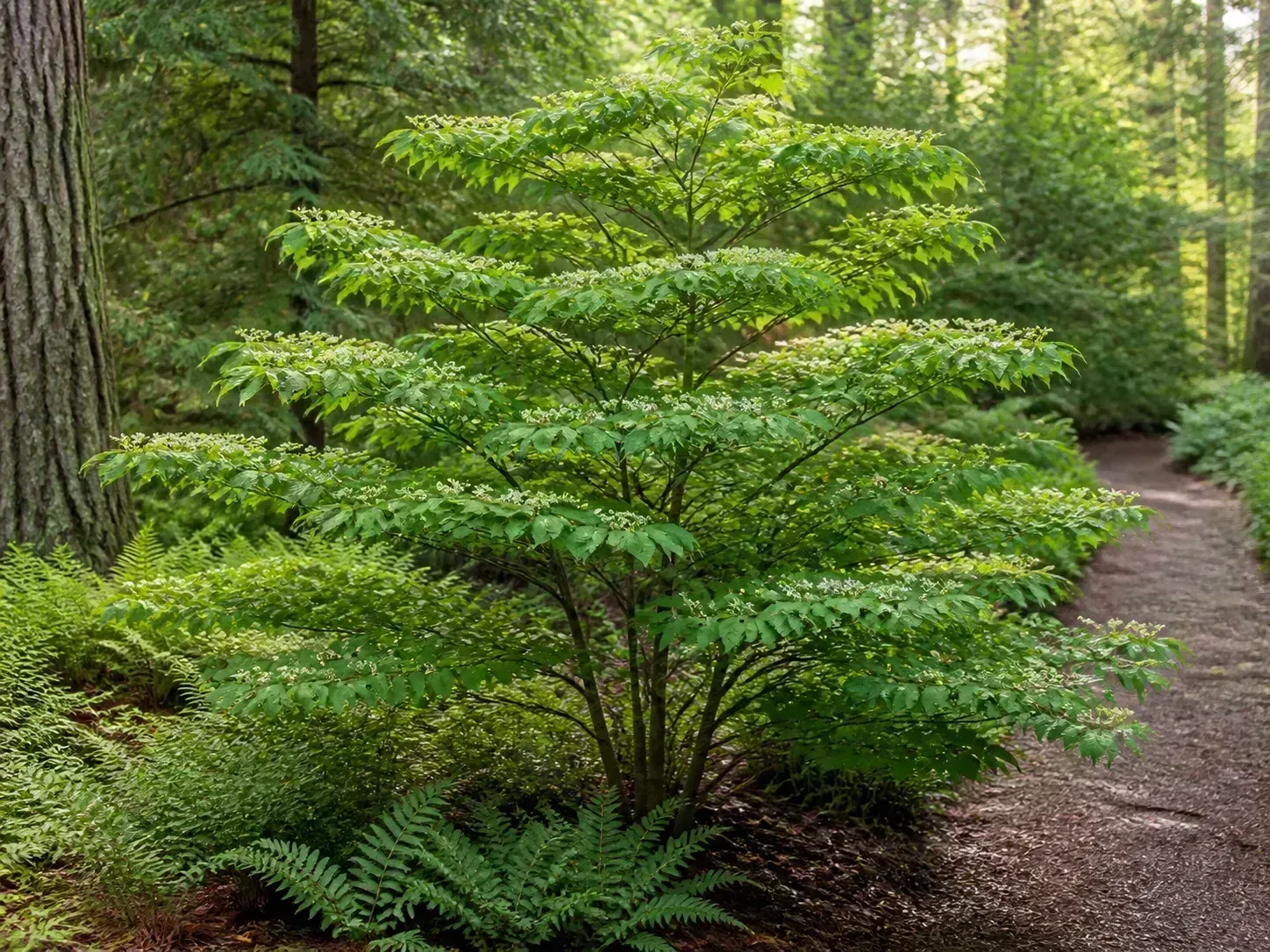
Pagoda dogwood is a small deciduous tree with horizontal tiers of branches, giving it a distinctive layered outline even when it is not in flower. Creamy spring flower clusters and dark fruits add seasonal interest; the fruit can draw birds. The tree is native to eastern North America and works especially well as an understory or woodland-edge specimen, where filtered light reaches its crown.
It prefers cool, moist, well-drained soil and can survive more shade than it can use for abundant flowers. Choose the brightest part of a shaded site if bloom is a priority, but avoid hot afternoon exposure in climates where its shallow-rooted soil dries quickly. A mulched, undisturbed root zone is usually easier to maintain than a bed of annuals that needs frequent digging. Use a cultivar only after checking its mature form and local performance; the golden-variegated plant shown below is one ornamental selection, not a promise that every pagoda dogwood has gold foliage.

Pawpaw (Asimina triloba)
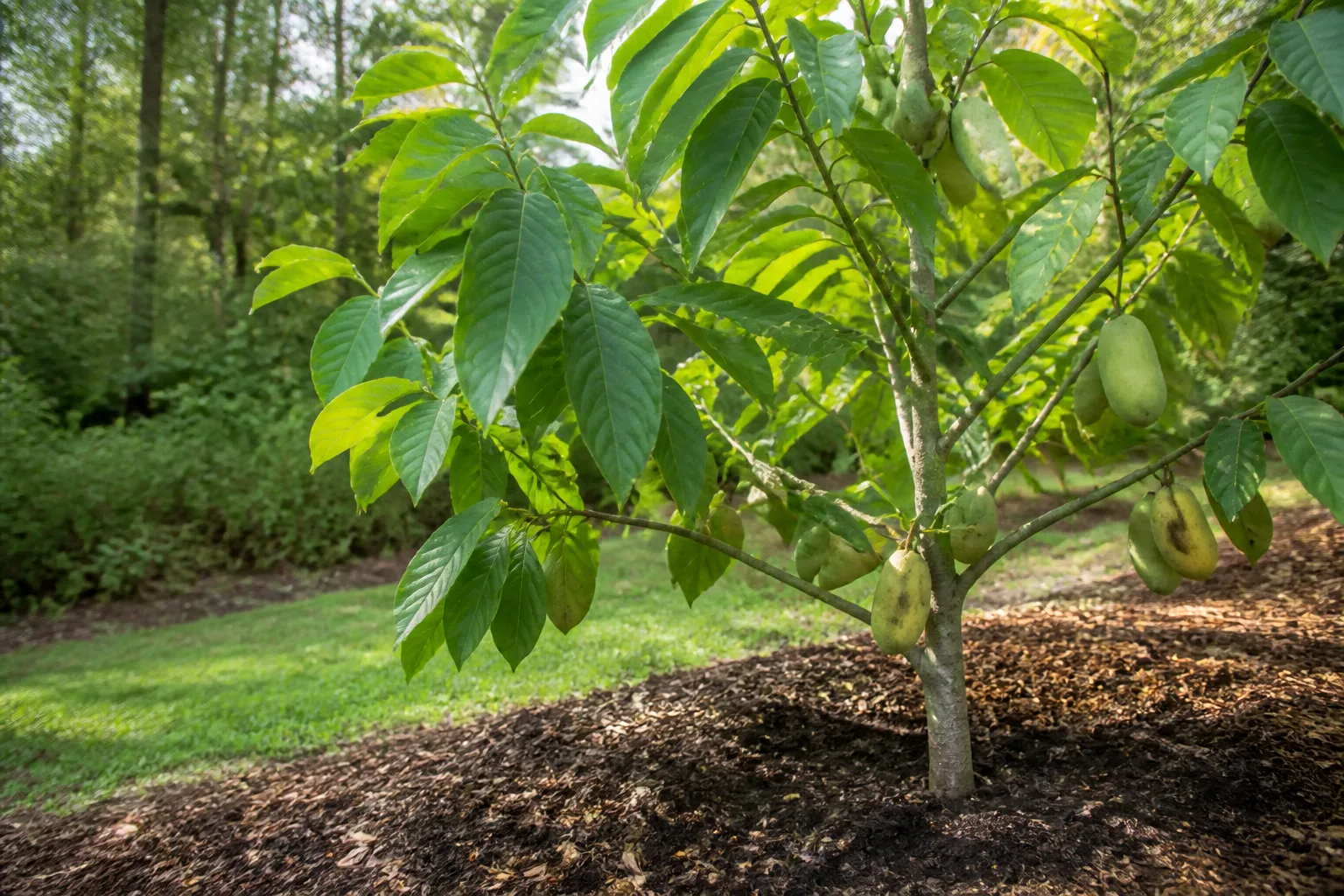
Pawpaw is a native fruit tree with large tropical-looking leaves and an unusually rich, custard-like fruit. Young plants naturally grow in woodland shade, which can protect tender foliage while a tree establishes. The University of Illinois Extension selector includes pawpaw among its full-shade choices; Lake Metroparks’ park biologist also describes pawpaw as a shade-loving understory tree of moist, rich soils.University of Illinois Extension Lake Metroparks
The trade-off is fruit production. A pawpaw can remain healthy in shade and still set little fruit; flowering and fruiting tend to improve when a mature tree gets more light. Many pawpaws also need pollen from a genetically different plant, so two seedlings taken from the same clonal patch may not be compatible partners. If fruit is the goal, buy two unrelated cultivars, give them more light than a deep forest floor, and confirm that your climate supports the species. If your priority is a native understory tree with broad foliage, shade is much less of a drawback.
Sugar maple (Acer saccharum)
Sugar maple is a large, long-lived eastern North American tree valued for a dense canopy, brilliant fall color, and sap used for syrup. It is shade-tolerant as a young tree and can establish beneath a forest canopy, but it needs a substantial footprint as it matures. It is not a good choice for a small front yard simply because a sapling fits there today.
Give it deep, fertile, well-drained soil and space away from structures, overhead wires, and pavement. Compacted soil and heat can be harder on sugar maple than a cool, roomy woodland setting. If your yard has heavy clay, hot reflected sun, or a very small root zone, another species better adapted to those conditions may live longer with less intervention. A shade-tolerant seedling can wait in the understory, but it still needs room and suitable soil to become the large canopy tree people picture.
Match the tree to the site, not the label
Start by sorting your location into one of three practical conditions: bright partial shade, cool woodland shade, or dry shade under established trees. For bright partial shade, Japanese maple and pagoda dogwood offer a smaller ornamental scale; their flowers or foliage color will usually be better with some filtered or morning light. For cool woodland shade, hornbeam, hop-hornbeam, eastern hemlock, and pawpaw have stronger ecological fit, provided soil and climate suit the species.
For dry shade under a mature canopy, think about competition before drought tolerance. A new sapling has a small root system, and nearby mature trees have already occupied much of the water and soil volume. Hop-hornbeam and hoptree can be worth considering at a canopy edge, but neither should be planted in a dry root mat and then abandoned. If the spot is both very dark and dry, the honest answer may be that a shrub, fern, or groundcover is a better long-term plant than a tree.
Use the mature dimensions, not the nursery container, to judge fit. Bigleaf maple, American beech, and sugar maple are large canopy trees; they need a wide, unpaved rooting area. Hornbeam, hoptree, Japanese maple, pagoda dogwood, and pawpaw are more manageable for many residential gardens, though each can still exceed the scale of a tight planting strip. Check the utility line and local right-of-way before planting, and ask your municipality about street-tree restrictions.
Planting inside an existing canopy
The most common mistake is to put a new tree directly against a mature trunk because that patch looks empty. It may be empty because the existing tree’s roots take up the space, rain is intercepted by its crown, and very little light reaches the ground. Move toward a canopy edge, natural gap, or place with morning light if your design allows. The shade-garden layering approach used by Better Homes & Gardens and woodland-gardening practitioners also favors working with the site’s light pattern rather than trying to make every spot behave like a sunny bed.Better Homes & Gardens Mostly Native Shade
When planting under another tree, dig only as large a hole as needed for the root ball, and stop if you encounter a major root rather than cutting it to force the planting. Set the root flare at or slightly above the finished soil level, backfill with the soil you removed, water to settle it, then spread a shallow mulch layer without piling mulch against either trunk. Do not rototill the area, raise the grade with a thick layer of soil, or trench for an irrigation line through large roots; those shortcuts can damage the tree you are trying to garden beneath.
Fall or early spring is usually easier than the hottest part of summer for planting a tree, but the local window depends on climate and nursery stock. Water slowly through the first growing seasons whenever rainfall is not enough to keep the root ball and surrounding soil from drying. A slow trickle over the root zone is more useful than a brief splash at the trunk. Avoid heavy fertilizer unless a soil test or local extension guidance identifies a need; it will not compensate for too little light, poor drainage, or a root zone packed with competing trees.
Aftercare that gives a shade tree time to establish
Check moisture by probing the soil around the root ball, not by reading the shade of the leaves. The surface can look damp while the root ball is dry, or it can stay wet long after rain in a poorly drained site. Water deeply when the surrounding root zone begins to dry, then let the soil drain. Adjust the schedule during heat waves, drought, and unusually wet periods instead of following a calendar that ignores weather and soil.
Keep turf, thick groundcover, and new shrubs away from the immediate trunk while the tree establishes. A broad, shallow mulch ring reduces competition and makes watering more efficient, but the mulch should not form a volcano against the bark. Inspect the trunk and canopy periodically for damage, dieback, or pest symptoms. For eastern hemlock, check your county extension or state forestry updates for current hemlock woolly adelgid activity; early local advice is more useful than applying a pesticide without identifying the problem.
Give the tree several seasons before judging its pace. Shade-grown trees may allocate energy to roots before adding obvious top growth, and natural understory species do not all behave like fast-growing street trees. If growth remains weak, recheck light, water, soil drainage, planting depth, and root competition in that order. Adding fertilizer or pruning neighboring trees should not be the first reflex.
Mistakes that make a shade planting fail
Do not assume every shade-tolerant tree will flower, fruit, or color well in the darkest location. A Japanese maple may survive but lose its vivid foliage; pagoda dogwood may bloom lightly; pawpaw may grow leaves without producing the fruit you hoped for. Choose first for survival and site fit, then decide which seasonal feature is realistic.
Do not use hardiness-zone numbers as a complete climate filter. A plant can survive winter in a zone but still suffer in a hot, dry summer, a windy exposed site, or waterlogged clay. Native range is a useful clue, but local conditions vary within a range; nearby extension, municipal forestry, and native-plant guidance can narrow the choice.
Do not plant a large tree because it is sold as a small sapling, and do not take shade tolerance as permission to ignore the canopy overhead. A beech or sugar maple that fits a gallon pot can eventually dominate a small yard. Conversely, small understory trees do not become giant shade providers just because their species tolerates low light. Match the eventual tree to the space you can actually provide.
Conclusion
The strongest choices for genuinely shady conditions are American hornbeam, American hop-hornbeam, eastern hemlock, and pawpaw, with important differences in size, moisture, evergreen structure, and fruiting. Japanese maple, pagoda dogwood, and hoptree are often better when the shade is brighter or the site has a woodland edge; American beech, bigleaf maple, and sugar maple need the room and climate their mature size demands. The right tree is the one that fits both the light you have now and the soil, roots, and space it will live with for decades.
Before buying, observe the site through the growing season, check the mature width and regional fit, and decide whether you want flowers, fruit, evergreen screening, or a future canopy. Plant near a gap rather than forcing a tree into a dense root mat, protect existing roots, and water the new tree through establishment. Those choices matter more than a label that simply says “shade tolerant.”



