12 Shrubs With Red Fall Color for Your Garden
Compare 12 shrubs with red fall color, including their mature size, light and soil needs, regional limits, and whether the red comes from leaves, berries, or bark.

“Red fall leaves” can mean anything from clear scarlet to burgundy, wine, or rusty red-orange. It can also be a loose label for a shrub whose berries or bare winter stems are red while its leaves turn yellow. That distinction matters when you are choosing a plant: a shrub selected for a red foliage display will not meet the same goal as one that keeps red fruit into winter.
The plants below are shrubs or large, multi-stem plants commonly grown as shrubs. They do not all turn the same color, and none can guarantee the exact shade in every garden. Use the site notes and color labels as carefully as you use the plant name; a good match for your climate and light usually matters more than a dramatic catalog photograph.
What “red fall foliage” really means
Leaves contain pigments that are easy to confuse in a short plant list. Yellow and orange carotenoids are present during the growing season and become more visible as green chlorophyll fades. Red and purple anthocyanins, by contrast, are produced in many plants during autumn; their amount and timing depend on the plant’s genetics and the season’s conditions. The NC State Climate Office explains how light, cool temperatures, drought, wind, and early freezes can shift or shorten the display. A dry, stressed plant may drop brown leaves early rather than develop better color. NC State Climate Office
That is why a reference to “red fall color” should be read as potential, not a guarantee of scarlet leaves on a particular date. One shrub may show crimson on an exposed sunny edge and mostly orange in a shaded interior; a warm autumn can delay color, while a hard early freeze can cut the show short. The profiles distinguish foliage from berries and stems so you can choose the seasonal feature you actually want.
12 shrubs to compare
| Shrub | What can turn red | Best reason to choose it |
|---|---|---|
| Oakleaf hydrangea | Burgundy, wine, or red-purple leaves | Large native shrub for part shade and multi-season interest |
| Virginia sweetspire | Red, burgundy, copper, and orange leaves | Moist sites and graceful white spring flowers |
| Dwarf fothergilla | Red mixed with orange and yellow | Compact, multi-season native shrub |
| ‘Tor’ birchleaf spirea | Red-orange and bronze leaves | Small, sunny planting spaces |
| ‘Tiger Eyes’ sumac | Orange-red leaves | Strong fall display and unusual summer foliage |
| Smokebush | Red to crimson leaves, especially in some cultivars | Bold foliage and architectural form |
| Arrowwood viburnum | Red, purple-red, or mixed autumn color | Wildlife value and adaptable native screening |
| Possumhaw viburnum | Red foliage; berries age from pink to blue-black | Moist soils and fruit as a second season of interest |
| Red chokeberry | Red-orange foliage; red fruit | Wet-tolerant native planting and persistent fruit |
| Black chokeberry | Orange-red to purple-red foliage; black fruit | Tough native shrub with edible, tart berries |
| Highbush blueberry | Scarlet to crimson foliage | Acidic beds, spring flowers, and edible summer fruit |
| Serviceberry | Orange-red leaves; spring fruit | A shrub or small tree with several seasons of interest |
1. Oakleaf hydrangea (Hydrangea quercifolia)
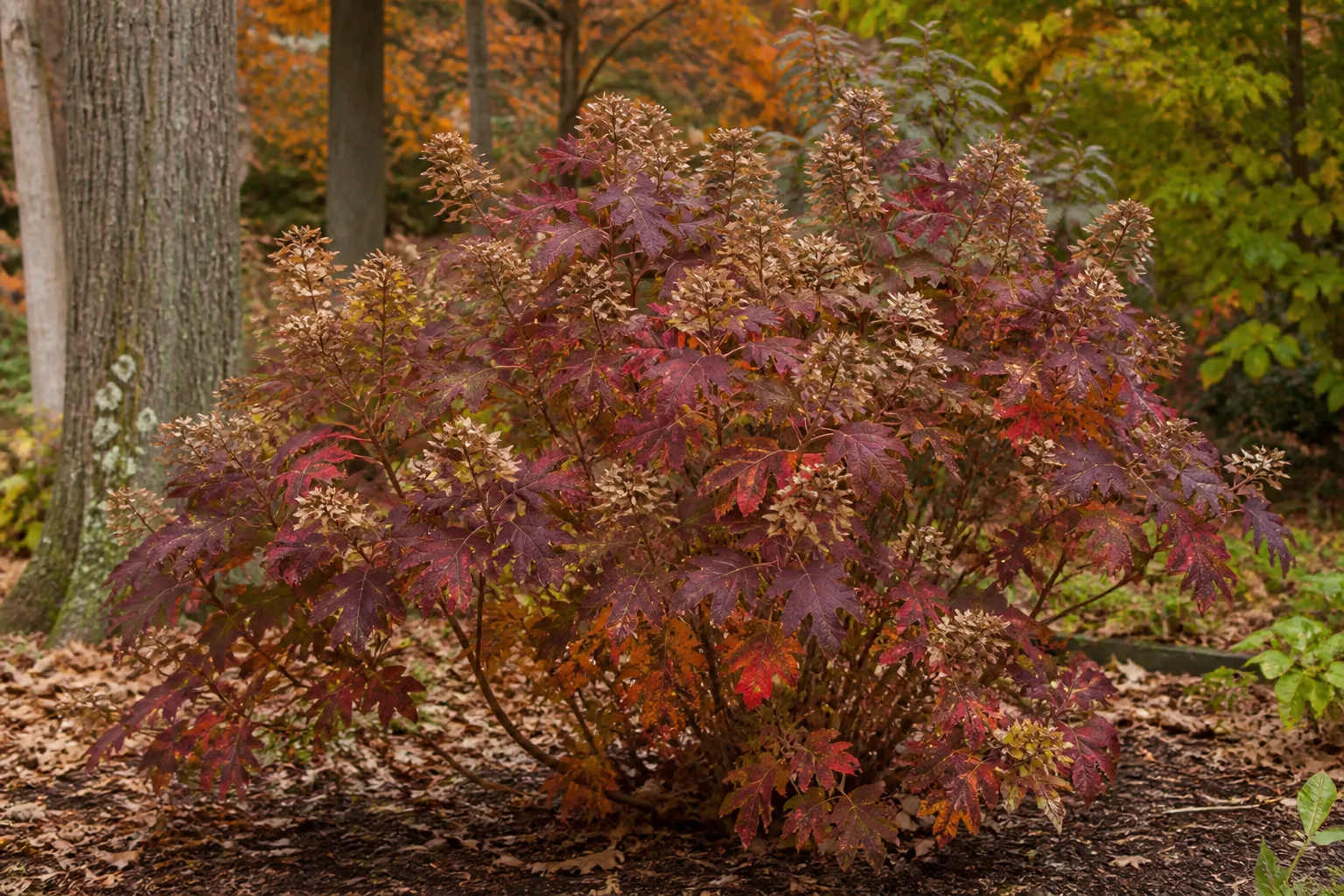
Oakleaf hydrangea earns its place when you want a substantial shrub with several seasons of interest, not just a brief color change. Its large leaves can turn wine-red, mahogany, purple-red, and orange in fall; the old flower panicles often dry to tan, and mature stems reveal exfoliating cinnamon-colored bark. The exact leaf color varies with cultivar, sunlight, and autumn weather, so treat “red” as one part of a broader palette. NC State Extension
This southeastern U.S. native is a good candidate for morning sun and afternoon shade, though it can take more sun when the soil stays evenly moist. Plant it in well-drained, organically rich soil and give it enough room: species plants can become broad shrubs several feet tall, while named cultivars differ. A common mistake is cutting it back in fall or late winter; oakleaf hydrangea flowers on old wood, so prune after flowering if shaping is needed. It suits a woodland edge or a foundation bed with breathing room better than a tight, sheared hedge.
2. Virginia sweetspire (Itea virginica)
Virginia sweetspire is one of the strongest choices for a moist garden where you want fall color plus spring flowers. Its arching stems carry fragrant white flower racemes in late spring or early summer, then leaves often shift through copper, orange, red, and burgundy. ‘Henry’s Garnet’ is a widely grown cultivar selected for especially rich reddish-purple fall foliage, but color remains dependent on the season and site rather than being an on/off switch.
NC State Extension describes the species as adaptable to sun or shade and to a range of soils, with best flowering, density, and fall color generally in full sun; it also notes that the shrub can sucker and form colonies. Mature dimensions vary, but a typical plant is several feet tall and may spread wider over time. Use it where a loose colony is welcome, such as a rain garden edge or damp border. If you need a single narrow specimen, check cultivar dimensions and plan to remove unwanted suckers rather than assuming the plant will stay in its original footprint. NC State Extension
3. Dwarf fothergilla (Fothergilla gardenii)
Dwarf fothergilla is a compact native shrub for gardeners who like a mixed, painterly display rather than one flat red. Its leaves may combine scarlet, orange, and yellow on the same plant, and spring brings bottlebrush-shaped white flowers with a honey-like fragrance. In a good autumn, the red tones can be vivid, but the full palette depends on the cultivar and local conditions; some plants lean more yellow or orange.
Give fothergilla sun for the strongest flowering and fall color, with some afternoon shade in hot climates if the soil dries quickly. It prefers acidic, moist but well-drained soil and is useful in a smaller foundation bed or woodland border where a broad, layered shrub can mature without frequent shearing. Do not expect it to thrive in a hot, compacted strip beside pavement with no irrigation. Durham County Extension Master Gardener observations include fothergilla among the Piedmont’s native fall-color plants and underscore that seasonal displays vary from year to year. Durham County Extension Master Gardener Volunteers
4. ‘Tor’ birchleaf spirea (Spiraea betulifolia ‘Tor’)
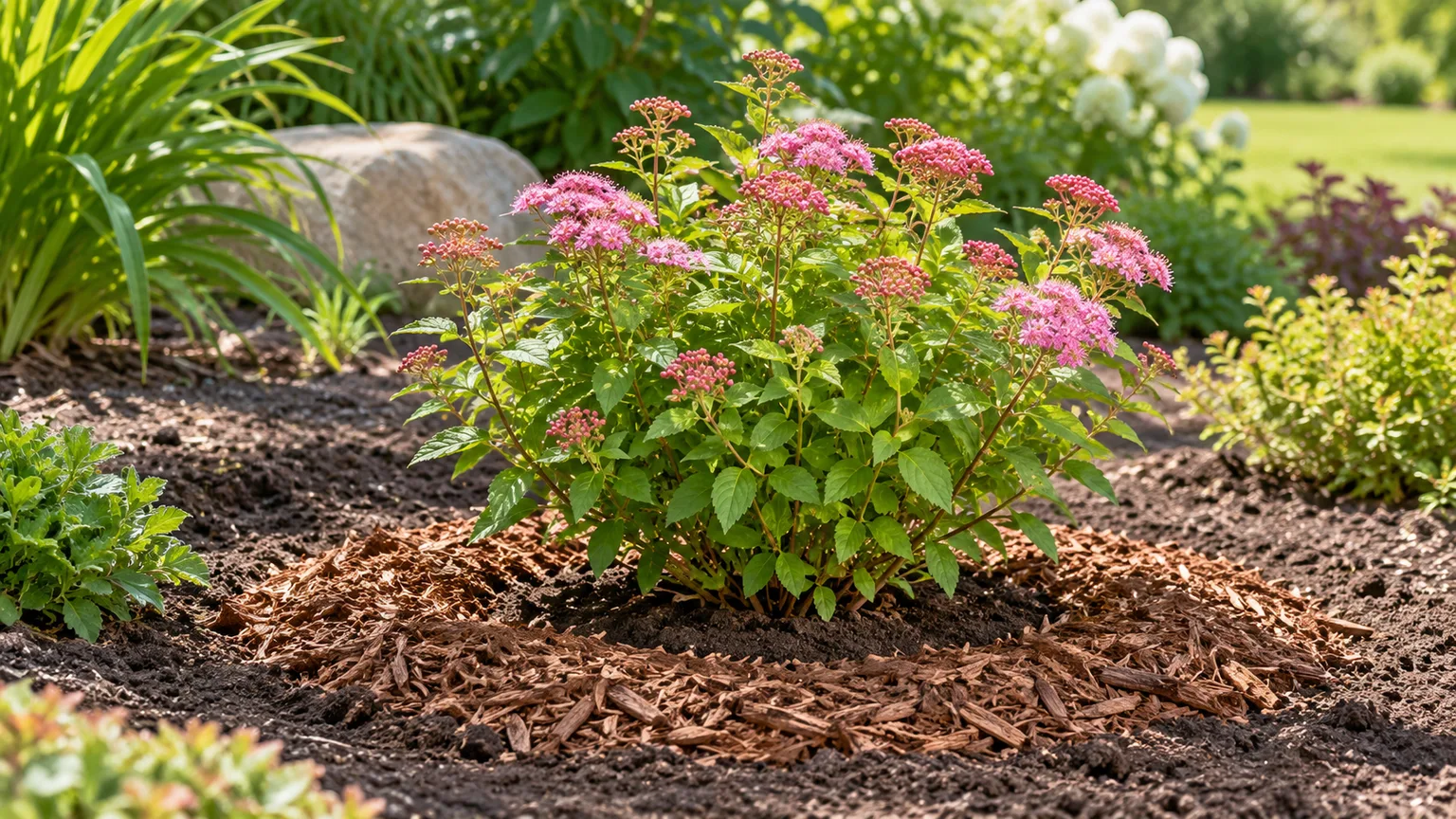
‘Tor’ is a useful answer when the space is limited but you still want a real autumn display. This compact, rounded spirea is often around 2 to 3 feet tall and 3 to 4 feet wide, with white spring flowers and birch-like leaves that can turn red-orange, bronze, and gold. Because its fall color is a mix, it is better described as a compact shrub with warm red-orange foliage than as a uniform scarlet plant.
Plant it in full sun or light shade in well-drained soil; a sunny position generally gives the best flowers and autumn color. Allow for its eventual width instead of clipping it into a tight ball, which hides its natural shape and can reduce flowering. ‘Tor’ blooms on new wood, so if it needs rejuvenation, late-winter pruning is more appropriate than cutting it back after the spring show. Horticulture’s cultivar profile gives the compact size and the red-orange, bronze, and gold fall range. Horticulture
5. ‘Tiger Eyes’ staghorn sumac (Rhus typhina ‘Bailtiger’)
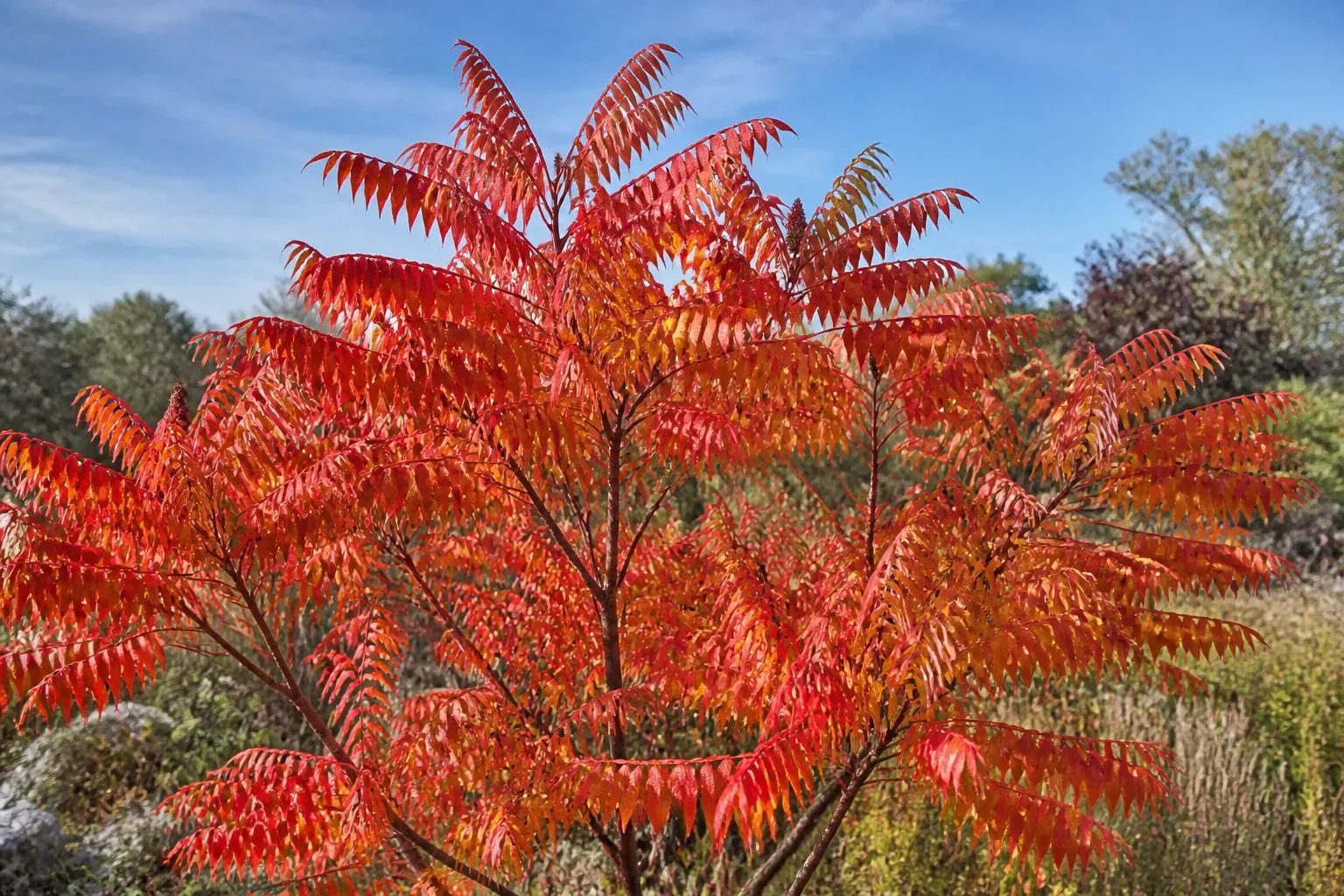
‘Tiger Eyes’ is grown for foliage that changes twice: its finely divided leaves emerge chartreuse, mature to yellow-green, then bring orange-red color in fall. It is not a shrub that stays red all summer, and the fall display may read more orange than scarlet. Its bright foliage gives it a distinct role in a large border, where the loose form and strong seasonal contrast have room to show.
This cultivar is smaller than straight staghorn sumac, often cited at roughly 6 feet, but it can still spread by suckers. Check the mature size of the nursery’s specific stock and avoid planting it beside a narrow walk, small foundation, or space where every new shoot will be a problem. Full sun helps preserve its colorful habit; average, well-drained soil is generally adequate once established. Choose it for a larger naturalistic planting, not a clipped formal hedge. Durham-area observations include sumac among reliable local sources of fall color, while Gardening Know How notes the cultivar’s red-orange autumn display and limited suckering compared with ordinary staghorn sumac. Durham County Extension Master Gardener Volunteers Gardening Know How
6. Smokebush (Cotinus coggygria)
Smokebush is a larger, architectural shrub whose cultivars may carry purple, blue-green, or green leaves through summer and shift toward red or crimson as the season closes. Some purple-leaved selections create a particularly dramatic red-toned autumn effect, but cultivar, sun exposure, and climate all influence the result. The airy summer flower clusters that give the shrub its “smoke” name add a separate visual feature earlier in the year.
Give smokebush open space and sun; strong light supports better foliage color and flowering. Before choosing it, check its mature dimensions and whether you want a large shrub or a shrub trained as a small tree, since repeated hard pruning changes its silhouette and flowering. It is a less natural choice for a small, shaded urban bed than dwarf fothergilla or ‘Tor’ spirea. Gardening Know How includes smokebush among shrubs with autumn color and notes its purple foliage changing toward crimson. Gardening Know How
7. Arrowwood viburnum (Viburnum dentatum)
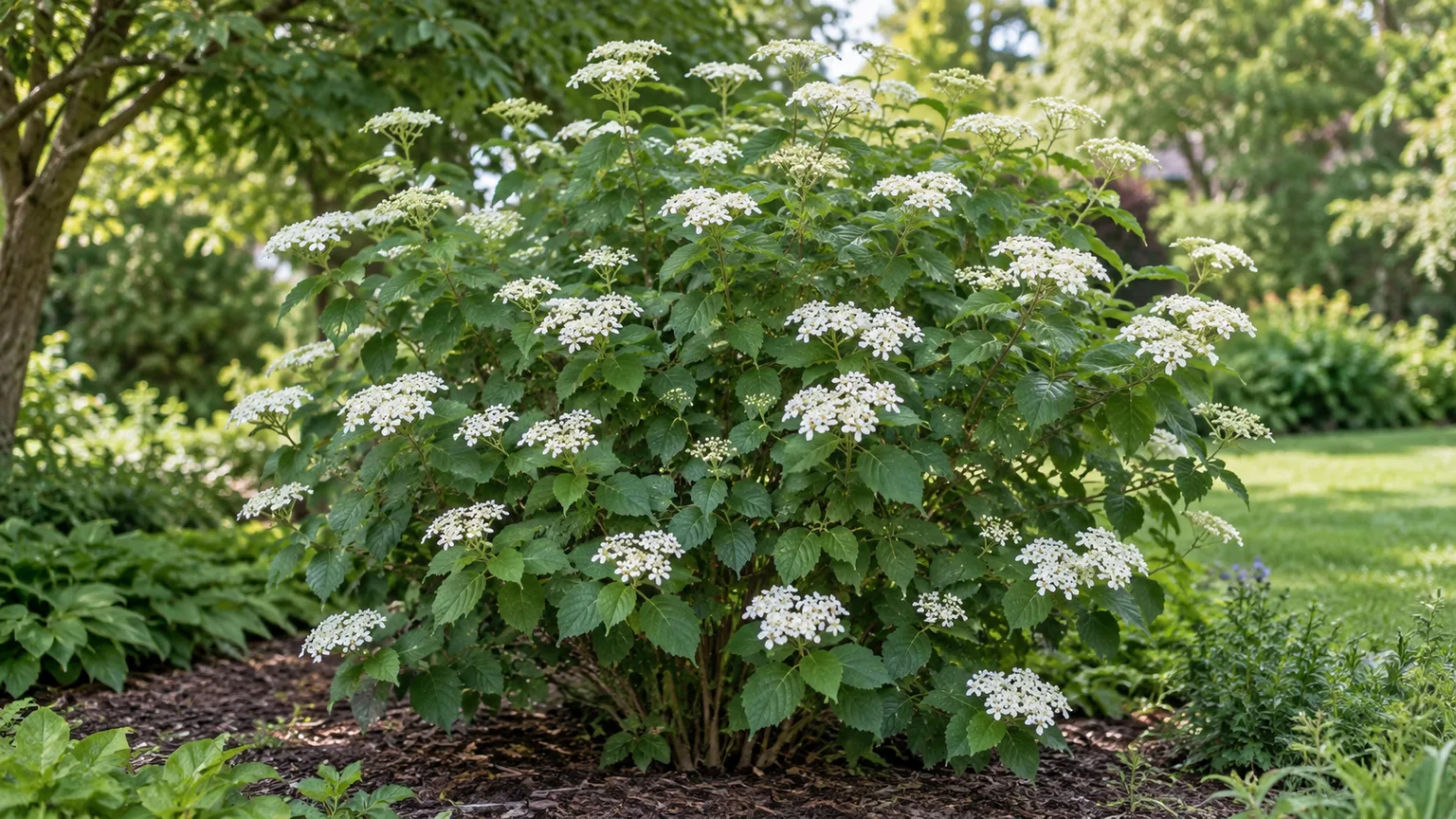
Arrowwood viburnum can bring red, wine, or purple tones to a fall border, though individual plants and local conditions may produce a broader red-purple-yellow mix. Its flowers feed pollinators in spring, and fruit clusters can feed birds later in the year. The foliage display is only one part of the value: this is a substantial native shrub that can be used as a screen or mixed hedge if you have room for its eventual size.
Do not buy a viburnum based on the genus name alone. Viburnums vary widely in mature height, fruit color, moisture tolerance, and fall display, so verify that the label says V. dentatum or a cultivar suited to your region. Arrowwood generally handles sun to partial shade and a range of garden soils, while better light often improves flowering and autumn color. Durham County’s native foliage observations include arrowwood viburnum; its field-based account is also a useful reminder that autumn shades differ with the weather and the exact growing site. Durham County Extension Master Gardener Volunteers
8. Possumhaw viburnum (Viburnum nudum)
Possumhaw, also called witherod viburnum, has a two-part fall show: leaves can turn red or burgundy while berry clusters progress from pale shades through pink to blue-black. The fruit colors are not the leaf colors, and the shrub may not hold both features at their peak simultaneously. If you want a wildlife-friendly planting with a long sequence of seasonal changes, that overlap is an advantage; if you want a consistent wall of red foliage, it is not the most predictable pick.
This eastern North American native is worth considering for a moist site, including the edges of rain gardens and woodland plantings, provided roots are not left in stagnant water. It can grow into a substantial shrub, so give it more than a narrow foundation slot and check the selected form’s mature dimensions. The fruit display depends on pollination and site conditions, so plant for its foliage, flower, and habitat value as a whole rather than treating every berry cluster as guaranteed. Horticulturist guidance from Plumline Nursery highlights possumhaw and arrowwood viburnums among shrubs that offer both fall color and fruit. Plumline Nursery
9. Red chokeberry (Aronia arbutifolia)
Red chokeberry is a foliage-and-fruit shrub, but the features arrive on different timelines. Its leaves can turn vivid red in fall, while bright red fruit often remains into the cooler season and attracts birds. The berries are very astringent raw, so do not mistake the shrub for a sweet-fruited garden blueberry. It is a good candidate for a native planting that needs both seasonal color and habitat value.
Red chokeberry is more tolerant of wet soil than many ornamental shrubs and can be useful near a rain garden’s outer, consistently moist zone. It may spread by suckers, so allow for a colony or remove shoots if you need to maintain a boundary. Check regional guidance for local native status and mature size before planting, and avoid putting it where roots must stay dry. A red-fruited plant should not be sold to you as a shrub with red berries all winter in every location; birds and weather influence how long fruit remains. Penn State Extension recommends chokeberry among native alternatives when replacing invasive burning bush. Penn State Extension
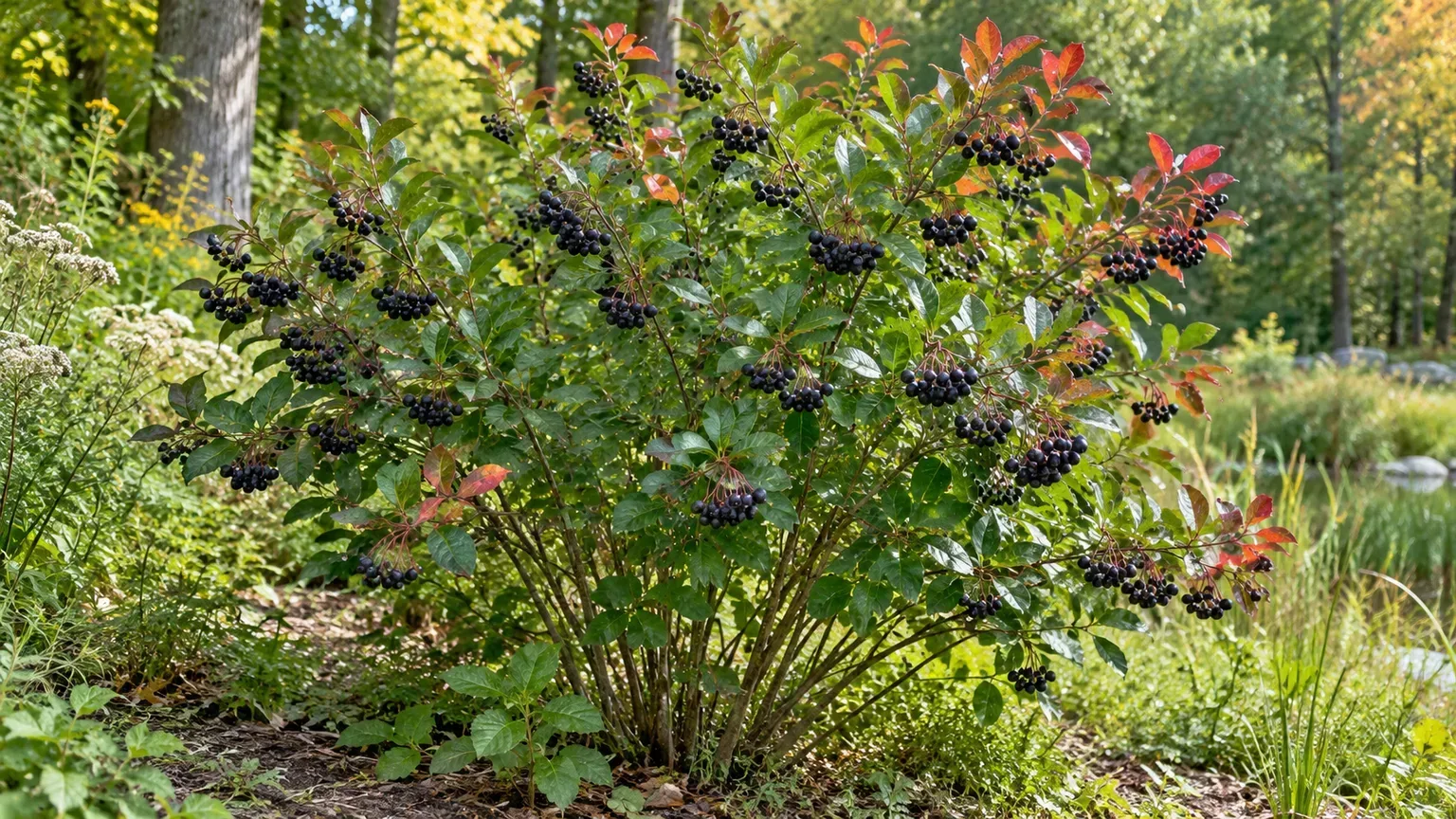
10. Black chokeberry (Aronia melanocarpa)
Black chokeberry is a close relative, but the fruit color is the easiest distinction: the berries mature dark purple to black, while foliage can turn orange-red, red-purple, or burgundy. Its spring flowers and dark fruit give it more than one season of interest, and the fruit can be processed into preserves or baked goods, though its raw flavor is notably tart. The leaves—not the berries—provide the red fall effect.
This is a resilient North American native that can tolerate a range of soil conditions, including periodic wetness, and it generally performs best in sun to partial shade. Like red chokeberry, it can spread into a colony rather than behaving like a perfectly contained specimen. That may be useful for stabilizing a broad planting edge and less welcome in a small, formal bed. If you want predictable red leaves in the smallest possible footprint, compare its mature spread with compact ‘Tor’ spirea or dwarf fothergilla before buying.
11. Highbush blueberry (Vaccinium corymbosum)
Highbush blueberry is a strong choice when the planting bed is already acidic or you are willing to prepare and maintain one. Its leaves can turn clear red, scarlet, or burgundy in fall; spring flowers and summer berries make it a productive edible shrub as well as an ornamental. The red can be excellent in some climates and subtler in others, so local nursery and extension advice helps set realistic expectations.
Blueberries need acidic soil, consistent moisture, and good drainage; they are not a plant to place in ordinary alkaline fill and hope to correct later with a small amount of amendment. Sun helps fruiting, while afternoon shade can help in hot regions. Multiple compatible cultivars often improve pollination and extend harvest, but cultivar compatibility and chill requirements depend on the species and climate. In a small garden, use the plants’ mature width to plan spacing so air can move through the canopy and fruit can be picked without stepping on neighboring plants. Durham County Extension Master Gardeners include blueberry among regional native plants with autumn color. Durham County Extension Master Gardener Volunteers

12. Serviceberry (Amelanchier spp.)
Serviceberries are often grown as small trees, but many species and multi-stem cultivars work as large shrubs. Their autumn leaves can move through orange and red, while white spring flowers and edible summer berries add earlier seasons of interest. “Serviceberry” covers multiple species with different native ranges, sizes, and climate preferences, so choose a botanical name and cultivar instead of assuming all nursery plants are interchangeable.
Most serviceberries do best in sun to part shade and moist, well-drained soil, with better flowering and fruiting in good light. They can be a smart choice for a mixed native border or a small-yard focal point, but they are not all compact shrubs: some become small trees and may send up multiple stems. Confirm mature height, spread, and local disease pressures with an extension service or knowledgeable regional nursery. An attractive red leaf display is a bonus, not the sole reason to select a form that is otherwise too large for the site.
Choose for the site, not just the color photo
For a smaller sunny bed, start by comparing dwarf fothergilla and ‘Tor’ spirea; both stay more compact than most viburnums, serviceberries, or oakleaf hydrangeas. If your site is partly shaded and holds moisture, Virginia sweetspire and oakleaf hydrangea are more logical candidates. For an acidic bed, blueberry may serve both as edible planting and fall-color shrub. For a broader naturalistic edge, sumac, chokeberries, and viburnums can contribute fruit and wildlife value, but check their mature spread and suckering habit first.
The clearest way to choose is to rank the features you care about. If red leaves are the priority, compare sweetspire, oakleaf hydrangea, ‘Tor’ spirea, fothergilla, chokeberries, and blueberry for the light and soil you can provide. If fruit matters too, possumhaw and chokeberries add fruit color, but remember the berries may be eaten or may not persist. If the color you want is bright red twigs after leaves fall, choose a redtwig dogwood instead; that is a red-stem shrub, not a reliable red-leaf selection.
Avoid choosing a plant because a single nursery image shows its best possible color. A shrub that receives too little light may still grow but show less vivid foliage; excessive drought can force early leaf drop, and a sudden freeze can end the display before peak color. Do not fertilize heavily in late summer to “boost” autumn color: that can encourage soft late growth and does not solve a poorly matched site. Give new shrubs regular water while establishing, mulch the root zone without piling mulch against stems, and let natural leaf drop occur before pruning unless you are removing damaged growth.
Burning bush (Euonymus alatus) deserves a specific caution because its brilliant red fall foliage has made it popular despite invasive behavior in many eastern U.S. regions. Penn State Extension explains that birds disperse its seed and that Pennsylvania prohibits intentional planting and propagation. Restrictions and invasiveness differ by location, so consult your state or provincial invasive-plant list; where burning bush is a problem, native viburnums, dogwoods, and chokeberries are practical alternatives. Penn State Extension
Conclusion
For the closest match to “red fall leaves,” look first at Virginia sweetspire, oakleaf hydrangea, ‘Tor’ birchleaf spirea, dwarf fothergilla, chokeberries, and highbush blueberry, then narrow the list by light, moisture, acidity, and mature size. Add ‘Tiger Eyes’ sumac, smokebush, viburnums, or serviceberry when their growth habit and broader seasonal features suit the planting. These shrubs can all contribute red tones, but the display is shaped by plant genetics and each autumn’s weather.
Buy for the whole plant and the conditions you can provide, not a perfect color promise. Confirm the cultivar, check local native and invasive status, measure the mature spread, and identify whether the feature you want is red foliage, fruit, or winter stems. That simple check is more likely to give you a satisfying autumn garden than chasing the brightest photograph.



