Yellow Leaves on Scindapsus Pictus: Causes, Checks & Fixes
Quick answer
Yellow leaves on Scindapsus Pictus usually mean the root zone has stayed wet too long-not a fertilizer shortage. Stop watering, check moisture 4–5 cm (1.5–2 in.) deep, and inspect stems before you change anything else.
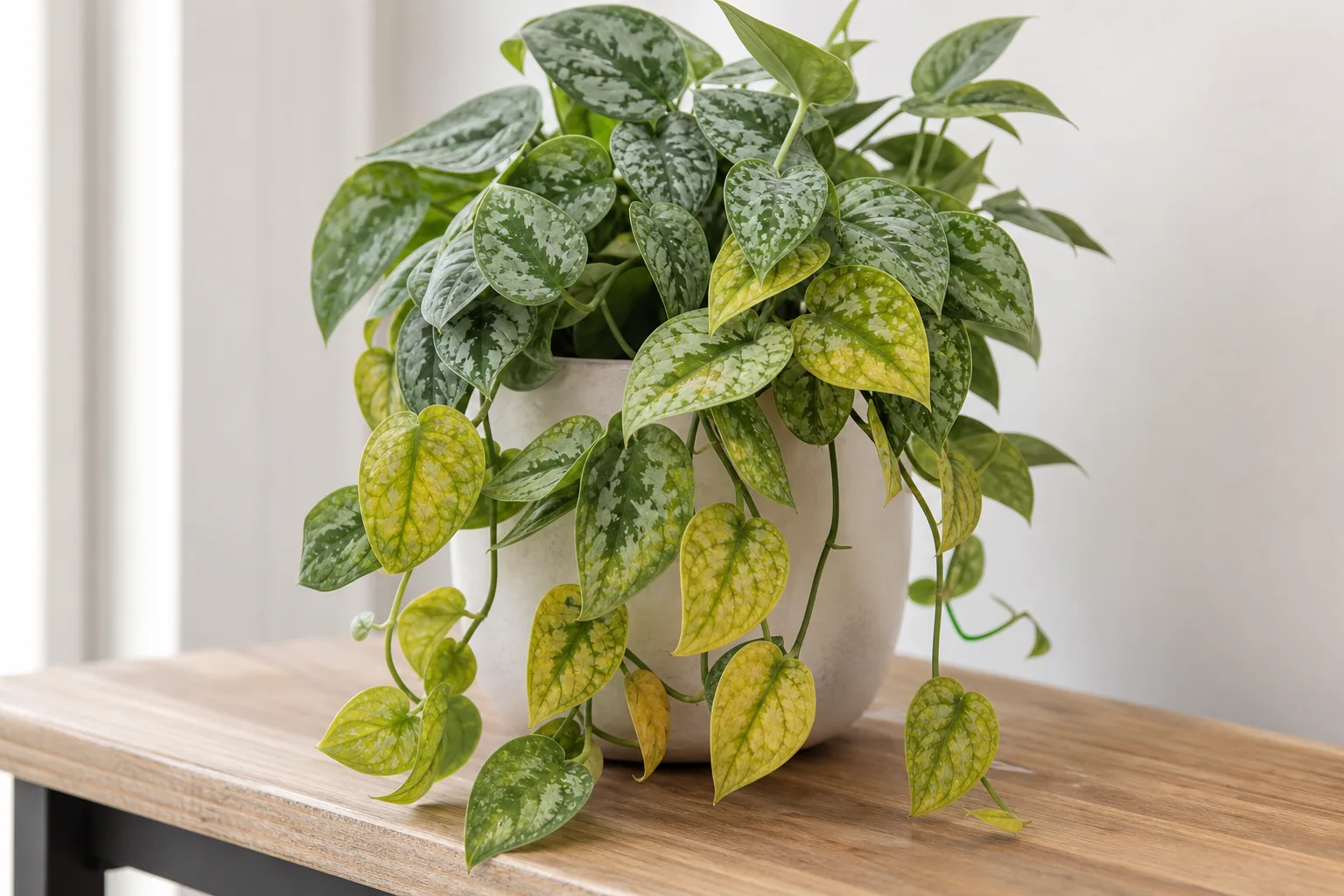
Yellow Leaves on Scindapsus Pictus: Causes, Checks & Fixes
This guide covers yellow leaves on Scindapsus Pictus. See also the general Yellow Leaves guide, watering, and light pages for this plant.
Yellow Leaves on Scindapsus Pictus: Causes, Checks & Fixes
Quick answer
Yellow leaves on Scindapsus pictus-sold as satin pothos, silver pothos, or silk pothos-almost always trace back to the root zone or environment, not hunger. This trailing aroid is not true pothos (Epipremnum): it grows more slowly and tolerates wet feet less than golden pothos owners often expect, so the same watering rhythm can leave soil saturated for days.
First step: stop watering and check moisture 4–5 cm (about 1.5–2 in.) deep-not just the surface. A heavy cool pot with damp soil points toward overwatering on Scindapsus Pictus. A light dusty pot with curled satin leaves points toward underwatering. One slow yellow leaf at the oldest node on a firm vine is often normal turnover.
| Pattern | Soil / pot | Urgency | Next guide |
|---|---|---|---|
| Lower leaves yellow, limp vines, heavy wet pot | Damp 3+ days | Moderate | Overwatering |
| Crispy edges, curled leaves, light pot | Dry throughout | Moderate | Underwatering |
| Silver dulling, long node gaps, slow dry-down | Moist at depth | Low–moderate | Not enough light |
| Sour smell, soft stems, fast spread | Wet, may smell | High | Root rot |
| One old lower leaf over months | Normal dry-down | Low | Monitor only |
| Stippling, webbing, sticky new growth | Any | Moderate | Spider mites, aphids |
Why Scindapsus Pictus gets yellow leaves
Overwatering is the leading cause. NC State notes that yellow leaves may be a sign of overwatering on this species, and root rot may occur in poorly drained or wet soils when oxygen-starved roots cannot support the vine. Several factors stack on satin pothos:
Chronic wet soil and poor drainage
The species prefers bright indirect light and moist, well-drained potting mix-meaning moisture after a proper dry-down, not constant saturation. Oversized pots, sealed cachepots, and heavy peat without perlite hold water around a small root ball while lower heart-shaped satin leaves yellow first. For full wet-soil rescue branches, use the dedicated overwatering guide rather than repeating protocol here.
Low light slowing dry-down
Dim corners slow transpiration so a summer watering rhythm keeps mix wet for weeks even when the surface looks acceptable. Missouri Botanical Garden lists bright indirect light indoors as the baseline; in shade, silver variegation dulls and soil lingers damp-a compound cause covered on not enough light on Scindapsus Pictus. Unlike faster-draining golden pothos in the same spot, satin pothos may yellow while soil still feels cool at depth.
Underwatering and fine root loss
Repeated drought is less common but real. NC State lists curling leaves as a sign of underwatering. The pot feels light, mix pulls from the rim, and lower leaves may yellow with crispy edges-the opposite weight pattern from overwatering. See underwatering on Scindapsus Pictus when dry soil accompanies limp vines.
Cold drafts and temperature drops
Room temperatures of 65 to 85°F (18 to 29°C) suit this plant best; cooler air and direct sun are not tolerated. Below about 60°F (15°C), metabolism slows and leaves on the chilled side can yellow even when watering looks unchanged-common on winter window sills and AC vents. Move the pot before assuming root failure.
Pests and secondary stress
NC State notes monitoring for scale, mites, mealybugs, and thrips on satin pothos. Stippling, webbing, or sticky residue on new growth can yellow tissue indirectly while roots stay firm-inspect undersides before spraying fungicides. Persistent fungus gnats hovering above the pot often mean mix never dries; see fungus gnats on Scindapsus Pictus when gnats accompany wet soil.
Normal leaf senescence
One or two oldest leaves yellowing slowly on an otherwise firm, well-drained trailing vine is aging, not saturation. Pattern matters: widespread lower-leaf yellowing on wet soil is the warning sign.
What yellow leaves look like on this plant
Watch the heart-shaped satin leaves and vine together-not leaf color alone.
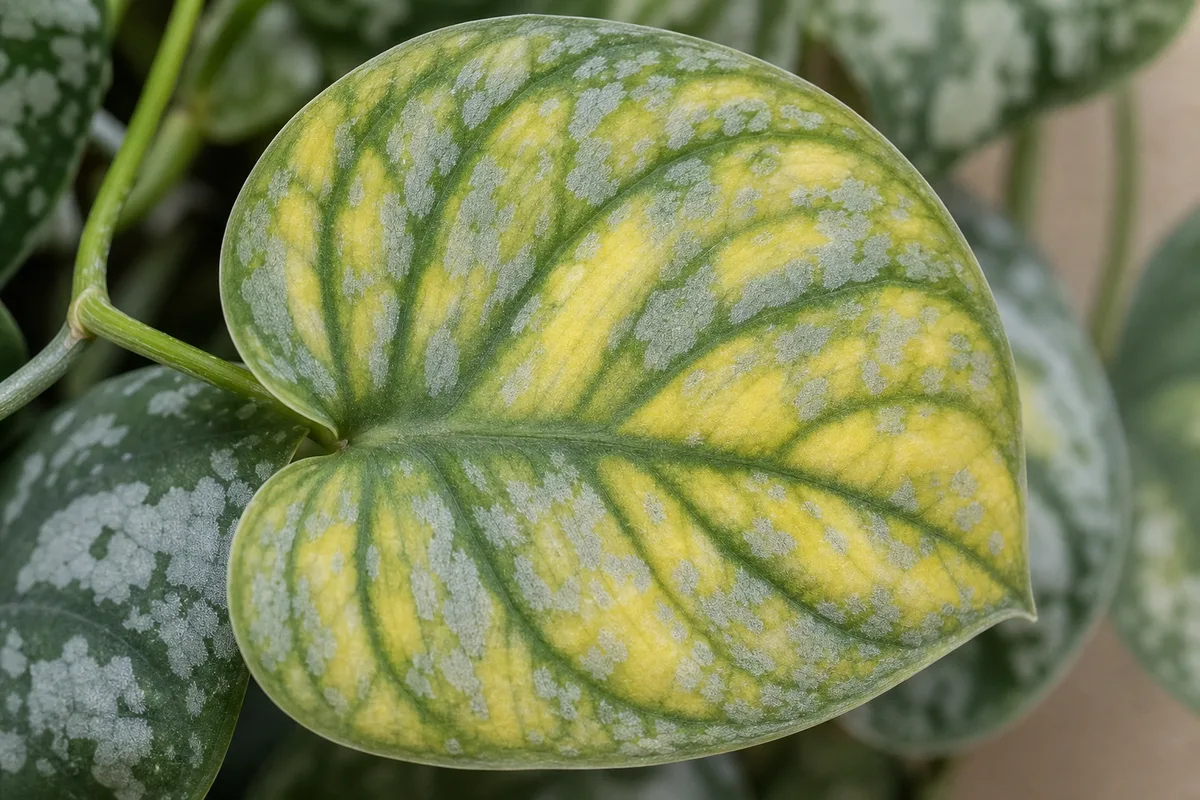
Yellow Leaves symptoms on Scindapsus Pictus - compare with healthy tissue on the same plant.
Overwatering pattern
- Yellow starting on oldest, lowest leaves along the vine
- Silver blotches dull before full chlorosis; stems feel soft at the soil line in advanced cases
- Pot stays heavy days after watering; soil surface dark and cool
- Sour or musty smell when lifted from the pot
- Small fungus gnats when mix stays constantly moist
Underwatering pattern
- Curled leaf edges, very light pot, dusty dry mix several centimeters down
- Firm stems but limp satin foliage; perks within 24 hours of a thorough soak
- Yellow may appear on lower leaves after repeated drought cycles
Low-light compound stress
- Leggy vines with smaller pale leaves and faded silver pattern
- Soil dries slowly in dim corners while owners keep a calendar schedule
- New growth may lose crisp variegation before widespread yellowing
Healthy comparison
- Firm green stems from soil line to growing tips
- Silver variegation crisp on matte green juvenile leaves
- Mix that dries in the top half within about 7–10 days during active indoor growth
Yellow on wet soil is the key split from drought stress. Yellow on dry soil with curl means the opposite fix.
Cause-branch decision table
| Likely cause | Soil moisture | Stem texture | Leaf pattern | First move | Deep guide |
|---|---|---|---|---|---|
| Overwatering / early root stress | Wet, heavy | Limp, may soften at base | Lower leaves dull first | Stop watering; dry top half | Overwatering |
| Underwatering | Dry, light pot | Limp, firm nodes | Lower yellow with dry edges | One deep soak, then dry-down | Underwatering |
| Low light + slow dry-down | Moist at depth | Firm, stretched | Pale small new leaves, dull silver | Brighter indirect light | Not enough light |
| Root rot (advanced) | Wet, sour smell | Mushy at soil line | Fast spread, collapse | Unpot, trim, repot | Root rot |
| Cold draft | Variable | Usually firm | Sudden yellow on draft side | Move off vent/glass | Wilting |
| Pests | Any | Firm unless secondary rot | Stippling, webbing, sticky tips | Inspect undersides | Spider mites, aphids |
| Normal senescence | Normal dry-down | Firm | One old leaf only | Monitor | - |
How to confirm the cause
- Soil moisture - Stick your finger or a dry skewer 4–5 cm (1.5–2 in.) into the mix. Wet, cool soil days after watering points to overwatering.
- Pot weight - Lift the container. Heavy with limp yellow leaves suggests roots are failing, not that the plant needs more water.
- Stem firmness - Pinch stems at the soil line and a mid-vine node. Mushy tissue confirms root trouble; firm green tissue supports dry-down recovery.
- Light level - Note placement. A north-facing room or far shelf slows dry-down; pair with the light guide if node gaps are wide.
- Temperature - Check for winter glass, AC vents, or frequently opened doors chilling one side of the vine.
- Root check - Unpot only if wet soil and decline continue after a full dry-down cycle, or if soil smells sour. Mushy roots mean the root rot protocol-not another watering attempt.
First fix for Scindapsus Pictus
Stop all watering and move the plant to brighter indirect light so the mix can dry.
This single pause helps most early cases. Do not pour more water because satin leaves look limp when soil is already saturated-that worsens root oxygen loss in waterlogged mix. Do not fertilize, mist heavily, or repot on day one unless stems are mushy.
Wait until the top half of soil is dry throughout-test at depth per the watering guide, not just the surface crust. When dry-down passes and stems still feel firm, water once thoroughly until excess drains, then discard saucer water immediately.
If underwatering is confirmed
One deep soak until runoff, then resume the top-half dry-down rule. Do not alternate flood and drought-that stresses fine roots on this slower-growing aroid.
If low light is the driver
Move to medium or bright indirect light without hot direct sun. Better light increases water use and helps silver variegation return on new leaves. See not enough light for placement detail.
If root rot is confirmed
Unpot, trim brown mushy roots, air-dry cut surfaces, and repot into fresh perlite-amended mix in a pot sized to the root ball-not the vine length. Full steps live on the root rot guide.
Step-by-step recovery
- Let the mix dry to your normal checkpoint (top half dry)-see seasonal intervals in the watering guide.
- Remove fully yellow leaves that pull away easily; leave partially green foliage for photosynthesis.
- Empty saucers and confirm drainage holes are open-not sealed inside a decorative outer pot.
- Resume deep watering only when the dry-down test passes; discard runoff within 30 minutes.
- Watch for new heart-shaped leaves with crisp silver blotches within two to three weeks after correcting moisture and light.
When to escalate to root-rot protocol
Escalate when nodes soften, soil smells sour, yellowing reaches new growth while the pot stays wet, or inspection finds brown mushy roots. Mild lower-leaf yellowing with firm nodes rarely needs unpotting.
Recovery timeline
Mild yellowing from one overwatering episode may stabilize within two to three weeks after the root zone dries and light improves. Lower yellow leaves may drop, but new silver-marked leaves at the tips confirm stabilization.
Moderate root trimming and repotting typically need four to six weeks before consistent new vine extension. Judge success by firm stems, fresh leaf unfurling, and soil that dries predictably in the top half-not by old yellow foliage re-greening.
Severe rot with most roots removed may take a full growing season to rebuild, or the parent may fail while stem cuttings root in four to six weeks. See the propagation guide if the base collapses but upper nodes stay firm.
Lookalike symptoms to rule out
Direct sun scorch - Bleached or brown-crisp patches on sun-facing leaves, not uniform lower-leaf yellowing on wet soil. Pull back from harsh midday rays.
Spider mites and aphids - Fine stippling, webbing, or sticky new growth with otherwise firm stems. Inspect before assuming watering error.
Fungus gnats - Hovering adults signal surface mix that never dries; often pairs with early overwatering, not a separate disease.
Nutrient deficiency - Uniform pale new growth on dry, well-managed soil is unlikely to be overwatering. Do not fertilize a stressed wet plant hoping to fix yellow leaves.
True pothos confusion - Golden pothos (Epipremnum) in the same spot may stay green while satin pothos yellows because dry-down and light needs differ. Confirm the tag reads Scindapsus pictus on the overview page.
What not to do
- Do not keep watering because limp satin leaves look thirsty when soil is already wet.
- Do not fertilize yellow leaves on wet soil-salts can burn compromised roots.
- Do not repot into a much larger pot hoping for recovery; extra soil holds extra water.
- Do not mist vines to “help” stressed leaves-extra surface moisture worsens rot risk on trailing aroids.
- Do not place a recovering plant in direct sun to dry it faster; scorch damages velvet-textured foliage.
- Scindapsus pictus is toxic to cats and dogs; wear gloves when inspecting roots. If a pet chews fallen yellow leaves, contact your veterinarian or the ASPCA Animal Poison Control Center at (888) 426-4435.
How to prevent yellow leaves next time
Build rhythm around the pot, not the calendar. Check the top half of soil weekly and water only when that zone is dry-in typical indoor conditions often every 7–10 days during active growth and every 14 days or longer in winter per the watering guide.
Use well-draining mix with perlite and a drainage hole sized to the root ball. Keep medium to bright indirect light so the plant uses water steadily. Reduce watering over winter when growth slows-a satin pothos in a cool room can sit nearly dormant while soil stays wet for weeks if you do not adjust.
Empty saucers after every drink. Watch for fungus gnats as an early warning that mix never dries enough between drinks.
When to worry
Treat as urgent when stems soften at the soil line, multiple leaves yellow within a few days, soil smells sour, or the plant collapses despite wet mix. Inspect and trim within 24 hours rather than waiting another dry-down cycle.
A plant with mostly mushy roots and a soft base may not be saveable as a whole specimen. Take firm stem cuttings immediately before tissue declines further.
Non-urgent: one or two yellow lower leaves on firm stems after a single overwatering event. Dry-down and corrected habits usually suffice.
Related Scindapsus Pictus guides
- Scindapsus Pictus overview - hub page, pothos misnomer, and seasonal watering FAQ
- Scindapsus Pictus watering - top-half dry-down rule and seasonal intervals
- Overwatering on Scindapsus Pictus - wet-soil rescue before roots turn mushy
- Root rot on Scindapsus Pictus - trim-and-repot when inspection confirms decay
- Underwatering on Scindapsus Pictus - dry-pot lookalike with curled satin leaves
- Not enough light on Scindapsus Pictus - silver dulling and slow dry-down in dim corners
- Scindapsus Pictus light - placement to hold variegation
- Fungus gnats on Scindapsus Pictus - wet-mix early warning
- Spider mites on Scindapsus Pictus - stippling lookalike
- Aphids on Scindapsus Pictus - sticky residue on new growth
Conclusion
Use this page to triage yellowing by pattern, pot weight, and silver variegation-not by assuming all trailing “pothos” behave the same. When wet soil and dull satin leaves align, dry down and follow the overwatering guide; when roots are mushy or stems soften, escalate to root rot rescue. Crisp new silver-marked leaves within a few weeks-not old blades re-greening-mean your satin pothos is recovering.