Slow Growth on Alocasia Dragon Scale: Causes, Checks & Fixes
Quick answer
Alocasia Dragon Scale is a naturally slow jewel aroid-one new leaf every four to eight weeks in summer is normal. First step: confirm the season and check whether light, humidity, and soil moisture match active growth before fertilizing or repotting.
Slow Growth on Alocasia Dragon Scale: Causes, Checks & Fixes
This guide covers slow growth on Alocasia Dragon Scale. See also the general Slow Growth guide, watering, and light pages for this plant.
Slow Growth on Alocasia Dragon Scale: Causes, Checks & Fixes
Quick answer
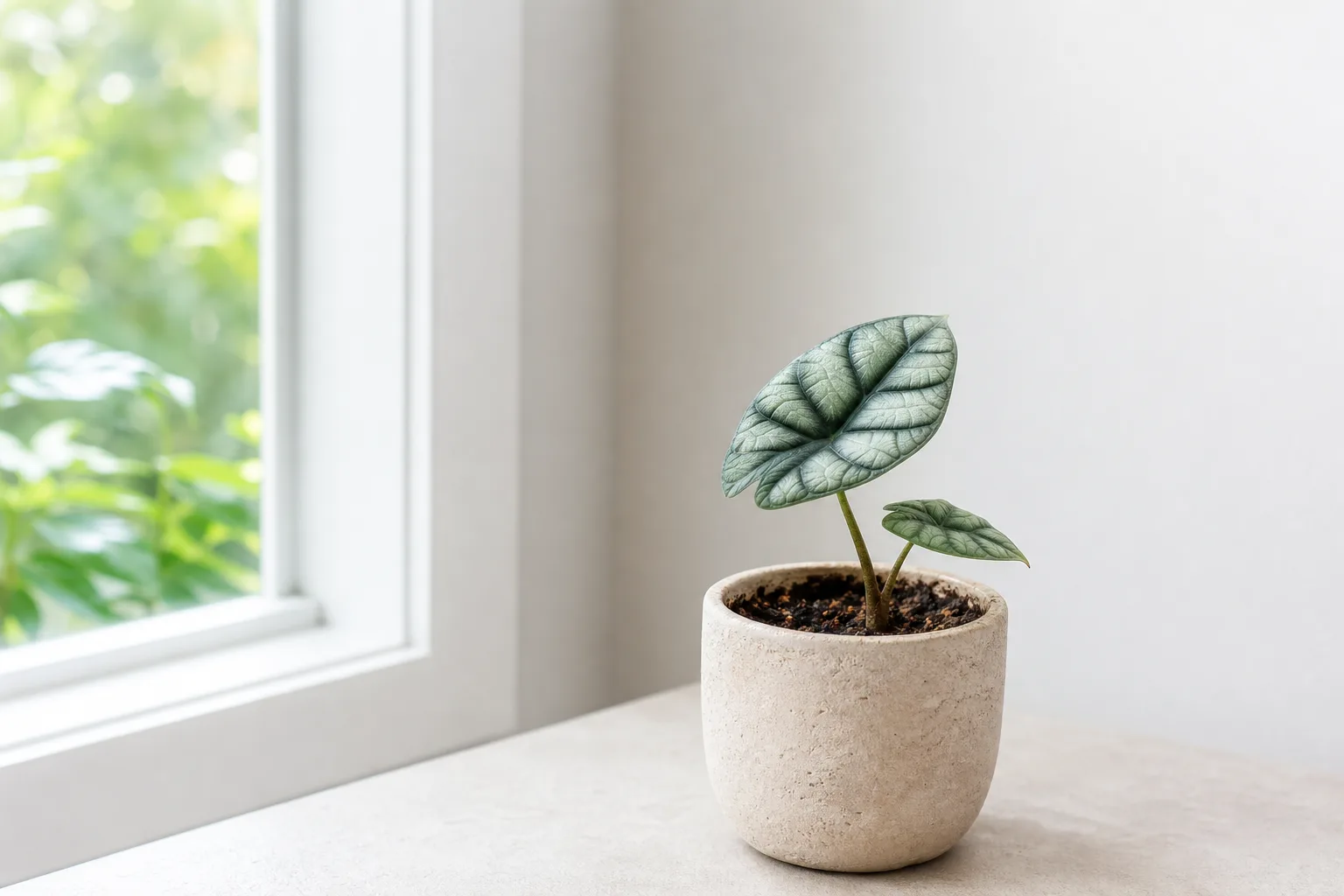
Alocasia Dragon Scale (Alocasia baginda ‘Dragon Scale’) is a jewel aroid built for slow, compact growth-not pothos speed. A healthy plant often carries only two to four textured leaves at a time and may push one new leaf every four to eight weeks during spring and summer. That pace is normal even when care is good.
Slow growth becomes a problem when zero crown activity lasts eight or more weeks during warm, bright months, new leaves emerge much smaller than the last, or the plant sulks for months after a single care mistake while soil, light, or humidity stay off. Winter leaf drop with a firm corm below the surface is usually dormancy, not failure.
First step: read the season and run a three-point check-bright indirect light, 60–80% humidity at leaf height, and soil that dries in the top 2–3 cm before the next drink. Fix the most likely limiter once, then wait four to six weeks before stacking repotting, fertilizer, or a major light move.
Slow growth vs. leggy growth vs. dormancy on Dragon Scale
These three patterns get confused because each can mean “my plant isn’t doing much.” They need different fixes.
| Pattern | What you see | Main driver | Where to go |
|---|---|---|---|
| Normal slow growth | One leaf every four to eight weeks in summer; tight rosette; firm tissue | Jewel-aroid biology | Stay on this page |
| Leggy growth | Long petioles, small new blades, lean toward window | Too little usable light (etiolation) | Leggy growth |
| Winter dormancy | Leaf drop in cool months; bare pot; firm corm below mix | Short days + cooler indoor air | Reduce water; no fertilizer |
| Stress stall | Crown silence eight or more weeks in warm summer; yellowing with wet soil | Roots, humidity, or repeated care mistakes | Sections below + root rot if crown softens |
Slow without stretch is often patience. Stretch without many new leaves is usually a light problem first. Bare pot with firm corm in January is usually rest-not death.
What slow growth looks like on Alocasia Dragon Scale
Slow growth on this cultivar shows up in how often the crown produces leaves, not as random spots on otherwise healthy blades. Learn to separate normal jewel-aroid pace from a true stall.
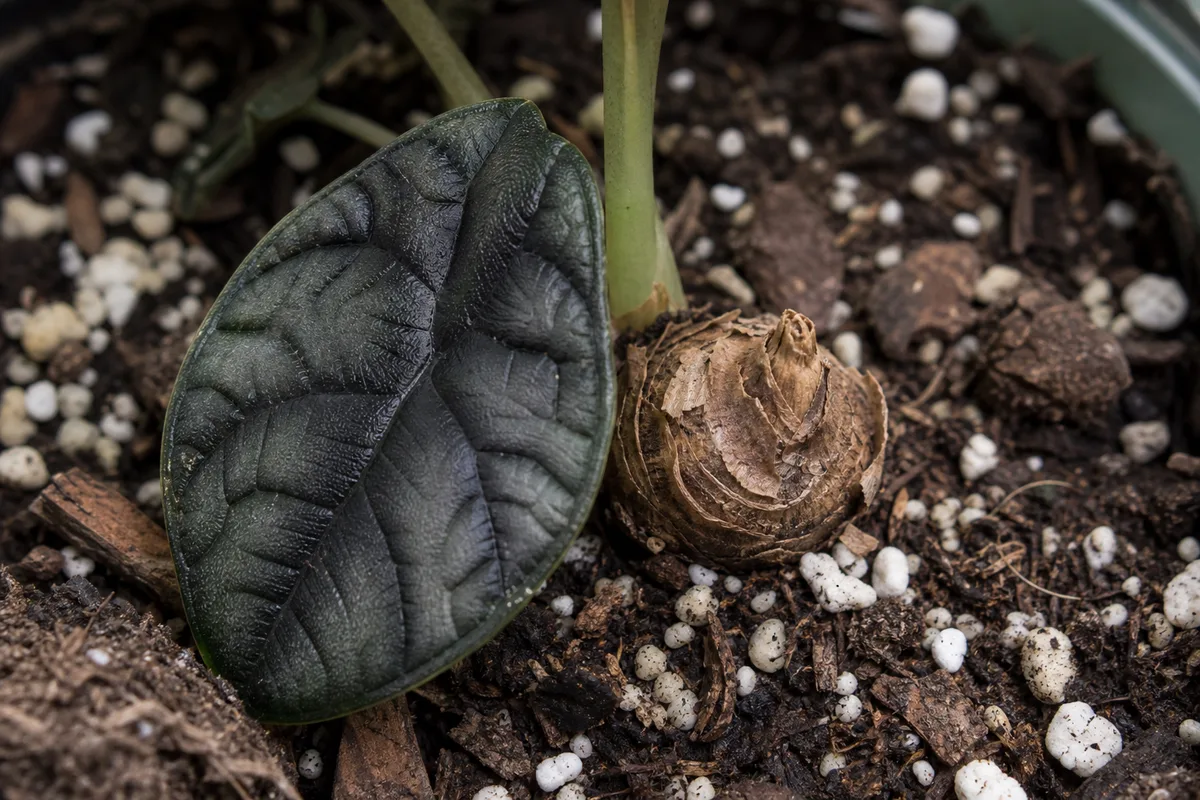
Slow Growth symptoms on Alocasia Dragon Scale - compare with healthy tissue on the same plant.
Normal jewel-aroid pace
Dragon Scale is described in botanical literature as a small, slow understorey species with thick, bullate leaves and a compact clumping habit (Kurniawan & Boyce 2011). Each textured leaf costs more energy to build than a thin-leaved alocasia leaf, so the plant never matches Monstera or pothos output even in ideal care. The bullate cuticle also extends visible unfurl time-a spear can sit partially open for two to three weeks while the silver embossing matures, which looks like a stall even when the crown is on schedule.
Normal slow growth looks like:
- One leaf unfurling at a time from the center, with older leaves aging out slowly
- Four to eight weeks between fully expanded leaves in spring and summer under bright indirect light
- A tight rosette of two to four leaves rather than a bushy fan
- Steady but unhurried petiole extension-new stalks roughly match the length of the previous leaf
- Firm, upright tissue with the silver-green embossing developing as the cuticle matures
If your Dragon Scale produces a new leaf every month or two in warm months with no yellowing spread, wet-soil smell, or crown softness, you likely have a healthy slow plant-not a sick one.
Abnormal stall signs
A true growth stall on Dragon Scale usually pairs crown silence with another stress signal:
- No new leaf for eight or more weeks during active season (late spring through early autumn) in a room above 18°C (65°F)
- New leaves much smaller than the previous two, or spears that abort before opening
- Yellowing that spreads while soil stays wet for days without use
- Long, weak petioles with tiny blades in a dim corner-stretch plus stall (see leggy growth for etiolation vs. pace)
- Crown or corm softening at the soil line with sour-smelling mix
- Months of sulking after overwatering, repotting, a cold draft, or a sudden move-common on this species even after the original mistake is corrected
Winter dormancy vs. stress stall
From late autumn through winter, Dragon Scale may drop all visible leaves and leave a pot of bare mix. Alocasias often need a cooler, drier rest period in winter and may lose foliage; the underground corm stores energy for spring regrowth (NC State Extension).
| Pattern | Likely meaning | What to do |
|---|---|---|
| Leaf drop in cool months, firm corm, mix drying slowly | Normal dormancy | Cut watering to roughly every three to five weeks; no fertilizer; keep above 10°C (50°F) |
| No new leaves in warm, bright summer | Stress stall | Audit light, humidity, roots-not patience |
| Wet soil + yellow lower leaves + no new growth | Root stress | Stop watering; inspect roots if smell or softness appears-see root rot |
| Long petioles, lean toward window, tiny new blades | Low light stall | Move to bright indirect light-see not enough light |
| Crispy edges, stalled unfurling, soil correctly moist | Low humidity | Raise RH to 60–80%-see low humidity |
Do not discard a bare pot in winter. Probe gently for a firm corm before assuming the plant is dead.
Grow-light winter maintenance vs. full dormancy
You can let Dragon Scale rest through winter with sparse water and no fertilizer-the RHS approach for alocasias in cooler months-or maintain slow activity with supplemental light. A full-spectrum LED delivering bright indirect intensity for 12–14 hours daily near the canopy can keep spears moving when windows alone would trigger dormancy.
If you choose grow lights, do not water or feed on a summer schedule. A corm under artificial light in December still drinks slowly; wet cold mix is the primary winter killer. Hold fertilizer until a new leaf unfurls in spring regardless of light setup.
Why Alocasia Dragon Scale grows slowly
Inherent slow crown output
Alocasia baginda evolved as a jewel aroid under tropical forest canopy-compact, thick-leaved, and energy-conserving (Kurniawan & Boyce 2011). NC State lists ‘Dragon Scale’ as a rare variety with a compact habit and thick, textured leaves. That biology sets a ceiling on speed that fertilizer cannot erase.
Comparing Dragon Scale to fast-growing houseplants is the most common reason owners search “slow growth.” The plant is working as designed when it holds a small leaf count and pauses between spears.
Insufficient light or humidity
Alocasias grow best in bright but indirect light; in lower light, growth becomes much slower. Dragon Scale’s bullate leaves also transpire steadily-when room humidity sits below about 50–60% RH, new leaves expand slowly or stall mid-unfurl even if watering is correct. Alocasias like medium to high humidity through the growing season, and dry indoor air is a common stall trigger.
Short winter days plus weak window light can push the plant toward dormancy alongside dim-corner placement. These two triggers compound: a room at 16°C (61°F) with grey December light stalls faster than the same temperature under a 12-hour grow light.
Root stress from overwatering
The single fastest way to stall Dragon Scale is soil that stays wet too long. Jewel alocasias have slow, sensitive root systems; saturated mix drives oxygen loss and root decline. The plant stops pushing new leaves while it survives on stored corm energy-sometimes for months.
Slow growth plus wet soil in a dim room is root stress, not “just patience.” See overwatering when the top 2–3 cm never dries within a week in warm months. Dense, moisture-retentive mix without perlite or bark can stall uptake even when you water correctly-see the soil guide for chunky aroid targets.
Cool temperatures and seasonal daylight drop
Keep alocasias above 16°C (60°F) during the growing season. Prolonged exposure below about 13°C (55°F) triggers dormancy: growth stops, leaves may yellow, and the plant retreats to its corm. Cold window sills, AC blasts, and winter drafts near glass are common indoor triggers.
Pot-bound or nutrient limits
Dragon Scale tolerates slight root binding and often performs better than in an oversized pot-alocasias prefer to be slightly pot bound until roots crowd drainage. Extreme circling roots or years without fresh mix can slow uptake, but repotting during a stall or dormancy frequently triggers more leaf drop. Nutrient deficiency is less common than overwatering or low light; salt buildup from heavy feeding on a non-growing plant can stall roots further. Resume light feeding only after the first healthy post-stall leaf, per the fertilizer guide.
How to confirm the cause
Work through this order before changing three variables at once:
- Season check - Is it late autumn or winter with shorter days? If yes, compare against the dormancy table above before treating as summer stall.
- Crown activity - Is a spear visible, or has the center been silent for eight or more weeks in warm months?
- Light and lean - Can you read comfortably where the leaf tips sit without a lamp? Does the rosette lean toward one window? Shadow test at midday: faint or absent shadow means too dim for active growth.
- Humidity - Are new leaves slow to unfurl with crispy margins while soil moisture is correct? Below 50% RH at leaf height slows expansion on textured alocasia foliage.
- Soil dry-down - Does the top 2–3 cm dry within about a week in summer? Wet mix for ten or more days without use points to overwatering, dense mix, or too little light slowing uptake.
- Corm and crown feel - Gently probe near the base. Firm corm with dry-to-lightly-moist mix in cool months fits dormancy. Soft crown with sour smell needs root inspection.
- Recent changes - Repotting, fertilizer surge, relocation, or one heavy watering often precede months of sulking on this cultivar.
Confirmation test: Fix the single most likely limiter (see first fix below). If a healthy new leaf with normal texture appears within four to eight weeks in warm months, you found the bottleneck. No change after six weeks in corrected conditions suggests a second stressor-usually roots, persistent low humidity, or cool drafts.
Recovery checkpoint: After correcting humidity on a windowsill Dragon Scale in summer, the next spear often appears within three to four weeks-then allow another two to three weeks for full bullate expansion. That rhythm is a practical home observation, not a guaranteed schedule.
First fix for Alocasia Dragon Scale
Match care to the season before adding inputs.
During active growth (spring through early autumn): Move the pot to bright indirect light-within about 1–3 feet (30–90 cm) of an east window or filtered south/west glass. Confirm humidity at 60–80% RH near the leaves with a humidifier or grouped plants, not misting alone. Water only when the top 2–3 cm of mix is dry, then soak thoroughly and empty the saucer. Hold fertilizer until one new leaf proves the environment works.
During dormancy (cool months, bare pot, or firm corm with no spears): Reduce watering sharply-often once every three to five weeks, just enough to prevent corm desiccation. Stop fertilizer entirely. Keep the pot above 10°C (50°F) in bright indirect light. Do not repot or divide until spring growth returns.
Do one correction at a time so you can read the plant’s response (make one care change, then wait). If wet soil is the obvious issue, stop watering first-do not brighten and fertilize on the same day.
For baseline rhythm through active and dormant phases, see the Alocasia Dragon Scale watering guide.
Recovery timeline
Normal slow pace: Expect four to eight weeks between leaves in summer even after care is ideal. Dragon Scale does not “speed up” overnight.
After correcting light or humidity: First visible spear often appears within two to four weeks; full leaf expansion may take another two to three weeks on thick bullate tissue.
After overwatering or repot shock: Six to twelve weeks of crown silence is common on jewel alocasias while the corm recovers. Judge progress by firm tissue and the next healthy leaf, not by old leaves greening up.
Winter dormancy: Eight to twelve weeks without foliage is typical indoors; new growth usually resumes when daylight and warmth increase in spring.
Signs you are on track:
- A new spear visible at the crown
- Soil drying on a predictable schedule again
- Firm corm and upright petioles on remaining leaves
- Larger or equal-sized new blade compared with the previous leaf
Signs the stall is worsening:
- Crown or corm softening
- Yellowing spread with persistently wet, sour-smelling soil
- New spears aborting repeatedly after starting
- All leaves dropping in warm, bright conditions without a firm corm below
What not to do
- Do not fertilize a dormant or stressed Dragon Scale to “kick-start” growth-unused nutrients accumulate and can burn slow roots.
- Do not repot, prune hard, move to direct sun, and feed on the same day when growth is slow. Stack one change, wait four weeks, then reassess.
- Do not place velvety leaves in direct midday sun to force speed-scorch sets the plant back further.
- Do not water on a summer calendar through dormancy-wet cold mix is the primary cause of corm loss in winter.
- Do not discard a bare winter pot without checking for a firm corm an inch or two below the surface.
- Do not compare growth rate to pothos or philodendron-jewel aroid pace is inherently slower.
How to prevent slow growth next time
Build the connected system from the Alocasia Dragon Scale overview: bright indirect light, chunky aroid mix, 60–80% humidity, stable temperatures between 18–27°C (65–80°F) in active months, and sharp irrigation cutback through dormancy.
Before autumn, reassess windows and humidity-the same shelf that supported summer growth may trigger dormancy or stall in January. Lift the pot weekly to learn dry weight instead of watering by date.
When repotting, use only one size up in spring at the start of active growth, and expect temporary sulking for several weeks afterward-normal for this species.
Track weeks between leaves in a notes app or calendar. One leaf every four to eight weeks in summer means success; eight or more weeks of silence in warm months means audit light, humidity, and roots before adding fertilizer.
When to worry
Escalate beyond patience when stress signals stack with crown silence in warm months:
- Crown or corm softens at the soil line, or the base smells sour-unpot the same day and follow the root rot trim-and-repot protocol. A firm corm with dry soil in winter is dormancy; a soft corm with wet soil in July is an emergency.
- Soil stays waterlogged for two or more weeks in summer with spreading yellow lower leaves and zero spears-stop watering immediately. If smell or softness appears at the crown, inspect roots within 24–48 hours rather than waiting another month.
- Eight or more weeks of crown silence during bright warm-season months after you corrected light, humidity, and watering once-re-check roots, mix structure (soil guide), and cold drafts before fertilizing.
- All leaves drop in warm, bright conditions without a firm corm below the surface-treat as collapse, not seasonal rest.
Pure slow pace with firm tissue and one leaf every four to eight weeks in summer is not urgent. When in doubt, probe the corm before repotting or feeding.
For repeated stalls after corrected conditions, consult your local cooperative extension office before stacking fertilizer, systemic products, or aggressive repots on a rare jewel aroid.
Related Dragon Scale guides
- Alocasia Dragon Scale overview - baseline care, dormancy rhythm, and jewel-aroid biology
- Leggy growth - long petioles and small blades from etiolation, not inherent slow pace
- Not enough light - window placement and wet-soil overlap when light is the limiter
- Low humidity - slow unfurling and crispy margins on textured leaves
- Root rot - wet-soil stall with yellowing and crown softness; numbered unpot recovery
- Overwatering - when slow growth pairs with soil that never dries
- Watering guide - active vs. dormant irrigation rhythm
- Soil guide - chunky mix for root oxygen when uptake stalls on “correct” watering
- Fertilizer guide - when and how lightly to feed after the first post-stall leaf
FAQs
Is it normal for Alocasia Dragon Scale to grow slowly?
Yes. Dragon Scale is a compact jewel aroid that produces one leaf at a time from the crown, not a trailing vine or fast bush. In bright indirect light with 60–80% humidity during spring and summer, a new textured leaf every four to eight weeks is healthy pace-not a problem to fix.
How long between new leaves is normal on Dragon Scale?
During active growth, expect roughly four to eight weeks between fully expanded leaves, sometimes longer after repotting or a care mistake. In winter dormancy, zero new leaves for eight to twelve weeks with a firm corm below the surface is also normal-not a stall.
Is slow growth the same as leggy growth on Dragon Scale?
No. Slow growth here means few new leaves at a normal pace-often with a tight two-to-four-leaf rosette. Leggy growth is etiolation: long petioles and small blades reaching for light in a dim spot. A plant can be slow without stretch, or stretch without a true stall. See the leggy-growth guide when petioles lengthen and blades shrink.
Is my Dragon Scale dormant or dying?
Dormancy looks like gradual leaf yellowing and drop until the pot appears empty, usually in fall or winter when daylight shortens and nights cool. Gently probe the mix-a firm corm an inch or two below the surface means the plant is resting. Mushy corm, sour-smelling wet soil, or crown softness point to rot, not dormancy.
Should I use a grow light in winter or let Dragon Scale go dormant?
Either works. Full dormancy with reduced water and no fertilizer is normal when the corm stays firm. A 12–14 hour full-spectrum LED at bright indirect intensity can keep slow spears moving through December if you want foliage year-round-do not pair extra light with summer watering volume or fertilizer on a resting corm.
When is slow growth urgent on Alocasia Dragon Scale?
Treat it urgently if the crown softens, soil stays wet and sour-smelling for weeks with no new growth in summer, or yellowing spreads while the mix never dries. Pure slow pace with firm tissue and one leaf every month in warm months is patience, not an emergency.