Is It Necessary to Rake Leaves off the Lawn?
Is it necessary to rake leaves off the lawn? Learn when a light layer can stay, when to mow or remove leaves, and how to put the excess to use.

The short answer: manage the cover, not every leaf
No, you do not have to rake every leaf off a lawn. A few scattered leaves can usually stay, and a moderate layer can often be chopped with a mower and left as fine fragments. Rake or collect leaves when they form a dense, wet blanket that hides the grass, cannot be mulched into small pieces, or is likely to remain matted through winter.
That distinction matters more than the calendar. Leaves are an organic resource: when finely shredded, they can return nutrients and organic matter to soil; when intact leaves pile up, they can block light and slow turf growth. University of Wisconsin–Madison Extension’s practical rule is that roughly 20 percent lawn coverage can be left alone, around 50 percent can be mowed into smaller pieces, and a thick layer that hides the grass should be partly removed before mowing.University of Wisconsin–Madison Extension The University of Connecticut Extension adds an important check: after a mulch-mowing pass, no more than about one-fifth of the lawn should remain covered by leaf fragments.University of Connecticut Extension
Think of fall cleanup as choosing among three options, not deciding whether leaves are “good” or “bad”: leave a thin scatter, mulch a workable layer, or remove some or all of a heavy mat. In many yards the best answer changes from week to week as the canopy drops leaves and the weather turns wetter.
Why a thick leaf layer can hurt grass
Grass needs light at the leaf blades to keep growing and replenishing its roots. An intact layer of broad leaves shades the turf, traps moisture, and can press grass flat; the damage is most likely where leaves pile against fences, settle in low spots, or collect beneath a dense tree canopy. A few leaves that shift around in wind are different from a continuous mat that stays in place.
The problem can build before the lawn looks completely buried. Wet leaves stick together, then dry into a compacted sheet that is harder to shred and less likely to blow away. If the grass disappears under that sheet, it receives less light just as fall days are getting shorter and turf growth is slowing. Penn State Extension notes that heavy cover can smother grass and delay spring growth; compacted leaves can also favor snow mold in regions where snow sits over the lawn.Penn State Extension
This is not a reason to chase every leaf with a rake. It is a reason to keep enough of the grass visible that it can breathe and receive light. The goal is not a spotless yard; it is a layer that does not mat over the turf or stay thick into the coldest part of the season.
How leaf coverage affects sunlight, turf growth, and snow
The leaf fragments left after successful mulching behave differently from whole leaves. Small pieces settle between grass blades where they can decompose, while large overlapping leaves lie on top of the canopy and block light. UConn Extension advises mowing when turf is dry and still actively growing, because sunlight must pass through the leaf residue for the turf to use it; a thick leftover layer late in fall can also slow spring green-up and may encourage snow mold beneath persistent snow.University of Connecticut Extension
Snow itself does not make every lawn leaf problem worse, and the same disease risk does not apply equally to every region. The practical concern is a thick, wet layer that remains on turf during extended cold, damp weather. If your area regularly has prolonged snow cover, make one last inspection and clear a visible mat before the ground freezes; in a mild climate, the more immediate test is whether the turf is still visible and growing beneath the leaves.
Use a simple coverage test before choosing a method
Stand in several parts of the yard and look down at the grass, not just across the lawn from the patio. Ask two questions: what share of the turf is covered, and can you still see upright grass blades through that cover? A single bare corner is not a useful average if the area under a maple or oak is buried under a separate, much heavier layer.
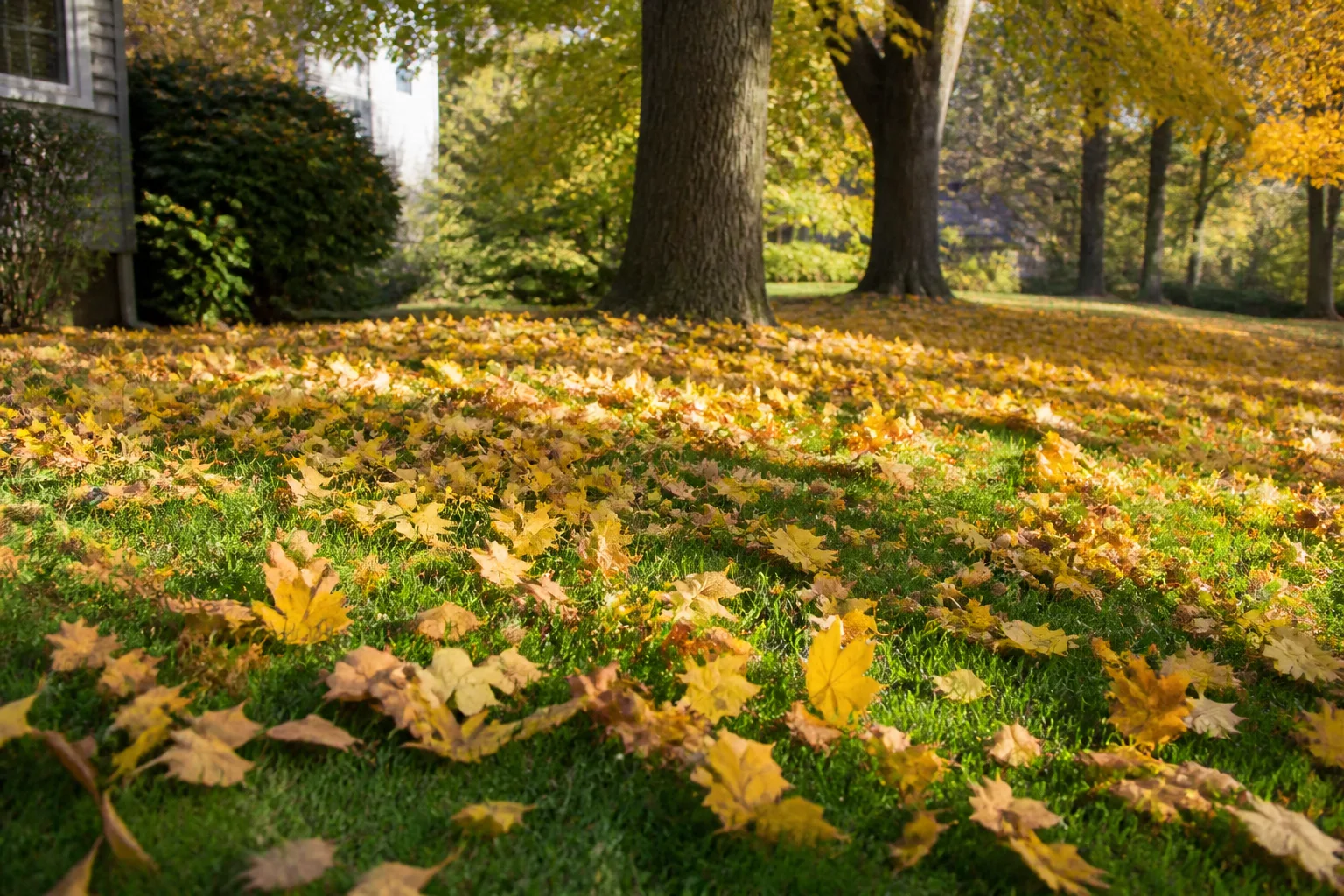
Use this table as a field guide. These percentages are practical thresholds from extension guidance, not a precision measurement or a promise that every cultivar and site will respond identically.University of Wisconsin–Madison Extension University of Connecticut Extension
| What you see | Best first move | What success looks like |
|---|---|---|
| Scattered leaves, about one-fifth of the turf or less covered | Leave them or make a normal mow if the lawn is due | Grass is plainly visible; leaves are not joining into a mat |
| Leaves cover roughly half the lawn, but the grass still stands up | Mulch-mow in dry conditions | Fine pieces settle between blades, leaving no more than about one-fifth visibly covered |
| Grass is hard to see, especially under a heavy tree canopy | Rake or bag at least part of the load, then mulch what remains | A mower can finish the thin layer without leaving a carpet of fragments |
| Leaves are wet, matted, diseased, or still thick before a long snowy period | Remove or wait for dry conditions; do not force a mower pass | The turf is not buried under a damp sheet or diseased debris |
The table is a starting point, not a strict numerical lawn prescription. A freshly seeded patch, thin shaded turf, or a lawn with a history of disease may need a lighter leaf load than established, vigorous grass. Conversely, a few harmless leaves can remain on an informal lawn even if a neighbor prefers a perfectly clean surface.
Light, moderate, and heavy leaf fall
With a light scatter, leaving leaves in place is usually the simplest choice. They may blow into a bed, break down on the soil, or disappear under ordinary mowing; there is no practical benefit to hand-picking the last leaves from a lawn that is otherwise clear.
A moderate layer is often ideal for mulch mowing, provided it is dry and your mower can chop it. Make a test pass over a small area before doing the entire yard. If you can see the grass after the pass and the chopped pieces are small, continue; if a thick layer still hides the blades, stop and collect part of the material or repeat the pass in a different direction.
Heavy leaf fall calls for a split strategy. Remove enough leaves to restore visibility, then shred a thinner remainder or save the collected leaves for compost. A mature tree can drop more material than a weekly mowing schedule can handle, especially after a storm; raising the mower deck or making several passes cannot always compensate for a pile that has been allowed to become wet and compacted.
When you can leave leaves where they land
Leave leaves when the layer is thin, loose, and spread across a lawn that is otherwise healthy. If grass blades show through and the leaves are not clumping against one another, they can break down without a dedicated cleanup. A last light pass with a mower can make the pieces smaller, but it is not required for every scattered leaf.
There is also a landscaping choice here. The goal of a formal, close-cut front lawn differs from an informal lawn edge or a naturalized area where a little leaf litter is acceptable. Keep leaves off sidewalks, drains, steps, and paths where they can become slippery or block water, even if you leave some under shrubs or at the edges of the property.
Leaf cover can return organic matter and nutrients to soil, but it is not a complete fertilizer plan. UConn Extension summarizes an estimate in which mulch mowing a two-inch seasonal layer across established turf returned roughly 150 pounds of nitrogen per acre, along with phosphorus and potassium; the key phrase is over the course of the fall season, not a two-inch blanket left on the grass in one session.University of Connecticut Extension Soil, leaf mix, mowing, and climate all affect how quickly nutrients become available, so do not use leaf depth alone to set fertilizer rates.
Leaving some leaves in the right place can also support wildlife. Whole leaf litter in garden beds or a tucked-away corner offers shelter for insects and other small animals overwintering in the landscape; lawn turf does not need to be the habitat zone. You can keep the lawn functional while preserving a portion of leaves where they will not smother grass.
When you should rake leaves off the lawn
Rake, sweep, or collect leaves when the grass is nearly hidden, the leaves lie in a thick overlapping layer, or the mower leaves large clumps behind. Removal is also useful if you need a clear walking area, if a drain or path is blocked, or if you prefer not to mulch leaves into a thin lawn. The right tool is the one that moves the material without tearing up the turf.
A rake is precise for small patches and bedsides but can be tiring over a large lawn. A leaf blower can move leaves into windrows, though it does not solve the problem of what to do with them afterward. A mower with a collection bag can both chop and collect; a lawn sweeper works best when leaves are dry and not matted. For a broad lawn, collect only the heaviest areas and leave a thin, mulched layer elsewhere rather than hauling every leaf away.
Timing depends on the drop and the weather, not a fixed “last rake” date. Check the lawn after windy days, after a major leaf drop, and before snow or a long wet spell if thick cover remains. The RHS recommends removing leaves from turf that would otherwise be smothered and moving them to a leaf-mold pile or back of a border; it also advises mowing only in mild conditions and at a slightly higher setting than in summer.Royal Horticultural Society
Wet, matted, diseased, and late-season leaves
Do not try to grind a wet mat into the lawn. Moist leaves tend to cling together and clog a mower deck or get pushed into piles instead of chopped evenly; wait for the surface to dry, or collect the worst of the mat with a rake. BBC Gardeners’ World’s autumn lawn guidance similarly advises against mowing wet or frosty turf, since those conditions can damage grass.BBC Gardeners’ World Magazine
Diseased foliage needs a different decision from ordinary fall litter. If the tree had a serious, recurring foliar disease, do not automatically shred and redistribute its leaves across the lawn; ask a local extension service whether that pathogen survives in fallen leaves and how to dispose of them. Wisconsin Extension advises removing significantly diseased leaves because they can be a source of spores for the next growing season, while UConn recommends following local yard-waste rules for leaves associated with persistent disease or pest problems.University of Wisconsin–Madison Extension University of Connecticut Extension
Before winter, remove a thick layer that will stay matted under snow. You do not need to chase a few fragments ahead of the first frost, but do not leave turf covered by an intact blanket simply because the calendar says the season is over. If the final leaves fall when the lawn is wet or frozen, wait for a safe dry window rather than driving a mower across soft, vulnerable turf.
Mulch leaves into the lawn with a mower
Mulch mowing is often the best middle ground: it reduces the amount you have to rake while returning finely chopped leaf matter to the lawn. You do not necessarily need a special mower, but a sharp blade and a mulching setting or blade improve the odds that leaves will be cut small enough to sift down between grass blades. UConn Extension says a mulching mower can process a deeper layer than a conventional mower, while a standard mower can be used at a higher deck setting with repeated passes.University of Connecticut Extension
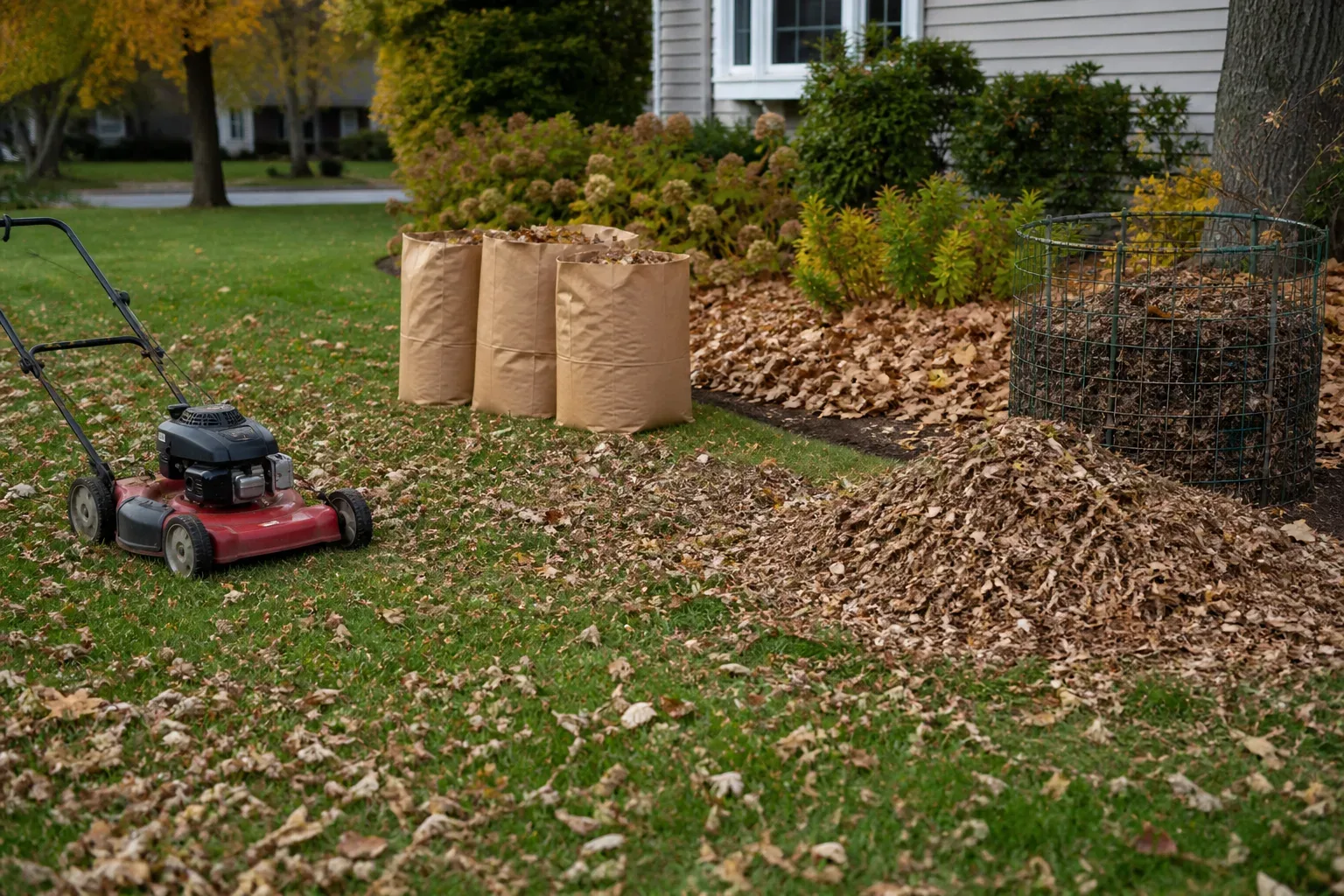
Start with dry leaves and a dry lawn. If leaves are damp, wait until they have dried; if the grass is wet, frosty, or soft underfoot, postpone mowing. Set the deck to the height appropriate for your grass rather than scalping it to reach the leaves, and avoid removing more than one-third of the grass blade in a pass. University of Georgia Cooperative Extension gives that one-third rule as part of sound mowing practice and recommends sharp blades and dry mowing.University of Georgia Cooperative Extension
Mow slowly enough for the deck to process the material, then inspect the result. On a standard mower without a dedicated mulch setting, a second pass at a right angle can improve particle size, but only if the leaves are not clumping and the grass remains visible. If the mower discharges chopped leaves in rows, scatter them with a light rake or make a pickup pass rather than leaving piles across the turf.
Check grass height and leaf condition first
Before starting, walk the route and remove branches, toys, stones, and other debris that leaves could hide. Check the mower blade and bag or mulch plug, and choose a dry portion of the day. A light dust mask can be sensible when mowing a large amount of dry, dusty material, particularly if you have respiratory sensitivity; UConn Extension specifically raises dust protection as a consideration during leaf mowing.University of Connecticut Extension
Make one test pass and look at the lawn from above. The right result is not “every leaf vanished”; it is small, fairly even pieces that settle down between grass blades so that the green canopy is still visible. UConn’s post-mulching limit is around 20 percent visible leaf coverage; use that as a useful upper bound, then be more conservative where the grass is thin, newly seeded, shaded, or recovering from stress.University of Connecticut Extension
If the grass is hidden, the mower is leaving clumps, or the machine is struggling, stop. Raise the deck if it is too low, sharpen or replace a dull blade, make another pass on a dry day, or collect a portion of the leaves before continuing. A machine’s advertised capacity is less important than the condition of your lawn after the pass.
What to do with leaves you remove
Collected leaves are valuable material, so try to keep them out of disposable plastic bags and landfills where practical. First check your city or county’s leaf collection rules: some programs require paper bags or curbside piles and exclude branches, soil, or diseased debris. If pickup is available, it can be the most efficient choice for a large volume.
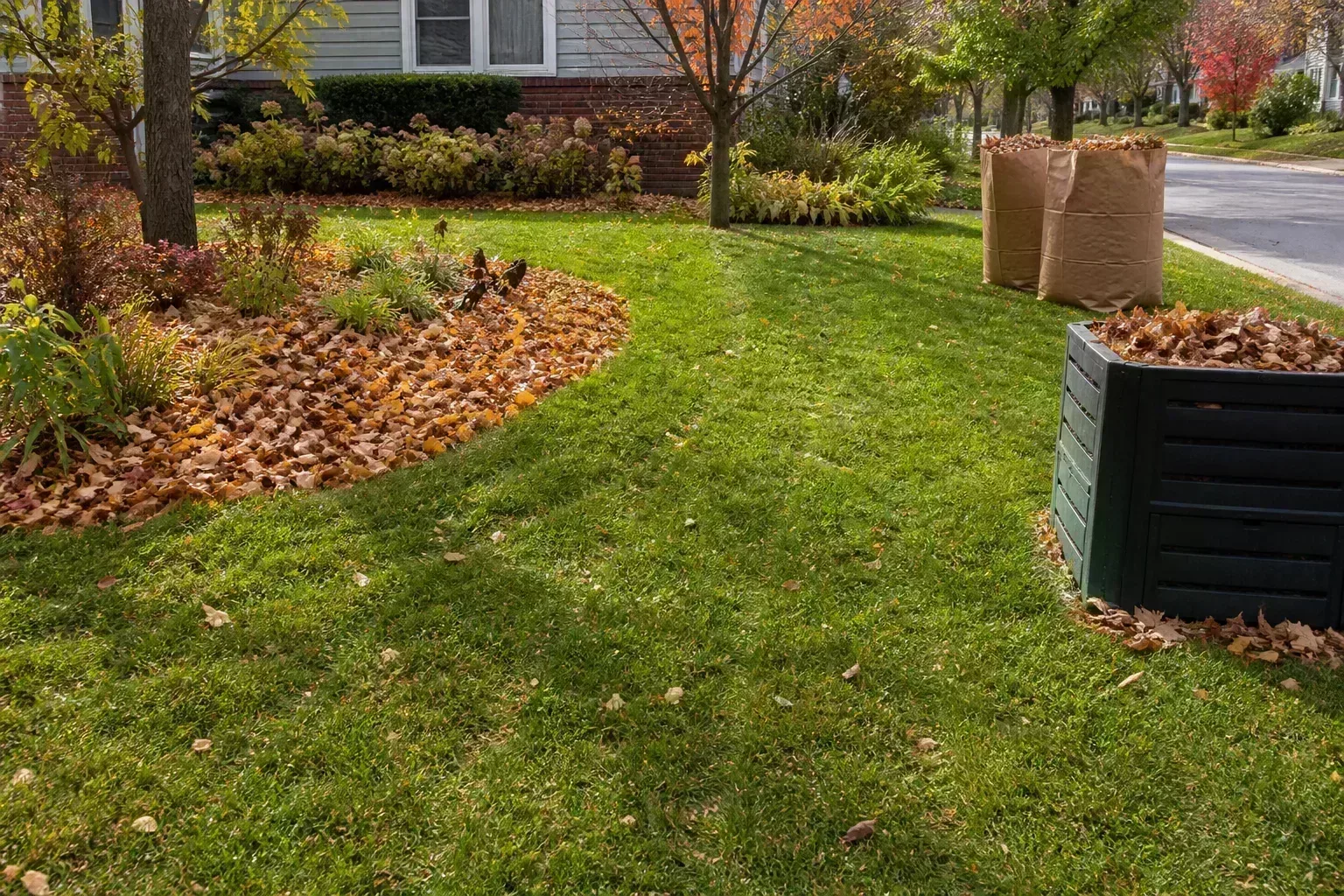
For home use, chop leaves before composting to speed decomposition and reduce matting. Mix dry “brown” leaves with greener material such as fresh grass clippings or kitchen scraps, then keep the pile damp but not waterlogged and turn it periodically for airflow. Purdue Extension notes that dry leaves break down slowly on their own and decompose faster when combined with green plant material; shredded leaves can also be used as mulch around landscape plants.Purdue Extension
A separate leaf-mold pile is an easy option when you have more leaves than green compost materials. It is simply a pile of leaves allowed to rot into a crumbly soil conditioner over time; shredding first helps it break down faster. Keep it contained if wind scatters leaves in your neighborhood, and avoid adding foliage with severe disease unless your local extension service says your composting method will reliably destroy the pathogen.
Leaves can also be moved to the back of a border or under shrubs where they will not bury plant crowns or smother low evergreen foliage. For actively growing ornamental plants, do not pile a deep, wet blanket against stems. Purdue recommends limiting leaf mulch around active plants to a few inches and shredding it to reduce matting; the correct depth still depends on plant type and site conditions.Purdue Extension
Do not burn leaves as a shortcut. Purdue Extension warns that leaf smoke contributes to air pollution and can carry irritating or harmful particles and gases; burning may also be restricted by local law and creates a fire risk.Purdue Extension Municipal collection, compost, leaf mold, and careful mulching give the material a more useful destination.
Keep leaf litter for wildlife without sacrificing turf
A tidy lawn and wildlife-friendly garden do not have to be the same surface. The lawn can receive a light mulch-mowed layer while whole leaves stay in less formal areas: beneath shrubs, in a perennial bed, or in a contained corner behind a shed. That keeps thick litter off grass while leaving overwintering cover where insects and other small creatures can use it.
The important distinction is between intact leaf litter and finely chopped turf mulch. Chopping makes leaves useful to the lawn but also disrupts the leaf layer as habitat; if insect shelter is a priority, keep some whole leaves in a bed rather than mowing every leaf on the property. UConn Extension notes that many beneficial insects overwinter in leaf litter, while Penn State Extension describes leaf piles and standing plant material as shelter for wildlife through winter.University of Connecticut Extension Penn State Extension
You do not have to spread leaves everywhere to make a difference. A small, out-of-the-way pile can be enough to retain habitat, while the lawn stays accessible for children, pets, sports, or walking. Keep leaf piles clear of storm drains, air intakes, fire pits, and places where they may create a slip hazard, and follow local rules if you live in a community with leaf collection requirements.
Leaves are not the same as lawn thatch
Raking leaves off the surface is not the same as dethatching a lawn. Fallen tree leaves sit above the green canopy; thatch is a layer of living and dead grass stems, roots, and other turf material that accumulates near the soil surface. A thin amount of thatch is normal, and removing it is a separate maintenance decision based on the lawn’s condition.
Finely chopped leaves do not automatically create a thatch problem. UConn Extension explains that leaf fragments increase organic matter at the soil surface but do not directly build turf thatch; grass stems and roots are the material more associated with that layer.University of Connecticut Extension University of Georgia Extension makes the same distinction for grass clippings: clippings break down rather than causing thatch buildup when mowing is done properly.University of Georgia Cooperative Extension
If the lawn has a spongy brown layer beneath the green blades, pulling a stiff rake across it may be scarifying, not leaf cleanup. Do not aggressively scarify a lawn just because autumn leaves are present; first check whether thatch is actually the issue and choose timing appropriate for your grass and climate. BBC Gardeners’ World describes scarifying as a distinct job for removing excess thatch and moss, and warns that too much thatch can restrict new growth.BBC Gardeners’ World Magazine
Conclusion: rake selectively and reuse the rest
Raking leaves off the lawn is necessary when they are thick enough to hide the grass, wet and matted, associated with a serious leaf disease, or likely to remain as a dense blanket through winter. A thin scatter can stay, and a moderate dry layer can usually be mulched if grass remains visible after mowing. Use the lawn itself as your guide: if you cannot see the turf through the leaf fragments, collect some of the load or make another dry pass.
Then put the excess to work. Compost it, build leaf mold, use a modest amount in suitable garden beds, or follow municipal collection rules. Keep a portion of whole leaves in a safe garden corner if you want winter habitat, and keep the active lawn clear enough to grow. This selective approach protects turf without treating every fallen leaf as waste.



