How to Prune Indeterminate Tomatoes Step by Step
A practical guide to pruning indeterminate tomatoes, from the first flower cluster to late-season topping, with support and sanitation advice.
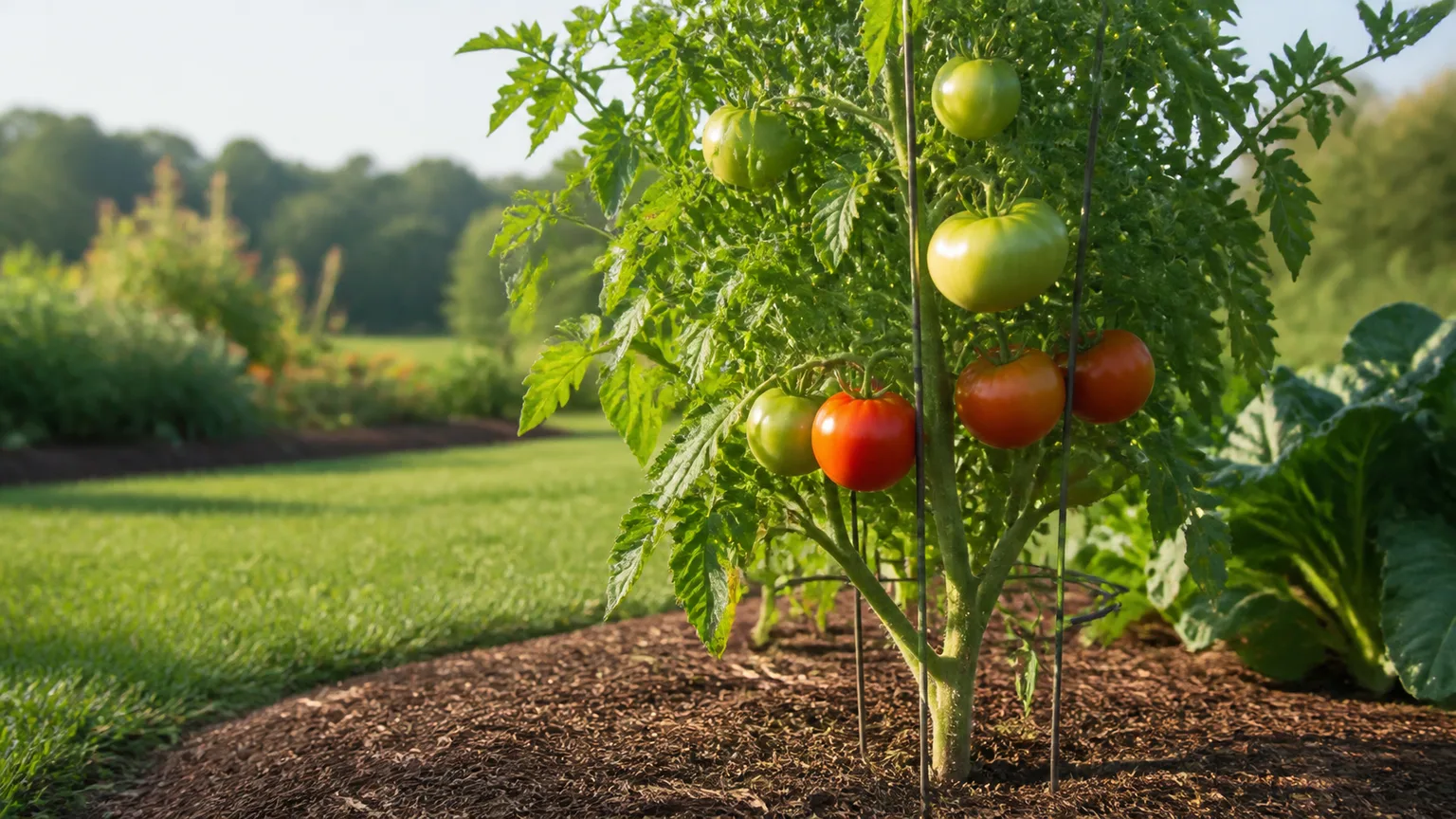
An indeterminate tomato keeps extending its main vine and making new flower clusters until cold weather stops it. Pruning can make that long growth easier to support and harvest, but every sucker you remove is also a potential fruiting stem. The best approach is therefore selective: decide how many leaders your support can carry, keep the leaves that protect developing fruit, and remove only growth that works against that plan.
For a single-stake plant, one or two leaders are usually easier to tie and manage than a thicket of stems. A wide cage or sturdy trellis has room for more, so it often needs less routine sucker removal. If the variety or support is uncertain, start with cleanup pruning and postpone cuts that would remove a healthy branch until you can see how the plant is growing.
The fast answer: prune to fit the way you grow
Begin when the transplant is established, tied to its support, and beginning to show its first flower cluster. Keep the main stem, decide whether you want one or two leaders, and pinch unwanted suckers while they are small. Recheck the plant about once a week during active growth; you do not need to make a cut every time you look.
Keep lower leaves from resting on soil, remove dead or clearly diseased growth, and tie fruiting stems before they bend under a heavy cluster. Avoid stripping the canopy to make a plant look tidy. Healthy leaves make the sugars that support fruit, and their shade protects tomatoes from sunscald.
In practice, the amount of pruning depends less on a fixed calendar than on the structure you have room to support. A narrow stake calls for a narrower plant. A roomy cage can hold a broader plant without a strict one-stem routine, especially if you can still reach the center to harvest and inspect it.
Confirm your tomato is indeterminate
Tomato plants are commonly grouped by growth habit. Determinate plants grow to a more limited size and set much of their crop in a concentrated period, while indeterminate plants keep elongating and producing fruit over a longer season. N.C. Cooperative Extension describes indeterminate tomatoes as aggressive, season-long growers that can become heavy and difficult to manage without support and selective pruning (N.C. Cooperative Extension).
Check the seed packet, plant tag, or cultivar listing before removing healthy shoots. Terms such as “vining” or “cordon” generally point to an indeterminate habit; “bush” often signals determinate growth. Cherry, heirloom, and beefsteak describe fruit or cultivar groups, not a pruning rule by themselves, so do not assume every cherry tomato should be pruned alike.
If the label is gone, watch the plant. A growing tip that continues extending beyond flower clusters and keeps forming new leaves is a useful sign that the plant is indeterminate. Until you are confident, remove only damaged, diseased, or ground-contacting growth and keep healthy side shoots that may be part of the crop.
What continued vine growth looks like
An indeterminate plant has an active growing point at the tip of its main stem. As that stem climbs, it produces leaves, flowers, and new side shoots; each side shoot can become another vine if you let it grow. This is why an apparently small seedling can become a wide, heavy canopy by midsummer.
A determinate plant behaves differently: it reaches a more limited framework and sets a large share of its fruit in a shorter window. N.C. Cooperative Extension notes that determinate tomatoes often need less pruning, while indeterminate plants benefit from more attention to their extending stems and support. This article’s leader-training advice is for the latter.
When you are unsure whether a side shoot is a sucker or a fruit cluster, look at its shape rather than its size alone. A sucker develops leaves and a growing tip; a flower truss carries buds or flowers on a short branching stalk. Waiting a day or two for the structure to become clear is safer than removing a branch you cannot identify.
Why the support system changes the job
Pruning and support work together. A tall, narrow stake can hold only a limited number of stems without becoming unstable, while a wide cage, Florida weave, or strong trellis can support several leaders spread across a broader space. N.C. Cooperative Extension and the University of Georgia Cooperative Extension both emphasize support as part of managing indeterminate vines and keeping stems off the ground.
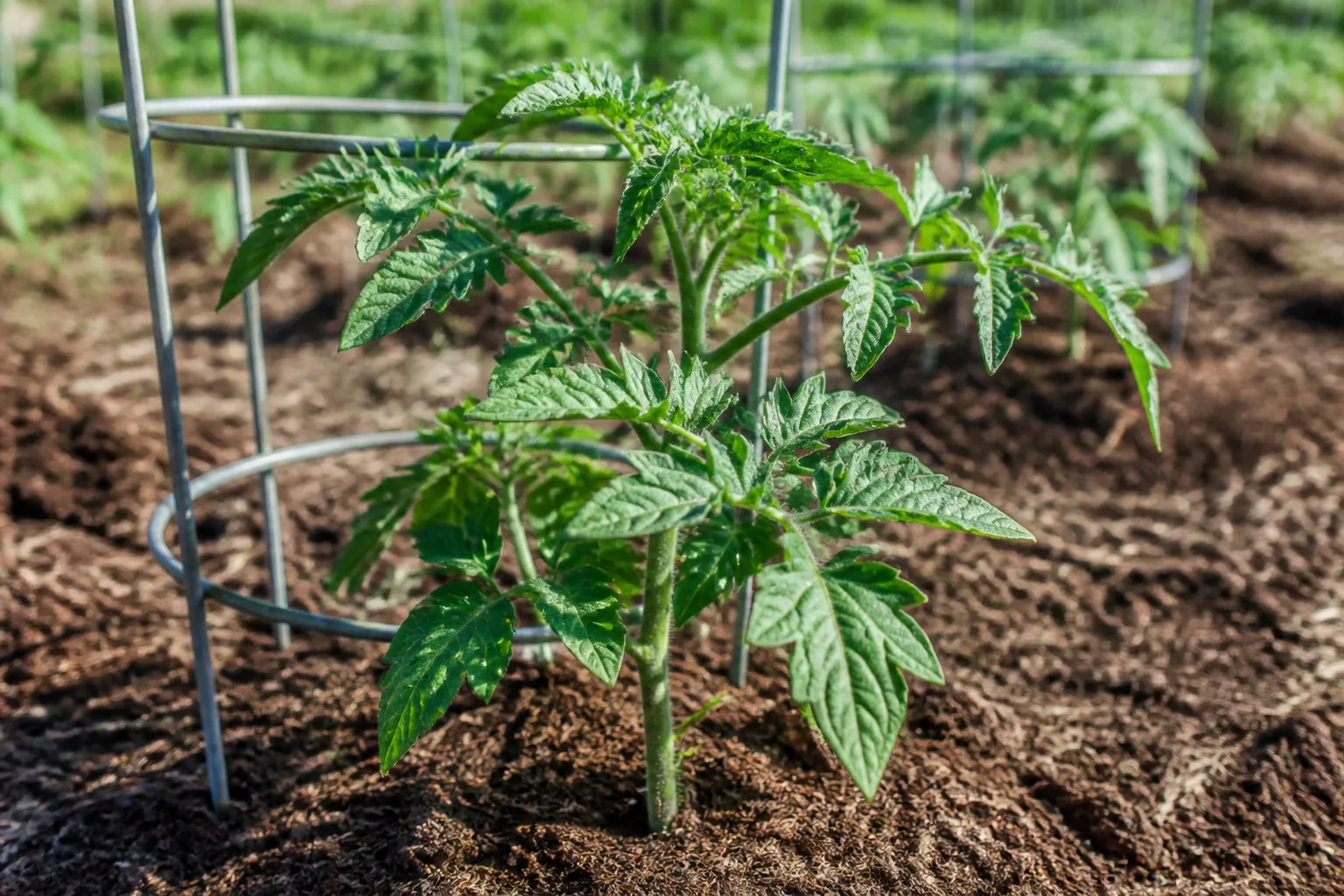
Set the support before the vine becomes heavy, then tie stems loosely so they can thicken. A single stake is not a reason to keep pruning harder and harder if the plant is already too vigorous for it; adding a second support or redirecting a stem may solve the structural problem with fewer cuts. If a plant is already carrying fruit, secure a loaded branch before removing a neighboring shoot that may be helping hold it upright.
What pruning can improve—and what it cannot promise
Selective pruning can reduce crowding, make it easier to tie and harvest a vine, and improve air and light movement through a dense canopy. Removing a low branch that repeatedly touches damp soil also reduces direct contact with the splash zone. These are practical management benefits, not guarantees that the plant will produce more tomatoes.
A sucker is not waste growth. Left in place, it can become a flowering, fruit-bearing stem; removed, it cannot carry that additional crop. The trade-off is straightforward: fewer leaders are easier to fit on a narrow support and may yield larger, more accessible fruit, while more leaders preserve more potential fruiting sites but require more room, stronger support, and better access.
A practical tomato-pruning guide from Blooming Expert makes the same useful distinction: a sucker is not disposable growth, since it can form its own flowers and fruit. Decide how many stems to keep based on the support and space you can provide, rather than assuming that each cut will increase the total number of tomatoes (Blooming Expert).
The University of Georgia Cooperative Extension recommends adjusting pruning to the tomato type and cautioning gardeners not to remove too much foliage, because fruit benefits from leaf shade and can scald when suddenly exposed to full sun (UGA Cooperative Extension). If the plant is healthy, well supported, and easy to manage, there may be little reason to remove every sucker simply because pruning is possible.
For many backyard growers, a good harvest means steady access to sound, ripe fruit rather than the biggest possible individual tomato. If you want abundant small tomatoes for salads or preserving, keep more stems on a broad support. If you want to simplify tying and harvesting, train fewer leaders. Neither choice is universally best; choose the one you can maintain without sacrificing the plant’s healthy leaf cover.
When to start and how often to inspect
Wait until the transplant has recovered from planting and is growing actively. The first visible flower cluster is a useful cue because it helps you identify the main stem and decide whether to keep a nearby sucker as a second leader. Epic Gardening’s tomato-pruning guidance similarly frames pruning as a recurring task whose frequency depends on the variety, how quickly suckers grow, and the trellis system (Epic Gardening).
During rapid growth, inspect every seven to ten days, or about weekly if the plant is vigorous and the growing season is short. You can check less often when growth slows or when the plant is in a broad cage and you are only removing problem growth. A regular walk-through is more useful than waiting until several foot-long suckers have formed and trying to reshape the whole plant in one session.
Choose a dry part of the day after dew, rain, and overhead watering have dried from the leaves. Wet plants are harder to inspect, and moving among them with tools can spread disease. If foliage is wet, the plant is wilted from drought, or a heat wave is stressing it, wait on optional sucker removal and return to the training cuts when conditions are calmer.
Make a few considered cuts, then step back. If the canopy already has enough open space for air to move and you can reach the fruit, stop. Pruning should make the plant easier to manage, not turn into a weekly attempt to remove every new leaf.
Find the sucker without cutting a fruit truss
A tomato sucker is a side shoot that forms in the leaf axil: the V-shaped junction where a leaf stalk meets the main stem. When small, it looks like a tiny leafy shoot with its own growing tip. Left alone, it can develop into another stem with leaves, flowers, and tomatoes, which is why growers either remove it or deliberately train it as a leader.

A fruit truss looks different. It is a short stalk carrying flower buds, open yellow flowers, or small tomatoes rather than a new leafy tip. If you are unsure, follow the structure back to where it joins the stem: a shoot emerging beside a leaf is likely a sucker, while a cluster of buds or fruit forms on a truss.
Do not remove a shoot merely because it is growing near flowers. If it is healthy and you still need another leader, it may be the branch you want to keep. Identifying the axil first prevents one of the most frustrating pruning mistakes: cutting off the very flower cluster you were hoping to harvest.
Choose one, two, or several leaders
A leader is a main stem you intentionally keep and tie to the support. There is no single correct number for every backyard plant; match the count to the space between plants, support width, cultivar vigor, and how much time you want to spend tying and thinning. University of Georgia Cooperative Extension describes single- and double-stake arrangements and notes that plants need room for airflow and harvest access.
| Growing setup | A practical starting point | What to keep in mind |
|---|---|---|
| One sturdy stake or vertical string | One leader; two if the stake and ties can carry both | Easier to keep narrow, but fewer fruiting stems |
| Wide cage or strong trellis | Two to four leaders, or light pruning | More fruiting sites need more support and access |
| Unknown cultivar or uncertain support | Cleanup only until the structure is clear | Avoid removing productive shoots by guesswork |
These are starting points, not strict horticultural limits. A very vigorous variety may overwhelm a small cage even with only two leaders, while a compact plant can remain manageable with more. If stems are shading one another, collapsing into the path, or too difficult to inspect, reduce crowding gradually rather than following a fixed stem count.
Train one leader on a stake
A single leader is the simplest system for a plant tied to one narrow stake or a single vertical string. Keep the main stem and remove the other suckers as they emerge, while tying the leader loosely at intervals along the support. Because the plant will continue growing upward, make sure the stake or string is tall enough and anchored securely before the vine reaches its limit.
This system gives you a compact column that is relatively easy to tie, scout, and harvest. It also sacrifices the fruiting potential of the removed suckers, so it is not automatically the highest-yielding choice. The goal is manageability: fewer stems are less likely to topple or spread into neighboring plants when the support is narrow.
If the main leader breaks, do not panic. Choose a healthy sucker near the break or just below it, guide that shoot upward, and treat it as the replacement leader. Tie it in place before it becomes long and floppy; the plant can continue growing from another active shoot.
Train two leaders on a wider support
For a double-leader plant, keep the main stem and choose one strong sucker to become the second leader. Many gardeners use a sucker close to the first flower cluster because it is easy to identify and train, but the exact choice matters less than selecting a healthy shoot with room to grow. Remove other unwanted suckers while they are still small.
Give each leader its own path up a sturdy stake system, broad cage, or trellis. Keep the tie loose enough that the stem is not girdled as it thickens, and leave enough space between leaders that leaves do not form a tightly packed, damp wall. The two-stem structure preserves more fruiting growth than one leader, but it needs more room and attention.
If the second stem begins to crowd the center or leans heavily, first adjust the ties and support. Only remove it if you have decided the plant’s canopy is too dense or the support cannot safely carry the load. Cutting a fruit-bearing stem at the height of summer can remove a meaningful part of the harvest.
Let a roomy cage carry more stems
A wide, sturdy cage can hold several stems without intensive suckering. Guide branches back inside the cage as they grow, remove only shoots that press into a neighbor, block access, or create a persistently crowded pocket, and secure any branch carrying a heavy fruit cluster. The University of Georgia recommends durable cages with enough diameter for branches to spread; flimsy, narrow cones are often inadequate for vigorous indeterminate varieties.
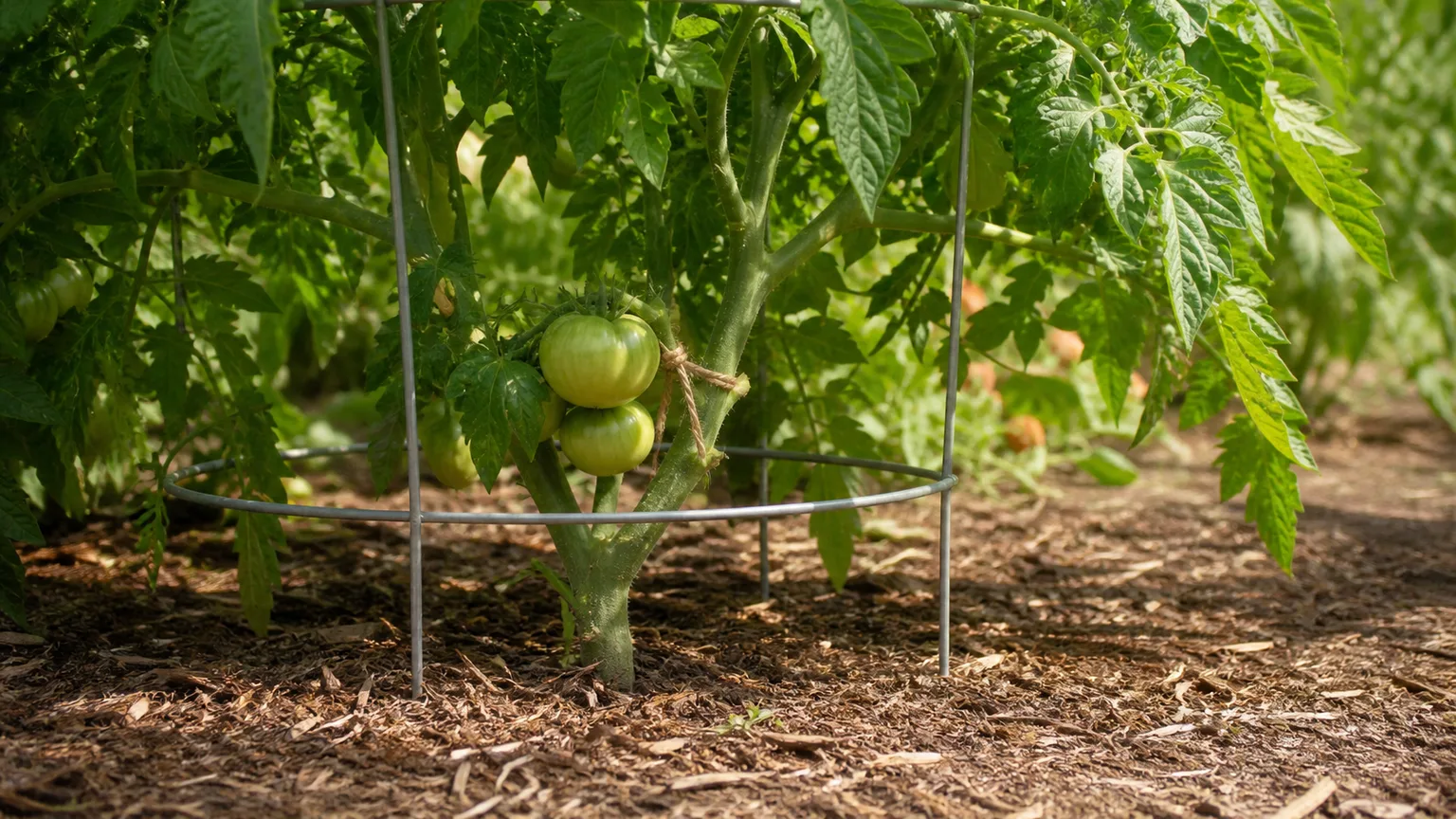
A caged plant is not a hands-off plant. Check that it remains upright, that branches are not slipping through the wire under fruit weight, and that you can still see signs of disease or pests. But if the canopy is airy and the plant is stable, selective cleanup may be all the pruning it needs.
A step-by-step pruning routine
Before cutting, decide what you are trying to achieve: establish a leader count, remove a low branch from soil contact, open a packed center, or remove diseased tissue. If you cannot name a useful result for a particular cut, pause and leave that shoot. Pruning is easiest to do well when each cut has a specific job.
Gather sharp bypass pruners or small garden snips for larger shoots, plus soft ties if a leader needs support. Small suckers can usually be pinched off cleanly with your fingers. Start with healthy plants and move to suspicious or diseased plants last; clean the blades between plants, and again after cutting diseased tissue.
Pinch small suckers and clip larger shoots
Trace the main stem upward and inspect the V-shaped leaf axils. Once you have chosen the leaders to keep, pinch unwanted suckers at the base while they are only a few inches long. The North Carolina and Georgia extension guidance recommends removing suckers when they are small; removing them early avoids the larger wound and heavier branch that forms when they are allowed to grow.
Hold a small sucker near its base and bend it gently sideways until it separates. Do not pull downward along the main stem, which can strip or tear the outer tissue. If the sucker has become thick or woody, use sharp, clean pruners to make a neat cut close to its origin without nicking the main stem.
Do not make a flush cut that injures the main stem, and do not leave a long, ragged stub. For a very large sucker that you do not want to remove entirely, you can shorten it instead, but leave enough leaf area for the plant to continue supporting any fruit on that branch. When a cut would remove a heavy, fruiting stem, support the branch first and reconsider whether the cut is worth the lost crop.
Remove low and unhealthy leaves selectively
Start at the bottom of the plant and remove leaves or stems that repeatedly touch soil or sit in wet mulch. N.C. Cooperative Extension recommends removing the lower six to twelve inches of leaves to reduce disease splash, but use the condition of your own bed as the guide rather than treating that measurement as a universal line. A plant in a dry raised bed may not need the same cleanup as one whose leaves drag through wet soil.
Remove dead leaves and tissue with clear disease symptoms promptly, especially if the problem is spreading beyond the lowest part of the plant. Ohio State University Extension advises taking off diseased tomato leaves with sanitized pruners and disposing of them away from the garden rather than leaving them under the plant (Ohio State University Extension). If you cannot identify a leaf problem, take a photo or sample to a local extension service rather than stripping every leaf with a spot.
Keep healthy leaves that shade green and ripening tomatoes. Removing too much foliage at once can expose fruit to strong sun and leave the plant with less leaf area to support it. If a dense plant needs significant cleanup, make a small pass and reassess after several days instead of removing a large fraction of the canopy in one sitting.
Late-season pruning and topping
As the season approaches its end, the question changes from “How do I train new growth?” to “Which existing fruit still has a reasonable chance to finish?” Use your local frost window, the forecast, and the size of the fruit rather than a fixed date. A mature, full-sized green tomato has a better chance of coloring than a flower that has just opened.
Topping means removing the growing tip of an indeterminate leader. It can stop the vine from extending and flowering above the fruit you want to keep, but it does not make green tomatoes ripen on command. Do it only when new flowers and upper growth are unlikely to have enough warm weather to produce a useful crop; leave leaves above the highest fruit cluster you want to mature.
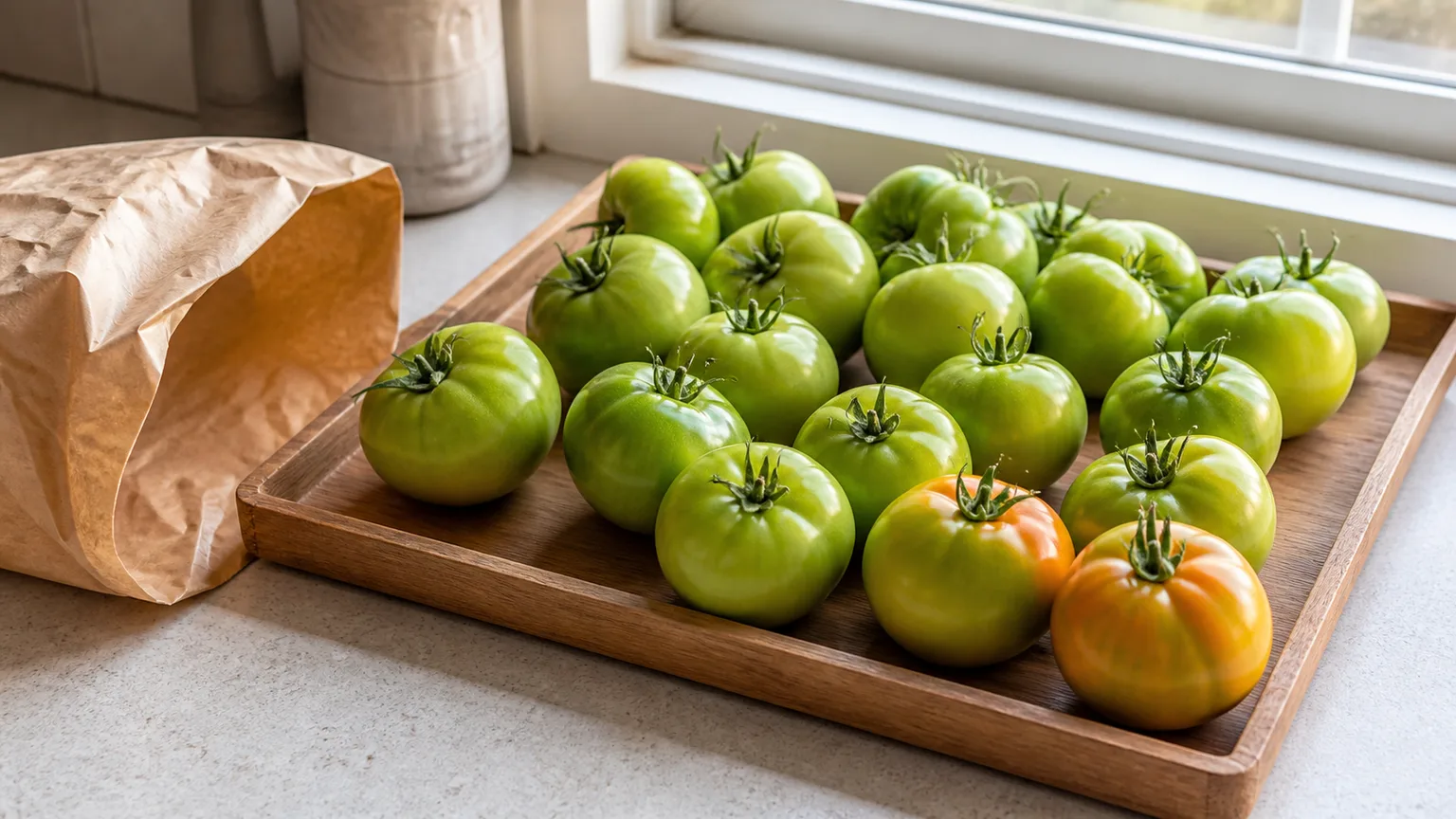
You can also remove a few late flowers or tiny fruit that are clearly too immature for the remaining season, while keeping healthy foliage around the existing crop. Do not make a severe cut just before frost or because the plant looks untidy. If frost is imminent, harvest sound fruit that is full-sized or starting to color and protect it indoors rather than expecting aggressive pruning to rescue it.
Common mistakes that cost fruit or spread disease
Pruning before confirming the plant type can lead you to remove valuable fruiting branches. If the label is missing or the plant is not clearly indeterminate, clean up only dead, diseased, or soil-touching growth until you know how the vine behaves.
Removing every sucker without a plan can turn a vigorous plant into a narrow stem with fewer fruiting sites than you intended. Select the leaders first, then remove only the shoots that do not fit the support and harvest goal.
Stripping healthy leaves to improve airflow can backfire by exposing fruit to harsh afternoon sun and reducing the leaves that feed the plant. Open the densest area gradually and keep enough foliage around the fruit cluster to provide shade.
Pruning wet foliage or moving dirty tools from plant to plant can help spread disease. Choose a dry window, use clean blades, and sanitize between plants when disease is present; keep diseased clippings out of the bed and dispose of them appropriately.
Waiting until suckers are large makes the work harder and creates bigger cuts. Inspect regularly during active growth, but if you missed a few weeks, do not remove every oversized shoot at once; tie up useful stems and reduce crowding in stages.
Cutting a loaded branch before supporting it can make the vine snap or drop fruit. Tie the branch first, check whether the sucker is actually holding up another stem, and remove growth in a way that leaves the remaining plant stable.
Conclusion
Prune indeterminate tomatoes to make the plant fit its support, not to chase a guaranteed yield increase. Start after the plant is established and its first flower cluster is visible, choose a leader count that matches your space, and remove unwanted suckers while they are small. A single stake usually calls for a narrower vine, while a roomy cage can carry more stems with lighter pruning.
Keep low or diseased growth off the plant, but preserve healthy leaves that shade fruit. Inspect during active growth, tie stems before they sag, and save topping for late season when new growth is unlikely to mature. When a cut does not solve a clear problem, leave the stem in place and let it keep producing.



