How to Grow and Care for a Weeping Willow Tree in Your Yard
Learn how to grow a weeping willow, choose a safe planting site, water it, prune weak branches, and avoid common root and maintenance problems in your yard.

A weeping willow can turn a damp, open stretch of ground into a landmark. Its canopy is beautiful in the right place, but the same tree can become a poor fit beside a driveway, a small lawn, or buried utilities because it grows large, sheds twigs and leaves, and carries weak wood. The most important part of care therefore happens before planting: make sure the site can accommodate the tree at full size.
Weeping willow usually refers to Salix babylonica, a deciduous tree native to northern China. It grows quickly in moist soil and tolerates a range of soil textures, but references do not agree on one dependable hardiness range or lifespan for every plant sold under this name. Many cultivated willows are hybrids or have been mislabeled, so check the botanical name and local nursery guidance instead of relying on a generic zone label.
Weeping Willow at a Glance
| Feature | What to plan for |
|---|---|
| Botanical name | Salix babylonica; confirm the nursery’s identity because weeping forms may be hybrids |
| Mature size | Commonly about 30–50 feet tall and similarly wide; some specimens grow larger |
| Light | Full sun to partial shade; a sunny, open site generally supports the strongest growth |
| Soil | Moist, reasonably fertile soil; tolerates several textures and a broad pH range |
| Water | Regular moisture while young; established trees cope with some drought but may shed leaves |
| Main constraints | Extensive roots, weak branches, litter, large crown, and variable cold tolerance |
| Best setting | A spacious, moist, low-traffic area near a pond or stream, well away from utilities and buildings |
The size range is more useful as a planning envelope than as a promise. University and botanical-garden profiles commonly list 30 to 50 feet in height and spread, while actual size varies with cultivar, climate, water, and age. Allow extra room beyond the listed crown because drooping branches extend outward and the root system can spread much farther than the canopy. Lifespan estimates also vary: UF/IFAS describes the tree as short-lived at around 30 years, while Gardenia gives a range of 40 to 75 years. Treat those as broad estimates, not a guarantee for an individual tree exposed to local weather, pests, or branch failure.
The quick profile from NC State Extension describes the tree as fast-growing, 30 to 40 feet tall and wide, and suited to very moist soils. UF/IFAS Extension and the Missouri Botanical Garden give a broader 30-to-50-foot range. Use a nearby mature specimen as your best local size guide.
Know Which Willow You Are Buying
“Willow” covers hundreds of species, and “weeping willow” is sometimes used loosely for any willow with hanging branches. Salix babylonica has long, narrow, finely toothed leaves, a gray-brown furrowed trunk, and thin yellowish- to reddish-brown branchlets that hang toward the ground. Its leaves are usually light green above and paler or gray-green beneath, then turn yellowish before falling.
A nursery label may instead identify a hybrid, such as Salix × sepulcralis or Salix × pendulina, or a different willow selected for a weeping habit. This distinction matters most for hardiness and mature size: the cold tolerance reported for the narrow species is not consistent across references, while hybrids and cultivars can behave differently. Oregon State University Landscape Plants notes that the identity of many cultivated plants is uncertain and that taxonomy varies among references.
If you want a particular tree, ask the nursery to write down the accepted botanical name, cultivar, expected mature size, and local hardiness. Avoid buying a plant described only as “weeping willow” if you live near the edge of its cold range or have limited space. The Missouri Botanical Garden Plant Finder likewise cautions that plants sold under this name may be hybrids or incorrectly identified.
How to identify a weeping willow
The most recognizable trait is the silhouette: slender flexible branches descend from a broad, rounded crown, often reaching close to the ground. Leaves are alternate, simple, and lance-shaped, typically three to six inches long; look for fine teeth along the edges and a lighter underside rather than relying on leaf shape alone.
In spring, willows bear catkins rather than showy petals. Male and female flowers occur on separate trees; the catkins are small and usually greenish or silvery rather than a dramatic ornamental bloom. Female trees can later produce capsules with tiny cottony seeds, which may add seasonal litter. These details can help identify the tree, but a botanical label is still the most reliable way to distinguish closely related species and hybrids.
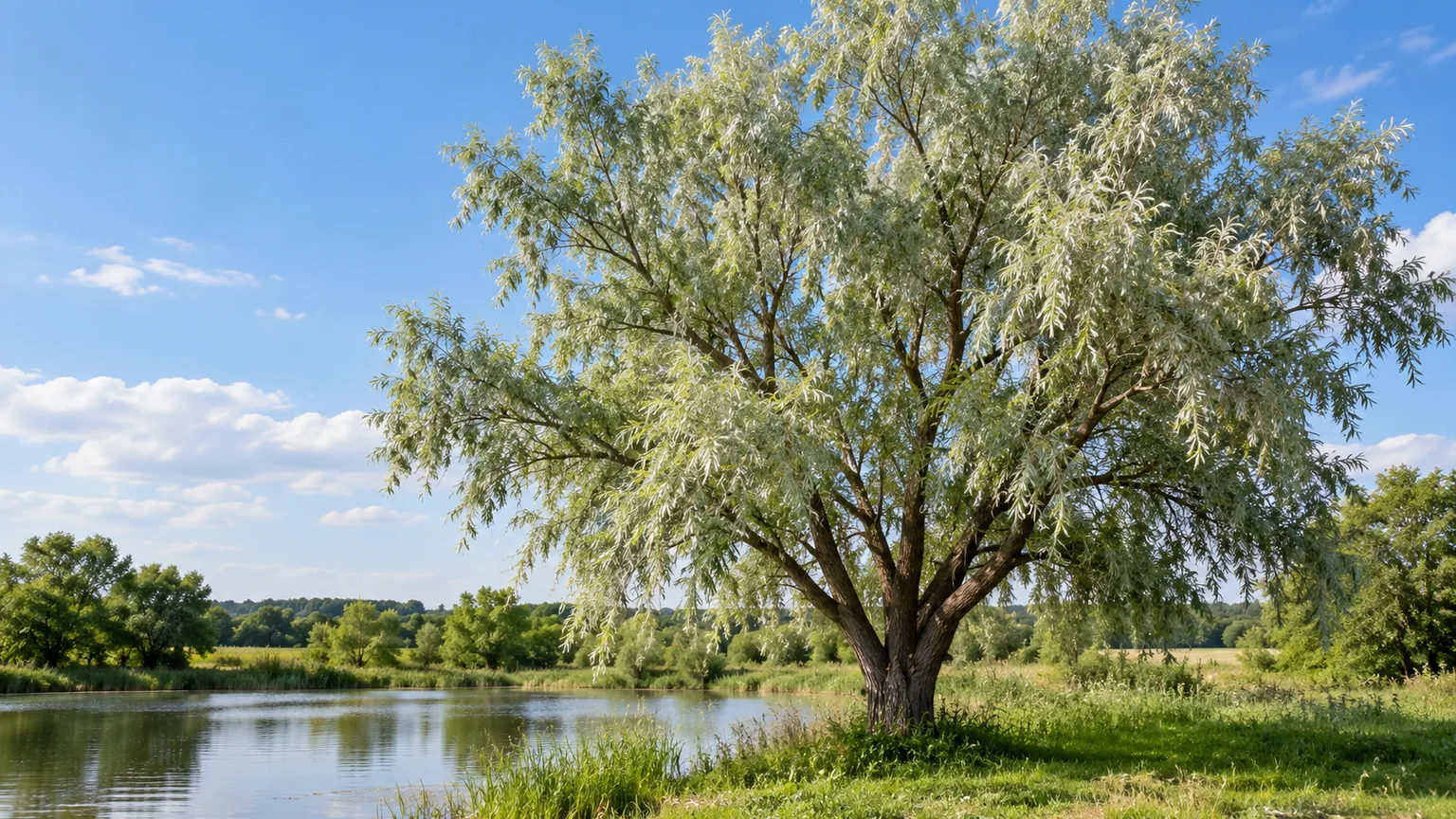
This related willow image is a reminder to check the plant’s identity: a white willow is not automatically Salix babylonica, even when it grows near water or has narrow leaves. Gardenia also describes the tree’s characteristic pendulous crown and notes that the forms sold in commerce can vary.
Decide if Your Site Can Carry a Willow
Choose the site before you buy the tree. A weeping willow is most at home in a broad, sunny landscape with dependable moisture and enough space for both canopy and roots. It can work beautifully beside a large pond, stream, or low area where soil stays moist, but the dramatic water-edge setting shown in garden photos is not permission to plant directly against a retaining wall, path, or utility line.
The tree’s weak wood and expansive form make exposure important. Choose a place where a falling limb would not land on a house, parked vehicle, play area, or overhead line. The University of Florida IFAS profile says willows need initial pruning and training to build a stronger structure but remain susceptible to breakage; NC State Extension also flags weak wood and litter as drawbacks in home landscapes.
Before planting, check the expected mature width against the width of the usable area, then look up underground water, sewer, irrigation, and septic infrastructure. If a utility map is unavailable, request one through the appropriate local service before digging. Keep the trunk well away from foundations, paving, septic drain fields, and pipes; there is no single safe setback for every property because pipe material, existing leaks, soil, root barriers, and local rules differ.
Where roots, utilities, and canopy matter
Willow roots are not a guarantee that a sound pipe will fail, but they are vigorous and often exploit moisture around leaks or existing openings. UF/IFAS reports that roots can spread roughly three times the distance from the trunk to the canopy edge, and that surface roots may lift sidewalks or complicate mowing. In practice, that means the visible crown is not a reliable boundary for the root zone.
A tree planted over a sewer line may look fine for years before a small leak or root intrusion becomes expensive. If the only available planting spot is near a line, do not guess at a setback: consult the utility provider, local code, and an arborist familiar with root barriers and site constraints. Root barriers may help in specific designs, but they do not make a poor location suitable or eliminate the need for clearance.

This general tree-root example shows why hardscape clearance belongs in the planting plan. Weeping willow roots also tend to spread near the soil surface, so a broad mulch ring is easier to maintain than grass or paving tight against the trunk.
Planting and Establishment
Planting during cool weather gives roots time to establish before summer heat, but the best window depends on your local climate and whether the tree is sold bare-root or container-grown. In regions with cold winters, early spring may be safer than fall; in mild climates, fall planting can work well if the ground remains workable. Follow local nursery guidance and do not plant into frozen, waterlogged, or drought-baked soil.
Inspect a container-grown tree before planting. The trunk should be upright, the root flare should be visible near the soil line, and the root ball should not be circling tightly around itself. Reject a badly damaged or girdling root system when possible; correcting a severe defect after the tree is established is much harder.
Step-by-step planting
- Confirm the site and clearances. Verify the tree’s identity and mature size, map underground utilities, and check that the canopy will not conflict with structures or overhead lines.
- Dig a broad, shallow hole. Make it about two to three times wider than the root ball but no deeper than the root flare. A wide hole lets new roots move into surrounding soil without burying the trunk flare.
- Set the tree at the correct height. Place the root flare at or slightly above finished grade. If the root ball is wrapped, remove twine and non-biodegradable materials; remove or fold back burlap from the top where practical.
- Backfill with the native soil. Break up large clods and firm gently to remove major air pockets. Do not add a small pocket of rich compost or fertilizer that encourages roots to stay in the hole rather than grow outward.
- Water slowly and mulch. Soak the root ball and surrounding soil, then apply a two- to three-inch mulch layer over the root zone while keeping it several inches away from the trunk.
- Stake only if needed. If the root ball rocks in wind, use low, flexible stakes and remove them after the tree is stable, usually within a year. Tight or permanent ties can injure the trunk and weaken natural trunk movement.
During the first growing season, inspect soil moisture every few days during hot or dry weather. Water deeply when the root ball begins to dry, rather than giving a little water every day; the goal is moist soil around young roots, not a permanently saturated planting hole. Extend watering across the expanding root zone as the tree grows and taper supplemental water only after establishment and according to rainfall.
Sun, Soil, and Water After Establishment
Weeping willows grow in full sun or partial shade, but a sunny site usually produces a fuller, faster-growing crown. They tolerate clay, loam, and sandy soils when moisture is adequate, and can grow across a broad pH range. Do not amend the entire planting area to chase a particular pH unless a soil test and local advice show a real need.
Moisture is more important than a precise fertilizer schedule. The tree tolerates wet soils and occasional flooding, but “likes water” does not mean every yard should be kept waterlogged; persistently saturated soil can restrict oxygen around roots and increase decline risk. If the site is naturally moist, extra irrigation may do more harm than good.
For an established tree, use rainfall and soil condition rather than a fixed weekly calendar. During a prolonged dry spell, check the soil several inches below the surface beneath the outer canopy; if it is dry, water slowly and broadly so moisture reaches the root zone. Avoid frequent shallow sprinkling, which wets turf more than tree roots and encourages roots to concentrate near the surface.
A mature willow in the right low, moist site may need little supplemental watering. In drier ground, it can survive drought but may shed leaves or show reduced vigor; that is a stress response, not proof that a daily hose is the answer. Check drainage, mulch, root damage, and the actual soil moisture before changing irrigation.
Routine fertilizer is rarely the first fix for a struggling willow. If growth is poor or foliage is pale, look for compacted soil, drought, waterlogging, root injury, pests, or disease first. A soil test can tell you whether nutrients are low; applying fertilizer without a diagnosis can push soft growth or increase runoff without correcting the real problem.
Prune for a Stable, Clear Canopy
Pruning should preserve the natural weeping shape while reducing avoidable structural hazards. Young trees benefit from early training toward one central trunk and well-spaced branch attachments; this is easier to do while branches are small. Because willow wood is weak, good early structure can reduce—but not eliminate—the chance of breakage later.
Do not cut every branch back to the trunk each winter. Severe heading or topping removes the natural crown, creates large wounds, and often triggers clusters of fast, weak shoots that need repeated management. A willow is not a hedge, and regular hard cutting does not turn a large tree into a safer small one.
What to cut and when
For light maintenance, remove dead, broken, diseased, crossing, or rubbing branches and any low limbs that obstruct a path. Make cuts just outside the branch collar rather than flush to the trunk, and avoid leaving long stubs. If a branch is too large to manage safely from the ground with hand pruners, bring in a qualified arborist.
Late winter or early spring, before new growth begins, is a common time for structural pruning because the branch framework is visible. Timing may shift with climate and disease concerns; dead or hazardous limbs should be assessed promptly, and diseased material should be handled according to local extension advice. Do not prune near power lines yourself, and do not climb a mature willow to remove heavy limbs.
If branches touch the ground, decide whether that is part of the look you want. Raise only the limbs needed for clearance and remove them gradually over more than one season rather than stripping the lower crown in one pass. For a young tree, ask a certified arborist to establish a durable framework before large branches become difficult to correct.
Propagate a Willow from Cuttings
Willows often root readily from stem cuttings, which makes vegetative propagation more practical than growing a named tree from seed. A cutting produces a clone of its parent branch, while seedlings may not retain the same weeping form or cultivar traits. Take material only from a tree you own or have permission to propagate, and confirm the parent’s identity before planting it elsewhere.
A simple dormant-season method is:
- In late winter, before buds break, select healthy one-year stems with no cankers, dieback, or insect damage.
- Cut sections about 12 to 18 inches long, making the basal end straight and the top end angled so you can keep the orientation clear.
- Insert the lower half to two-thirds of each cutting into a pot of clean, moist propagation mix or directly into a prepared nursery bed. At least one or two buds should remain above the surface.
- Keep the medium evenly moist but not submerged, and place the pot outdoors in bright light where it is protected from drying wind.
- Allow a full growing season for roots to develop. New leaves show the cutting is alive, but do not tug it repeatedly; wait until roots hold the medium together before transplanting.
The NC State Extension plant profile lists stem cuttings as a propagation method. A practical willow-growing guide from Willowrise Gardens also describes hardwood cuttings and stresses keeping the medium moist. Rooting success does not solve the eventual site problem: do not propagate a tree unless you have room for its mature crown and root system.
Read Pests and Disease Symptoms
Willows host aphids, scale, mites, caterpillars, borers, and other insects. A few insects or minor leaf blemishes usually do not justify treatment on a mature tree; first check whether the crown is otherwise growing normally. Honeydew, sticky leaves, clusters of insects, repeated defoliation, or branch dieback are stronger reasons to identify the pest before deciding what to do.
Diseases can include leaf spots, rust, powdery mildew, cankers, willow scab, and root rot. Their symptoms overlap with water stress, heat, and normal seasonal leaf drop, so inspect more than one leaf and note where symptoms begin. The UF/IFAS profile describes scab and blight symptoms on young leaves and shoots, while NC State lists several insect and disease problems that can affect willow.
Diagnose leaf yellowing and dieback
Start with timing and pattern. A uniform yellowing in fall is often normal; yellowing across the canopy in summer may point to drought, waterlogged roots, nutrient issues, or root damage. If only one branch or one side of the crown is declining, inspect for broken limbs, cankers, trunk injury, or a problem near that part of the root zone before changing the watering routine.
Brown, crispy edges during hot weather can indicate moisture stress, but they can also follow root disruption or salt exposure. Check the soil several inches down and compare it with recent rain; if the root zone is dry, water slowly and reassess over the next week or two. If it is wet or poorly drained, adding more water can worsen the problem.
Look under leaves for orange rust pustules, dark spots, white mildew, or insects. Willow scab and related blights can cause young leaves and shoots to blacken or die back quickly, while cankers appear as sunken or discolored areas on branches. Photograph the pattern, prune only small accessible dead twigs with clean tools, and consult a local extension office or arborist if symptoms spread through the crown or threaten structural branches.
Avoid preventive pesticide or fungicide sprays. A large tree is difficult to cover well, and the wrong treatment may affect beneficial insects without addressing the cause. If a pesticide is warranted after identification, follow the product label and local regulations; for a mature tree, consult a licensed professional rather than estimating a dose or spraying overhead yourself.
Flowers, Fruit, and Seasonal Cleanup
Weeping willows are dioecious, so a tree is male or female. Both can form catkins in spring, but the small, greenish or silvery flowers are subtle rather than showy; only female trees develop seed capsules. That distinction explains why one tree may release cottony seeds while another nearby does not.
The leaves usually turn yellow and fall in autumn, and twigs or small branches may drop during the year. Plan for cleanup before planting if the tree will overhang a pool, patio, vegetable bed, or frequently used path. A broad lawn or naturalized pond margin is easier to maintain than a narrow strip of hardscape.
In fall, rake or collect leaves that show repeated disease symptoms and dispose of them according to local guidance rather than leaving a heavily infected layer under the crown. Healthy leaves can often be composted, but avoid piling mulch or leaf litter against the trunk. Inspect the canopy after severe wind or ice; do not attempt to remove hanging or cracked limbs yourself if they are large or elevated.
Wildlife and Environmental Considerations
Willows can provide early-season pollen and support insects that feed birds and other wildlife. NC State Extension lists weeping willow as a larval host for viceroy butterflies and notes that it supports specialized bees in its regional plant profile. Those benefits are real, but they do not make every willow species a good fit for every habitat.
Salix babylonica is native to northern China, not to most North American landscapes. It has naturalized in some areas, and the identity of cultivated weeping forms can be uncertain; before planting beside a natural waterway or in a restoration project, check local invasive-plant guidance and choose a regionally native willow if that is the ecological goal. Native willows vary by region and often fit local wetland conditions better than an imported ornamental.
Weeping willows can stabilize soil when properly sited, but do not plant one to “fix” a drainage problem without considering where the water will go. A tree may use water and shade a pond edge, yet its roots and debris can complicate a small stormwater feature or engineered bank. For erosion control, match the species, slope, soil, and water regime to local conservation or extension recommendations.
Weeping Willow Alternatives and Cultivars
Cultivar and hybrid names can be confusing because some trees sold as weeping willow are not pure S. babylonica. Golden-branch forms may be listed under Salix alba or a hybrid name; the Oregon State profile discusses the uncertainty around cultivated material and the variable way taxonomists treat weeping willows. Ask for the full botanical name and a region-specific size and hardiness estimate.
A narrow space is not a reason to shop for a “dwarf weeping willow” without reading its label. Some smaller weeping forms, such as weeping goat willow (Salix caprea ‘Kilmarnock’), are different plants with different mature sizes and flowering habits; they are not miniature versions of a large weeping willow. In a small yard, compare a locally adapted small tree with a weeping form only after confirming the mature height and width from a reliable nursery or extension source.
Choose S. babylonica when you have a genuinely large site, want its characteristic canopy, and can accept branch litter and structural maintenance. Choose a regional native willow when habitat value and local adaptation matter most, or a smaller tree when the property cannot safely contain a 30-to-50-foot crown and its much wider root zone. A different species with a “weeping” label still needs its own care plan.
Common Mistakes and Troubleshooting
| What you notice | First check | Better next step |
|---|---|---|
| Leaves yellowing during autumn | Whether the color change is widespread and seasonal | Rake as needed; do not treat normal fall color as a disease |
| Summer leaves yellow or drop | Soil moisture, drainage, recent heat, and root disturbance | Correct the diagnosed issue; do not automatically add more water |
| Brown edges or crispy leaves | Dry soil, heat, salts, or recent root work | Water deeply if the root zone is dry; investigate other causes if it is wet |
| Blackened young shoots or rapidly expanding dieback | Leaf undersides, shoot tips, cankers, and weather pattern | Get local disease identification; remove only small accessible infected twigs |
| Roots lifting lawn or pavement | Distance between the trunk and hardscape | Keep future planting clear of walks; consult an arborist before cutting major roots |
| Repeated branch failures | Crotches, deadwood, storm history, and crown balance | Arrange a structural assessment; do not top or aggressively thin the crown |
The most common preventable mistake is choosing the tree for the picture rather than for the site. If the location cannot accommodate a broad crown, surface roots, and regular debris, no fertilizer or pruning schedule will make it a low-maintenance small-yard tree. Moving a young tree or choosing another species is easier than managing a mature willow beside a sewer line or house.
A second mistake is treating every leaf problem as underwatering. Wet soil, root injury, disease, pests, seasonal change, and drought can look similar from a distance; the pattern and soil condition help separate them. Diagnose first, change one condition at a time, and ask for professional help when the trunk, large limbs, or much of the canopy is affected.
Conclusion
A weeping willow thrives when it has what it naturally wants: light, moisture, and a large, open place to grow. Give it generous distance from foundations, hardscape, septic fields, and underground utilities; water young trees according to soil conditions; and train the structure early without topping or cutting back every branch.
Before buying, confirm which willow you are getting and check its mature size and local hardiness. If the available space is tight or the tree would overhang valuable structures, choose a smaller or regionally native alternative. That site decision will do more for the tree’s long-term health—and your maintenance workload—than any fertilizer or pruning routine.



