10 Trees With Big Leaves That Bring Shade to Your Yard
Compare 10 trees with big leaves by mature size, climate, shade, and cleanup, then choose a canopy that fits your yard and your long-term planting space.
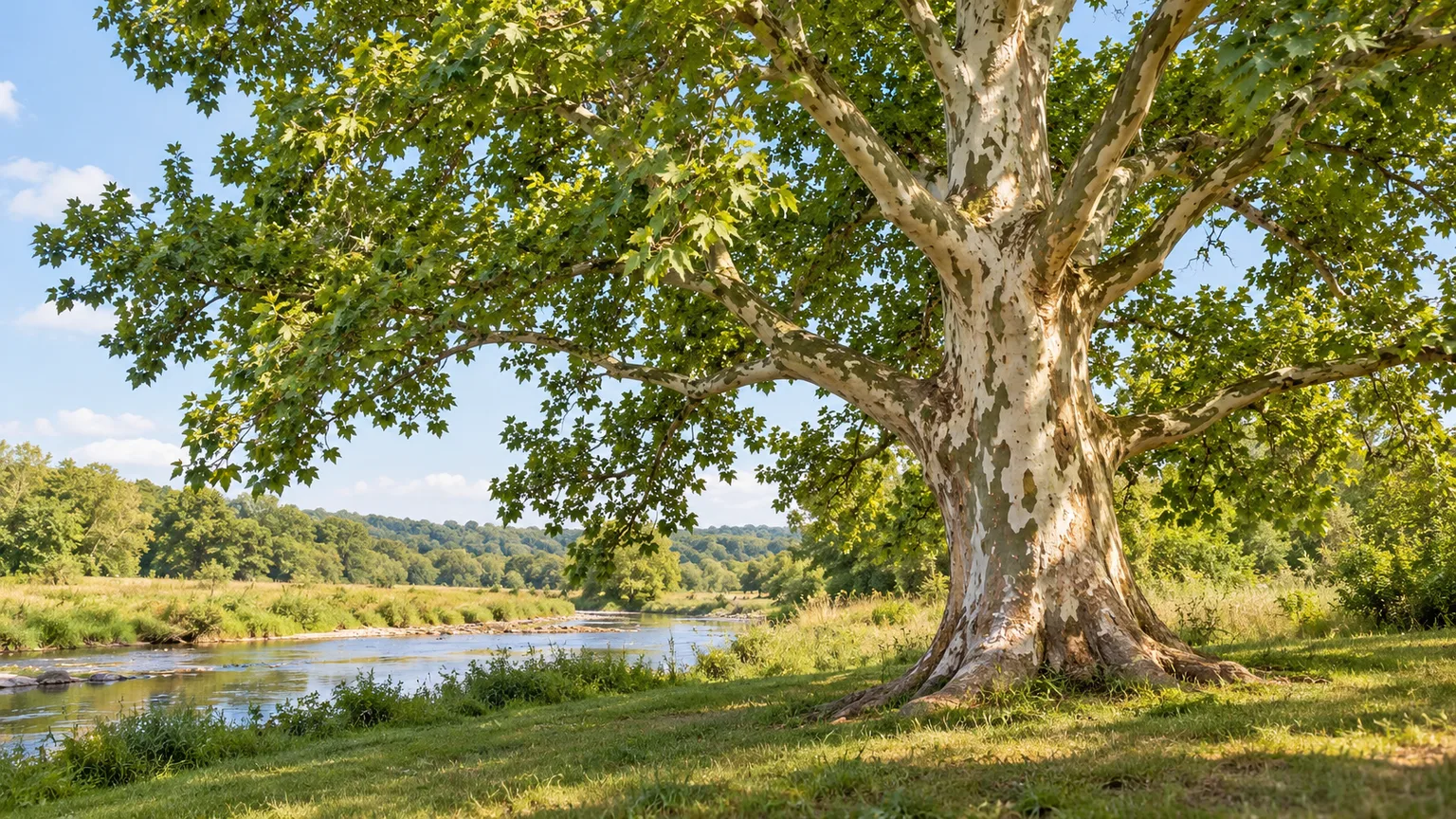
A tree can have leaves the length of your arm and still cast less shade than a smaller-leaved tree with a broad, dense crown. If your goal is a cooler sitting area, look at mature canopy width, foliage density, and whether the tree keeps its leaves through the hot season—then use leaf size as a bonus. That distinction prevents a common mistake: buying the most dramatic leaf in the nursery catalog and discovering that the tree needs a much larger or wetter site than the yard can offer.
The ten trees below range from woodland-sized pawpaws to huge sycamores. Several are native to specific parts of North America; others fit only warm or urban sites. Use the mature dimensions as a planning range, not a guarantee: cultivar, climate, soil, and pruning can change a tree’s eventual shape.
How to Read This List: Leaf Size Is Not Canopy Shade
“Big leaf” can mean a broad simple leaf, a long blade, or a compound leaf made of many leaflets. A bigleaf magnolia has a single blade that can reach about 3 feet long, while a bigleaf maple’s usual leaves are around 12 inches across, with exceptional leaves much wider. Those are striking measurements, but shade over a patio comes from how much of the sky the mature crown covers—not from the largest individual leaf on one branch. The U.S. Forest Service notes that bigleaf maple is an excellent shade tree, while North Carolina State Extension describes the bigleaf magnolia as a 30- to 40-foot tree with very large foliage (U.S. Forest Service: Bigleaf Maple; NC State Extension: Bigleaf Magnolia).
For a reliable shade spot, estimate the crown’s mature spread and place the trunk so that the eventual canopy—not just the current nursery pot—covers the area you want shaded. Deciduous trees provide strong summer shade but let more winter sun through after leaf drop. Southern magnolia stays evergreen in much of its range, so it gives year-round screening and deeper winter shade, a trade-off if you want passive winter warmth.
Quick Comparison: Large Leaves, Climate, and Mature Spread
| Tree | Typical leaf size | Approximate mature size | Best fit | Main trade-off |
|---|---|---|---|---|
| Bigleaf maple | About 12 in. across; larger leaves occur | About 50 ft. tall; broad crown | Moist Pacific Coast sites | Not a universal U.S. tree; needs room |
| Bigleaf magnolia | Up to 36 × 12 in. | 30–40 ft. tall and wide | Sheltered, moist Southeast gardens | Wind can shred foliage; slow to bloom |
| Umbrella magnolia | 10–24 in. long | Often 15–30 ft. tall | Woodland edge and partial shade | Irregular form; large leaves drop together |
| American sycamore | Up to about 9 in. wide | 75–100 ft. tall and wide | Large, moist open sites | Oversized, messy, and root-spreading |
| London planetree | About 8–10 in. wide | 70–100 ft. tall; 65–80 ft. spread | Spacious urban sites | Bark, fruit, and leaves create litter |
| Northern catalpa | About 6–12 in. long | Roughly 50–80 ft. tall | Large yards and pollinator gardens | Pods, litter, and brittle wood |
| Bur oak | About 4–10 in. long | 70–80 ft. or more; equally broad | Large sunny properties | Slow to fill out; acorns and leaves |
| American basswood | Up to about 10 in. long | 60–80 ft. tall; broad crown | Eastern and central regions | Too large for tight lots |
| Pawpaw | About 6–12 in. long | About 15–30 ft. tall and wide | Woodland edge or edible garden | Modest shade; fruit needs a pollination partner |
| Southern magnolia | Commonly about 5–10 in. long | Often 60–80 ft. tall | Warm southern yards | Evergreen litter and substantial footprint |
Dimensions come from mature species profiles, including NC State Extension’s bigleaf magnolia profile, University of Florida IFAS’s sycamore profile, Virginia Cooperative Extension’s London planetree profile, and the University of Minnesota’s bur oak profile. Treat them as a first screen: check the variety’s label and your local extension’s recommendations before planting. A tree listed as hardy in your zone may still struggle with your summer heat, compacted soil, wind exposure, or winter road salt.
10 Trees With Big Leaves for Different Yards
Bigleaf Maple
Bigleaf maple (Acer macrophyllum) is a strong shade choice if you garden along the Pacific Coast, from southern British Columbia through the western United States. Typical leaves reach about a foot across; unusually large leaves can approach 2 feet. An open-grown tree forms a rounded, spreading crown, so it offers the combination many homeowners want: a recognizable oversized leaf and real summer cover. The Forest Service reports that mature trees are commonly about 50 feet tall, with large individuals reaching much higher (U.S. Forest Service: Bigleaf Maple).
Do not assume it will behave the same in an inland or eastern yard. Its natural range follows the Pacific side of the continent, where moisture and climate differ from hot, dry interiors. Give it room to spread, avoid a narrow planting strip, and think of it as a regional native rather than a generic maple for every state.
Bigleaf Magnolia
Bigleaf magnolia (Magnolia macrophylla) wins on leaf scale: its simple, oblong blades can reach 3 feet long and about a foot wide. The tree typically matures around 30 to 40 feet tall and wide, a more approachable footprint than a sycamore, and produces large fragrant white flowers. It is native to the southeastern United States, especially moist woodland and ravine habitats; North Carolina State Extension recommends rich, moist but well-drained soil and a site protected from strong wind (NC State Extension: Bigleaf Magnolia).
That wind guidance matters. The enormous leaves can tear in exposed positions, so the tree may look ragged after a storm even when it is healthy. Choose a sheltered lawn or woodland edge with room for a broad crown, not a windy corner or waterlogged hollow. It is a foliage-first specimen; blooms may take years to appear, so do not buy it expecting an immediate flower show.
Umbrella Magnolia
Umbrella magnolia (Magnolia tripetala) is a smaller eastern North American native with leaves commonly 10 to 24 inches long. The leaves gather near branch tips, creating a layered, umbrella-like outline; the tree is often 15 to 30 feet tall, sometimes taller. That makes it a useful choice for a woodland edge or a generous small garden where a sycamore would overwhelm the space. NC State Extension describes it as a native tree with leaves up to 24 inches long and a preference for moist, well-drained conditions (NC State Extension: Umbrella Magnolia).
It provides localized, dappled shade rather than the broad, uniform canopy of a mature oak. The form can be irregular, and large leaves fall conspicuously in autumn. Plant it where its unusual foliage can be seen and where periodic leaf cleanup is acceptable; avoid deep shade, which can slow growth and reduce the tree’s display.
American Sycamore
American sycamore (Platanus occidentalis) is a true large-yard shade tree: it can reach 75 to 100 feet tall and develop a crown just as wide. Its lobed leaves can be about 9 inches across, but the bigger draw is the enormous canopy and fast growth on a suitable site. University of Florida IFAS describes it as native to the eastern half of the United States and best suited to low-lying, moist areas or as a specimen where there is ample room (UF/IFAS: Sycamore).
The same scale that makes it effective rules it out for many suburban lots. Sycamore sheds leaves, twigs, seed balls, and exfoliating bark; roots can compete with turf and hardscape, and old trees may develop structural problems. It belongs in a large lawn, park-like property, or spacious streamside setting—not beside a foundation, small patio, septic field, or overhead line. If the available planting space is only a few yards across, pick a smaller tree instead.
London Planetree
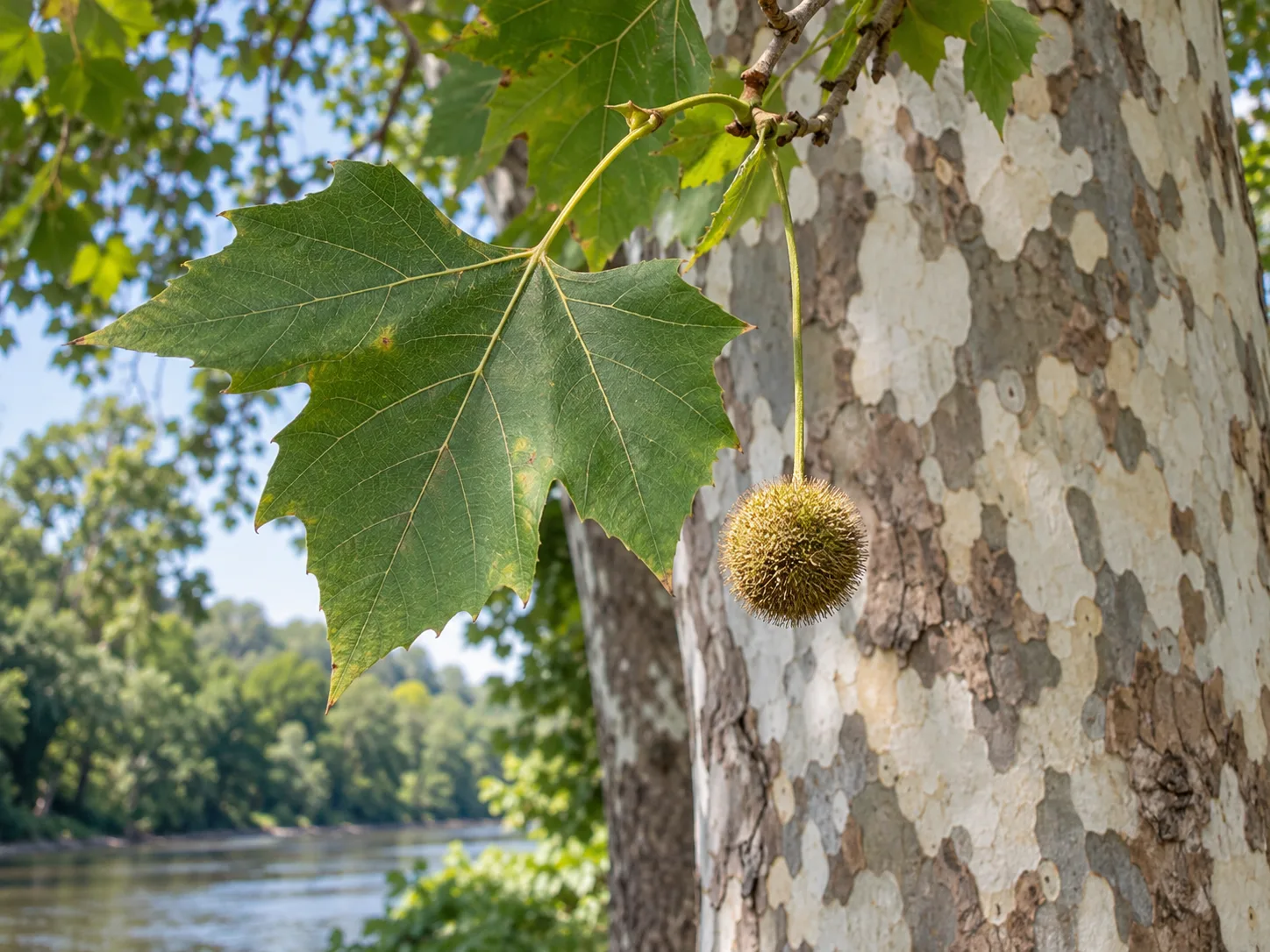
London planetree (Platanus × acerifolia, also sold as P. × hispanica) combines maple-like leaves with mottled, peeling bark. The leaves can approach 8 to 10 inches across, and a mature tree may grow 70 to 100 feet tall with a 65- to 80-foot spread. Virginia Cooperative Extension lists it as tolerant of a broad range of conditions, including air pollution, but explicitly advises giving it ample spread and keeping it clear of power lines (Virginia Cooperative Extension: London Planetree).
This is a candidate for a large, paved or urban site where many trees struggle—not a compact-yard shortcut. The Royal Horticultural Society also cautions about the vigorous root system near buildings, while noting that it can grow in several soil types (RHS: London Plane). Its leaves, seed clusters, and loose bark need cleanup. In areas with plane-tree disease pressure, ask a local arborist or extension office whether a disease-resistant cultivar is available and suitable.
Northern Catalpa
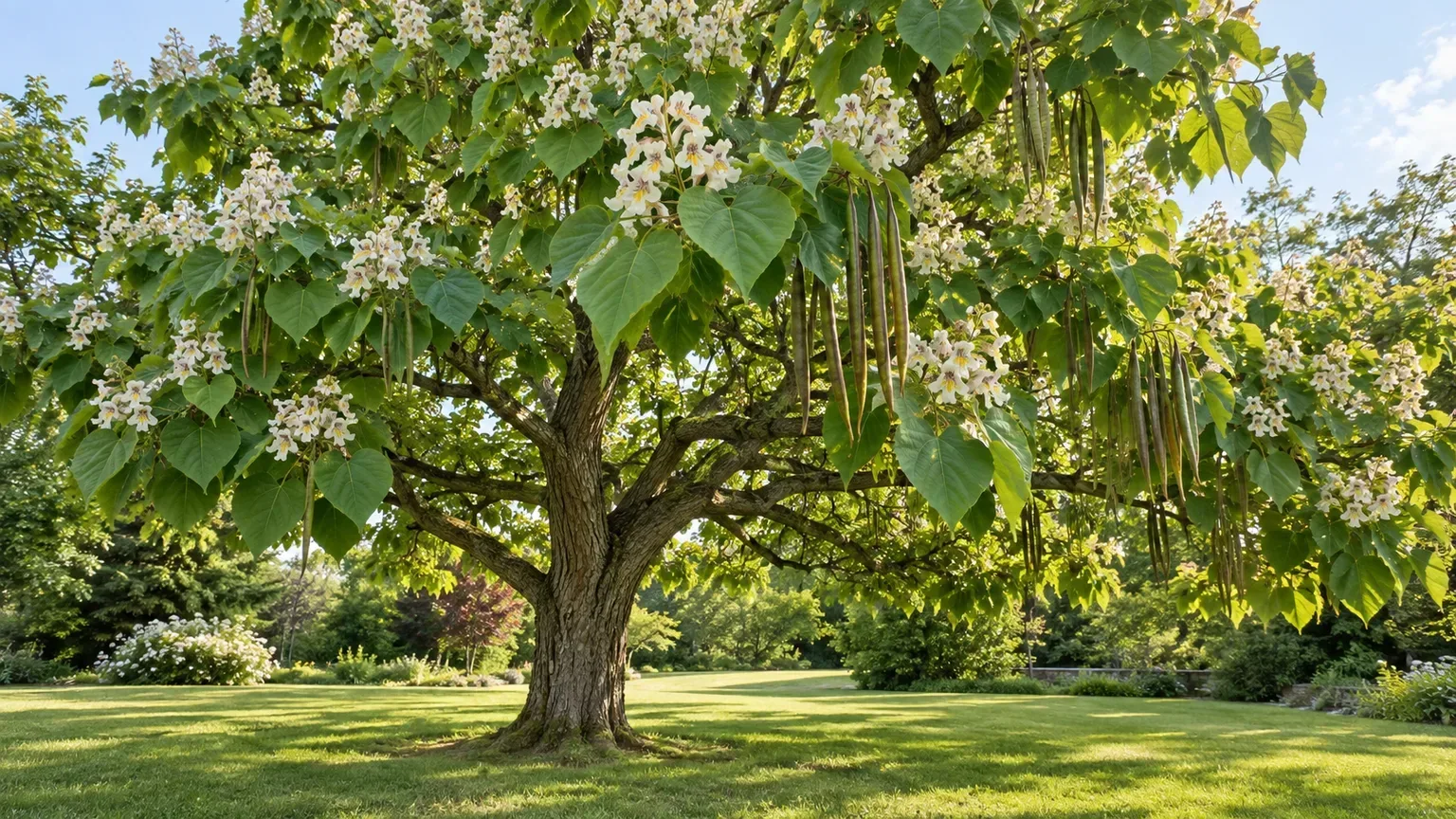
Northern catalpa (Catalpa speciosa) carries broad, heart-shaped leaves about 6 to 12 inches long and showy white flowers marked with purple and yellow. The tree grows quickly into a rounded crown, commonly reaching roughly 50 to 80 feet tall. It tolerates a range of soils and can handle dry conditions after establishment, which is useful where a thirsty magnolia would struggle. Iowa State University Extension describes the large leaves and long, narrow pods that persist into winter.
Those pods are the reason catalpa is not a tidy choice. Add fallen flowers, big leaves, and sometimes brittle branches, and you have a tree that rewards a gardener willing to rake and prune responsibly. Catalpa hornworms may also strip sections of foliage; healthy established trees can usually tolerate some feeding, so avoid spraying automatically. Choose it for a spacious yard where the flowers, shade, and wildlife value outweigh seasonal debris.
Bur Oak
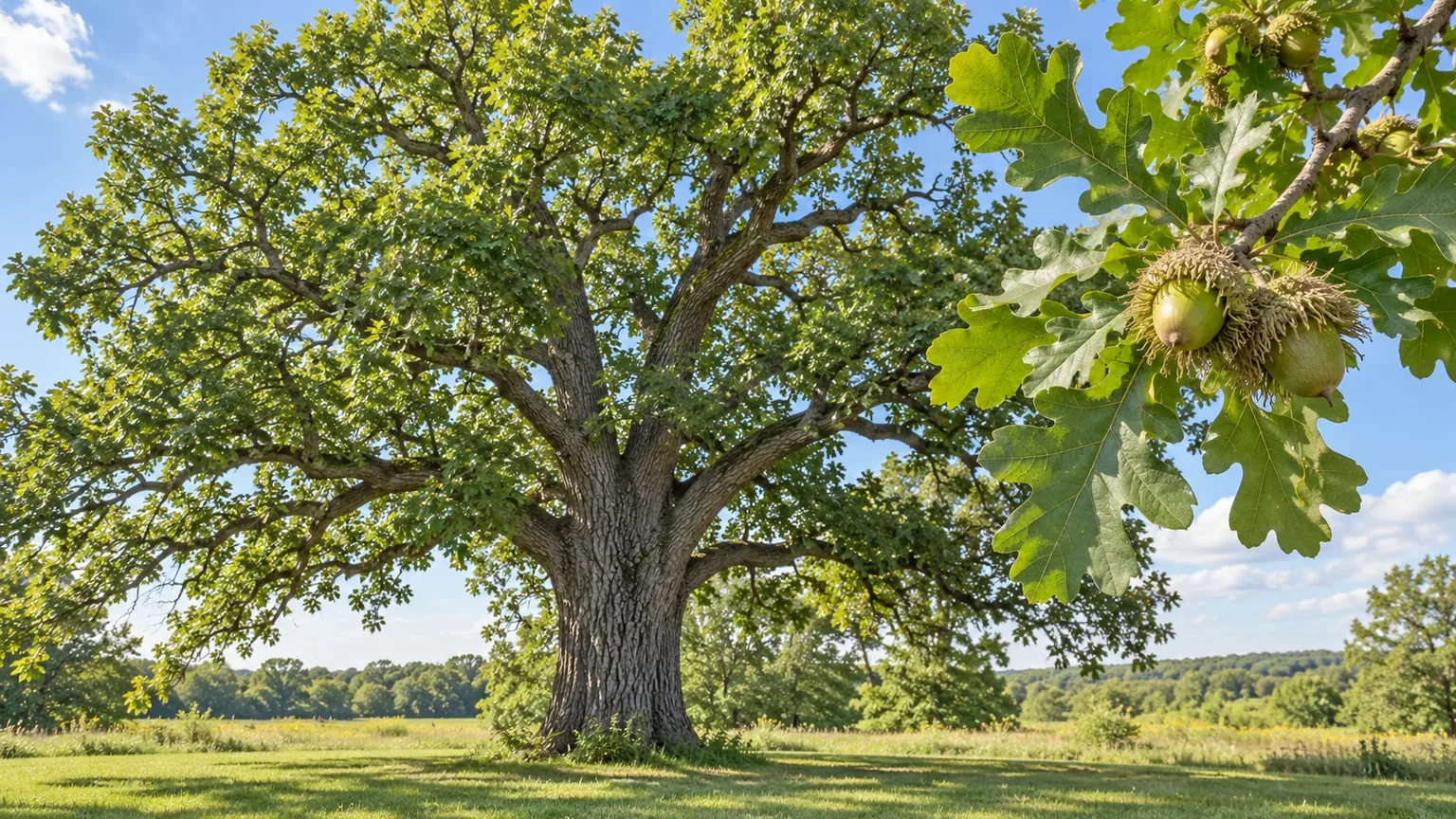
Bur oak (Quercus macrocarpa) has large, deeply lobed leaves—often 4 to 10 inches long—and grows into a broad, durable canopy. It is native across central and eastern North America, adapts to many conditions, and provides long-term shade and habitat. The U.S. Department of Agriculture’s bur oak plant guide describes a typical mature height of 70 to 80 feet, with a broad rounded crown (USDA NRCS: Bur Oak Plant Guide).
This is a future-generations tree, not a quick privacy fix. Young oaks establish gradually, and the eventual canopy can exceed the dimensions of a typical house lot. Acorns and fall leaves are part of the bargain, but they also feed wildlife. Pick bur oak when you have a sunny, open site and want a long-lived native shade tree; do not plant one where its final spread must be controlled by repeated severe pruning.
American Basswood
American basswood (Tilia americana), also called American linden, pairs large heart-shaped leaves with a substantial crown and fragrant early-summer flowers. Leaves can reach about 10 inches long, and mature trees often grow 60 to 80 feet tall. The flowers feed bees and other pollinators, which is why the tree is sometimes called a bee tree. NC State Extension describes it as a large shade tree that tolerates clay and some dry, rocky soils once established (NC State Extension: American Linden).
Basswood is a better fit for a large lawn, woodland edge, or roomy residential site than for a narrow front strip. It can provide meaningful shade without the tropical look of a magnolia, and it supports pollinators, but the canopy and root zone still need space. Before choosing it, check that the mature height will clear wires and that the spread will not force branches against a roof or neighboring property.
Pawpaw
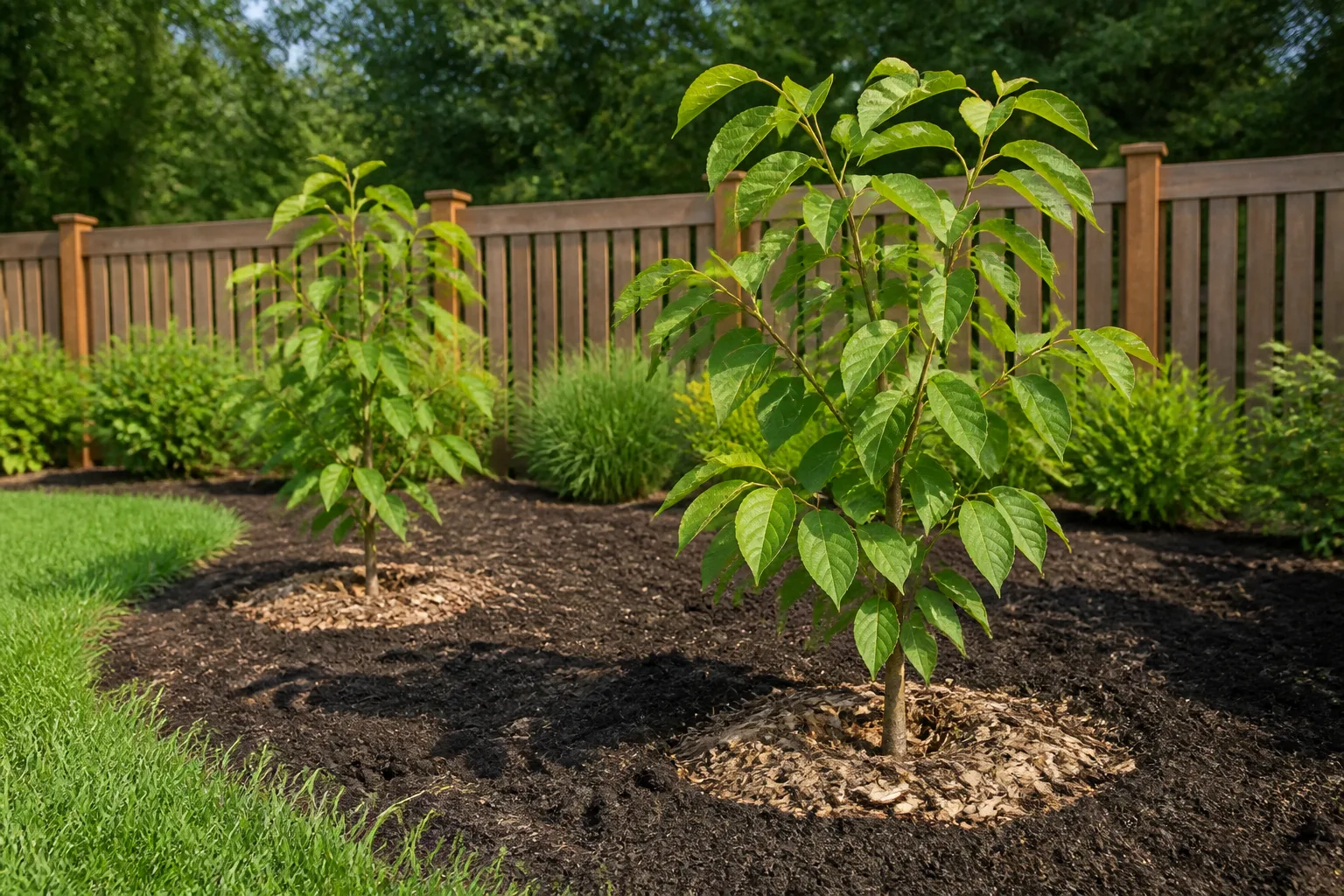
Pawpaw (Asimina triloba) is the small-space option on this list. Its tropical-looking leaves are typically 6 to 12 inches long, yet the tree usually stays around 15 to 30 feet tall and wide. As an understory species native to eastern North America, it tolerates dappled shade; it fruits more reliably with more sun and moist, well-drained soil. NC State Extension notes that pawpaw needs a genetically different pollinizer for fruit, so gardeners planting for harvest should choose two compatible trees rather than one (NC State Extension: Pawpaw).
Do not expect a pawpaw to shade a whole patio. It is a smaller canopy tree for a woodland garden, edible landscape, or the edge of a larger shade planting. The leaves turn yellow in fall, and ripe fruit can attract wildlife; harvest promptly if you want to eat it. Young trees can need protection while establishing, especially in exposed full sun.
Southern Magnolia
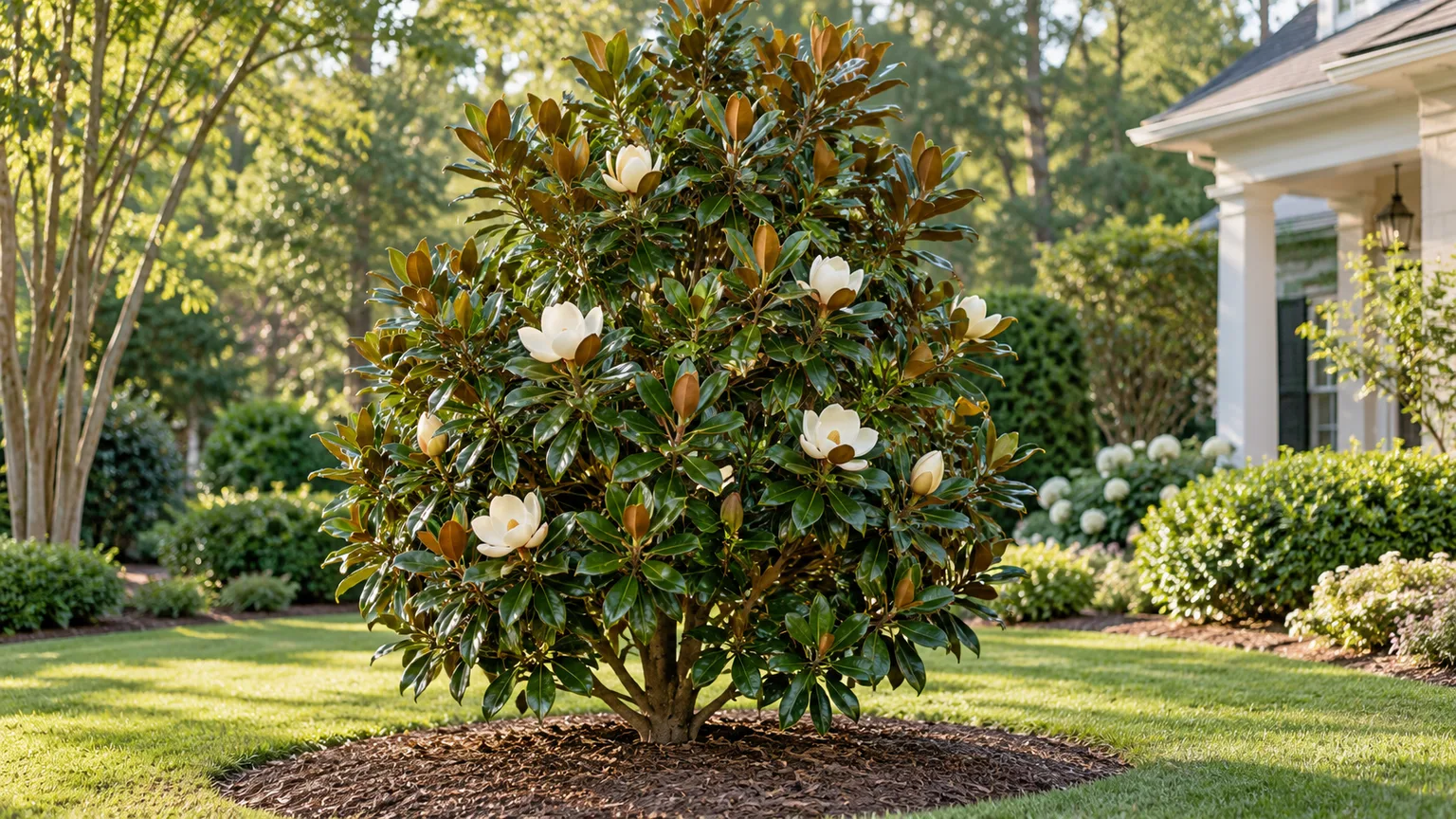
Southern magnolia (Magnolia grandiflora) is the evergreen choice for warm regions. Its thick, glossy leaves are smaller than those of bigleaf magnolia—commonly around 5 to 10 inches long—but they stay on the tree year-round in much of the South. Mature trees can reach 60 to 80 feet, and their dense foliage creates dependable screening and shade. NC State Extension recommends it for large southern yards and warns that the species is too large for many suburban lots; fallen leaves arrive in both spring and fall (NC State Extension: Southern Magnolia).
Allow space for low branches and a broad root zone, and remember that the shade remains in winter. Grass and sun-loving beds may struggle beneath a mature canopy, so plan for mulch or shade-adapted planting rather than trying to maintain a thirsty lawn against the tree’s roots. If you like the look but lack the room, select a compact cultivar only after confirming its real mature dimensions in your climate.
Why Empress Trees and Large Figs Need Caution
Royal paulownia or empress tree (Paulownia tomentosa) makes enormous leaves and grows rapidly, but it should not be treated as an easy shade solution. It can produce many seedlings, its wood is weak, and it is considered invasive in some regions. The Missouri Botanical Garden lists princess tree among invasive plants for the St. Louis region; status varies by location, so check your state or county invasive-plant list before buying. Fast growth is not a benefit if the tree spreads into natural areas or needs repeated removal (Missouri Botanical Garden: Invasive Plants).
Fiddle-leaf fig (Ficus lyrata) is a tropical tree in its native climate but is a houseplant or summer patio plant across most of temperate North America. North Carolina State Extension describes it as a tropical plant commonly kept in containers in temperate regions; it is not a dependable cold-winter yard tree (NC State Extension: Fiddle-Leaf Fig). Australian banyan (Ficus macrophylla) is even less practical in most residential landscapes: its native-range specimens grow into enormous trees with widely spreading branches and aerial roots that can form secondary trunks (Royal Horticultural Society: Australian Banyan). Reserve it for frost-free climates and exceptionally large sites where its expanding structure cannot conflict with pavement or buildings. The general rule is simple: a tree that survives in a warm microclimate is not automatically a good fit for the average yard.
Choose by Yard Size, Climate, and Shade Goal
Start with the space the tree will occupy at maturity, not the leaf you liked in a photo. For a small or medium yard, pawpaw or umbrella magnolia may offer large leaves without the 70- to 100-foot scale of a sycamore or London planetree. Bigleaf magnolia sits between those extremes, but only where its regional climate, soil moisture, and wind protection fit. For a large property in the central or eastern United States, bur oak or American basswood can become enduring shade trees; in the Pacific Northwest, bigleaf maple is the regional match. The Old Farmer’s Almanac likewise recommends planning around a tree’s mature dimensions before buying or planting (The Old Farmer’s Almanac: Planting Trees to Landscape Your Yard).
Then decide what “shade” means for your use. A dense evergreen southern magnolia screens views and blocks winter light; a deciduous oak gives summer shade and allows more winter sun. A pawpaw creates a smaller, more intimate understory zone. Catalpa and sycamore offer bold summer cover but also more cleanup. The practical answer to “Which tree gives the most shade?” is usually the suitable species with the widest healthy crown—not the species with the record-setting leaf.
Check your site’s drainage and exposure. A low, moist area can suit sycamore, while a windy ridge is a poor place for bigleaf magnolia’s vulnerable leaves. Consider road salt, compacted soil, heat, and drought if the tree will grow near pavement. Big trees can also change the garden below them: dense shade and root competition make it harder to keep turf or moisture-demanding plants directly under the canopy. Fine Gardening’s planting-under-trees guidance recommends working around existing roots and adapting understory choices to drier, shaded conditions rather than assuming every bed will thrive (Fine Gardening: Planting Under a Tree).
Plant for the Tree’s Mature Form
Before purchase, write down the tree’s mature height and spread, then sketch a circle on your yard plan using the spread as the diameter. Check that circle against the house, fence, driveway, septic area, neighboring trees, and both overhead and underground utilities. Exact safe distances vary by tree and utility; in the United States, call 811 before digging and ask the local utility or arborist about overhead-line clearance. University of Minnesota Extension likewise recommends planning for mature size and locating utilities before planting (UMN Extension: Planting Trees and Shrubs).
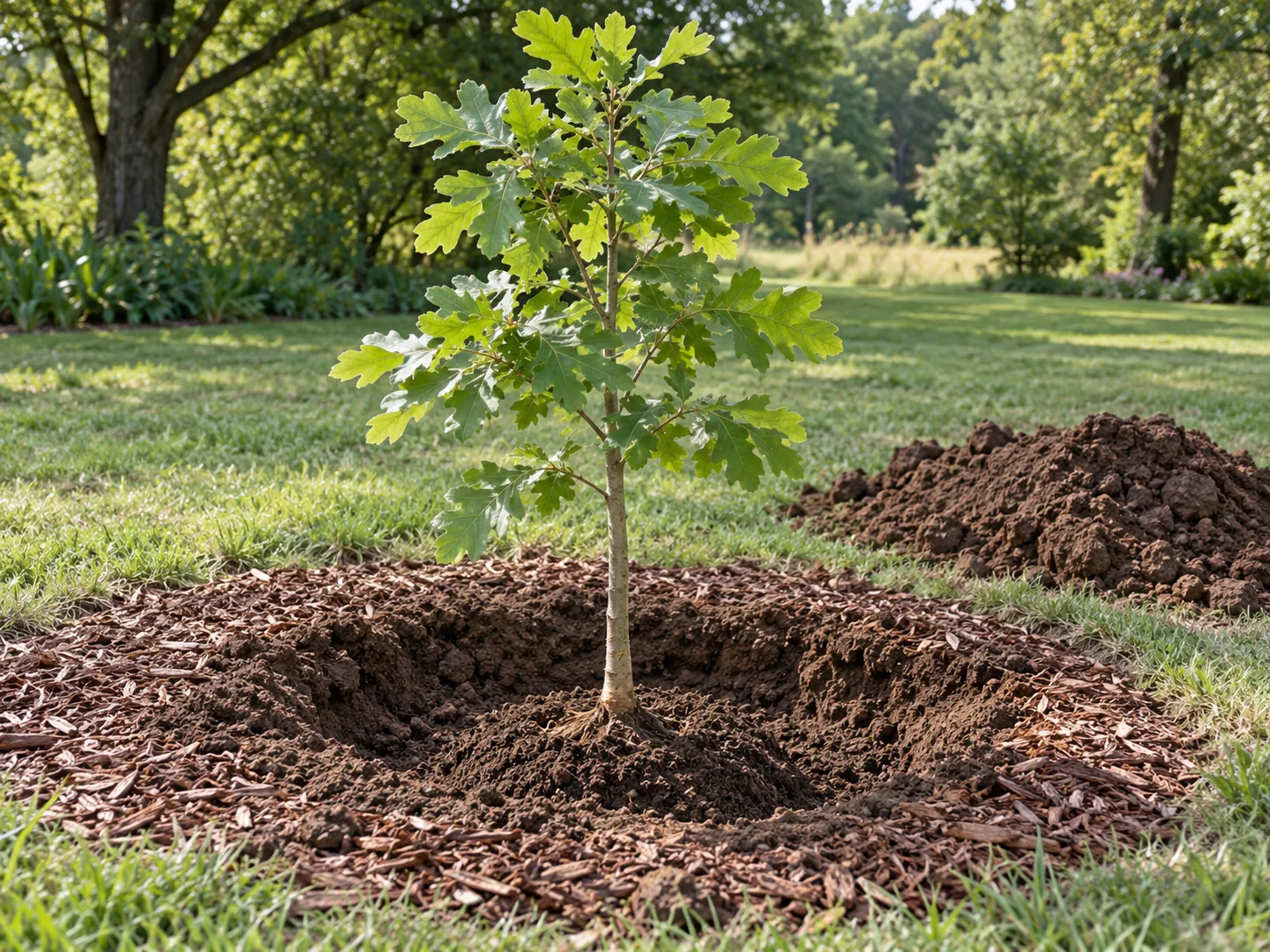
Buy a healthy, locally appropriate tree from a reputable nursery, and confirm whether a named cultivar changes the species’ typical dimensions. Plant when local conditions favor root establishment, following your extension service’s timing for your region. Dig a broad hole no deeper than the root ball, expose the root flare, and keep it at or slightly above grade; do not bury the trunk to make a sapling look stable. Water the root zone deeply during establishment, replenish mulch as it settles, and keep mulch away from the trunk. Avoid piling extra soil or building a raised bed over established roots; Fine Gardening notes that substantial grade changes can reduce oxygen around roots and injure a mature tree (Fine Gardening: Planting Under a Tree).
Do not solve a spacing mistake by topping the tree later. Topping creates large wounds and weak regrowth while leaving the root system and species’ mature needs unchanged. If a tree already conflicts with a structure, have a qualified arborist assess pruning options. The least expensive intervention is usually choosing the right species and planting location before the root ball goes in the ground.
Conclusion
For the largest individual leaves, bigleaf magnolia and umbrella magnolia are standouts. For broad, high-impact summer shade, consider a regionally appropriate bigleaf maple, sycamore, London planetree, bur oak, basswood, catalpa, or southern magnolia—but only if the mature canopy fits. Pawpaw is the smaller-scale choice, while empress tree and tropical figs need strong regional caveats. Match the tree to climate, soil, and long-term space first; its spectacular leaves will be far more rewarding when the tree can grow without constant correction.



