17 Best Climbing Roses for Walls and Arbors
Compare 17 climbing roses by mature size, repeat flowering, hardiness, fragrance, and pruning needs so you can choose a rose that fits your support and climate.
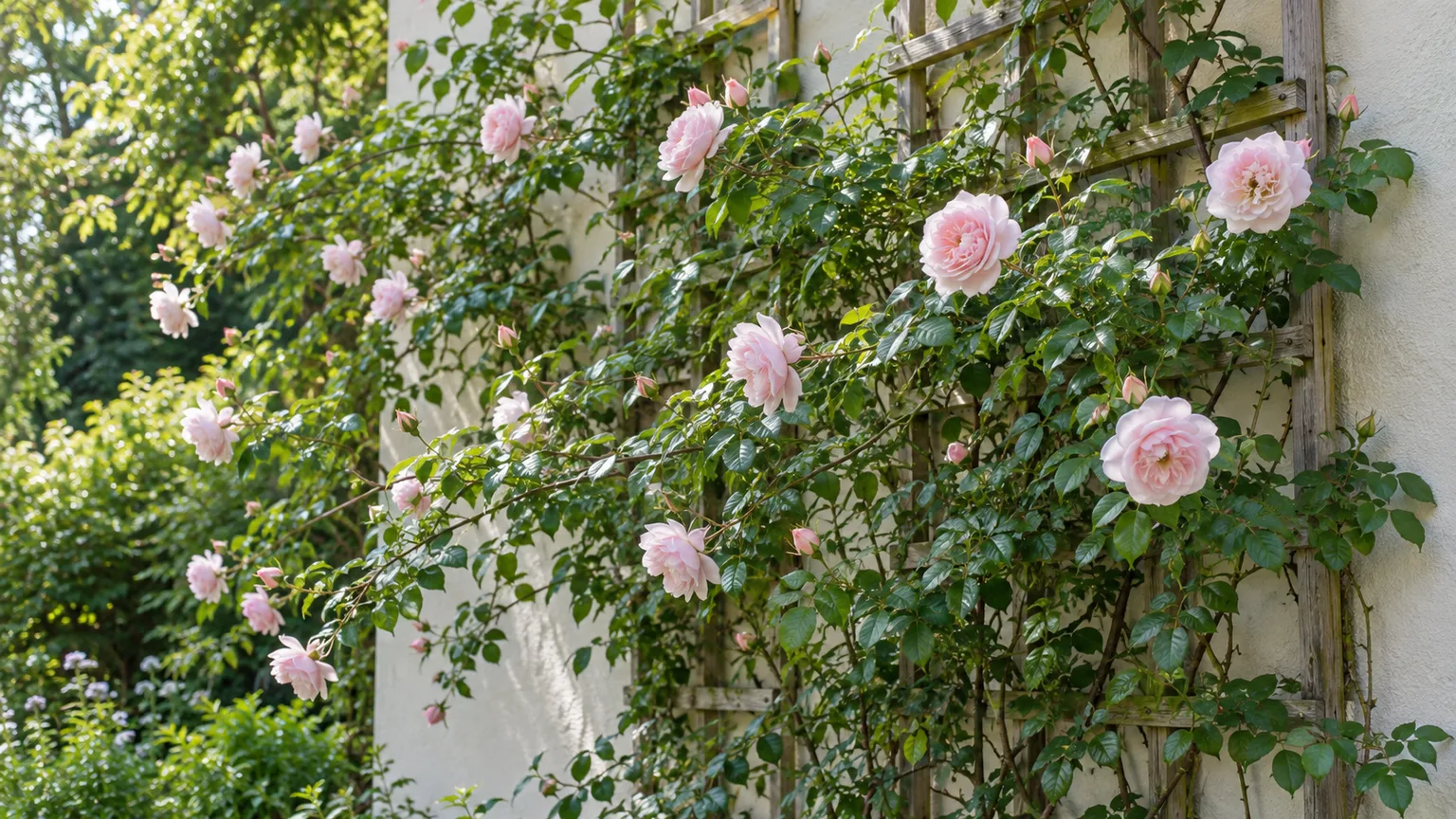
A climbing rose is a long-term planting decision: the canes can cover a fence, soften a wall, or turn an arbor into a flowering entrance, but the wrong cultivar can outgrow its support or bloom only once when you expected color all summer. Start with the space and the bloom habit, then choose a named rose whose mature size and hardiness suit your garden.
These 17 choices include true climbers, climbing sports, and a few roses sold in both shrub and climbing forms. That distinction matters. A plant called “Iceberg” or “Lady of Shalott” may be a compact shrub unless the label specifies its climbing form; the base name alone is not enough to estimate height or choose pruning cuts.
Quick picks by garden job
For a dependable, soft-pink climber with a documented repeat bloom, start with New Dawn. NC State Extension’s New Dawn profile describes it as a 10- to 15-foot rose that blooms heavily in June and repeats through fall; its 6- to 8-foot spread needs a broad trellis or fence, not a narrow decorative panel. For a striped flower with a similar vertical role, Fourth of July is a repeat-blooming climber listed by the Missouri Botanical Garden at 10 to 14 feet tall and 3 to 6 feet wide.
Choose Zephirine Drouhin for fragrant pink flowers and canes with fewer prickles than many roses, but do not treat it as thorn-free or disease-proof. Tangerine Skies offers a more compact, warm-colored option for an arch or pillar. If you want an old-fashioned blush flower, compare the climbing forms of Cécile Brunner, Eden, and Souvenir de la Malmaison—and check whether your local supplier describes the one you want as repeat-flowering or once-flowering before buying.
Identify the plant form before you buy
Roses do not climb like clematis or ivy. They lack tendrils and adhesive roots, so long canes must be attached to a support. A true climber usually has stronger, longer canes that can be trained against a wall, over an arch, or around a pillar. A rambling rose tends to make more flexible, vigorous shoots and often produces one concentrated flush, although repeat-flowering ramblers exist. The Royal Horticultural Society’s climbing-rose pruning guide explains that flowering time can help distinguish climbers and ramblers, but habit and cultivar label are more reliable than a simple rule.
“Pillar rose” is a way to train a rose, not a separate guarantee of compact growth. A flexible climber can be spiraled around a post or tied to a narrow vertical frame; a huge rambler cannot be made small simply by giving it a thin support. Before ordering, find the exact cultivar name, the word climbing if it has a separate climbing sport, mature height and width, hardiness listing, and whether it blooms once or repeatedly.
A useful caution: the standard Iceberg rose is not the same thing as Climbing Iceberg. The Missouri Botanical Garden’s Iceberg record lists standard ‘KORbin’ as a 3- to 5-foot floribunda shrub, not a 15-foot climber. Buy the named climbing form for vertical coverage. David Austin lists ordinary ‘Lady of Shalott’ as an English shrub rose and sells a separate English climbing form; the shrub’s dimensions should not be used to size the climbing version.
Compare 17 climbing roses by size, bloom, and hardiness
The dimensions below are typical mature estimates for the named climbing form, not a promise that every rose will reach that size. Nurseries sometimes disagree by several feet or one hardiness zone, especially for old cultivars and climbing sports. The verified profiles linked above support the New Dawn, Fourth of July, and standard Iceberg details; other size and zone ranges are catalog-level planning estimates and should be checked against the exact grower’s label. USDA zones estimate winter cold tolerance; they do not predict summer heat, humidity, disease pressure, or how much cane survives an exposed winter. Confirm the exact plant label and local performance before you commit to a permanent structure.
| Rose and best use | Approximate mature size | Flowering | Pruning class and common U.S. hardiness listing |
|---|---|---|---|
| Altissimo — single red flowers for a small wall or pillar | 7–20 ft tall; 5–8 ft wide | Repeat, with waves of bloom | Repeat climber: preserve main canes; late-winter cleanup. Zones 5–10 |
| American Beauty, climbing form — deep pink, old-fashioned flowers | 12–15 ft; 6–8 ft wide | Repeat, usually strongest in the main flush | Confirm the climbing sport on the label; prune as a repeat climber. Zones 5b–9b |
| Cécile Brunner, climbing form — clusters of small blush-pink flowers | Up to about 20 ft; around 6 ft wide | Often a strong early-summer flush; rebloom can vary by form and climate | If it flowers once, prune after bloom; do not hard-prune in spring. Common listings span zones 6–10 |
| Dublin Bay — rich red flowers on a manageable modern climber | 8–12 ft; up to 5 ft wide | Repeat | Repeat climber; thin and shape in late winter. Zones 6–9 |
| Climbing Iceberg — white flowers for a large support | About 10–15 ft; 4–6 ft wide | Repeat | Buy the climbing sport, not standard shrub Iceberg; late-winter framework prune. Zone listings commonly begin around 5 |
| Fourth of July — red-and-white striped flowers | 10–14 ft; 3–6 ft wide | Repeat | Repeat climber; late-winter to early-spring cleanup. Zones 5–9 |
| Climbing Peace — large cream, yellow, and pink blooms | About 10–15 ft; 5–8 ft wide | Repeat | Climbing sport; retain older framework and prune laterals in late winter. Common listings around zones 6–9 |
| Royal Sunset — apricot blooms and fruity fragrance | About 8–15 ft; 4–6 ft wide | Repeat | Repeat climber; prune lightly in late winter. Zones 6–10 |
| Souvenir de la Malmaison, climbing form — pale, very full flowers | Roughly 10–15 ft; allow 6–8 ft of spread | Repeat, with the heaviest flush often in spring | Climbing Bourbon form; remove dead wood and shorten laterals after flowering or in late winter. Zones 5–10 are often listed |
| Westerland — copper-apricot flowers for a broad pillar | About 5–12 ft; around 4 ft wide | Repeat | Large shrub or short climber; use a pillar or broad support. Structural prune in late winter. Zones 5b–9b |
| Zephirine Drouhin — highly fragrant pink flowers near a path | 10–15 ft; about 6–9 ft wide | Repeat from late spring into autumn in suitable conditions | Repeat climber; late-winter thinning. Canes are nearly thornless, not reliably thorn-free. Zones 5–9 |
| Eden (Pierre de Ronsard, ‘MEIviolin’), climbing form — cream-pink, cupped blooms | About 8–12 ft; 4–6 ft wide | Repeat in flushes; the first can be strongest | Climbing hybrid; late-winter framework prune. Zones 5–9 are commonly listed |
| Don Juan — classic dark red, fragrant flowers | 8–12 ft; 3–6 ft wide | Repeat | Repeat climber; prune dead or damaged canes in late winter, then shorten laterals. Zones 6–10 are often listed |
| Lady of Shalott, English climbing form — orange flowers for a smaller arch | Around 8–10 ft; allow several feet of width | Repeat | Order the separate climbing form; use its seller’s pruning directions. The standard shrub is listed at 5 × 4 ft and zones 4–11 |
| Tangerine Skies™ Arborose® (‘KORtangenu’) — orange flowers and a smaller footprint | Around 6–8 ft; about 3–4 ft wide | Repeat | Compact repeat climber; late-winter shaping. Common listings: zones 5–9 |
| Raspberry Cream Twirl™ — striped blooms for a close viewing spot | About 10–12 ft; around 5 ft wide | Repeat | Modern climbing rose; retain framework and prune laterals in late winter. Check the grower’s own zone label; listings commonly begin near zone 5 |
| New Dawn — soft pink flowers and a broad fence or pergola | 10–15 ft; 6–8 ft wide | Heavy early-summer bloom, then repeats into fall | Repeat climber; prune in late winter to early spring as needed. Zones 5–9 commonly listed |
The most exact profiles in this group illustrate why labels matter. NC State Extension documents New Dawn’s size, repeat bloom, and late-winter-to-early-spring pruning. The Missouri Botanical Garden gives Fourth of July a 10- to 14-foot height, 3- to 6-foot spread, zones 5–9, and repeat flowers; its standard Iceberg record describes a short shrub. Treat the other ranges as starting estimates and use the exact grower’s tag for a climbing sport.
Choose by space and flowering goal
Smaller supports and short pillars
If the support is under 8 feet tall, look first at Tangerine Skies, the climbing form of Lady of Shalott, or Westerland trained as a pillar. They still need a strong stake or frame and occasional tying; “compact” describes relative size, not a self-supporting plant. Altissimo can also be trained as a pillar, but its potential height varies widely, so prune and tie it while shoots are young rather than waiting until they have become rigid.
For a narrow wall, choose by eventual width as well as height. A rose that is 10 feet tall but 8 feet wide can overwhelm a small trellis when several main canes mature. If your space cannot accommodate those long lateral stems, a shrub rose or a shorter flowering vine will be less work than repeatedly cutting a climber back to a size it does not naturally fit.
Large walls, fences, and pergolas
For a broad structure, New Dawn, Cécile Brunner, American Beauty, and Climbing Peace have the reach to cover more area once established. Match the support to the full cane span, not just the rose’s first-year pot size. Leave access to the back or sides if you need to tie canes, remove old wood, or inspect foliage after wet weather.
A rose may take several seasons to fill a large frame. Avoid planting several vigorous cultivars close together for instant coverage: they compete for light and become harder to prune as their canes tangle. If you want an early screen, use a temporary panel or combine the rose with a non-invasive annual climber rather than overfeeding a newly planted rose to force growth.
Choose flowers for color, scent, and season
Color and fragrance are easy to shop for; bloom timing and flower form change the day-to-day result. Fourth of July adds striped semi-double flowers and a mild sweet scent. Dublin Bay and Don Juan supply saturated reds, while Iceberg is the white choice only when you buy the climbing form. Raspberry Cream Twirl stands out for unusual stripes, but its visual novelty does not make it thornless or automatically low-maintenance.
For perfume, compare Zephirine Drouhin, Royal Sunset, Souvenir de la Malmaison, and Don Juan. Scent strength shifts with temperature, time of day, and bloom age; a fragrant rose may not perfume an entire patio at all times. Nearly thornless canes make Zephirine Drouhin easier to handle near a path, but it can still prick and its foliage may struggle in humid, crowded sites.
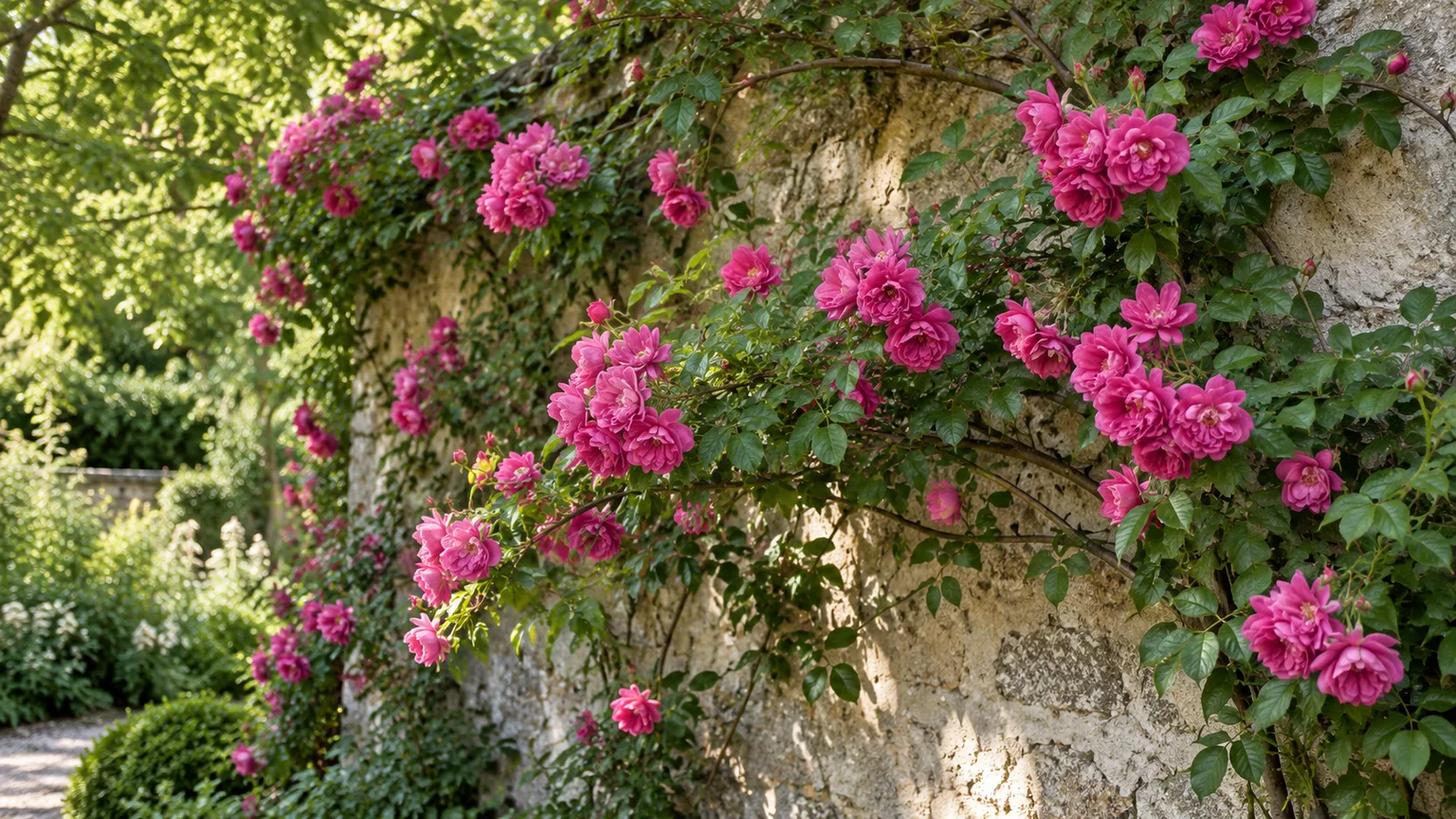
If season-long color matters most, prioritize a documented repeat-bloomer such as New Dawn or Fourth of July, then keep enough healthy foliage for the plant to make new flowering shoots. “Repeat” means additional flushes under good conditions; it does not mean every cane carries flowers nonstop. A once-blooming climber can still be a good choice if you want a dramatic early-summer display and attractive foliage afterward.
Build the support before planting
A climbing rose is heavy when mature, especially after rain, and its woody canes can become difficult to bend. Put a durable support in place before you plant so you do not damage roots later while digging in posts or anchors. The framework should be stable in wind, have crosspieces or wires that let you tie canes at several heights, and leave enough space for air to move behind the foliage.
Walls and fences
For a wall, use a trellis or horizontal wires fixed to sound masonry with suitable anchors. Do not fasten canes directly to the wall and assume the plant will grip it; roses have no adhesive pads. Keep ties loose enough for cane growth, use soft garden ties, and inspect them once or twice each growing season so they do not girdle stems.
A fence works when its posts and rails can bear the weight and you can reach both sides. If the fence is mostly solid, allow an air gap rather than pressing foliage flat against damp boards. A freestanding panel can also be easier to prune than a rose planted hard against a building.
Arbors, pergolas, and pillars
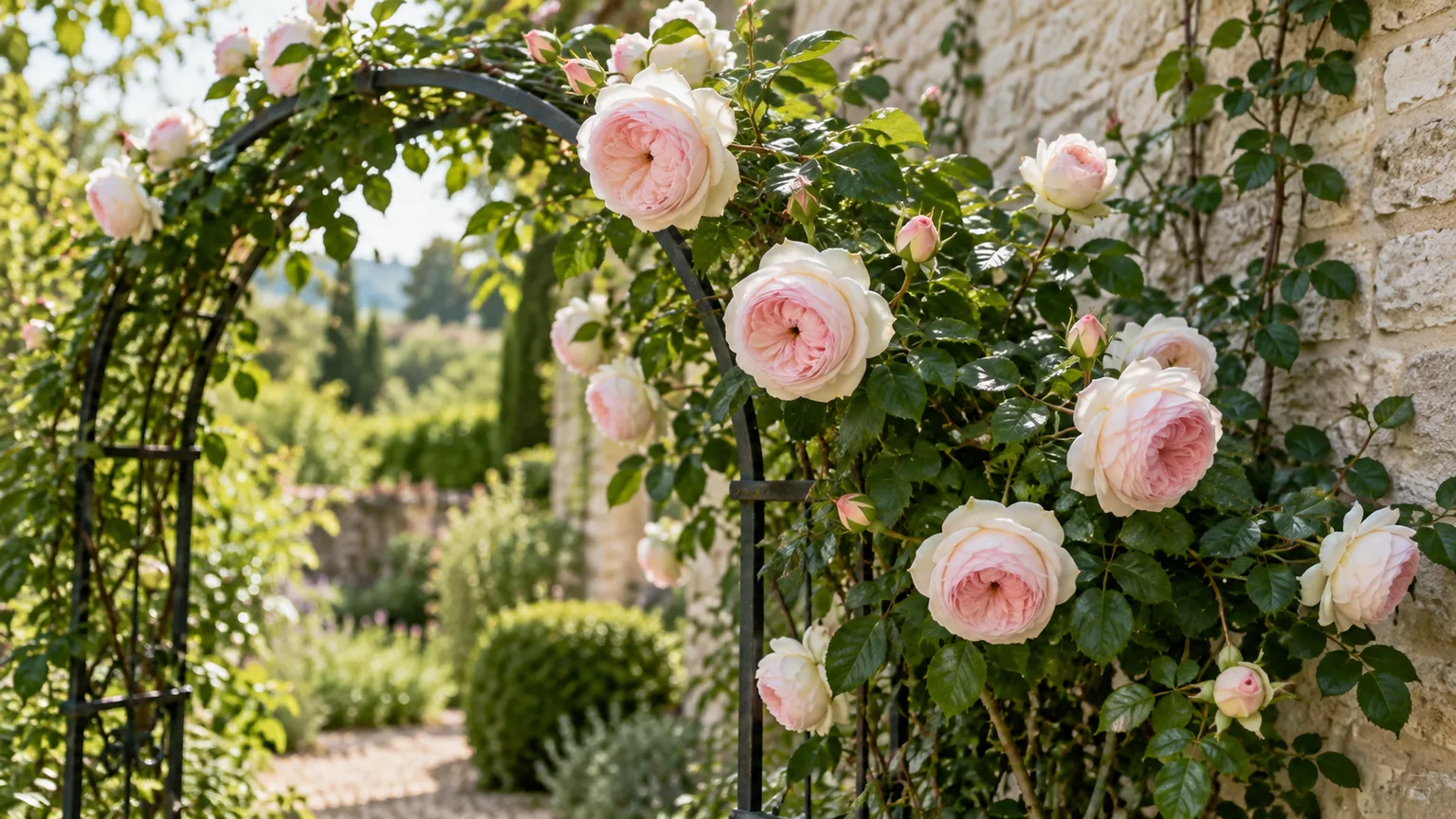
An arbor needs a strong top and firmly anchored legs. Plant on the side where you can reach the canes as they grow; a rose can cover an opening if you allow shoots to arch across the passage. For a pergola, secure the main canes along the beams and direct side shoots outward, away from seating and walkways.
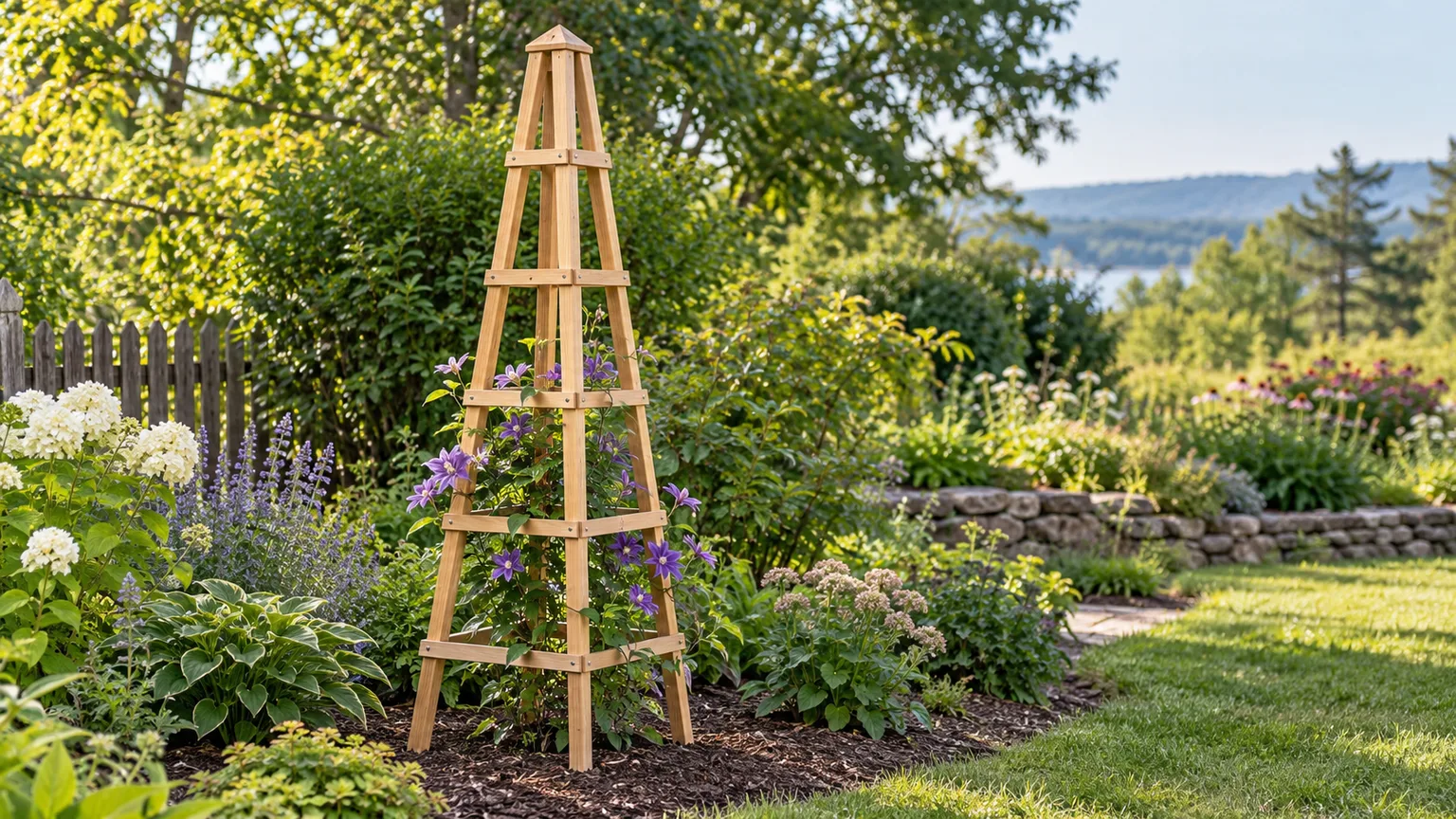
Pillars and obelisks suit flexible, moderate-size climbers. Tie the young canes around the support in a loose spiral instead of forcing one stiff cane into a tight turn. A massive rambler is a poor match for a small obelisk even if its nursery photo shows a single post.
Train canes to spread flowers along the frame
Most climbing roses produce more flowering laterals when their main canes are trained diagonally or close to horizontal instead of straight up. David Austin Roses’ climbing-rose training guide describes tying long stems outward along a support so side shoots develop along more of the cane; an upright cane often puts most of its flowers near the top. Use that principle without forcing a rigid cane flat: fan the stems, keep broad curves, and secure them as they lengthen.
Start with the strongest healthy canes and tie them loosely to the support at regular intervals. Keep young shoots separate when possible so they do not rub together, and guide new canes into gaps before they harden. If a cane resists a bend, use a wider arc or train it vertically rather than snapping it for a more symmetrical pattern.
During the first one or two seasons, let the rose build roots and framework. Remove broken or dead wood, but avoid a hard annual cut that removes the plant’s future flowering structure. Once the frame covers its allotted space, renew it gradually by removing an old or unproductive cane at its base and tying in a younger replacement.
Prune according to bloom habit
There is no single pruning calendar for every rose sold as a climber. The RHS has separate guidance for climbing roses and ramblers because flowering habit and the age of flowering wood affect timing. Confirm the cultivar’s bloom pattern before making a structural cut, especially with older roses and climbing sports. Its general guidance for repeat-flowering climbing roses is to prune in the dormant season, while once-flowering roses should be pruned after their flowers fade. For a practical sequence of cuts, Epic Gardening’s climbing-rose pruning guide also emphasizes retaining the main framework and shortening side shoots.
Repeat-flowering climbers
For a repeat-flowering climber, wait until the main winter cold has passed and buds begin to swell, then remove dead, diseased, damaged, and crossing wood. Keep the main framework canes that cover the support. Shorten side shoots that flowered the previous year, leaving several healthy buds, and tie in selected young canes to replace old ones. Do not cut every long cane to the same height as though it were a hybrid tea bush.
After each flush, remove spent flowers if you want a tidier plant and additional bloom, but stop deadheading late in the season in cold climates so new growth can harden and hips can form. A newly planted climber may bloom lightly for a year or two while it establishes; that is not a signal to prune harder or add more fertilizer. NC State’s New Dawn profile recommends pruning as needed in late winter to early spring, removing crossed, diseased, or dead canes to improve airflow.
Once-flowering climbers and ramblers
If the rose makes one large flush on last year’s growth, prune immediately after that flowering period, not in early spring. First remove dead and weak canes, then cut back the side shoots that have flowered and tie in a few young replacement canes. A spring haircut removes the wood holding that season’s buds, so it can cost nearly a full year of flowers.
Ramblers often make longer, more flexible canes than climbers and may need more room and more frequent renewal. The RHS and rose growers note exceptions to the once-blooming pattern, so verify the named cultivar rather than assuming that every rambler blooms once or every climber repeats. If you cannot confirm the bloom class, make only sanitation cuts until you identify the plant.

Give the rose the conditions it needs
Sun, soil, water, and airflow
Choose an open spot with several hours of direct sun and well-drained soil. Most climbing roses flower best in full sun; a rose advertised as shade-tolerant may survive with less light but often produces fewer flowers and longer, weaker growth. Avoid a pocket where rainwater stands or air stays still around damp leaves. Airflow will not prevent every fungal problem, but it makes inspection and cleanup easier.
Water newly planted roses often enough to keep the root ball from drying while roots spread, then water established plants deeply when the root zone is beginning to dry. The right interval depends on soil, wind, temperature, rainfall, and how much foliage the rose carries. Water at the base when practical; do not use a fixed gallons-per-week rule for every garden. Apply mulch over the root zone without piling it against the canes, and feed according to local rose guidance or a soil test rather than trying to force a weak plant into faster growth.
Treat disease-resistance language as a comparative claim, not immunity. The Missouri Botanical Garden’s care notes on its Fourth of July and Iceberg profiles emphasize sun, airflow, and cleanup of diseased leaves; disease pressure still differs by climate. If black spot returns each season, improve spacing and sanitation, avoid wetting foliage late in the day, and choose a cultivar with a good local record when replacing a plant. Follow pesticide labels and local extension advice before using a fungicide.
For a dependable choice, select the exact named climbing form that fits the support, confirm its hardiness with a local source, and prune it by bloom habit. A sturdy frame and a few well-positioned canes will do more for a rose-covered wall than planting the most vigorous cultivar you can find.
Conclusion
The best climbing rose is the one that fits the support and gives you the bloom pattern you actually want. New Dawn and Fourth of July are practical repeat-flowering choices for a broad structure; Tangerine Skies suits a smaller frame; Zephirine Drouhin offers fragrance with relatively smooth canes; and the climbing forms of Iceberg, Lady of Shalott, and other sports need an exact label check before you plant.
Size the trellis for mature width, tie the canes in while they are flexible, and preserve the old framework. Prune repeat bloomers in the dormant season and once-flowering roses just after bloom. That simple match between cultivar, structure, and timing helps the rose cover its space without costing you the flowers you planted it for.



