How to Spray Your Yard for Ticks Safely and Effectively
Learn when a yard tick spray makes sense, how to choose a labeled product, where to apply it, and how to protect children, pets, pollinators, and water.
A yard treatment can reduce ticks in a labeled area, but it cannot make a property tick-free or guarantee protection from Lyme disease. Before reaching for a hose-end bottle or pump sprayer, identify where people are encountering ticks, check whether those locations match a product’s approved use, and decide whether removing habitat or using personal protection would solve more of the problem with less pesticide.
If a treatment makes sense, think in zones rather than “spray the whole yard.” For many homes, the places worth assessing are shaded borders where lawn meets woods or brush, leaf litter under ornamental shrubs, stone walls, and paths people use along a vegetation edge. The exact target depends on the tick species, local guidance, and product label; the label controls what you may treat and how.
Decide whether spraying fits your yard
Start with a short assessment, not a calendar reminder. Note where a tick was found, whether it was attached to a person or pet, how often encounters happen, and whether the location is a mowed lawn, a garden bed, a brushy edge, or somewhere else. One tick carried home on a dog is useful information, but it does not prove that every part of the lawn is infested or that a broad application is needed.
Yard spraying is most defensible when there is a repeatable exposure area, suitable tick habitat, a product labeled for that pest and site, and a practical way to keep people and animals out during the label’s restricted period. If those conditions are missing, begin with habitat cleanup, daily pet checks, and personal protection. The EPA’s integrated pest management guidance starts with monitoring and prevention, then uses a control method when it is justified by the problem.
Start with the tick species and a simple yard check
Tick behavior is not identical across species. Blacklegged ticks are often associated with shaded, humid ground cover, leaf litter, wooded margins, and ornamental borders. American dog ticks can use more open, sunny vegetation, while lone star ticks may move between different conditions. Regional tick species and disease risks vary, so a “deer tick” plan may be a poor fit if the tick you are seeing is a different species.
If you can safely do so, save a tick in a sealed container or take a clear close-up photo and ask your county extension, local health department, or state tick-identification service for help. Do not handle it with bare fingers. A drag cloth survey can be useful for trained people, but a few casual passes are not a reliable proof that a yard is free of ticks; results depend on species, season, weather, vegetation, and technique. Identification gives you a better question to take to local authorities: which tick is active here, and what management is appropriate now?
Map the places a treatment could actually reach
Walk the yard and mark the places people or pets regularly cross near tick habitat. Look first at the boundary between maintained lawn and woods, brush, tall grass, or unmanaged ground cover. Also check leaf-packed stone walls, wood piles, sheds, shady perennial beds, the edges of paths, and areas where pets rest or pass repeatedly. Do not assume ticks are sitting in tree canopies; many encounter people close to the ground in leaf litter or low vegetation.
A simple sketch helps separate three zones: the frequently used zone (patio, play equipment, vegetable beds), the transition zone (lawn edge, path, fence line), and the tick-supporting habitat (brush, leaf litter, wooded margin). Only consider treatment where the label specifically permits the product and where local advice supports it. This avoids using more pesticide than the problem requires and makes it easier to keep people, food crops, and beneficial insects out of the application area.

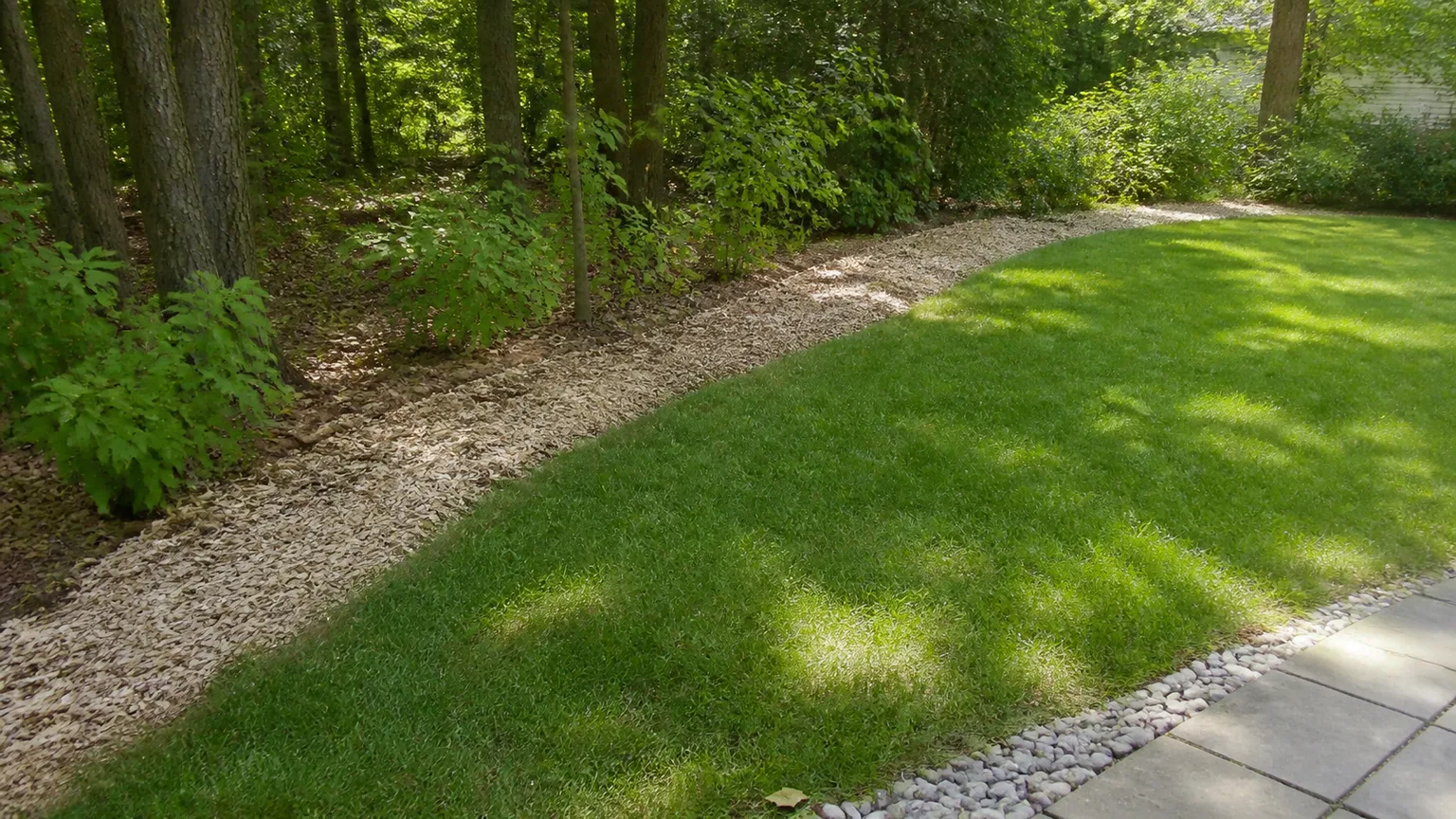
The CDC’s yard guidance recommends removing leaf litter and brush, mowing, and separating lawn from wooded areas. It describes a 3-foot-wide gravel or wood-chip barrier as a way to discourage blacklegged ticks from moving into recreational areas. Treat that dimension as a practical landscape recommendation, not a sealed wall: animals can carry ticks across, gaps can form, and a barrier cannot replace bite checks.
Choose an acaricide by label, not active-ingredient hype
An acaricide is a pesticide used to kill ticks and mites. The active ingredient matters, but the brand name or a familiar chemical alone is not enough to decide whether a bottle is suitable. A product labeled for ants, mosquitoes, or garden insects is not automatically labeled for ticks, and a product labeled for indoor cracks is not automatically allowed on lawn, shrubbery, or a wooded margin.
Read the complete label before buying. Confirm that it names the target tick or ticks, allows residential outdoor use on the specific surface you plan to treat, and gives directions for the application method you own. Check the application rate, any seasonal or maximum-use limits, required protective equipment, weather restrictions, reentry instructions, storage, first aid, and disposal. Under EPA pesticide-label rules, using a pesticide in a manner inconsistent with its labeling violates federal law. The label is the controlling instruction, even when a store page, neighbor, or online recipe suggests something else.
Do not choose a product solely because it is described as “natural,” “organic,” or “pet friendly.” Those phrases do not tell you whether it works against the tick species in your yard, whether it is allowed on your site, or what precautions apply. Some products marketed as minimum-risk pesticides are exempt from federal registration; that does not mean every such product has been evaluated by EPA for effectiveness as a yard tick treatment. Botanical oils and fungal products may have different evidence, duration, and label uses from conventional acaricides. The University of Maine Tick Lab’s chemical-control guidance notes that natural extracts for residential landscapes are still being evaluated, so don’t treat “natural” as a guarantee of either safety or performance.
Match the product form to the site and equipment
Ready-to-use sprays, hose-end concentrates, concentrates mixed in a tank sprayer, and granules are not interchangeable. Each has a label specifying where and how to apply it. A hose-end attachment may make broad coverage easy, which is a disadvantage if your goal is a narrow, carefully controlled target area. A pump sprayer can give you more control, but only when its nozzle and pressure are compatible with label directions and you can keep the spray on target.
Never borrow a rate from another product with the same active ingredient. Different formulations can have different concentrations, sites, application rates, protective gear, and re-treatment intervals. Do not increase concentration to compensate for a weak result, mix products unless the label explicitly allows it, or repurpose a clothing repellent as a yard pesticide. If the label does not describe your exact site or use, put the product back and ask your cooperative extension or state pesticide office for guidance.
Pick timing by local tick stage, not calendar alone
There is no single national “spray day.” The best timing depends on which tick is present, its life stage, local weather and habitat, and the current recommendation in your county or state. For blacklegged tick nymphs in parts of the Northeast, University of Maine Extension identifies mid-May to mid-June as a common treatment window; adult activity can make a fall treatment relevant in some areas. Those dates should not be copied to a different climate or species without checking local guidance.
A product label may also limit when an application can be made, how long before rain it must be applied, whether plants can be flowering, and how often you may repeat the treatment. If a rainstorm, high wind, irrigation, or a temperature restriction conflicts with the label, wait. Do not reapply automatically because it rained or because the yard still contains ticks. First check what the label permits, whether the first application reached the intended habitat, and whether new ticks may have arrived with wildlife.
Prepare the yard, household, and equipment
Read the label once before purchase and again before mixing or application. Calculate the actual area you are allowed to treat, using the label’s unit and rate. Mark boundaries so you can stop at the edge rather than drifting into the whole lawn. Check the sprayer for leaks and confirm that it is intended for pesticide use; do not use a container that previously held fertilizer, herbicide, or a household cleaner unless the equipment instructions and pesticide label explicitly allow it.
Choose a calm weather window that also meets the label’s rain requirements. Remove children, toys, pet bowls, bird food, and movable items from the intended area. Keep pets indoors or otherwise away, and make sure neighboring properties, vegetable beds, flowering plants, ponds, storm drains, and play areas are outside the application path. If the label calls for specific protective clothing or eye protection, wear exactly that equipment; a respirator is not a generic substitute for following the label’s stated precautions.

Do not mix pesticide near food, a well, a storm drain, or a waterway. Measure with dedicated tools, never a kitchen spoon or drinking cup, and do not prepare more solution than you need. Keep the original container and label accessible during the job. If you are interrupted, close and secure the product before stepping away. The EPA’s pesticide safety guidance advises keeping children and pets away until the product has dried or for the longer period specified by the label.
Apply only labeled tick habitat
Follow the label’s sequence exactly. Mix only if the product is a concentrate and the label directs mixing; use the amount printed for that product and area. Apply only to the permitted site and target. If the label allows a perimeter or spot treatment, stay within that scope and avoid treating broad, mowed lawn simply because it is easy to reach. The University of Minnesota Extension says maintained lawns rarely need tick insecticide and that treating wooded or brushy edges and paths may reduce numbers. It also cautions that large sprays into woods or dense vegetation may miss ticks sheltered in leaf litter, and animals can reintroduce ticks to treated areas.
Work slowly enough to keep the spray where intended. Do not spray above your head, into wind, over people or pets, or onto a path you must immediately walk through. Avoid spraying to runoff. Keep nozzle height, pressure, droplet size, and distance consistent with product directions; don’t improvise by pushing spray deep into woods or flooding leaf litter. A targeted application is only useful if the label allows it and the product can contact the target habitat as directed.
A useful difference in extension guidance is that some sources describe targeted applications as a tool to reduce yard tick numbers, while Iowa State Extension warns that sprays can be ineffective in tall grass and understory where droplets fail to reach ground-level ticks. That is not a reason to ignore either source: it is a reason to avoid broad, blind spraying and to ask whether your actual target zone and application method fit the product. Dense woodland is a strong reason to get local professional advice rather than increase the dose.
Keep spray out of flowers, food beds, drains, and water
Before starting, identify everything that should not receive spray: flowering plants being visited by pollinators, edible crops unless the label specifically permits their treatment, children’s play surfaces, pet dishes, ponds, streams, swimming pools, wells, storm drains, and a neighbor’s property. If a permitted tick-treatment zone overlaps a vegetable or herb bed, do not assume that rinsing the produce later makes an off-label application acceptable. Find a product whose label explicitly covers that crop and use pattern, or exclude that section from treatment.
Many residential tick products are pyrethroids, and EPA notes that pyrethroids are highly toxic to aquatic organisms. Drift and runoff can carry pesticide beyond the target into drains, water, and sediment. Follow all environmental hazard statements and buffers on the label, avoid windy or rainy conditions, and never rinse equipment where the rinse water can reach a drain or surface water; EPA’s consumer drift and runoff guidance gives additional precautions. EPA also notes that many insecticides are toxic to bees; do not spray blooming plants or active pollinator areas unless the label specifically allows the application and its pollinator precautions can be met. See its pollinator-protection guidance for product-specific label precautions.
Protect children, pets, pollinators, and wildlife
The label sets the reentry rule. It may say to keep people and pets out until the treated area is dry, specify a different interval, or require a longer restriction for a particular site or product. Use the longest applicable label direction; do not substitute a universal “one hour” rule or assume that a dry-looking lawn means a restricted interval has ended. Keep pets from licking treated plants, chewing granules, or carrying wet product indoors on paws.
Cats can be especially sensitive to some chemicals. Do not use a yard product on an animal, and do not apply a dog tick product to a cat; ask a veterinarian which animal-specific prevention is appropriate. The CDC recommends daily tick checks for outdoor pets and veterinary advice on pet preventives. If a label or your veterinarian’s advice is unclear about a pet’s access, keep the pet out and ask before reopening the yard.
Protect pollinators by keeping treatment off flowers and avoiding drift to blooming plants. Protect birds and other wildlife by keeping pesticide away from feeders, baths, and food, using only the quantity required for the labeled area, and storing leftover product securely. A broad-spectrum spray can affect organisms other than ticks; the risk depends on the active ingredient, formulation, exposure, and application. The safer practical choice is to minimize the treated area, obey the label’s buffers and timing rules, and choose nonchemical methods where they can address the problem.
Know what to expect after treatment
A correctly applied acaricide may reduce ticks in the treated zone for a period, but no yard treatment forms a permanent boundary. The effect varies with the product, weather, vegetation, application quality, and movement of wildlife. Ticks can return from untreated habitat or arrive on animals, so visible ticks after treatment do not automatically mean that the product failed or that another spray is allowed.
A two-year randomized, placebo-controlled trial involving 2,727 households in three northeastern states found about 63% fewer host-seeking ticks on treated properties, yet it found no difference in human–tick encounters or tick-borne disease between treatment groups. The study used a single spring barrier application and measured one approach, so it does not answer every question about every product or location. It does show why a lower tick count must not be translated into a promise that spraying prevents Lyme disease. The published trial and the CDC’s yard-spraying guidance both support keeping that distinction clear.
Write down the product, EPA registration number, date, weather, treated locations, and any observed tick activity. Recheck the same locations after the label’s stated interval and use a consistent method. If you still see ticks, identify whether they are in the treated zone or along a new route, then revisit the habitat and label before considering another treatment. Do not exceed the maximum number of applications or shorten the interval printed on the label.
Reduce tick habitat and host activity between treatments
Yard maintenance often has more lasting value than repeated applications because it changes where people meet tick habitat. Keep grass mowed where people play or walk; remove leaf litter and brush from the lawn edge; trim low vegetation where appropriate; and move patios, play equipment, and pet resting spots away from wooded or brushy margins. Keep firewood dry and neatly stacked, and remove debris that shelters small mammals near frequently used areas.
Wildlife exclusion has limits. A fence may reduce access by deer if it is tall and designed for that purpose, but it cannot stop mice, birds, or every animal that carries ticks. Avoid feeding deer, and clean up spilled birdseed if rodents gather near the house. University of Maine Extension’s landscape guidance and a practical Homes & Gardens yard-maintenance overview both emphasize attention to the moist, brushy edges where people and hosts meet; the extension source is the stronger reference for tick-specific recommendations.
Build a buffer without creating a damp refuge
A 3-foot strip of gravel or wood chips between lawn and woods can make the transition visible and discourage some blacklegged ticks from crossing into a recreation area. It is a buffer, not an impenetrable barrier. Keep it continuous where practical, clear encroaching grass, and maintain the surface so it does not become a damp layer of old leaves or dense vegetation. The CDC’s recommendation is specifically framed around reducing blacklegged tick migration; do not assume it works identically for every species or property.
Place the buffer between tick habitat and the places people use, rather than winding it around every garden bed. A gravel or wood-chip path can also serve as a visual cue to change clothing, check pets, or avoid brushing against shrubs. If wood chips are used, keep them in a defined strip and refresh them as they decompose. Do not move leaf piles or brush to the edge of a play area to make the lawn look tidy; that simply relocates moist cover.

Decide when a licensed professional is worth hiring
Call a licensed pest management professional when the suspected habitat is too large or dense to treat accurately, the site includes a pond or sensitive garden, the label requires professional certification, or you cannot confidently measure and keep the application inside its boundaries. A professional can identify the target habitat, use equipment suited to the label, and explain the required reentry period. Their equipment does not make a broad treatment necessary; ask for an integrated plan that begins with inspection and explains why each area would be treated.
Before agreeing to service, ask for the product name and EPA registration number, the label’s permitted sites, the exact treatment zones, the expected reentry time, precautions for pets and pollinators, and whether state or local rules require notification. Ask whether the company will document the application and what it recommends if ticks continue to be found. In the United States, states regulate pesticide applicators; the EPA recommends checking that pest-control firms are licensed by the state. Be cautious of guarantees that a yard will be tick-free or that a spray will prevent disease.
Keep bite prevention separate from yard treatment
A yard plan can reduce contact with habitat, but personal protection remains important during gardening and outdoor play. Wear long pants and sleeves when working in brushy edges, consider EPA-registered skin repellents used according to their labels, and use clothing or gear treated with 0.5% permethrin only as directed. Permethrin products meant for fabric are not skin repellents and should not be sprayed on pets unless the label specifically says the product is for that animal.
After time outdoors, check skin, clothing, gear, and pets, including after working in your own yard. Shower soon after returning indoors and remove an attached tick promptly with fine-tipped tweezers. The CDC notes that many exposures occur in home yards or neighborhoods and advises checking yourself and pets after outdoor activity. These habits remain necessary whether you use a pesticide, rely on landscaping, or choose not to spray.
Avoid the mistakes that make spraying less useful
The most common mistake is treating convenience as a reason to cover the whole lawn. Maintained turf is often not the main habitat for blacklegged ticks, and a broad application can expose more organisms without reaching ticks tucked into dense leaf litter. Another mistake is choosing a product because the label says “insect killer” without confirming that it names ticks and the exact outdoor site you intend to treat.
Do not use a homemade essential-oil blend, vinegar, dish soap, or a clothing repellent as a substitute for a labeled yard acaricide. Do not spray blooming flowers, food crops, or water-adjacent ground unless the label specifically permits it. Do not mix at a stronger rate, apply just before rain, ignore wind, reenter early, or repeat on a monthly schedule that the label does not authorize. “Organic” and “pet safe” are not replacements for reading the label.
Finally, do not stop checking people and pets because a treatment was applied. Even a well-planned product can miss ticks, lose effectiveness, or leave untreated pathways. Keep notes, inspect the actual spots where people encounter ticks, adjust landscape conditions, and ask local extension or health officials if the species or timing is uncertain.
Conclusion
The best way to spray a yard for ticks is to treat only an identified, label-approved area when local conditions and repeated exposure justify it. Map the shaded borders and paths people use, verify the tick and site on the product label, choose a safe weather window, follow every rate and reentry instruction, and protect flowers, food beds, pets, children, and water.
Then keep the plan bigger than the sprayer. Remove leaf litter and brush, maintain a visible buffer, manage pet protection with a veterinarian, and use clothing, repellents, and tick checks whenever you spend time outside. A targeted treatment may lower tick numbers in its zone; it cannot promise a tick-free yard or replace the habits that prevent bites.