How to Get Rid of Ants Outside in 4 Easy Ways
Learn how to get rid of ants outside by matching the method to the problem: use bait for trails, treat risky mounds carefully, and prevent repeat visits.

Ants crossing a patio or building a mound in the middle of a lawn can make a yard feel overrun, but seeing a line of ants does not automatically mean the colony is damaging your plants. Many outdoor ants feed on other insects, dead material, and honeydew; some help move seeds or turn soil. The useful question is not “How do I kill every ant?” but “What problem is this colony causing, and which treatment reaches that problem with the least collateral damage?”
For most nuisance trails, start by removing food and water, then use an outdoor bait that workers will carry back if colony control is necessary. Reserve a direct mound treatment for a specific mound that threatens people, pets, or an area you need to use. Clean ants off a patio for fast relief, but understand that contact cleanup will not eliminate a nest elsewhere. These four approaches work for different jobs, so matching the method to the situation saves time and reduces unnecessary pesticide use.
| What you see | Best first step | What to expect |
|---|---|---|
| A few ants on a patio or outdoor table | Remove food and wipe the hard surface with soapy water | Quick cleanup; the nest may remain |
| A steady trail with no stings or plant injury | Inspect the trail, then try a protected outdoor bait if needed | Slow reduction as foragers carry bait home |
| Ants tending aphids or scale on plants | Address the sap-feeding insects and their host plant | Ant activity may decline as the honeydew source does |
| A stinging mound in a play or work area | Keep people away and identify the ant before treatment | A labeled, species-appropriate treatment may be needed |
First Decide Whether the Ants Need to Go
A trail is not proof of plant damage
Ants often pass through garden beds because they are searching for food, water, or shelter. They can be beneficial scavengers and predators, and killing workers that happen to cross a path does not necessarily affect the colony. UC IPM notes that ants can feed on fleas, termites, caterpillars, and other pests, while also tending honeydew-producing insects such as aphids, soft scales, whiteflies, and mealybugs. That last behavior matters: if ants repeatedly climb a plant, look for clusters of aphids or scale insects on tender growth and leaf undersides before reaching for an ant killer.
Ants usually do not chew healthy leaves or roots simply because they are present. A mound can loosen soil and be a nuisance around a mower, path, or seating area, while some species sting or nest in wood. Those are real reasons to intervene, but each calls for a different response. The gardening guidance from Epic Gardening also emphasizes that many ants are part of the garden ecosystem and that intervention is more appropriate when a colony is creating a clear problem, such as protecting aphids or spreading into a living area.
If ants are only foraging in a bed and no one is being stung, no plant is under active pressure from sap-feeding pests, and the mound is not in a high-use location, leaving them alone is a reasonable control choice. “Ant-free” is not a realistic long-term condition outdoors: neighboring colonies can move in, and the same yard continues to offer food, water, and shelter. Aim to reduce a specific nuisance rather than sterilize the soil.
Find the route, food source, and risk area
Watch a trail for a few minutes before treating it. Note whether it ends at a food source, a damp crack, a tree cavity, a mound, or a plant covered in aphids. Follow it in both directions if possible; the nest may not sit beneath the most visible cluster. On a lawn, ants can nest under stones, paving edges, landscape timbers, or dry patches where the soil is easy to excavate. Carpenter ants are a different concern: large ants near softened or damp wood may signal a nest in a stump, fence post, or structure, and a simple lawn bait may not solve that problem.
You do not need to identify every harmless ant to clean up crumbs or set a bait station. Identification becomes important when the ants sting, the mound is extensive, the nest may be inside a building, or a pesticide label limits which species or sites it covers. Red imported fire ants are a particular concern in regions where they occur. Their mounds should not be kicked or dug into to “see what happens”; keep children and pets away and use local extension guidance or a licensed professional if you cannot confidently identify the problem.
Four Practical Ways to Get Rid of Outdoor Ants
1. Remove food, water, and aphid attractants
Make the yard less rewarding before applying a product. Pick up fallen fruit, spilled birdseed, pet-food remnants, and food scraps after outdoor meals. Rinse sticky residue from hard surfaces, use a covered trash bin, and fix a dripping hose connection or irrigation leak. Trim branches that touch the house, and move stacked firewood away from the foundation. Penn State Extension recommends starting with the conditions attracting ants and using prevention as the first part of integrated pest management; reducing food and water can prevent repeated pesticide applications that offer only short-term relief.
If ants are concentrated on one plant, inspect rather than spraying the ant trail. Aphids and soft scales excrete honeydew, a sugary liquid ants collect. Where the plant can tolerate it, a firm stream of plain water can dislodge aphids; repeat inspection is more useful than a one-time knockdown because new insects may return. For a tender plant, heavy infestation, or a problem you cannot identify, use plant-specific extension advice before applying an insecticide. Treating the aphids or scale that provide the food source can reduce ant traffic without broadcasting ant poison over flowers and soil.

Do not remove all mulch just because ants are present. Instead, pull excess mulch and dense vegetation back from the house foundation, keep gutters clear of decomposing debris, and avoid leaving boards or pots directly against a wall for long periods. Penn State Extension advises keeping vegetation and mulch at least 6 inches from the base of the house; UC IPM recommends an even wider one-foot clearance for reducing foraging and nesting around buildings. These are useful ranges, not a reason to bare every garden bed. Preserve a healthy mulch layer where it helps plants, while creating a dry, inspectable strip beside the structure.
2. Use bait when colony control is the goal
Bait is the better choice when ants are following a persistent route and you want workers to bring an active ingredient back toward the nest. In contrast to a contact spray, a slow-acting bait gives foragers time to return and share food within the colony. UC IPM explains that the bait needs to act slowly for that reason, and that results depend on species, bait material, and other food available. Bait does not work like an instant perimeter barrier, so do not judge it by whether the first few ants disappear within an hour.
Place an outdoor bait station beside an active trail or near a nest opening where the label permits. Keep it level, shaded when possible, and protected from irrigation and rain; Bob Vila cites a pest-control expert who recommends keeping outdoor stations out of direct sun and away from rain. Avoid putting bait where children, pets, wildlife, or food-preparation surfaces can contact it. Use only a product labeled for outdoor use and for the location you are treating; the package instructions govern placement, amount, weather limits, and precautions.
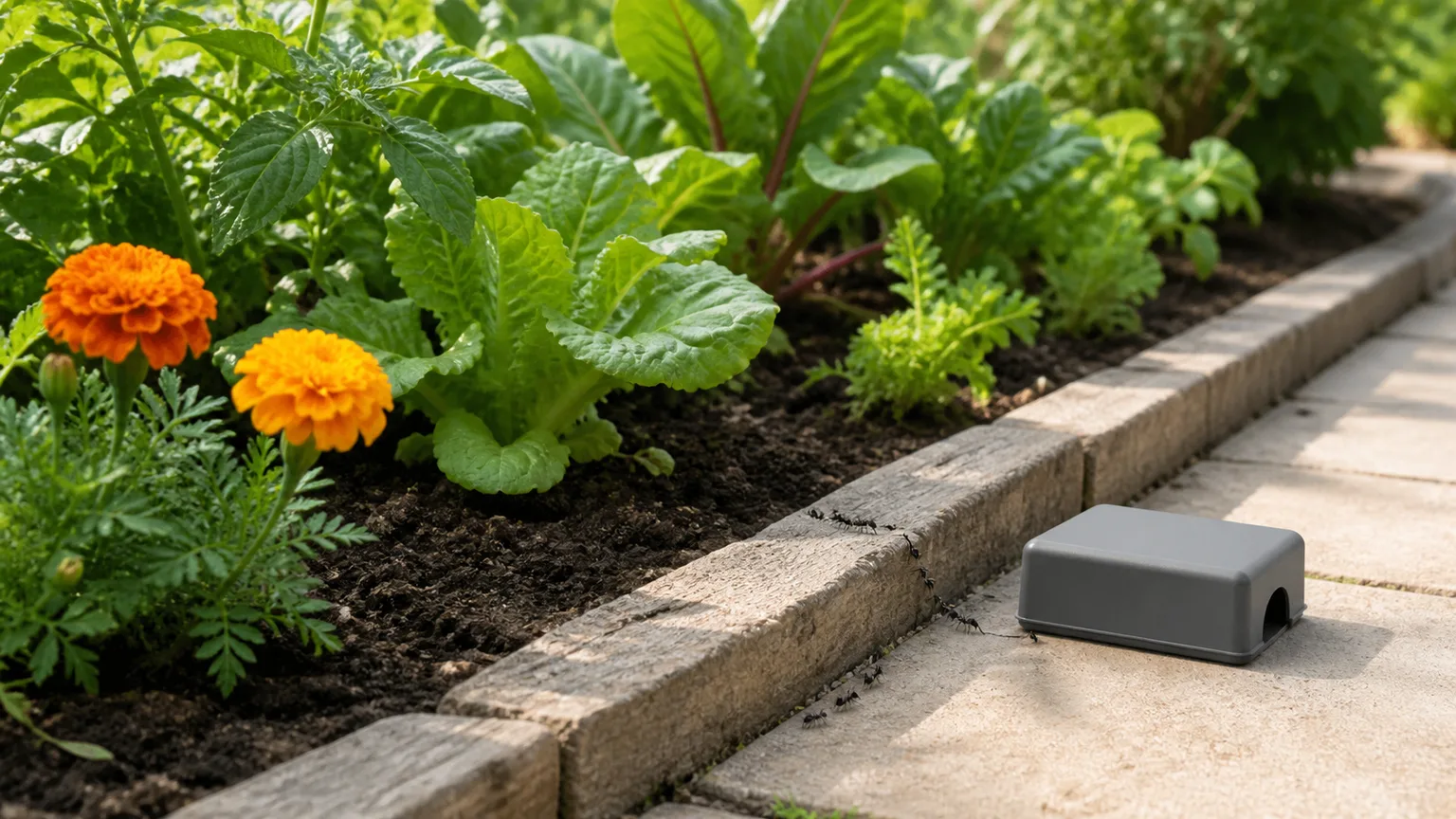
Match the bait to the ants and protect the station
Ant colonies do not all prefer the same food. Some foragers respond to sweet liquid bait; others may take a protein- or grease-based formulation. If ants walk past a bait without feeding, do not assume the colony is immune. Try a different labeled bait type or move the station directly onto a trail where workers already forage. Remove competing crumbs and spilled drinks nearby, but do not wipe out the bait trail or spray the ants approaching the station.
Use fresh bait and check the station as directed. Replace an empty, dried-out, rain-damaged, or contaminated station only according to its label. Keep other insecticides off the route while bait is being carried; a repellent spray may divert workers before they take bait home. UC IPM reports that some bait programs show fewer ants after roughly 5 to 10 days, while complete control may take several weeks or longer. The timeline is not a guarantee: the ant species, colony size, weather, competing food, and bait acceptance all matter.
Do not make a homemade borax recipe by guesswork. Concentration affects how quickly ants die and whether foragers carry bait back; an overly strong or poorly placed mixture can be ineffective and creates avoidable exposure. A sealed, labeled product is easier to place consistently and keep away from non-target animals.
3. Treat a hazardous mound with a labeled method
A mound treatment is appropriate when a particular nest sits where people need to walk, play, garden, or work, or when local advice identifies a stinging species. It is not a whole-yard cure. Choose a product labeled for that ant and site, then follow its instructions exactly. Depending on the product, treatment may mean applying a drench, granules with water, dust, or a bait to the mound. These methods are not interchangeable: some require water, some should not be disturbed, and some leave residues at the surface.
For common, non-stinging ants, first ask whether moving a stepping stone, trimming back a path edge, or tolerating a low mound solves the actual problem. If you use a pesticide, do not increase the dose or combine products in an attempt to speed it up. Penn State Extension cautions that using the wrong product for the pest can create risk without providing control. Follow the label for personal protective equipment, weather, application location, re-entry, and disposal. Never apply a lawn product to a vegetable bed or patio unless the label explicitly allows that site.
Boiling water is not a reliable universal fix. Texas A&M AgriLife reports that pouring 2 to 3 gallons of very hot or boiling water onto a fire-ant mound kills ants only about 60% of the time; survivors may relocate, and the water can kill grass and nearby plants. The volume itself creates a serious scalding risk, especially on a slope or near children and pets. Avoid carrying boiling water across a yard or pouring it into a planted bed. If you consider hot water for a small mound on bare soil, treat it as a limited, risky option rather than a guaranteed colony treatment.
Fire ants need a separate plan
Imported fire ants are not just a patio nuisance: disturbing a mound can trigger a defensive rush and painful stings. Keep a wide buffer around the mound. If fire ants are established in your region, use your county extension service’s current recommendations for timing and product selection. Texas A&M’s Two-Step Method is designed for heavily infested areas or places where preserving native ants is less important: a labeled fire-ant bait is broadcast under the stated conditions, followed later by a direct treatment only for problem mounds. The method is not a generic instruction to scatter any ant bait across any yard.

Texas A&M AgriLife advises using fresh bait when the ground and grass are dry and no rain is expected for 24 to 48 hours, and when worker ants are actively foraging. Its guidance notes that fire-ant bait works slowly, often over weeks or months, while a labeled individual mound treatment can act faster. Your product label and local extension instructions take precedence because permitted products, rates, and timing vary by state and formulation. Never apply fire-ant bait to flowering plants or in a way that exposes pollinators or other wildlife contrary to the label.
4. Wash ants off hard surfaces for immediate relief
If ants are on a patio table, pavers, or a trash-bin lid, remove the food source and wash the hard surface with soapy water. This physically removes visible workers and helps erase their scent trail; it does not reach the nest or prevent new foragers from arriving if food remains. For outdoor dining, clean syrup, fruit juice, grease, and crumbs as soon as the meal ends, then keep the food sealed until it is brought indoors.
Keep household cleaners and detergent mixtures on nonporous hard surfaces, not on leaves, soil, or a vegetable bed. Soap formulated for dishes or windows is not automatically safe for plants or insects you want to protect. A quick rinse is enough for the trail; there is no need to spray the surrounding lawn. If the same route returns, use the observation steps above to locate the source and decide whether bait or attractant removal is necessary.
Why Sprays and Diatomaceous Earth Are Not Default Fixes
A contact spray can kill the ants it touches, so it may look effective for a few minutes. But unless the product is a bait or a specifically labeled colony treatment, killing surface foragers alone usually leaves the nest intact. The UC IPM guidance warns that outdoor pyrethroid sprays can harm beneficial insects and pollute waterways, particularly when applied to hard surfaces where runoff can reach drains. Spraying a trail beside a bait station can also repel workers and reduce the chance that they carry bait home.
Use an outdoor spray only when the exact product label allows the target site and pest, and when a focused application solves a clearly defined need. Do not broadcast a perimeter spray around an entire garden by default, and never spray flowering plants where pollinators are visiting unless the label explicitly permits it. “Natural,” botanical, and essential-oil products still require label reading and can affect non-target organisms or plants. The word “natural” does not remove the need for careful use.
Diatomaceous earth is also limited. It can affect insects that contact a dry, exposed dust, but it does not lure workers back to a colony, and moisture reduces its usefulness. Wind can move fine powder where it is not wanted, and inhaling dust can irritate airways. Avoid dusting flowers, food crops, or wide areas of soil. If a label-approved formulation is used at all, apply only where it can remain dry and inaccessible to children, pets, and beneficial insects. For most persistent trails, bait is a more direct colony-level tool.
Keep Outdoor Ants From Becoming a Repeat Problem
After the activity drops, keep the food and water cues from returning. Empty outdoor trash often, rinse sticky containers before they go into recycling, and bring pet bowls inside when feeding is over. Pick up fallen fruit before it softens, and clean barbecue drips and sugary spills. Fix leaking hose fittings and avoid leaving a shallow saucer of water beside the house unless it is an intentional wildlife feature.
Inspect plants ants visit repeatedly. If you find aphids, soft scale, or mealybugs, choose a control appropriate to the plant and the pest. Ants may protect these insects for their honeydew, so treating only the visible ants can leave the food source untouched. Prune or support branches that rest on siding, keep gutters clear, and create a narrow inspection strip along the foundation. Move firewood, stacked pots, and scrap lumber away from the structure rather than placing them directly against it.
Keep this work targeted. Ants in a remote corner of the yard do not need treatment simply because they are visible. Treating every mound can remove native species and expose pollinators or other small animals to products that were not necessary. Check a bait station after rain, observe whether ants are feeding, and stop using it when the activity that justified it has ended or the label directs. Prevention is a routine of removing specific attractants, not a promise that ants will never cross the yard again.
How Long Control Takes and What to Do if It Fails
Surface cleanup is immediate but temporary. A contact spray or soapy wipe can remove ants you see, but a nest may send out another group. Bait is slower because its purpose is to let foragers carry food back before the active ingredient takes effect. UC IPM says some outdoor bait programs can show a reduction in 5 to 10 days, while full colony control can require several weeks or longer. Fire-ant broadcast bait can take weeks or months to achieve substantial control under the conditions described by Texas A&M AgriLife.
If a bait station is untouched after several days, check four things: Is the station on an active trail? Has rain, heat, or irrigation spoiled it? Is another food source more attractive? Could the ants prefer a different bait formulation? Move or replace only as the product label allows, and keep the station protected. Do not spray the trail to force ants toward it. If ants feed but activity does not decline, allow the labeled treatment period before adding a second method; mixing approaches too early can disrupt bait collection or expose more non-target insects.
If activity increases briefly around a bait, that can mean workers have found the food, not that the treatment has failed. Continue to watch the trail and replenish bait only as directed. If the colony is nesting inside a wall, under a slab, or in rotting structural wood, if ants are stinging people, or if multiple properly placed bait attempts fail, move from DIY experiments to species identification and professional advice. The best next step may be to treat a different pest or food source rather than use more ant killer.
When to Call a Pest Professional
Contact a licensed pest professional when stinging ants pose a recurring risk, a mound is close to a doorway or play area and cannot be treated safely, or the nest appears to be inside a structure. A professional can identify whether the ants are fire ants, carpenter ants, or a nuisance species and choose a treatment site and formulation that fit the colony. Ask for an explanation of the target species, active ingredient, application location, expected wait time, and precautions for children, pets, gardens, and nearby water.
Seek local extension help before applying products to a large lawn, edible garden, pond edge, or a region with regulated invasive ants. Fire-ant species and control guidance differ across states. Bring a clear photo of the ants and mound, note where the trail leads, and describe any stings or property damage. That information is more useful than applying a broad-spectrum spray to every spot where an ant appears.
Conclusion
To get rid of ants outside, begin by deciding what the ants are actually doing. Remove food, water, and aphid attractants; use a protected, labeled bait when you need workers to carry control back to a colony; reserve mound treatments for a defined hazard; and wash ants off patios for quick, limited relief. Give slow-acting bait time, follow the label, and avoid blanket sprays that can harm organisms beyond the target. Some ants can stay. The goal is a yard where they are no longer creating a specific problem, not a yard with no ants at all.