How to Grow and Care for a Silver Maple Tree
Silver maple grows quickly and tolerates wet soil, but its roots and limbs need room. Get site, planting, watering, pruning, and seedling guidance.
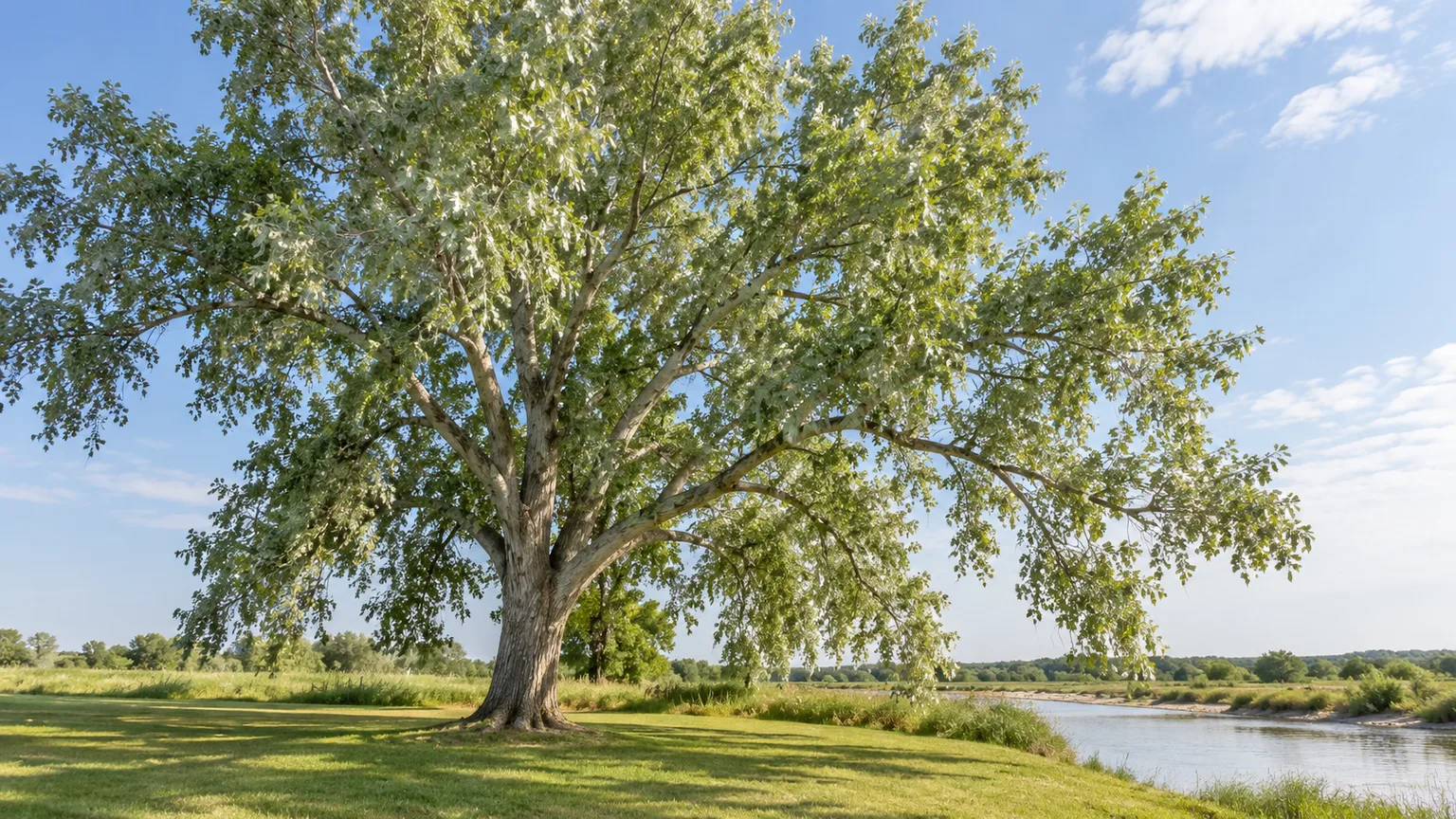
A silver maple can turn a wet, open corner into shade much faster than many native trees. Its leaves flash pale beneath their green surfaces when wind moves through the crown, and the species tolerates seasonal flooding that stresses less adaptable trees. Those advantages come with a real trade-off: a mature silver maple is large, its limbs can fail in storms or ice, its vigorous surface roots can conflict with hardscape, and its paired seeds may germinate across a lawn.
The first care decision is therefore not fertilizer or watering. It is whether the tree has enough room to grow without putting people, pavement, drains, or overhead wires in its future path. If the site is right, young trees are straightforward to establish; if it is tight, choose a smaller tree before planting rather than trying to prune a silver maple into a shape it cannot safely hold.
Silver Maple at a Glance
| Feature | What to expect |
|---|---|
| Botanical name | Acer saccharinum |
| Mature size | Commonly about 50–80 feet tall and 30–60 feet wide; exceptional trees can be larger |
| Growth | Fast, especially when young and given ample moisture |
| Light | Full sun to partial shade |
| Soil | Adaptable, but performs best in moist soil; tolerates periodic flooding |
| Hardiness | Commonly listed for USDA Zones 3–9; local climate and provenance matter |
| Main strengths | Quick shade, native wildlife value, wet-site tolerance, broad adaptability |
| Main drawbacks | Weak wood, storm breakage, surface roots, abundant seedlings, ordinary fall color |
Ranges vary among references because a tree’s size, form, and hardiness depend on local conditions and individual genetics. NC State Extension lists the tree at roughly 50–80 feet tall and 40–60 feet wide, while the University of Connecticut’s plant database notes that older specimens can exceed 100 feet. Plan around the larger credible size, not the dimensions of a young nursery tree. NC State Extension describes the species’ range, traits, and landscape considerations, and Oregon State University’s Landscape Plants database records its rapid growth, wet-habitat tolerance, and potential to lift sidewalks or clog drains.
How to Identify Silver Maple
Silver maple (Acer saccharinum) is a deciduous member of the soapberry family, Sapindaceae. Its opposite leaves usually have five deeply cut lobes: the green upper surface contrasts with a pale, often silvery underside. In a breeze, the leaves turn and make the crown look lighter than it is. The name is a useful field clue, but leaf color alone is not enough to identify a tree; compare leaf shape, buds, bark, and seed together.
The paired seeds, called samaras, mature in spring. Each has one seed with a long wing, and the two wings form a broad angle. They fall and spin like small helicopters, a familiar sight under silver maples and other maples. Silver maple flowers also arrive early, before or as leaves emerge, in small clusters that can be reddish or greenish. Older trunks develop gray bark with long, shaggy strips. For a botanical comparison of leaf, bark, flower, and fruit characteristics, Oregon State’s species profile and UConn’s Silver Maple database entry are useful references.
Do not confuse a silver maple with sugar maple because both have lobed leaves. Sugar maple leaves tend to have broader lobes and shallower notches; silver maple leaves are more deeply cut and show a bright underside when lifted. Fall color is also a weak identification shortcut: silver maple often turns pale yellow or yellow-green, but individual trees and weather can shift the shade. If a decision depends on exact species, photograph a mature leaf, its underside, a bud, and a samara and ask a local extension office or certified arborist to confirm it.
Decide Whether Silver Maple Fits Your Yard
Silver maple is best treated as a large-site tree, not a small-yard quick fix. It can make sense on a roomy property, park edge, flood-prone lawn, or restoration planting where a broad crown and fast shade are benefits and the ground beneath the tree can accommodate roots and seed fall. It is a poor match for a narrow front yard, a small lawn surrounded by pavement, a spot below utility lines, or a planting bed where annual seedling removal would be unwelcome.
Use this quick test before buying one:
- Room: Can you accommodate a crown that may spread 40 feet or more without crowding buildings, neighboring trees, or travel routes?
- Infrastructure: Can you keep the trunk well away from walks, driveways, underground services, septic components, and sewer laterals?
- Structure: Is there enough distance from parking, play areas, roofs, and other targets that could be harmed by a falling limb?
- Maintenance: Are you willing to inspect the canopy, arrange structural pruning while the tree is young, and remove volunteer seedlings?
- Purpose: Do you need a fast shade tree for a wet or difficult location, or do you mainly want a tidy tree with showy autumn color?
The Morton Arboretum warns that the species has weak wood and is susceptible to ice damage; it also notes that mature trees may spread seedlings and develop roots that enter sewer pipes. Its profile lists silver maple as a fast-growing tree with a vigorous root system and high pruning needs. The Morton Arboretum’s silver maple profile presents a candid, site-specific summary. Those cautions do not make every existing silver maple unsafe or every planting irresponsible. They mean the tree needs a deliberate site and long-term care, rather than being planted wherever a fast-growing nursery tree will fit today.
Map the canopy, roots, and risk area
Before planting, draw the tree’s expected canopy at maturity on a simple site sketch. Include the house, garage, walks, driveway, fence, patios, overhead conductors, buried irrigation, sewer route, and septic field. A silver maple’s root system is broad and often shallow, so the relevant space is not limited to the trunk’s planting hole. Large roots can lift paving as they thicken; fine roots can exploit moisture and openings in older pipes. Roots do not drill through sound modern pipe simply because the tree is nearby, but they can enter existing cracks, loose joints, or leaks and then make the obstruction worse.
No single distance guarantees that roots or branches will never reach a structure. Root spread responds to soil, water, obstacles, and tree size, while utility corridors and local codes set their own clearances. If you cannot keep the tree’s projected canopy and root zone away from important infrastructure, select a smaller species with a mature size suited to the space. For an established tree beside a building or a high-use target, ask an ISA Certified Arborist for an on-site risk assessment instead of cutting large roots or limbs yourself.
Plant a Silver Maple the Right Way
Plant a healthy, locally adapted nursery tree when the soil is workable and weather is cool rather than during heat or drought. In cold-winter regions, dormant-season planting in fall or early spring is practical; in warmer climates, follow local extension timing and avoid the hottest, driest weeks. A container tree can be planted outside dormancy if you can keep its root ball moist and protect it from establishment stress, but planting into saturated or frozen ground makes it harder to set the root flare correctly.
Find the root flare before digging. It is the point where the trunk widens into the first major roots; nurseries sometimes bury it under potting mix or mulch. Make the planting hole broad enough to spread the root ball but no deeper than the distance from the root flare to the base. Set the flare at or slightly above finished grade, especially in heavy soil, and backfill with the soil removed from the hole. Do not bury the trunk, plant too deep, or create a small pocket of highly amended soil that holds water around the roots.
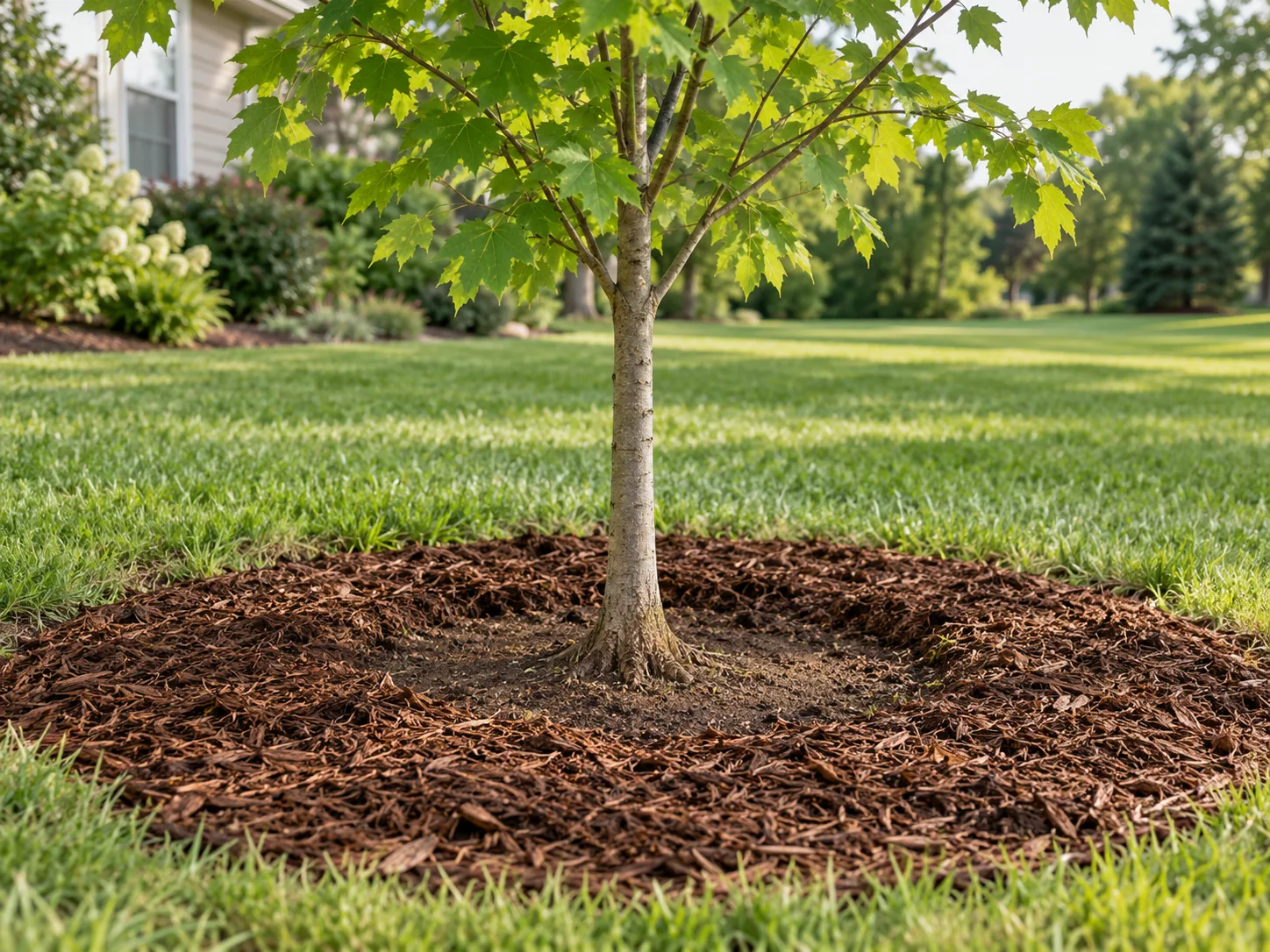
Water slowly after planting so soil settles around the root ball, then check that the tree has not sunk. Spread a broad, shallow layer of organic mulch over the root zone, leaving a clear gap around the trunk. Stake only if wind or an unstable root ball makes it necessary; tight ties and long-term rigid staking can injure a trunk that should be developing movement and taper. Remove broken branches at planting, but avoid heavy crown reduction to “balance” roots. Structural shaping belongs in small, thoughtful cuts as the tree grows.
Choose Sun, Soil, and Climate
Give a silver maple an open position in full sun if the site allows it. It tolerates partial shade, but an open canopy has room to develop and the tree’s broad form is easier to manage where nearby plants and buildings do not force it into one-sided growth. USDA hardiness maps commonly place the species in Zones 3 through 9, but a zone range is only a starting point: local heat, seasonal moisture, wind exposure, and the origin of nursery stock also affect performance.
Soil adaptability is a strength, but “tolerates wet soil” does not mean a newly planted root ball can be left dry. Silver maple naturally grows in floodplains and bottomlands and can withstand periodic inundation better than many landscape trees. It also grows in ordinary garden soil if roots can reach moisture. Avoid assuming that the tree wants permanently waterlogged conditions in every setting; prolonged saturation around a recently planted tree can limit oxygen and complicate establishment.
High-pH soil can lead to chlorosis, a yellowing of leaves that may leave veins greener than the tissue between them. Do not treat pale foliage by guessing at iron or manganese products. Drought, root damage, compaction, disease, and nutrient availability can look similar from a distance. Check watering and site conditions first, then use a soil test or qualified diagnosis before adding fertilizer or changing soil pH. Oregon State University notes chlorosis risk on alkaline soils, while UConn’s profile flags nutrient-related chlorosis in high-pH soil.
Water a Young Tree by Soil Condition
During establishment, the goal is evenly moist root-zone soil, not a fixed number of watering days. Water the nursery root ball and surrounding backfill slowly enough to soak several inches down, then let excess water drain. Check moisture near the edge of the original root ball before watering again: cool, damp soil means wait; soil that is drying at root depth means water. This check is more reliable than a calendar because sand, clay, rainfall, sun, and wind change how quickly soil dries.
A newly planted tree may need regular attention through its first one or two growing seasons, especially during hot or rainless periods. A slow hose stream, drip line, or soaker hose can wet the root zone without washing soil away. Watering bags can help only if they release water gradually over the root area; they are not a substitute for checking soil. Keep mulch over the root zone, but do not pile it against bark, where constant dampness can hide damage or encourage decay.
Once established, silver maple is moderately drought tolerant, but a long dry spell can still stress it. Give a mature tree a deep soak during prolonged drought if local water restrictions and soil drainage allow. Do not keep adding water just because leaves wilt at midday: hot afternoons can cause temporary droop, while waterlogged roots also wilt. Check the soil at several inches deep and look at the whole canopy. A tree that remains limp in the morning, develops widespread scorch, or declines over successive weeks needs a closer diagnosis.
Mulch and Fertilizer: Keep Care Simple
Silver maple usually does not need routine fertilizer in a home landscape. Its rapid growth is part of what makes it attractive, and pushing extra growth with nitrogen does not fix a poor site or improve weak branch structure. It can instead stimulate foliage at a time when the tree’s long-term need is balanced roots and well-spaced limbs. If an established tree has weak growth or abnormal leaf color, identify the cause first and follow a soil-test recommendation rather than applying a general-purpose fertilizer by habit.
A 2- to 3-inch layer of shredded bark or leaf mulch can conserve soil moisture, reduce lawn competition, and make the root zone easier to maintain. Extend it broadly if space allows, but keep mulch several inches away from the trunk and root flare. Avoid “mulch volcanoes,” deep buried bark, and frequent cultivation under the canopy. Silver maple roots often run close to the surface; mowing and digging too deeply can wound them. If roots become visible, do not cut or bury large ones without advice from an arborist.
Prune Early for Better Structure
The most valuable pruning happens while the tree is young and the cuts are small. Silver maples can grow quickly into tall trees with broad, heavy limbs; early inspection lets an arborist address competing leaders, tight branch unions, and crowded attachments before they become large defects. A tree that has several stems of nearly equal size or a long branch with a heavy end may need staged correction, not an aggressive one-season makeover.
For a young tree, preserve a stable central framework and well-spaced scaffold limbs while removing dead, broken, rubbing, or poorly attached growth in measured increments. Avoid topping, lion-tailing, flush cuts, and large unnecessary wounds. A proper pruning cut protects the branch collar rather than cutting into the trunk or leaving a long stub. Never remove a large share of live canopy at once simply to make the tree smaller; silver maple is not a compact tree that can be kept small through repeated hard cuts.
When to prune and when to call an arborist
The Morton Arboretum recommends summer pruning to reduce sap “bleeding” that can occur when silver maple is pruned during dormancy or spring. Bleeding is conspicuous but is not the same as a fatal wound; still, for routine structural work, schedule pruning in summer when practical and local conditions are suitable. Dead, broken, or hazardous limbs should be assessed promptly regardless of season. The Morton Arboretum’s care notes give the species-specific timing and storm warning.
Call an arborist for large branches, work above ground level, branches over a roof or public path, electrical-line conflicts, visible cracks, or a split union. Ask for an ISA Certified Arborist and a written scope that explains which branches will be removed and why. Do not climb a mature tree with a chainsaw, attach a rope to a suspect limb, or let a tree service top the crown as a “storm-proofing” shortcut. Pruning cannot make weak wood invulnerable to severe weather, and a sound assessment may conclude that a risky tree needs monitoring or replacement rather than more cuts.
Flowers, Samaras, and Volunteer Seedlings
Small flowers open in early spring before leaves fully fill the canopy. They are not the reason most people plant the tree, but they are part of the seasonal cycle, and maples can provide an early pollen and nectar source. Paired samaras follow and ripen in spring or early summer depending on climate. A mature tree can drop a large crop that spins across lawns, lands in gutters, catches in planting beds, or germinates wherever bare soil stays moist.
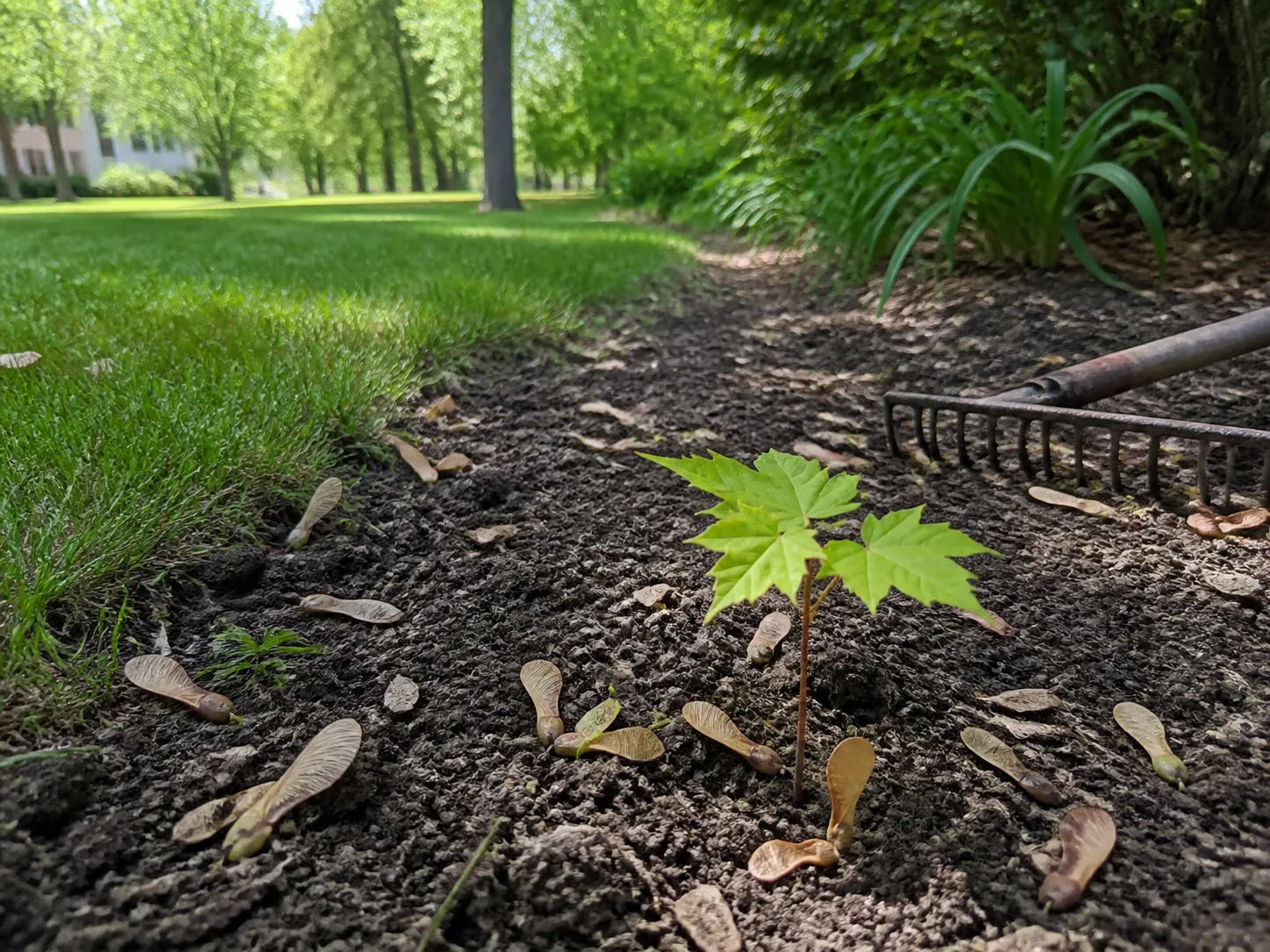
Seedlings are easiest to control when they are small. Pull them after rain or water the soil first so the root releases with less resistance; use a hand tool for those rooted in cracks, taking care not to damage paving or larger tree roots. Recheck beds and lawn edges after seed fall because germination can be staggered. On a large site, mowing young seedlings in lawn is simple; in beds, remove them before the stem thickens. Do not use herbicide on a seedling near a desirable tree or planting without following the product label and local rules.
Propagate Silver Maple From Fresh Seed
Silver maple is most reliably propagated from freshly collected seed. Gather samaras once they are mature and beginning to fall, remove the wing if convenient, and sow them promptly in a container or nursery bed of clean, well-draining medium. Keep the medium evenly moist, not saturated, and protect the pot from drying winds and animals. Fresh seed can germinate without the long cold stratification that many tree seeds need, but old, dried seed may lose viability, so prompt sowing matters more than elaborate pretreatment.
A volunteer seedling under a nearby tree can also be transplanted while it is small and dormant. Water the area first, loosen soil around the roots, and lift as much of the root system as practical; silver maple tolerates transplanting better when the seedling is young. Pot it temporarily if the final site is not ready, then keep the root ball moist while it establishes. A seed-grown tree will not necessarily reproduce a named cultivar’s exact traits. For selected forms sold under cultivar names, use a reputable nursery and ask how the tree was propagated rather than expecting seed to create a clone.
Recognize Pests, Diseases, and Stress
A healthy silver maple can host leaf galls, aphids, scales, leaf spots, and several fungal problems without needing routine pesticide treatment. Small rounded galls or blister-like bumps are often cosmetic and do not justify spraying a mature tree. Inspect both leaf surfaces, twigs, and the canopy as a whole; note whether a mark appears on one flush of foliage, one branch, or across the entire tree. An isolated cosmetic blemish and a progressively dying crown call for different responses.
Anthracnose and tar spot can produce leaf discoloration or dark lesions, particularly when spring weather favors infection. Verticillium wilt can be more serious, but a homeowner should not diagnose it from one yellow branch. Drought, root injury, compaction, girdling roots, trunk damage, and other diseases can produce overlapping symptoms. Remove dead branches only when they are safely reachable and small; do not cut extensively into live crown while the cause is unknown. The Morton Arboretum lists common silver maple problems, and Penn State Extension’s maple disease guide helps compare symptoms and management across maples.
Separate cosmetic leaf marks from decline
Start with the pattern. If the tree leafs out normally, grows well, and has a few spotted leaves or galls, monitor and clean up fallen leaves where practical. If symptoms appear throughout the canopy, return each year, or coincide with branch dieback, cracks, trunk decay, or a rapidly thinning crown, request an in-person diagnosis from a certified arborist or local extension diagnostic clinic. Photos of the whole tree, the affected branch, and both sides of the leaves help an expert narrow the possibilities.
Avoid applying broad-spectrum insecticides or fungicides before identifying a target. Sprays rarely solve problems that start in roots, soil, or tree structure, and indiscriminate treatments can affect beneficial insects. When a disease such as Verticillium wilt is suspected, an arborist or plant clinic may recommend a sample or laboratory diagnosis; there is no reliable home spray that reverses severe vascular decline. Treat the actual cause where one can be corrected, and keep expectations realistic where a mature tree has an incurable or structural problem.
Cultivars and Better-Fit Alternatives
Cultivars may vary in leaf shape, branch habit, seed production, or growth, but no selection should be assumed to erase all species-level risks. ‘Silver Queen’ is commonly described as producing little or no seed, which can reduce samara cleanup, yet its mature size and structural needs still require ample space. Other named forms may have pendulous or dissected leaves. Confirm the cultivar name, propagation method, local performance, and expected mature dimensions with the nursery; labels such as “stronger wood” are not guarantees against breakage.
Freeman maple, Acer × freemanii, is a hybrid of red and silver maple often selected for rapid growth with stronger structure and more colorful fall foliage than silver maple. Its performance depends on the named cultivar and regional adaptation, so compare actual mature size and disease resistance before buying. For a smaller property, choose a tree whose natural mature crown fits the space instead of a fast-growing large species that will need continuous restriction. Gardening Know How’s silver maple overview explains the Freeman hybrid as an alternative, while Gardenia’s plant profile summarizes the trade-offs among silver maple’s speed, wet-soil tolerance, canopy, and roots.
Seasonal Silver Maple Care
Late winter to spring: Check the crown from the ground for deadwood, cracks, rubbing limbs, and branch unions that have changed. Do not rush to prune a sound tree because sap drips from an old pruning wound; instead, arrange planned structural work for a suitable summer window. Spring is also when samaras may ripen, so clear gutters and watch beds before small seedlings become woody.
Summer: Water newly planted trees when the root ball begins to dry and give established trees a deep soak during prolonged drought if soil drains. This is also the preferred window for routine pruning to reduce bleeding. Avoid mowing or trenching through visible surface roots; maintain a mulch ring and keep bark clear.
Autumn and winter: Rake or mulch leaves where disease history makes sanitation useful, inspect the site after storms, and remove seedlings while the soil is moist. Heavy snow and ice can break weak or poorly attached limbs, so keep people and vehicles away from a visibly cracked branch until it is assessed. For established large trees, a periodic arborist inspection is more useful than a calendar of automatic pruning.
Conclusion
Silver maple is a fast, adaptable shade tree for a site that can absorb its size, surface roots, seed fall, and need for structural attention. Choose it where wet-soil tolerance and quick canopy growth solve a real landscape problem, not simply because the young tree is inexpensive or grows quickly. Set the root flare at grade, keep the root zone moist while the tree establishes, mulch without burying the trunk, and guide the framework early with small, well-planned cuts.
If a house, pavement, sewer line, overhead wire, or busy outdoor area leaves too little room, choose a better-sized species now. For a mature silver maple, monitor the whole crown and involve a certified arborist when defects or high targets make pruning a safety decision. That approach preserves the tree’s genuine benefits while respecting the liabilities that determine whether it belongs on a particular property.