18 Fast-Growing Evergreen Trees for Backyard Privacy
Compare 18 fast-growing evergreen trees by shape, climate, mature size, privacy value, and upkeep so you can choose a screen that fits your yard for years.

Fast-growing evergreens can soften a fence, screen a patio, or break a cold wind sooner than slow-growing trees. They can also turn a small planting strip into an expensive pruning problem. The best choice is not simply the tree with the largest annual growth figure; it is the one whose mature height, width, climate needs, and maintenance fit the place you have.
Start with the view you want to block and measure the planting area before you shop. A narrow columnar juniper can fit a tight boundary where a broad pine cannot, while a fast-growing hedge may be the wrong answer if you need a screen only a few feet high. The trees below include vigorous conifers, columnar forms, and broadleaf evergreens, with the limitations that matter when you plan them for a backyard.
What “Fast-Growing” Means in a Real Yard
“Fast-growing” is a relative nursery and landscape label, not a guarantee of a particular height by a particular year. Growth changes with species, cultivar, soil drainage, sun, water, wind, heat, cold, and how well a transplanted root system establishes. Even a vigorous tree may pause above ground while it rebuilds roots after planting; a stressed tree may stay small while developing problems rather than becoming a manageable dwarf.
Use a published annual rate as a comparison, not a forecast. For example, NC State lists Green Giant arborvitae at three to four feet per year under optimal conditions, with a mature range of 40 to 60 feet tall and 12 to 18 feet wide.
That rate and footprint make it a quick screen on a large property, but a poor “small hedge” if you expect it to stay narrow. The NC State Plant Toolbox profile is a useful reminder to read height and width together.
Evergreen also does not mean instant privacy. A young tree may have open gaps near the ground, and plants set far apart for healthy mature growth can take time to knit together. If you need a private patio this season, pair a future tree screen with a temporary fence, trellis, or outdoor curtain rather than crowding trees so tightly that they become difficult to maintain.
Decide What You Need the Trees to Do
A row planted to block a neighbor’s second-story window needs a different height and density than a windbreak protecting a vegetable garden. Before settling on a species, mark the target view from the spot where you sit, stand, or work. Then measure from that line to the planting site and check what the evergreen’s foliage looks like at the height that must be screened.
Privacy screens
For a year-round screen, choose foliage that stays dense where the sight line crosses it. Narrow, upright trees such as Taylor juniper, Skyrocket juniper, Italian cypress, or American Pillar arborvitae work where the planting bed is constrained, but their slim width can leave gaps unless the row is planned around the mature plant and the viewing angle. Broader trees can fill a view more completely, but need far more space between the trunks and buildings.
A single row is not the only layout. A staggered double row can close visual gaps while leaving room for each crown to expand, though it requires a wider planting strip. In a long boundary, a mixed screen is usually more resilient than a wall of one cultivar: if one pest, disease, or weather event damages a single species, the entire property line is less likely to lose its screening function at once.
Windbreaks and focal trees
A windbreak should slow moving air rather than act like a solid wall. A dense, tightly packed barrier can create turbulence on its lee side, so a layered planting with varied heights or a partly porous screen may suit an exposed garden better. Eastern white pine and some larger spruces can provide a high canopy, while a lower layer of shrubs helps reduce wind near the ground.
If you want one specimen tree rather than a hedge, prioritize its natural shape, shade, and mature canopy. A grand fir or Monterey pine may grow impressively fast but can reach a scale that belongs on a large property, not beside a garage or under utility wires. The right evergreen for a focal point should still have enough room to become itself without repeated shearing.
18 Fast-Growing Evergreen Trees, Grouped by Fit
Treat the species below as a shortlist, not a universal ranking. Growth figures on nursery tags often describe strong, established plants in favorable conditions; regional heat, winter cold, water, and drainage can change both vigor and survival. Check the cultivar name as well as the species name, because dwarf and compact cultivars of a fast-growing species may grow much more slowly than the standard tree.
Tall growers for large properties
These trees can add height quickly, but their mature footprint makes them better choices for broad lots, windbreaks, or large screens than for narrow beds beside a house.
1. Leyland cypress (× Hesperotropsis leylandii) is among the quickest ways to build a tall evergreen wall in a suitable climate. Its speed is also its main liability: NC State describes it as problematic and flags canker and root rot among the serious issues, especially when site stress is involved.
It can reach roughly 60 to 70 feet tall and 10 to 15 feet wide, so reserve it for a site with drainage, airflow, pruning access, and room beyond its juvenile size. The NC State profile and Oregon State University landscape profile both make clear that “fast” is not the same as carefree.
2. Green Giant arborvitae (Thuja ‘Green Giant’) is a vigorous, dense option for a tall screen, windbreak, or noise-buffer planting where the tree can reach its full dimensions. Its green sprays usually hold color through winter, and it needs little shaping when allowed to grow naturally.
NC State reports that it can reach 40 to 60 feet tall and 12 to 18 feet wide; do not plant it close together based only on the small nursery pot. It prefers sun and reasonably moist, draining soil, and salt spray is a poor fit.
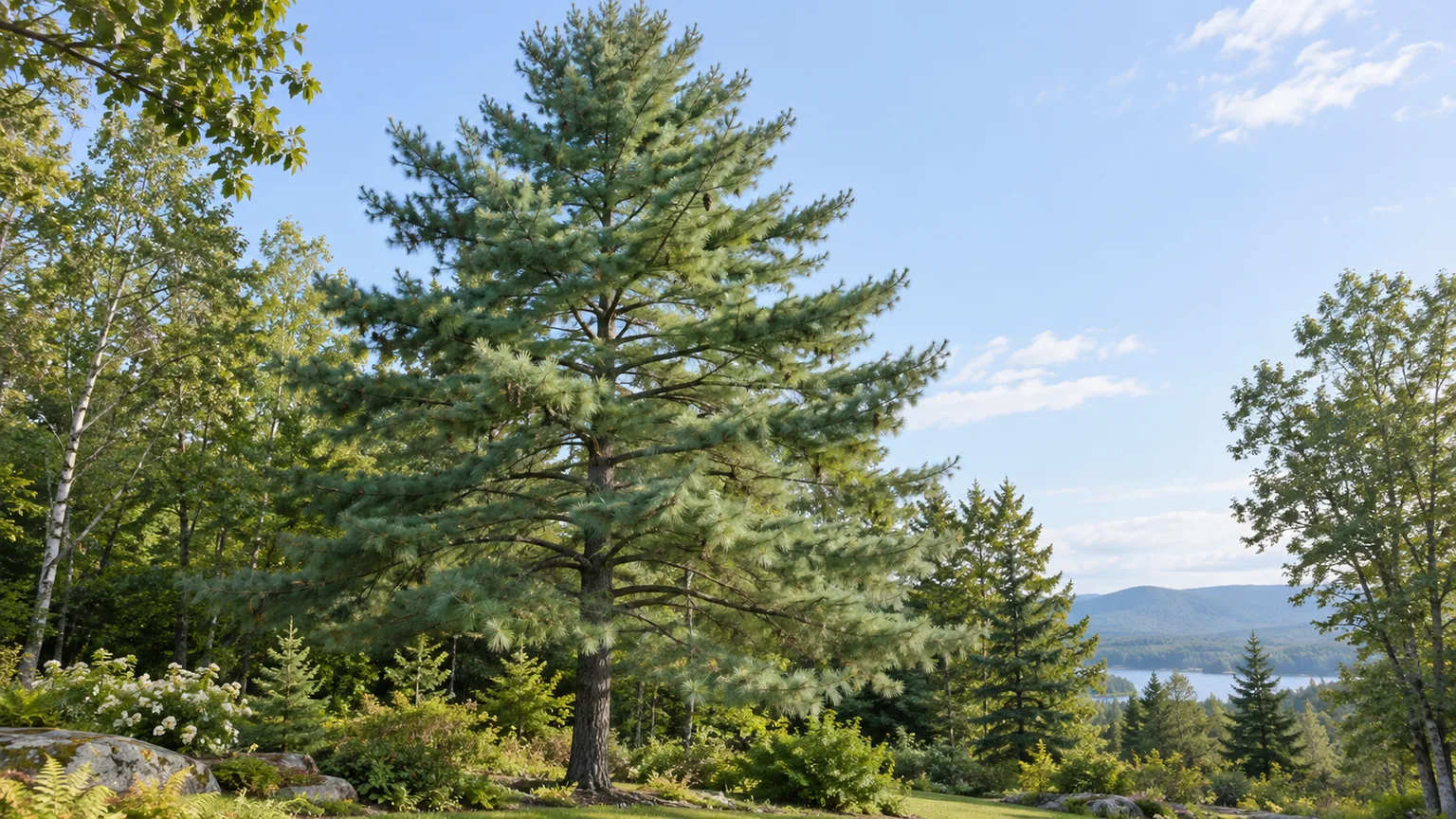
3. Eastern white pine (Pinus strobus) is a broad, soft-needled evergreen for a larger yard or open windbreak, not a tight hedge. Its long blue-green needles and layered silhouette bring a lighter texture than dense arborvitae, but an older tree can spread widely and cast substantial shade.
Give it overhead and lateral room before planting, and avoid sites where urban air pollution is a persistent stress. It is a better choice when you want an airy canopy and habitat value than when you need a narrow privacy column.
4. Monterey pine (Pinus radiata) grows rapidly in climates that suit it and can become a large, upright tree. That does not make it a broadly suitable backyard evergreen: its native range is limited to coastal parts of California and Mexico, and it is best considered where local climate, disease pressure, and regional tree guidance support it.
A fast-growing plant that is poorly adapted to the site will not provide reliable screening. Ask a local arborist or extension office before using it outside a proven regional planting context.
5. Norway spruce (Picea abies) is a cold-climate evergreen with a strong pyramidal form and long branches that can sweep toward the ground. It can make a substantial specimen or windbreak, but its eventual width is easy to underestimate when a young nursery tree has a narrow outline.
Give it room on all sides and avoid hot, dry locations where it may struggle. Its mature shape is more graceful when it is allowed to branch naturally instead of being clipped into a rigid flat wall.
6. Western redcedar (Thuja plicata) suits gardens with adequate moisture and room for a large tree. Its layered, drooping sprays provide a softer screen than tightly clipped hedging, and regional forms can make handsome windbreaks in the Pacific Northwest and other mild, moist settings.
It is not a reliable shortcut for a hot, dry yard that cannot be irrigated during establishment. Confirm the exact cultivar and its mature spread; selections sold for hedges may be narrower than the species.
7. Grand fir (Abies grandis) belongs on a genuinely large property where a tall forest-scale evergreen is the goal. It can grow quickly, but its potential height—well over 100 feet in good conditions—makes it a poor choice for an ordinary backyard or a boundary near buildings.
Choose a smaller conifer if you need a tree that can be maintained from the ground. A dwarf fir cultivar may fit a compact garden, but it will not give you the same quick, towering screen.
Narrow forms for vertical screening
Columnar evergreens are useful when the planting bed is narrow, but a narrow tree still needs a safe root zone, overhead clearance, and room for its mature height. They block a view best when repeated at a spacing that preserves their individual shape, not when their branches are forced into a crowded hedge.
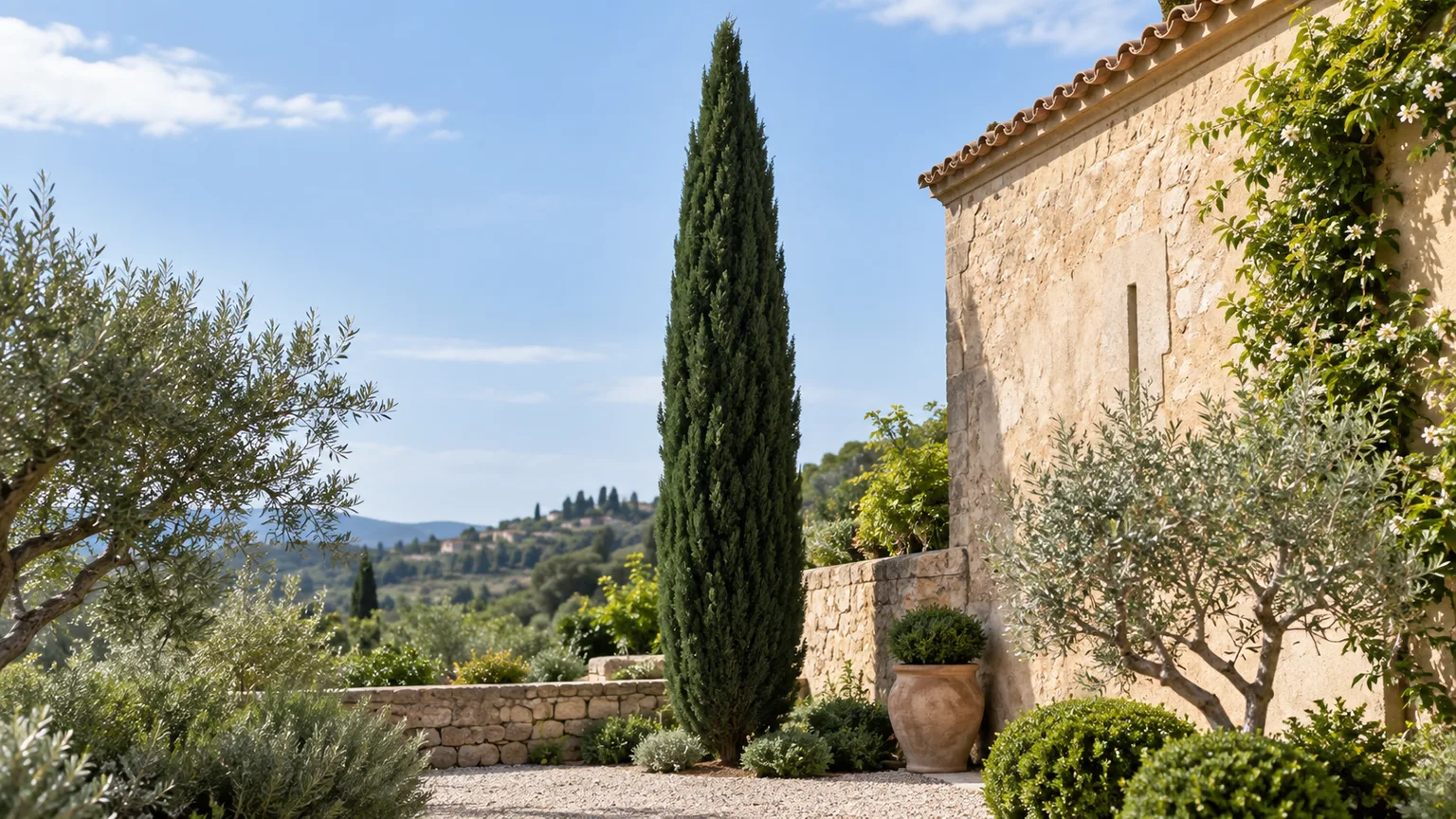
8. Italian cypress (Cupressus sempervirens) supplies the classic tall, pencil-thin silhouette for a warm, dry, Mediterranean-style landscape. Its upright form uses less ground width than most pines, but it can still become dozens of feet tall and is not a small foundation shrub.
Use it where winters are mild enough for the chosen cultivar and drainage is reliable. Avoid assuming that regular hard shearing will keep an overgrown specimen narrow; choose the desired mature size at purchase.
9. Skyrocket juniper (Juniperus scopulorum ‘Skyrocket’) is a blue-green, narrow cultivar that can add vertical structure where a broad tree would crowd a path or garden bed. It is more useful as a columnar accent or spaced screen than as a solid hedge that hides every sight line.
Junipers need a site with good drainage and airflow; cramped, damp conditions can invite foliage disease. Read the nursery label carefully, since other Rocky Mountain juniper cultivars have very different widths and growth habits.
10. Taylor juniper (Juniperus virginiana ‘Taylor’) is a slim Eastern redcedar selection valued for a naturally upright outline. It can be a practical screen in colder regions where an Italian cypress would fail, and it generally needs less clipping than a broad, fast-growing hedge.
Plan for height as well as width: a narrow crown does not make a tree safe under wires or against a roof. Confirm local availability and mature dimensions because cultivar descriptions can vary among nurseries.
11. American Pillar arborvitae (Thuja occidentalis ‘American Pillar’) is a narrow, vertical selection for cold-winter gardens that need evergreen coverage in a tight strip. It can be used as a line of upright trees, but the row still needs enough spacing to prevent branches from competing and becoming thin at the base.
Its foliage may bronze in winter, which is a seasonal color change rather than necessarily a health problem. If uniformity matters, buy plants with the same cultivar name and similar size.
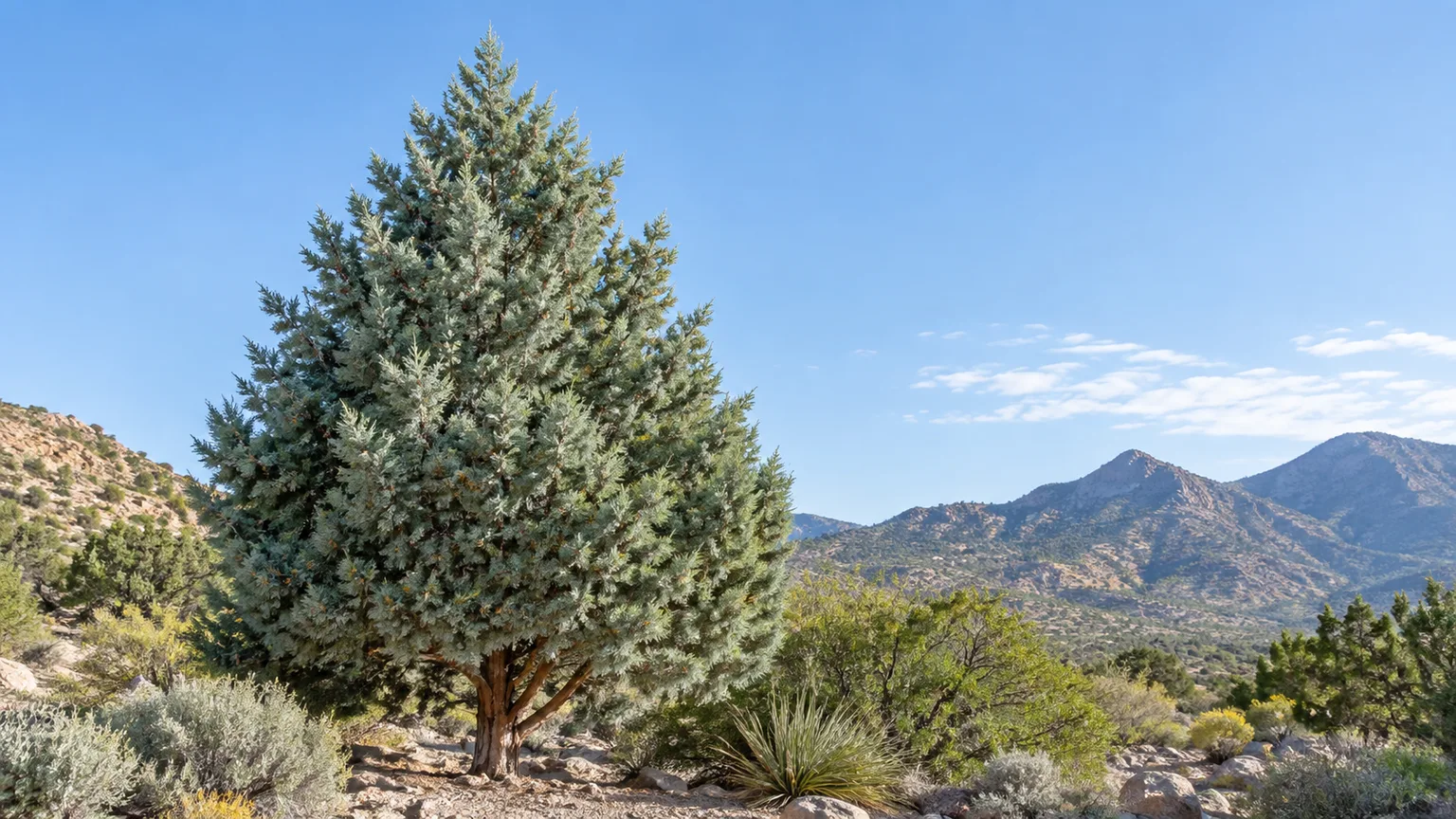
12. Carolina Sapphire cypress (Cupressus arizonica var. glabra ‘Carolina Sapphire’) brings airy blue-gray foliage and a quick-growing form to hot, sunny landscapes. It is a better candidate for well-drained sites in warm regions than for persistently wet soil or dense shade.
Its open crown offers lighter screening than a tight arborvitae hedge, so use it when texture and wind filtering matter more than a solid visual wall. Check how the cultivar performs in your county before planting a long row.
Broadleaf evergreens for softer screens
Broadleaf evergreens can add flowers, berries, and wildlife value alongside year-round foliage. They are often shrubbier than the word “tree” suggests, so check whether the plant you are buying is a standard species, a tree-form selection, or a compact cultivar.
13. Nellie R. Stevens holly (Ilex × ‘Nellie R. Stevens’) is a glossy-leaved, berry-bearing evergreen that can be trained as a small tree or maintained as a tall screen. Its dense branching can block a view more completely than a transparent, open-crowned conifer, but the mature width still needs to be planned.
Fruit production depends on flowering and pollination; ask the nursery whether another compatible holly is needed nearby for the crop you want. Keep the planting away from tight walkways if the cultivar has sharp leaf tips.
14. Common myrtle (Myrtus communis) is a smaller evergreen for mild-winter gardens where a fragrant, clipped hedge or compact tree is more appropriate than a giant conifer. Leathery leaves, white flowers, and dark berries add seasonal interest, and regular light pruning can help maintain a defined form.
It is not a cold-climate substitute for a spruce or arborvitae, and a severe winter can limit its usefulness outdoors. Choose it for a warm, protected site and the smaller scale it naturally offers.
15. Wax myrtle (Morella cerifera) grows quickly in warm regions and can function as a loose screen, wildlife planting, or large informal shrub. Its aromatic foliage and pale, waxy fruits give it a different look from needle-leaved evergreens.
Fruit is produced on female plants when pollination occurs, so a single plant may not deliver a heavy crop. It is a poor choice if you want a rigid, narrow hedge that needs little room; its informal habit is best with space to broaden.
16. Cherry laurel (Prunus laurocerasus) can form a dense, broadleaf evergreen screen and tolerates pruning better than many conifers. It also deserves a deliberate safety and regional check: NC State’s plant profile identifies cyanogenic compounds in its leaves, stems, and seeds.
Keep prunings away from children and animals, and check your local invasive-plant guidance before planting. Do not select it simply because a nursery tag says it tolerates shade.
17. Burford Chinese holly (Ilex cornuta ‘Burfordii’) is a heat-tolerant broadleaf evergreen with glossy, spiny leaves and red berries on female plants. It can be grown as a large shrub or trained into a small tree, but its size and thorny foliage make it better away from narrow passages.
NC State’s Chinese holly profile notes that the species has been listed as invasive in North Carolina and Georgia; check current local guidance before planting this cultivar, and consider a locally native holly where the species is discouraged. The berries can cause stomach upset if eaten in quantity, so keep fruit away from small children and pets.
Japanese black pine for a sculptural focal point
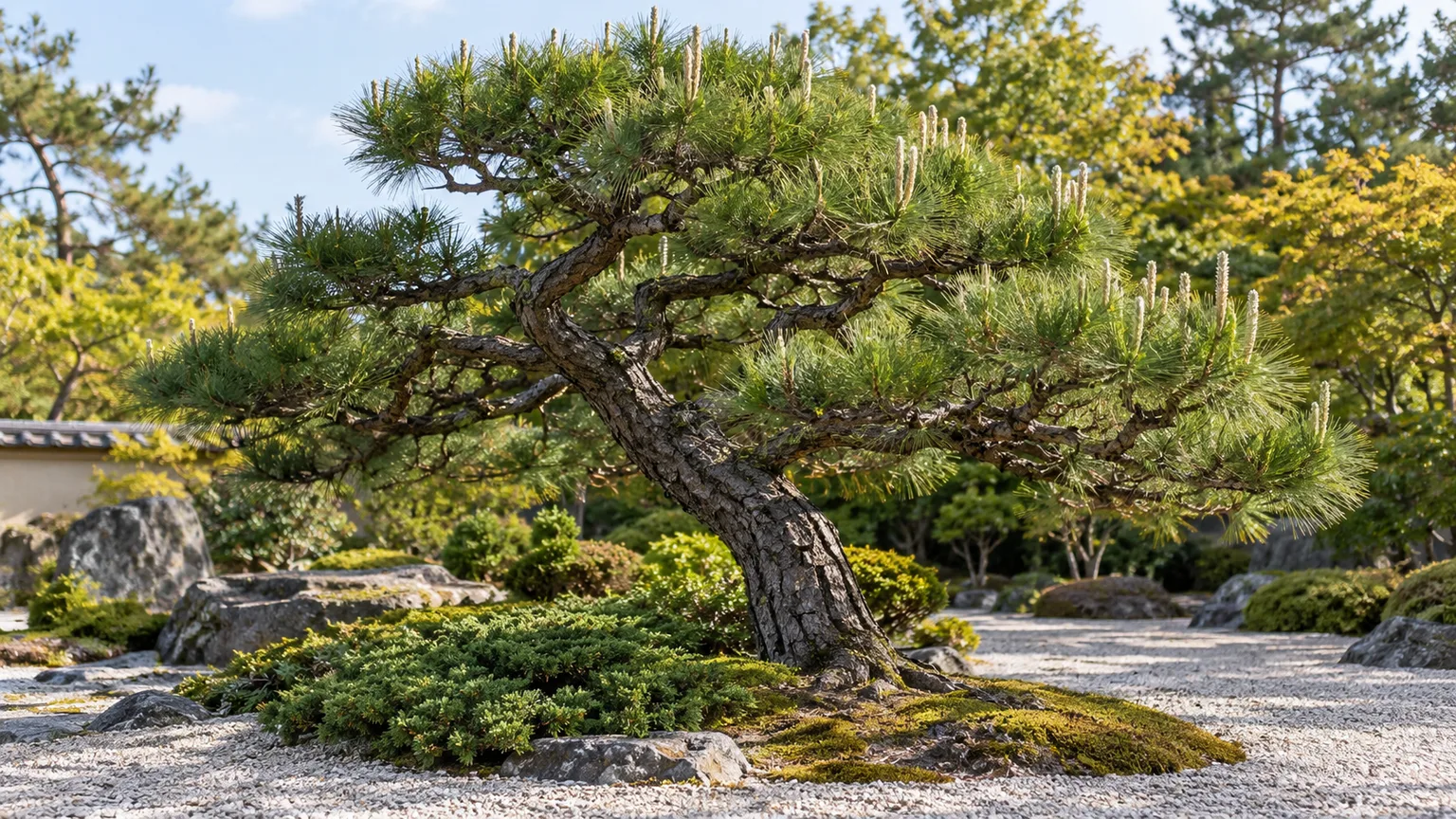
18. Japanese black pine (Pinus thunbergii) has a rugged, windswept character rather than the uniform outline of a privacy hedge. It can grow into a large, irregular tree, but selected cultivars and trained specimens are also used in compact gardens and bonsai.
Give an untrained landscape tree room to spread and avoid buying a bonsai cultivar when you want quick shade. It is especially worth considering in a coastal garden where its form suits the site, but local pests and climate should guide the final choice.
Compare the Shortlist Before You Buy
| Your main goal | Better candidates to compare | What can make them the wrong choice |
|---|---|---|
| Fast, tall screen on a large lot | Green Giant, Leyland cypress, wax myrtle in warm regions | Oversize, frequent pruning, disease or drainage stress |
| Narrow vertical accent | Taylor juniper, Skyrocket juniper, Italian cypress, American Pillar | The tree may be tall enough to conflict with wires or roofs |
| Broad windbreak | Eastern white pine, western redcedar, Norway spruce | Mature width, climate mismatch, or lack of airflow |
| Soft, flowering or berry-bearing screen | Holly, myrtle, cherry laurel, wax myrtle | Fruit, prickly leaves, toxicity, pollination, or local invasive status |
| Large specimen tree | Grand fir, Monterey pine, Japanese black pine | Too much mature scale, regional disease, or a poor climate match |
| Warm, dry landscape | Italian cypress, Carolina Sapphire, common myrtle | Drainage still matters; “drought tolerant” does not describe new transplants |
The quick comparison narrows the choices, but it cannot replace the plant tag and local advice. Names such as “arborvitae,” “cypress,” and “juniper” cover plants with different mature widths and climate tolerances. Confirm the botanical name and cultivar, then look up that exact plant in a regional extension or botanical reference before ordering several.
Plant for a Screen That Lasts
Set spacing from mature width
Do not use one spacing number for all 18 trees. A dense hedge may be planted closer than a row of specimen pines, but closer spacing does not make a large tree permanently smaller; it makes crowns compete sooner. Start with the mature spread on the cultivar label, decide whether you want individual crowns to touch or overlap, and preserve access to inspect and prune both sides of the planting.
For a narrow boundary, mark each trunk location with a stake and stand at the patio or window you want to screen. This reveals whether a staggered arrangement will block the actual sight line with fewer plants.
Keep trees clear of overhead wires, roofs, fences, walks, septic infrastructure, and property lines, and contact your local utility-locating service before digging. A tree that grows quickly can reach a conflict faster than expected.
Establish roots before chasing growth
Plant in a season when roots can establish without extreme heat or frozen ground, following local extension timing for your region. Set the root flare at or slightly above grade, spread roots into native soil rather than burying the trunk, and water the root ball thoroughly after planting. Apply a broad mulch ring to reduce grass competition, leaving space between mulch and bark so the trunk stays dry.
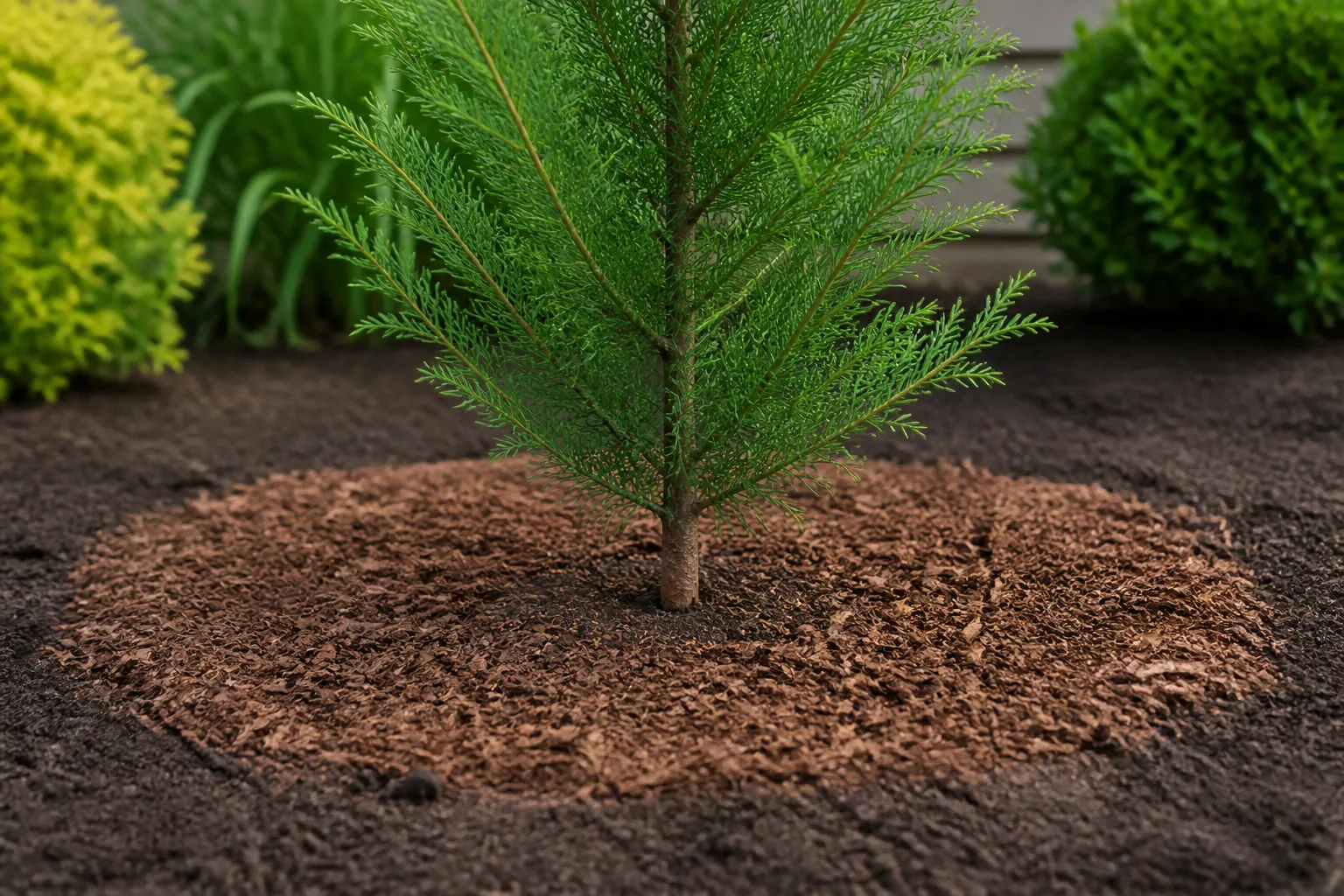
During the first growing season, check moisture in the root ball and surrounding soil rather than watering by the calendar alone. A new tree needs consistent moisture, but persistently saturated ground deprives roots of oxygen and can raise disease risk.
Once roots extend into the surrounding soil, adjust irrigation to rainfall, soil type, heat, and the needs of the species. Avoid heavy fertilizer as a shortcut: extra top growth does not compensate for a poorly established root system.
Plant diversity helps hedge longevity. Three kinds of evergreen planted in a repeated pattern can still look cohesive, but a mix is less vulnerable to a pest or disease that targets one species.
The Gardenia guide to evergreen privacy trees likewise emphasizes checking mature size, foliage density, climate, and exposure together rather than selecting only by growth speed. A professional hedge grower also documents how quickly unplanned Leyland growth can become a maintenance burden; treat that experience as a caution about managing size, not as a universal growth forecast (InstantHedge’s Leyland cypress alternatives).
Mistakes That Make Fast Growers a Poor Fit
Do not plan to top a tree into a small space
A fast-growing tree is not a compact tree. If it is already too large for the location on paper, repeated topping will not turn it into a low-maintenance choice.
Severe cuts can expose old bare wood, create weak regrowth, and leave permanent holes in a screen. Pick a naturally narrow or smaller plant when the space is tight, even if the first few seasons feel slower.
Another common mistake is planting a single-species wall because every tree on the nursery lot looks healthy. One stressed or diseased plant can expose the whole row to the same problem, while crowding limits airflow and makes inspection harder. If a particular species is known to struggle locally, a long uniform hedge multiplies that risk; ask a county extension office or certified arborist about alternatives before committing.
Finally, do not treat hardiness-zone numbers as a complete climate test. They describe average winter minimums, not summer humidity, reflected heat, salt spray, soil drainage, wind, or local disease pressure.
Compare regional plant references and observe which evergreens thrive nearby. A fast grower in one climate may grow slowly—or decline—in yours.
Conclusion
The best fast-growing evergreen is the one that reaches the screen or shade you want without outgrowing the site. Green Giant and Leyland cypress can make tall coverage quickly on roomy, well-drained properties; narrow junipers and Italian cypress fit a more vertical design; broadleaf hollies and myrtles add flowers, fruit, and a softer outline; very large pines and firs belong where they can mature.
Measure first, verify the exact cultivar, and use its mature width and local climate fit to set spacing. Give new roots steady moisture without waterlogging, and avoid planting a row so tightly that future pruning becomes unavoidable. Those choices may delay the first closed-in view, but they are much more likely to leave you with a healthy screen you can keep.