How to Manage Rose Sawflies on Rose Bushes Safely
Learn where rose sawfly larvae hide, remove them by hand or water, and decide when a labeled treatment is justified while protecting your roses and pollinators.
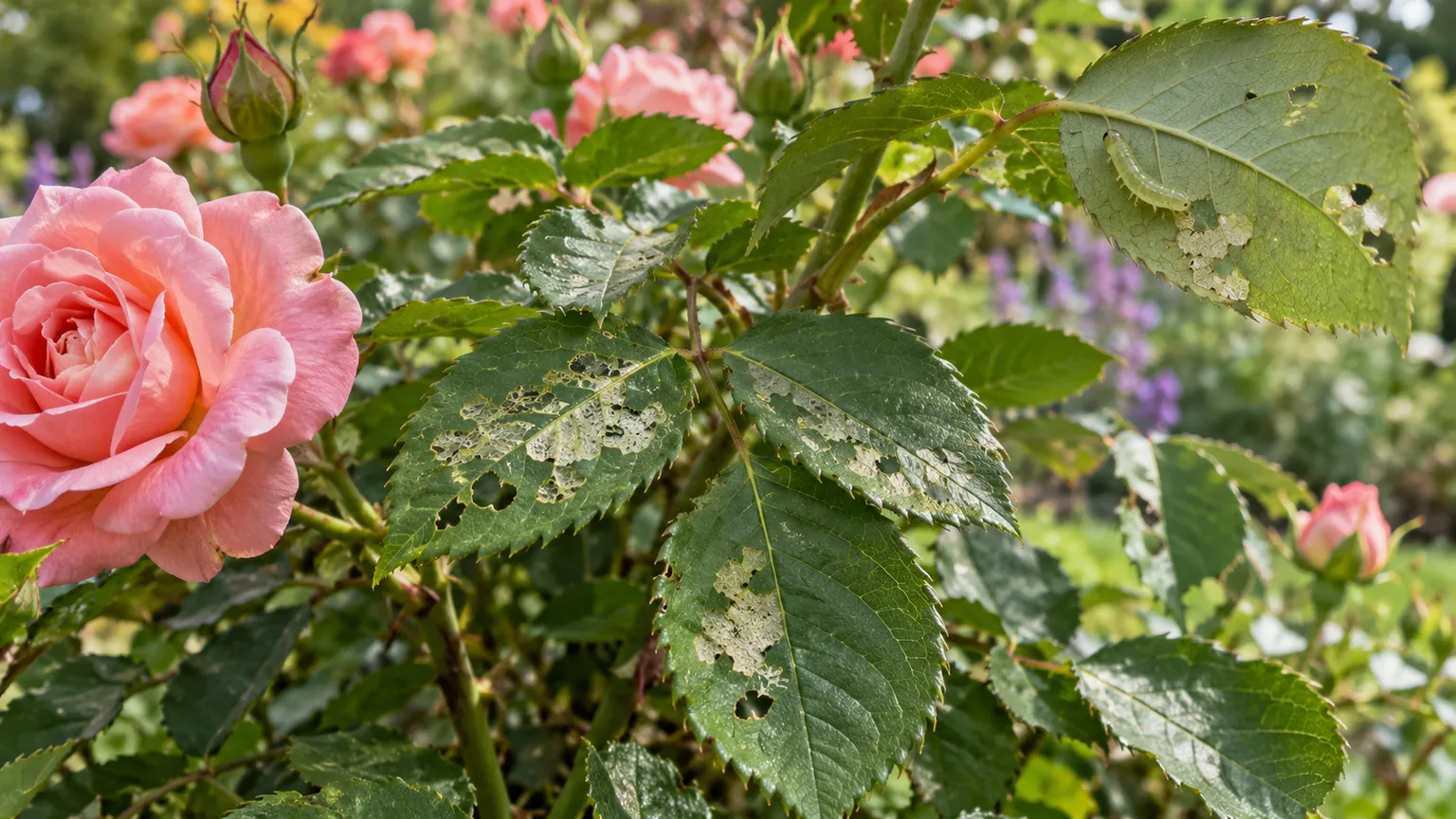
Rose sawfly larvae can leave rose leaves pale, lacy, or full of holes, but leaf damage alone does not tell you whether the insects are still there. Turn the leaves over and look for small, soft-bodied larvae before reaching for a spray. If you find only old damage, treatment cannot repair those leaves; if larvae are present, a few targeted steps often control a small outbreak without disturbing the rest of the garden.
The name “rose slug” adds to the confusion. These pests are not true slugs and are not butterfly or moth caterpillars. That distinction matters because it changes which products work and which beneficial insects you might protect while controlling them.
What rose sawflies are—and what “rose slug” means
Rose sawflies are members of the wasp order, Hymenoptera. The adult is a small, non-stinging sawfly; the leaf-eating stage is its larva, often called a rose slug or roseslug because its smooth, slightly shiny body can look slug-like.
The larva is the stage to find and manage. Adult sawflies are not responsible for the familiar scraped patches on rose leaves.
Several species feed on roses, and their appearance and habits overlap. Common examples include the common roseslug (Endelomyia aethiops), bristly roseslug (Cladius difformis), and curled rose sawfly (Allantus cinctus).
UC IPM notes that these species vary in how they feed and where they pupate; some scrape leaf tissue, some chew through it, and some may form a pupation chamber in a stem. A single calendar or one visual description therefore cannot represent every rose sawfly in every region (UC IPM’s rose sawfly guide).
A typical cycle includes eggs, feeding larvae, pupae, and adults. Depending on the species, females insert eggs along a leaf margin or midrib; young larvae then feed before leaving the foliage to pupate in litter, on a leaf, in soil, or—in some species—a stem.
The number of generations varies with species and location: Illinois Extension describes one generation for the European roseslug, two for the curled rose sawfly, and six or more for the bristly roseslug in Illinois. Use local season and what you see on the plant, rather than assuming the pest appears only once in spring (Illinois Extension’s rose sawfly guide; Missouri Botanical Garden’s rose and pear sawfly guide).
How to identify rose sawfly larvae and look-alikes
A rose sawfly larva is usually green to yellow-green, with a small brownish or pale head; depending on species, it may be smooth, lightly bristled, or marked with short projections. It may be only a few millimeters long when young and grow to roughly three-quarters of an inch. Its location is often more useful than color: inspect the leaf surface that is being scraped and the undersides of nearby leaves, where larvae commonly rest.
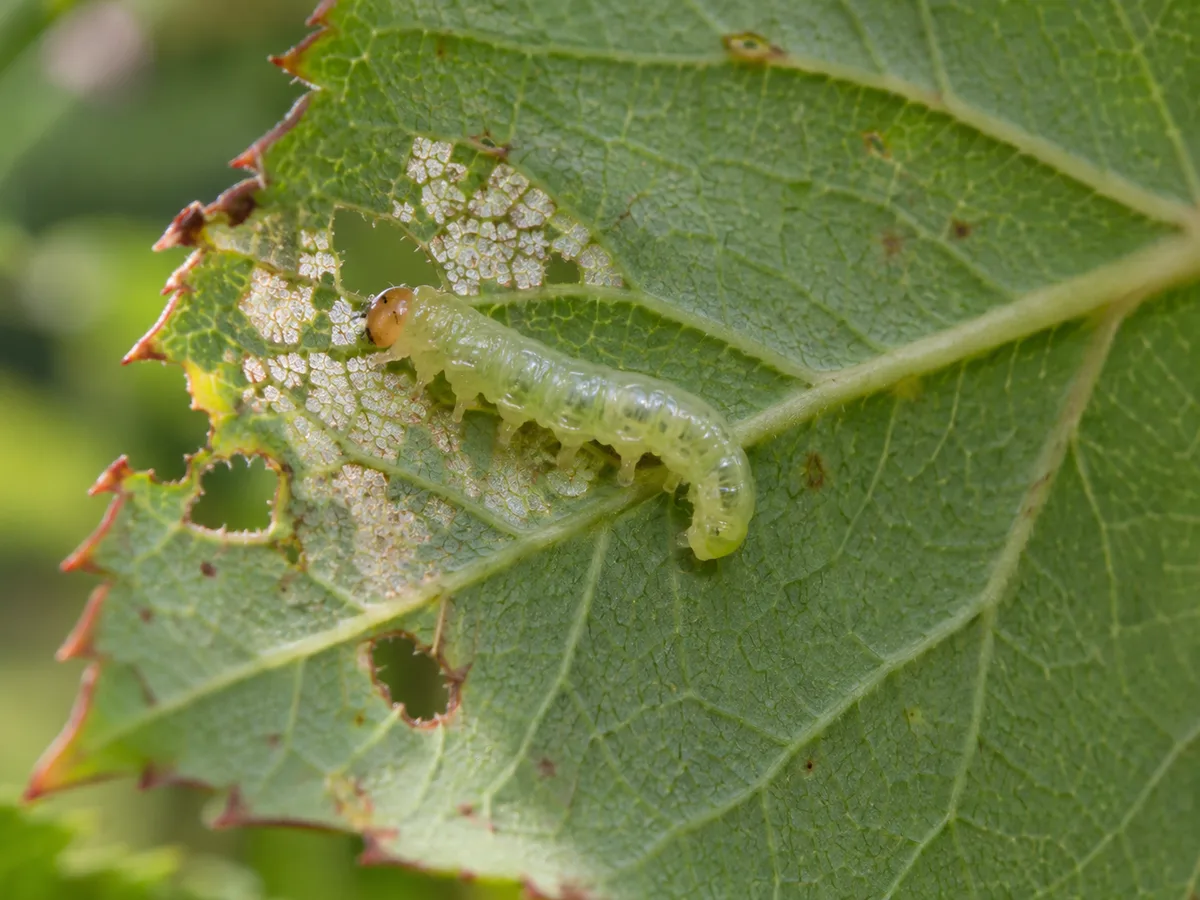
The “rose slug” is a sawfly larva. Match a visible larva with fresh feeding before deciding to treat.
Caterpillars are also plant-eating larvae, but they belong to moths and butterflies, not sawflies. One useful clue is the number of fleshy abdominal prolegs: UC IPM describes rose sawfly larvae as having prolegs on at least six abdominal segments, while most caterpillar-like larvae found openly on foliage have five or fewer. That detail can be difficult to judge with a small moving larva, so treat it as a supporting clue, not a reason to handle or identify every insect under a magnifier.
A true slug is a mollusk with no insect legs, and it tends to leave irregular chewing rather than the thin, papery “window” made when a sawfly larva scrapes one leaf surface. Also distinguish rose sawflies from beneficial hoverfly larvae: hoverfly larvae often occur among aphids and have no true legs; sawfly larvae occur beside chewed or scraped tissue. UC IPM recommends using both the insect’s location and the damage pattern to avoid removing a helpful predator by mistake.
Match the leaf damage to a live larva
Early feeding can look like translucent windows where green tissue has been scraped away but veins and the opposite leaf surface remain. As some larvae grow, they chew through the leaf and leave holes; other species may chew from an edge or consume most of the leaf between veins. Missouri Botanical Garden describes heavier damage as papery foliage that can turn brown and scorched-looking when defoliation is extensive (Missouri Botanical Garden).
Fresh damage plus a larva is stronger evidence than either clue alone. Holes can come from beetles, caterpillars, leafcutter bees, or other insects; old translucent patches may remain long after the feeder has pupated.
If you cannot find larvae after checking several damaged leaves, pause before spraying and inspect again later. A product applied after the feeding stage has left the plant has no target to control.
What rose sawfly damage means for the plant
Light feeding is usually a cosmetic problem on an established, healthy rose. A few scraped or perforated leaves do not automatically justify pruning or pesticides, and UC IPM says sawfly feeding generally makes foliage unsightly; severe feeding may reduce later blossoming, but it usually does not threaten the survival of a healthy rose.
The decision changes when new damage keeps appearing across many leaves, a young or already stressed rose is losing a substantial part of its foliage, or the plant is trying to recover from another problem. Repeated defoliation reduces the leaf area available to support growth and flowering.
In that situation, controlling larvae early is worthwhile—not because a single leaf must be perfect, but because the plant has less reserve to replace leaves after repeated feeding. Missouri Botanical Garden likewise distinguishes light-to-moderate cosmetic injury from heavy leaf loss that can stress a shrub.
Do not use a fixed percentage of damaged leaves as a universal treatment threshold. A vigorous mature shrub can tolerate more cosmetic injury than a newly planted rose in drought or a plant with disease. Instead, combine three observations: whether live larvae are present, whether damage is spreading, and how much healthy foliage the rose has left.
When and where to inspect roses
Start checking when new rose growth is expanding in spring, but continue through the growing season if you have seen larvae before. Timing varies with climate and species; UC IPM reports one or more generations in California, and Illinois Extension describes one to six or more generations for different species in Illinois. In a warm region or a garden with recurring damage, a one-time spring check can miss later larvae.
Inspect in daylight, when you can see the leaf surface clearly. Begin with the newest tender leaves and any foliage showing pale scraped patches or small holes.
Turn leaves over, then check the upper surface too: different rose sawfly species feed from different sides, and some larvae may move or hide along veins. Look for a small larva near the edge of fresh damage, not just any green insect on the bush.
A short, repeated inspection is more useful than an occasional long search. While sawfly larvae are active, scan the same few branches every several days, especially after you notice fresh feeding.
Mark a branch mentally or with a garden note so you can tell whether damage is advancing. Garden writers at Hobby Farms and Hedgerow Rose also emphasize that spotting the larvae early makes hands-on control more manageable, but extension guidance should take priority on identification and pesticide choices (Hobby Farms; Hedgerow Rose’s garden observations).
A staged plan for managing active larvae
Use the least disruptive step that matches the number of larvae and the amount of fresh feeding. The simplest path is direct removal for a few visible larvae, a directed water spray for a larger scattered group, and selective pruning only when a limited leaf or shoot is heavily infested. Reserve pesticide products for repeated, substantial feeding that continues after these steps, and only when a current product label supports the use.
| What you find | First response | What to check next |
|---|---|---|
| A few larvae on one or two leaves | Pick them off or remove the affected leaf | Recheck nearby leaves in several days |
| Several larvae spread across a shrub | Direct a controlled water spray at both leaf surfaces | Look for fresh feeding and remaining larvae |
| Repeated heavy feeding on vulnerable roses | Confirm the pest and assess remaining foliage | Consider local extension advice and labeled options |
| Old holes or pale patches, no larvae | Do not spray the old damage | Inspect again only if new feeding appears |
Remove a small group by hand
For a small infestation, pick larvae off with gloved fingers, tweezers, or a small container and destroy them in a way that prevents them from returning to the plant. If handling is unpleasant, clip only the leaf that carries a cluster of larvae and place it in household waste. Avoid stripping every damaged leaf from the rose; the remaining green foliage is still helping the plant recover.
Check both sides of the leaf and nearby new growth, because removing the larvae you see on one leaf does not prove that the rest of the shrub is clear. A practical rose-growing article from Hobby Farms describes the trade-off well: hand removal can work for a few larvae, but searching and removing them one by one becomes laborious as the population spreads. At that point, a water spray or limited pruning may be more efficient than repeatedly squashing isolated larvae (Hobby Farms).
Dislodge scattered larvae with water
A firm stream from a hose can knock soft-bodied larvae off leaves, especially when you aim from below and above rather than wetting only the outer canopy. Use enough force to move the larvae, not enough to tear tender growth or strip flowers. Illinois Extension and Missouri Botanical Garden both list water as a control option, and UC IPM recommends handpicking or clipping a small infested portion when that is more practical (Illinois Extension; Missouri Botanical Garden).
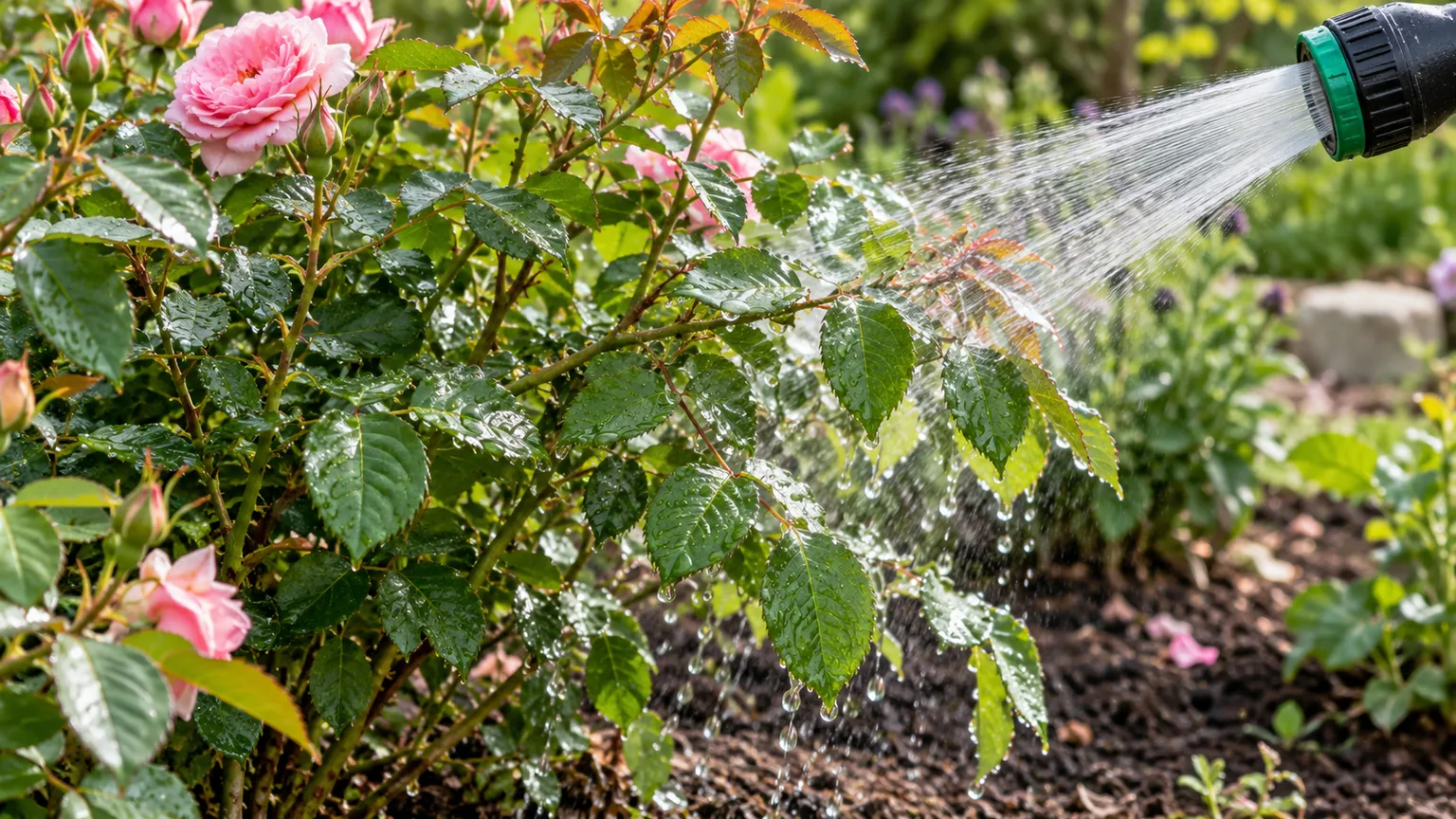
Aim the spray at the leaf undersides and use a pressure that will not shred leaves or flowers.
Do this when foliage can dry promptly—typically in the morning—and avoid repeated overhead wetting late in the day, particularly where black spot or other foliar disease is already a concern. Afterward, inspect again rather than assuming every larva is gone. Water moves insects off the plant; it does not create a lasting barrier, and some larvae may be missed in crowded growth.
Prune only when a leaf or shoot is heavily infested
If one leaf or a small shoot carries most of the larvae, removing that portion can be simpler than treating the whole shrub. Keep the cut selective and retain as much healthy foliage as possible. Put the removed material in sealed household waste rather than leaving it under the plant, where larvae or pupae could remain close to the rose.
Do not make a severe pruning cut just because the leaf looks skeletonized. The damage is in the leaf tissue; cutting back healthy canes will not remove larvae that are on other leaves or pupating elsewhere.
If an entire stem is wilting or dying, inspect for a different cause as well. Some rose sawfly species can pupate in stems, but widespread dieback is not proof of that species and may require a separate diagnosis.
When a pesticide may be justified
Consider a pesticide only when you have confirmed live rose sawfly larvae and fresh feeding continues to threaten a young, weak, or repeatedly defoliated plant despite practical hand removal, water, or selective pruning. A spray is not a way to repair old leaves, prevent a future generation reliably, or treat every green insect on a rose. On a healthy mature shrub with a few larvae, the likely benefit may be smaller than the risk to pollinators and other insects.
Some contact products—including certain soaps, oils, or other labeled insecticides—may control exposed larvae when they directly reach the insect. But the exact product, active ingredient, allowed plant, target pest, rate, weather limits, and retreatment interval vary by location and label.
Read the entire current label before use; do not rely on an old article, a brand name, or a recipe found online. If the label does not clearly allow use on roses and the pest you are targeting, choose another approach or contact your local extension office.
Check the label and protect pollinators
Coverage matters for contact products: larvae tucked under leaves may not be affected if spray reaches only the top of the canopy. Follow the label for application method, protective equipment, re-entry, weather, and repeat interval, and never increase the dose to compensate for missed coverage. Test a small area if the label recommends it, because oil- or soap-based products can injure foliage under some conditions or on sensitive cultivars.
Protect bees and other beneficial insects as carefully as the rose. Do not spray open flowers or active pollinators, and follow any pollinator restrictions on the specific label. UC IPM specifically cautions that spinosad can harm bees and certain natural enemies and says not to apply it to flowering plants; “organic” or “natural” does not mean harmless.
UC IPM also advises avoiding persistent broad-spectrum products such as carbaryl and pyrethroids because they can harm bees and natural enemies and may affect aquatic organisms when they move off site. If a treatment appears necessary during bloom, a local extension specialist can help determine whether a lower-risk option is appropriate for your region and pest.
Why Bt and routine preventive sprays are poor fits
Products based on Bacillus thuringiensis (Bt) are used against susceptible caterpillars, but rose sawfly larvae are not caterpillars. UC IPM and Missouri Botanical Garden both state that Bt is not effective for sawflies. Applying it because a larva looks like a caterpillar wastes effort and can delay a useful response.
A routine systemic treatment in the soil is also a poor default for an occasional leaf-feeding pest. You need to know that larvae are present before choosing a response, and preventive insecticides can expose pollinators or natural enemies without a confirmed target.
Rose sawfly species also differ in their timing and pupation sites, so a single soil application does not reliably address every stage or region. Monitor first, then treat only active feeding when the plant’s condition warrants it.
Avoid blanket soil cultivation around every rose as a universal “pupa removal” method. Some sawflies pupate in litter or soil, but others may pupate in leaves or stems; disturbing a shrub’s root zone can create a separate problem while missing the insects you intended to expose. Remove localized infested material and use the life-stage evidence on your plant to guide the next step.
Help a rose recover after feeding
Once you stop active feeding, leave the plant’s healthy leaves in place. A rose that has lost some foliage may produce new growth when conditions are favorable, but regrowth depends on its health, the season, water availability, and how much leaf area remains. Do not fertilize heavily to force a quick flush: excess growth can be soft, and fertilizer will not replace damaged leaves overnight.
Keep moisture steady at the root zone during dry weather, avoid unnecessary pruning, and follow ordinary rose care for your climate. If the plant has other problems—black spot, drought stress, poor drainage, or root damage—address those separately rather than assuming sawfly feeding explains every yellow or wilting leaf. Continue checking for larvae while new foliage expands, because fresh growth can attract another round of feeding if adults lay eggs later in the season.
Reduce repeat damage without disrupting the garden
The most dependable prevention is early detection. During the period when roses are producing tender new leaves, make a quick underside check during routine watering or deadheading. If you have had repeated infestations, keep checking throughout the growing season rather than relying on a calendar date; species and generations vary by climate.
Remove a small number of infested leaves promptly, keep the rose in good overall condition, and avoid broad-spectrum sprays that eliminate predators along with pests. Rose sawfly populations have natural enemies, including parasitic wasps, predatory beetles, and birds; UC IPM and Missouri Botanical Garden describe these organisms as part of natural population control. They can help reduce pressure, but they will not always prevent visible damage in a particular season.
A diverse garden can support beneficial insects, but planting companion flowers is not a direct treatment and will not guarantee that sawflies stay away. Do not buy predatory insects or add plants on the promise of eliminating rose sawflies.
The immediate decision still comes down to whether larvae are present, how much fresh feeding is occurring, and how resilient the rose is. Responsible pesticide use helps preserve the natural enemies already working in the garden.
Common mistakes that waste effort
Treating the name as a diagnosis. “Rose slug” sounds like a mollusk, while the larva resembles a caterpillar. Confirm the insect and its feeding evidence before choosing a product; a control intended for slugs or caterpillars may not work on a sawfly.
Spraying old damage. A leaf can stay pale or perforated after the larva has moved on to pupate. Check for live insects and new feeding first. If there are no larvae, wait and monitor instead of applying a contact spray with no target.
Spraying only the visible top of the plant. Larvae may sit on the underside or move to a different leaf surface depending on species. A treatment that requires direct contact must reach the pest, so coverage and label directions matter more than the number of times you spray.
Assuming every green larva is harmful. Some larvae on roses are beneficial predators that feed on aphids. Use location and feeding pattern together; if the insect is among aphids and there is no adjacent leaf scraping, do not automatically remove it.
Using “organic” as a safety shortcut. Natural-origin products can still injure beneficial insects, bees, or the rose itself. Read the label, avoid open blooms and active pollinators, and use nonchemical methods first when the infestation is small.
Removing too much foliage. A badly damaged leaf is unattractive, but broad defoliation by the gardener can compound stress. Remove only leaves that are heavily infested or no longer useful, then let healthy foliage support recovery.
Conclusion
For rose sawflies, start with the leaf underside and confirm that live larvae are still feeding. A few larvae are usually manageable by hand; a scattered group can often be dislodged with a controlled water spray, while selective pruning is useful only for a localized infestation.
If feeding continues and the rose is losing substantial foliage, confirm the pest, check local guidance, and use a current product label to decide whether any treatment is appropriate. Avoid Bt, routine preventive sprays, and broad-spectrum applications that put pollinators or natural enemies at unnecessary risk. Then keep inspecting new growth: timely observation is the most reliable way to catch another generation before it becomes a serious problem.



