How to Grow and Care for Rhaphidophora Decursiva
This Rhaphidophora decursiva care guide explains how to encourage mature divided leaves, choose a moss pole, avoid root rot, and propagate healthy cuttings.
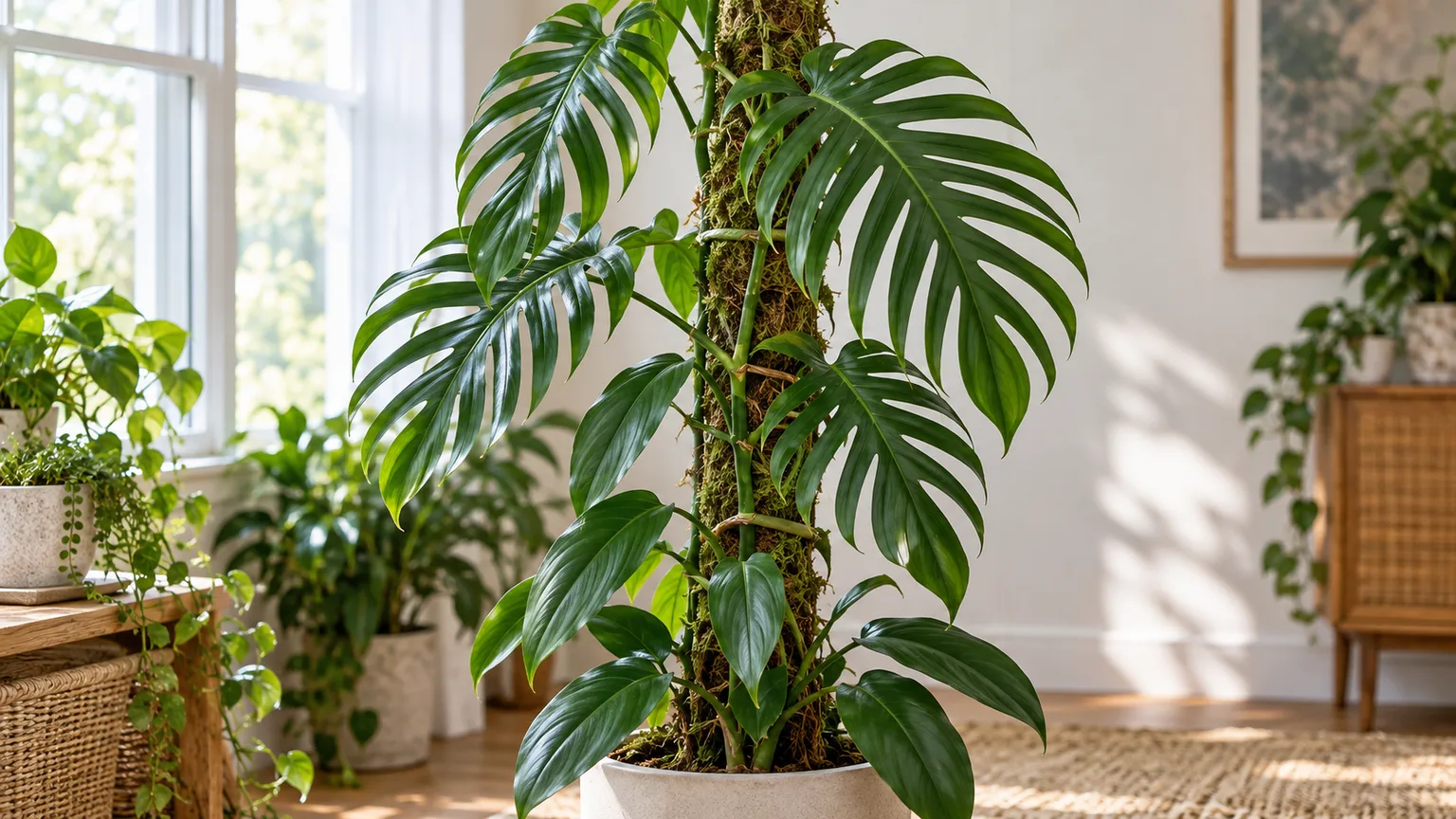
Rhaphidophora decursiva is a climbing tropical aroid whose leaves can change dramatically as the plant matures: young foliage is simple, while mature leaves become deeply divided into long, narrow lobes. The most useful care priorities are steady bright light, a well-drained root zone, and a support the vine can climb; a moss pole by itself cannot make an undersized or poorly lit plant produce mature leaves.
This species is often sold as a “dragon tail plant,” but common names are applied loosely in the houseplant trade. Start by confirming the botanical name on the label, then match care to the plant’s actual growth and the conditions in your home rather than a fixed watering schedule.
Identify Rhaphidophora decursiva before you troubleshoot it
Kew accepts Rhaphidophora decursiva as the botanical name and places it in the aroid family, Araceae. Monstera decursiva appears among its historical synonyms, which explains why older labels may use “Monstera,” but the accepted genus is Rhaphidophora. Kew’s Plants of the World Online records its native range from the Indian subcontinent through southern China and Indochina and describes it as a climber of wet tropical regions.
Juvenile leaves may be entire, or without deep cuts, and can look quite different from the large adult foliage people expect. The botanical treatment in Flora of China describes mature R. decursiva leaves as irregularly and asymmetrically pinnately divided; it also notes historical confusion with Epipremnum pinnatum, another climbing aroid that can develop divided leaves. A label that says only “dragon tail” is not enough to distinguish these plants, so compare the scientific name and the leaf shape rather than relying on the common name.
This plant does not need to show adult foliage immediately to be healthy. A small nursery plant, a recently propagated cutting, or a vine grown without a climbing surface may still carry simple leaves; assess its new growth over time instead of judging it by one leaf.
At-a-glance care that fits a real home
| Care factor | Practical starting point | What to adjust |
|---|---|---|
| Light | Bright, filtered or indirect light | Increase light gradually if stems stretch or growth stalls |
| Water | Water thoroughly after the upper mix begins drying | Check the pot as well as the surface; slow down in dim, cool months |
| Potting mix | Airy, moisture-retentive mix in a pot with drainage | Make it chunkier if it stays wet too long |
| Support | Stable vertical pole, board, or trellis | Choose a structure that can hold the climbing vine as it grows |
| Temperature | Warm, steady indoor conditions | Protect from cold drafts and sudden drops |
| Humidity | Average indoor humidity can work | Add a humidifier if dry air repeatedly damages new leaves |
These are starting points, not a prescription for every room or container. A large plant in a warm, bright spot can use water much faster than a small cutting in a cool room, and a dense peat-heavy mix dries differently from a coarse bark-and-perlite blend. Plant Proper’s species care guide likewise recommends bright indirect light, allowing the upper mix to dry between waterings, and reducing fertilizer outside the growing season.
Give it bright, indirect light
Set the plant near a bright window where it receives plenty of daylight without prolonged, hot sun through the glass. An east-facing window often gives gentle morning light; a bright north-facing location may work in some homes, while a west- or south-facing window may need a sheer curtain or a little distance from the glass. Watch the leaves and stems rather than assigning the window a universal rating, because nearby buildings, overhangs, and seasonal sun all change the light a plant receives.
Low light usually shows up first in the growth pattern: longer gaps between leaves, stems stretching toward a window, smaller new foliage, or a plant that makes little progress during the bright part of the year. The University of Minnesota Extension’s indoor-light guide describes leggy stems and stretched internodes as signs of insufficient light and notes that plants in dimmer conditions grow more slowly and use less water. That last point matters: if the plant moves into a darker spot, keep the old watering interval from driving you to water a pot whose mix is still damp.
Too much direct sun can bleach or scorch the leaves, particularly after a move from a sheltered nursery or a dim interior. If you take the plant outdoors for a warm season, acclimate it over several days in bright shade first, then move it only to a spot where the foliage is protected from the strongest afternoon rays. Bring it back indoors before cold weather, inspect the undersides of leaves for pests, and give it time to adjust to the lower indoor light.
Add vertical support before stems sprawl
In its native range, R. decursiva is a climbing vine, not a compact self-supporting shrub. The Flora of China description records it growing along the ground, over rocks, or up trees; its stem roots help it attach as it climbs. A support therefore gives the plant a direction and lets you manage its size, but it is not a shortcut that guarantees giant leaves.
A moss pole is useful when you want the vine’s aerial roots to meet a textured surface and you are willing to keep the pole appropriately moist. A board, plank, or sturdy trellis can be simpler to maintain and still keep the stems upright; however, smooth, dry supports may provide less root contact. Choose the support based on how much maintenance you can realistically provide, and make sure it is anchored deeply enough in the pot or secured to a stable stake so a top-heavy vine cannot tip the container.
Place the support close to the back of the stems when potting or repotting, because pushing a large pole through an established root ball can cause avoidable damage. Use soft plant ties to hold the stem loosely against the support, leaving room for it to thicken, and point the side of the stem with aerial-root nubs toward the pole. The Royal Horticultural Society’s guide to tropical aroids describes aroids’ natural forest-floor and climbing-tree habits; that context helps explain why a vertical structure can suit this plant better than letting a long vine hang unsupported.
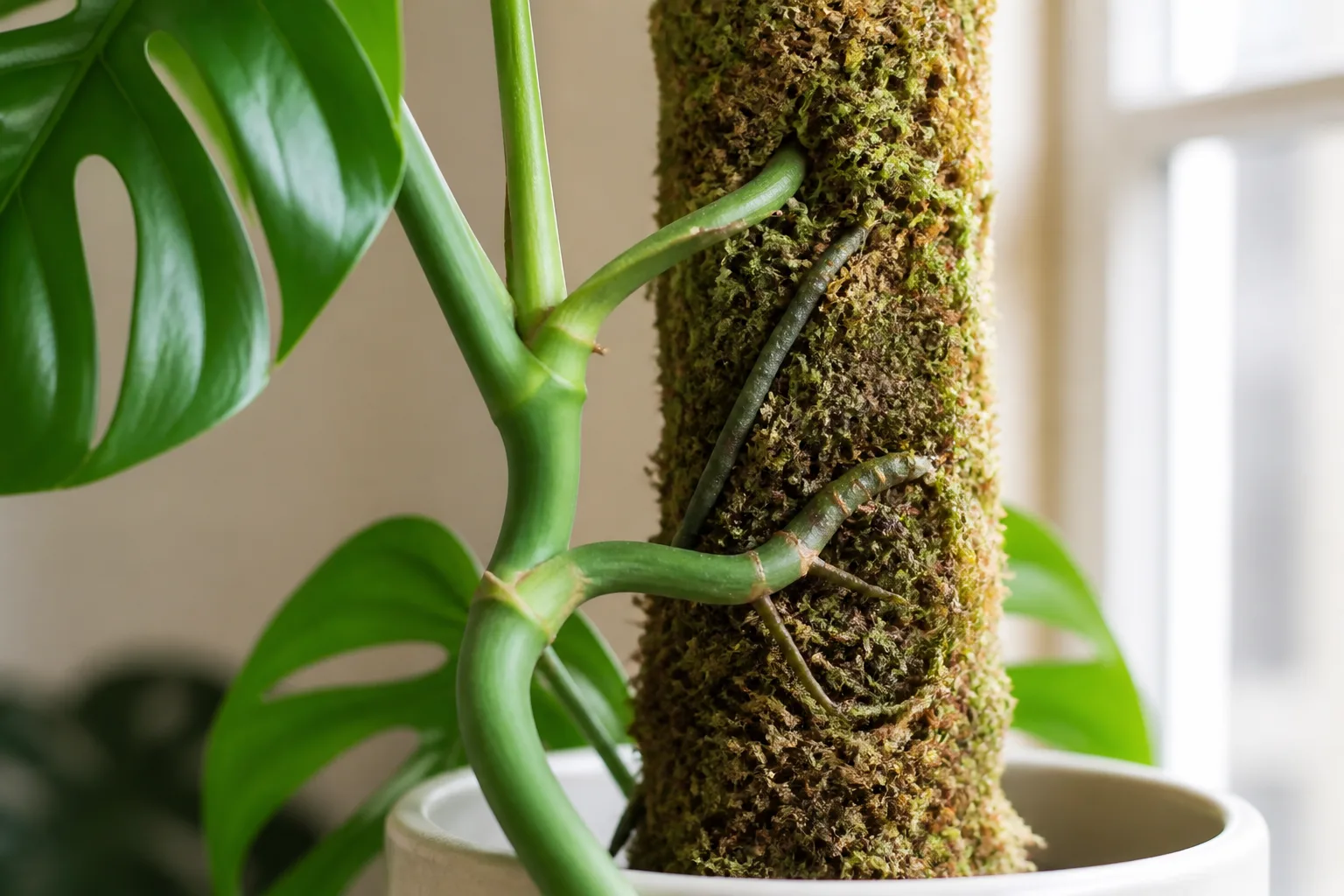
As the vine reaches the top, extend the pole or redirect the growing tip while it is still flexible. Do not force a stiff, older stem around a tight corner; train one new section at a time and avoid cinching ties around petioles, which need to move as the leaves turn toward light. If your goal is a compact plant rather than a tall specimen, prune the vine and accept that it may not develop the same mature form as a well-lit climber.
Water by checking the root zone, not a calendar
Check the mix before watering by feeling the upper couple of inches with a finger or a clean wooden stick. If that layer is still cool and damp, wait and check again later; if it is dry while the deeper root zone is only faintly moist, water thoroughly until excess runs from the drainage holes. Empty the saucer or decorative cachepot afterward so the plant does not sit in collected water.
Do not use “once a week” as a rule. The actual interval changes with pot size, root mass, the mix, temperature, light, and whether the plant is producing new leaves; it may need more frequent checks in warm active growth and fewer in winter or a dim room. Plant Proper advises letting the top few inches dry between waterings, while practical species guides vary in their suggested timing. Treat any calendar estimate as a reminder to inspect, not as proof that the plant needs water.
A plant that droops is not automatically thirsty. Check the mix and the stem base first: a dry, light pot may need a thorough drink, while a heavy pot with persistently wet mix, yellowing lower leaves, or a sour smell needs better drainage and closer root inspection. Repeated small sips are also unhelpful because they can leave parts of the root ball dry while the surface stays wet; water slowly across the whole surface and let the pot drain.
Use an airy mix that still holds some moisture
The goal is a mix that holds enough water for the roots to take it up while leaving air spaces after watering. A dense, fine potting mix can stay saturated around the roots, especially in a pot that is too large or a room with limited light; an extremely coarse mix can dry so quickly that the plant wilts before the next check.
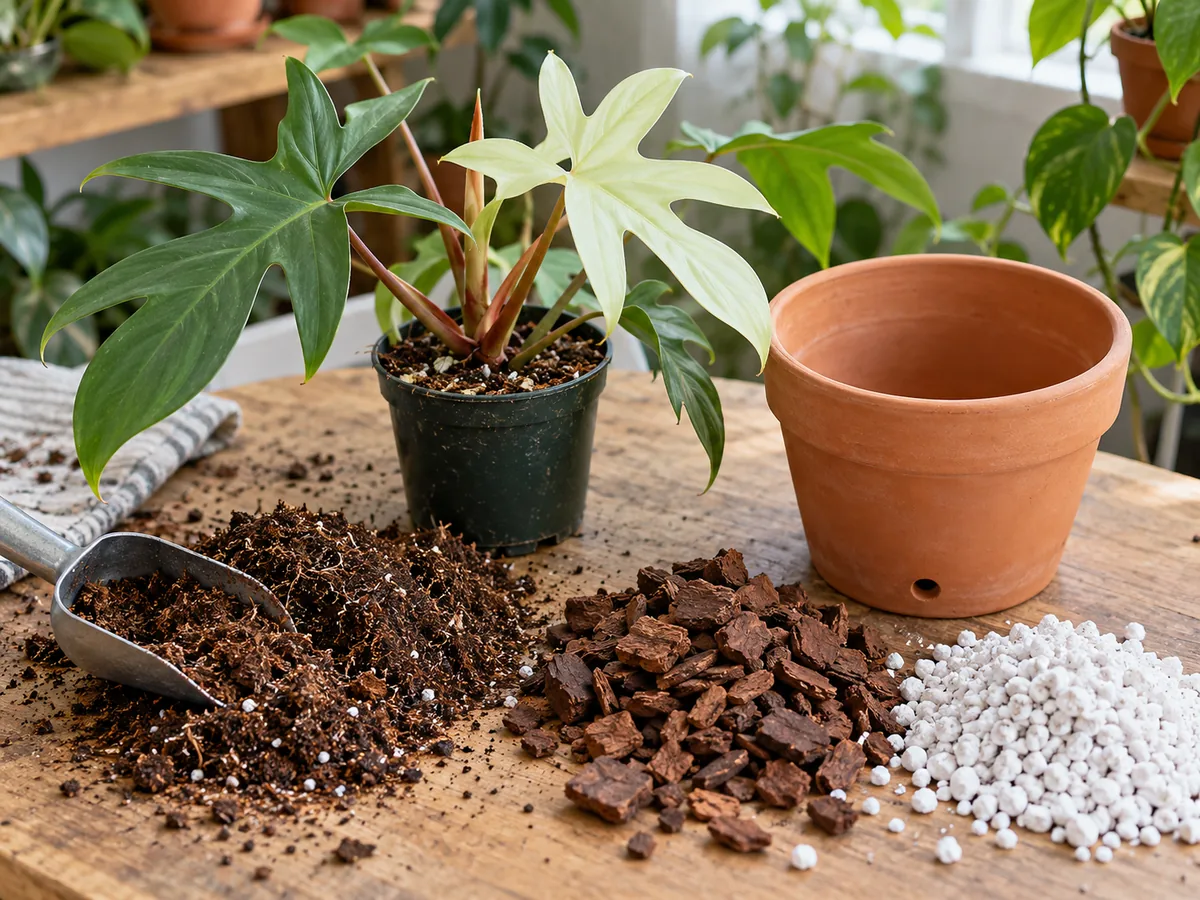
As a practical starting blend, combine two parts quality indoor potting mix or coco-based mix with one part fine orchid bark and one part perlite or pumice. This is a flexible houseplant recipe rather than a tested formula for this species. If your home is cool or you tend to water often, increase the chunky bark or mineral portion; if the pot dries very quickly in a warm, bright room, use a little more base mix instead.
Use a pot with open drainage holes. A decorative cachepot is fine as an outer sleeve, but lift out the nursery pot for watering and empty standing water before replacing it; a layer of gravel at the bottom does not fix a container that cannot drain. The Penn State Extension guide to repotting houseplants recommends drainage holes to keep mix from becoming waterlogged and advises choosing a pot based on the plant’s root needs.
Keep it warm and raise humidity only when needed
A warm, stable room is more useful than chasing tropical humidity with daily misting. A practical indoor range is the temperature most people already keep in a comfortable living space; avoid cold window glass, unheated rooms, and direct blasts from air conditioners or heaters. The species is native to warm, wet tropical regions, so protect it from cold exposure rather than testing its limits.
Average household humidity can be adequate, although dry air may slow the unfurling of a new leaf or contribute to crispy edges when other stresses are present. The species-specific Plant Proper care notes say the plant tolerates normal household humidity and may appreciate added humidity, but misting is not a lasting way to change room humidity. If leaves repeatedly emerge with dry edges in a heated room, use a small humidifier nearby and keep air moving; do not keep the soil wetter to compensate for dry air.
Avoid grouping the plant tightly against a cold pane or placing it directly above a radiator. Those locations can create a root zone and leaf surface that differ sharply from the room’s average conditions, so a hygrometer placed near the plant is more informative than a reading across the room. Stable conditions help the plant keep growing without turning care into a cycle of dramatic changes.
Feed during active growth, then ease off
Use a balanced liquid houseplant fertilizer during periods when the plant is actively producing leaves. Follow the product label, and if you are uncertain, start at a conservative dilution rather than doubling the dose to force larger leaves; fertilizer cannot substitute for adequate light, a healthy root system, or a climbing support. Water the mix first if it is dry so concentrated fertilizer does not contact a dehydrated root ball.
Reduce or pause feeding when growth slows in winter or when the plant is stressed, freshly repotted, or dealing with root damage. More fertilizer during a low-light period can add salts without producing useful new growth. A pale crust on the mix or pot rim, brown tips after repeated feeding, or a plant that worsens despite regular fertilizer are reasons to review the label and watering habits, not to add a stronger dose.
Species-specific care recommendations commonly call for feeding monthly in spring and summer; Plant Proper suggests a diluted general houseplant fertilizer monthly during active growth. The exact rate still depends on the product, the potting mix, and how often watering leaches nutrients from the container.
Repot when the roots or potting mix give you a reason
Repotting every year is not automatically beneficial. Check for roots circling tightly around the root ball, growing from drainage holes, or forming a dense mat at the bottom; another clue is a plant that dries much faster than it used to despite similar light and temperature. A slow-growing plant in dim conditions may not need a bigger pot at all, so rule out light and root problems before treating container size as the solution.
When the plant is clearly root-bound or the mix has broken down, choose a pot only modestly wider than the root ball, with drainage holes. A very large container holds excess damp mix around roots that have not yet reached it, which raises the risk of prolonged wetness. Repot during active growth when possible, moisten the fresh mix so it settles evenly, and preserve any healthy aerial roots that are attached to the support.
If the vine is already rooted into a pole, do not yank it free just to move the plant. You can keep the old support in place and set it into a slightly larger pot, or trim the vine and propagate sections if the pole has become unmanageable. Penn State Extension notes that roots through drain holes, pot-bound roots, and mix that dries unusually quickly are useful repotting clues.
Prune for size, balance, and cuttings
Prune when the vine is outgrowing its space, growing in an awkward direction, or carrying damaged leaves. Use clean, sharp snips and cut just above a node, the point where a leaf and bud meet the stem; a node below the cut gives the remaining plant a place from which a new shoot may develop. Removing a dead leaf alone does not require a major trim.
If the plant is leaning, first check whether the support is secure and the light comes from one side before cutting the whole vine back. You can redirect soft new growth toward the support and rotate the pot gradually to balance light exposure; severe rotation all at once may leave the plant facing away from its previous light source. Keep track of the stem’s direction as you tie it so the aerial roots, not the leaf stalks, face the support.
Healthy pruned sections can become cuttings if each has a node. If you want a fuller pot, root a few cuttings and plant them back beside the original stem after they establish; this fills the container without crowding it with a much larger pot. University of Minnesota Extension’s spring houseplant guidance advises trimming just above a node and repotting only when clear signs call for it.
Propagate from a stem node
A leaf alone will not make a new climbing vine if it lacks a node. Find the raised joint or slight swelling where a leaf stalk or aerial root emerges, then take a stem section that includes at least one node; two nodes give you more margin if the cutting is not perfectly positioned. Penn State Extension describes stem cuttings as sections containing nodes, where buried nodes can form roots and exposed ones can produce shoots.
Take the cutting from a healthy vine with clean pruners, cutting just below the lowest node you want to keep. Remove any leaf that would sit under water or in wet substrate, but leave a healthy leaf when possible because the cutting still needs to support itself while it roots. A short leafless “wet stick” can be attempted, but it has less stored energy and can be harder to monitor, so use it only when you understand which end contains the growth point.
Choose water or a moist rooting medium
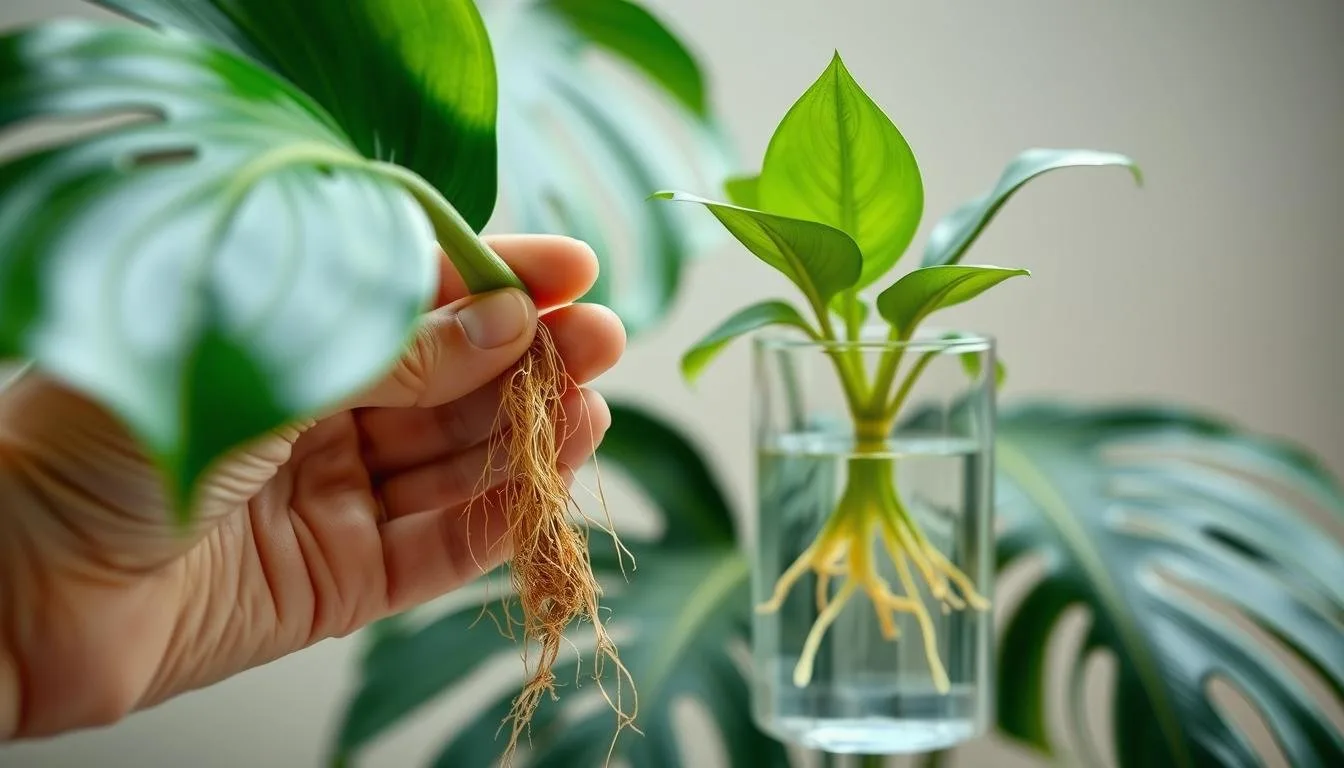
For water propagation, place the node under clean water and keep the leaf above the surface. Set the jar in bright, indirect light, refresh the water if it becomes cloudy, and check the cutting for soft or darkening tissue; a rotting node will not recover simply by waiting longer. Move the cutting to a small pot once it has several roots long enough to hold the mix, rather than waiting for a tangled mass that is difficult to spread.
For direct rooting, press the node into a lightly moist, airy mix or a damp rooting medium, keeping the leaf and growth point above the surface. The medium should feel like a wrung-out sponge, not a saturated cup; overly wet substrate can rot a cutting before it roots. A loosely placed clear cover can slow drying, but open it regularly for fresh air and remove it once the cutting begins active growth.
Water and substrate can both work, and neither is universally faster for every cutting or home. Water makes it easy to see root development, but newly water-grown roots must adapt to potting mix; starting in substrate avoids that transfer but hides early root growth. Penn State Extension’s houseplant propagation guide recommends stem sections with nodes and warm, bright indirect conditions for rooting; Plant Proper’s species guide also notes that cuttings can be rooted in water or planted directly in soil.
Diagnose yellowing, browning, and slow growth
One damaged leaf rarely identifies the cause by itself. Look at which leaves are affected, how quickly the pattern is spreading, what the pot feels like, and whether new growth is changing; then adjust one condition at a time so you can tell whether the change helped. Avoid adding water, fertilizer, a humidifier, and pesticide all at once, since that can create new stress while hiding the original problem.
Yellow leaves and soft stems
One older lower leaf that yellows slowly while the plant continues making healthy new growth may be natural leaf turnover. Several leaves yellowing in sequence, especially when the mix remains wet, point toward a root-zone problem; check drainage, smell, and the roots before increasing watering. When roots are black or brown, limp, and deteriorating rather than firm, trim damaged tissue with clean tools and repot into fresh airy mix only if healthy roots remain.
A drooping plant can be either thirsty or overwatered, so use the pot and soil to distinguish them. A light pot with dry mix is consistent with thirst; a heavy pot with wet mix and soft stems suggests too much water or damaged roots. Penn State Extension’s plant-diagnosis guide lists several possible causes for wilt and yellowing, including water stress, root rot, low light, and fertilizer injury, which is why symptoms should be checked against the growing conditions rather than matched to a single internet checklist.
Brown edges, spots, and stalled leaves
Crispy margins can follow a prolonged dry spell, dry indoor air, root problems, or fertilizer-salt buildup. If the damage appears only on the window-facing side, test for direct sun before changing the water routine; bleached patches are more consistent with excess light than with thirst. Brown or black spots that spread across multiple leaves deserve closer inspection and improved airflow, especially if foliage stays wet for long periods.
If the plant produces long bare stem sections and small leaves, improve the light before adding fertilizer. A pole can stabilize a vine, but it cannot compensate for low light, a root-bound pot, or a cool dormant season. If growth has slowed in winter and the plant otherwise looks firm and healthy, wait for brighter active-growth conditions before repotting or feeding more aggressively.
Check for common houseplant pests
Inspect the undersides of leaves, the joins where petioles meet the stem, and the nodes around aerial roots. Fine stippling or webbing can indicate spider mites; silvery scars and tiny dark specks can suggest thrips; white cottony clusters are typical of mealybugs; and small fixed bumps may be scale insects. Isolate a plant with suspected pests before treating it so the problem does not spread through a collection.
Start with identification and physical removal. Wipe leaves with a damp cloth or rinse the plant, then recheck it every few days because pests can hide in tight joints and emerge after the first cleanup. Illinois Extension’s houseplant-pest guide recommends scouting leaf undersides, washing or wiping plants, and using pesticides only when needed and according to their label directions. If you use a product, confirm that it is labeled for indoor plants and test it on a small area first, since leaf sensitivity can vary.
Fungus gnats usually indicate that the mix stays moist for too long; adult flies are irritating, but their presence does not by itself prove that the plant has root rot. Let the upper mix dry appropriately between waterings, remove decaying debris, and avoid leaving water in the saucer. Repeated pest checks are more useful than a one-time spray because many contact treatments miss eggs or insects tucked out of sight.
Handle the plant carefully around children and pets
The Queensland Poisons Information Centre lists Rhaphidophora species as potentially toxic and says chewing or eating plant parts can cause tingling or burning followed by swelling in the lips, mouth, or tongue; it also notes that skin or eye irritation can occur in sensitive people. Place the vine where young children cannot chew it, and wash your hands after pruning or handling damaged tissue. Seek urgent medical help if a person develops swelling or difficulty breathing or swallowing.
For pets, use a cautious placement and do not assume a plant is safe because a common name is familiar. The ASPCA’s toxic and non-toxic plants list is a general reference that the organization says is not all-inclusive; it does not establish that Rhaphidophora decursiva is individually listed. If a pet may have chewed the vine, contact a veterinarian or ASPCA Poison Control and provide the plant’s botanical name and, if possible, a clear photo. Do not induce vomiting or try a home treatment unless a veterinary professional directs you.
Conclusion
The most reliable Rhaphidophora decursiva routine is simple but responsive: provide bright filtered light, water when the root zone begins to dry, use a pot that drains, and guide the climbing stem onto a support that can handle its future weight. Expect juvenile leaves to remain simple for a while; mature division is a developmental change, not a switch that fertilizer or a moss pole can flip overnight.
When growth falters, diagnose the whole setup before changing several things. Check light, soil moisture, drainage, temperature, and pests in that order, then make one measured adjustment and watch the next growth. That approach keeps the plant healthy while giving it the space and structure to develop its distinctive climbing form.