How to Grow and Care for Philodendron Spiritus-Sancti
A practical Philodendron spiritus-sancti care guide: choose a nursery-grown plant, prevent root rot, manage humidity, and troubleshoot leaves without guesswork.
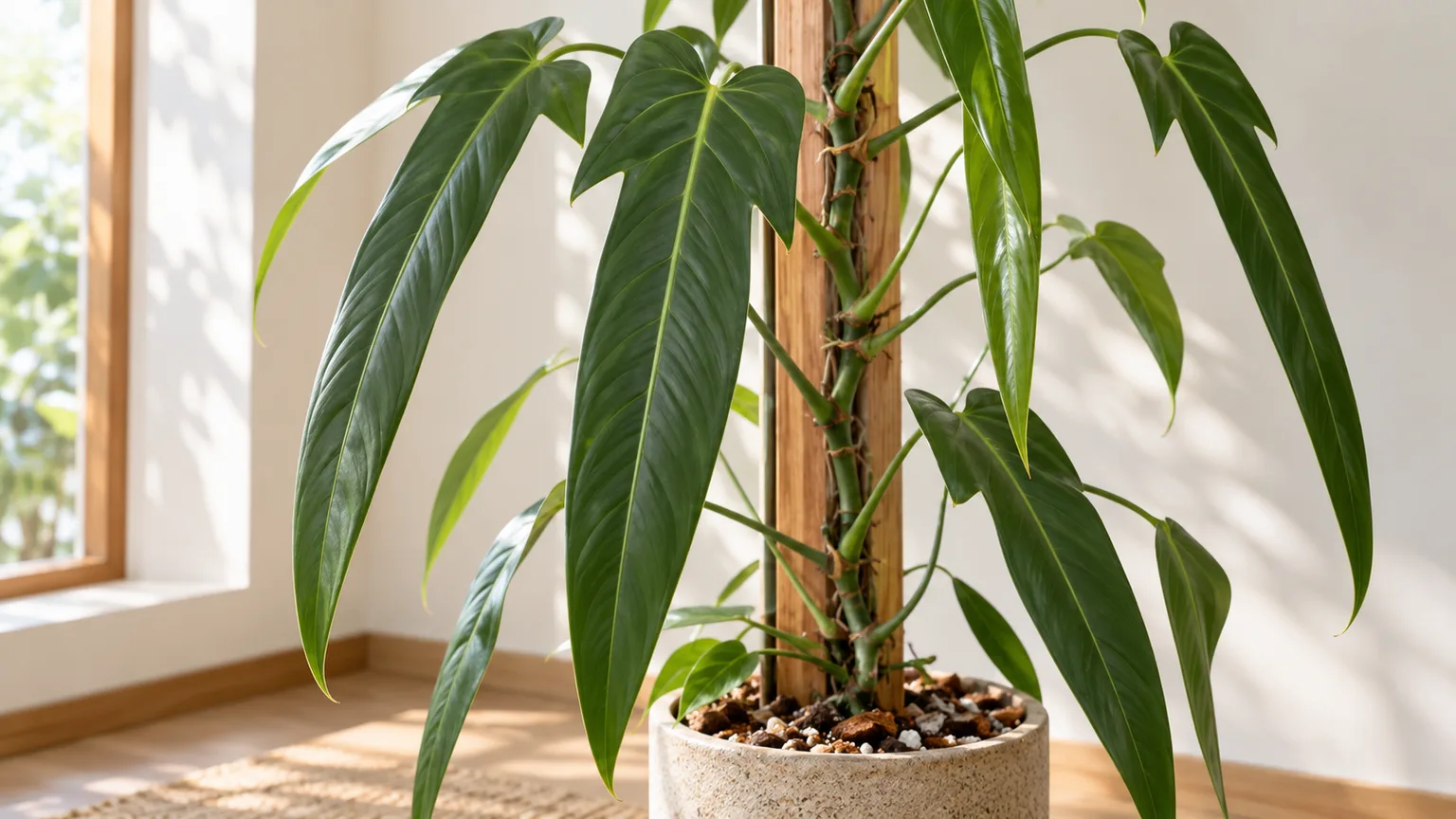
Philodendron spiritus-sancti is a climbing aroid whose long, narrow leaves make it look more delicate than it is; the part that needs the most care is usually the root zone. Give it bright filtered light, a loose mix that can hold a little moisture without turning dense, and a thorough watering only after the upper part of the root ball has begun to dry. A stable support lets the vine climb as it grows.
Treat those as starting conditions, not a rigid recipe. Pot size, light, season, and indoor airflow all change how fast the mix dries, and the species has limited published cultivation research compared with common philodendrons. The checks below help you adjust without repeatedly changing the plant’s environment.
Choose a nursery-propagated plant and ask about its origin
The species is native to a restricted area of Espírito Santo, Brazil, and grows as a hemiepiphyte in tropical forest. Kew’s Plants of the World Online profile records it from the type locality around Domingos Martins and describes its forest habitat; a Brazilian botanical garden profile describes the mountainous Atlantic Forest setting and long, pendent leaves. Its common name, Santa Leopoldina, also points to this Brazilian home.
Conservation labels need context. The Brazilian CNCFlora profile lists the species as Endangered in its 2012 assessment, while Kew’s current profile lists it as Data Deficient because the plant remains poorly known and attempts to relocate it were unsuccessful; Kew also displays a separate 2024 model prediction of threatened risk. These labels come from different dates and assessment methods, so a single label or a collector’s claim should not be treated as a complete picture of the plant’s status.
That uncertainty is a reason to favor cultivated stock with clear provenance. A 2024 paper by Brazilian botanists describes the species as highly sought after in ornamental trade and warns about overexploitation; its existence in a shop or collection does not prove a specimen was responsibly propagated. Ask the seller whether the plant was nursery-propagated, tissue-cultured, or seed-grown, and look for ordinary sales documentation and any permits required where you live. Avoid plants presented as freshly collected from the wild.
Inspect the plant before bringing it home: choose firm stems, leaves without spreading spots or webbing, and a root ball that smells earthy rather than sour. A smaller, stable plant with healthy roots is usually a better purchase than a large specimen sitting in soggy media. Quarantine it from other houseplants for a couple of weeks while you check leaf undersides and new growth for pests.
Place it in bright, filtered light
Aim for a bright room where the leaves receive plenty of ambient light but not prolonged, hot midday sun. An east-facing window is often a forgiving starting point; near a brighter south- or west-facing window, use a sheer curtain or set the plant farther back. Rotate the pot occasionally so the vine does not lean toward one side.
Direct sun through glass can bleach or scorch exposed leaves, especially after a sudden move from a dim nursery or cabinet. If a patch becomes pale or papery on the window-facing side, soften the light rather than moving the plant repeatedly between extremes. A single older leaf yellowing elsewhere is a different clue and should prompt a soil check, not a light change by default.
If new leaves stay small and the stem stretches with long gaps between leaves, the plant may be reaching for more light. Move it closer to a bright window over several days or add a grow light on a consistent schedule. A pole can support the vine, but support cannot compensate for a dim position.
Use a chunky mix that drains but does not dry instantly
In its forest habitat, this species uses tree trunks as support and develops roots in a much airier environment than compact garden soil. In a pot, aim for a mix that admits air, drains freely, and still keeps a little moisture around the roots. A useful starting blend is two parts peat-free houseplant mix, one part orchid bark, and one part perlite or pumice, measured by volume; adjust after you see how it behaves in your home.
The exact ingredients matter less than the result. After watering, excess should leave the pot promptly, while the center of the root ball should not become bone dry the same day. If the mix stays heavy and wet for many days, add more coarse bark or mineral aeration and check that drainage holes are open. If it dries almost immediately, use a little more potting mix or a slightly smaller bark grade rather than watering on a timer.
Avoid dense garden soil, a pot with no drainage, or a layer of rocks at the bottom as a substitute for drainage holes. A clear nursery pot can make root inspection easier, but it is optional; a sturdy pot with several open drainage holes is enough. Do not chase a precise soil pH unless you have a specific water or nutrient problem to solve.
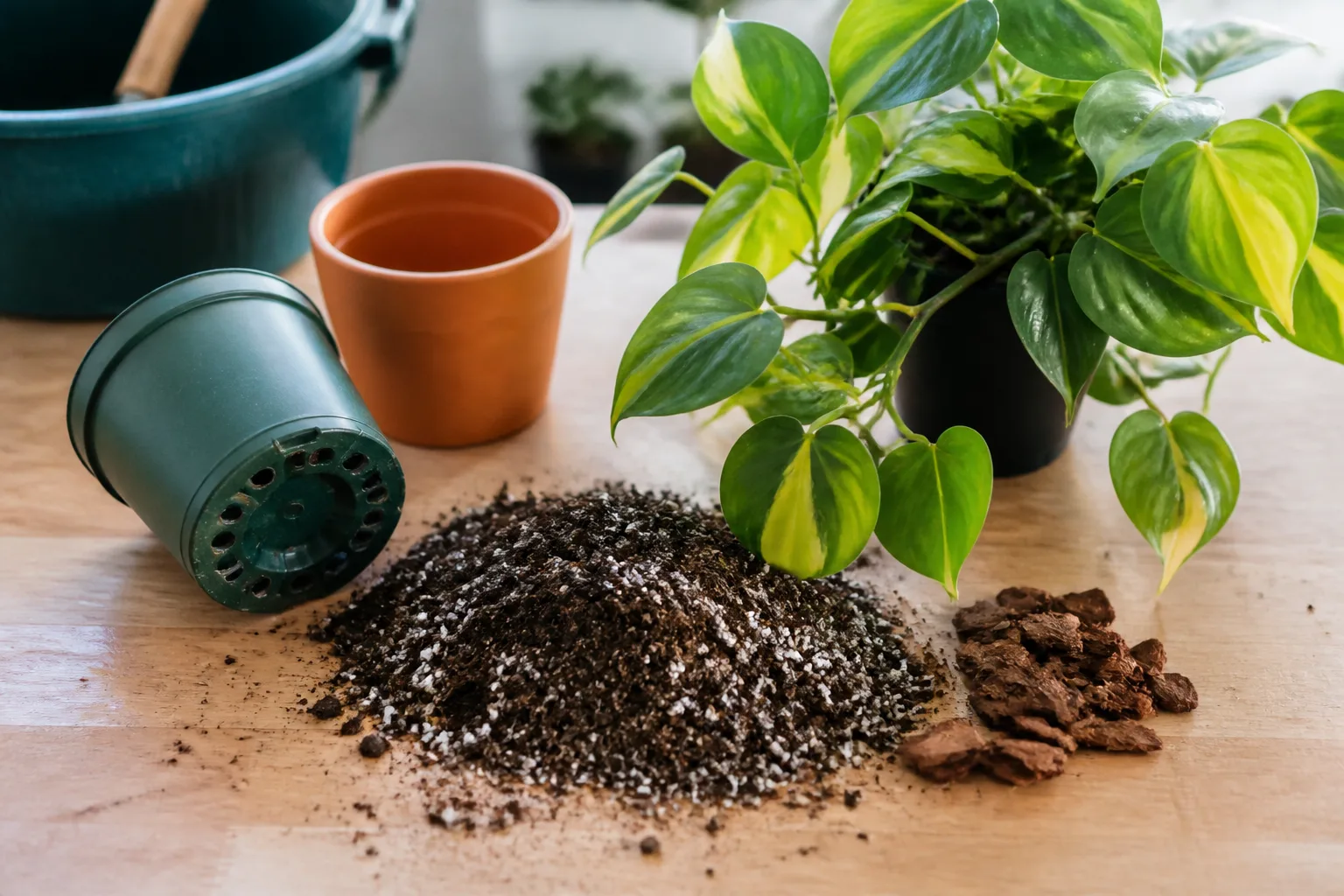
Water from the root ball’s condition, not the calendar
There is no dependable “every seven days” schedule for this plant. A small pot in bright warmth may dry much faster than a larger pot in winter light, even in the same room. Iowa State University Extension’s general philodendron advice is to let the top of the soil dry before watering and avoid soggy media; that is a useful baseline, but use your own pot as the gauge.
Check the mix with a finger or a clean wooden skewer near the pot’s edge. When the upper inch or two has dried and the mix below is only lightly moist rather than wet, water slowly until it drains from the bottom. Let the pot finish draining, then empty the cachepot or saucer so the roots are not left standing in water.
If the surface feels dry but the pot is still heavy and the skewer comes out damp, wait and check again later. If the whole root ball is dry and water runs down the sides without soaking in, apply water in two or three passes a minute apart, then let it drain; repeated shallow sips can leave the center dry while the bottom remains wet. In a cooler, darker season, expect longer gaps between waterings and confirm dryness each time.
Keep temperatures steady and humidity sensible
Keep the plant in a comfortably warm room and away from cold glass, exterior doors, air-conditioning blasts, and hot radiators. Iowa State Extension gives 65–80°F as a well-tolerated range for philodendrons generally; use it as a practical indoor guide, not a species-specific biological limit. Sudden cold or heat can stress new growth even when the average room temperature seems acceptable.
This is a tropical forest plant, so moderately humid air can support smoother leaf expansion. The RHS philodendron guide notes that philodendrons prefer moderately humid air but can adapt to the lower humidity in most homes; there is no well-supported single percentage that every home must hit. If new leaves repeatedly dry at the edges or struggle to unfurl, measure the room first with a hygrometer before buying equipment or changing several care variables.
When air is very dry, a room humidifier near the plant is more predictable than misting. Keep air moving gently and leave enough space around the foliage for leaves to dry; a sealed, stagnant cabinet can create its own problems. Grouping plants may soften dryness locally, but it will not make humidity stable across a room, so measure rather than guessing.
Give the climbing stem stable support
Philodendron spiritus-sancti is a climber, and Kew describes it as hemiepiphytic: it uses other structures as it grows rather than behaving like a compact floor rosette. A moss pole, rough plank, or sturdy trellis gives the stem a vertical route and a place for aerial roots to attach. Choose support before the plant becomes top-heavy, and anchor it securely so it cannot rock in the pot.
Guide the stem—not the leaf stalk—toward the support and fasten it loosely with soft ties. The leaves should be free to face the light and the stem should not be pinched. A moss pole can be kept slightly damp where roots are meant to attach, but a permanently saturated pole beside a wet potting mix can keep the root zone too wet.
You can let a young plant trail temporarily if space is limited, but its leaves may remain smaller and the vine may sprawl rather than climb. Fine Gardening’s philodendron guide notes that many climbing philodendrons use aerial roots to grip supports; keep those roots intact unless they are dead or getting in the way. Do not bury an aerial root just to make the plant look tidy.

Feed lightly during active growth
A fresh, aerated potting mix and steady root health matter more than heavy feeding. During spring and summer, when the plant is making leaves, use a balanced houseplant fertilizer at the package’s conservative houseplant rate. If you have a sensitive or recently repotted plant, begin at half strength and watch the new growth before increasing; do not feed a dry root ball.
Reduce or pause fertilizer when growth slows in fall and winter. White crust on the mix, browning tips across several leaves, or a sudden decline after feeding can indicate salt buildup or over-fertilizing. Flush the mix thoroughly with plain water if it drains well, then hold fertilizer until active growth resumes. More fertilizer will not fix low light, rot, or a damaged root system.
Repot when the roots or mix say it is time
Repotting every year is unnecessary for many indoor philodendrons. Check the root ball when water runs through unusually quickly, roots circle densely at the bottom, the plant becomes unstable, or the old mix has collapsed into a slow-draining mass. A few roots at a drainage hole alone do not prove that the plant needs a larger pot.
Move up only one pot size, keeping several drainage holes and a stable base for the support. Gently loosen the outside of the root ball, remove only mix that falls away easily, and set the plant at the same depth as before. Avoid cutting healthy roots just to make the plant fit a decorative container.
Spring or early summer is a sensible window because the plant can resume growth in brighter conditions, but a plant with rotting roots needs attention regardless of the calendar. If you suspect rot, use a clean pot and fresh airy mix after removing only clearly soft, dead roots. Do not add fertilizer immediately after repotting; let the roots settle first.
Prune with clean tools and gloves
Prune to control the vine, remove a damaged section, or prepare a propagation—not to force faster growth. Use sharp, clean shears and cut just below a node if you want the removed piece to include a viable growth point. Wipe sap from tools and clean them before cutting another plant.
Avoid removing several healthy leaves at once from a small or stressed specimen. Each leaf helps power new roots and growth, and a major cut can leave a slow-growing plant with less energy to recover. If the stem is getting too long, secure it to its support or plan a single deliberate cut rather than repeatedly shortening the growing tip.
Propagate carefully: preserve the node and parent
Philodendrons are often propagated vegetatively, but success in a common heartleaf philodendron should not be treated as a guaranteed result for this rare species. Before making a cut, make sure the parent is healthy, actively growing, and has more than one viable node. If you have only one short growing tip, it may be wiser to wait than to risk losing the plant for a second specimen.
Choose between keeping the section attached until it roots and taking a conventional cutting. The first approach lets you confirm roots before separating the new plant; the second is simpler, but a cutting can dry out or rot before it establishes. Use a clean blade, warm stable conditions, and an airy rooting medium, and accept that there is no reliable home timetable for this species.
Air-layer a node before cutting
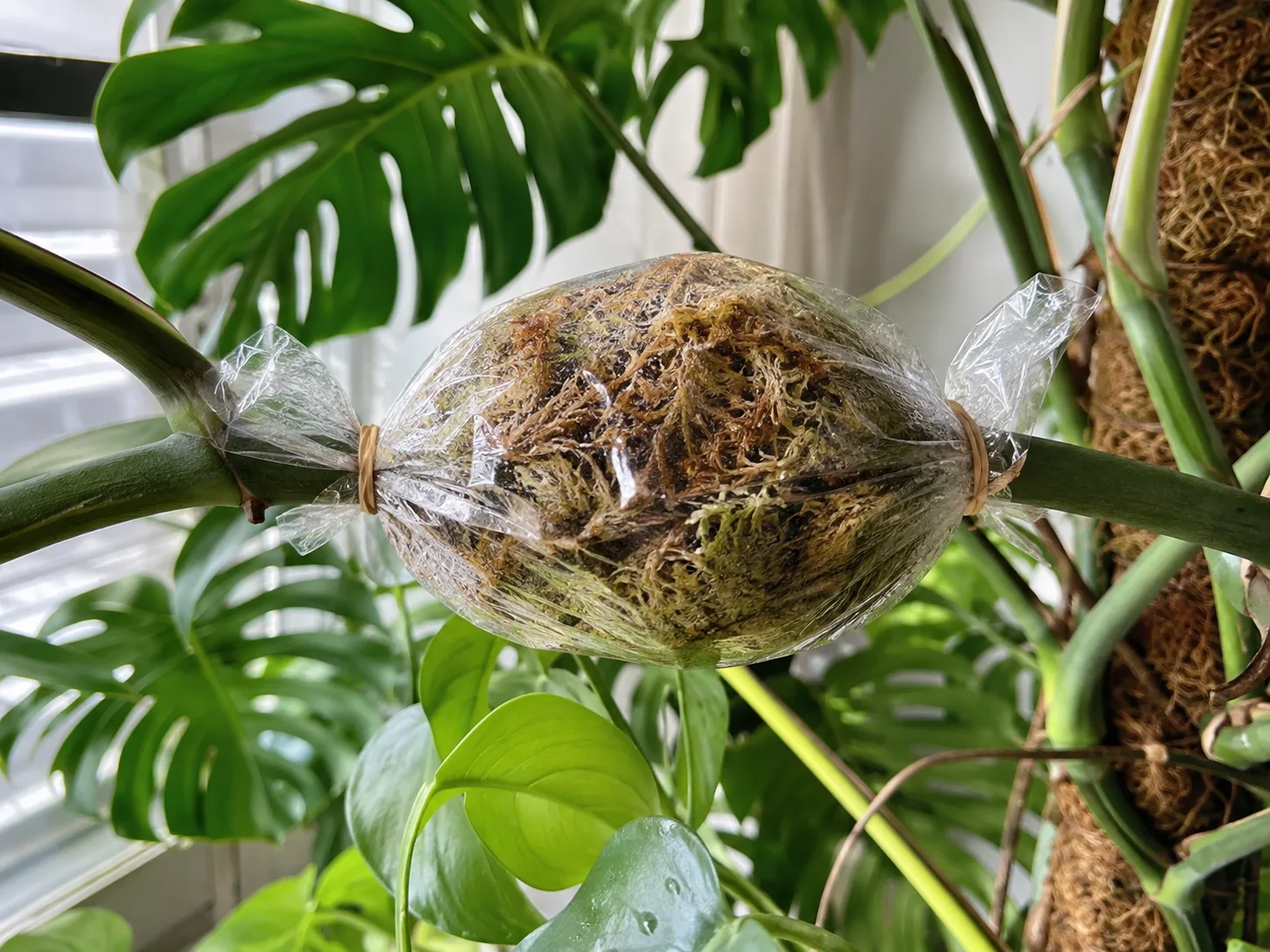
Air layering is a practical option when preserving the parent matters. The Royal Horticultural Society’s air-layering guide lists philodendrons among suitable plants and explains the basic method: keep a stem attached while moist sphagnum encourages roots to form around a selected point. It still involves handling and sometimes wounding the stem, so it is not risk-free.
Choose a firm section with a visible node, ideally with an aerial root, and wrap damp—not dripping—sphagnum around it. Secure the moss loosely in plastic so it stays humid but can be opened for inspection; check it regularly for drying or soft, discolored tissue. Once several healthy roots are visible through the moss, cut below that rooted section with sterilized shears and pot it without stripping the new roots bare.
Do not cut because a calendar says three weeks have passed. Rooting may take longer, and the RHS notes that air layers can remain in place for months depending on the plant. If the moss smells sour or the stem softens, unwrap it, improve airflow, and reassess rather than sealing the problem in.
If taking a cutting, check these three things

- The cutting includes a node. A leaf and its petiole alone cannot produce a new climbing stem; the node is where new roots and shoots can develop.
- The node is below the cut and has room to root. If an aerial root is already present, keep it with the cutting. Remove any leaf that would sit underwater or buried in the rooting medium.
- The medium stays lightly moist and airy. Use clean water changed regularly or a loose, pre-moistened propagation medium; do not leave the node in stagnant, cold conditions.
The RHS philodendron growing guide describes stem cuttings as a standard method for climbing and trailing philodendrons. That genus-level guidance does not establish the success rate for P. spiritus-sancti, so treat the first cutting as an experiment, not a promise. Pot the cutting once it has a small network of roots, keep it warm in bright indirect light, and avoid fertilizer until it is growing again.
Troubleshoot leaves by looking at the whole plant
One leaf rarely tells the full story. Note whether the symptom is on an old or new leaf, whether several leaves are affected, which side faces the window, and how long the mix stays wet. Change one likely cause at a time; moving the plant, repotting, pruning, and changing fertilizer together makes it difficult to know what helped.
Yellow leaves or a soft stem
An occasional older leaf fading while new growth remains healthy can be normal. Several yellow leaves close together, especially with a heavy wet pot, sour smell, or soft stem at the soil line, point more strongly to root stress. Stop watering until the mix begins to dry and confirm that the drainage holes are open.
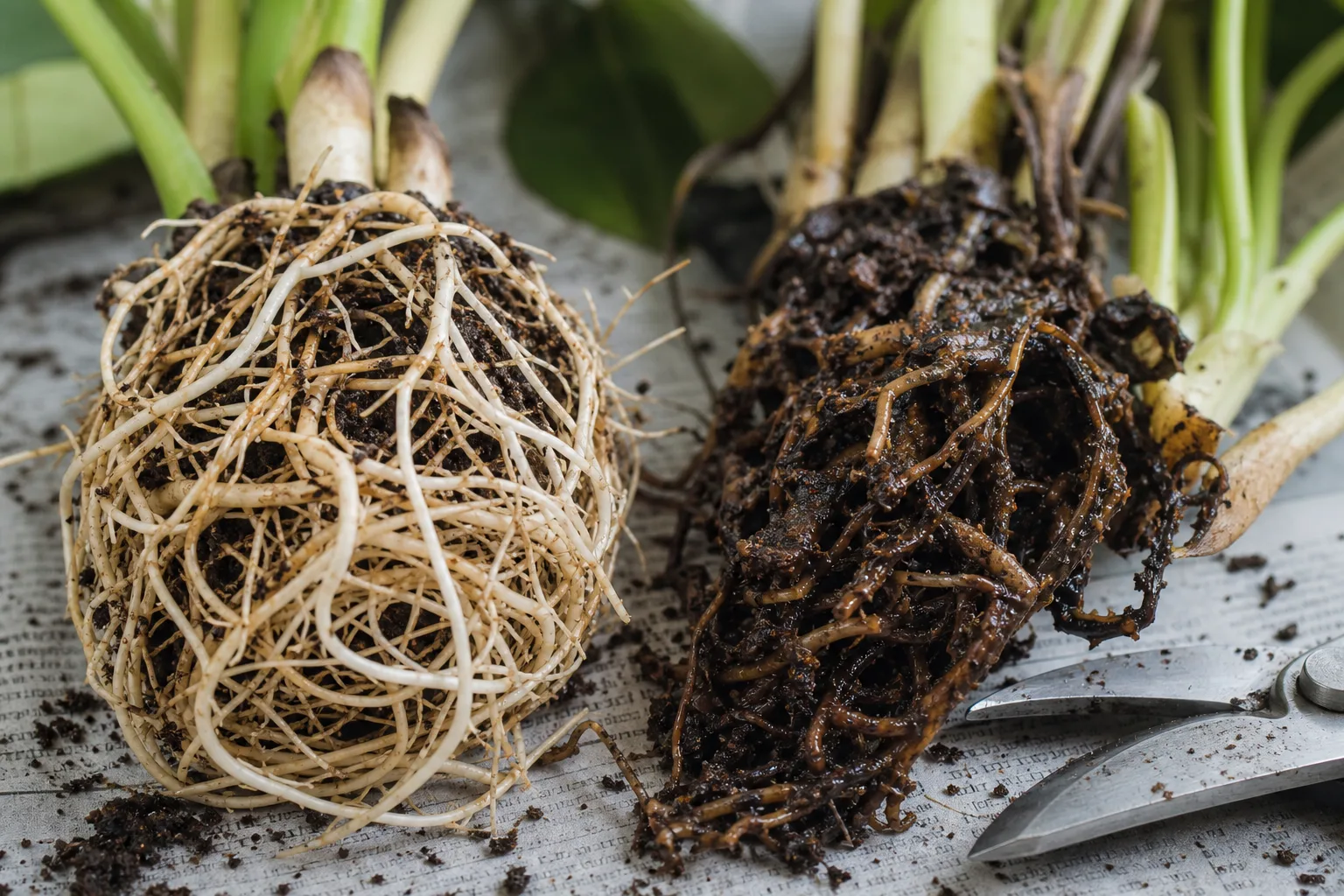
If the plant continues to decline or the roots are dark and mushy, slide it from the pot and inspect the root ball. Firm roots are the goal; remove only roots that are clearly soft or hollow, then repot into fresh, open mix in a clean pot. Do not pour extra water on wilted leaves until you know whether the roots are dry or damaged: both underwatering and root rot can make foliage droop.
Brown edges, stalled leaves, or leggy growth
Brown tips can follow several stresses: a root ball that swings between bone-dry and saturated, mineral or fertilizer salts, very dry air, or direct sun. Look for a pattern before choosing a fix. Sun scorch tends to mark the exposed side; salt buildup may coincide with crust on the mix; dry-air damage may show most on tender leaf edges. Correct the likely condition gradually and trim only the dead tissue with clean scissors.
A leaf that is slow to open can be responding to dry air, low light, or an abrupt temperature change. Raise humidity only if a hygrometer and repeated symptoms support it, and never pull a stuck leaf open by force. Long bare spaces between leaves usually mean the vine needs more light; move it toward brighter filtered light and give the stem a support.
Check for pests before they spread
Inspect the undersides of leaves, the stem joints, and the area where leaf stalks meet the vine. Spider mites can leave fine webbing and pale stippling; mealybugs look cottony around joints; scale appears as small, fixed bumps. New plants are a common route into a collection, so keep this one separate while you inspect it.
For a small outbreak, isolate the plant and rinse foliage where practical, then recheck every few days because eggs and hidden insects may survive a single cleanup. If you need a treatment, identify the pest first and use a product labeled for that pest and indoor plants, exactly as directed. Avoid improvised detergent mixtures and do not apply a treatment to sunlit leaves unless its label says that is safe.
Blooming is possible but not a care target
Mature philodendrons can flower, but indoor conditions and plant age make flowering unpredictable. If this specimen produces an inflorescence, expect the aroid structure—a spathe surrounding a spadix—rather than a conventional petaled flower. The plant does not need to bloom to be healthy, and increasing fertilizer or heat to chase flowers is more likely to stress roots than help.
Once an inflorescence has faded, remove it with clean shears if it is declining or if you do not want the plant to spend resources on fruit. Keep any developing fruit away from pets and children, and use gloves when handling cut tissue. There is no need to cut a healthy leaf or growing point as part of routine post-bloom care.
Protect people and pets from the sap
Philodendrons contain insoluble calcium oxalate crystals. Poison Control explains that chewing plant tissue can cause immediate pain and swelling in the mouth; sap can also irritate skin or eyes. The ASPCA’s plant safety guidance lists philodendrons among plants containing insoluble calcium oxalates and advises contacting a veterinarian or animal poison service when a pet eats one.
Place the plant where a child or animal cannot chew leaves, flowers, or discarded cuttings. Wear gloves when pruning or repotting, wash your hands and tools afterward, and do not leave propagation pieces in an open glass. If ingestion or eye exposure occurs, contact your local poison center, medical professional, veterinarian, or animal poison service for case-specific advice rather than relying on a home remedy.
Conclusion: steady roots beat chasing a number
The most dependable care routine is straightforward: give Philodendron spiritus-sancti bright filtered light, keep it in an airy pot with drainage, and water when the root ball has partly dried rather than following a fixed schedule. Keep the room warm and stable, use a support that will not wobble, and make changes only after the plant’s growth or the mix gives you a reason.
For a rare plant, cautious propagation and clear provenance are part of responsible care. A healthy root system and an intact parent are more valuable than a fast cutting, and cultivation should not add pressure to already limited wild populations. Check the plant regularly, correct the first real sign of stress, and let steady conditions do the work.



