Variegated Monstera Adansonii Care and Growth Guide
Variegated Monstera adansonii care starts with bright indirect light and airy soil. Learn to water, propagate by node, and manage browning or reversion.
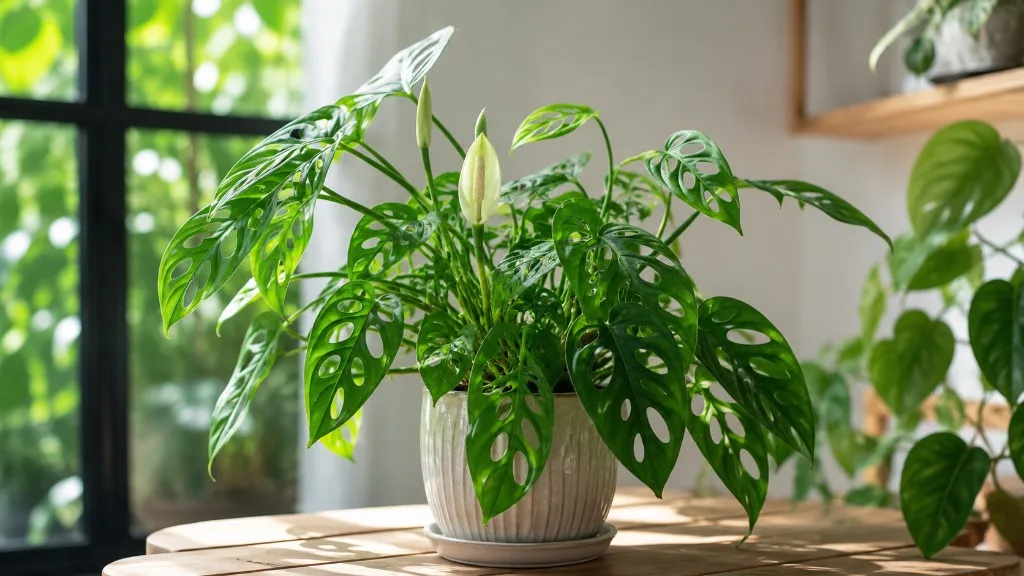
A variegated Monstera adansonii is a climbing tropical vine with the species’ familiar oval leaf holes and patches of cream, white, pale green, or yellow. It needs the same basic conditions as green Swiss cheese vine, but its pale tissue has less chlorophyll, so the plant has less margin for dim light, harsh sun, repeated drying, and damaged roots. The useful goal is not to force every leaf to be whiter; it is to keep the vine growing steadily while protecting the pattern that is already present.
Start with a bright room where the plant receives filtered light, a pot with drainage, and a mix that holds some moisture without staying wet. Check the actual root zone before watering, and judge changes in variegation across several new leaves rather than reacting to one unusual leaf.
What variegated Monstera adansonii actually means
The accepted species name is Monstera adansonii. It is a tropical climbing aroid with aerial roots and perforated leaves; the holes distinguish it from the deeper splits typical of M. deliciosa.
Kew Plants of the World Online records the species as native across tropical parts of the Americas, while NC State Extension’s plant profile describes its climbing habit, indoor use, and the variegated cultivar ‘Archipelago’. The name “variegated” describes foliage with more than one color; it does not identify one uniform form with a predictable pattern.
In the plant trade, labels such as Albo, Mint, or Aurea may describe a look, a clone, or a seller’s category, and usage is not always consistent. A plant with sharp white sectors behaves differently from one with a softer pale-green wash because the proportions and arrangement of green tissue differ. Ask for a photo of the actual plant and stem if you are buying; a spectacular leaf alone cannot tell you what the next growing point will produce.
Check that the seller’s photos show the actual plant rather than a stock leaf, and ask for the stem near the active tip. A healthy rooted plant is usually easier to establish than a single-node cutting, though cuttings may cost less and take up less space. Prices and availability move with the houseplant market, so judge the purchase by the visible node, root condition, and seller’s return terms rather than by a “rare” label alone.
Many traded variegated Monsteras are understood to have mosaic or chimeral growth: different cell lines contribute to the developing leaf, so a new node can carry a different balance of green and pale tissue. The green parts contain most of the leaf’s chlorophyll; a nearly white patch contributes little to photosynthesis and can mark more easily.
Foliage Factory’s discussion of Monstera adansonii variegation explains why the pattern can shift at a growing point. That biology is why light and pruning can support a plant but cannot reliably create a new variegation pattern.
Quick setup: the conditions that matter most
| Care decision | A practical starting point | What to watch |
|---|---|---|
| Light | Bright, indirect light; soften strong midday or afternoon sun | Stretched stems suggest too little light; bleached or crisp areas facing a window suggest too much |
| Water | Water thoroughly after the upper mix dries | A small basket and a deep pole pot dry at different speeds |
| Mix | Potting mix opened with bark and perlite or pumice | Water should drain freely without the root ball drying in a day |
| Temperature | Comfortable, stable room warmth | Keep away from cold glass, drafts, and heater or air-conditioner blasts |
| Shape | Climb on support or trail from a shelf or basket | Support changes how the vine is displayed; it is not required for survival |
Treat those as starting conditions, not a rigid schedule. Window direction, season, pot material, mix texture, and the amount of pale tissue all affect how quickly the plant uses water and makes new leaves. Change one condition at a time, then judge the next flush of growth.
Give it bright, filtered light
Bright indirect light is the safest target for a variegated Swiss cheese vine. Set it close to an east-facing window, or a little back from a brighter south- or west-facing window where a sheer curtain or nearby wall softens direct rays. A bright room without a clear view of the sky can still be dim at plant level, so look for compact growth and leaves that hold their size rather than assuming the room feels bright to you.
The green portions need enough light to support the plant, and pale areas can be more vulnerable to scorching. Give the plant brighter conditions than you might give a solid-green adansonii, but acclimate it over a week or two instead of moving it suddenly into a strong sunbeam. A grow light can help in a dark room; keep it at the manufacturer’s recommended distance and use a consistent daily period rather than placing leaves directly under a hot lamp.
Low light does not make a green plant variegated. It more often slows growth, lengthens the spaces between leaves, and can leave a patterned plant producing small, weak foliage. Epic Gardening’s Monstera adansonii guide likewise recommends indirect bright light and cautions against full sun.
If you move a plant to a brighter spot, assess the new leaves; old leaves will not change their existing pattern. Turn the pot a little every week or two if the vine leans toward one window, but do not rotate it daily and expect that to change the variegation.
Water by root-zone dryness, not by weekday
Let the upper part of the mix dry before watering again, then soak the root ball evenly until water comes through the drainage holes. For a typical indoor pot, begin by checking the top inch or two with a finger or wooden stick; if it still feels cool and damp, wait and check again. Lift the pot after watering and as it dries so you learn its heavier and lighter feel.
Do not let the plant sit in a decorative cachepot full of runoff. Empty the saucer after the water has drained, because water held around the roots limits air and raises the risk of rot. A small terracotta pot beside a warm window may need attention much sooner than a large plastic pot on a cool shelf, so “weekly” is only a reminder to inspect, not an instruction to pour.
In winter or during a stretch of cloudy weather, the mix may stay damp longer because the plant is using water more slowly. Reduce the frequency by checking more often before watering, not by giving the plant frequent sips. If the whole root ball has become bone-dry and the leaves are limp, water thoroughly and allow the excess to drain; if the mix is already wet, more water will not fix drooping.
Choose an airy mix and a draining pot
The roots need both moisture and oxygen. A useful starting blend is about two parts quality indoor potting mix, one part fine orchid bark, and one part perlite or pumice. Adjust the proportions to your room and container: add a little more aeration if the mix remains soggy, or more moisture-holding mix if a small pot dries out within a day.
The exact recipe matters less than the result. After watering, the mix should wet through and drain, while the root ball should not become dry immediately; coarse particles should keep it from collapsing into a dense, airless mass. RHS guidance for Swiss cheese plants also favors an open, well-drained medium and warns that poorly draining compost can leave roots vulnerable to rot.
Use a nursery pot or other container with drainage holes, then place it inside a decorative cover if you want. Do not add a layer of gravel to the bottom as a substitute for drainage holes. Choose a pot only modestly larger than the root ball; excess unused mix can remain wet long after the roots have taken up what they need.

Keep it warm and manage dry indoor air
Normal comfortable indoor temperatures suit this tropical vine. Aim for a steady range around 65–80°F (18–27°C), and avoid chilly windowpanes, drafty doors, and direct air from heating or cooling vents. NC State notes that M. adansonii is tender and should be protected from cold drafts and temperature drops; a sudden cold spell can stall growth even when the soil and light are right.
Moderate household humidity is usually workable if watering and roots are in good shape. If the room becomes very dry in winter and new leaves repeatedly crisp as they unfurl, move the plant away from hot air and consider a humidifier nearby. A pebble tray may add a little moisture immediately around the pot, but it will not change the humidity of an entire room; misting is also brief and can leave leaves wet without correcting dry air for long.
Do not sacrifice airflow to chase tropical humidity. A warm bathroom with a window can be a good position, but a dim bathroom or one that stays stagnant and wet may be worse than a bright living area at ordinary humidity. Watch the plant’s new growth and the soil’s dry-down instead of aiming for a single number.
Decide whether to train it up or let it trail
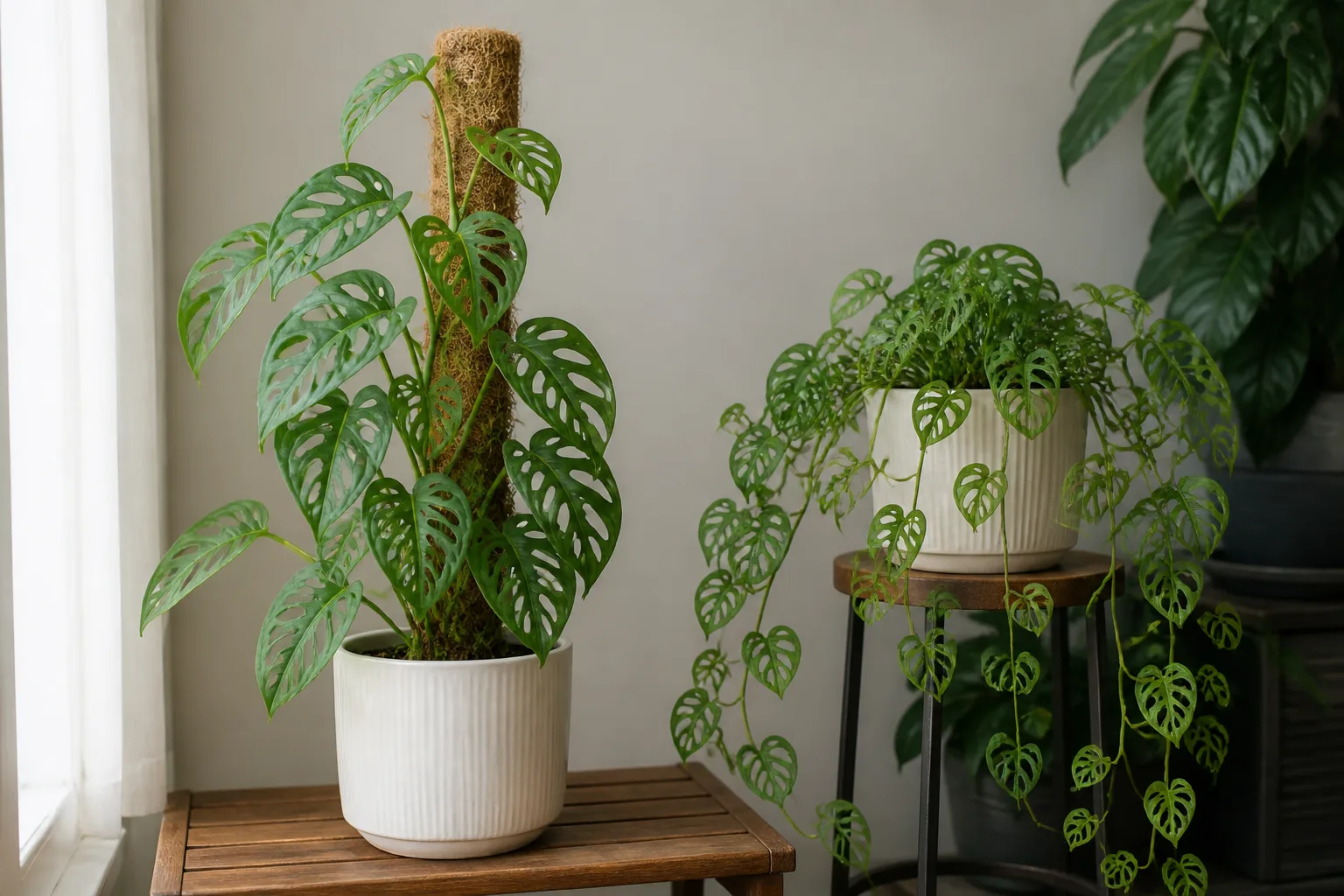
Monstera adansonii is naturally a climber, but it can be grown as a trailing vine. A moss pole, trellis, or narrow support helps organize long stems vertically; a hanging basket or shelf lets them cascade. Neither choice is mandatory, so choose based on your space and how you want the leaves displayed.
| Display | Best when you want | Practical trade-off |
|---|---|---|
| Climbing | A compact footprint and a vertical vine | The support needs to be stable and attached without pinching stems |
| Trailing | A cascading basket or shelf display | Long vines take horizontal space and can become sparse away from the light |
Place a support in the pot before the root ball becomes crowded, and loosely secure the stem with a soft tie. Aerial roots may attach as the vine grows; they are not a sign that the plant is desperate for water. A moss pole can be kept lightly moist if aerial roots are expected to grow into it, but do not let that extra moisture keep the potting mix wet.
Feed modestly during active growth
Fertilizer supports new growth, but adding more does not make the pale sections greener or more stable. During spring and summer, when the plant is actively producing leaves, use a balanced liquid houseplant fertilizer at a conservative dilution, following the product label. If the potting mix already contains a slow-release fertilizer, wait until that supply is spent rather than stacking products.
A monthly light feeding is a reasonable starting point for a home plant in good light. A larger vine growing rapidly may use nutrients faster, while a small plant in a dim room has little demand; if the plant is barely growing, solve the light or root problem before increasing fertilizer. Skip or reduce feeding when growth slows in winter.
If leaf edges brown after repeated feeding, or a crust forms on the potting mix, pause fertilizer and flush the mix with plain water if drainage is good. Salt buildup can stress roots, and a weakened root system makes leaves more vulnerable to both dry-down and overwatering. Do not apply fertilizer to a bone-dry root ball.
Prune for plant health, not to manufacture color
Prune with clean snips when a stem is damaged, the vine is too long for its space, or a green-only shoot has become the dominant line of growth. Cut just above a node, the joint where a leaf and aerial root emerge. That node is the source of the next shoot, so inspect the stem and recent leaves before choosing the cut point.
If you want to preserve a pattern, cut back to a node that shows some variegation in its leaf or stem rather than removing every green leaf on the plant. Green tissue supplies much of the plant’s energy; stripping it indiscriminately can leave a slow-growing vine with too little functional leaf area. Pruning can select which existing growth point continues, but it cannot make an all-green node reliably produce white tissue.
A few greener leaves do not mean the plant has failed. Compare the last several leaves and the stem near the active tip. If the new growth is consistently all green and the plant is healthy, selective pruning back to a patterned node may be worth trying; if the plant is weak or recently stressed, stabilize the roots and light first.
Propagate from a node that carries the pattern
Use a stem cutting with at least one healthy node; a leaf without a node cannot grow a new vine. For a patterned clone, choose a cutting from a section where the leaf and stem show the kind of pattern you want to retain, while keeping enough green tissue to support the cutting. No cutting can promise an exact color balance on future leaves.
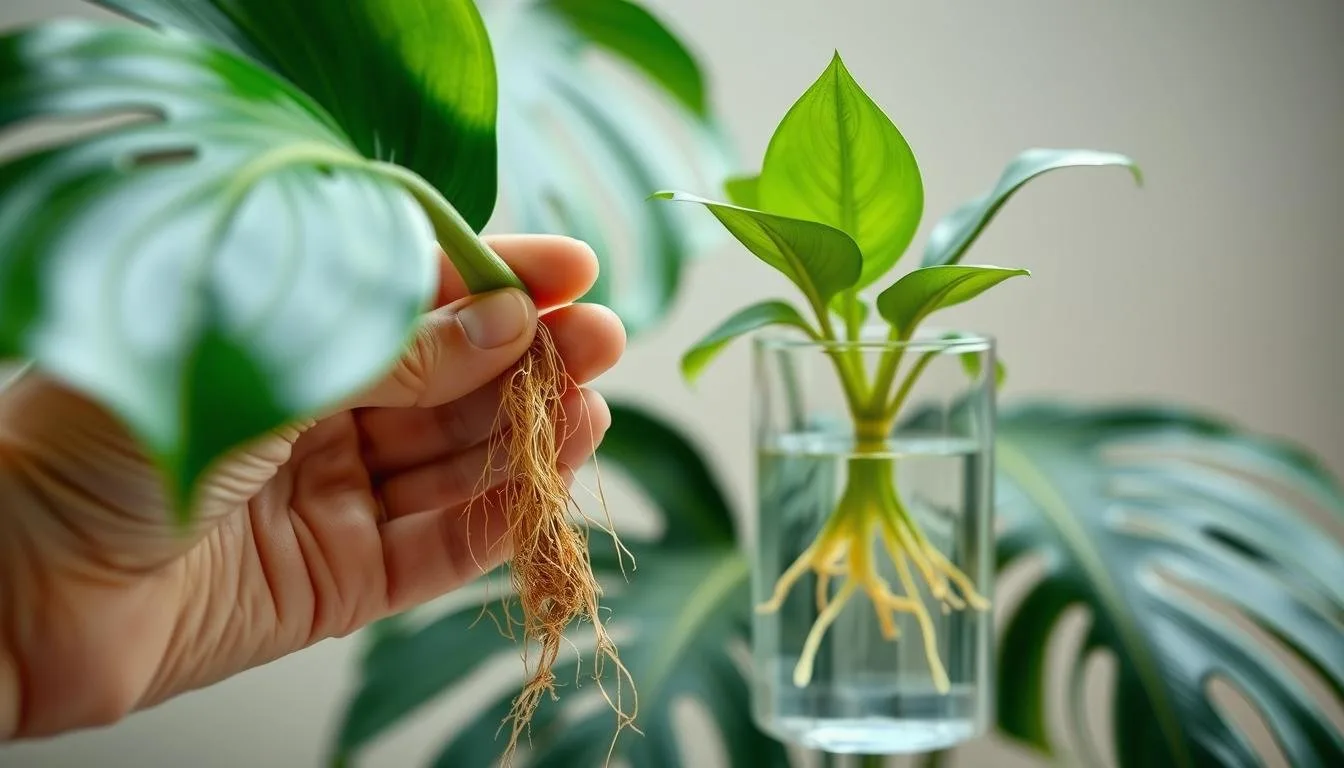
To root a cutting in water, use clean snips and cut just below the node. Put the node under clean room-temperature water, leave the leaf above the waterline, and set the vessel in bright indirect light. Refresh the water if it clouds or develops an odor; when several roots have formed and begun to branch, pot the cutting into a small draining container with airy mix.
You can also place a node directly into a lightly moist, airy rooting medium. Keep it warm and bright but out of direct sun, and avoid keeping the medium saturated while roots are forming. Water-rooted cuttings may pause briefly after potting as they adapt to a less uniform water supply, so keep conditions steady and do not repot them immediately.
The strongest propagation decision happens before the cut. Look for a firm stem, a visible node, and a healthy parent plant; avoid sections that are very pale, soft, pest-damaged, or recently scorched. If the cutting grows green, more light will help it grow if it was previously too dim, but it will not add variegation to tissue whose growing point does not carry it.
Repot when the roots give you a reason
Repotting every two years is not a rule. Check the pot when roots are densely circling, emerging from the drainage holes, or holding the mix in a tight root-bound plug that dries unusually fast. A plant that has slowed down without those signs may need a brighter position, more stable watering, or pest inspection instead.
When you do repot, move up only one modest pot size and retain the same planting depth. Loosen only the outer roots that need it, remove mushy roots if rot is present, and replace broken-down mix with a fresh airy blend. After watering, let the pot drain fully; avoid fertilizer until the plant has resumed steady growth or any included fertilizer has been used up.
Set realistic growth expectations
Variegated adansonii often grows more slowly than a vigorous all-green plant because its pale tissue contributes less to photosynthesis. The rate still depends on light, warmth, root health, plant size, and the balance of green tissue, so a fixed “inches per month” promise is not useful. A healthy plant may produce a run of leaves during warm bright months, then slow considerably when days shorten.
Juvenile leaves may be smaller and less perforated than mature leaves, and a trailing vine may look different from one growing vertically. Judge the plant by whether its new leaves are firm and its stems remain healthy, not by whether every leaf is dramatically variegated or larger than the last. A stable routine is a better sign than a burst of growth driven by excess fertilizer.
Troubleshoot changes in the leaves
Color alone does not diagnose a problem because natural variegation, sun damage, dry roots, and excess moisture can all create pale or brown areas. Look at where the change appears, what the newest leaves are doing, and how the mix feels before changing care.
White sections turn brown or crisp
Brown edges limited to the palest tissue can reflect that tissue’s lower tolerance for direct sun and drying. If the damaged leaves face the window, filter the light or move the plant slightly back; if the room is very dry, move it away from hot airflow and raise ambient humidity gradually. Do not compensate for a crispy patch by keeping the soil constantly wet.
If brown marks spread across green and white areas, check for inconsistent watering, salt buildup, or root trouble as well. A stem that is soft at the base, a sour-smelling mix, or roots that are dark and mushy points to an overly wet root zone. Correct the underlying condition and wait for new growth; existing damaged tissue will not turn green again.
New leaves carry less variegation
First compare several leaves and inspect the stem near the newest node. One mostly green leaf can be a normal shift; a succession of all-green leaves may mean the active shoot is coming from a greener growth point. More light can support better growth, but direct sun is not a color treatment and can damage the pale parts.
If the vine is otherwise vigorous, you can prune back to a node that shows the desired pattern and let that bud continue. Do not prune back so hard that only a tiny amount of green leaf area remains. If the plant is weak, fix the basic conditions and let it recover before trying to shape its pattern.
Leaves yellow, droop, or soften
Check moisture before adding water. A dry, lightweight pot with limp leaves may need a thorough drink; a heavy pot with damp mix and yellowing lower leaves needs time to dry and a root inspection if the decline continues. Yellowing does not automatically mean overwatering, but repeated wet soil, poor drainage, and soft roots make that explanation more likely.
Also inspect leaf undersides and stem joints for scale, mealybugs, or spider mites, especially if growth is distorted or leaves have stippling. Isolate an infested plant, identify the pest, and follow a product label if using a treatment. Avoid mixing several home remedies at once; that makes it harder to see what worked and can further stress pale leaves.
Keep the plant away from pets and children
NC State lists Monstera adansonii as toxic if ingested, and UF/IFAS’s houseplant toxicity reference identifies insoluble calcium oxalate crystals in Monstera, including Adanson’s monstera. Penn State Extension’s Monstera overview also cautions that Monstera plant parts can be harmful if eaten.
Chewing can irritate the mouth and throat, and sap can irritate skin, so place the vine where curious pets and young children cannot reach it. Wear gloves if you are sensitive to plant sap and wash your hands after pruning.
If a pet or child chews the plant, contact a veterinarian, poison-control service, or local medical professional for advice rather than trying a home treatment. A high shelf is not sufficient if a long trailing vine can hang within reach; secure stems or choose another placement.
Conclusion
Give variegated Monstera adansonii bright filtered light, an airy mix, warm conditions, and a watering routine based on the pot’s dry-down. Choose climbing or trailing for the space you have, feed lightly while it grows, and repot only when the roots are crowded or the mix has deteriorated.
Most importantly, treat variegation as a trait to manage, not a switch to turn up. Protect pale tissue from harsh sun, keep enough green growth to power the vine, and select patterned nodes when you prune or propagate. If a leaf changes, diagnose the growing conditions and node before making a drastic cut.