Mexican Fan Palm Care: What to Know Before You Plant
Mexican fan palm care is simple only when the site fits. Check its mature size, water needs, cold limits, pruning risks, and invasive status before planting.
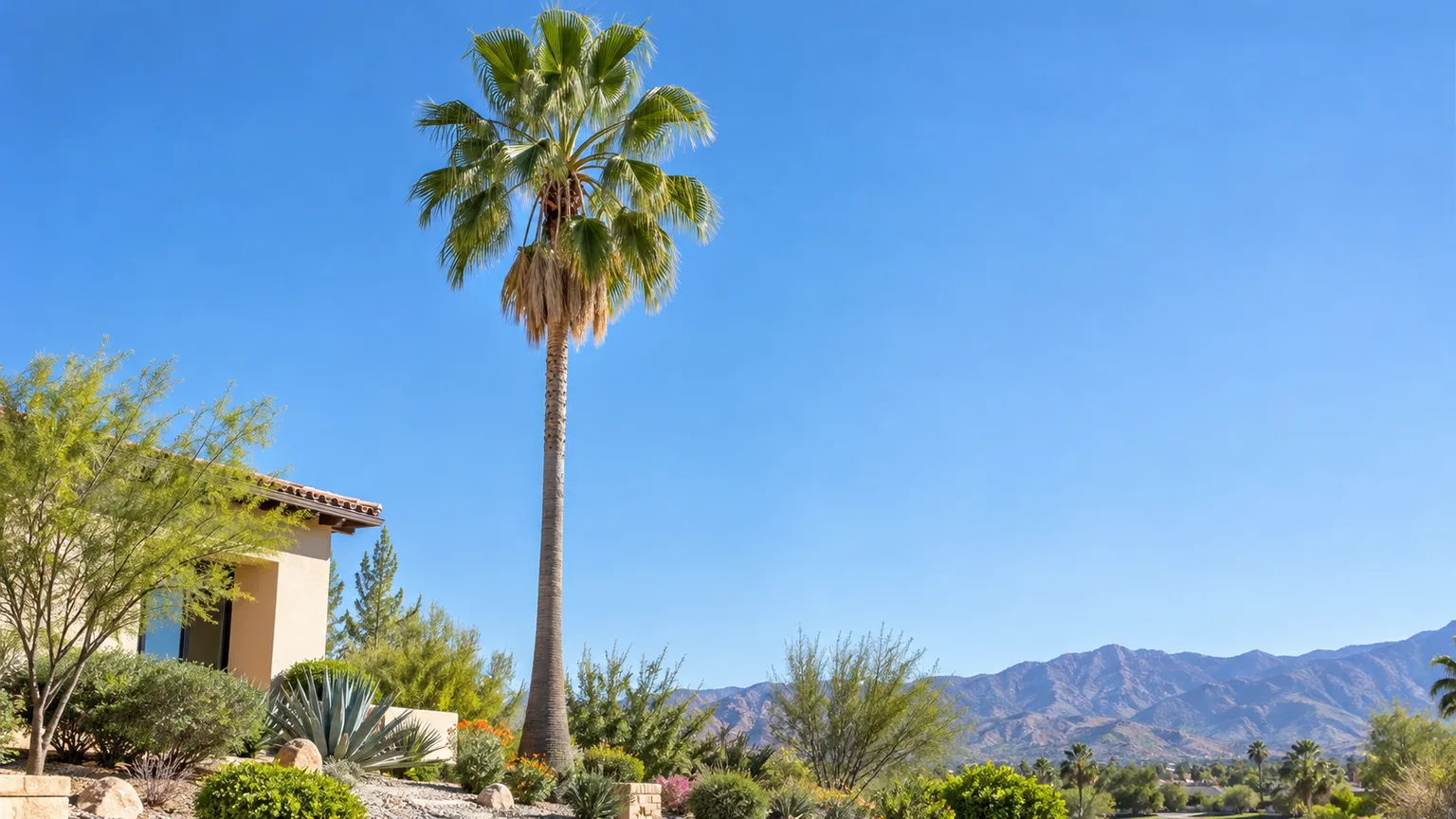
A Mexican fan palm can be an excellent boulevard or courtyard tree—and a poor fit for a small yard. Washingtonia robusta grows quickly into a very tall, slender palm, and its persistent dead fronds, sharp leaf stalks, abundant fruit, and difficult-to-reach crown are part of the maintenance decision, not afterthoughts. Before buying one, confirm that its mature size, cold limits, pruning needs, and local invasive status suit your site.
Where it does fit, care is straightforward: give it full sun, well-drained soil, steady water while it establishes, and enough room for a tree that may reach 50 to 100 feet. After establishment it tolerates dry spells, heat, salt, and wind, but prolonged cold, saturated roots, nutrient imbalance, and careless pruning can still cause serious damage. NC State Extension and trusted horticulture guides agree on the basics; the useful difference is knowing when those basics do—and do not—make this palm a sensible choice.
Is a Mexican fan palm right for your yard?
Start with the mature tree, not the nursery pot. NC State Extension lists a potential height of 50 to 100 feet and a spread of about 8 to 10 feet. A young palm looks modest, but its crown will rise well above most homes, and the old fronds can hang beneath that crown until removed or shed. If the space is bounded by overhead wires, roof edges, narrow walkways, neighbors’ property, or a swimming pool, the future tree may create years of access and cleanup problems.
The palm is most practical where summers are long and warm, winters are mild, drainage is quick, and there is open sky above the planting site. It can work as a tall accent, street tree, or large-property specimen. It is a poor “small tropical touch” for a compact suburban bed if the owner expects a tidy, short tree or cannot arrange safe crown maintenance.
There is also an ecological decision. Birds and water can move its seeds, and the species has naturalized or become invasive in some regions. Check state and county invasive-plant lists and local planting rules before you purchase it. If the palm is listed as invasive where you live—or if volunteers already spread into nearby natural areas—choose a locally appropriate alternative instead.
What Mexican fan palm looks like—and what it is not
Washingtonia robusta is a single-trunked palm with a narrow, ringed trunk and a rounded crown of large, fan-shaped leaves. Mature leaves can be several feet across, and the leaf stalks, or petioles, have sharp teeth. The dead leaves often remain attached and fold down around the trunk as a brown skirt. Cream-colored flowers appear in long, drooping sprays, followed by small dark fruits.
The California fan palm, Washingtonia filifera, is a close relative and a frequent source of confusion. Cal-IPC describes Mexican fan palm as generally more slender, with a more compact crown and brighter green leaves; California fan palm typically has a stouter trunk and grayer foliage. The species can also hybridize, so a single visual feature may not settle identification. NC State notes another look-alike, the native sabal palm (Sabal palmetto), whose trunk and crown differ from Washingtonia.
A correct ID matters most when you are selecting a native replacement or deciding whether a plant is invasive locally. Do not assume a palm with “fan” in its common name has the same climate tolerance, stature, or environmental impact. Look at the trunk, the shape and color of the crown, petiole teeth, and your regional plant list together. (NC State Extension; California Invasive Plant Council)
Choose a site that can hold a very tall tree
Picture the full-grown palm in a storm, not just on a still summer day. Leave open clearance above the crown and consider where a dead frond, fruit cluster, or damaged trunk could land. Avoid planting beneath electrical wires or where future pruning would require a ladder over a roof, pool, driveway, or busy sidewalk. A qualified arborist can assess a mature tree, but a bad planting location cannot be fixed by routine trimming.
The trunk is slender compared with the canopy height. Although NC State lists the species as wind-tolerant, very tall palms can be vulnerable to severe wind, saturated ground, and poor anchoring. Do not put one where a fall could strike a home, play area, or essential utility. In exposed sites, ask a local arborist or landscape professional whether the palm is suitable for local storm conditions and soil.
Choose full sun when possible. Partial sun is tolerated, but a shaded or crowded position can produce a less balanced crown and competing canopies. Give the root zone access to well-drained soil rather than enclosing it in a permanently wet pocket. Mexican fan palm handles coastal salt and urban conditions, but those tolerances do not compensate for flooding, restricted overhead space, or a location where fallen fruit and fronds become a hazard.
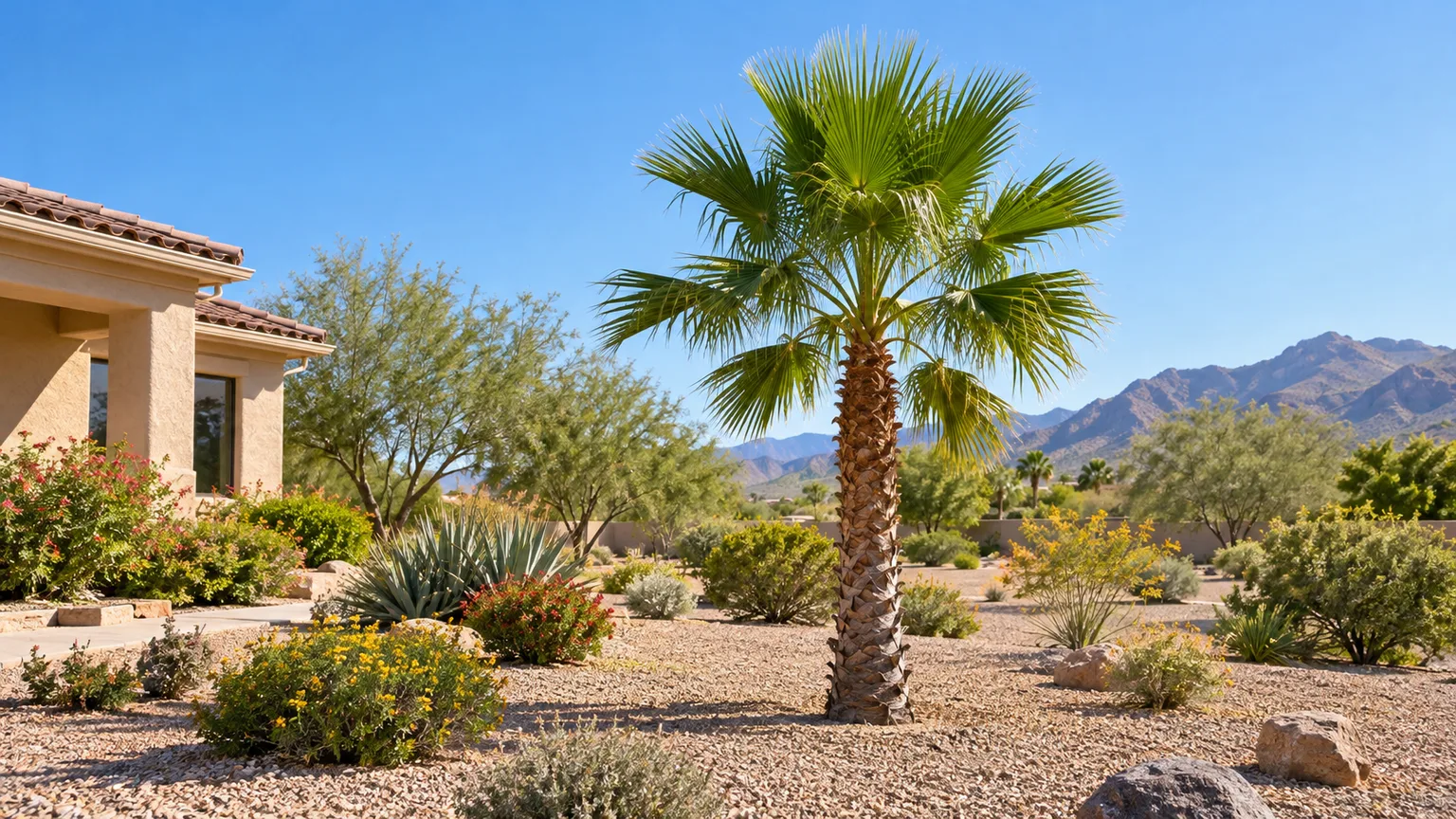
How to plant a Mexican fan palm
Plant when the ground is warm and the tree can establish before its first cold season. Spring or early summer is a practical window in many climates, but avoid the hottest, driest stretch if you cannot keep the root ball watered. Water the nursery root ball before planting so it is evenly moist, not dripping wet.
Dig a hole no deeper than the root ball and several times wider. Set the palm so the root-ball surface sits level with the surrounding grade; burying the trunk or the root initiation area can keep it too wet and compromise establishment. Loosen circling roots only if they are visibly bound at the outer edge, and handle the trunk carefully. Backfill with the soil removed from the hole unless a local soil test or site condition calls for a specific correction. A planting hole filled with rich, loose amendment inside heavy native soil can hold water like a basin.
Water slowly after planting to settle soil around the roots, then keep the root zone evenly moist as new roots grow. Garden Guides likewise advises deep watering and consistent moisture during establishment while warning against saturated soil; treat any fixed establishment period as a local starting point, not a universal timer. In a dry climate, build a temporary low watering berm outside the root ball; in a rainy or clay-heavy site, make sure water drains away rather than pooling around the trunk. Keep mulch a few inches back from the trunk so the base can dry and be inspected. (Garden Guides)
Planting is also the time to get spacing right. NC State lists a mature width around 8 to 10 feet, while the crown and the effect of a towering specimen can occupy much more visual space. The tree should not be squeezed between a wall and a walkway just because the current root ball is small.
Watering: establish it, then adjust to conditions
A newly planted palm needs more dependable moisture than an established one. For the first weeks, check the root ball and surrounding soil every few days during hot, dry weather. Water deeply when the root zone begins to dry; reduce the frequency after rain or when the ground stays cool and damp. A fixed “once a week” rule can under-water a palm in hot sand and over-water one in cool clay.
Use a slow application that wets the root ball and adjacent soil rather than a quick splash at the trunk. A drip ring or soaker line can work if it distributes water around the root zone and does not keep the trunk base constantly wet. As the palm establishes and begins to put out new growth, extend the time between irrigation and let the soil partially dry between thorough waterings.
Mature Mexican fan palms tolerate drought, but “drought tolerant” does not mean “never water.” In arid landscapes, occasional deep irrigation can support growth, especially during prolonged heat. Conversely, fast growth is not a reason to keep the soil wet. NC State notes that the palm can grow faster with consistent moisture but quickly declines in constantly wet, oxygen-poor soil. Watch the soil and the tree, not a calendar.
For a container palm, check much more often. Pots heat and dry from all sides, but a large container that stays wet can also suffocate roots. Water until excess drains, empty any saucer, and wait until the mix has begun to dry before watering again.
Soil and drainage matter more than drought tolerance
Mexican fan palm is adaptable to sandy or loamy soil and can tolerate a range of pH, but the essential condition is drainage. Water should move through the root zone rather than sit around it. If a test hole holds water long after rain or irrigation, correct the site or plant elsewhere; do not assume a palm will turn a wet hole into a healthy one.
In heavy clay, planting slightly high in a broad mound can help keep the root-initiation zone from remaining saturated, but only if runoff will not wash soil away from the roots. Do not dig a deep pit and fill it with gravel; that can create a perched water zone rather than improve drainage. A landscape professional can assess persistent drainage problems before a large palm is installed.
The species tolerates salt and urban soil better than many ornamentals, which helps explain its use along coasts and streets. Still, salt tolerance is not immunity to every coastal stress, and compaction around a young root ball can slow establishment. Protect the planting area from repeated vehicle or foot traffic while roots spread.
Sun, heat, wind, and cold
Give the palm at least six hours of direct sun when the site allows. It tolerates partial sun, but full sun supports the compact, strong growth expected of a landscape palm. Heat is usually easier for it to handle than prolonged wet cold. Hot, dry wind can still increase water demand on a newly planted tree, so check the soil rather than assuming the palm is drought-proof.
Hardiness-zone labels are broad averages, not a guarantee that a palm will come through every winter without injury. NC State assigns it to Zones 9a through 11b and notes that leaf damage can occur around 20°F. Gardener’s Path likewise cautions that this temperature is not a safe long-term exposure and that persistent cold—especially cold, wet weather—can damage foliage. A single brief dip and several hours or nights below freezing are different exposures; the crown, tree age, wind, soil moisture, and local microclimate all affect the outcome. (NC State Extension; Gardener’s Path)
If your winter routinely brings hard freezes, choose a more cold-hardy palm rather than planning to wrap a tall tree every year. Small container palms can be moved to a bright, protected location before frost, but an in-ground mature specimen cannot be made reliably cold-proof with improvised covers. Avoid fertilizing late in the growing season to push soft new growth before cold weather.
Fertilizer and potassium deficiency
Do not assume that every brown tip means the palm needs more fertilizer. NC State identifies potassium deficiency as a common issue in Mexican fan palm; it can cause leaflet-tip necrosis, discoloration, and early death of older leaves. Drought, root injury, poor drainage, salt buildup, cold, and normal aging can also discolor leaves, so look at the whole pattern and growing conditions before treating.
If older fronds show progressive tip burn or discoloration while the newest leaves remain more normal, inspect watering and drainage first. Then consider a soil test, a local extension diagnosis, or professional palm assessment. A palm-formulated fertilizer that includes potassium and magnesium may be appropriate, but the blend and rate depend on region and soil. Avoid high-nitrogen lawn fertilizer around the root zone: UF/IFAS explains that unbalanced nitrogen can worsen potassium or magnesium problems in landscape palms, particularly in Florida soils. Its Florida maintenance guidance is region-specific, so use your own extension service and the product label for local rates. (NC State Extension; UF/IFAS Extension)
Palms replace their leaves from the crown, so visible recovery takes time. UF/IFAS notes that correcting potassium deficiency can take one to three years or longer as the canopy renews. Do not remove discolored but still-attached older fronds simply to make the palm look cleaner; removing them can reduce the remaining canopy and does not correct the cause. Do not drill, inject, or apply concentrated fertilizer near the trunk without specialist direction.
Growing a Mexican fan palm in a container
A young Mexican fan palm can live in a heavy container with large drainage holes, which is useful for a patio specimen or for moving a small plant indoors during a cold snap. It is not a realistic permanent houseplant for most homes. The species grows rapidly, wants strong light, and eventually develops a height and crown that outgrow ordinary rooms and pots.
Use a free-draining palm or tree container mix and a pot heavy enough not to tip as the crown expands. A container that is far larger than the root ball can stay wet for too long, so move up gradually when roots fill the current pot or the mix dries unusually fast. Repotting a larger specimen may require help because the pot can become heavy and top-heavy.
Keep the palm outdoors in full sun during warm weather, introducing it to stronger exposure gradually if it has been grown in shade. In winter, move a manageable container to a bright, frost-protected place before cold arrives. Reduce watering as growth slows, but do not let the root ball remain bone dry for long periods. If the tree already needs repeated heavy pruning just to fit, it has outgrown its container and should be moved to a suitable landscape or replaced.
How to grow Mexican fan palm from seed
Propagation is by seed; the species does not form the clumping offsets used to divide some other palms. Before collecting or sowing seeds, check local rules and ecological guidance. Because birds and water disperse the fruit, raising extra seedlings can create a problem if the palm is invasive in your area.
Collect mature, dark fruits and remove the fleshy pulp from the seed. Gardener’s Path recommends soaking cleaned seeds in warm water for a few days, then sowing them just below the surface in a freely draining medium; warmth and steady, non-soggy moisture encourage germination. Sow several seeds in a small pot if you have room to select the strongest seedlings, and label the container with the species and sowing date. (Gardener’s Path)
Keep the pot warm and bright, but protect it from harsh midday sun while the medium is drying quickly. Check moisture daily at first: the mix should stay lightly moist, not waterlogged. Germination may take days to a few weeks depending on seed freshness and temperature, so do not discard a firm seed after only a short wait. Once seedlings have true leaves and roots hold the mix together, pot them individually without burying the stem more deeply than before.
Harden seedlings gradually before putting them outside. Move them into gentle outdoor shade for a short period, then increase sun and wind exposure over a week or two. A seedling that has spent its life indoors can scorch or dry rapidly if it is placed directly into full desert sun.
Pruning: manage dead fronds without overpruning
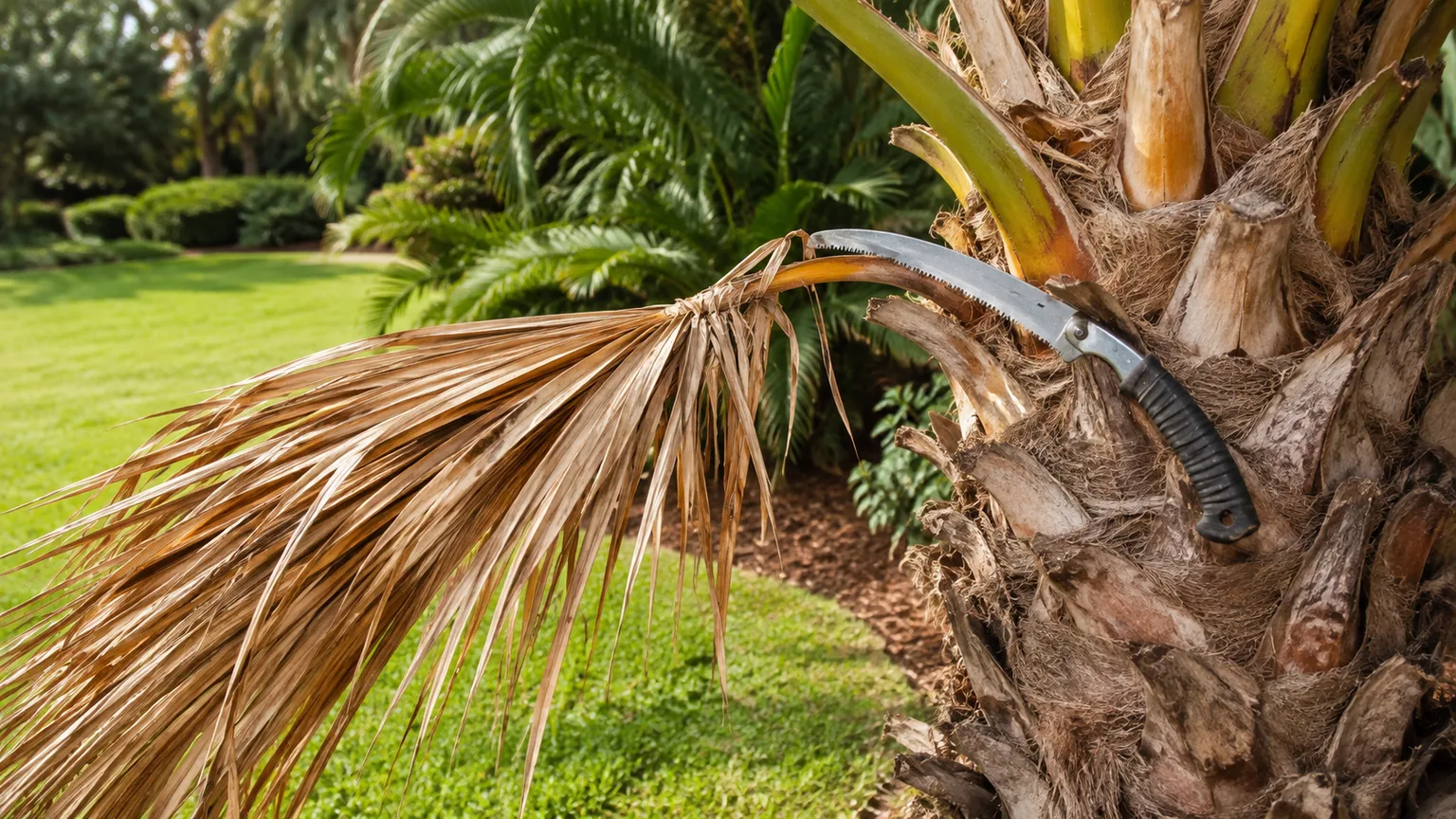
The brown skirt is not just a cosmetic issue. NC State notes that dead fronds can be removed to reduce fire hazard, while also providing roosts for owls, bats, and other wildlife when left in place. Plant Pono identifies the skirt as a fire and rat-habitat concern in Hawaiʻi, and Cal-IPC notes the fire risk in California. The right choice depends on fire exposure, local rules, nearby buildings, and whether habitat value outweighs the practical risk at your particular site. (NC State Extension; Plant Pono; California Invasive Plant Council)
If removal is appropriate, limit pruning to fully dead or broken leaves and spent flower stalks. Never cut healthy green fronds to make a “sharper” shape or strip the crown into a severe V; green leaves supply energy and removing them can worsen stress and nutrient problems. Avoid cutting into the trunk or damaging the single growing point at the crown. Do not nail signs or climbing hardware into the trunk.
Work on the ground only if a frond is safely within reach. A mature crown can be many stories high, and sharp petiole teeth, heavy fronds, falling debris, and proximity to power lines make climbing or ladder pruning dangerous. Hire an insured, qualified palm arborist for elevated work, and ask them to remove only what is necessary. Never use a chainsaw from a ladder or allow an untrained worker to climb the trunk.
Flowers, fruit, seedlings, and invasive risk
A mature palm may send out long, arching clusters of small cream-colored flowers, commonly in warm-season months. The flowers develop into small dark fruits. NC State describes the fruits as edible but thin-fleshed; they are generally more important in the landscape as a food source for birds, which can carry seeds away from the parent tree.
That dispersal is why naturalization matters. NC State reports that the palm has naturalized in parts of Florida, California, Hawaiʻi, Louisiana, and Texas. Cal-IPC documents invasive populations in California riparian areas, orchards, and landscaped areas; Plant Pono identifies it as invasive in California, Florida, and Hawaiʻi and as a no-grow species for the Big Island program. The listing and severity are regional, not a statement that every specimen everywhere is prohibited. Check current local sources before planting or sharing seed. (NC State Extension; California Invasive Plant Council; Plant Pono)
If local guidance allows the palm but you want to limit spread, remove fruit clusters before ripe fruits fall, collect dropped fruit, and pull volunteer seedlings while they are small and the roots can be removed. Do not dump fruits or seedlings near waterways, vacant lots, parks, or natural areas. Where a local authority lists the palm as invasive or discourages new plantings, prevention is better than managing a continuing seed source.
Troubleshooting growth, pests, and disease
Older leaves develop brown tips or turn yellow-orange. Potassium deficiency is one possibility, especially when the damage progresses on older leaves, but it is not a diagnosis by itself. Check moisture at root depth, drainage, salt exposure, recent cold, and whether nearby turf is receiving a high-nitrogen fertilizer. A soil or tissue diagnosis is more useful than applying a random nutrient product.
New growth is distorted, brown, or fails to open. Inspect the crown from the ground with binoculars if needed; do not climb to investigate. Cold injury or physical damage can harm the growing point, and persistent wetness can encourage bud or trunk problems. If the center spear loosens, the crown collapses, or the trunk develops soft or fungal growth, contact a palm specialist or arborist promptly. A palm grows from a single terminal growing point, so major crown damage is serious.
Leaves have fine stippling, webbing, or scale. NC State lists spider mites and scale among the few insect problems reported for this palm. Confirm insects before treating: dust, drought, and normal old-leaf decline can be mistaken for pests. For a young, reachable plant, rinse the foliage and inspect the undersides and petiole bases. On a mature tree, pest treatment belongs to a licensed professional who can identify the pest and select a suitable, legal treatment.
The trunk leans or the palm appears unstable. Do not try to straighten or brace a tall, established palm yourself. A new palm may settle after planting, but a changing lean, exposed roots, soil heaving, or a damaged crown can indicate a structural problem. Keep people away from the fall zone and ask a qualified arborist to assess it, especially after high winds or saturated soil.
Winter care in the ground and in a pot
For an in-ground tree in a suitable warm climate, keep the root zone draining and avoid late-season fertilizer that encourages tender growth. Water before a cold spell only if the soil is dry; do not saturate the base as a protective measure. After a freeze, wait for the extent of damage to become clear before removing foliage. Brown fronds may still protect parts of the crown, and cutting them off immediately can expose living tissue.
A container palm is easier to protect because it can be moved. Bring it to a bright, sheltered place before frost, not after the pot and roots have frozen. Reduce irrigation as growth slows, but let the mix dry only partly. Keep the pot away from cold drafts and heating vents, and return it outdoors gradually in spring so leaves acclimate to sun and wind.
If cold events are routine where you live, annual wrapping is not a durable plan for a palm expected to outgrow ladders and covers. Choose a more cold-hardy species before planting. A mild winter on one sheltered wall does not predict how the tree will fare in a future exposed freeze.
Landscape uses—and when to choose another palm
Use Mexican fan palm where height is an asset: a large subtropical property, a broad street planting, or a sunny site with ample clearance and access for professional care. It can make a strong vertical accent and tolerates coastal salt, heat, and urban conditions. Group planting needs even more spacing and repeated crown maintenance; a row of young palms can become a line of very tall trees before a homeowner realizes how much canopy and cleanup the design commits them to.
Choose another species if you need a compact palm, live where hard freezes are regular, cannot manage fruit and seedlings, or have no safe way to maintain the crown. The best replacement depends on your region. In North Carolina, NC State lists the native dwarf palmetto, Sabal minor, as a native alternative for a similar planting niche, but it is much shorter and is not a one-for-one substitute in every climate. Ask a local extension office or native-plant organization for a palm that suits your exact region rather than substituting another nonnative fan palm by appearance alone. (NC State Extension)
Quick Mexican fan palm care calendar
| Season or stage | What to do | What to avoid |
|---|---|---|
| Before planting | Check mature clearance, local invasive lists, winter lows, drainage, and pruning access. | Buying a small nursery palm before checking overhead wires or future crown space. |
| Planting and first months | Plant in warm weather, keep the root ball evenly moist, and check the soil frequently during heat. | Deep burial, a saturated planting hole, or a rigid weekly watering rule. |
| Active warm-season growth | Water deeply during extended dry spells, inspect leaves and trunk, and use local palm-fertilizer guidance if needed. | High-nitrogen lawn fertilizer near the root zone or untested “fixes” for leaf discoloration. |
| Flowering and fruiting | Watch for dark fruit and remove clusters or seedlings if local rules allow the tree but seed spread is undesirable. | Moving ripe fruit or seedlings into natural areas. |
| Before winter | Stop late feeding; protect manageable container plants and keep the root zone draining. | Assuming a brief 20°F rating means a palm will tolerate prolonged freezing weather. |
| After storms or freezes | Inspect from the ground for lean, crown damage, broken fronds, and hazards; call an arborist when needed. | Climbing, topping, or removing green fronds to make a damaged palm look tidy. |
Conclusion
Mexican fan palm care is easiest when the site can accommodate the tree it becomes. Plant it only where a 50- to 100-foot crown, ongoing fruit and seedling management, and occasional professional pruning are realistic; give it sun, fast drainage, and careful establishment water; and treat fertilizer or leaf symptoms as problems to diagnose rather than invitations to guess. In regions where it spreads or local rules discourage it, the most responsible care decision is to choose a better-suited palm before planting.



