7 Lawn Mowing Patterns and When Each Works Best
Compare seven lawn mowing patterns, from stripes to diamonds and circles. See how grass type, slope, mower discharge, and turning space affect each design.

Straight stripes are the easiest place to start, but the best mowing pattern depends on what your yard will safely allow. Slope, obstacles, the mower’s discharge chute, grass type, and room to turn can matter more than whether you prefer diamonds or waves. A clean design begins with a route that suits those conditions and still follows sound mowing practices.
The light and dark bands are an optical effect: mowing bends blades in different directions, changing how they reflect light. The pattern does not mean one strip is healthier or greener than the next. You can choose a look for appearance, then rotate your route to avoid repeatedly driving the mower over exactly the same tracks.
What a mowing pattern can—and cannot—do
A lawn stripe is not a second cut, a different grass variety, or a fertilized band. Grass blades leaning away from the viewer reflect more light across their surface and appear lighter; blades leaning toward the viewer appear darker.
Change your viewing position or the sun angle, and the contrast can shift or seem to reverse. Better Homes & Gardens describes the same effect in its guide to mowing lawn stripes.
The effect is strongest when a healthy lawn has enough leaf length to bend, the mower lays blades consistently, and the passes are straight. A short, sparse, drought-stressed, or recently scalped lawn may show little contrast.
That is a limitation of the turf and conditions, not a reason to lower the deck, make extra passes, or add heavy equipment.
A stripe pattern itself does not make grass healthier. Varying the route can help shift tire traffic and reduce repeated wear or scalping; Maine’s yard-care mowing guidance recommends changing patterns for that reason.
But the same heavy mower can still compact soil, especially on wet ground or during repeated tight turns. A new direction is a sensible maintenance habit, not a cure for poor drainage, compaction, or thin turf.
Choose a pattern using five yard constraints
Before choosing a design, decide where the mower can travel comfortably, where clippings can go, and how much time you want to spend. A simple plan that follows the lawn’s open shape usually looks better than a complicated pattern interrupted by a narrow gate, tree roots, or steep bank. Use this quick comparison as a starting point rather than a rulebook.
| Pattern | Best fit | Effort | Main constraint |
|---|---|---|---|
| Straight stripes | Rectangular, open lawns | Low | A straight reference line and room to turn |
| Diagonal stripes | Small rectangles or lawns viewed from a house | Low to moderate | Narrow corners can create more edging |
| Gentle waves | Broad lawns with curved beds | Moderate | Tight curves cause uneven overlap |
| Circles or spiral | A safe, open focal area | Moderate to high | Obstacles and turning radius |
| Checkerboard | Flat, open areas where a second cut is practical | High | A full crosscut pass adds time and traffic |
| Diamonds | Large open lawns and experienced operators | High | Two precise diagonal passes and good traction |
Slope and obstacles set safety limits
On flat ground, you can choose a route for visual effect. On a slope, machine stability and footing come first, even if that means breaking a stripe or leaving a bank for a trimmer or professional.
Penn State Extension advises checking the operator’s manual for the mower’s slope limits and gives different approaches by mower type; its riding mower safety guidance says riders should generally travel up and down on slopes steeper than 15 degrees, while walk-behind mower safety guidance from the Ag Safety and Health Community of Practice recommends mowing across a slope with a walk-behind machine. Those are general instructions, not permission to exceed your mower’s limit; model design, traction, surface wetness, and obstacles matter.
A complex pattern should never force a sharp pivot on a grade or a turn close to a ditch, retaining wall, pond, or drop-off. If your manual prohibits mowing the slope, or the ground is slick, uneven, or too steep to walk securely, skip it. Leave a safety gap around tree trunks, raised roots, edging, and planting beds; a mower blade can damage bark and hardscape, and a wheel can scalp turf when it rides over an edge.
Grass type and cutting height set stripe potential
Grass species differ in blade width, stiffness, growth habit, and recommended mowing height. Many cool-season lawns show more visible striping than stiff-bladed warm-season turf, but cultivar, water status, mower deck, and growing conditions all affect the result. Lawn Love’s overview of mowing patterns notes that Bermuda and zoysia can be harder to stripe than fescue or bluegrass; treat that as a tendency, not a promise about every lawn.
Longer leaves generally bend more readily, so striping may be more visible near the high end of the height range recommended for your specific grass. Do not raise or lower the deck to chase a photograph without checking local guidance.
The University of Nevada, Reno Extension recommends a three-inch setting for the lawns addressed in its mowing guidance, while Maine’s recommendation is different for its region. The variation is exactly why a universal height number is not useful.
Use the one-third rule as a practical guardrail: avoid removing more than one-third of the leaf blade at a mowing. If the lawn has grown too tall, raise the deck for the first cut, then bring it toward the intended height over later mowings instead of scalping it in one pass. Nevada Extension explains that repeated, high mowing helps preserve leaf area and reduce stress; the pattern should adapt to that care requirement, not override it.
Mower discharge can dictate pass order
A side-discharge mower throws clippings from one side of its deck; a rear-discharge or mulching mower handles them differently. Before committing to a pattern, identify where material exits, keep the deflector in place, and avoid directing debris toward people, pets, roads, windows, vehicles, water, or flower beds. Penn State Extension emphasizes keeping the discharge chute in place and away from people and property in its safety guidance.
The direction you travel changes where the chute points relative to the lawn. On alternating stripe passes, the chute may switch from pointing inward to pointing toward the lawn edge; plan the first row and the order of the remaining rows so clippings are not repeatedly dumped into a bed or onto a walkway.
If you cannot prevent heavy clumps from accumulating, mow when the grass is dry, slow down, use a suitable mulching or collection setup, or choose a pass direction that spreads material more evenly. Never block, lift, or remove a safety deflector to improve flow.
Seven common lawn mowing patterns
Straight lines are not the only option, but they are the foundation for most designs. Start by matching the pattern to the open area, then decide whether a second angle or a curved route is worth the added turns and time. The following choices move from simple to more demanding.
1. Straight stripes
Straight, alternating passes are the easiest pattern for most rectangular lawns. Choose a reference such as a sidewalk, long fence, or driveway edge, mow the first lane parallel to it, then turn and return beside the first lane in the opposite direction. Small overlap between deck widths helps prevent missed slivers; it does not require running the tires over the exact same rut every week.
You can also group the visual rhythm by sending two neighboring lanes in one direction before reversing the next pair. It keeps the same basic route but creates broader alternating bands; try it only if the pass sequence still puts clippings in a safe place.
Straight stripes work well when the lawn’s longest dimension is open and the mower has room for broad turns at both ends. If the center of the lawn is clear but the boundary is irregular, mow the main rectangle first and trim or mow the remaining pockets separately. Look toward a point ahead rather than at the front wheels so the reference line stays straighter.
2. Diagonal stripes
Diagonal stripes use the same back-and-forth method, but the first lane runs across the yard at an angle to the house, path, or longest edge. They can make a small rectangular lawn seem broader and can be easier to align with the view from a patio or window. Pick a clear landmark at the far side for the first pass; a small aiming error becomes more obvious over a long diagonal.
This pattern is a good way to change direction without mowing a second time over the whole area. On a narrow yard, however, diagonal passes create shorter runs and more turns near the corners, which can increase wear and make edges harder to finish. If the lawn sits on a slope, the safe mower direction takes priority over a diagonal that crosses it unsafely.
3. Gentle waves
A wave pattern replaces straight lanes with long, shallow curves. Use a generous turning radius and repeat the same broad curve across the lawn; small, abrupt wiggles make mowing slower and cause the deck to overlap unevenly. Waves suit a broad lawn with curved borders because the lines can echo the landscape instead of fighting it.
They are less forgiving in a small or sharply edged yard. The mower may need to cross its own turns, clip the same patch twice, or leave crescents at the perimeter. If the curves require constant steering corrections, simplify them into diagonal stripes; a calm route is easier to mow evenly than a highly detailed design.
4. Circles around a focal point
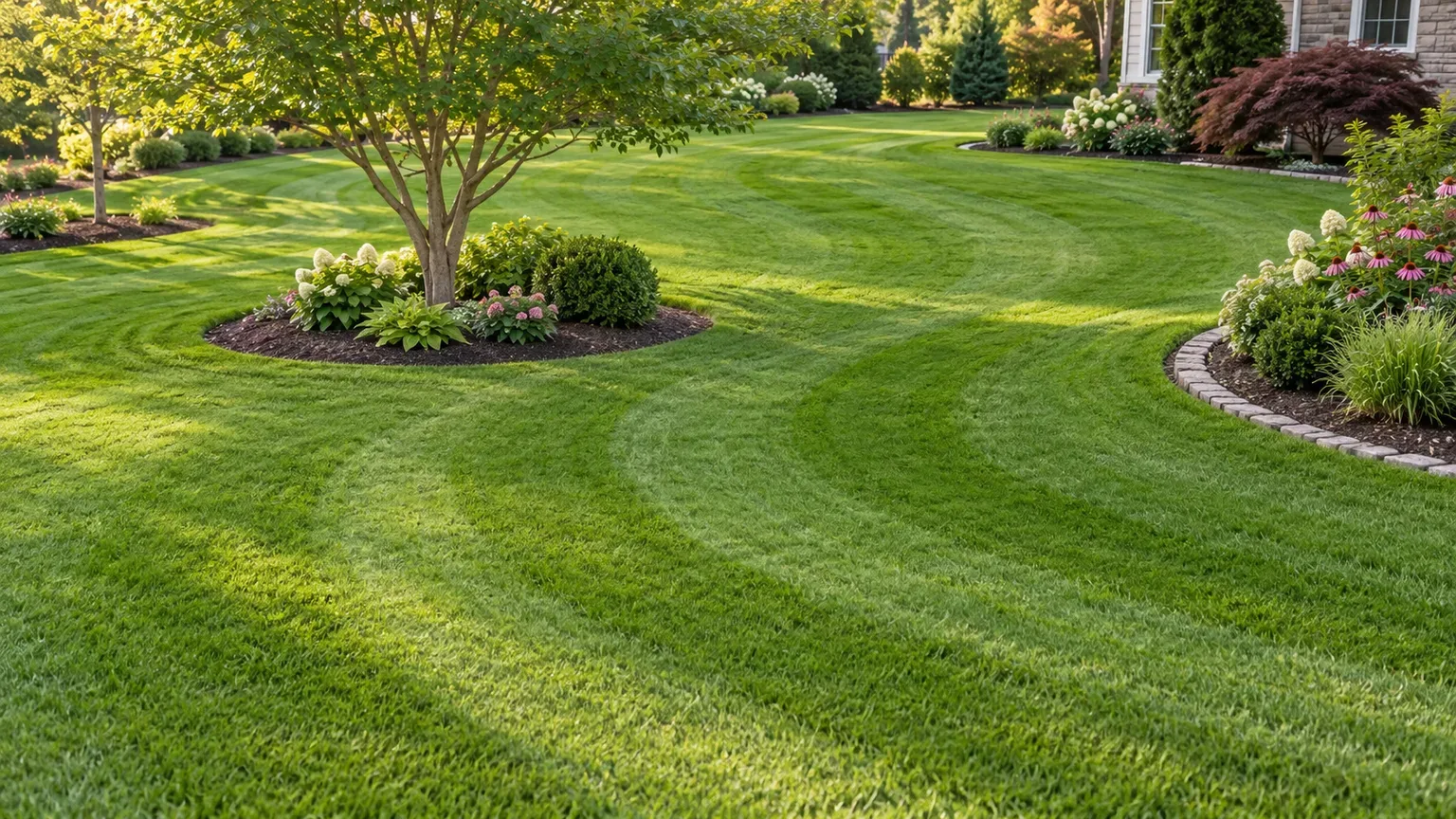
Circular mowing works when a safe, open focal point—such as a freestanding tree island or round lawn feature—sits near the center of the area. Begin with a wide ring around the feature, then move outward in adjacent loops, keeping the mower’s turning radius broad enough that the deck does not gouge the turf. A tree close to the edge or a small, cluttered bed is usually better handled with straight lanes and careful trimming.
Circular routes are harder when the lawn is irregular or the mower cannot turn smoothly. The inner rings become short and tight, and repeatedly steering around a trunk can scrape bark or flatten grass. Leave a generous buffer around trunks and hardscape, then use a trimmer only where it is safe and practical.
5. Concentric rings and a spiral
Concentric rings are a more formal version of circular mowing: each loop follows the previous one at a fairly even distance. A continuous spiral can reduce the number of stops by gradually widening or narrowing the loop, but it is difficult to keep evenly spaced near obstacles and boundaries. Choose rings when you can pause and reposition safely; choose a spiral only when the focal area is broad and unobstructed.
Neither method is ideal for a lawn with steep banks, narrow pinch points, or many fixed objects. The first loop establishes the visual center, so a crooked or lopsided starting ring remains visible in every later lap. Keep speed slow and avoid pivoting the mower in place, particularly when the ground is soft.
6. Checkerboard
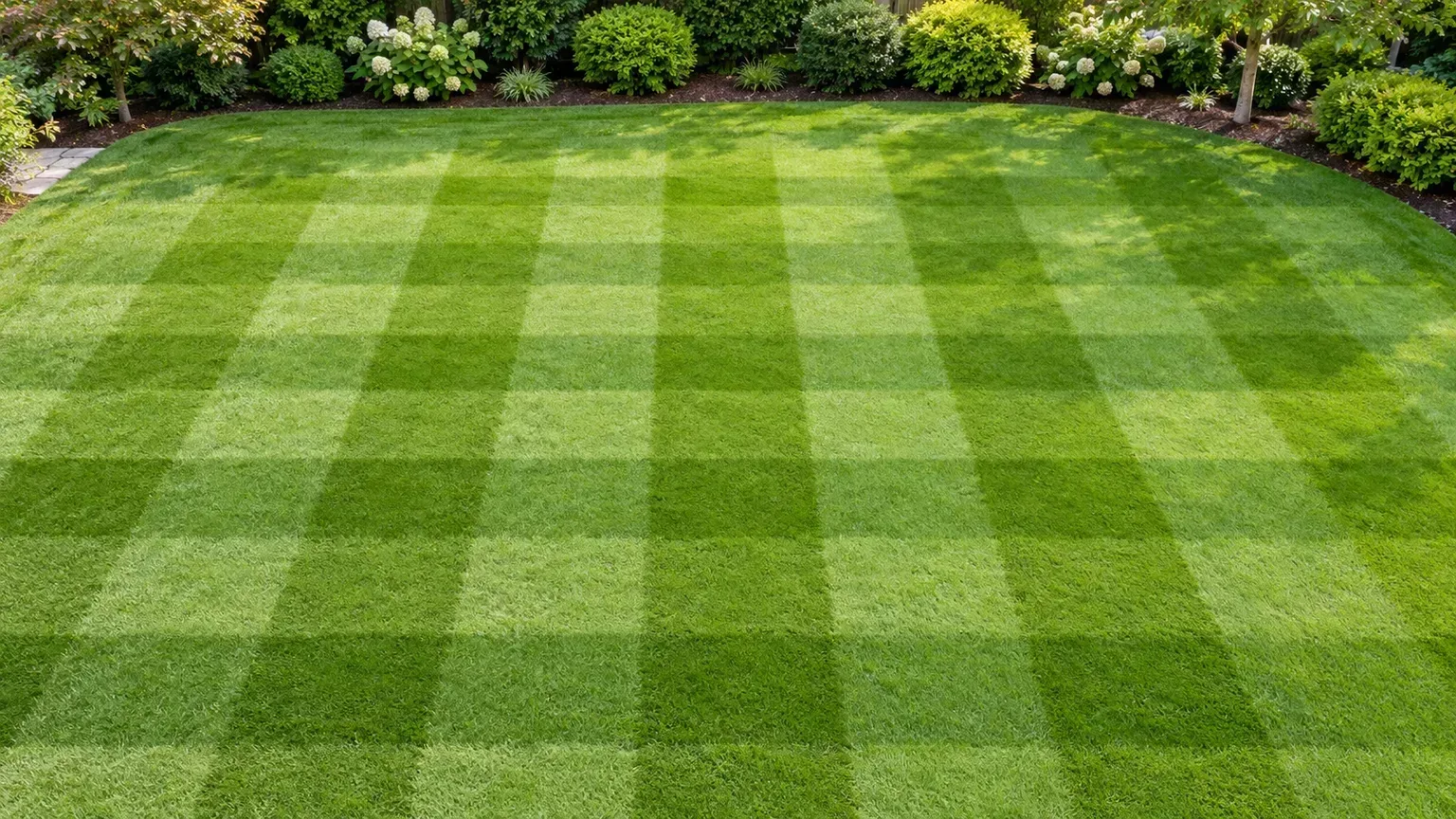
A checkerboard begins with parallel stripes across the lawn and adds a second set of passes at roughly 90 degrees. The crossing directions make alternating blocks appear light or dark as the bent blades reflect light differently. Better Homes & Gardens describes this at-home method as mowing a stripe set, then crossing it at a right angle; the extra pass takes longer and adds wheel traffic, so reserve it for a lawn that is flat, dry, and large enough to maneuver comfortably.
For a clean result, choose one direction for the first set and use a straight boundary as your guide. Then mow the whole area across that first set, maintaining the same overlap and speed. A final perimeter lap can neaten the outer edges, but it is optional; avoid repeating a heavy border route every time if the soil begins to rut.
7. Diamonds and crisscross
A diamond pattern is a diagonal checkerboard. Mow a set of parallel lanes at about 45 degrees to the lawn’s main edges, then mow a second set across those lanes at a right angle. The intersection creates diamonds; the first diagonal sets the scale, so use a long straight landmark or a visible line at the opposite edge to keep the angle consistent.
This design works best on a large, open, relatively level lawn where the second pass will not run into narrow corners or obstacles. It takes more time and usually means covering the turf twice. If you want the diagonal look with less effort, choose diagonal stripes instead; they require one mowing pattern and still change the lawn’s visual direction.
How to mow a clean pattern from first pass to finish
The goal is a route you can repeat without guessing where the previous lane ended. Plan the route before starting the mower, particularly if discharge direction, garden beds, or a slope make certain passes less suitable. Do not try to fix every irregularity by driving over the same spot repeatedly.
1. Check conditions and set a suitable height
Mow when the lawn is dry enough that the wheels have traction and the blades cut cleanly. Wet clippings tend to stick and clump, visibility suffers, and sloped ground becomes less predictable.
Remove sticks, stones, toys, wires, and other debris before mowing; wear sturdy closed-toe footwear and eye protection, keep children and pets away, and use hearing protection as needed. Penn State Extension’s riding mower safety practices cover debris, protective clothing, discharge guards, and slope precautions.
Set the mower to the height suited to your grass and season before you begin. A sharp blade produces a cleaner cut than a dull one, and a well-maintained mower is less likely to leave ragged strips that disrupt the pattern. If the grass is long enough that the one-third rule would be exceeded, do not mow it to the final height in one visit.
2. Plan the perimeter and first reference line
Walk the route and identify beds, trunks, drainage dips, gates, and turns before setting the deck down. On an open lawn, a first perimeter pass can create a turning lane; some operators instead mow the main stripes first and finish the border afterward. Either approach works if you leave enough space to turn without reversing over a cut row or taking a tight pivot on a soft patch.
Align your first lane to a straight visual reference and choose a direction that keeps the discharge away from people and sensitive areas. If a side chute would throw clippings outward on one pass and inward on the next, map that behavior in advance. Use the pattern’s safety-compatible direction on slopes, even if it means the visual lines no longer align perfectly with the house.
3. Alternate passes, turn smoothly, and manage clippings
Mow at a steady pace and overlap the previous cut just enough to prevent a thin uncut seam. At the end of each row, make a broad turn in the headland instead of skidding the tires or pivoting sharply.
Vary the main mowing direction over later mowings; Better Homes & Gardens suggests rotating stripe direction, and Maine’s mowing guidance notes that changing patterns can reduce repeated compaction and scalping. Shift the route gradually if the lawn already shows ruts rather than asking one new pattern to repair them.
Inspect the first few rows for missed strips, clumps, and discharge landing in the wrong place before continuing across the entire yard. Light, finely chopped clippings can remain on a lawn; visible piles should be dispersed or collected so they do not smother patches. If you add a striping roller, use it only on firm ground and understand that extra weight can increase soil pressure; no attachment is necessary for a subtle stripe.
Safe mowing and pattern changes that prevent wear
A pattern is optional; safe operation is not. Follow the mower’s owner’s manual for slope limits, operating direction, and blade adjustments. Penn State Extension advises operators to move slowly, keep the discharge guard in place, clear debris, and stop the machine before maintenance.
Its guidance notes that children should not operate riding mowers under age 14 and that riding machines should not carry extra passengers. Those reminders matter even for a small backyard because mower blades can propel debris and turning or reversing can bring a person into danger.
Use the mower type to guide slope travel. General extension guidance separates walk-behind and riding mower directions, but the manual for your exact machine controls, and you should not use a general angle threshold to justify mowing a slope that feels unstable.
Avoid mowing when grass or soil is slick, keep the chute pointed away from people and property, and stop the machine if someone enters the work area. Before clearing a clog or touching the blade, disengage it, shut off the engine, wait for moving parts to stop, and follow the manufacturer’s maintenance procedure.
Change direction often enough to avoid making every mowing follow the same tire tracks, but do not force an elaborate crosscut just for appearance. Straight stripes can be rotated between horizontal and diagonal passes, while curved or circular areas can be approached from a different direction on the next visit. If the lawn is sparse, stressed, soft, or newly seeded, prioritize an appropriate cutting height and gentle traffic over a crisp stripe.
Conclusion
The right lawn mowing pattern is the one that fits the shape of the lawn, the mower’s discharge, the grass’s recommended height, and the safe route across the property. Straight stripes suit most open yards; diagonal, curved, circular, checkerboard, and diamond designs add visual variety when there is enough room and time to mow them well.
Start with dry turf, a sharp blade, a modest overlap, and a first pass you can follow. Change directions across mowings to vary traffic, but treat stripes as an optical effect rather than proof of healthier grass. When slope, obstacles, or debris make a pattern awkward, simplify the route and mow safely.