How to Remove Kudzu: Identify Crowns and Control Regrowth
Identify kudzu by its leaves and vines, then remove root crowns, protect trees, dispose of cut growth, and monitor regrowth with a realistic control plan.
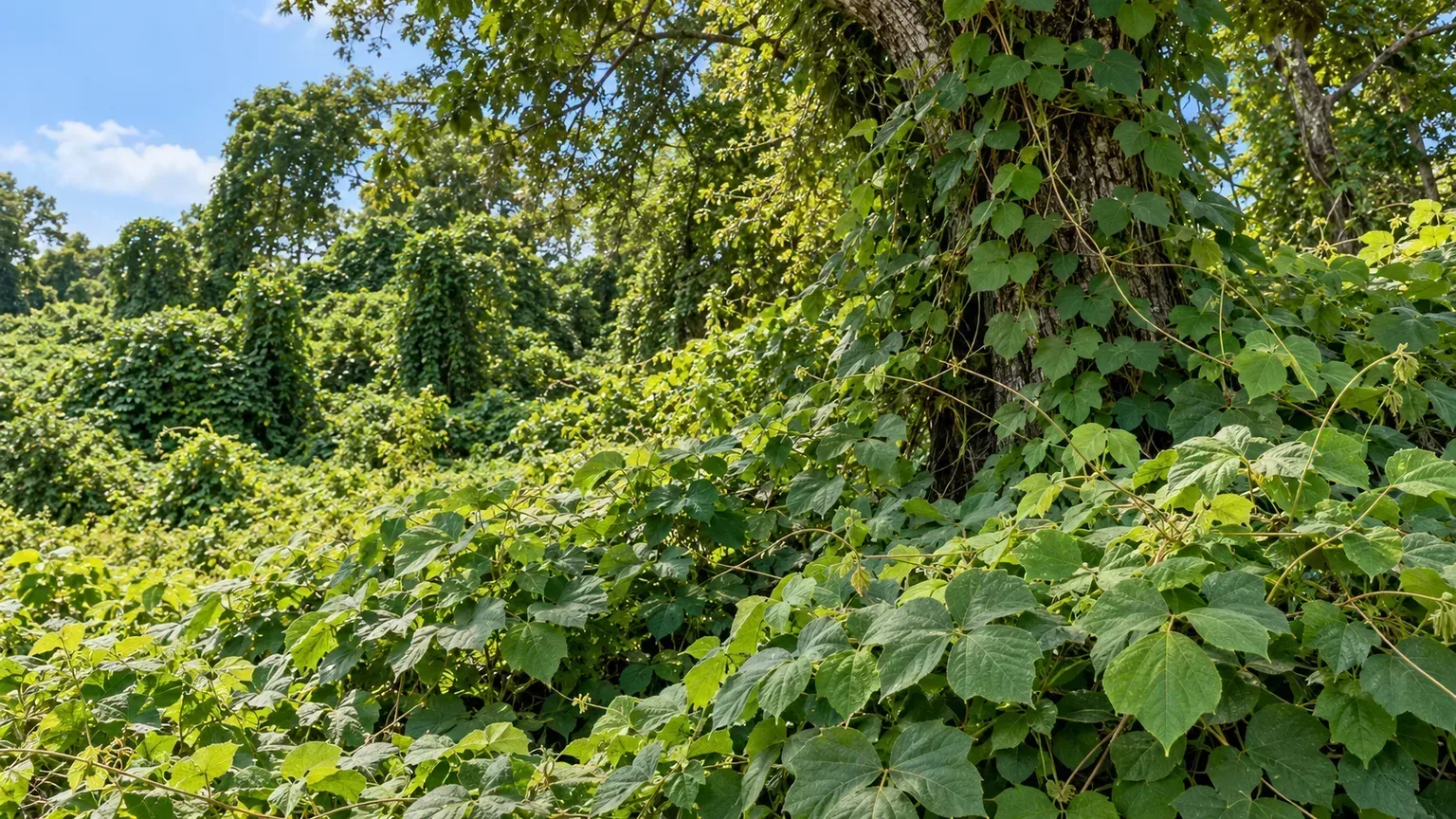
Kudzu is easier to control when you find it early, follow each vine to every place it has rooted, and choose a method you can repeat. Cutting the visible foliage once may make a patch look smaller, but it does not remove the root crowns and vine nodes that can send up new growth.
Start by confirming the plant, then map its edge and any vines climbing trees or structures. A few isolated crowns can often be dug out; an established mat may need repeated cutting, carefully selected herbicide, or professional help over several growing seasons. The right plan depends as much on access, slope, water, and nearby plants as it does on the size of the leaves.
What Kudzu Looks Like in the Field
Kudzu is a deciduous, woody perennial vine in the legume family. Its most useful field clue is the leaf: each leaf is made of three broad leaflets on one leaf stalk, often oval to heart-shaped, with soft hairs on the underside. The center leaflet may have rounded lobes, while the two side leaflets are usually less deeply lobed; leaf shape varies enough that no single leaf is a perfect test.
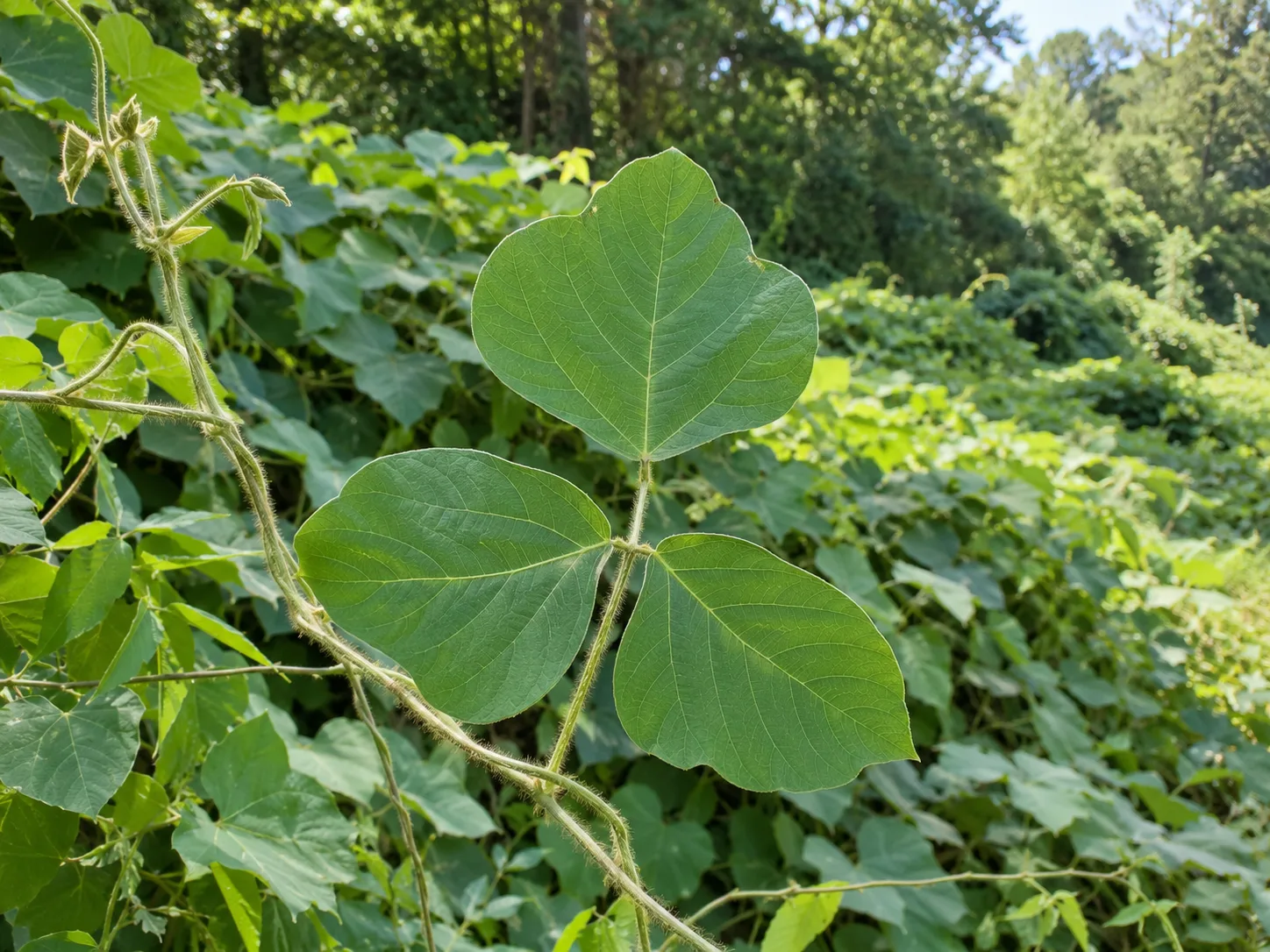
Look at the whole plant, not just one leaf. Young stems are flexible and hairy; older vines become thick and woody, and a long runner may lie across the ground before climbing a tree, fence, sign, or building. The National Park Service describes kudzu as a twining, mat-forming vine with alternate three-part leaves and purple-to-wine flower clusters; flowers and flattened, hairy pods can help confirm an identification in season.
In much of the United States, flowers appear in summer, but flowering depends on climate and exposure, so a lack of flowers does not rule kudzu out. It spreads vegetatively when nodes touch soil and root, and established crowns can support multiple vines. North Carolina State Extension’s plant profile describes this ground-running, node-rooting habit, while the National Park Service’s kudzu overview documents its leaves, stems, flowers, and fruit.
How to Tell Kudzu from Similar Vines
Several vines can make a quick glance misleading. Virginia creeper usually has five leaflets radiating from one point; wild grape has one large, lobed leaf per leaf stalk, often with toothed edges and tendrils; poison ivy commonly has three leaflets but does not form kudzu’s extensive, fuzzy, woody vine mats. Greenbrier has simple leaves and may have sharp prickles along its stems.
These are clues, not a complete botanical key. A young kudzu shoot may have smaller leaflets, and other plants can have leaf hairs or three-part leaves. If the plant is unfamiliar, photograph a full leaf, stem, node, and the way it climbs, then compare those features with a local extension or invasive-plant office before applying a control treatment.
Treat “three leaves” as a reason to slow down, not as a reason to grab the vine. Poison ivy and some native vines can be mixed into a kudzu mat, especially along woodland edges. If you cannot reliably distinguish the target from nearby desirable or irritating plants, pause and ask a county extension office or invasive-species program for identification.
Trace the Infestation Before You Cut
Kudzu can root wherever a stem node stays in contact with soil, so what looks like one patch may contain multiple rooted points. Walk the perimeter first and note where stems cross into neighboring property, under a fence, through shrubs, or into a tree canopy. Mark your intended work boundary with flags or a simple sketch so follow-up visits cover the same area.
On a small patch, follow each runner back to the ground and look for where several shoots emerge from a compact crown. Also look for places where a stem has been covered by leaves or mulch and re-emerges farther away; a buried vine can root at another node. If you only cut at the patch’s visible edge, connected growth may continue to feed it from beyond your work area.
Before walking into thick growth, check what may be hidden underneath. Dense vines can conceal holes, discarded wire, rocks, logs, stumps, uneven ground, and wildlife; a mower can catch in tough vines or strike an unseen object. Alabama Cooperative Extension’s 2024 control guidance specifically warns about mowing hazards in dense stands.
Choose a Control Method That Fits the Site
Match the method to both the infestation and the surroundings. Digging is selective but labor-intensive, repeated mowing needs safe access and a reliable schedule, and herbicide can injure desirable plants or create water and drift concerns if the site or application is wrong.
| Site condition | Practical starting point | Main limitation |
|---|---|---|
| A few young shoots or isolated crowns | Dig out every crown and rooted point | Follow-up is still needed for hidden nodes or new seedlings |
| Vines climbing one tree or fence | Cut reachable stems at the base, then trace the ground runners | High vines should be left to dry and fall; do not pull them down |
| Broad patch on open, level, mowable ground | Repeated cutting that removes foliage throughout the growing season | One or two cuts only suppress the patch; hidden hazards must be checked |
| Large, old mat, slope, wetland edge, or mixed planting | Consult extension, land manager, or licensed invasive-plant professional | Site-specific methods and product labels matter |
For a small, accessible patch, start with mechanical removal and reserve targeted treatment for crowns that return. For a wide patch that cannot be excavated without damaging soil or nearby roots, choose a long-term control plan rather than forcing a one-day cleanup. Conserving Carolina’s land-management advice also emphasizes that patch size and terrain affect whether crown removal, repeated mowing, grazing, or other methods are realistic.
Dig Out Small Patches by Removing Root Crowns
The removal target is the root crown, where buds and stems emerge, not every inch of the deep storage root. Kudzu roots can be large and woody, but extension guidance explains that the crown is the part that produces new shoots; an intact crown left in place can regenerate even after the top growth is removed. Alabama Cooperative Extension notes that digging out the entire tuberous root is not necessary for control.
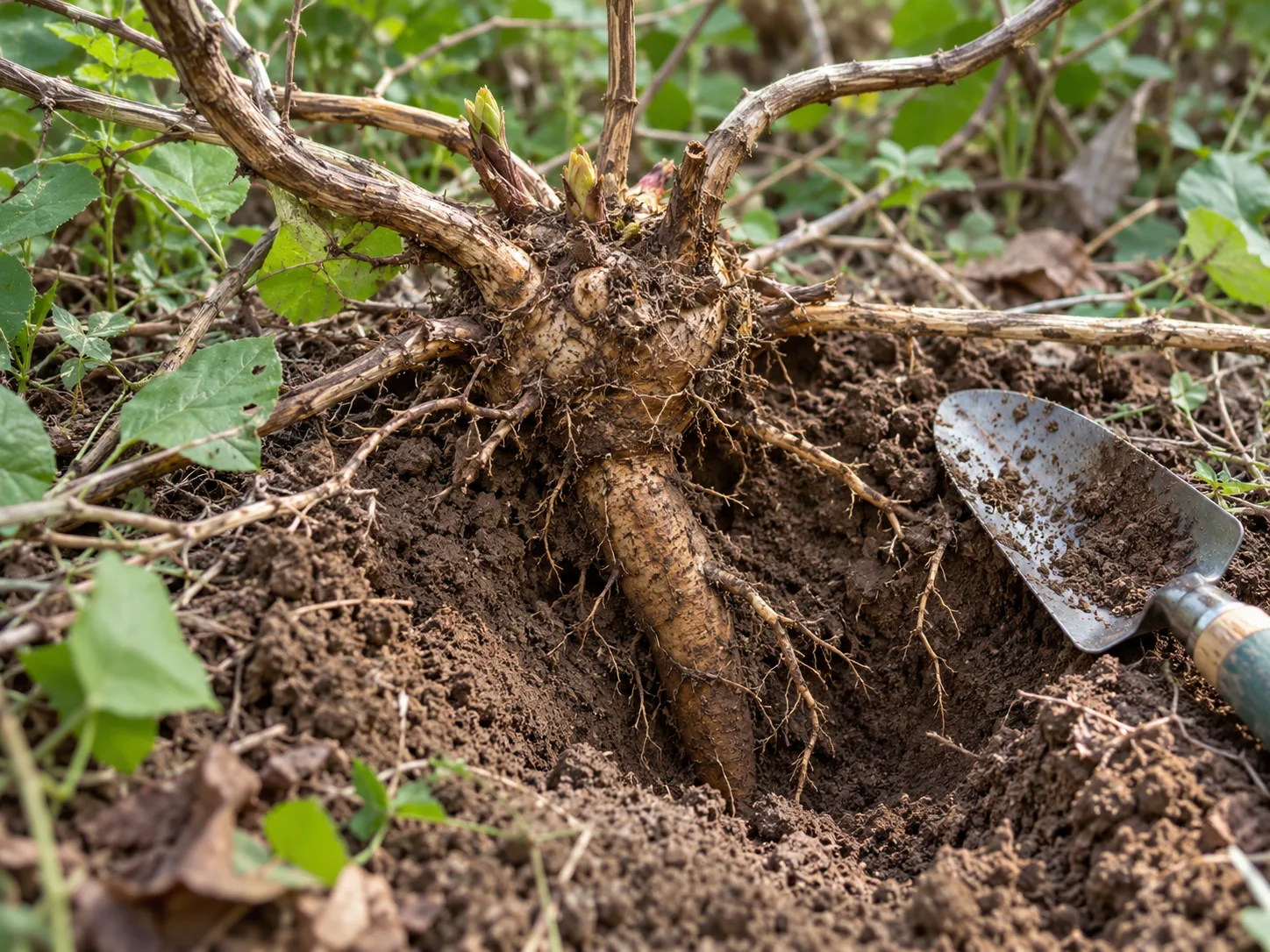
Work when the soil is moist enough to dig but not saturated. Cut the vines above the crown so you can see and reach the base, then use a sturdy shovel or mattock to expose the crown. On large, fibrous crowns, a hand pruner may not be enough; use an appropriate cutting tool and keep your body out of the blade’s path.
Follow every connected runner to each place it has rooted. A runner that has formed new roots can develop another crown, so removing one large crown does not necessarily remove the whole patch. If the vine disappears under leaf litter, gently move the litter aside and inspect before deciding that the root system ends there.
Lift out the crown and inspect the soil opening for buds or woody tissue that could remain attached. You do not need to excavate the deep taproot after the crown is removed, but do not confuse a length of buried vine with a harmless root: a node on that vine may have rooted and need separate attention. Backfill the hole, firm it lightly, and mark the spot for a check in a few weeks.
Digging is best for isolated crowns, not a mature patch on a steep bank. Broad excavation can expose bare soil and increase erosion, while repeated digging around tree roots can cause avoidable damage. If the patch is too large to trace crown by crown, switch to a repeated-control strategy or get site-specific advice.
Cut Kudzu off Trees and Structures Safely
When kudzu has climbed a tree, first protect the tree and yourself. Cut each reachable vine near the ground or at a safe working height, then sever it again if needed to create a gap; the upper section will lose its connection and eventually die. The Trees Atlanta removal guide recommends cutting climbing vines rather than pulling them down from above.
Do not climb a tree, use a ladder under a vine curtain, or tug on heavy growth overhead. Dried vines can remain suspended in branches, and pulling them may break limbs or bring down dead material. Let high sections dry and fall naturally, or have an arborist assess vines entangled in a canopy, close to power lines, or above a roof, road, or frequently used area.
After making the cut, trace the lower vine toward every soil-contact point and crown. Cutting the trunk-side vine prevents the canopy from being continuously smothered, but it does not kill the connected ground mat if that plant remains rooted elsewhere. Revisit the tree base and the outer perimeter; new shoots can emerge from crowns or rooted nodes after the first cut.
For fences and sheds, remove loose stems carefully without pulling attached material across other plants. If a vine has woven through wire, gutters, or roofing, cut it into manageable lengths and avoid levering against the structure. Where kudzu has covered a building or become mixed with utility infrastructure, a professional can assess access and damage risk before removal.
Repeated Mowing or Cutting Can Weaken Accessible Patches
Repeatedly removing foliage forces the plant to spend stored energy replacing leaves. That can suppress or eventually kill kudzu when cutting is thorough and frequent enough, but the schedule must continue through the growing season and over multiple years. Alabama Extension reports that removing most of the leaf area about monthly for several years can substantially weaken a stand where mowing is safe and practical.
This method works best on open, level ground that a mower can cross without hitting hidden objects, damaging trees, or throwing cut vines into roads or neighboring beds. Inspect the area first and use equipment suited to fibrous vines; if stems wrap around the blade or deck, stop and clear the machine safely according to its instructions. A string trimmer may handle only young growth and can spread fragments or expose the operator to debris.
If a mower cannot reach the patch, hand-cut the shoots close to the ground with loppers or a brush tool and collect long stems rather than letting them trail into clean areas. Plan repeat visits before you start: for example, add a recurring monthly reminder during the active growth period and inspect the patch between cuts for new shoots outside the boundary. Missing several cycles allows leaf area to rebuild and makes the next round less effective.
Mowing only a narrow strip along the edge may limit visible spread without eliminating the source. If runners emerge from a dense patch beyond the mowed boundary, they can keep advancing into the cleared strip. In that case, work inward in manageable sections, remove isolated crowns at the edge, or get help designing a perimeter-control plan.
Use Herbicide Only When the Site and Label Fit
Herbicide can be useful for established patches, especially where manual removal is impractical, but there is no safe universal recipe for every yard. A product that is appropriate in a forest or right-of-way may not be labeled for a home landscape, garden bed, or area beside water. Herbicides also differ in whether they can harm broadleaf trees, shrubs, vegetables, or other plants that kudzu is climbing.
Read the product label before buying or applying anything. Confirm that the product lists kudzu or an applicable site and method, that it is allowed for the location, and that the application directions match your equipment and target. Follow required protective gear, weather restrictions, re-entry instructions, and disposal directions; do not copy concentrations from a blog, mix products, or apply near water unless that exact product label allows the use.
A foliar treatment reaches leaves; a cut-stump or cut-stem treatment targets freshly cut woody growth. Which method fits depends on vine size, desirable vegetation, slope, water, and product labeling. For example, selective products may spare some unrelated plants while damaging others in the same family as kudzu, so “selective” never means harmless to the whole landscape.
Time Foliar Treatment for Active Growth
Timing is regional and product-specific, but the general principle is to treat healthy foliage that can absorb the labeled application. Alabama Extension recommends late summer into early fall for foliar control in forest, right-of-way, and natural areas and advises avoiding treatments before leaves have fully expanded, on severely drought-stressed plants, or when a hard frost is close. Those timings are not a substitute for the label or local residential guidance.
Do not spray on a windy day or when rain could wash the product into a storm drain, pond, or stream. Shield nearby desirable plants where permitted by the label, and consider a cut-stem application if the vines are mixed with plants you want to preserve. If the kudzu is on a slope, near a wetland, or tangled into a valued tree, contact your local extension or invasive-species office before choosing a product.
Expect follow-up. Older crowns may need repeated treatment for several years, and even a treated mat can produce shoots from missed crowns or rooted sections. Mark treated areas and check for green regrowth rather than treating again automatically; apply only when the label permits another application and the new growth is an appropriate target.
Contain and Dispose of Cut Material
Keep crowns, seed pods, and long vines contained while you work. Place them on a tarp or directly into a yard-waste container so the stems do not trail across clean ground and rooted nodes do not remain pressed against moist soil. If flowers or pods are present, bag or otherwise handle them according to local invasive-plant guidance instead of leaving them in a sunny pile.
Disposal rules differ among municipalities and invasive-weed programs. Some allow cut foliage in yard waste after crowns are removed; others require bagging the whole plant or prohibit transport of certain invasive species. Check your local waste authority’s directions before composting or moving kudzu off site, especially if you are hauling it in an open vehicle.
Clean soil and plant fragments from tools, mower decks, boots, and tarps before moving to an uninfested area. This is a simple way to avoid carrying rooted pieces or seed pods elsewhere. Keep a separate work zone for contaminated material and close bags securely before disposal.
Repair the Cleared Ground and Block a Return
Once a section is under control, do not leave large areas of bare ground exposed. Bare soil invites weeds and can erode, particularly on a bank where kudzu may have been holding soil in place even though it is not a good long-term restoration plant. Stabilize the surface with an appropriate native groundcover, shrubs, or grasses suited to the site’s light, moisture, and maintenance needs.
Planting desirable vegetation is not a stand-alone kudzu treatment. First reduce the vine enough to give new plants light and space, then install replacements and continue removing kudzu shoots that emerge through them. Choose plants that can establish in the local conditions, and avoid aggressive replacements that create a second invasive-plant problem.
Along a wooded edge, a layered mix of locally native shrubs, grasses, and groundcovers can close gaps more reliably than a single row of plants. On a residential slope, preserve existing tree roots and use erosion-control approaches that do not bury trunks or block drainage. If the site is large or ecologically sensitive, ask a local conservation group, extension office, or land manager which native species are appropriate in your area.
Monitor the Patch for Several Growing Seasons
Treat success as a trend: fewer shoots, smaller leaves, less area covered, and longer intervals between regrowth. After cutting or digging, inspect the original crowns, any places where vines touched soil, and the perimeter where runners may have crossed under leaves. A monthly walk during active growth is more reliable than waiting until the canopy is covered again.
Keep a simple record of the date, method, and locations treated. A phone photo from the same angle can reveal whether a patch is shrinking even when the change is gradual. Mark each recurring shoot on a sketch or map so you can distinguish a missed crown from a new edge of spread.
Older infestations often take several years of repeat work; exact timing varies with crown age, patch size, method, climate, and whether the source extends beyond your property. Dormant seed can also germinate later, so a cleared area still needs scouting. Continue monitoring after the mature vines disappear, and remove small seedlings or shoots while you can trace them easily.
Common Mistakes That Let Kudzu Recover
The most common mistake is cutting the foliage but never tracing the vine to its rooted points. That may free a tree canopy temporarily while leaving the connected plant alive on the ground. Make each cut the start of a tracing and follow-up task, not the finish line.
Another error is trying to excavate every inch of a deep taproot. That wastes effort and can create a large disturbed area; the root crown is the key target. The opposite mistake is pulling out a piece of woody root and assuming the crown came with it—inspect for buds and stems emerging at the soil surface.
Do not yank vines out of trees, burn the patch and call it eradicated, or mow blindly into a dense mat. Fire can remove visible foliage without reliably killing crowns, and mowing through concealed debris can cause injury or equipment damage. Also avoid blanket spraying across a mixed planting or beside water without confirming the label, site, and drift conditions.
Finally, do not clear more area than you can stabilize and revisit. If the plan depends on one intense weekend and has no follow-up dates, prioritize the advancing perimeter, the trees at immediate risk, and isolated crowns first. A smaller controlled section is often more useful than a large bare patch that reverts before the next visit.
When to Bring in a Professional or Local Agency
Get help when the patch covers a large area, vines are high in a mature canopy, the site is steep or wet, the growth is mixed with desirable plants, or the infestation reaches beyond your property line. A licensed vegetation-control professional can evaluate the site, select a method allowed for that location, and set a repeat schedule. For vines on wires or near electrical service, contact the utility rather than cutting near the hazard.
Local invasive-species rules vary. Some counties require control or ask residents to report new occurrences, while others offer identification or treatment advice. Before transporting or disposing of a suspected infestation, check the relevant local weed program; a county extension office can help verify the plant and point to the rules and methods that apply in your region.
Conclusion
To remove kudzu, confirm the plant, trace the full patch, and target every root crown and rooted node you can reach. Use digging for small isolated growth, repeated cutting for a safe and accessible mat, and label-compliant treatment or professional guidance where the site is larger or more sensitive.
Cutting one vine or pulling one visible root will not settle the job. Contain the debris, repair the cleared ground, record where shoots return, and revisit the patch through several growing seasons. Persistent, methodical follow-up is what turns a temporary clearing into lasting control.



