How to Grow and Care for Seagrape (Coccoloba uvifera)
Grow Coccoloba uvifera in a warm landscape or movable container with practical guidance on planting, watering, pruning, propagation, fruit, and winter care.
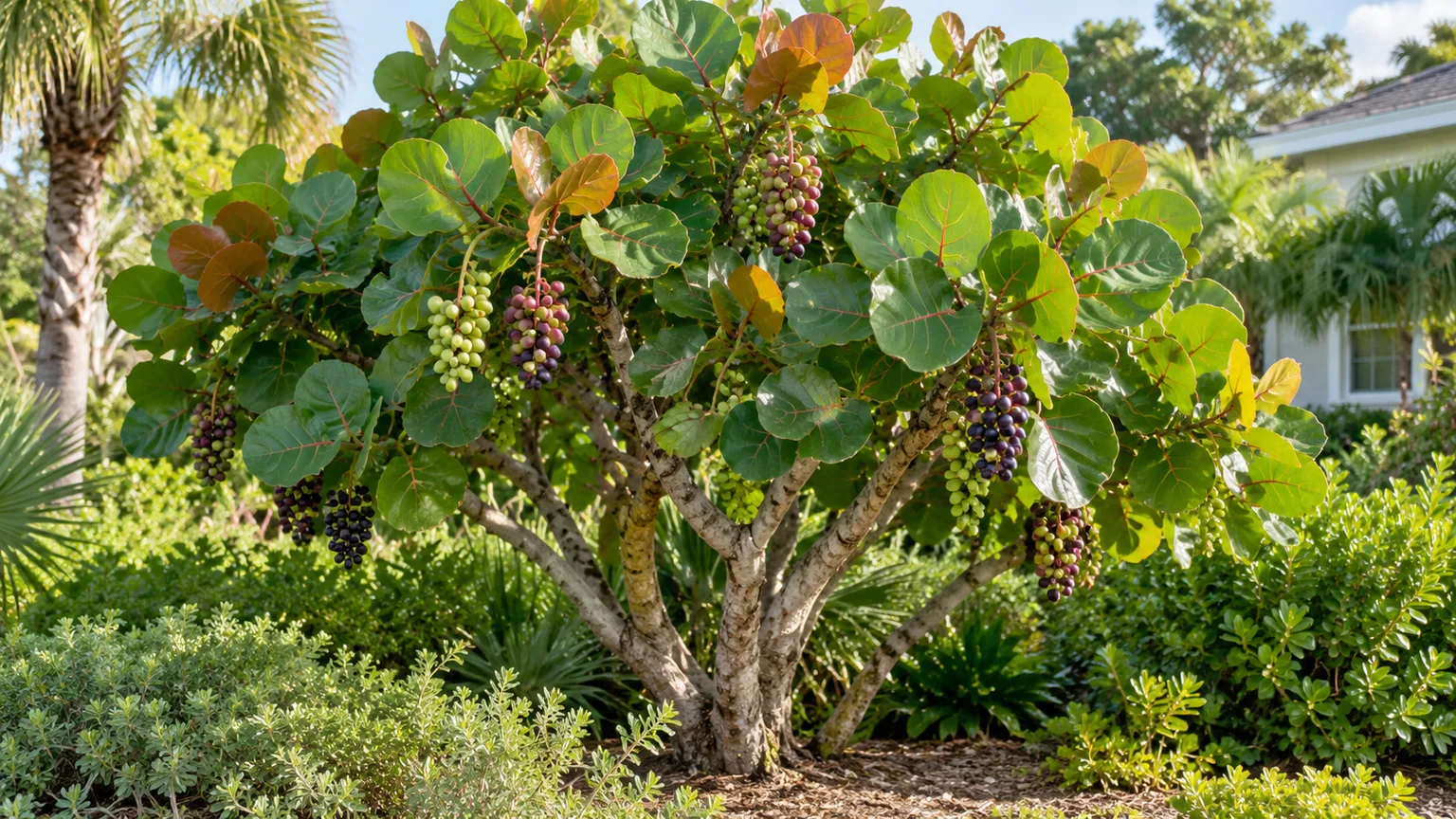
Seagrape (Coccoloba uvifera) is a broadleaf evergreen shrub or small tree built for warm, sunny coastal landscapes. Its round, red-veined leaves and hanging fruit clusters are distinctive, but the mature plant can be far larger than a patio shrub, and it is sensitive to frost. Decide first whether you can give it a warm climate and enough room; pruning cannot turn a frost-sensitive tree into a cold-hardy one or keep a large specimen permanently small without ongoing work.
The practical care pattern is simple: plant in sun and freely draining soil, water consistently while roots establish, then reduce irrigation as the plant settles in. Prune selectively to build sound branch structure and shape, and plan on protecting a container-grown specimen before cold weather. If fruit matters, ask about the plant’s sex and nearby pollen sources before buying; one seagrape is not both male and female.
At a Glance: Is Seagrape Right for Your Climate and Space?
| Need | Practical guidance |
|---|---|
| Climate | Best suited to warm, nearly frost-free regions; UF/IFAS lists USDA zones 10A–11 |
| Mature footprint | Often about 35–50 feet tall and 20–30 feet wide in favorable landscapes |
| Light | Full sun is the dependable choice; partial shade is tolerated |
| Soil | Freely draining soil is essential; sandy coastal soil is typical, but the species tolerates several soil textures |
| Water | Keep young plants from drying out; established in-ground plants tolerate drought better than new ones or plants in pots |
| Fruit | Expected on female plants after pollination; male and female flowers are on separate plants |
| Main trade-offs | Frost sensitivity, a large eventual canopy, and sizable leaves that can create litter |
These size and climate figures describe landscape specimens, not a promise that every seagrape will reach the same dimensions. The UF/IFAS species profile lists a mature height of 35 to 50 feet and spread of 20 to 30 feet, while site conditions and pruning change the form. Treat zone information as a first filter, not a guarantee of survival in a particular yard: cold air settling in a low spot, exposure, and the duration of a freeze all matter.
A seagrape makes sense when you want a substantial evergreen screen, windbreak, specimen tree, or coastal shrub and have room to let it develop. It is a poor match for a small foundation bed where it would need constant severe shearing, or for an exposed garden that regularly freezes. A large movable pot can extend its range, but it also makes watering, root-space limits, and winter relocation part of the care routine.
Identify Seagrape Before You Plant It
The species is not a grapevine. It grows as a woody, upright-to-spreading shrub or tree, usually with multiple trunks if left to develop naturally. Its thick, nearly round leaves may grow 8 to 12 inches long; young growth is often bronze, mature leaves are glossy green with red veins, and foliage can redden before dropping in cooler months.
Small cream-colored flowers appear in long drooping clusters called racemes. On female plants, pollinated flowers develop into grape-like fruits that change from green through reddish hues to purple as they mature; birds and other wildlife eat them, and people use the fruit fresh or cooked. UF/IFAS reports flowering mainly in spring to early summer and fruit ripening by early fall, with seasonal variation by site and climate. The UF/IFAS Extension Pasco County overview describes this seasonal progression and the plant’s coastal habitat.
This identity check matters because seagrape is often confused with true grapes in casual descriptions. The foliage, branching, and fruit clusters belong to a woody coastal tree in the buckwheat family, not to a climbing vine that needs a trellis. Choose a location and pruning plan for a tree or hedge, not for a plant that will stay at its nursery-pot size.
Choose the Right Site
Start with the temperature and mature footprint, then look at light and drainage. Seagrape is native to tropical and subtropical American coasts, including Florida and the Caribbean, and is commonly recommended for warm Florida landscapes. UF/IFAS places its natural Florida range mainly in zones 10A–11 and notes frost sensitivity; reports of survival farther north should not be read as dependable cold hardiness. If freezes are normal where you garden, grow it only if you can protect a container plant in a bright, frost-free place.
Sun, Salt, and Wind
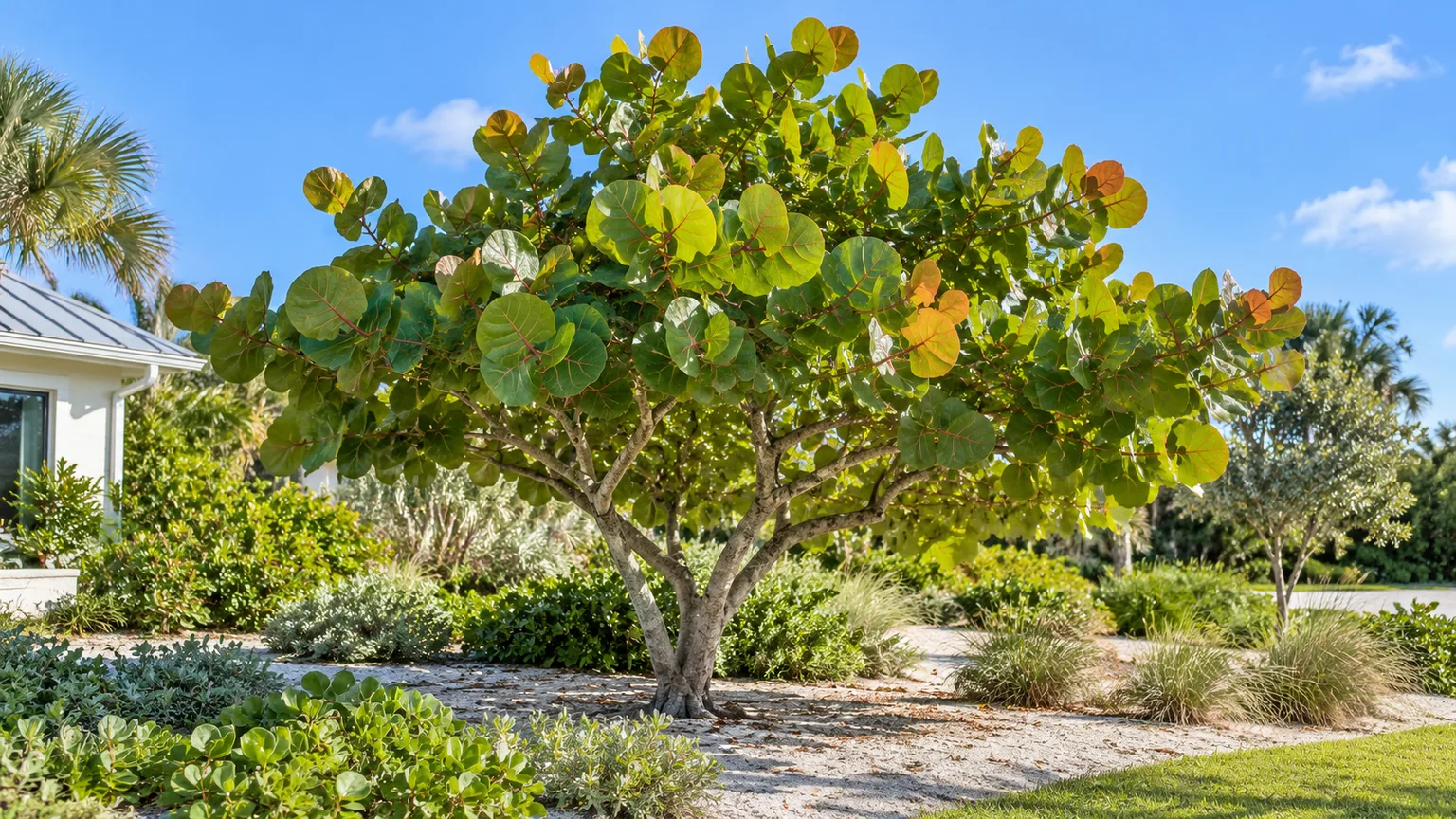
Give seagrape full sun when you can. It tolerates partial shade, but a sunny position better matches its coastal growing habit and usually supports a denser, more balanced canopy. Salt spray and salty soils are strengths of the species, so it can suit a coastal garden where many ornamental shrubs struggle; salt tolerance does not mean it is immune to drought stress during establishment or to freeze damage.
Wind tolerance is useful, but a windy site can keep a plant low and irregular rather than producing a tall, uniform tree; a UF/IFAS Extension Miami-Dade overview notes that local wind shear helps shape its growth. Think about the shape you want: a breezy exposed edge may favor a broad shrub or hedge, while a more sheltered inland yard may allow an upright small tree. Leave clearance from buildings, paths, utility lines, and neighboring plants based on the mature form you can realistically maintain.
A seagrape planted on a natural Florida dune raises a separate ecological and regulatory issue. UF/IFAS explains that Florida law protects dune vegetation from damage and advises against cutting or consuming seagrape along the shoreline without appropriate permission. Buy nursery stock for a home landscape and check with the relevant local coastal authority before disturbing vegetation near a beach; rules outside Florida may differ.
Soil, Drainage, and Planting Position
Seagrape tolerates sand, loam, and some clay as long as water can drain away. Sandy, well-drained soil is the usual recommendation for coastal sites, but the important distinction is not “sand or no sand”; it is whether water stands around the roots. In compacted or poorly drained ground, choose a better-drained planting area or improve the broader site rather than filling a small planting hole with a pocket of sharply different soil that can collect water.
Before planting, observe the area after a heavy rain and note where runoff pools. Keep the root flare at about the surrounding soil level, and avoid burying the trunk base under mulch. A broad mulch ring can reduce weed competition and conserve moisture, but keep mulch away from direct contact with the bark. These small setup choices matter more to establishment than a strong dose of fertilizer.
Planting a Seagrape in the Ground
Plant during a warm period when the young tree has time to establish before the most stressful heat or any likely cold season. In warm climates, spring is a straightforward window; in areas with a distinct rainy season, the start of reliable rainfall can reduce irrigation work. Avoid planting immediately before a forecast cold snap or when the root ball is already dry and stressed.
Dig a hole wide enough to loosen the surrounding soil without making it deeper than the root ball. Set the plant so the top of the root ball sits level with the grade, backfill with the native soil, and water slowly to settle it around the roots. If the site is exposed, temporary staking may keep a newly planted tree from rocking, but check and loosen ties so they do not rub or girdle the trunk as it grows.
During the establishment period, check the root ball itself rather than relying on a lawn sprinkler schedule. A newly planted tree can wilt while the surrounding soil is still damp if the root ball dries faster than the adjacent ground; conversely, frequent irrigation in slow-draining soil can keep roots oxygen-starved. Water thoroughly when the root zone is drying, then allow excess water to drain. UF/IFAS recommends keeping young seagrape well-watered until established, then using only occasional irrigation depending on conditions.
Give a free-standing tree room for a broad crown. The Gardenia plant profile suggests wide spacing for specimen plants; even if you plan to prune, do not set one directly below wires or where its mature canopy will block access. A hedge can be placed closer, but close spacing means more frequent hand pruning and more leaf litter along the line.
Grow Seagrape in a Container
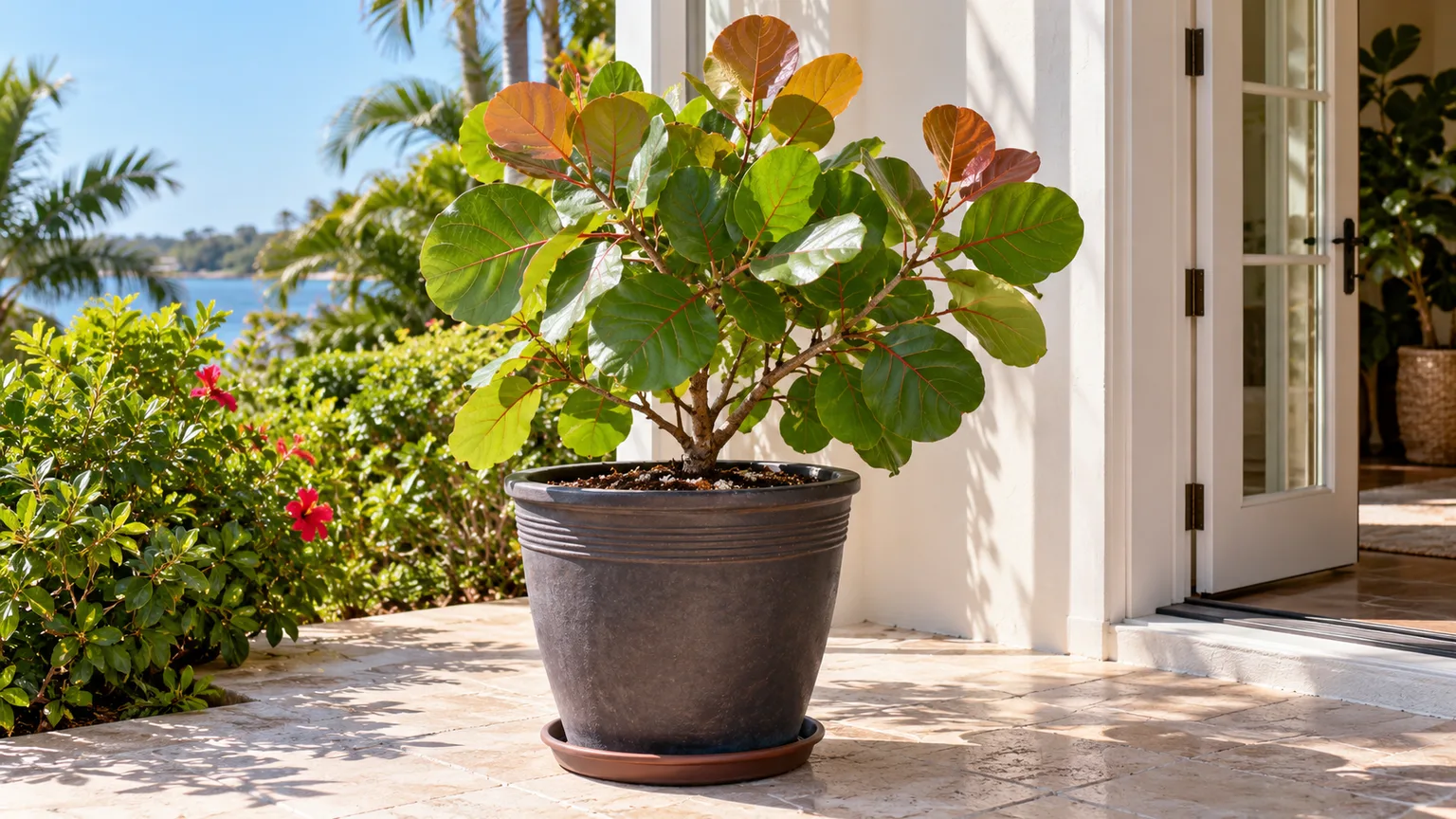
A pot is useful if your winter climate is too cold for reliable outdoor planting, if you have a sunny balcony, or if you want to maintain a young plant as a compact specimen. It is not a way to make seagrape frost hardy: the plant still needs a protected winter location before freezing weather. Nor is every mature seagrape suited to life in a pot; large leaves and woody growth can quickly outgrow a small decorative container.
Pot, Mix, and Repotting
Choose a sturdy container with several unobstructed drainage holes, sized only moderately wider than the root ball. An oversized pot holds a larger volume of mix that may stay wet longer than the roots can use; a very small pot dries quickly and may tip as the canopy grows. A lightweight resin pot is easier to move before winter, while a heavier pot resists wind better, so choose based on your climate and whether relocation is part of the plan.
Use a high-quality container mix that drains freely. Do not use garden soil alone in a pot, and do not rely on a layer of gravel at the bottom to correct a poorly draining mix; the drainage holes and the mix itself need to do that job. Set the root flare just above or level with the mix surface, leave watering space below the rim, and empty any outer cachepot or saucer after irrigation.
Repot when roots densely circle the root ball, water runs straight through without wetting the mix, or growth stalls despite suitable light and care. Move up one pot size at a time rather than shifting a small plant into a huge tub. If keeping it permanently small is essential, treat it as a deliberately trained specimen and expect regular root and canopy management rather than assuming it will stay miniature on its own.
Watering a Container Seagrape
Pots dry faster than garden beds, especially in wind and summer sun, so check the mix with a finger rather than watering on a fixed weekly schedule. When the upper layer has dried and the pot feels lighter, water thoroughly until excess drains from the base. If the mix is still damp or the pot remains heavy, wait; constantly wet roots are a greater risk than allowing a brief drying interval between waterings.
When bringing the plant indoors for winter, reduce watering as growth slows and indoor light drops. Keep it bright, protect it from cold drafts, and continue to use the soil as your guide. A dry heated room can make a pot dry quickly, while a cool, dim room can leave it wet for too long, so adjust to actual conditions instead of following a calendar.
Watering and Fertilizing After Establishment
An established in-ground seagrape is drought tolerant, but “drought tolerant” describes survival after roots are settled; it does not mean a new planting should be neglected. In a rainy coastal climate, natural rainfall may be enough after establishment. During a prolonged dry spell, give a slow, deep soak at the root zone rather than a quick sprinkle that wets only the soil surface.
Watch the plant and the soil together. Temporary drooping during intense heat can recover by evening, while persistently limp leaves in wet soil suggest a drainage or root problem rather than thirst. If foliage is pale or growth is poor, first check drainage, light, root competition, and recent cold stress; fertilizer will not correct any of those underlying problems.
Seagrape generally needs little feeding in a suitable site. The UF/IFAS profile emphasizes its ability to grow in a range of soils and describes low-maintenance care once established. If a soil test or consistent growth symptoms point to a nutrient shortage, use a complete landscape fertilizer appropriate to the site and follow its label; routine heavy feeding can push soft growth without solving the actual cause of poor performance.
Train a Strong Tree or Manage a Hedge
Seagrape can grow as a multi-stemmed vase-shaped tree, a shrub, a screen, or a hedge. Pick the form early because the first years are when it is easiest to guide major branches without making large wounds. The decision is not only visual: a good framework reduces the chance of heavy stems competing from narrow unions and makes later clearance pruning simpler.
A free-standing tree benefits from selected trunks with well-spaced, sturdy attachments. A hedge needs more frequent shaping and should retain enough width at the base for light to reach lower foliage; repeatedly shearing only the outer surface can leave a dense shell with bare interior growth. Since the leaves are large, hand pruning gives a cleaner outline than mechanical shearing and avoids turning every cut into a row of oversized half-leaves.
Hand Pruning for Structure and Clearance
Inspect the plant while it is young and remove dead, crossing, rubbing, or poorly attached branches with clean cuts just outside the branch collar. UF/IFAS advises structural and corrective pruning during the first several years, including attention to embedded bark and weak unions. Avoid stripping out most of the canopy in one session; the goal is a sound framework, not a bare trunk unless you are deliberately training a tree form.
For a hedge, shorten selected long shoots by cutting back to a side branch or leaf node rather than shearing the entire plant into a hard box. To raise the canopy, remove lower branches gradually over multiple seasons so the trunk and upper crown can develop. Remove storm-broken wood promptly when it is safe to do so, but hire an arborist for large limbs, overhead cuts, or work near utilities.
Pruning time should fit the plant’s growth and your goal, not an arbitrary late-summer rule. If you want fruit, heavy shaping during flower or fruit development can remove the racemes you hope to keep. For structural work, focus on the plant’s framework and avoid pruning before a forecast freeze, when fresh cuts and tender regrowth would face additional stress.
Flowers, Pollination, and Fruit
Seagrape is dioecious: male flowers and female flowers are produced on separate plants. A single female plant can make fruit only if pollen reaches its flowers from a male plant nearby; one individual does not normally contain both sexes and self-pollinate. This distinction is crucial if fruit is the reason you are buying the plant.
Ask a nursery whether a plant is known to be female and whether it was propagated from a fruiting female parent. Seed-grown seedlings may not be identified by sex before flowering, so they can be a gamble for fruit. A known female cutting or layer preserves the parent’s sex, but fruit still depends on flowering and pollination conditions. The UF/IFAS Gardening Solutions guide notes the separate sexes and recommends considering a male pollen source when no seagrape is growing nearby.
Fruit generally develops on female plants after flowering, first green and then red-purple as it ripens. UF/IFAS notes that the fruit is edible and compares its flavor with muscadine; it can be eaten fresh or cooked into jelly. If you harvest from your own cultivated tree, choose fully colored fruit and wash it before eating. Do not collect fruit from protected coastal dune plants in Florida; check local rules anywhere you are harvesting wild plants.
Propagate by Seed or Layering
You can start seagrape from seed or propagate it vegetatively. Choose seed if you want a new plant and do not need to preserve a particular fruiting trait; choose a cutting or layer from a known female if keeping that parent’s sex and characteristics matters. Propagation is not instant: young plants need warm conditions, steady but not waterlogged moisture, and time to build a root system before they are ready for a landscape site.
Start With Fresh Seed
Collect ripe purple fruit from a plant you have permission to harvest, remove the fleshy coating, and sow the cleaned seed promptly in a small pot of free-draining propagation mix. Keep the mix evenly moist but never saturated, and place the pot somewhere warm with bright light. The exact germination time varies with seed freshness and growing conditions, so keep the pot labeled and continue checking rather than discarding it after a short wait.
Once a seedling has several sturdy leaves and roots hold the mix together, move it carefully into a slightly larger pot. Give it time to adapt before exposing it to harsh wind or all-day sun; gradual acclimation reduces stress. A seedling will not reliably preserve the fruiting sex or quality of its parent, so buying a sexed nursery plant or using a vegetative method is more predictable when harvest is the goal.
Root a Cutting or Layer a Branch
For a cutting, take a healthy section of semi-mature growth from a plant whose identity and fruiting sex you know. Remove leaves from the lower portion, place the stem into a sterile, airy propagation medium, and maintain warmth and consistent moisture without leaving the medium soggy. Rooting hormone can be used according to its label, but it is not a substitute for clean material, warmth, or drainage; rooting success and timing vary.
Ground layering is another option when a low, flexible branch can reach the soil. Bend a portion of the branch down, lightly wound or scrape the part that will contact the soil only if you are confident doing so, cover that section while leaving the tip exposed, and keep it from drying out. Once the covered section has formed roots, sever it from the parent and pot or plant it. Gardenia describes layering as a way to clone seagrape and notes that a rooted branch may take several months to separate; inspect for roots rather than relying on a fixed date. A vegetative clone preserves the parent plant’s sex, which is useful if that parent fruits.
Diagnose Pests, Gall, Frost, and Leaf Drop
Seagrape is not completely pest-proof. UF/IFAS identifies the seagrape borer, which can kill stems or branches, and a nipple gall that creates raised reddish bumps on leaves; major diseases are generally not a central issue. If one branch begins to die, inspect the stem and nearby foliage, prune clearly dead wood with clean tools, and watch whether the damage spreads before treating the whole plant.
Raised red bumps by themselves are not the same as a spreading disease. If the plant otherwise grows normally, avoid unnecessary pesticide use; identify the problem first and ask a local Extension office if decline continues. A dead branch may require more investigation for borer damage, frost injury, or a structural break. Avoid applying an insecticide unless the pest is positively identified and the product label specifically allows that use on the site and plant.
Some leaf change is normal. New leaves can be bronze, mature leaves have red veins, and older foliage may redden and fall seasonally; UF/IFAS describes winter reddening and leaf turnover. Concern rises when leaf loss is sudden and widespread, branch tips die back, or leaves remain limp while the root zone is wet. Check the recent temperature, soil drainage, and root-ball moisture before assuming the plant simply needs more water or fertilizer.
Seasonal Care and Container Wintering
In warm regions, established seagrape can be a low-input landscape plant after it is watered through establishment and structurally trained. Refresh mulch when needed, remove broken or dead branches, and water deeply during extended dry weather. Expect fallen leaves and, on female plants, dropped fruit; the large leaves break down slowly, so avoid placing the plant over a tidy paved area if regular cleanup would bother you.
In cooler climates, keep a potted plant outdoors only while nights remain safely warm for a frost-sensitive species. Move it to a bright, protected, frost-free location before freezing conditions arrive rather than waiting for visible injury. If there is no such space, seagrape may not be a practical container choice in that climate; a warm-season patio can work only if you have a winter plan.
A plant that has experienced cold should be assessed patiently. Do not cut every discolored branch immediately after a freeze, because damaged leaves can obscure which stems remain alive; wait until new growth shows where recovery is occurring, then remove dead wood. Keep the root zone from becoming either bone dry or saturated during recovery. UF/IFAS places the dependable Florida range in zones 10A–11 and warns that reports farther north come with frost and freeze sensitivity, so do not treat a brief mild winter as proof of hardiness.
Conclusion
Grow seagrape where warmth, sun, drainage, and long-term space line up. Water it carefully through establishment, train its branches while they are young, and keep container plants mobile enough to escape frost. If fruit is important, confirm that you have a female plant and access to pollen from a male; that one detail prevents the common disappointment of waiting for berries from a plant that cannot produce them alone.



