27 Flocked Christmas Tree Decorating Ideas
Find flocked Christmas tree decorating ideas for every style, with tips to choose colors, place ribbon and ornaments, and keep the display safe at home.

A flocked tree carries its own visual idea: evergreen branches dusted with snow. The pale coating brightens a room and changes how ornaments read—deep colors look richer, clear glass catches light, and pale pieces need texture or definition.
Treat the flocking as part of the palette. Choose one main accent, one supporting finish, and a texture that connects the tree to the room. The 27 combinations below range from traditional red and gold to cool blue, wood, and fabric, followed by a simple decorating sequence.
Start by treating flocking as a design color
“Flocked” usually means a snow-like material applied to green branches, unlike a tree made with white needles throughout. Coverage ranges from a light dusting to a dense coating, so check the tree in daylight and evening light before choosing ornaments; white may read as bright, creamy, or shadowed in your room.
Let the coverage guide the design. A heavily flocked tree already supplies contrast, so use ornaments with clear shapes, saturated color, or reflective surfaces and leave some branches open. With a lighter dusting, green needles still influence the palette, and pinecones or wood beads feel at home. Decide whether the mood is warm, icy, rustic, glamorous, or playful, then repeat a few colors at different heights.
Choose a palette before you decorate
A dependable formula is one dominant accent, one metal or reflective finish, and one soft or natural texture. Cranberry, brass, and velvet warm the tree; pale blue, silver, and glass feel cooler; forest green, bronze, and wood add depth.
To connect it to the room, repeat a color from a rug, lamp, or throw, then add just one supporting tone. If the room is already colorful, let the flocking provide negative space and keep the tree to one or two accents.
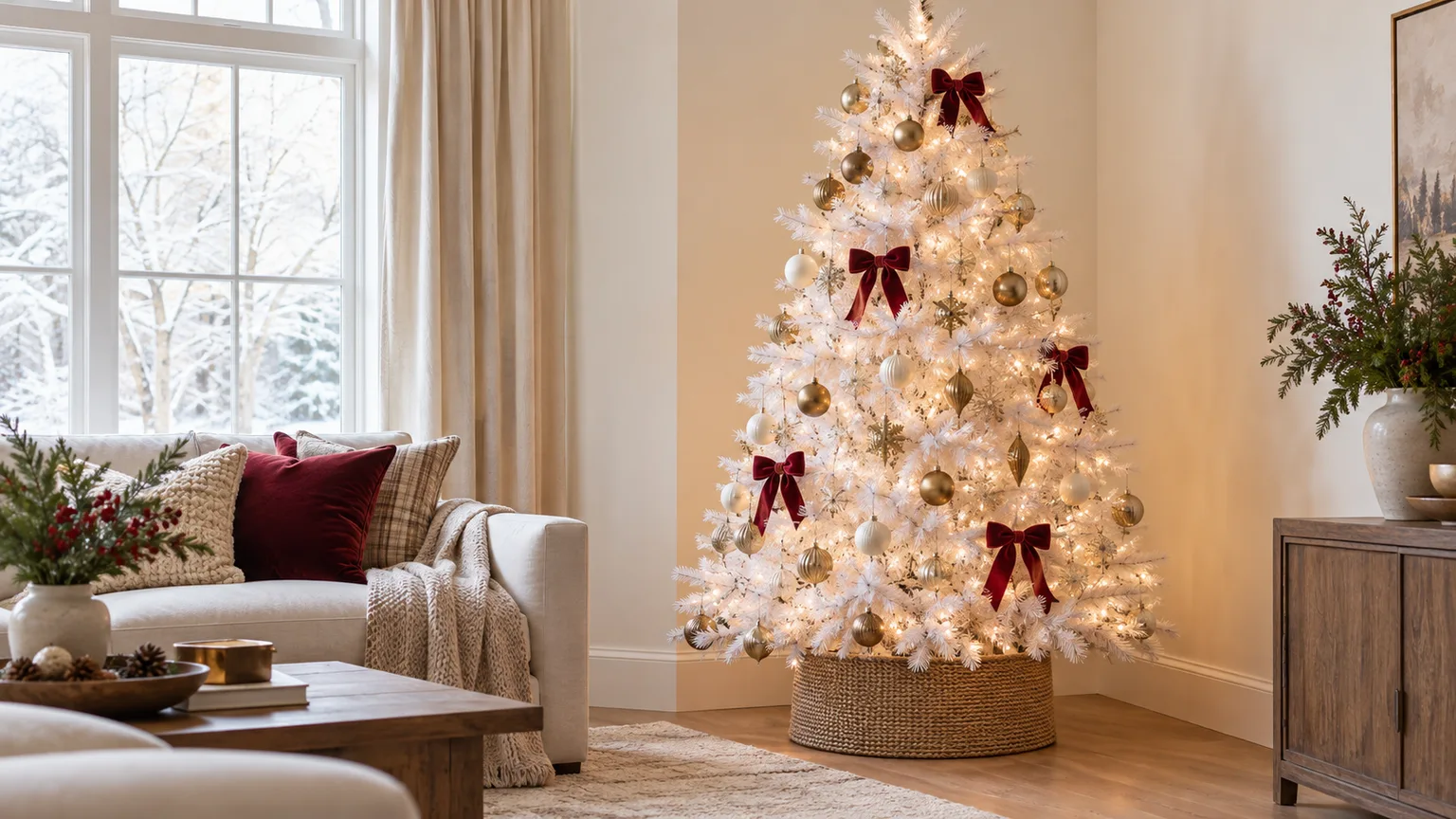
Nine cool and classic flocked tree ideas
1. Cranberry red with warm gold. Red ornaments are easy to see against white branches, while gold keeps the contrast from feeling stark. Repeat the red in a handful of velvet bows or berry sprigs, then use gold bells or finials as the smaller linking detail. If you already own a mixed ornament box, pull out only the reds and warm metallic pieces for this tree.
2. Silver, clear glass, and icy blue. This palette leans into the snowy effect without requiring every ornament to be white. Let silver carry the sparkle, use clear glass to keep the branches visible, and add just a few blue ornaments at different heights. If the room has very warm bulbs or cream walls, add a small amount of champagne metal so the tree does not look cold by comparison.
3. Navy and rope for a coastal tree. Deep navy offers strong contrast, and a few rope loops, shell shapes, or star ornaments suggest the coast without turning the tree into a themed gift shop. Keep most ornaments matte or lightly reflective, and use rope as a short accent rather than a thick spiral that hides the flocking. This look works especially well with blue-and-white rooms and natural woven baskets.
4. A single-color red tree. Choose one red family—true red, cranberry, or burgundy—and vary the shape and sheen instead of adding more colors. Mix matte balls, glossy ornaments, and a few berries so the display has depth. On a flocked tree, the bright background does much of the separating for you; leave small gaps so the red does not become one solid band.
5. Black, white, and wood. Black ribbon or felt shapes bring definition to a pale tree, while wood beads and simple wooden ornaments keep the contrast from feeling formal. Use black sparingly: a repeated bow, a narrow garland, or a few graphic shapes is enough. This combination looks deliberate in a room with dark window frames or black hardware, but can feel abrupt if the rest of the space has no dark accents.
6. Mint green and pearl. Mint ornaments echo the cool cast of snow and look gentle against the green needles still visible beneath lighter flocking. Mix glossy mint balls with pearly white pieces, then add a silver detail for definition. Use a few deeper green ornaments if the tree is almost entirely white; the contrast will help the decorations read from across the room.
7. Baby blue and pearl white. Soft blue ribbon and pearl-like ornaments add color while preserving a quiet winter palette. Put the blue in a few larger elements—bows, finials, or medium balls—then use smaller white accents to bridge the spaces. Keep the ornaments varied in silhouette, because pale spheres against pale branches can vanish at a distance.
8. Champagne, ivory, and brass. This is a warm neutral alternative to a silver-and-white tree. Champagne ornaments blend gently into the flocking, while brass bells or a few darker gold pieces provide enough contrast to define the shape. Add velvet or linen ribbon for a matte texture. If everything is the same pale shade, include one warm brown or green element to anchor the design.
9. Soft pink with silver. Dusty rose, blush, or muted pink brings color without overpowering the snow effect. Pair it with silver or clear glass rather than several additional pastels, and repeat the pink at the top, middle, and lower third of the tree. A few darker rose ornaments help keep the color visible against thick white flocking.
Nine warm, natural, and rustic flocked tree ideas
10. Rustic twigs with antique gold. A few slim twig picks or wooden ornaments make the snowy finish feel like a winter woodland. Add brushed or antique gold rather than a mirror-bright metal, and keep the branch accents light enough not to bend the tips. The mix works best when the tree still has visible green and the room includes wood, leather, or other natural materials.
11. Forest green and bronze. Repeat the evergreen color with a small number of dark green ornaments, then add bronze for warmth. The darker green becomes a visual bridge between the flocking and the tree underneath, while bronze gives the branches a glow under warm lights. Keep the ornament sizes mixed: a few large pieces toward the trunk, medium pieces on the outer branches, and small accents where the color needs repeating.
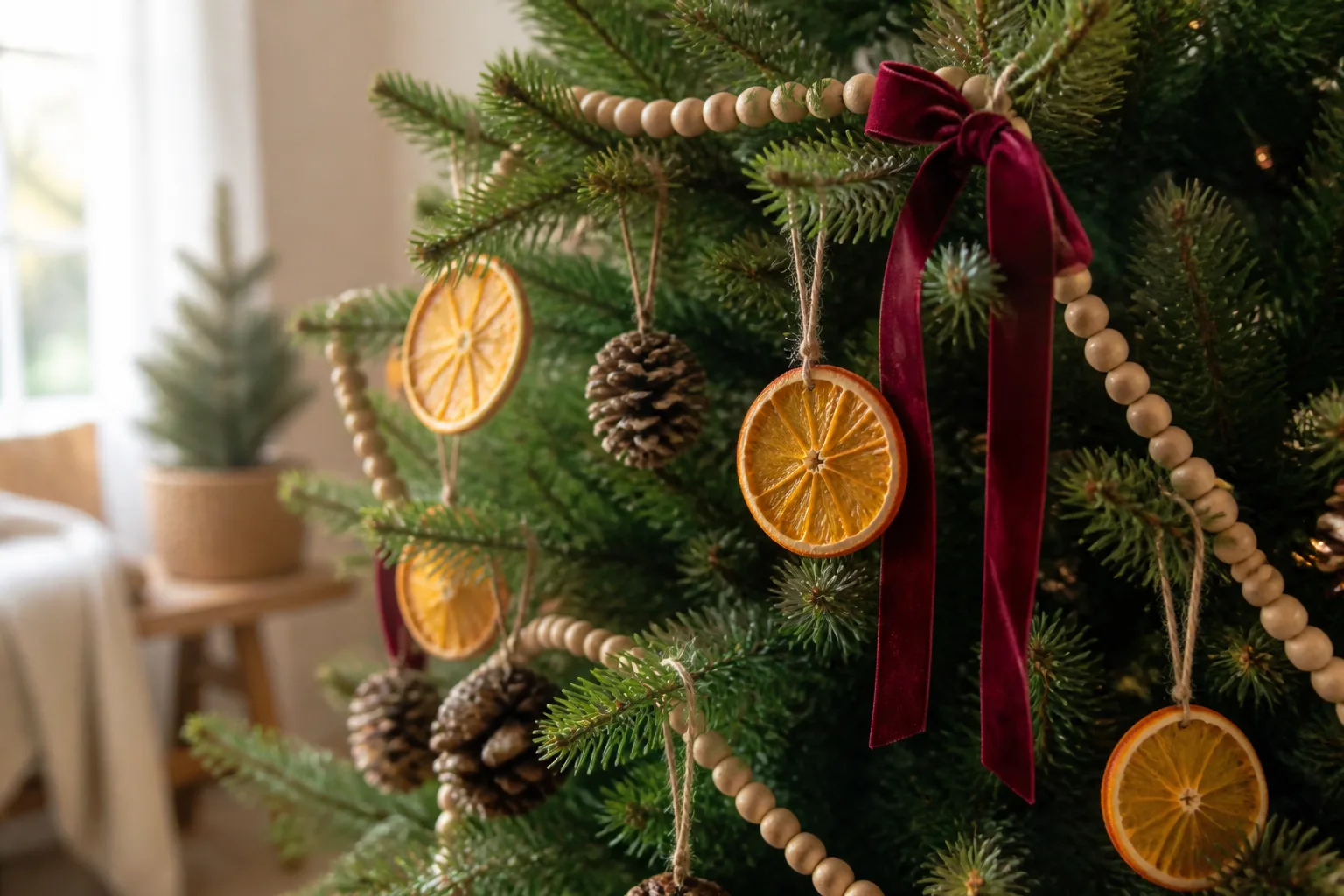
12. Pinecones, dried citrus, and wood beads. Natural ornaments add shape and a warm tan-and-orange palette. Use lightweight, fully dry citrus slices, small pinecones, and a single bead garland, spacing them instead of clustering all the rustic materials together. Avoid fresh fruit or heavy homemade pieces that can soften, stain, or pull down delicate branches. A burgundy bow gives this earthy combination a controlled point of color.
13. Farmhouse neutrals with green ribbon. Cream, wood, galvanized-looking metal, and a muted green ribbon make a flocked tree feel relaxed rather than glossy. Use a few homespun fabric ornaments or cotton-like shapes, but avoid making every piece the same texture. If you use a chunky garland, keep it loose and shallow so the tree still reads as a tree instead of a wrapped column.
14. French-country blue and white. Use a toile or ticking stripe ribbon with blue-and-white ornaments, then add a small number of porcelain-inspired shapes. Fragile dishes or teacups are not suitable tree ornaments; choose lightweight replicas or durable pieces designed to hang. Add a natural wood or brass detail so the palette does not become an unbroken field of pale blue and white.
15. Boho layers of fiber and beadwork. A woven star, wood-bead strand, tassels, or a few fabric ornaments bring handmade texture to a flocked tree. Choose one dominant fiber and one secondary material rather than putting every craft-store texture on the branches. Keep the shapes varied—flat stars, rounded beads, and soft tassels—so the pale flocking remains visible between them.
16. Scandinavian simplicity. A sparse ornament plan can be the strongest choice when the tree itself is dense with snow. Use warm white lights, a few wood or straw shapes, and a modest number of red or brass accents. Leave gaps across the front instead of trying to fill every opening. A simple star and woven collar can finish the design without introducing more ornament styles.
17. Faux fur and a small plaid accent. A soft white or cream tree skirt makes the snowy branches feel cozy, while a narrow plaid ribbon or a few tartan ornaments add pattern. Keep the plaid to one scale and one location; large pattern at the base and a second competing pattern through the canopy can make the tree look disconnected. Choose washable or easy-to-store fabric for the skirt.
18. Natural greenery with berries. A few evergreen picks and red berries add depth where the flocking is sparse. Angle each pick along the branch rather than straight out, and repeat the berry color in two or three places. Use clean, purpose-made faux stems or fresh greenery only where it can be safely secured and removed; loose needles and sap are not worth adding to an artificial tree that is meant to stay tidy.
Nine playful and personal flocked tree ideas
19. A Santa or storybook theme. Collect a small family of Santa figures, toy soldiers, or storybook characters and let them provide the visual rhythm. Use the figures in different sizes, but keep a common color—red, white, or brass—running through the rest of the ornaments. A character topper can work if it is light enough for the tree’s central support and does not pull the top off-center.
20. Woodland animals and birds. Felt foxes, owls, cardinals, or small birds suit a snowy background because their silhouettes are easy to spot. Choose a few species rather than mixing every animal on one tree, and repeat a feather, twig, or berry texture to connect the shapes. Place fragile bird clips higher and use soft or shatter-resistant versions near the floor.
21. Vintage glass and mercury-glass sparkle. Reflective silvered ornaments, bells, and old-fashioned shapes look especially crisp against flocking. Balance reflective pieces with matte ceramic or fabric ornaments so lights do not bounce from every branch at once. Use family heirlooms as focal points, and place them on branches where passing shoulders, pets, and doorways will not catch them.
22. Ribbon bows instead of a dense garland. Velvet, satin, or wired ribbon can add color without hiding the shape of the tree. Tie separate bows onto sturdy branch junctions or tuck short lengths vertically so they appear to move through the tree. Better Homes & Gardens describes a tuck-and-loop approach that uses the ribbon as a structural layer before ornaments; its ribbon decorating guide is a useful reference for shaping the drape. On a flocked branch, work gently and avoid pulling a wire edge across the coating.
23. Red-and-white candy stripes. Striped ribbon, peppermint-shaped ornaments, and a few red baubles create a cheerful theme without needing a literal candy on every branch. Use only food-safe sealed decorations if you choose to hang wrapped sweets, and keep real candy out of reach of pets. Repeat the stripe at the top and lower third so the look feels intentional rather than concentrated in one patch.
24. A color-blocked tree. Assign a different ornament color to each broad band—such as red low on the tree, green in the middle, and gold near the top—or create looser vertical zones. Use a few transition ornaments where colors meet so the bands do not appear like hard stripes. Color blocking is easier to control on a tree with a clear cone shape and can become messy on an asymmetrical or very sparse tree.
25. Family memories and handmade ornaments. Mix a few photographs, initials, children’s craft ornaments, or travel keepsakes with simpler balls in a shared palette. Give sentimental pieces clear breathing room so they are easy to notice, and use duplicates or lightweight copies on low branches if originals are fragile. The point is not perfect matching; repeating a color or material is enough to make personal objects feel connected.
26. Pastel storybook colors. Pale lilac, mint, blush, and soft blue can feel whimsical when the ornaments share a similar muted intensity. Choose two or three pastels, not the entire rainbow, and add clear glass or white between them. If your flocking is bright white, slightly deeper versions of the colors will remain visible; if the coating is cream, use a warmer pastel mix.
27. A gathered ornament cluster with a simple canopy. Instead of scattering every ornament evenly, group a few large pieces in three loose clusters and leave the rest of the branches open. A cluster might combine a large bauble, a small flower, and a ribbon tail in the same color family. This produces a designed look with fewer pieces and lets the flocking fill the quieter areas.
Decorate in an order that protects the flock
Work from structural decisions to small details: shape the branches, test the lights, place ribbon or garland, then add large, medium, and small ornaments. Finish the topper and base once you can judge their scale against the decorated canopy.
Before hanging anything, gently tap one branch over a sheet to check for loose flocking. Some shedding can happen during setup, especially with a new tree, but avoid forceful shaking, brushing, or repeated bending. Follow that model’s care directions; coatings differ, and cleaning methods are not interchangeable.
Shape branches and test lights
Set up the tree on a level surface and open branches from the trunk outward, following the direction of the tips. Pulling against flocked needles can remove coating and expose green gaps. If one remains, reposition nearby tips instead of hiding it under a thick ornament.
If the tree is pre-lit, plug it in before adding decorations and confirm every section lights. For a separate strand, select a product intended for indoor use and check its packaging and the tree maker’s instructions. A simple way to check the look is to test one section in the room after dark with the lamps you normally use. That reveals whether the bulbs look too blue, too amber, or just right next to your furnishings.
Work ribbon and garland into the branches
Ribbon is easiest to arrange before ornaments fill the branch gaps. You can make a loose vertical cascade by tucking the strand in and out, form short loops across the canopy, or attach individual bows. The editorial advice in Homes & Gardens’ ribbon feature and Better Homes & Gardens’ step-by-step ribbon guide shows how different drapes and bow placements change the tree’s movement.
Do not pull ribbon tight around a flocked branch or force a wide wired edge through dense tips. Tuck it into sturdier inner branches and leave enough slack for the tree’s shape. If you use more than one ribbon, vary texture or width but repeat at least one color. A single patterned ribbon plus a quieter velvet or sheer ribbon generally creates more definition than four patterns competing against the flocking.
Place ornaments for balance and depth
Hang the heaviest ornaments on strong inner branches rather than at the ends of flexible tips. Put some medium ornaments closer to the trunk to create depth, and use smaller or lighter pieces near the branch tips. Spread the accent colors from the top through the middle and lower third so the eye travels across the tree instead of stopping at one dense cluster.
Do not judge spacing only from arm’s length. Walk to the doorway and view the tree from its usual angle, then turn the lights on. A bare patch that looked obvious up close may disappear at distance, while a group of reflective balls may become a bright hotspot. Move ornaments first; buying extra pieces is rarely the best fix for an uneven pattern.
Pick lights that make the white look intentional
Warm-white lights usually soften the snowy coating and coordinate easily with brass, natural wood, red, and cream. Cool-white lights make silver, clear glass, and icy blue appear crisper, but can feel stark beside warm lamps or tan walls. “Warm” and “cool” labels differ by brand, so compare the actual strand rather than assuming two boxes will match.
A flocked tree can look bright with fewer lights because pale branches reflect them. Keep bulb color consistent, and switch on a pre-lit tree before adding another strand. Avoid wrapping so densely that you hide the branch pattern and flatten the snowy texture.
Light strands are a functional part of the setup, not just a color choice. Check cords and sockets for damage, follow product directions, do not overload outlets, and keep the tree away from heat sources. CPSC holiday guidance says to look for the fire-resistant label on an artificial tree and not to connect more than three sets of incandescent lights. ESFI also advises keeping trees at least three feet from heat sources and using only non-combustible or flame-resistant trimming materials. See CPSC holiday safety guidance and ESFI Christmas tree safety tips for the full context. A “fire resistant” label does not mean fireproof, so keep open flames and hot decorations away from the tree.
Finish with a topper and a well-scaled base
The topper should look like the natural endpoint of the tree, not a separate oversized object balanced on a weak branch. Check its height and weight before decorating. A star, angel, bow, snowflake, or simple spray of branches can work if it attaches securely to the central support and does not lean the tree. Repeat the topper’s main material or color once or twice below it to connect the top with the rest of the canopy.
At the bottom, a tree skirt softens the stand and catches loose flocking; a collar or basket adds a cleaner, more structured edge. Measure the stand’s width and choose a skirt or collar that extends beyond it without swallowing the lower branches. A woven collar brings warmth to a snowy tree, while velvet or faux fur creates a softer, more formal base. Keep enough access to unplug lights and reach any live-tree water reservoir; do not hide cords beneath a pile of fabric.

Match decorations to the room and tree shape
Measure ceiling clearance, height including the topper, and the widest branch span. A tree can fit by height yet block a door, walkway, vent, or cabinet once its lower branches open. For a tight room, consider a pencil or tabletop tree; place tabletop models on a stable surface and keep cords clear of drawers and chair wheels.
Consider whether the tree will be seen from all sides. If it sits against a wall, concentrate the best ornaments and ribbon on the visible half, but still secure lights and the stand properly. If it is in the center of a room, decorate all the way around and step back from several viewpoints before deciding a section is finished. Match the number and size of ornaments to the branch density: a slim tree needs fewer wide garlands; a full tree can support larger focal pieces if the limbs are sturdy.
The room itself can supply part of the color plan. Repeat a shade already present in a rug or textile, then use the tree’s white coating as the breathing space. A bright palette may be enough for a neutral living room, while a vivid room may look calmer with only metallic and natural details on the branches. This is a practical design choice, not a rule that every ornament must match a cushion or curtain.
Keep the setup safer around kids, pets, and outlets
Use a stable stand and place the tree away from busy doorways. If a child or pet could pull it over, use an appropriate anchor; a heavy collar is not a substitute. Keep hooks, beads, glass, and heirlooms out of reach, and choose shatter-resistant ornaments for lower branches in a busy room.
Choose ribbon, sprays, and other trim with the material and light setup in mind. CPSC advises never leaving candles unattended, avoiding overloaded outlets, and using no more than three connected sets of incandescent lights. ESFI’s guidance cautions against placing trees near fireplaces, radiators, and space heaters and recommends non-combustible or flame-resistant decorations. Use battery-operated or plug-in decorative lights according to their directions, and switch the tree off when you leave home or go to bed.
A coating does not establish that the tree or its ornaments are fireproof. Check its label and manual; do not apply an unapproved retardant, cleaner, fragrance, or sealant. If flocking sheds heavily, becomes damp, or smells unusual, stop handling it and ask the maker about care.
Reduce flocking mess and store the tree well
Some loose white particles may fall during setup. Lay a sheet under the stand, then vacuum the floor after decorating; avoid brushing or vacuuming branches because that can pull off more coating and leave a patchy finish.
Take a photo of the finished arrangement before taking it down. Remove ornaments one at a time, fold ribbon loosely, and keep fragile pieces in separate compartments. Follow the manufacturer’s directions for collapsing or separating branches. If the coating is heavily flocked, a storage bag or box that allows the branches to fit without crushing them can reduce rubbing, though the right method depends on that tree’s construction.
Store the tree in a cool, dry place out of direct sunlight. Do not use household cleaners, water, or compressed air on the coating unless the manufacturer explicitly approves them. Label the box with any special assembly notes, the light set used, and which decorations belong to the tree; next year’s setup will be easier if you can repeat what worked without pulling flocking off while searching for parts.
Troubleshoot a tree that looks cold, busy, or sparse
If the tree feels cold, check the bulbs and shiny silver first; warm lights, wood, velvet, brass, or cranberry can soften it. If it looks busy, remove a garland or filler ornaments and let branches show. If it blends into a pale wall, repeat a darker accent—navy, red, forest green, or brown—at several heights.
A tree that looks sparse may need branch shaping rather than more decorations. Open the tips outward and rotate adjacent branches to cover gaps, then add only a few medium ornaments to draw the eye through the area. If the tree looks top-heavy, reduce the topper or distribute more visual weight toward the lower third with larger ornaments and a fuller skirt. If the lower branches look crowded, remove the widest ribbon or collar and recheck the walking space.
When ornaments do not stand out, alter one variable at a time: color contrast, scale, or finish. A matte white snowflake may disappear on a dense coating; the same shape in wood, red, or clear glass with a dark edge may read better. Editing is usually faster and less expensive than buying a new collection.
Conclusion
A flocked tree can look classic, coastal, rustic, glamorous, or playful; leave room for its snowy branches to contribute. Start with one accent, a linking finish, and a texture. Add lights, ribbon, and ornaments in order, then choose a topper and base that fit. Adapt the 27 combinations to your room, and let repetition and open space finish the display.



