Epidendrum Orchid Care: A Complete Growing Guide
Learn how to grow Epidendrum orchids indoors or outdoors, choose a draining mix, water by growth and weather, support canes, and propagate rooted keikis.
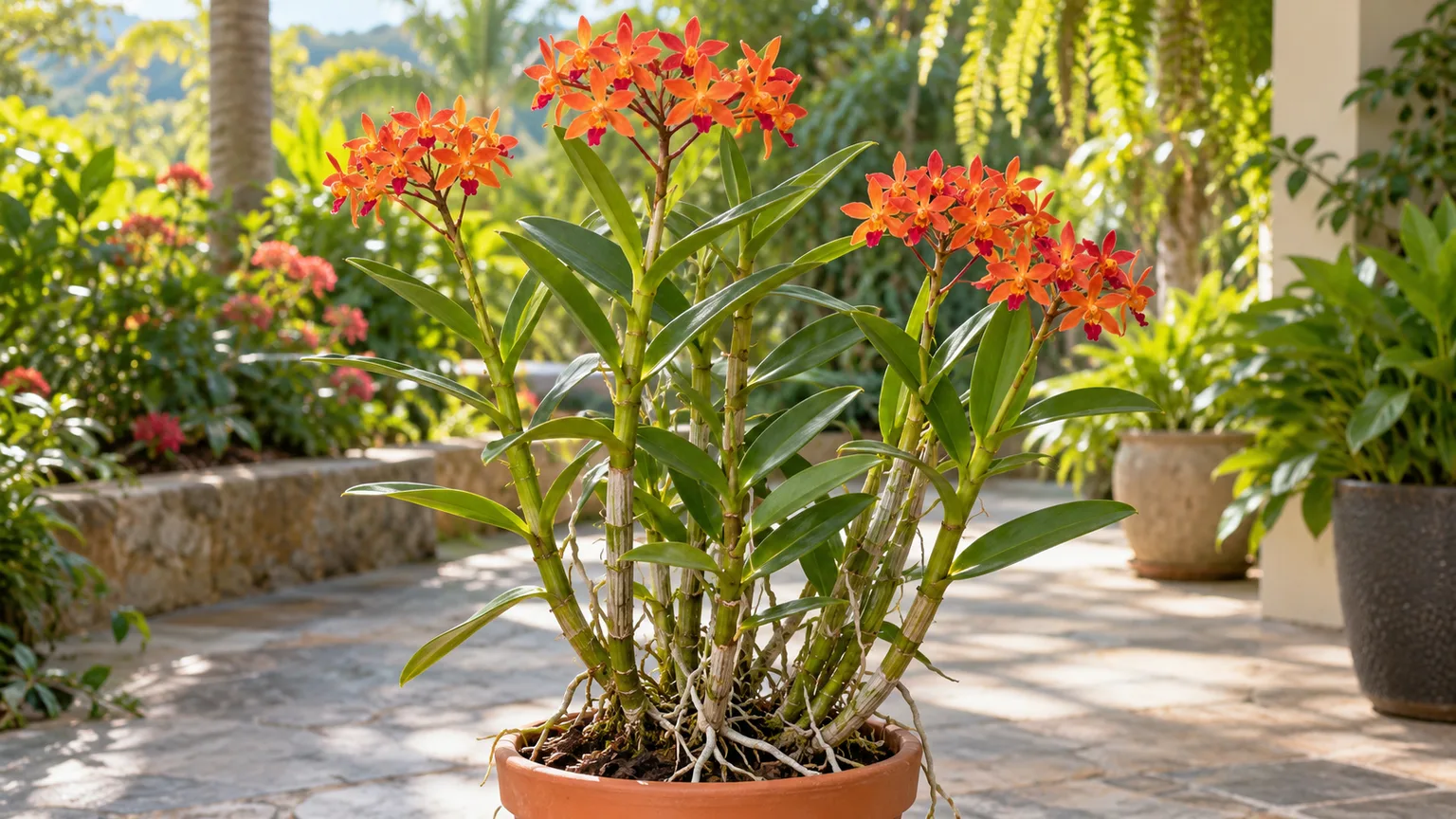
The first step in Epidendrum orchid care is identifying how your plant grows. The genus includes orchids that cling to trees, grow on rocks, or root in soil; a care routine that keeps one type happy can leave another too dry or waterlogged. The bright, upright reed-stem orchids sold as crucifix orchids are among the most adaptable, but they are only one slice of a diverse group.
If your plant has leafy canes, roots emerging along the stems, and clusters of small starry flowers at the tips, start with the reed-stem guidance below. If the plant has pseudobulbs, a creeping rhizome, or a label naming a less common species, use the broad principles—bright light, air around the roots, and water matched to the medium—then verify the species’ specific temperature and seasonal needs.
Identify the Epidendrum before you set a routine
Epidendrum is a large genus of New World orchids, but published species counts differ because taxonomists have changed the boundaries of the group over time. The American Orchid Society’s genus profile describes a wide range of habits and forms, while the North American Orchid Conservation Center notes that Epidendrum includes epiphytes, lithophytes, and terrestrial plants with widely variable stems and leaves. In practical terms, the name on a plant tag does not tell you whether its roots want a bark basket or a soil-based bed.
Look at the plant’s structure before choosing a medium. A reed-like stem with leaves spaced along it and roots forming at the nodes points toward the common crucifix-orchid group. A compact clump, hanging or trailing stem, conspicuous pseudobulbs, or a plant sold by a precise species name may have different needs; keep its original label and search that exact name before changing the setup.
The common names “reed orchid” and “crucifix orchid” usually refer to vigorous reed-stem species and hybrids such as plants sold as Epidendrum radicans, E. ibaguense, or related crosses. Names are not always applied consistently in retail trade, and flower color alone is not a dependable identification. Kew’s Plants of the World Online profile for E. radicans treats it as an accepted species; keep the name on your nursery label rather than relying on a common name to infer every detail.
Reed-stem crucifix orchids are the common garden type
Reed-stem Epidendrums grow from leafy canes and often make aerial roots along the stem. Mature canes can carry a rounded head of many small flowers, and new shoots can emerge from the base or from nodes on an older cane. This growth habit makes the plant look more like a clumping perennial than a typical moth orchid, but it is still an orchid with roots that need oxygen and a medium that drains.
For these common forms, a useful starting point is bright light, warmth, steady moisture during active growth, and an airy root zone. Do not apply those same settings automatically to every Epidendrum. Some species are cool-growing or miniature, some trail, and some need greenhouse conditions; the Royal Horticultural Society’s genus profile underscores how much size and appearance vary across the group.
Decide whether your space fits the plant
Reed-stem types can work as houseplants if you have a genuinely bright window, room for several upright canes, and a way to support them as they grow. A dim shelf may keep leaves alive but often produces stretched stems and few flowers. A south- or west-facing window can be useful in a cool climate, though summer sun through glass may heat leaves quickly; use a sheer curtain or move the plant slightly back if the foliage heats or bleaches.
In a warm, frost-free climate, these orchids can be grown outdoors in a container, raised bed, or well-drained garden site. The UC Cooperative Extension Master Gardener profile describes reed-stem forms grown outdoors in mild coastal California, while ABC Gardening Australia notes that cultivation and frost tolerance vary among species. Those regional examples are not a universal hardiness promise: a plant can suffer cold damage well before a forecast reaches freezing.
If winter nights are cold, grow the orchid in a pot and bring it under cover before temperatures fall sharply. A bright greenhouse or sunroom is easier than a warm, dark room. You can also put it outside for summer and bring it indoors for winter, but move it gradually so the change in light, wind, and humidity does not shock soft growth.
Give reed-stem Epidendrums bright, filtered light
Light is often the main reason a reed-stem orchid makes plenty of green growth but few flowers. The American Orchid Society’s reed-stem culture guidance puts these orchids in bright light comparable to Cattleyas, around 2,500–3,500 foot-candles under its growing conditions. Most home growers will not measure foot-candles, so use the plant’s response: strong upright growth and medium-green leaves suggest a workable level; long, weak canes and sparse flowering point toward too little.
Acclimate a plant to stronger light over a week or two rather than placing it immediately in hot midday sun. Increase morning exposure first, then assess new growth and leaf color. A little bronzing can occur in strong light, but sudden pale patches, dry tan areas, or scorched edges mean the change was too abrupt or too intense. Cold stress can also bronze foliage, so check recent temperatures before assuming the sun is the cause.
Indoors, place the plant near the brightest unobstructed window you have, with filtered midday sun if the glass becomes hot. If the plant grows well but repeatedly fails to flower, consider a grow light or a summer stay outdoors before increasing fertilizer. More feeding cannot replace the light needed to mature flower-bearing canes.
Match potting medium to the roots and growth habit
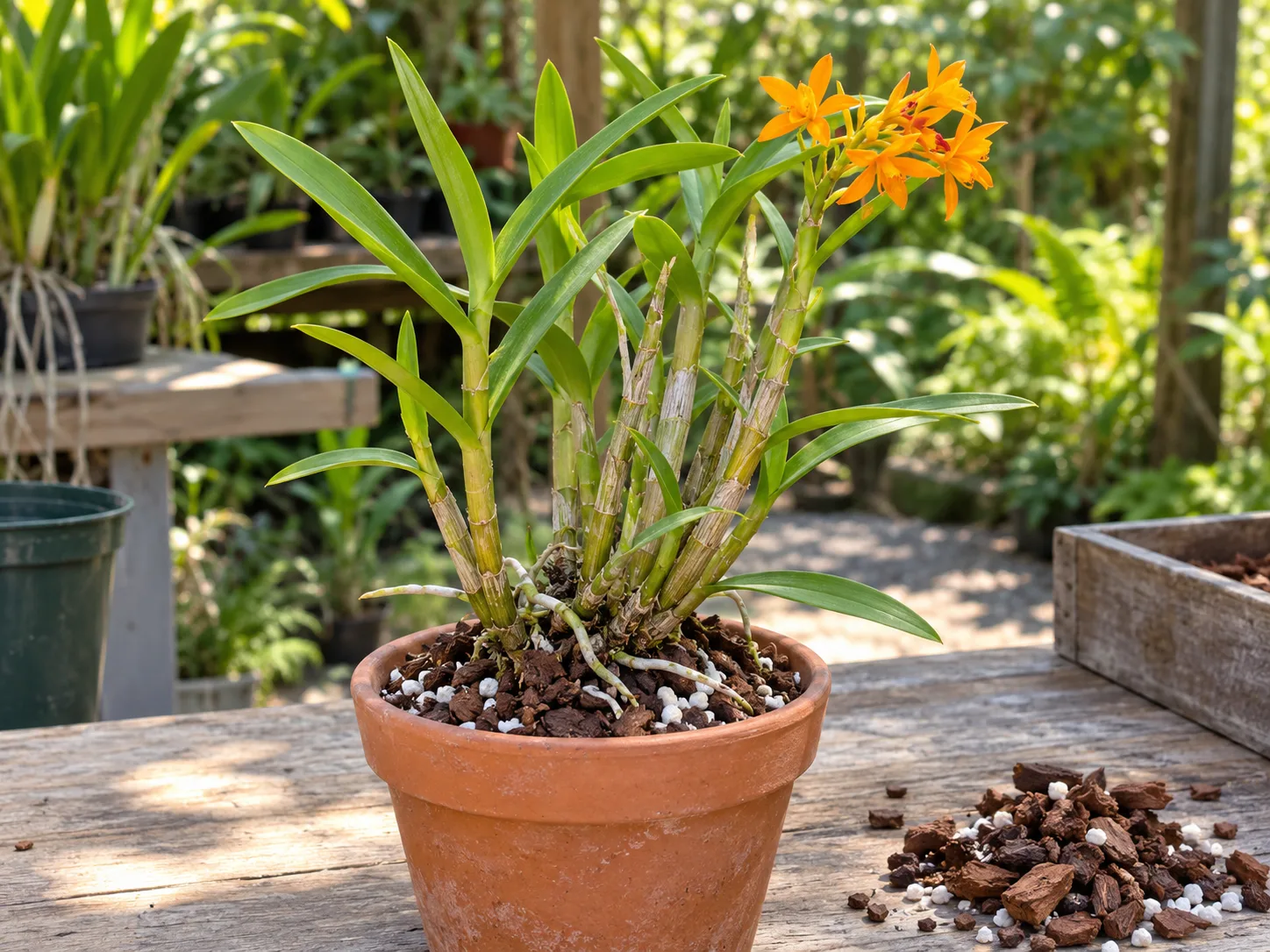
Choose a medium that gives the roots both moisture and air. A medium-grade orchid bark mixed with coarse perlite is a useful container starting point for many reed-stem Epidendrums. Add a modest amount of sphagnum if your air is dry or the pot dries too quickly; reduce moisture-retaining material if the mix stays damp for days. The American Orchid Society culture article describes an open bark-and-perlite mix and stresses adjusting watering to the medium and local conditions.
For a garden-grown reed-stem type, ordinary compact potting soil is a poor choice. A raised bed or open, organic-rich soil can work in a frost-free climate if water drains freely after rain. The UC Cooperative Extension example uses bark and perlite for containers and notes that clay pots dry faster than plastic; the practical principle is that the root zone should not remain saturated, whatever the material.
Other Epidendrum habits call for different mixes. A tree-growing epiphyte generally needs a coarse, fast-draining orchid medium or a mount; a trailing species may need to be secured to a slab with a small moisture-retaining pad; a terrestrial species may accept a more moisture-retentive mix but still needs oxygen around the roots. A simple comparison helps:
| Growth habit | Container or site | Medium starting point |
|---|---|---|
| Reed-stem, often sold as crucifix orchid | Pot, basket, raised bed, or frost-free garden | Medium bark with perlite; add a little sphagnum if it dries too fast |
| Epiphytic clump | Airy pot or basket | Medium-grade bark or another open orchid mix |
| Trailing epiphyte | Slab or hanging mount | Bare roots with a small moisture-retaining pad |
| Terrestrial species | Pot or suitable garden bed | More moisture-retentive than bark alone, but still free-draining |
Water for active growth, then adjust to dry-down
Watering depends on the medium, pot material, root mass, temperature, and wind. In warm weather, an actively growing reed-stem Epidendrum may use water quickly; a plastic pot in a shaded room dries more slowly than a small clay pot on a sunny patio. Instead of watering by the calendar, check the mix with a finger or wooden skewer and learn how heavy the pot feels just after watering and again as it approaches dry.
When the bark is nearing dry, water thoroughly until water runs from the drainage holes, then let the pot drain completely. During a hot growth flush, keep the mix lightly and evenly moist rather than allowing it to become bone-dry for long stretches. In cool, cloudy weather, slow down because roots use water more slowly. The American Orchid Society’s culture notes describe more frequent watering during active growth and a somewhat drier period later in the year, but they also emphasize adapting that cycle to local weather and the chosen medium.
For a mounted plant or an exposed-root epiphyte, the roots may dry much faster than roots in a pot. These plants may need more frequent watering or a small moisture-retaining pad; the correct interval can be daily in hot, breezy conditions and much longer indoors. Conversely, a reed-stem plant in a water-retentive garden bed should not be watered just because a weekly reminder says so. Check the roots and medium first.
Use room-temperature water when possible and avoid leaving a pot standing in a saucer of water. Cold water on tender foliage can contribute to spotting in some Epidendrums, and water that remains around the crown in cool, still conditions raises the risk of rot. If your tap water leaves heavy mineral crusts, periodically flush the medium with lower-mineral water and reduce fertilizer salts.
Keep warmth, humidity, and airflow in balance
Many common reed-stem hybrids grow best in warm conditions and should be protected from frost. The American Orchid Society describes greenhouse night temperatures around 50°F as a conservative baseline for its reed-stem plants; it also reports test plants surviving brief outdoor exposure down to 40°F under cover, while noting visible stress from chilling. Treat that as context, not a recommendation to expose your plant to cold. The species, hybrid, wetness, wind, and duration all affect the outcome.
If you do not know the plant’s cold tolerance, bring it in before nights regularly approach 50°F. A plant in a small pot can chill faster than one in a protected garden bed. Cold-damaged leaves may bronze, soften, or drop, so move the plant to shelter, keep the medium only lightly moist while growth slows, and wait to see whether the canes remain firm before pruning.
Humidity helps, but it is not a substitute for watering the roots. A UC Cooperative Extension Master Gardener profile suggests at least 50% humidity with air movement for its common garden-grown reed-stem orchid. If your indoor air is much drier, group plants or use a humidifier, but do not crowd the orchid against a damp wall or mist it repeatedly while airflow is poor. Gentle movement of air helps leaves and roots dry between waterings and reduces stagnant conditions.
Feed lightly while new growth is active
Feed an actively growing Epidendrum with a balanced orchid fertilizer at a diluted rate, following the product label. The American Orchid Society recommends a balanced formula for reed-stem types, while UC Cooperative Extension describes using a half-strength balanced fertilizer during the blooming season in its local growing context. A practical home routine is to feed weakly during active leaf and root growth, then reduce or pause feeding when growth slows in winter or when the plant is stressed.
Do not try to force flowers with a concentrated “bloom” product. Light, healthy roots, and steady growth have more influence than a single high-phosphorus dose. If white crust forms on the bark or pot, or root tips turn brown after repeated feeding, flush the mix with plain water and use a weaker solution next time. Never fertilize a plant with badly rotted roots as though fertilizer will repair them; correct drainage and root health first.
Choose a container or garden bed that can drain
For a container, prioritize drainage holes and a size that holds the root mass without burying the base of the canes in a large volume of wet mix. Plastic retains moisture longer than unglazed clay; clay can be useful in warm, humid weather or for a top-heavy plant, but it may require more frequent watering in a dry home. A slotted orchid pot or basket can improve airflow around roots, though very open baskets dry quickly and may be inconvenient if you cannot water often.
In frost-free landscapes, reed-stem forms can grow in a raised bed, border, or large outdoor container. Choose a bright site protected from the hottest afternoon sun and from strong salt-laden coastal wind. The stems can spread and lean as the clump matures, so allow room around the plant and check local guidance before planting a vigorous orchid outdoors. Some horticultural references advise checking regional weed potential; a container is the safer option when you are unsure how aggressively it may spread in your climate.
Indoors, use a cachepot only if you can remove the nursery pot to water and let it drain before returning it. Standing water at the bottom of a decorative cover can keep the lower roots wet while the top appears dry. Check the bottom of the pot every time you water, especially in winter when evaporation slows.
Support tall canes without cutting healthy growth
Tall stems can lean under the weight of a flower cluster, especially in a small plastic pot. Insert a slender stake near the pot edge and tie each cane loosely with soft clips or plant ties; avoid cinching the tie across a leaf node or aerial root. A wider, heavier pot can also improve stability, but do not move a healthy plant into an oversized container just to make it harder to tip over.
Some reed-stem Epidendrums naturally grow upright while others arch or ramble. If growth is unusually stretched and sparse, improve light before trying to prune the plant into a compact shape. Cutting down green canes removes stored energy and may remove nodes that could produce roots, keikis, or additional growth. Support the plant’s natural form and remove only dead or damaged tissue with a clean tool.
Encourage repeat blooms and prune only spent spikes
Bloom timing varies by species, hybrid, light, and growing conditions. Common reed-stem Epidendrums can flower repeatedly or over a long season when they receive enough light and keep producing healthy new canes. Some species and hybrids produce new flowers from old inflorescences, so do not cut a green flower stalk simply because its first flush has faded.
After flowers drop, inspect the stalk and the cane separately. If the flower stalk is still green and the plant has a history of branching from it, leave it in place. If the stalk has dried brown, trim that stalk back with a clean blade without cutting into the leafy cane below. A living cane may continue to support the plant even when it is no longer flowering; do not remove it unless it is fully dead or diseased.
When an Epidendrum does not bloom, start with the simplest checks: Is new growth receiving stronger light than it did in the past? Has the plant matured enough to flower? Is it getting a warm active season, healthy roots, and dilute nutrition? A seasonal shift may help some reed-stem hybrids, but not every species needs a dry winter rest. Avoid imposing a rest period unless the plant’s identity or grower notes support it.
Repot when the medium or roots tell you to
Repot when the bark has broken down into fine, slow-drying material, roots are declining because the mix stays wet, the container is failing, or the plant has become unstable and crowded. There is no need to repot every Epidendrum on a fixed three-year schedule. A fresh, open mix is helpful when the old one no longer drains or aerates; disturbing healthy roots just because the calendar says so adds stress without improving care.
Choose a time when the plant is beginning active growth if possible, because new roots can establish into the mix. Slide the root ball out gently, remove loose decomposed material, and trim only roots that are clearly dead, hollow, or mushy with a clean tool. Keep healthy aerial roots even if they point out of the pot. Set the plant at the same depth it was growing before, with the base of the canes above the medium rather than buried.
Use a pot only modestly larger than the remaining root mass. A container that is too large holds unused wet medium and dries slowly, increasing the risk of rot. After repotting, water enough to settle the mix, let it drain, and hold off on strong fertilizer until you see new root or shoot activity.
Propagate by keiki, stem section, or division
Reed-stem Epidendrums may produce keikis—small plantlets—on a cane, often where the plant can form aerial roots. Wait until the plantlet has several firm roots of its own and enough leaves to support growth. Leave it attached while it develops; separating a rootless nub turns a simple propagation into a rescue attempt.
When the keiki is established, use a clean, sharp blade to cut the cane on both sides of the plantlet, preserving its roots and a short section of stem. Pot it shallowly in a small container with an airy, lightly moist orchid medium, secure it so it does not wobble, and keep it warm with bright filtered light. Do not bury the leaves or pack wet moss tightly around the base. The University of California Cooperative Extension profile describes cutting a reed-stem section below its aerial roots and planting it in a draining mix.
You can also divide a crowded clump when repotting. Keep several strong canes and a healthy root section together in each division; very small pieces may survive but take longer to regain flowering size. The division method suits clumping species better than a trailing species that is best mounted. Seed propagation is generally a specialist or nursery task because orchid seed is dust-like and normally germinated under sterile culture conditions, not in an ordinary seed tray.

Diagnose slow growth, weak blooms, and root problems
Look for a pattern across leaves, canes, roots, and medium instead of treating one symptom as a complete diagnosis. A cane may naturally lose an older lower leaf while producing new growth elsewhere; repeated yellowing across several leaves, soft stems, or a sour-smelling pot calls for a closer root inspection. Change one condition at a time when possible so you can tell whether the adjustment helped.
Separate light problems from root problems
Long, weak stems with few flowers point first to insufficient light, especially if roots remain firm and the plant continues to grow. Move the orchid gradually to a brighter location and give it time to produce mature growth; a sudden jump into hot sun can add scorch to the original problem. If leaves are bronzed, consider both light and cold exposure and review recent changes before moving the plant again.
Wrinkled or limp foliage can indicate a plant that dries too fast, but it can also happen when damaged roots cannot absorb water. Firm, active roots and a mix that becomes dry soon after watering suggest the setup may be too open, too small, or too warm. Soft, brown, hollow roots in a medium that stays damp point toward poor drainage or excess watering. Fix the root environment rather than watering more just because the leaves look thirsty.
Watch for scale and aphids
Inspect the undersides of leaves, cane joints, and fresh flower clusters for hard scale, aphids, or sticky residue. The American Orchid Society identifies scale and aphids among pests seen on reed-stem Epidendrums. Isolate a plant with a new infestation, remove visible pests carefully, and confirm the insect before choosing a treatment; follow product labels and local rules if you use a registered control. Good spacing and airflow make inspection easier and help you catch a small problem before it spreads.
Move Epidendrum orchids through the seasons
In spring and summer, increase watering as new roots and shoots become active, feed weakly, and acclimate the plant to outdoor light if the nights are warm enough. Check outdoor pots after rain: an orchid can need frequent watering in heat yet still develop rot if its pot sits in a water-filled saucer. Stake new canes early, before they lean into a nearby plant or snap in wind.
In autumn, watch night temperatures and bring tender plants indoors before cold weather arrives. Reduce watering and fertilizer as growth slows, but do not let roots desiccate completely. The American Orchid Society describes a wetter growing season followed by a cooler, drier period for some reed-stem growing conditions; ABC Gardening Australia cautions that some Epidendrums have no dormant period. Follow the plant’s growth rather than forcing every specimen into a calendar-based dormancy.
When moving indoors, inspect the plant for pests and rinse away outdoor dust before placing it near other orchids. Keep it in the brightest available location, leave room for air to move around the leaves, and adjust watering to the slower winter dry-down. In spring, reverse the move gradually. If your orchid has a species name, the source grower’s culture notes should take priority over generic advice for the genus.
Conclusion
Epidendrum orchid care becomes much easier once you stop treating the whole genus as one plant. Identify whether your orchid is a reed-stem garden type, an epiphyte, a lithophyte, or a terrestrial species; then match its light, medium, watering rhythm, and cold protection to that habit.
For the common reed-stem crucifix orchid, provide bright light, warmth, an airy but not bone-dry root zone, and support for tall canes. Water and feed more as active growth speeds up, back off as the plant cools and slows, and keep healthy green stems until they are truly spent. Those simple checks will guide you more reliably than a fixed weekly schedule or a one-size orchid mix.



