What Is Drought-Tolerant Landscaping? A Practical Guide
Plan a drought-tolerant landscape for your climate. Map sun and drainage, choose region-ready plants, group by water needs, and water through establishment.

Drought-tolerant landscaping is a way of planning and caring for a yard so its plants and outdoor spaces can get by with less supplemental water during dry weather. It combines plant choice with layout, soil care, irrigation, mulch, and decisions about where lawn or hardscape actually serves a purpose. The goal is a landscape that uses water thoughtfully and still works for the people who live with it.
That does not mean “no water,” a bare yard, or a collection of rocks and cacti. A newly planted drought-tolerant garden still needs water while roots establish, and a mature landscape may need occasional irrigation during a long or unusually severe dry spell. The practical shift is to reduce avoidable demand and put water where it supports useful plants.
What drought tolerance means for a whole landscape
A drought-tolerant plant can withstand periods of low soil moisture better than a plant that needs consistently moist ground. How well it does depends on the species, its age, the weather, soil drainage, wind, sun, and whether it is growing in conditions that suit it. A plant that thrives through dry summers in its native range may struggle in heavy, compacted soil or in a humid climate with wet winters.
“Drought tolerant” and “drought resistant” are often used loosely in garden writing and plant labels. Neither should be read as a promise that a plant can live indefinitely without rain or irrigation. For landscape planning, ask a more useful question: once established in this exact spot, how much supplemental water will the plant need compared with the existing lawn or thirsty border?
A drought-tolerant landscape applies that question to the whole property. It reduces the area that must be irrigated heavily, puts plants with similar needs together, and keeps water from landing on pavement or running down a slope before it soaks in. That system matters as much as whether individual plants have silver leaves, deep roots, or other traits associated with dry habitats.
Xeriscaping is a design method, not a gravel recipe
Xeriscaping is a form of water-conscious landscape design. The term is associated with dry-climate gardening, but its core ideas—planning around local conditions, selecting suitable plants, grouping them by water use, irrigating efficiently, and using mulch—can help in any region with seasonal dry periods. UF/IFAS describes water-wise landscaping in terms of plant selection, efficient irrigation, water-use zoning, turf choices, and mulch (UF/IFAS).
A xeriscape can include flower beds, shade trees, a small patch of lawn, vegetables, paths, or a patio. Gravel is one possible surface, not the definition. Replacing every green space with stone can raise surface temperatures, send rainwater into drains, and create a harsh environment for plants; a good design balances planted areas with the outdoor spaces a household actually uses.
The terms “xeriscape,” “water-wise,” and “drought-tolerant landscaping” overlap, but they do not always mean exactly the same thing to every nursery, water utility, or local program. Focus on the outcomes rather than a label: a landscape that suits its climate and needs less avoidable irrigation without sacrificing function or habitat.
When a low-water landscape makes sense
This approach is useful in naturally dry climates, but it is also practical where summer rain is unreliable, watering restrictions are common, a slope sheds water, or a narrow strip of lawn is hard to irrigate without overspray. You can convert just one part of a yard. The awkward corner beside a driveway, a hot south-facing foundation bed, or the steep bank that is difficult to mow can be a better first project than the entire lawn.
Before spending money, list what you want that area to do. A play surface, dog run, shaded sitting spot, pollinator border, privacy screen, and low-care entry garden need different layouts. The best water-saving choice is often the one that solves the original problem with fewer inputs—not the one that removes the most plants.
Water and labor savings are possible, but they are not automatic. A new garden can cost more at the start than keeping an existing bed, and plant establishment may require regular watering for a season or longer. Your eventual savings depend on the area converted, your current irrigation use, local water rates, plant choices, and the maintenance you are replacing.
Start with a water map of your yard
A quick sketch prevents a common mistake: buying attractive plants first and then trying to force them into the wrong conditions. Draw the house, paths, lawn, beds, trees, downspouts, and irrigation heads. Mark places that stay wet after rain, dry quickly, receive reflected heat, or are difficult to reach with a hose.
If you plan to retrofit a lawn, check the sprinkler pattern before removing turf. Colorado State University Extension advises redirecting spray so it waters planted areas rather than pavement and notes that narrow strips can be difficult to irrigate efficiently with spray heads (CSU Extension). That is a useful diagnostic principle even if the exact dimensions and equipment differ in your region.

Record sun, slope, soil, and existing trees
Observe the area through a normal day and, if possible, after a rain or irrigation cycle. Note the hours of direct sun, shade from buildings and mature trees, wind exposure, slopes, runoff, and whether the soil stays wet or dries fast. The ground beside a sunny driveway can behave like a different climate from the shady side of the same house.
Check soil before deciding to add compost, gravel, or a new irrigation line. Compacted ground may shed water instead of absorbing it; clay and sandy soils hold and release water differently. A local soil test can help identify pH, nutrient, and organic-matter issues. Avoid driving or repeatedly walking over wet soil, which can make compaction worse.
Mark every tree and large shrub you want to keep. Trees often have roots extending well beyond the visible canopy, and a tree that has been receiving lawn irrigation can become stressed if that water disappears overnight. Keep a plan for those roots as you redesign nearby turf instead of assuming a mature tree will immediately adapt to rainfall alone.
Group planting areas by water needs
A hydrozone is an area where plants with similar water needs share an irrigation zone. Put plants that need regular moisture apart from those adapted to dry soil. If a thirsty shrub shares a valve with dry-climate perennials, the system has to overwater one group or leave the other short of water. “Native” is not a water-use category: some local natives grow in wetlands or shaded woodland.
For a simple plan, sketch three broad areas: plants that need regular water, moderate-water plantings, and established low-water plantings. These are planning categories, not fixed botanical labels. A newly planted low-water shrub belongs temporarily in a more closely monitored watering routine than it will need after its roots grow into the surrounding soil.
Separate zones also make adjustment easier. You can shorten irrigation to an established drought-adapted bed without cutting water to a vegetable patch, new trees, or a lawn used for play. If you rely on hand watering, the same idea still works: keep plants with comparable needs together so you can water each section intentionally.
Choose plants for climate and microclimate
Start with the climate where the plant will live, not a national “best drought-tolerant plants” list. Look for plants recommended by a local Cooperative Extension office, native-plant society, botanical garden, or water utility. A regional list can account for more than winter cold: rainfall pattern, summer heat, humidity, soil, elevation, and invasive-plant concerns all affect whether a plant is a sensible choice.
Use plant examples as a starting point, not a recipe. In parts of the central United States, blue grama and little bluestem are examples of drought-adapted grasses; yarrow can add flowering color in suitable sites. In warmer, dry regions, plants such as Texas sage or red yucca may fit where winter temperatures and drainage are appropriate. Lavender is commonly used in dry gardens but still needs a sunny position and soil that drains well. Better Homes & Gardens includes these kinds of grasses, perennials, and shrubs in its xeriscape plant coverage, while also cautioning that suitability depends on local climate (Better Homes & Gardens).

For more species-by-species options and first-year watering notes, see our guide to drought-tolerant plants for a water-wise garden.
Native plants help, but the label is not enough
A native plant evolved in a particular region, but that does not mean it is drought tolerant everywhere in that region or suitable for every yard. University of Georgia Cooperative Extension explains that some native species are adapted to wet habitats and that plants do best when a landscape recreates the conditions of their natural site (UGA Cooperative Extension). A native woodland groundcover planted in full sun and dry fill soil may need more care than a nonnative plant adapted to that sunny, dry exposure.
Native and regionally adapted plants can support local insects and other wildlife, and they are often a strong choice when matched to their site. They are not automatically pest-free or maintenance-free. Choose by the plant’s water needs, habitat, mature size, sun exposure, and soil preference; then check whether the plant is invasive or discouraged in your area.
Read plant labels for more than hardiness
A plant tag is a first screen, not a guarantee of success. Check mature width and height, sun exposure, drainage preference, cold hardiness, and water needs after establishment. If the tag says “drought tolerant,” ask whether that means it survives dry spells, flowers best with regular water, or can handle your region’s full seasonal pattern.
Hardiness zones describe a plant’s ability to survive winter cold, not whether it will thrive through a hot, dry summer or in poorly drained soil. When a plant is unfamiliar, look up its botanical name and ask a local nursery or Extension office about its behavior in your county. That extra check can prevent an attractive but poorly matched purchase from becoming a replacement job next year.
Keep the lawn that earns its space
A low-water yard does not have to be lawn-free. Grass can be useful for recreation, pets, erosion control, and a comfortable surface beside a patio. Colorado State University Extension notes that turf can help filter runoff and serve play and exercise needs, while difficult-to-water lawn shapes are often better candidates for conversion (CSU Extension).
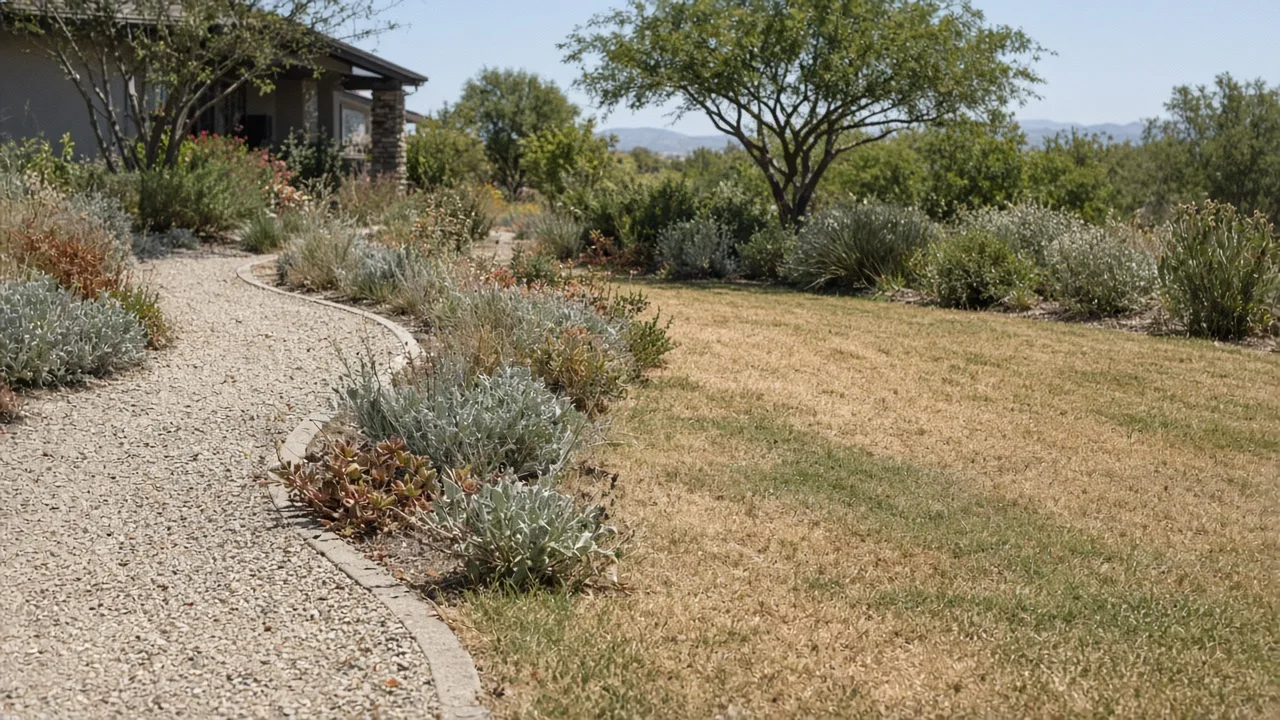
Keep the sections that receive real use and shrink the parts that are mostly decorative or hard to maintain. Irregular corners, steep banks, fence strips, and narrow pieces between a sidewalk and driveway may be easier to manage as planted beds, groundcover, or path. If retaining grass, choose a type suited to local climate and intended traffic, and tune its irrigation separately from lower-water beds. Our drought-tolerant lawn grass guide compares turf options by climate and use.
Artificial turf is not automatically a cooler or more ecological substitute for living plants. It eliminates mowing in one location but still has material, heat, drainage, and end-of-life trade-offs. Compare it with a living groundcover, shade planting, mulch path, or smaller lawn before treating “no grass” as the only water-saving option.
Match soil care and mulch to the plants
Do not amend every bed with compost by default. Many plants adapted to dry or lean soils can become weak or short-lived in a rich, moist planting bed. Colorado State University Extension recommends assessing the soil and notes that many xeric plants perform well in leaner soils that resemble their natural conditions; improve soil where a test or the chosen plant calls for it, not as a reflex (CSU Extension).
Mulch slows water loss from soil and can reduce weed pressure, but the right material depends on the plant and climate. Organic mulch such as wood chips or leaves can suit trees and many garden beds. Gravel may suit plants that need fast drainage around their crowns, but it can be a poor choice where plants prefer cool, moist soil or where reflected heat is already a problem. Gardening Know How recommends using mulch to reduce evaporation and refreshing it as it breaks down or blows away (Gardening Know How).
Keep mulch away from plant stems and crowns, and do not bury a tree trunk. Skip landscape fabric under permanent beds unless there is a specific reason for using it; it can complicate later planting and does not remove the need to manage weeds. A healthy mulch layer works with the soil, not as a sealed barrier above it.
Hardscape can reduce the area that needs watering when it provides a real function—a walkway, sitting area, or step. Prefer surfaces and layouts that let rain soak into planted areas where practical, and avoid channeling runoff toward a foundation or a neighbor. Rocks can be attractive in the right setting, but covering a yard in gravel is not a substitute for thoughtful water management.
Water for establishment, then adapt
Drought-tolerant plants need supplemental water after planting. Their existing roots have been disturbed, and the root ball may dry faster than the surrounding ground. Colorado State University Extension notes that establishment watering can range from days to years depending on plant size and conditions; UGA Extension likewise cautions that newly installed plants need supplemental water even when they are native (CSU Extension; UGA Cooperative Extension).
Do not copy a neighbor’s schedule or keep a timer unchanged all season. Check moisture a few inches below the surface near the root zone, then adjust for rainfall, heat, soil texture, slope, and plant age. Water slowly enough for the soil to absorb it. On slopes or compacted soil, a cycle-and-soak approach—short runs separated by pauses—can reduce runoff; drip or low-pressure micro-irrigation can direct water to beds, but it still needs inspection for leaks, clogged emitters, and wet spots where water is not needed.
As roots establish, extend the interval between waterings gradually and watch the plant, not just the controller. A sudden cut-off can stress new plantings, and stopping lawn irrigation may also deprive an established tree that has depended on it. Some trees can be weaned over time; others need supplemental water as long as they are in the landscape. Ask a local Extension office about a valuable tree if its needs are unclear.
Convert a yard in phases
A phased project lets you learn how the site behaves before repeating a design across the whole property. Choose one area that is easy to observe and that has a clear reason for changing—such as a strip that is difficult to water or a slope that is hard to mow. A manageable first bed is easier to weed, irrigate, and adjust than a full-yard overhaul.
Use this sequence:
- Set the job and boundary. Decide whether the area needs to provide seating, flowers, screening, erosion control, or another function. Mark its edge before removing turf.
- Map conditions and utilities. Record sun, drainage, soil, current sprinkler coverage, underground services, and nearby tree roots. Check local watering rules and any available utility or municipal guidance before altering irrigation.
- Select plants by site and water zone. Make a short list from local recommendations, then confirm mature size, soil needs, and whether a plant can spread beyond its bed.
- Prepare the ground and irrigation. Remove live turf and weeds, address compaction carefully, and reconfigure heads or drip lines so they serve the new layout. Keep watering access for plants that still need it.
- Plant, mulch, and monitor. Water new plants as they establish, suppress weeds, and take notes on where runoff or dry pockets appear. Adjust irrigation before installing the same design elsewhere.
If you are converting an existing lawn, avoid stripping out all vegetation and covering exposed soil with fabric and rock in a single weekend. That can leave soil hot, compacted, and difficult to plant. A steady conversion also spreads plant and irrigation costs over time and helps reveal which choices are suited to the property.
What maintenance and costs to expect
A mature low-water garden can need less frequent irrigation and mowing than a conventional lawn-heavy yard, but it is not maintenance-free. New plantings need monitoring, weeds need attention while plants fill in, and paths or gravel may need periodic cleanup. Some plants benefit from pruning or division, and irrigation equipment still requires maintenance.
Budget for more than plants. Removing sod, improving a compacted area, changing irrigation zones, hauling soil or mulch, and adding paths can cost as much as the planting material. A do-it-yourself conversion can lower labor costs, while keeping part of the lawn and converting a small bed can control the scale. Water-bill savings are most likely when the old area used substantial irrigation and the new layout actually reduces it.
The environmental benefit also depends on what you plant and how you care for it. Locally appropriate native plants can offer food and habitat, and reducing fertilizer or pesticide use may be possible when plants are well matched to the site. But drought-adapted does not mean pest-proof, and gravel alone does not create habitat. Aim for a landscape that uses less water while still supporting the soil, trees, and wildlife you value.
Common mistakes that waste water or plants
Assuming native means no water. Newly transplanted natives need establishment care, and some species are adapted to wet or shaded habitats. Match the plant to the actual site before planting.
Replacing all lawn without planning for use. A small patch may be the most practical surface for children, pets, or everyday access. Convert the areas that are hard to water or rarely used first.
Putting every drought-tolerant plant on one irrigation valve. Their water needs can differ, particularly during establishment. Group by water use and make adjustments as each zone matures.
Changing the whole irrigation schedule at once. New beds, established trees, and lawn may need different treatment. Retain or redesign separate zones instead of abruptly shutting off water across the property.
Treating rock as a universal mulch. Gravel can suit some dry-climate plants, but it may overheat a bed or make future changes harder. Choose the surface for local conditions, plant needs, and the job of the area.
Expecting a maintenance-free garden immediately. Weed control and plant replacement are more likely in the first seasons than after a well-planned bed fills in. Start at a scale you can care for and expand after seeing what works.
Conclusion
Drought-tolerant landscaping is a site-specific way to keep an outdoor space useful and attractive while relying less on supplemental water. It works through the combination of climate-fit plants, water zones, efficient irrigation, suitable soil and mulch, and a thoughtful choice about where to keep lawn or add hardscape.
Start with one difficult-to-water area. Map its sun, soil, slope, and existing trees; choose plants recommended for your region; and give them water while they establish. Once that section is healthy, you will have a better guide for converting the next part of your yard.