Crimson Queen Japanese Maple Care and Growing Guide
Plant a Crimson Queen Japanese maple in the right light and soil, then learn to water, prune, overwinter, and grow it in a container with fewer mistakes.
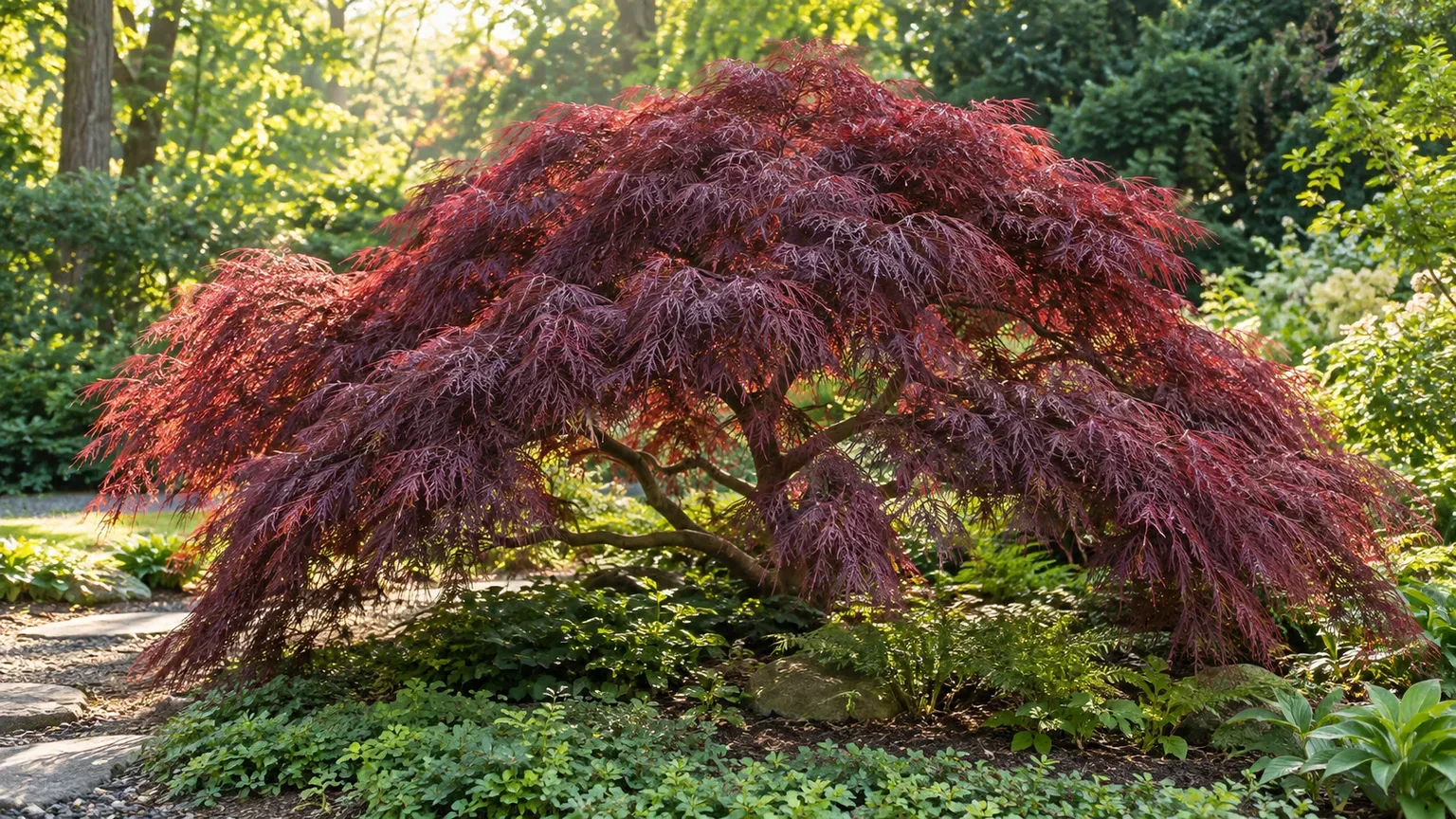
Crimson Queen is a slow-growing laceleaf Japanese maple with a low, cascading crown and finely cut, burgundy-red leaves. It is compact compared with a full-size shade tree, but “dwarf” can be misleading: a mature specimen may stand 8 to 10 feet tall and spread 10 to 12 feet, so give the branches room to develop rather than planting it as a narrow foundation shrub.
The care decision that matters most is the planting site. This cultivar keeps its color best when its shallow root zone stays evenly moist and its delicate foliage is protected from the combination of hot afternoon sun, drying wind, and drought. Choose that setting first; watering, mulching, and pruning are much easier once the tree is not fighting its location.
Crimson Queen at a glance
| Trait | What to expect |
|---|---|
| Botanical name | Acer palmatum var. dissectum ‘Crimson Queen’ |
| Mature size | About 8–10 feet tall and 10–12 feet wide; allow for local variation |
| Habit | Slow-growing, rounded to spreading, with arching and cascading branches |
| Foliage | Deeply divided reddish-purple leaves; red and orange tones can appear in fall |
| Light | Full sun to partial shade; afternoon shade is helpful in hot areas |
| Soil | Moist, organically rich, slightly acidic to neutral, and well drained |
| Broad hardiness reference | USDA zones 5–8; selection, exposure, and winter protection matter |
| Best use | Specimen, sheltered understory accent, patio focal point, or large container |
The Missouri Botanical Garden lists the cultivar at 8 to 10 feet tall and 10 to 12 feet wide, while the RHS gives a comparable range of roughly 5 to 8 feet in both directions over 10 to 20 years. These are garden estimates rather than a promise: graft height, climate, soil moisture, and the age of the plant affect the final silhouette. Missouri Botanical Garden Plant Finder and the RHS cultivar profile both identify this as a spreading, arching laceleaf maple.
Think in terms of the mature spread, not the small nursery pot. If a path, wall, or neighboring shrub sits beneath the eventual canopy, the tree may need regular selective pruning or the planting location may be wrong; its graceful low branches are part of the cultivar’s appeal.
What makes this cultivar distinctive
Crimson Queen belongs to the dissectum, or laceleaf, group of Japanese maples. Its leaves are divided into narrow, deeply cut lobes, and its branches arch outward before cascading, giving the plant a layered umbrella-like outline rather than the upright shape of cultivars such as Bloodgood. The Missouri Botanical Garden notes that its red foliage retains color well through the growing season, and the RHS describes red-to-orange autumn color.
Color is not a fixed paint chip. New growth, summer heat, light exposure, and seasonal temperatures can shift the foliage from crimson or burgundy toward deeper purple or greener tones, especially in stressful conditions. A healthy tree in an appropriate site is more likely to show its characteristic color, but no care routine can make every leaf stay the same shade all year.
Small reddish flowers appear in spring and are followed by paired winged seeds called samaras. They are subtle compared with the foliage and branching, but they help explain why a mature maple may drop a scattering of seeds nearby; seedlings will not necessarily resemble the named cultivar.
Is it right for your garden and climate?
Crimson Queen suits a garden that can offer shelter, consistent soil moisture, and enough horizontal space for a wide crown. It can become a focal point beside a patio or pond, under the high canopy of taller deciduous trees, or in a protected courtyard where its branches can be viewed at close range. It is not a good choice for a narrow strip that is baked by afternoon sun or a low spot that stays waterlogged.
The Missouri Botanical Garden lists zones 5 through 8 for this cultivar. Treat that range as a planning guide, not a guarantee: Japanese maples vary in cold tolerance, and a windy site, late frost, or freeze-thaw cycle can damage tender growth even where the average winter temperature is within range. The University of Connecticut notes that hardiness differs among Japanese maple selections and warns against windswept winter locations in its Japanese maple profile.
In a colder climate, place the tree out of prevailing winter wind and avoid a frost pocket where cold air settles. In a hot climate, morning light with afternoon shade is usually a safer starting point than an exposed west-facing bed. If the site is both hot and dry, choose a more heat-tolerant tree rather than expecting frequent watering to compensate for an unsuitable microclimate.
Choose light that protects the leaves
Crimson Queen can grow in full sun, particularly in cooler regions where the leaves are not exposed to intense heat for long stretches. In warm regions, filtered light or morning sun followed by afternoon shade reduces the chance that the thin, divided leaves will dry faster than the roots can replace water. A sheltered east or north side of a building, or the edge of a taller tree canopy, often provides a useful balance.
Observe the site at the hottest part of the day before planting. A spot can appear shaded in the morning and receive several hours of reflected heat from a pale wall, driveway, or south-facing patio later; that reflected heat can be harder on foliage than soft direct morning sun. The RHS says leaf color is often best in partial shade and links scorch to either insufficient soil moisture or excessive exposure in its Japanese maple growing guide.
Wind matters as much as the sun exposure. A breezy corner can desiccate a fine-textured canopy even when soil is moist, so use a hedge or larger tree as a windbreak without placing the maple directly under dense, thirsty roots. Do not crowd the trunk against a wall; airflow and room for its mature spread still matter.
Prepare the soil and planting spot
The target is soil that holds moisture without staying saturated. Slightly acidic to neutral soil with organic matter is a good fit, but the drainage is more important than trying to engineer a precise pH; the RHS lists several soil textures for the cultivar while still specifying moist, well-drained conditions. If you are unsure about pH or fertility, a soil test is more useful than adding lime, sulfur, or fertilizer by guesswork.
Check drainage before committing to the location. After a heavy rain, look for standing water around the proposed root zone; if the ground remains soggy, move the tree to a better-drained area or build a broad, gently raised planting mound rather than putting gravel in the bottom of a deep hole. In heavy clay, avoid creating a loose, rich pocket surrounded by dense soil, because water can collect in the planting hole.
Do not prepare just a tiny amended pocket. Loosen a wide area around the planting hole and use the native soil for backfill; a light surface dressing of finished compost can improve the root zone over time. Keep salt spray, deicing runoff, and hot reflected surfaces away from the canopy and roots, as these stressors can make leaf edges look scorched even when you are watering.
Plant without burying the root flare
Plant in spring or fall when the soil is workable and temperatures are moderate. Water the nursery root ball before removing the container, then find the point where the trunk widens into the first main roots; this root flare should sit at or slightly above the finished soil grade, not several inches underground.
Dig a hole about twice as wide as the root ball but no deeper than its depth. Loosen circling roots at the edge and bottom, then set the tree upright with the most attractive branching facing the place where it will be viewed; backfill with the soil you removed and water slowly to settle it. If the plant is grafted, leave the graft union above the soil and do not bury it in mulch.
Finish with a broad layer of organic mulch, keeping it several inches away from the trunk. Do not add a concentrated fertilizer dose to the hole or prune the canopy to “balance” roots that were not heavily cut; a newly planted tree needs time to establish fine roots, not a forced burst of top growth.
Water through establishment and summer
A newly planted Crimson Queen needs steady moisture while roots spread into surrounding soil. During the first growing season, check the nursery root ball and nearby soil every few days during warm, dry weather; they can dry at different rates, so test with a finger or small trowel rather than reading only the mulch surface. Water deeply when the root zone begins to dry, then let excess drain away.
Do not use a fixed rule such as watering twice a week for every tree. Sandy soil, a small root ball, wind, heat, and a container all shorten the interval; clay, rain, shade, and a larger established root system lengthen it. The goal is moist soil, not standing water, because roots in saturated ground can decline even while leaves look limp.
Once established, the tree can tolerate brief dry spells better than a new planting, but it is not drought-proof. During a heat wave, inspect the soil beneath the mulch and water slowly at the root zone if it is dry several inches down; shallow, frequent sprinkling wets the surface but does little to recharge deeper roots. If the soil is already damp and foliage is drooping, pause before adding more water and check drainage, recent root disturbance, or heat exposure.
Mulch and feed with restraint
A 2- to 3-inch layer of shredded bark or leaf mulch helps keep the shallow root zone cool and slows moisture loss. Spread it beneath the canopy as the tree grows, but leave a clear ring around the trunk so bark stays dry and visible; a piled “mulch volcano” traps moisture against the stem and hides the root flare. Refresh the layer when it thins rather than adding a deep blanket every year.
Crimson Queen is not a tree to push with heavy nitrogen. If new growth is healthy and the leaves are normal for the cultivar, fertilizer may be unnecessary; use a soil test if the tree has persistently weak growth or suspicious chlorosis, because drainage and soil pH can block nutrient uptake even when nutrients are present. A named horticulture source, Savvy Gardening, likewise recommends basing feeding on soil conditions and avoiding fertilizer at planting in its Japanese maple fertilizer guide.
If a test shows a deficiency, apply an appropriate, modest fertilizer in early spring according to its label and the tree’s size. Avoid lawn fertilizer around the root zone and do not feed late in the growing season, when a flush of tender growth has little time to harden before cold weather. Compost used as a thin surface mulch is a gentler way to add organic matter, but it is not a substitute for correcting poor drainage.
Prune to reveal the natural cascading form
Most Crimson Queen maples need little pruning. The goal is to maintain a clear, layered canopy and remove dead, damaged, crossing, or rubbing branches—not to shear the tree into a tight ball or shorten every branch to the same level. Its broad low silhouette is a cultivar trait, so first decide whether a branch is actually a problem or simply part of the weeping form.
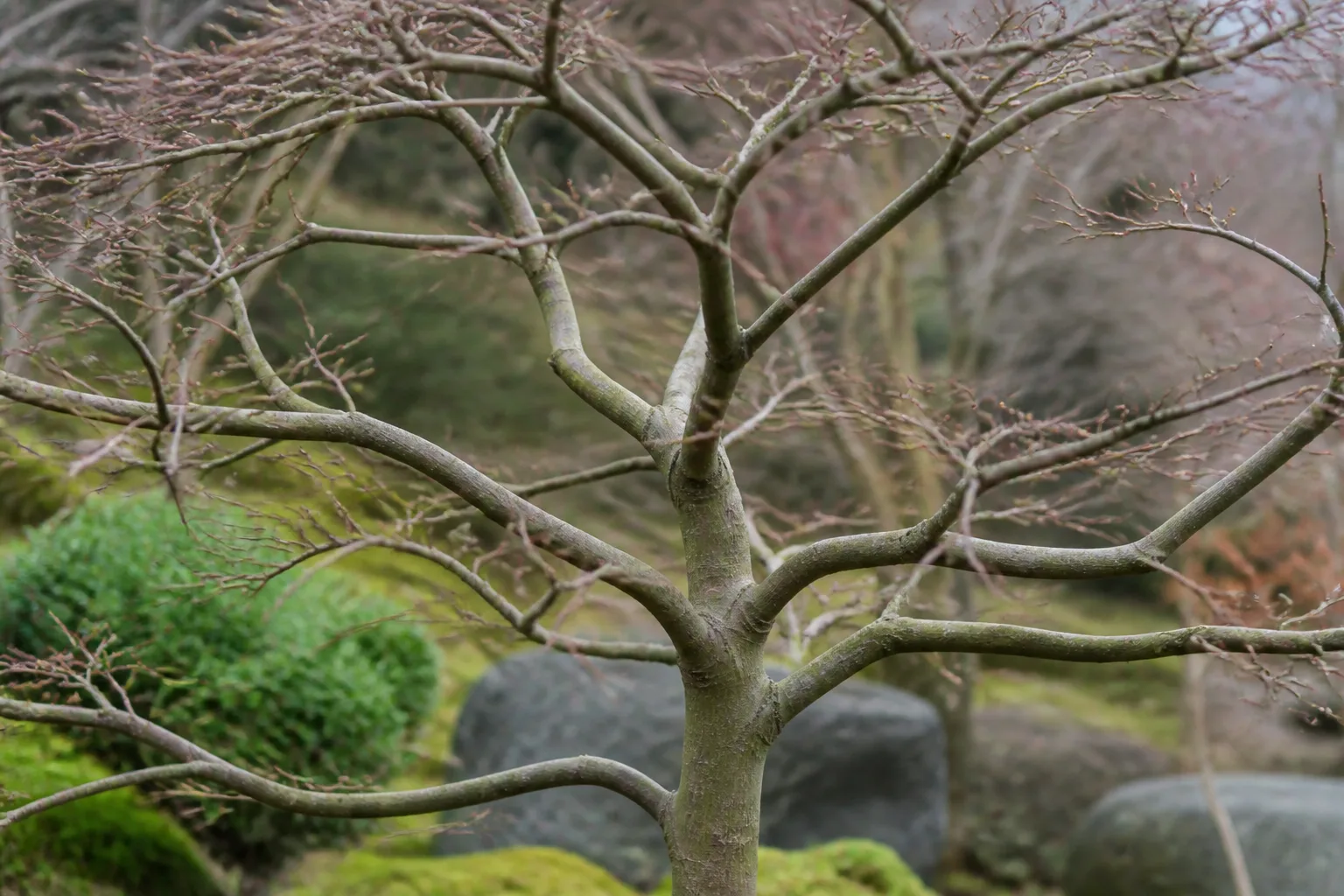
For routine cuts on living wood, the Missouri Botanical Garden recommends late fall to midwinter; a named Japanese-maple pruning guide from Savvy Gardening also favors the dormant-season window and cautions against pruning as spring sap begins to flow. Local weather changes the calendar, so work after leaf fall and before buds swell, avoiding periods when severe cold is forecast. Remove a completely dead or broken limb when needed rather than leaving a hazard in place.
Start by looking underneath the canopy, where dead twigs and crossed branches are easy to miss. Use clean bypass pruners for small growth and a pruning saw for larger branches; cut just outside the branch collar, not flush with the trunk and not leaving a long stub. Make a few deliberate cuts, step back to inspect the outline, and stop before you remove a large share of the living canopy.
If branches drag on a path, selectively remove or shorten the offending branch back to a suitable side branch instead of topping the tree. Do not “lift” the entire skirt at once if you want to keep the cascading look, and remove any vigorous shoots emerging below the graft because they belong to the rootstock. If the tree needs major structural correction, consult a qualified arborist rather than trying to reshape it in one season.
Grow Crimson Queen in a container
A container is useful when garden soil drains poorly, the patio needs a focal point, or you want to move the tree away from harsh summer sun. Japanese maples’ relatively slow growth and fibrous roots suit pot culture, but a container is not a way to make a mature Crimson Queen permanently maintenance-free; it still needs root space, dependable watering, and winter root protection. The RHS and Horticulture magazine both describe Japanese maples as suitable container subjects, with the latter drawing on specialist grower Patricia Smyth’s long-term experience in its container-tree guide.
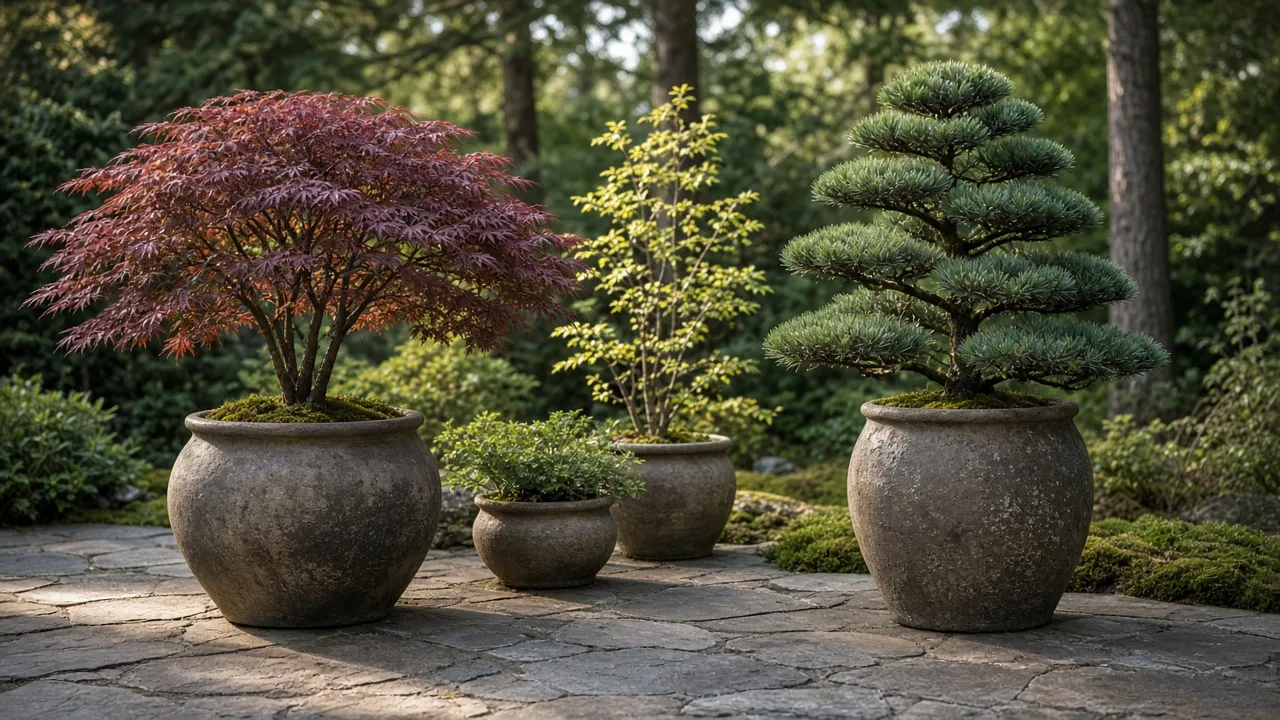
Choose a stable pot with generous drainage holes and enough volume for roots to expand. For a young tree, stepping up from the nursery pot to roughly double its soil volume is a practical starting point; moving a small root ball straight into an enormous pot can leave a large volume of wet mix that the roots cannot use. Use a quality, free-draining container mix, not garden soil, and keep the trunk base at its previous grade.
Pots dry faster than beds, especially in wind and direct sun, so check moisture frequently in summer and water until excess drains from the bottom. Elevate the pot slightly so drainage holes stay open, and avoid letting the root ball alternate between bone dry and waterlogged. Do not let standing water remain in a saucer beneath the pot.
Repot based on the root system and the tree’s performance, not a fixed two-year timer. If water runs straight through, roots are tightly circling the pot, or growth has slowed despite good light and moisture, inspect the root ball; depending on your skill and the tree’s health, move it one size up or have an experienced grower root-prune it. Specialty growers sometimes reduce roots to keep a maple in a chosen container, but severe root pruning is not a casual annual chore.
Protect the roots through winter
An in-ground Crimson Queen in its hardiness range usually needs a sheltered location and a layer of mulch over the root zone rather than a complicated wrapping routine. Water during a dry autumn before the ground freezes, but do not saturate the soil; remove fallen diseased leaves if the tree had a documented leaf disease, and keep mulch away from the trunk. A young tree exposed to drying wind may benefit from a temporary windbreak.
Container roots are more exposed to cold than roots in the ground. Before a severe freeze, group pots against a protected wall, insulate the outside of the container, or sink the pot into soil or mulch; an unheated garage or cold frame can work if the tree stays dormant and the root ball does not dry out. Do not bring it into a warm living room, where it may break dormancy prematurely and lose the seasonal rest a deciduous tree needs.
As spring approaches, protect emerging leaves from a forecast late frost with breathable garden fabric supported so it does not crush branches, then remove the cover when temperatures recover. A late frost may blacken new growth without killing the whole tree; wait until the damage is clear before pruning, because buds farther down a branch may still push new leaves.
Diagnose pests, diseases, and leaf symptoms
Brown leaf edges are often a stress signal, not proof of a fungal disease. Heat, drying wind, drought, salty runoff, and root damage can all cause scorch; look for damage concentrated on the most exposed side, then check soil moisture below the mulch and review the recent weather. The RHS identifies insufficient moisture and excessive exposure as common contributors to acer leaf scorch, while NC State Extension lists sun, wind, drought, and late frost among causes of maple foliage damage.
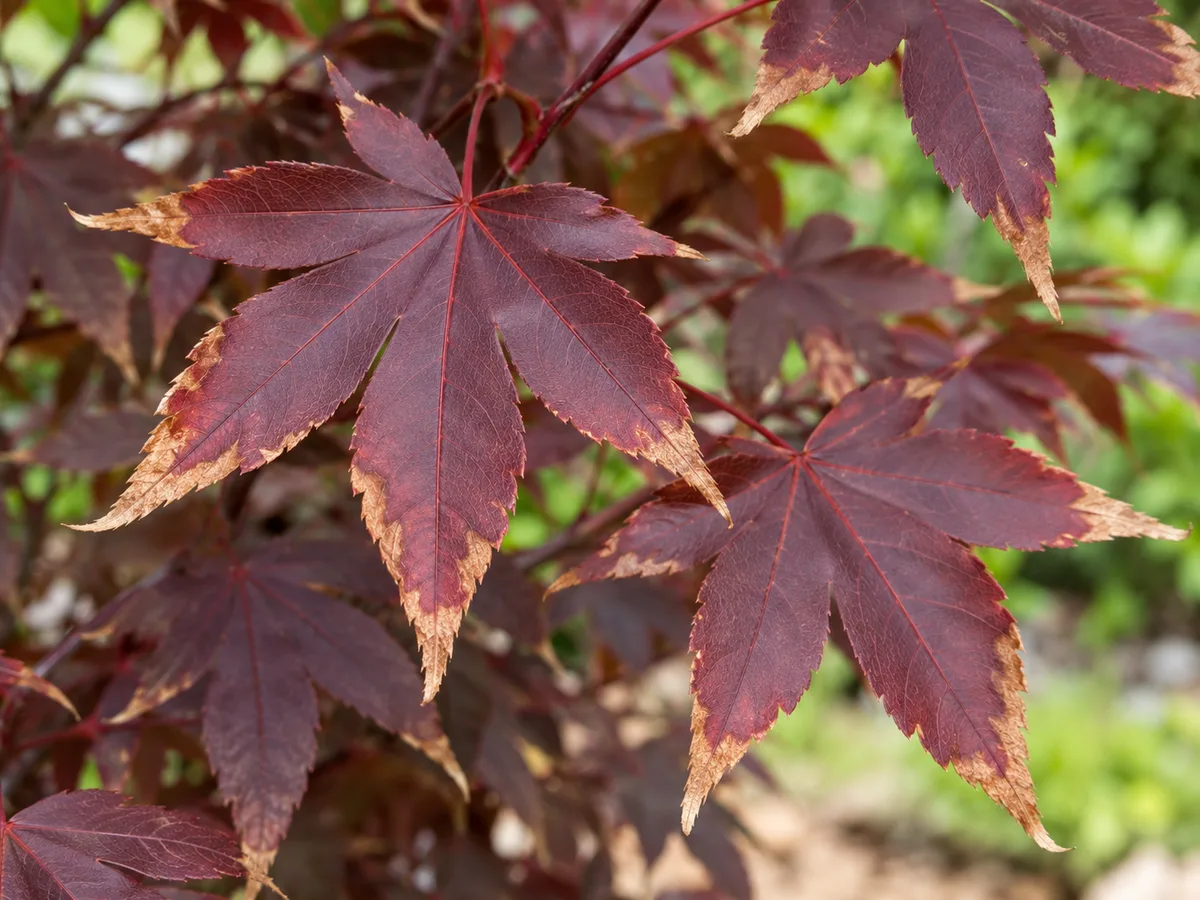
Use the pattern to decide what to do first. Crisp edges on the sunward side suggest exposure or water stress; sudden blackened new leaves after a cold night suggest frost; scattered spots or lesions spreading over time may point to disease; stippling, curling, sticky residue, or visible insects suggest a pest. Correct the site or watering problem before applying a pesticide or fungicide, and remember scorched tissue will not turn green again—the useful measure is whether new growth emerges healthy.
Aphids, scale, caterpillars, and maple gall mites can affect Japanese maples, but a few insects or cosmetic galls do not automatically justify treatment. Inspect the undersides of leaves and young stems, identify the pest, and use local extension guidance before selecting a control; avoid broad-spectrum sprays that can harm beneficial insects. For branch dieback, persistent one-sided wilt, or decline despite reasonable moisture and drainage, ask an extension office or arborist to diagnose the tree before pruning or treating it.
Propagation: why grafted trees are the usual choice
If you want another plant that looks like Crimson Queen, buy a named, grafted tree or learn grafting from an experienced propagator. A seedling from its samaras may have attractive leaves, but sexual reproduction reshuffles traits; it will not reliably keep the parent’s red color, finely divided leaves, mature size, or cascading habit. The University of Connecticut’s plant database notes that Japanese maple cultivars are generally grafted, and specialist growers interviewed by Joe Gardener describe grafting as a way to preserve known cultivar traits on a selected rootstock.
Softwood cuttings are another possibility, but success is variable and young maples can be slow to root. The RHS lists grafting and softwood cuttings as propagation methods for the cultivar, and Savvy Gardening’s propagation overview explains the extra control needed to maintain humidity and avoid rot. If you experiment, take healthy current-season growth in late spring or early summer, use a clean blade and sterile, airy medium, and keep the cutting humid in bright indirect light; do not assume it has rooted until it resists a gentle tug and begins new growth.
Keep any rooted cutting protected while it builds a substantial root system. A rooted twig is not ready for a harsh exposed site, and seed-grown plants should be labeled as Japanese maple seedlings rather than sold or shared as Crimson Queen. For a reliable landscape specimen, the cost of a correctly labeled grafted plant often saves years of uncertainty.
Design around the mature silhouette
Give the canopy room to spread so its arching branches can be seen from a path, patio, or window. A Crimson Queen works as a focal point in a small courtyard, at the edge of a woodland bed, or above a low groundcover; a gently raised bank or the margin of a water feature can make the cascading shape easier to appreciate, as long as the roots do not sit in saturated soil. Do not plant it where a future fence, roof, or walkway will force repeated hard pruning.
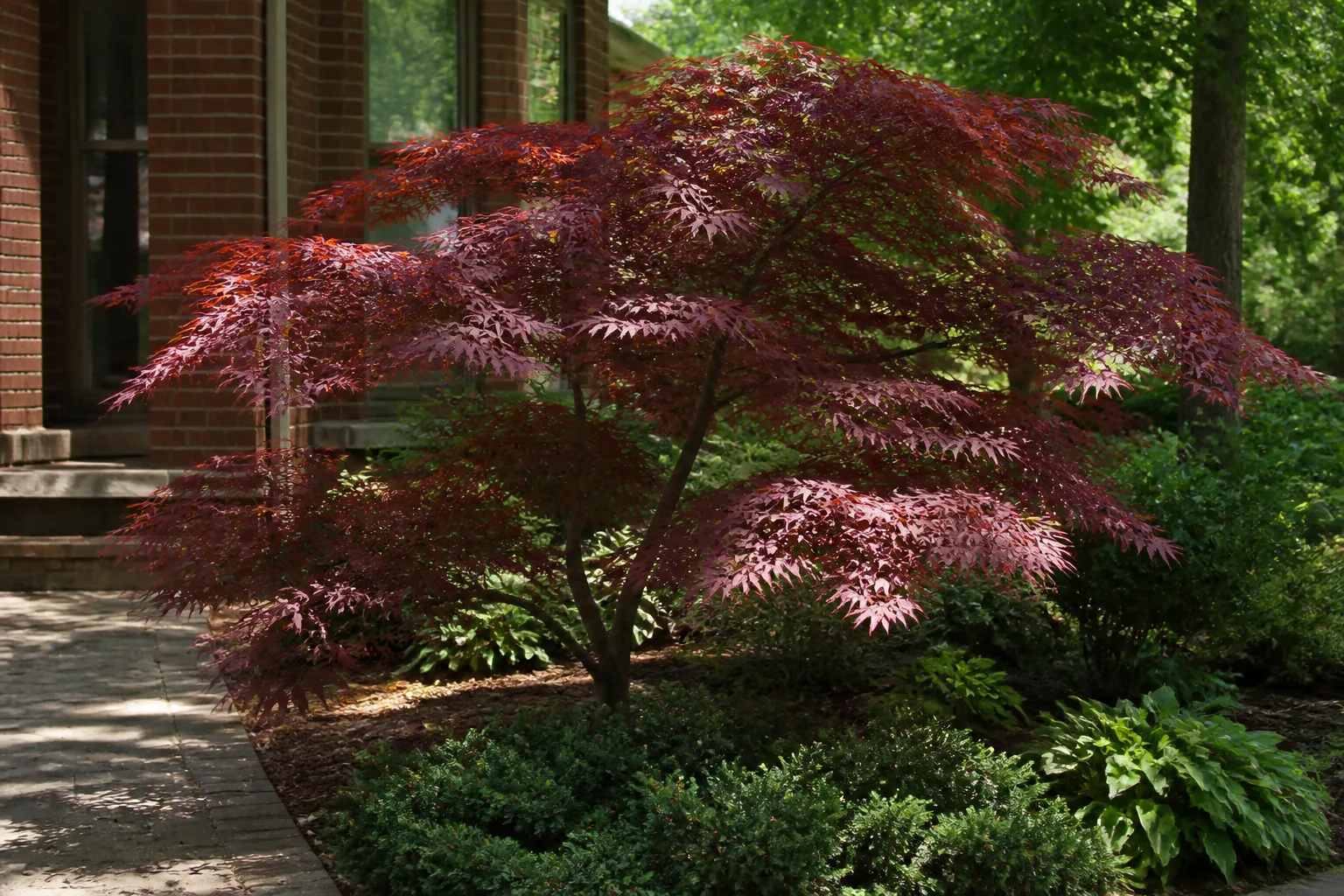
Underplant with shade-tolerant, non-aggressive companions such as ferns, sedges, hellebores, or low groundcovers that do not require frequent digging. Keep a mulch ring around the trunk and avoid turning the root zone into a high-maintenance annual bed; repeated cultivation can damage shallow feeder roots. In a container, leave enough visible space around the trunk and canopy to show the plant’s layered structure rather than crowding the pot with thirsty companions.
Avoid the mistakes that set young trees back
The most common setback is planting for the leaf color on the nursery tag without checking afternoon heat and wind. If you are choosing between a sunny, dry site and a slightly shadier, evenly moist one, the second is often the safer choice for the fine foliage; a healthy plant in a good microclimate is more valuable than a theoretical maximum-sun exposure.
Other avoidable errors include burying the root flare, keeping the root zone constantly wet, fertilizing at planting, pruning the crown into a lollipop, and assuming that a compact nursery tree will stay small. Do not respond to every brown leaf with more water: first check whether the soil is dry, saturated, or simply exposed to hot wind. That one check prevents both drought stress and root suffocation.
Finally, do not expect a potted maple to overwinter like a houseplant or assume that a seedling will be an exact Crimson Queen. The first needs a cold dormant period with its roots protected; the second can be a good tree but may have different foliage and form. Match the care to the plant you actually have.
A practical seasonal care checklist
Spring: Check for winter-damaged wood and wait until frost-damaged growth is easy to distinguish from living buds. Replenish mulch without covering the trunk, confirm that drainage remains open, and apply fertilizer only if a soil test or clear growth issue supports it. Watch for a late frost when leaves are emerging.
Summer: Inspect moisture during heat and wind, especially in the first year and in containers. Water at the root zone when the soil begins to dry, and note which sides of the canopy scorch; that pattern can reveal whether the tree needs more afternoon protection. Check leaves and stems for pests before choosing any treatment.
Autumn: Enjoy the foliage transition, clear fallen leaves if disease was present, and water an in-ground tree during an unusually dry fall before the soil freezes. This is a good time to assess the canopy and plan selective dormant pruning rather than making large cuts in response to summer scorch.
Winter: Keep containers insulated and dormant, maintain a windbreak for exposed young trees, and avoid heavy pruning during severe cold. In late winter, protect swelling buds from a forecast hard frost; resume regular moisture checks as the ground thaws.
Conclusion
Crimson Queen is a strong choice when you can give a slow-growing, wide laceleaf maple a sheltered spot with moist but well-drained soil and enough room for its branches to cascade. Its mature dimensions are substantial for a small garden, so measure the planting area before buying and decide whether a protected bed or a container is the better fit.
After planting, use the soil—not a calendar—to guide watering, mulch broadly but keep it off the trunk, and feed only when evidence says the tree needs it. Prune lightly to preserve its natural outline, protect container roots through winter, and diagnose browning by checking exposure, moisture, frost, and pests before reaching for a treatment. Those few decisions do more for long-term color and form than a complicated maintenance routine.



