How to Choose the Right Flower Fertilizer for Your Garden
Choose flower fertilizer by plant, soil-test results, and growing setup. Compare NPK labels, liquid and slow-release forms, and when feeding is unnecessary.

The fertilizer labeled for flowers is not automatically the right one for your garden. A useful choice depends on what is already in the soil or potting mix, what kind of flowering plant you are growing, and whether you need a measured quick feed or a slower supply. A high-phosphorus “bloom booster” can be a poor buy when phosphorus is already adequate, while a general-purpose product may be perfectly reasonable when its analysis and application rate match the plant’s needs.
Use this order: identify the plant and its setting, check fertility before adding nutrients, compare the fertilizer label with the recommendation, then choose a form you can apply correctly. If the plant is healthy and growing in fertile soil, the right fertilizer may be no fertilizer at all.
Begin with the flower, soil, and growing setup
Before you compare bags and bottles, name the plant group and where it grows. A fast-growing annual in a small hanging basket, an established peony in a border, a rose in a raised bed, and a native wildflower patch do not share one feeding schedule. Their root volumes, growth rates, water losses, and tolerance for extra nutrients are different.
Next, look at the growing medium. Garden soil can hold a history of compost, manure, lime, and prior fertilizers; a container may have fresh potting mix with a starter charge or controlled-release prills already mixed in. If you feed without counting those inputs, you can stack nutrients even when every individual product is used as directed.
Finally, ask whether there is evidence of a nutrient problem. Sparse flowers alone do not prove that a plant needs fertilizer. Check whether it receives the light its tag recommends, whether the root zone drains, whether recent pruning removed flower buds, and whether it is still establishing or dormant. Poor flowering can come from those conditions, and extra fertilizer will not correct them.
Read a soil test before buying a formula
For an established flower bed, a soil test is a better starting point than choosing a ratio from the front of a package. A lab can assess pH and the nutrients it reports, then provide a recommendation suited to a sampled area. The University of Massachusetts Amherst’s flower-garden guidance recommends using soil-test information to guide garden fertilizing, while University of Georgia Extension’s home-garden soil-testing guide explains how to collect a representative sample and use the lab report.
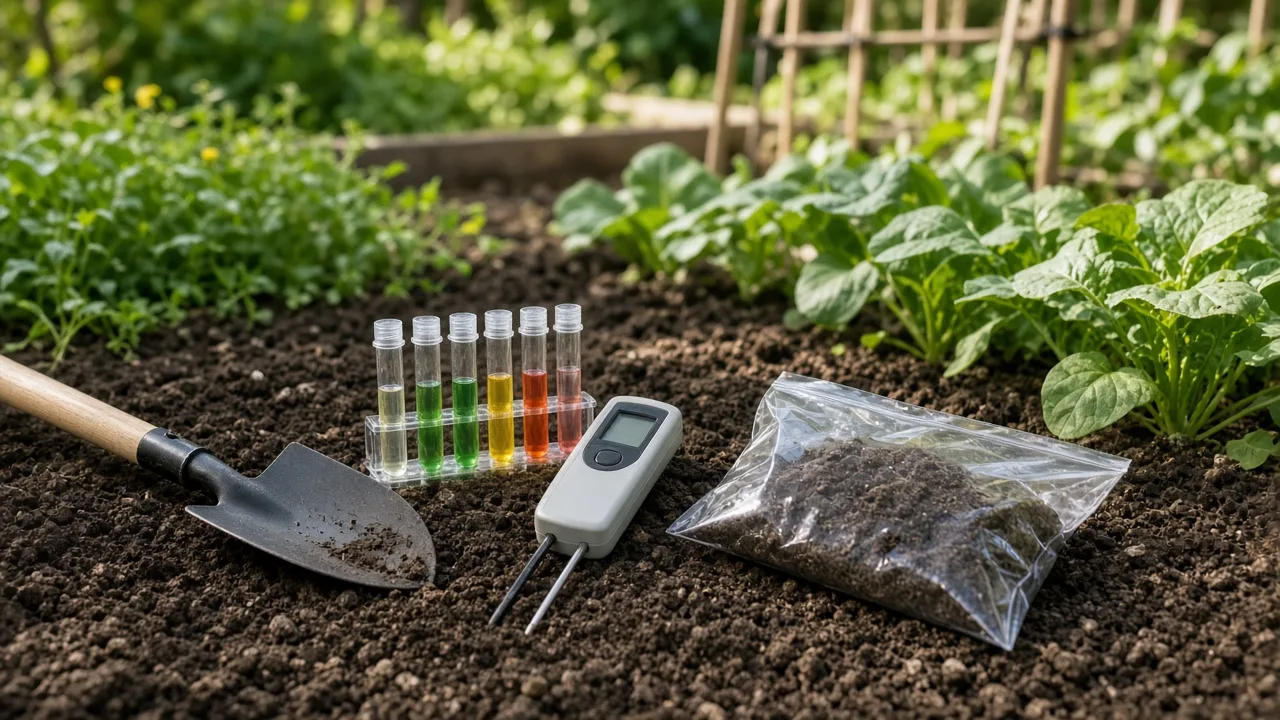
Keep unlike spaces separate when sampling. A sunny border, a new raised bed filled with purchased mix, and a shaded area amended with years of compost may need different recommendations; combining them into one sample blurs the result. Follow the local lab’s instructions for depth, number of cores, and timing, and tell it that the area is an ornamental flower garden rather than a lawn or vegetable plot if it asks.
Do not assume every garden test gives a precise seasonal nitrogen forecast. Nitrogen changes form and moves through soil, so local labs may base their recommendations on crop type, history, and other reported results rather than one universal nitrogen number. If the report says phosphorus is already high, another phosphate-heavy formula is unlikely to be the answer to weak flowering. Penn State Extension’s phosphorus guidance explains why soil testing and careful application matter: phosphorus can accumulate and can move off a site with eroded soil or runoff.
If you do not have a recent test, avoid applying several products while you wait. Track what you add, use a conservative label-compliant approach only when a plant or growing mix calls for it, and schedule a lab test before making repeated amendments. A soil report is particularly useful for beds that have received manure, compost, bone meal, or bloom fertilizer year after year.
Decode the label without falling for “bloom booster”
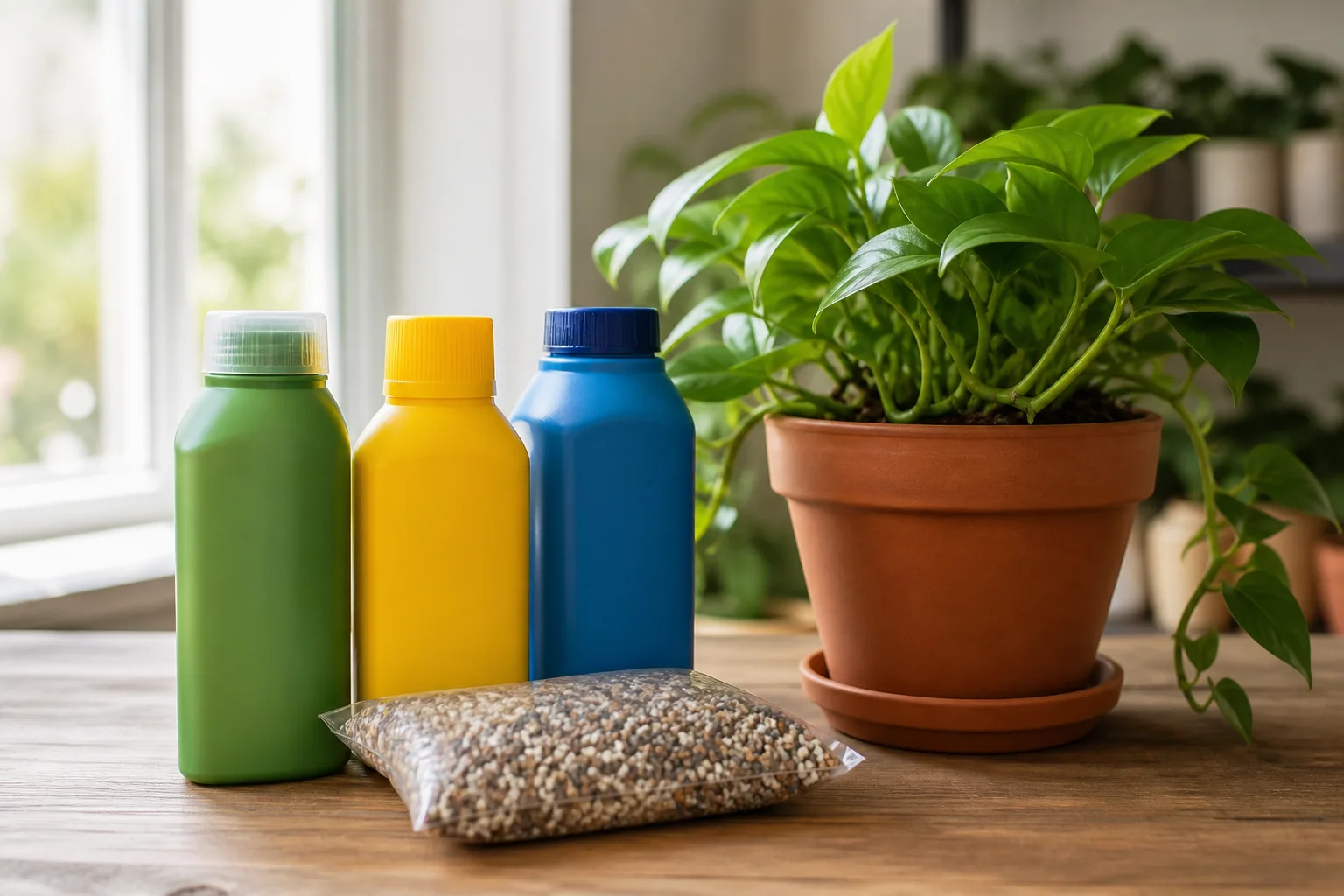
The guaranteed analysis tells you what nutrients a fertilizer supplies. On U.S. labels, the familiar three numbers represent total nitrogen, available phosphate expressed as P₂O₅, and soluble potash expressed as K₂O, in that order. They are percentages by weight, not a score of how effective the fertilizer is. A 10-10-10 product contains a different concentration from a 4-4-4 product even though the nutrient ratio is the same.
Also separate “complete” from “balanced.” A complete fertilizer contains all three primary nutrients; a balanced fertilizer has them in equal or similar proportions. A product can be complete without being balanced, and neither label guarantees that a flower bed needs all three nutrients. The Royal Horticultural Society’s guide to fertilizer labels offers a useful primer on interpreting analyses and product directions; for a deeper explanation of the three numbers, see our fertilizer label guide.
What N-P-K can—and cannot—tell you
Nitrogen supports leafy growth and the proteins and chlorophyll plants use. Phosphorus is involved in energy transfer and supports root development and reproduction; potassium supports a range of functions, including water regulation. Flowers need these nutrients in appropriate amounts, but that does not mean that increasing the middle number will trigger more buds. It means the plant needs access to a sufficient supply without excess.
“Bloom booster” is a marketing phrase, not a soil diagnosis. A high-phosphorus ratio makes sense only in a situation where the plant’s needs, the growing medium, and the product label call for that nutrient profile. If a bed already has adequate phosphorus, choosing a formula with an even higher middle number may add cost without helping the plant and can raise environmental concerns. Oregon State University Extension’s fertilizer-selection guidance emphasizes matching the product to soil and plant requirements instead of treating the highest analysis as the best.
The label is also not a complete description of a fertilizer’s behavior. It may show secondary nutrients or micronutrients, but it does not tell you whether a plant lacks them, how quickly an organic ingredient will mineralize in your particular soil, or whether a potting mix already contains a controlled-release charge. Compare the guaranteed analysis with the test report and the entire label, not a single large number on the front.
When one nutrient or a micronutrient makes sense
A single-nutrient product can be useful when a soil test identifies a specific need and a local recommendation calls for it. That is a more controlled option than supplying nitrogen, phosphorus, and potassium together when only one is needed. It still has to be measured and applied according to the label; a product with one main nutrient can be concentrated.
Micronutrients call for even more caution. Yellow leaves, weak stems, or poor growth can result from watering, root injury, unsuitable pH, pests, or nutrient availability—not just a shortage of iron or another trace element. Ask the lab or local Extension office to interpret the test before choosing a micronutrient blend or spraying leaves. A foliar product can be useful in specific documented situations, but it is not a replacement for a sound root system or a complete long-term fertility plan.
Match fertilizer to the flowers you grow
The species and setting narrow the choices. Use a product explicitly labeled for the plant or use site, then apply the rate for that label’s particular situation; a planting-hole direction is not interchangeable with a side-dress direction, and a container dilution is not a bed rate. When a general flower fertilizer and a plant-specific recommendation conflict, follow the plant’s local guidance and product label.
Annuals in beds and containers
Annuals can make rapid growth and repeat flowers over a long season, but their feeding needs depend on how they are planted. In-ground annuals share a larger soil reservoir and may need little added fertilizer if a soil test shows adequate nutrients. A container annual has a limited volume of mix, and frequent watering can carry soluble nutrients out through the drainage holes; it may therefore need a consistent, label-directed feeding plan while it is actively growing.
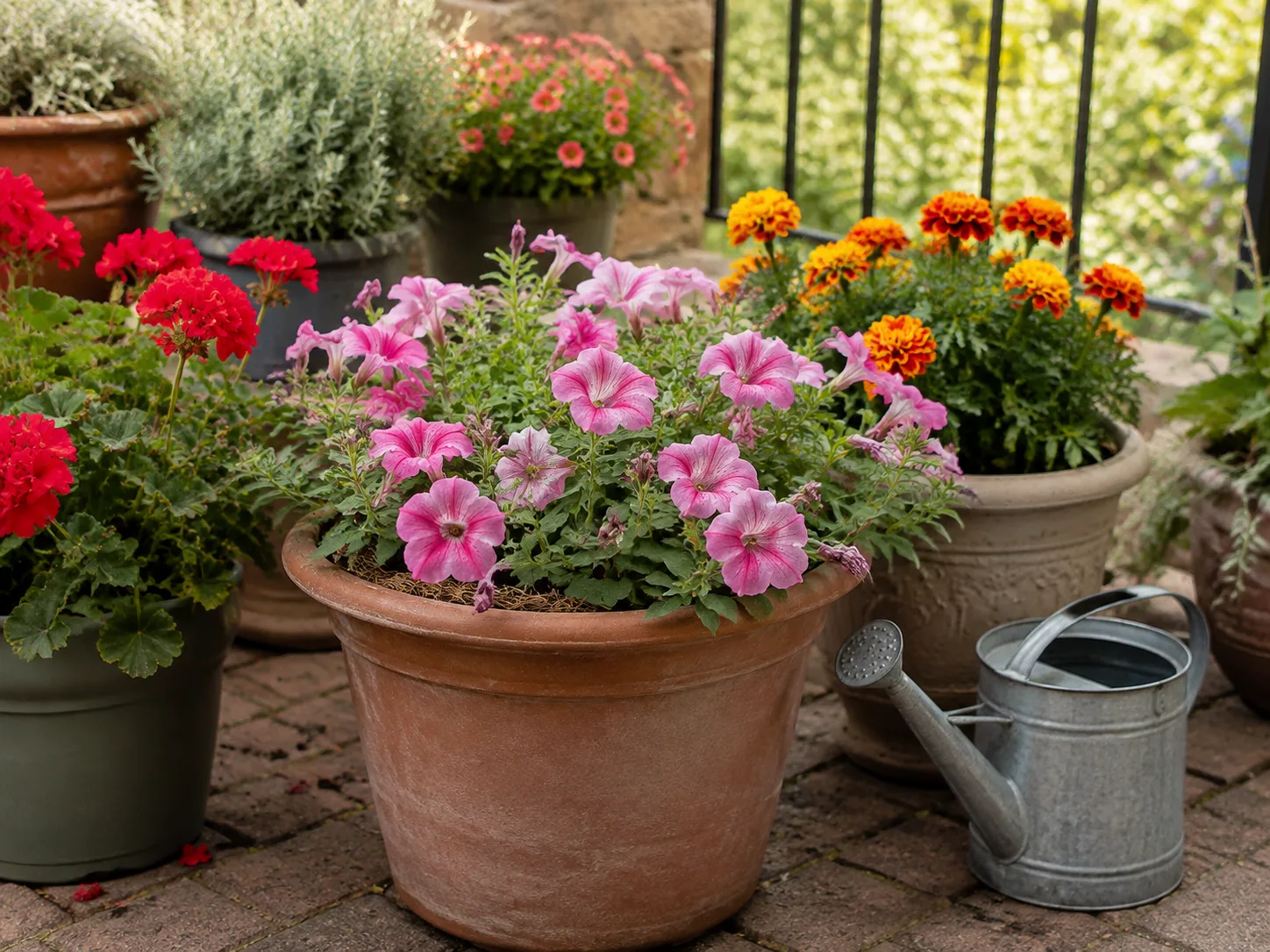
Before adding anything, inspect the potting-mix bag or the plant’s label. Some mixes include a starter fertilizer or controlled-release prills, so adding a second slow-release product at planting can duplicate the feed. For a container with no ongoing fertilizer charge, choose either a measured soluble product that you can apply as directed or a labeled controlled-release formula suited to flowering annuals. Bricks ’n Blooms’ practical guide to potted annuals also treats potting mix, container conditions, and feeding as a connected routine rather than a fertilizer-only fix.
If you grow a mixed pot, select for the hungriest plant only when the other plants can tolerate the same product and schedule. If their needs differ, separate them into containers; a fertilizer plan for a fast-growing petunia can be excessive for a slower-growing companion. Stop and reassess if growth becomes soft and leafy, the plant wilts despite moist mix, or fertilizer salts collect on the surface.
Established perennials and flowering shrubs
Established perennials often need less frequent fertilizing than container annuals because their roots explore a wider area and they are adapted to the local soil. A healthy plant that grows and flowers normally may not benefit from a routine spring dose. If a test recommends nutrients, use the report’s rate and timing; if the plant is weak, first rule out crowding, shade, drought, poor drainage, disease, or age.
Shrubs have plant-specific timing and pruning rules. A rhododendron or hydrangea may respond poorly to a generic schedule that suits a summer annual, while an established rose or summer-flowering shrub may have a specific local recommendation. For example, the time to feed a shrub does not override the need to prune it at the right point in its flower-bud cycle. For hydrangeas, use the species-specific advice in our hydrangea fertilizing timing guide, and avoid trying to solve a lack of flowers with extra fertilizer before checking light and pruning.
Roses, acid-loving plants, and bulbs
Roses are not a reason to ignore the soil test. Choose a rose-labeled fertilizer if its analysis and directions fit the bed or container, but do not assume that a “rose food” is needed every month or that every rose wants the same dose. UMass Amherst’s flower-garden guidance is a useful baseline for test-led bed feeding; for rose-specific timing and pruning context, check local Extension recommendations for your climate.
Acid-loving shrubs such as azaleas and some hydrangeas need suitable soil conditions, but an “acid-loving plant” fertilizer is not a universal cure for yellow leaves or poor bloom. Soil pH affects nutrient availability, and the flower color of some bigleaf hydrangeas is also linked to aluminum availability and soil conditions, not simply to a high-phosphorus or high-potassium fertilizer. Test pH before applying an acidifying product, and use a plant-specific source when the label and local guidance support it.
Bulbs are also stage-specific. A spring bulb that is flowering or going dormant should not receive an arbitrary dose just because its blooms have faded; leave healthy foliage in place until it yellows naturally so the bulb can replenish reserves. At planting or during active growth, use a bulb product only if its label and a soil recommendation suit that stage and location. Do not put concentrated fertilizer directly against a bulb or its new roots unless its directions explicitly instruct you to.
Native flowers and low-input plantings
Native wildflowers and other low-input plants are often selected because they can grow with limited supplemental feeding once established. Rich soil or repeated high-nitrogen fertilizer may push foliage at the expense of sturdy stems, and the added nutrients can favor vigorous plants that crowd slower-growing species. That does not mean every native planting must be nutrient-poor; it means you should follow the species’ site needs and test rather than fertilize from habit.
For a recently prepared bed, focus first on appropriate soil structure, sunlight, drainage, and the moisture regime the seed mix or transplants require. Some prairie or meadow species perform better without a routine fertilizer program, while disturbed or unusually depleted soil can call for a targeted correction. A locally adapted seed mix, Extension office, or restoration guide is more useful than a broad “flowering plant” label.
Choose a release type you can use consistently
Fertilizer form determines how you measure it and how nutrients reach the roots; it does not tell you whether the nutrients are needed. Think of the options as different delivery schedules. Pick a product whose label fits the growing site and whose application you can repeat accurately, rather than buying multiple types to cover every possibility.

Slow-release granules and coated products
Dry granules are straightforward to measure over a bed or around a larger planting. Some are readily soluble once watered in; others contain coated or otherwise controlled-release nutrients intended to become available gradually. Release depends on the product design and conditions such as moisture and temperature, so use the manufacturer’s stated duration as a planning guide, not a promise that every garden will receive the same dose on the same calendar.
Slow-release products can suit outdoor containers when watering is frequent and a consistent supply is helpful. They can also be convenient when you prefer fewer applications. Their trade-off is less day-to-day control: once mixed into a pot or soil, coated prills cannot be removed easily if you later discover that the plant or mix already had fertilizer. UF/IFAS’s overview of controlled-release and slow-release fertilizers explains why coating and release characteristics matter to nutrient-management decisions.
Spikes and concentrated tablets require careful placement and label matching. A point-source product can leave nutrients concentrated in a small area rather than distributed through the root zone. Do not push a spike next to a stem simply because the pot or shrub has a convenient spot for it; use it only where the label describes that plant and growing setup.
Water-soluble liquids
A water-soluble concentrate or powder lets you control the dose and distribute it with watering. That can be useful for actively growing plants in pots, where the medium has little reserve and the gardener is already irrigating regularly. The same convenience can become a drawback if you forget to measure, make the solution stronger, or feed on every watering without checking the label.
Liquids are not automatically a better emergency treatment. A plant with drought-damaged, waterlogged, diseased, or newly disturbed roots may not take up nutrients normally; adding a concentrate can further stress it. Rehydrate a dry pot with plain water, let an actively growing plant stabilize, then use a diluted product only at the specified rate and interval. Avoid spilling solution onto paving or applying ahead of heavy rain, when nutrients can leave the garden instead of reaching roots.
Organic, synthetic, and blended sources
“Organic” describes a source or production claim, not a guaranteed release time or an exemption from careful use. Compost and many meal-based fertilizers depend on soil organisms to release at least part of their nutrients, so their availability can vary with temperature, moisture, and the material itself. Other organic products are sold as liquids and may act more quickly; read their analysis rather than assuming all organic feeds work alike. Fine Gardening’s overview of organic fertilizer sources is useful for comparing how different materials supply nutrients.
Synthetic or mineral fertilizers can provide a clearly labeled analysis and may be available in fast-acting or controlled-release forms. That makes them convenient when the plant and test call for a predictable dose, but a concentrated product is easy to overapply. Organic, synthetic, and blended products can all supply useful nutrients; each can also be a poor choice if its analysis adds more than the plant or site needs. Oregon State Extension’s overview of chemical and organic fertilizers discusses the differences without treating one category as universally superior.
Fish emulsion, compost, manure-based products, and plant meals should be evaluated by their label, nutrient analysis, intended use, and how they fit with the existing fertility plan. Compost can improve soil organic matter, but it is not a precisely measured substitute for a test-based fertilizer recommendation. If animal-derived meals are used, store them securely and follow the label’s pet and wildlife precautions; “natural” does not mean every product is harmless when eaten.
Adjust the choice for season and location
Feed when the plant can use nutrients: generally during active growth and according to its own seasonal cycle. A spring application may fit one perennial, while a container annual may need smaller label-directed feeds during a long period of active flowering. There is no universal “once a week” or “every month” schedule for all flowers, because product concentration, plant type, pot volume, irrigation, temperature, and existing nutrients change the math.
Do not fertilize a dormant plant or treat a freeze-stressed, drought-stressed, or waterlogged plant as hungry. In hot weather, water and root health come before fertilizer; dry soil can concentrate salts around roots, while saturated soil limits their oxygen. If temperatures or short days slow growth, continuing a full-season feeding rate can add nutrients the plant is no longer using.
Local conditions change which recommendation applies. Soil texture, rainfall, irrigation, growing season, and regional rules all affect application and runoff risk. The USDA Fertilizer Recommendation Support Tool describes its soil-test interpretations as a supplement to, not a replacement for, state recommendation systems; for a home flower bed, use your local lab’s guidance rather than borrowing a rate from a different state or crop.
Apply the fertilizer without wasting it
Measure the bed or container, read the complete label, and calculate the amount for that exact area or use. If the recommendation gives nutrient mass per square foot or per 1,000 square feet, convert it to product using the fertilizer’s analysis; do not treat a tablespoon-per-pot direction as equivalent to a rate per garden bed. For an existing container, account for fertilizer already mixed into the medium before adding another source.
Apply granular products evenly across the indicated root zone and keep them off foliage, flowers, stems, and crowns unless the instructions say otherwise. Water in only as directed; a controlled-release product may have different incorporation instructions from a soluble feed. For liquid products, measure the concentrate into the prescribed amount of water and use a dedicated measure rather than estimating by eye.
Timing matters for water quality as well as plant uptake. Keep fertilizer off sidewalks, driveways, and storm drains; sweep up spilled granules instead of washing them into the street. Do not fertilize before intense rain or on frozen, saturated ground. If the label calls for watering after application, use enough to move product into the root zone without creating runoff.
Keep a short record of the plant group, product, analysis, amount, date, and any compost or soil amendment applied. That makes it easier to notice if a plant received overlapping feeds and gives a soil-testing lab a more useful history. It also prevents the common midsummer mistake of repeating a dose because the previous application was forgotten.
Reassess if the bloom problem remains
If a plant has plenty of leaves but few flowers, stop before reaching for a higher middle number. Too much nitrogen can favor leafy growth; too little direct light, pruning at the wrong time, a young plant that has not matured, excessive shade from neighbors, or a natural seasonal pause can also explain the gap. Correct the factor you can verify first and wait for new growth before changing fertilizer.
Yellowing leaves are not a diagnosis either. Check whether older or newer leaves are affected, whether soil stays wet, whether roots are crowded, and whether symptoms follow a specific part of the bed. A soil test can identify some nutrient or pH issues, but it cannot repair poor drainage or root damage. Avoid adding iron, Epsom salt, bone meal, or a “complete” blend based on a single visual clue.
Brown margins, a white crust on potting mix, sudden wilting after feeding, or scorched leaves can point to fertilizer salts or an application error, though water quality and root problems can look similar. Stop feeding, remove visible granules if you can do so without damaging roots, and check the label. For a freely draining pot, plain water may help move soluble salts through the medium, but do not flood a plant in a container that drains poorly. If symptoms continue, contact a local Extension service or diagnostic lab before applying a corrective product.
Conclusion: choose for need, not the label
The right flower fertilizer is the one whose analysis, release form, label directions, and timing fit the plant and its growing medium. Start with the plant and soil test, count what has already been added, and ignore “bloom booster” claims that are not supported by a real nutrient need. A liquid feed can offer control, a slow-release product can reduce how often you apply, and an organic source can fit a soil-building plan, but none is automatically best for every bed.
If the plant is healthy and the soil is already fertile, skip the extra dose. When there is a confirmed need, apply one suitable fertilizer at the labeled rate, keep a record, and judge the result from new growth rather than from the promise on the package.



