How to Grow and Care for a Butternut Tree
Butternut trees offer edible nuts and wildlife value, but canker changes the planting decision. Get practical site, water, pruning, and monitoring advice.
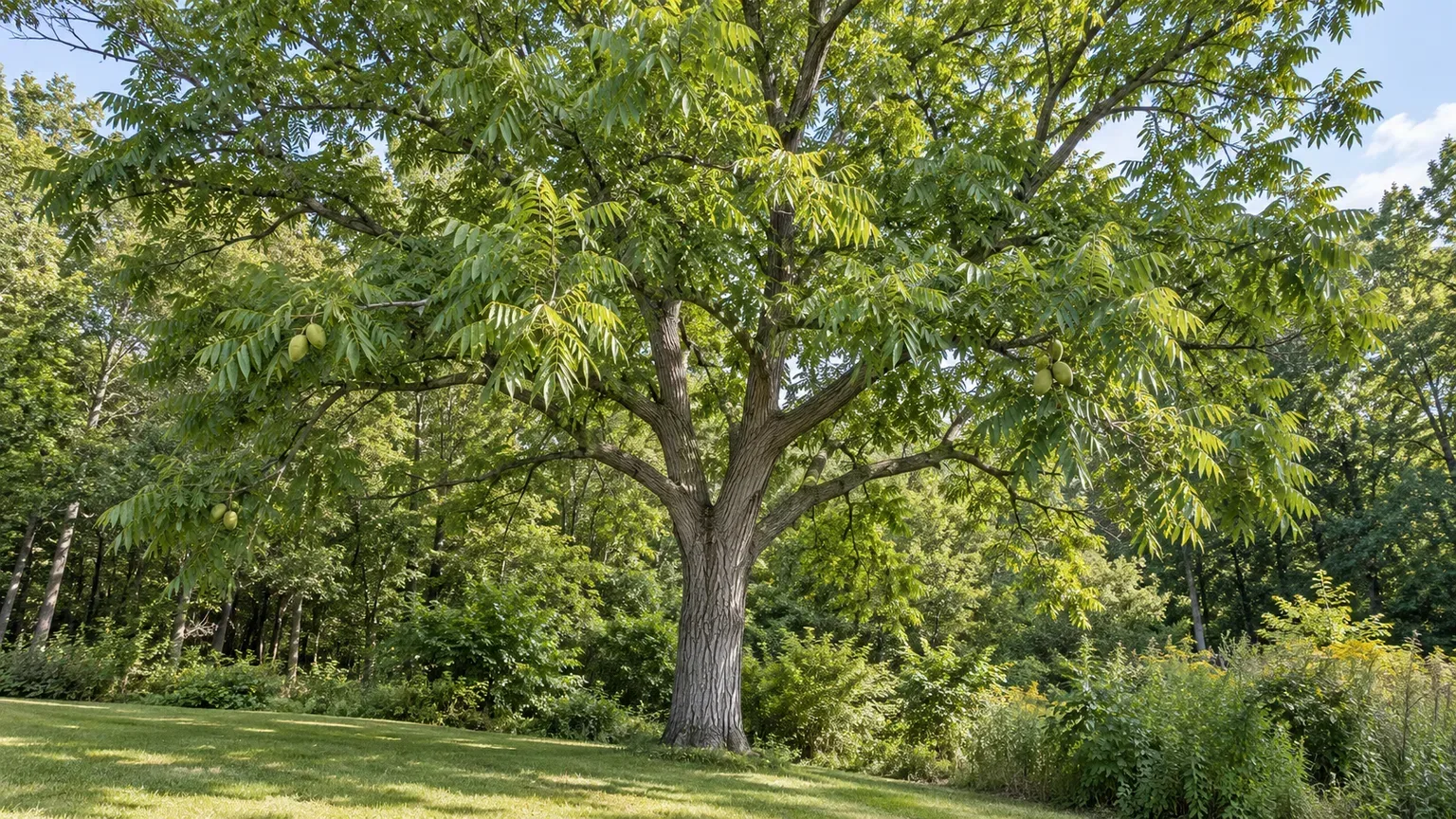
Butternut (Juglans cinerea), also called white walnut, is a large eastern North American tree with a broad crown, aromatic compound leaves, and sweet, oily nuts. It can be an excellent fit for a spacious property, a nut planting, or a well-planned native-tree restoration project. It can also be the wrong tree for a small yard or a place where you need dependable, low-risk shade: butternut canker has devastated native populations, and no ordinary care routine can make a susceptible tree immune.
Before you buy, settle the main question: what is your goal? If you want a pure native species for conservation, source it through a reputable restoration or forestry program that can document identity. If your priority is nuts, ask a knowledgeable nursery about its selection, pollen compatibility, and evidence behind any resistance claims. If you need a long-lived ornamental that will not complicate a vegetable garden, choose a different tree. Butternut can reach roughly 40 to 60 feet in both height and spread, and it is difficult to transplant once established. (North Carolina State Extension; Morton Arboretum)
Decide whether a butternut belongs in your yard
Butternut is best treated as a long-term tree and a deliberate planting choice, not a quick landscape accent. Its open, spreading canopy provides shade and habitat, while its nuts feed people and wildlife. The same traits bring practical costs: fallen leaves and nuts need cleanup, the crown needs room, and roots can conflict with plants that are sensitive to juglone, a chemical associated with walnut-family trees.
The larger cost is uncertainty around canker. The fungal pathogen has caused severe declines across the species’ native range; an otherwise healthy young tree may still become infected years after planting. The Morton Arboretum advises against planting butternut in its native range because the disease is widespread there, while forestry and restoration sources discuss planting as part of efforts to conserve the species and identify more tolerant trees. Those positions address different goals. A homeowner choosing a decorative shade tree can reasonably select a less vulnerable species; a landowner working with a restoration program may decide that planting documented native stock is worthwhile despite the risk. (Morton Arboretum; USDA Forest Service)
Think through the whole site before ordering. Can you leave at least a 40-foot-wide mature-tree footprint, with additional clearance from buildings, pavement, overhead wires, septic infrastructure, and frequently cultivated beds? Can you water during dry spells for the first few summers? Are you willing to inspect the trunk and main branches each year? If any answer is no, a smaller or less disease-prone tree will usually serve you better.
Butternut is not a container tree. Its eventual size and strong rooting habit make a pot a temporary nursery stop at most, not a long-term growing plan. A small sapling may look manageable now, but selecting a tree for its mature dimensions prevents the expensive mistake of placing it too close to a house or garden.
Identify a healthy, correctly labeled tree
A true butternut has long pinnate leaves, usually 10 to 20 inches long, with roughly 11 to 19 toothed leaflets and a terminal leaflet. The leaflets are narrower and more lance-shaped than those of black walnut, and the fruit is an elongated or oval husk rather than the rounder fruit of its relative. The gray bark becomes more furrowed with age. A leaf or fruit can help with identification, but no single trait should settle a high-stakes identification when a protected or rare tree may be involved. (North Carolina State Extension; Morton Arboretum)
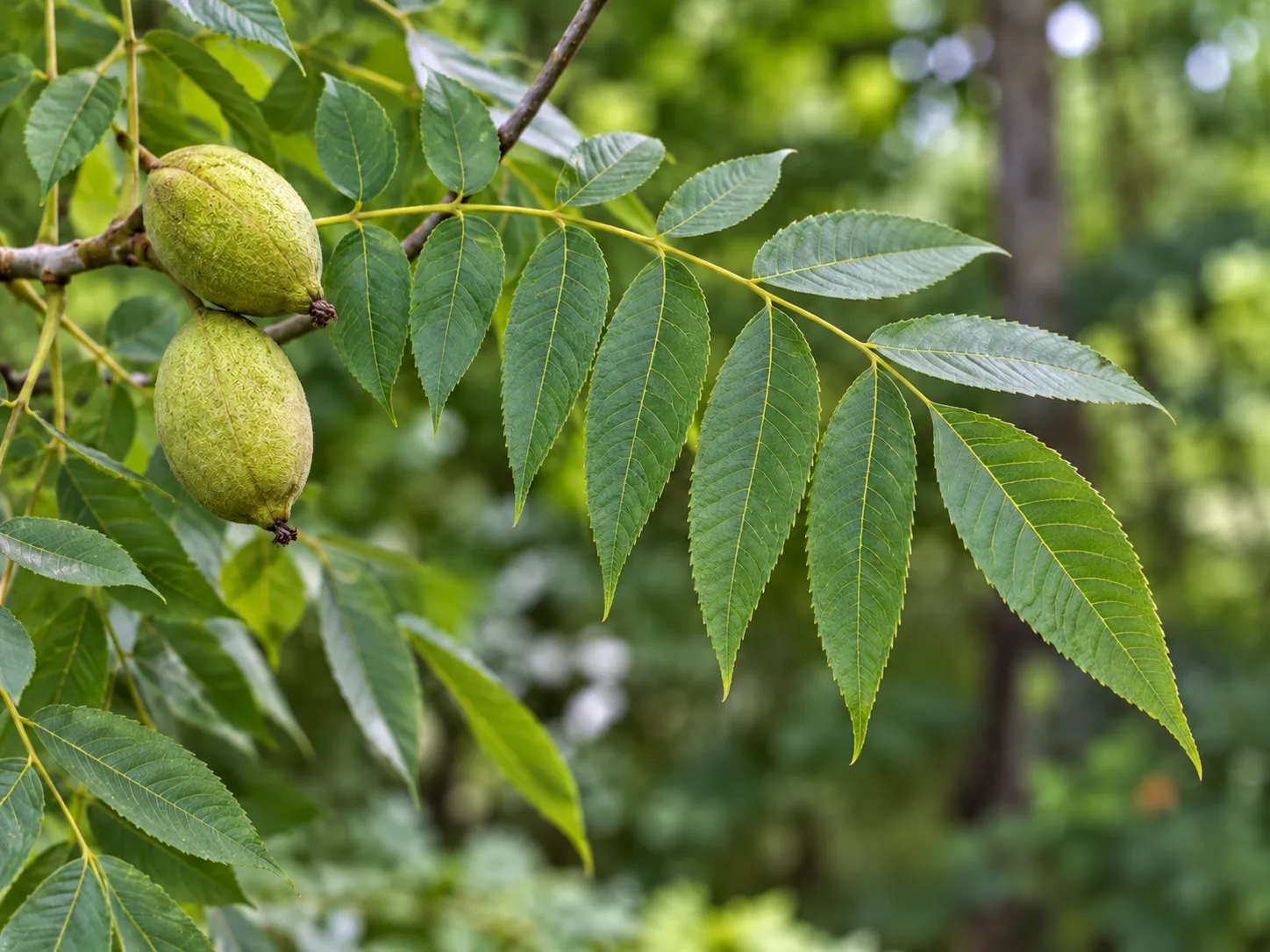
Check the nursery label carefully. Butternuts hybridize with other walnuts, particularly Japanese walnut, and some trees sold or casually described as butternuts may be hybrids known as buartnuts. A hybrid may be a reasonable choice for nut production, but it is not interchangeable with pure J. cinerea if your purpose is native-species conservation. Purdue Extension notes that hybrids are often more tolerant of canker and can bear heavily, but also cautions that hybrid stock can be mislabeled and that its ecological role is not identical to the native species. (Purdue Extension; USDA Forest Service)
Ask the seller to put the identity and propagation method in writing. Find out whether the tree is seed-grown, grafted, or a named hybrid; where the parent material came from; whether it has a compatible pollen source; and what specific evidence supports any claim of disease tolerance. “Canker resistant” without a named selection, trial history, or local performance record is not a guarantee. The research picture is still developing, and the USDA Forest Service reports that there is little evidence of moderate resistance in native butternut even as some Japanese-walnut hybrids show enough tolerance to persist and produce nuts. (USDA Forest Service)
For a native planting, work with your state forestry agency, extension service, native plant organization, or local recovery program rather than collecting nuts from a wild tree on your own. Rules vary by jurisdiction, and seed from an unknown tree may not be the right material for the conservation goal. If you are trying to identify an existing tree, have an extension educator or qualified arborist confirm it before pruning, moving, or removing it.
Choose a site for a full-size tree
Select a site with full sun and deep, fertile soil that holds moisture without staying waterlogged. Butternut occurs naturally in moist bottomlands, stream edges, and some well-drained slopes; it does not thrive when shaded or crowded by competing trees. The RHS describes it as a tree for deep, fertile soil and very large gardens or parks. Use these habitat cues as a starting point, then adapt them to your local rainfall and soil rather than trying to recreate a swamp. (North Carolina State Extension; Royal Horticultural Society)
Check drainage after a heavy rain. If water remains in the proposed planting hole area for much of a day, the site may be too poorly drained; if the soil becomes powder-dry quickly, plan on supplemental watering during establishment. A soil test is more useful than guessing at pH or adding lime, sulfur, compost, or fertilizer by habit. Avoid compacted construction fill and sites where grading has buried the existing topsoil.
Plan the canopy and root zone, not just the trunk location. Butternut can spread 40 to 60 feet, so keep it clear of overhead lines and give branches space to develop without constant cutting. Avoid planting it where its roots will have to compete with a vegetable garden, narrow foundation bed, or small paved courtyard. Root conflicts become harder to fix as the tree grows, and major root cutting can destabilize or stress a mature tree.
Make the location decision with canker in view. Isolation is not a dependable prevention strategy: spores spread by rain splash, while longer-distance movement by insects and birds is suspected, and even trees away from a natural stand can be exposed. Good air and light help support tree health, but spacing a butternut far from its neighbors does not make it disease-proof. (Purdue Extension)
Prepare the soil and plant correctly
Plant a nursery-grown tree while it is dormant and the ground is workable, commonly in early spring or fall in regions with mild autumns. Avoid planting into frozen, saturated, or drought-baked ground. Bare-root stock should be planted promptly after purchase; keep roots cool and moist until planting, and do not let them dry in the wind.
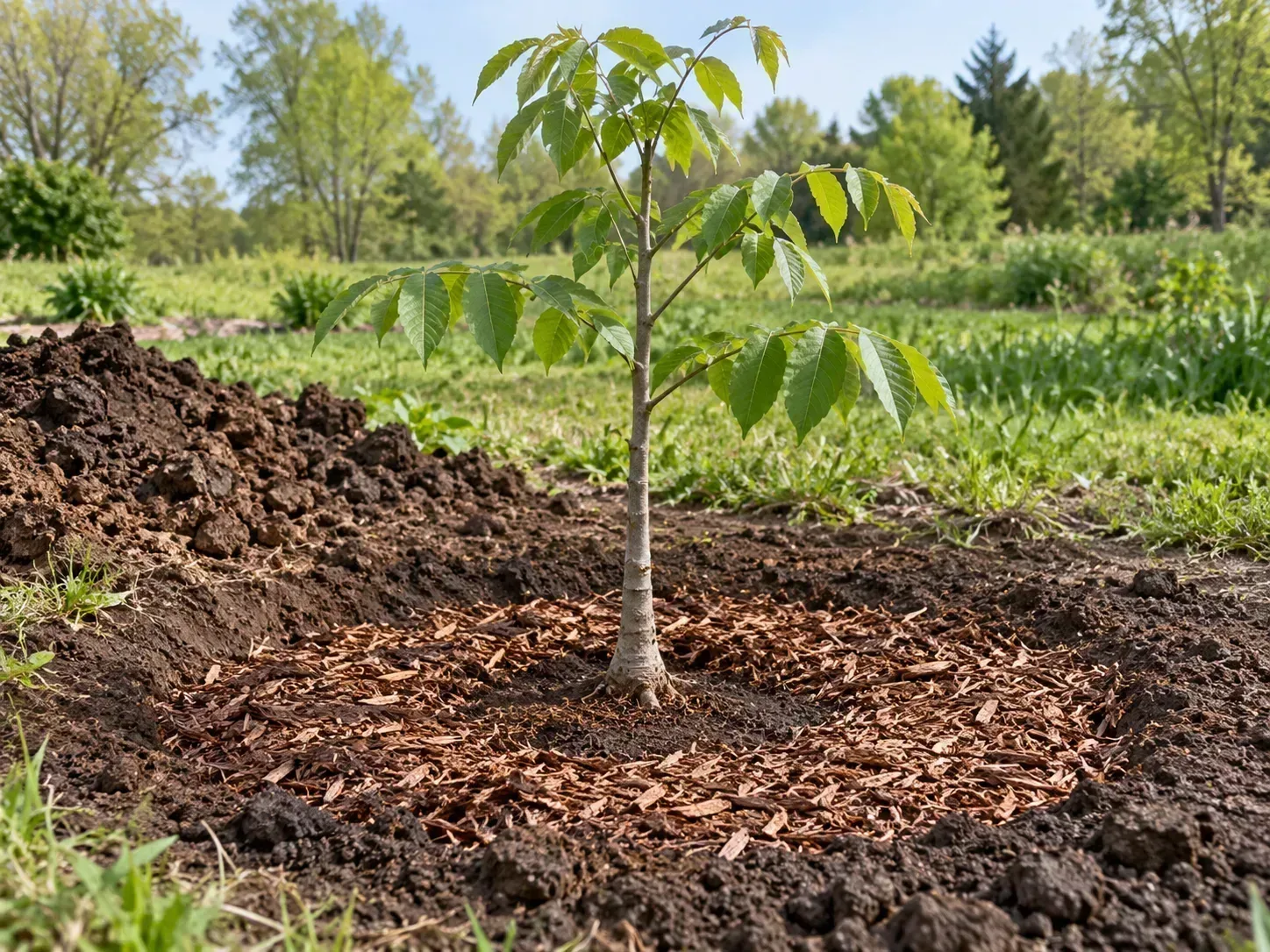
Dig a broad hole no deeper than the root system and several times wider than the root ball. Roughen glazed sides, remove grass and debris, and locate the root flare—the point where the trunk begins widening into the upper roots. Set that flare at or slightly above finished grade. Planting too deeply traps moisture against the trunk and can restrict oxygen to roots; a too-shallow tree can dry out or tip before it anchors.
For container stock, slide the root ball out and loosen circling roots. If the roots are tightly wound, correct them before planting rather than leaving the tree to grow in a spiral. For bare-root stock, spread roots outward and downward in their natural direction. Backfill with the native soil you removed; do not make a rich, sharply different “pot” in the hole, because roots need to move into the surrounding soil instead of lingering in an amended pocket.
Water slowly to settle soil around roots and close air gaps. Stake only if the tree cannot stand upright or the site is exposed to strong wind, and remove the support when the root ball is stable; a tree left tied tightly for years can be girdled. Spread a 2- to 3-inch layer of organic mulch over the root zone, extending outward as the tree grows, but keep mulch several inches away from the trunk. Do not pile mulch into a cone around the stem.
Water through establishment and dry spells
During the first growing season, check the root zone before watering rather than following a rigid calendar. Water deeply when the upper few inches of soil have dried, then let excess water drain. The aim is evenly moist soil around the young roots, not daily surface sprinkling or a permanently soggy planting hole.
In the second and third seasons, roots extend beyond the original root ball, so water a broader area and reduce frequency as the tree establishes. A slow trickle from a hose or a soaker hose can wet the root zone more thoroughly than a quick splash at the trunk. During hot, windy weather, check more often; during cool rainy weeks, skip irrigation if the soil is already moist.
Established butternuts can tolerate some drought, but prolonged dryness can reduce growth and nut development. If a young tree wilts in afternoon heat, check the soil before adding water: wilt in wet soil can signal root stress, not thirst. Do not rely on a lawn sprinkler that wets leaves but fails to soak the deeper root zone, and avoid repeated heavy watering that leaves the soil oxygen-poor.
Keep a mulch ring broad enough to reduce turf competition. Grass takes water and nutrients from shallow soil where a young tree is trying to establish, so removing it in a generous circle is more useful than adding frequent fertilizer. Expand the ring each year rather than letting grass creep back to the trunk.
Fertilize only when soil or growth calls for it
Do not automatically fertilize a newly planted butternut. A soil test can show whether the site lacks a nutrient or has an unsuitable pH; if the test finds no deficiency and the tree is producing normal new growth, fertilizer may add little. Excess nitrogen can push soft shoots and foliage without solving water stress, compacted soil, root damage, or canker.
If a test or local extension recommendation calls for nutrients, follow the stated product and rate for the tree’s size and soil. Keep granular fertilizer away from the trunk and water it in as directed. Avoid feeding late in the season in cold climates, when tender growth may not harden before winter.
Watch the pattern of growth rather than judging one leaf. A newly planted tree may put energy into roots before it makes dramatic top growth. Persistent short shoots, pale foliage, or poor vigor can come from several causes, so check drainage, planting depth, root competition, and possible damage before treating it as a fertilizer problem.
Understand flowering, pollination, and nut production
Butternut carries separate male and female flowers on the same tree. The male flowers hang in catkins; the smaller female flowers sit near the tips of current shoots. Because the two flower types may not release or receive pollen at exactly the same time on a given tree, a second butternut or compatible walnut nearby can improve the chance of pollination and a reliable nut crop. The RHS recommends more than one tree for nut production. (North Carolina State Extension; Royal Horticultural Society)
Ask about flowering overlap before you plant a pair. Two trees of the same name are not automatically a compatible pair if they bloom at different times or if the nursery cannot verify the stock. Wind carries pollen, so the trees do not need to be side by side, but distance and surrounding buildings or dense vegetation may affect how reliably pollen moves. A reputable grower should explain the likely pollination requirements for the specific selection.
Expect patience. Seed-grown trees can take many years to mature enough to bear, and the age at first crop varies with genetics, site, and growing conditions. Grafted selections may fruit sooner than seedlings, but a seller’s estimated bearing age is not a promise. A tree that flowers but sets few nuts may be immature, poorly pollinated, stressed by drought, or affected by late frost. Track flowering and nut set for several years before assuming that the tree needs drastic pruning or feeding.
Butternuts are oval and enclosed in a green husk that turns yellow-brown as it matures. The tree may produce a better crop in some years than others. Healthy leaf growth, adequate soil moisture, and reduced competition help support fruiting, but they cannot compensate for a mismatched pollen source or disease that is damaging the crown.
Harvest and handle butternuts safely
Harvest timing varies with weather and location, but ripe fruits generally fall in autumn as their husks soften or change color. Gather nuts from the ground promptly, before squirrels, rodents, insects, or wet conditions claim them. Wear gloves when handling husks; the husk pigments can stain skin and clothing, and the husk should be removed before the nut is dried or stored.
Remove husks outdoors or on a washable surface. Do not throw intact husks into a vegetable bed or use them as mulch near sensitive plants, because walnut-family tissues contain juglone. Discard damaged, moldy, or insect-riddled nuts rather than storing them with clean ones. Rinse off debris, then dry nuts in a well-ventilated place with good air movement; avoid sealing damp nuts in a bucket or plastic bag.
The shells are hard and the kernels are oily, so harvest processing takes more effort than picking a soft fruit. Crack only what you plan to use soon, and store kernels cold in an airtight container because their oils can turn rancid. If you plan to save seed for propagation, keep sound whole nuts separate from edible harvest and label the source tree and collection date. For any collection from a wild population, first check landowner permission and local rules.
Prune for structure without creating wounds
Prune mainly to establish a strong framework while the tree is young. Remove dead, broken, crossing, or sharply competing branches, and favor well-spaced scaffold limbs with broad attachment angles. A central leader can be maintained if the young tree has one, but butternuts naturally develop an open, sometimes forked crown; do not force an artificial shape that requires repeated large cuts.
Make cuts just outside the branch collar, using a clean sharp tool appropriate for the branch diameter. Avoid topping, flush cuts, leaving long stubs, or removing a large share of the canopy at once. Heavy pruning creates wounds and reduces leaf area the tree needs to support its roots. The best pruning window depends on local disease pressure and climate; prune during dry weather and follow regional arborist or extension guidance, especially for a valuable tree.
Raise the canopy gradually only if there is a real clearance need. Removing all lower limbs at once can leave a top-heavy crown and large wounds. Do not prune simply to force more fruit or to keep a naturally broad tree in a narrow space; if the site requires constant size control, it is the wrong site for butternut.
Clean tools between cuts when working on a tree with suspected disease, and avoid moving from an infected tree to a healthy one without sanitation. Pruning cannot cure trunk canker, and indiscriminate removal of suspicious branches may remove valuable healthy wood. If the tree is mature, protected, or close to people or structures, hire a qualified arborist.
Watch for butternut canker
Butternut canker is the main disease concern, caused by the fungus Ophiognomonia clavigignenti-juglandacearum, historically called Sirococcus clavigignenti-juglandacearum. It can infect branches, trunk, and exposed roots. Cankers may merge and girdle tissue, eventually interrupting water movement and killing branches or the whole tree. Purdue Extension notes that there is no practical way to prevent infection in forest trees; good growing conditions may help a tree delay decline but are not a cure. (Purdue Extension; Ontario Ministry of Natural Resources)
Inspect the trunk, branch unions, and lower crown at least once a year, ideally when leaves are off and bark is easy to see. Also look up into the crown during the growing season for branches that leaf out poorly or die back progressively. Record the location and size of any suspicious lesion, then compare it over time. A single dead twig can have many causes; multiple expanding lesions plus crown dieback deserve closer attention.
What canker looks like
Early cankers may appear as narrow, elongated, sunken dark areas around leaf scars, buds, or wounds. Older lesions can crack, develop raised callus edges, or expose dark-stained tissue below the bark. In spring, infected areas may ooze dark fluid; as lesions expand and connect, bark can split and branches above them can die. Minnesota Extension describes sunken dark cankers, cracked bark, and expanding crown dieback as useful warning signs. (University of Minnesota Extension; Ontario Ministry of Natural Resources)
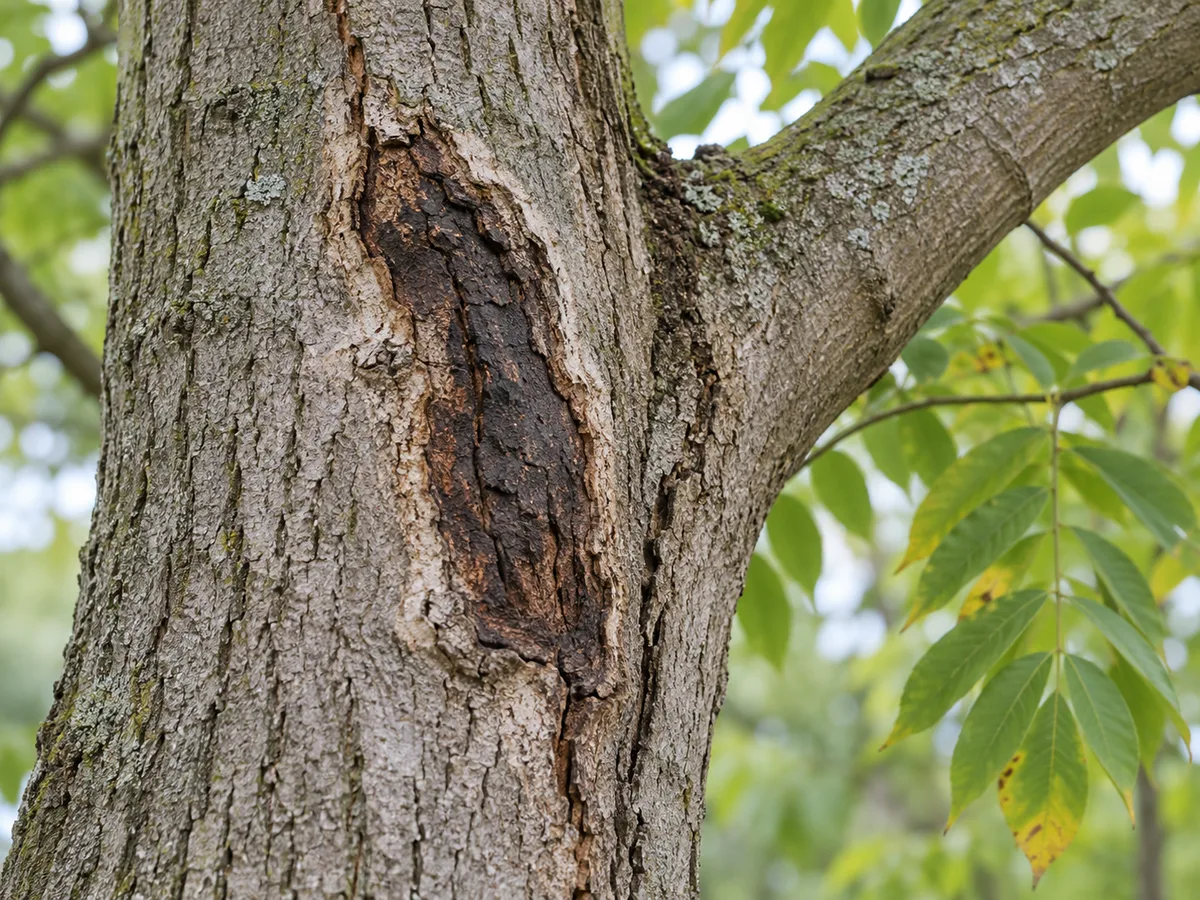
An elongated sunken lesion can be a warning sign, but a photograph alone cannot confirm butternut canker.
What to do if symptoms appear
Do not scrape, carve, paint, or seal a suspected canker. Photograph the area, note how quickly it changes, and ask a local extension plant clinic, forestry office, or certified arborist to confirm the diagnosis. Other cankers, mechanical injuries, and insect damage can resemble one another, so a visual guess is not enough to justify removing a rare tree.
There is no known cure for a trunk infection. Pruning a small, confirmed canker on a branch may sometimes remove that branch infection, but it does not eliminate risk elsewhere in the tree. Make any cut well below the affected tissue according to local professional advice, and sanitize tools between cuts. If the trunk or root flare is involved, or the crown is declining, ask an arborist to assess safety, prognosis, and local rules before deciding whether to retain or remove the tree. (Purdue Extension; Ontario Ministry of Natural Resources)
In some places, butternut is legally protected, including in Ontario under species-at-risk rules. Regulations differ across the United States and Canada, and a tree that appears sick may still be protected. Before cutting a naturally occurring tree, moving it, collecting seed, or treating it, check with the relevant local or state agency. (Ontario Ministry of Natural Resources)
Manage other pests and leaf problems
Butternut can be affected by insects such as borers, nut weevils, lace bugs, bark beetles, and husk flies, as well as leaf diseases. A few chewed leaves or a small amount of leaf spotting usually do not justify pesticide use on a large tree. Start by checking whether the issue is isolated or spreading, whether new growth is affected, and whether the tree is under drought or root stress. (North Carolina State Extension)
Look for tunneling, frass, loose bark, clusters of insects, or repeated early leaf drop before choosing a response. Different pests need different control timing, and a product applied after an insect has left the tree may do nothing. If a diagnosis points to a regulated pest or a serious trunk borer, contact your extension office or arborist; avoid broad-spectrum insecticides that can harm pollinators and beneficial insects.
Leaf yellowing can also result from poor drainage, drought, nutrient imbalance, construction damage, or normal autumn color. Check soil moisture and the pattern of symptoms across the canopy. If one limb declines while the rest of the tree looks normal, inspect that branch and trunk union; if the whole crown fades after a hot dry period, evaluate water and root-zone conditions before treating for disease.
Plan around juglone and root competition
Butternut, like other members of the walnut family, contains juglone-related compounds in roots and other tissues. Some plants, including tomatoes and potatoes, can be sensitive when their roots contact walnut-family roots or decomposing tissue. The effect is not a simple poison cloud extending uniformly beneath every branch, so “nothing grows under a walnut” is too broad. University of Wisconsin Extension explains that root contact or close proximity is central to the problem and that susceptibility varies by plant. (University of Wisconsin Extension)
Before planting, put a vegetable garden outside the tree’s expected root competition area rather than relying on annual beds directly beneath the future canopy. If you already have a butternut, observe what grows successfully in your specific soil, and choose tolerant plants rather than repeatedly replacing sensitive crops. A physical root barrier may help in some layouts, but installing one near a mature tree can damage roots and should be planned with an arborist.
Do not spread fresh husks, leaves, or walnut-family root chips around sensitive vegetables. Do not remove a valuable butternut just because one crop struggles: root fragments can remain in the soil after removal, and the problem may not disappear immediately. Consider relocating the crop, using raised beds with a clean root barrier, or choosing plants known to tolerate the site conditions.
Propagate only for the right goal
Butternut can be grown from seed, but seed-grown trees vary and will not reproduce the exact traits of a selected parent. Fresh nuts need protection from wildlife, and germination generally follows exposure to cool, moist winter conditions. A practical small-scale approach is to collect only permitted nuts from a known source, remove the husk, label each seed, and sow outdoors in a protected nursery bed in fall. Use a sturdy mesh cover to keep rodents from digging them up, then transplant a seedling while it is still small.
Container sowing is possible, but the developing root system needs depth and a seedling can quickly outgrow a small pot. Keep the medium moist but not waterlogged, and move the seedling to its permanent location while its root system is manageable. Do not repeatedly disturb a taproot to check whether it has sprouted.
If the goal is a named nut selection or a tree chosen for disease tolerance, grafting or professionally propagated stock is more reliable than saving nuts. Seed from a grafted tree will not necessarily inherit the grafted cultivar’s traits. For conservation plantings, use a documented source and coordinate with a local program so the planting supports, rather than confuses, the effort to preserve native butternut genetics. (North Carolina State Extension; Royal Horticultural Society; USDA Forest Service)
Prepare for winter and long-term maintenance
A healthy butternut grown within its cold-hardy range does not need a winter wrap once established. Protect a newly planted trunk from deer, rabbits, and mechanical damage with a properly sized guard that does not trap moisture or rub the bark. Check guards and ties regularly, especially after snow, and remove them before they constrict the trunk.
Continue watering young trees during autumn drought until the ground freezes, then stop irrigation when the soil is frozen. Maintain mulch, but keep it away from the trunk and refresh it only when it has thinned. Do not pile snow, road salt, soil, or construction materials over the root zone; a large tree can be damaged by root compaction long before symptoms appear in the leaves.
For a mature tree, annual checks matter more than a complicated fertilizing schedule. Note new growth, crown density, trunk injuries, cankers, and any branch failures. Keep mowers and string trimmers away from the base; small bark wounds create entry points for pathogens and are avoidable. If the tree is valuable, have a qualified arborist inspect it after major storms or whenever the crown changes noticeably.
Conclusion
A butternut tree needs full sun, deep fertile soil, room for a 40- to 60-foot canopy, steady water while young, and occasional structural pruning. Its edible nuts and wildlife value are real benefits, but so are the constraints: juglone can complicate nearby planting, pollination may require another compatible tree, and widespread butternut canker makes long-term survival uncertain.
Make the planting decision around your purpose. Choose another species if you want a low-risk ornamental; choose documented stock and local guidance if your goal is nuts or native restoration. Plant at the correct depth, protect the young root zone, avoid unnecessary wounds, and monitor the tree without assuming that good care can cure canker. That is the most useful way to give a butternut a strong start while respecting the limits of what a gardener can control.



