How to Prune Japanese Maple Trees: A Step-by-Step Guide
See when to prune a Japanese maple, which branches to remove, how to make collar-safe cuts, and how to shape upright or laceleaf trees without topping.
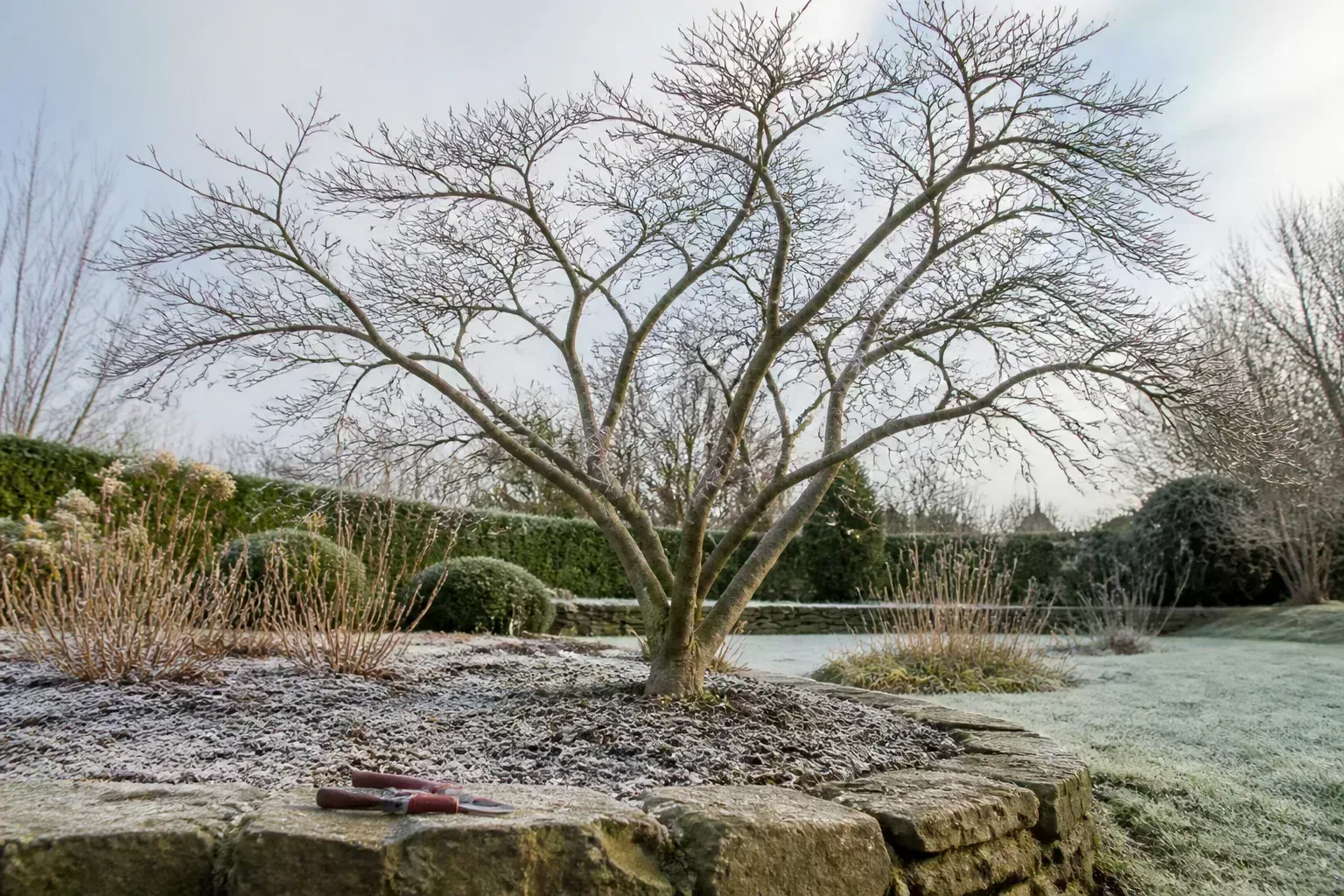
A Japanese maple rarely needs an annual haircut. Prune only when you can name the problem or the result you want: remove dead or damaged wood, stop two branches from rubbing, improve a young tree’s framework, or selectively reveal the layered canopy. If the tree is healthy, has room to grow, and already looks balanced, leaving it alone is often the best pruning decision.
The approach depends on the cultivar. An upright Acer palmatum is built around visible scaffold branches; a weeping laceleaf maple has a cascading canopy whose fine branch pattern is part of its appeal. Both respond best to selective cuts that work with their natural form, not shearing or repeated shortening. Timing matters too: winter shows the branch framework clearly, while summer lets you judge how dense the leafy canopy has become.
Why Japanese maples need a light hand
Japanese maples are ornamental trees valued for their branching, leaf shape, color, and seasonal silhouette. Pruning should reveal those features, not impose a generic tree shape. The Royal Horticultural Society (RHS) notes in its Japanese maple growing guide that these trees usually need little pruning beyond removing winter dieback and poorly placed or crossing shoots; it advises pruning to a side branch rather than leaving a stub and cautions that the most graceful form develops when the tree is allowed to grow naturally.
A useful test is to stand several feet back and look through the canopy before picking up a tool. If the crown is airy enough, the branches do not rub, and no damaged or hazardous wood is present, stop there. A dense crown can benefit from careful thinning, but “more open” is not automatically better: removing too much inner growth can leave foliage concentrated at branch tips, expose formerly shaded bark to sun, and spoil the layered outline.
When to prune: choose by goal and climate
There is no single month that fits every climate or every pruning job. The best window depends on whether you need to see the bare framework, judge leaf density, remove a broken limb, or avoid sap flow. Use seasonal cues—full leaf fall, dormant buds, leaf emergence, and local heat—rather than following a fixed calendar from another region.
For planned structural work, many gardeners use the dormant season after the leaves fall and before buds swell. The bare canopy makes it easier to see crossing branches and the tree’s overall architecture. Utah State University Extension’s maple guidance recommends minimal pruning once a tree’s early framework is established and suggests pruning while dormant to see the canopy clearly; it emphasizes removing dead, diseased, and crossing branches.
Japanese maples can also be selectively pruned in summer. With leaves on the tree, you can see whether branches actually crowd or shade one another and avoid removing more foliage than intended. Fine Gardening’s Japanese maple pruning guide describes winter and summer as useful pruning windows, while warning against pruning in hot weather or taking too much of the crown. The RHS places its recommended window from July through January because maples may bleed from cuts at other times. These ranges differ by climate and by what the gardener is trying to see, so treat them as guidance rather than a universal date rule.
Dormant-season pruning
Choose a mild, dry day after the tree has dropped its leaves and before spring growth begins if the main job is structural cleanup. Look for dead twigs, broken limbs, rubbing branches, and shoots that grow through the center of the canopy. Because the tree is leafless, it is easier to trace a branch back to its origin and decide whether removing it will leave a useful lateral or an awkward gap.
In some climates, a late-winter cut can bleed sap as temperatures rise and the tree comes out of dormancy. Sap dripping from a cut often looks alarming, but a small amount of bleeding does not automatically mean the tree is dying. If you make a cut and sap begins to flow, do not keep making optional cuts; pause the structural work and resume in a more suitable window. A general maple-pruning overview from Gardening Know How describes why sap may flow from late-winter wounds and why many gardeners wait until the tree is fully leafed out.
Summer pruning
Use summer for small, deliberate adjustments when the leafy crown reveals a clear issue: a branch rubbing its neighbor, a shoot growing straight through a weeping canopy, or a few crowded interior tips. Selective pruning in summer tends to stimulate less vigorous regrowth than comparable winter pruning, which can help the tree stay open longer. It is not a license to thin aggressively.
Avoid substantial pruning during hot, dry weather, especially when the tree grows in full sun or already shows scorched or curled leaves. Fine Gardening advises avoiding pruning when temperatures are around 80°F or higher because removing foliage can expose shaded bark to sunscald. That temperature is a practical caution from its Japanese maple guidance, not a universal physiological cutoff; heat, exposure, drought, and tree condition all matter. If the maple is stressed, limit work to dead or broken branches that pose a problem and wait on cosmetic shaping.
Inspect the tree before choosing cuts
First identify the form you have. Upright cultivars usually show one or several ascending trunks with lateral branches; laceleaf or dissectum forms spread and cascade, often creating a broad dome. Some plants are grafted, so locate the graft union—a swollen or angled join near the lower trunk—before deciding what to do with shoots near the base.
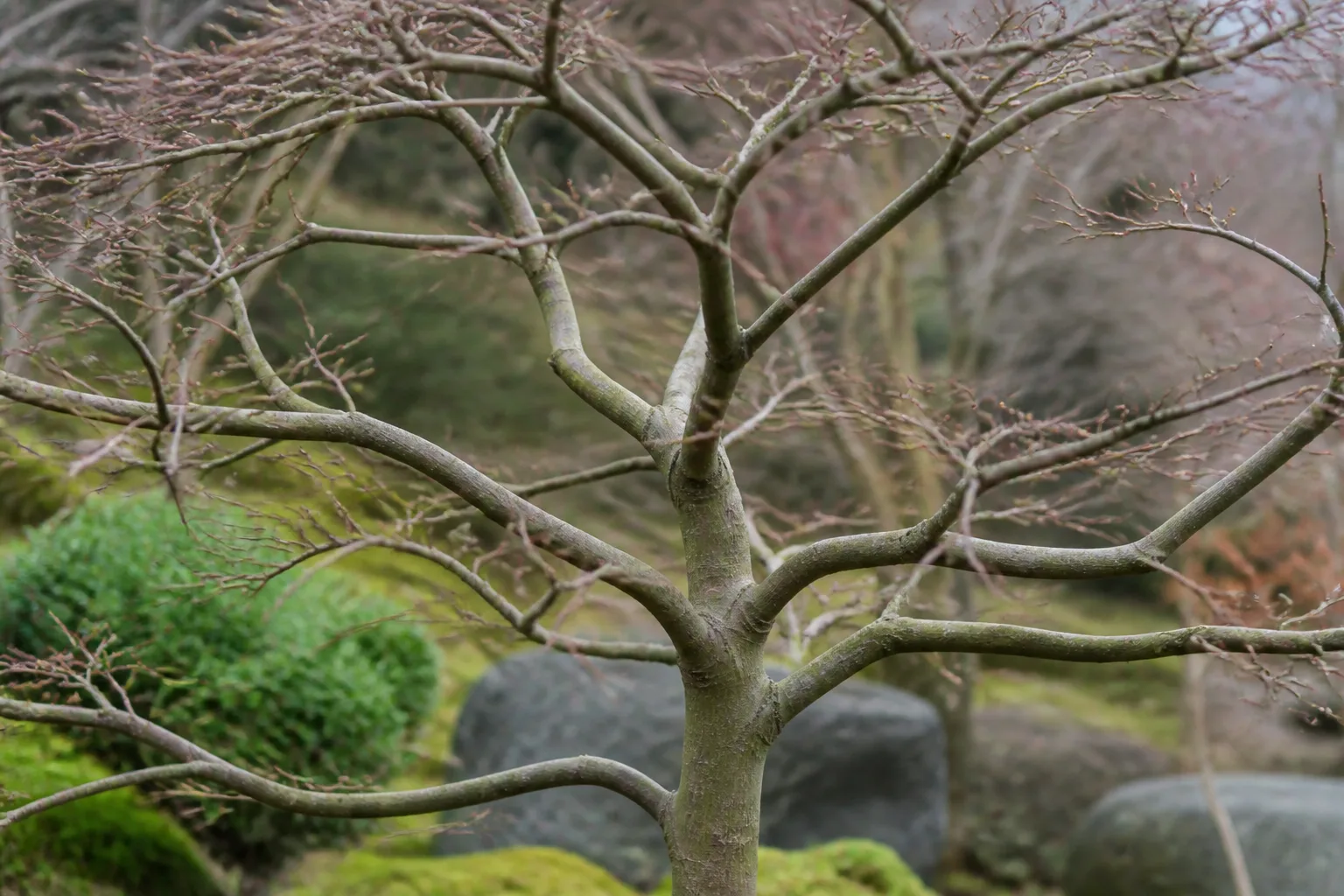
Then inspect the canopy from more than one side. Mark branches that are dead, cracked, diseased, crossing and rubbing, or growing inward through the center. Note any branch that obscures the tree’s natural outline, but do not remove it just because it points downward: drooping limbs are characteristic of many weeping selections. Also check whether a large branch has a weak, narrow attachment or hangs over a path, roof, or play area; those are safety and structure questions, not simple cosmetic fixes.
If you are unsure whether a branch is dead, wait until buds open or scratch a tiny patch of bark on a small twig: living tissue just beneath the bark is usually green and moist, while dead wood is dry and brown. Do not use this test on a large limb. For winter dieback, wait until the live/dead boundary is clear, then cut back to healthy wood or a suitable side branch. The RHS recommends removing winter dieback at shoot ends rather than reshaping the entire tree.
Choose tools that fit the branch
Use sharp bypass hand pruners for small shoots, loppers for reachable branches that are too thick for pruners, and a pruning saw for larger limbs. The tool should cut cleanly without crushing bark or requiring you to twist the branch. If you have to force the cut, switch to a tool with a larger capacity; a ragged tear creates a larger, less controlled wound.
Before you start, remove dirt and sap from the blades. Clean and disinfect tools between trees when disease is suspected or confirmed, following the disinfectant label; routine wiping between every cut on a healthy tree is usually unnecessary. Keep both feet on the ground for homeowner pruning. Do not use a chainsaw, climb into the canopy, or make cuts near a power line. Those tasks require a trained arborist and the proper safety equipment.
Make cuts that preserve the tree’s structure
Two cuts handle most homeowner pruning: a branch removal cut to eliminate an entire branch and a reduction cut to shorten a branch back to an appropriate side branch. Both preserve the tree’s natural framework when placed thoughtfully. Avoid cutting randomly midway along a branch, because the remaining stub may die back and can trigger weak sprouts.
A branch’s attachment has two useful landmarks: the branch bark ridge along the upper angle of the union and the branch collar, the slight swelling at its base. Penn State Extension explains that the collar is part of the tree’s natural defense zone. A proper cut preserves it; a flush cut removes protective tissue and can allow decay to extend into the parent stem. Penn State’s guide to pruning cuts explains the distinction between removal, reduction, and heading cuts.
Branch removal cuts
To remove a small branch, cut just outside the branch collar without cutting into the trunk or leaving a long stub. Angle the cut to follow the collar’s outer edge rather than cutting flush to the trunk. For a thin twig, position the cut just beyond a healthy bud or side branch that points in a useful direction; avoid leaving a blunt stem beyond the bud.
On a Japanese maple, each small cut changes the view through the canopy. Before removing a branch, follow it from its tip to its attachment and ask whether it supports an attractive layer or fills a useful gap. A branch that crosses another may sometimes be shortened to an outward-facing side branch instead of removed completely. The goal is a clear separation between branches, not a hollow center.
Reduction cuts and larger limbs
If you need to shorten a long branch, trace it back to a healthy lateral branch growing in the direction you want the tree to continue. Make the cut just beyond that lateral. Penn State Extension recommends that the retained side branch be roughly one-third or more of the diameter of the branch being shortened; a very small side shoot cannot take over the parent branch’s role effectively. This keeps the cut from acting like a blunt heading cut that leaves a stub and provokes fast, poorly attached regrowth.
For a limb too heavy to support safely with one cut, use the three-cut method to prevent bark from tearing. First make an undercut several inches out from the branch collar. Then make a top cut slightly farther toward the tip to remove the limb’s weight. Finally, make the clean finishing cut just outside the collar. This method is for manageable limbs from the ground. If the branch is large, overhead, near a structure, or beyond your tool’s safe range, leave it to an arborist.
A safe, repeatable pruning sequence
A short sequence keeps a pruning session from turning into an overcorrection:
- Name the goal. Choose one main reason—deadwood cleanup, reducing a rubbing point, improving young-tree structure, or lightly thinning a crowded canopy. Do not try to make the whole tree “perfect” in one session.
- Walk around the tree. View it from the garden and the house, then identify the branches that create the problem. On a weeping maple, look at the overall cascade as well as the structure underneath.
- Remove dead, broken, or clearly diseased wood first. If disease is suspected, bag or dispose of affected material as local guidance recommends and clean tools before moving to another tree.
- Resolve one conflict at a time. Where branches rub, remove the less useful one or reduce it to a suitable lateral. Avoid removing both sides of a crowded fork unless there is a clear structural reason.
- Step back after each major cut. Look through the canopy again from several angles. If the original problem is solved, stop—even if other branches could be removed.
- Save size reduction for last. Use small reduction cuts distributed around the crown, not a row of cuts at one height. If there is no suitable side branch to cut back to, do not invent one by topping the limb.
Keep the removed branches beside the tree for a moment if you are uncertain: seeing the amount of foliage on the ground helps you judge whether you have gone too far. Never make a cut simply to use the tool or to reach an annual pruning quota. Penn State Extension’s landscape-tree pruning guide advises a natural pruning system that retains the characteristic form of the species and warns against excessive interior removal that leaves foliage concentrated at the ends.
Shape upright Japanese maples
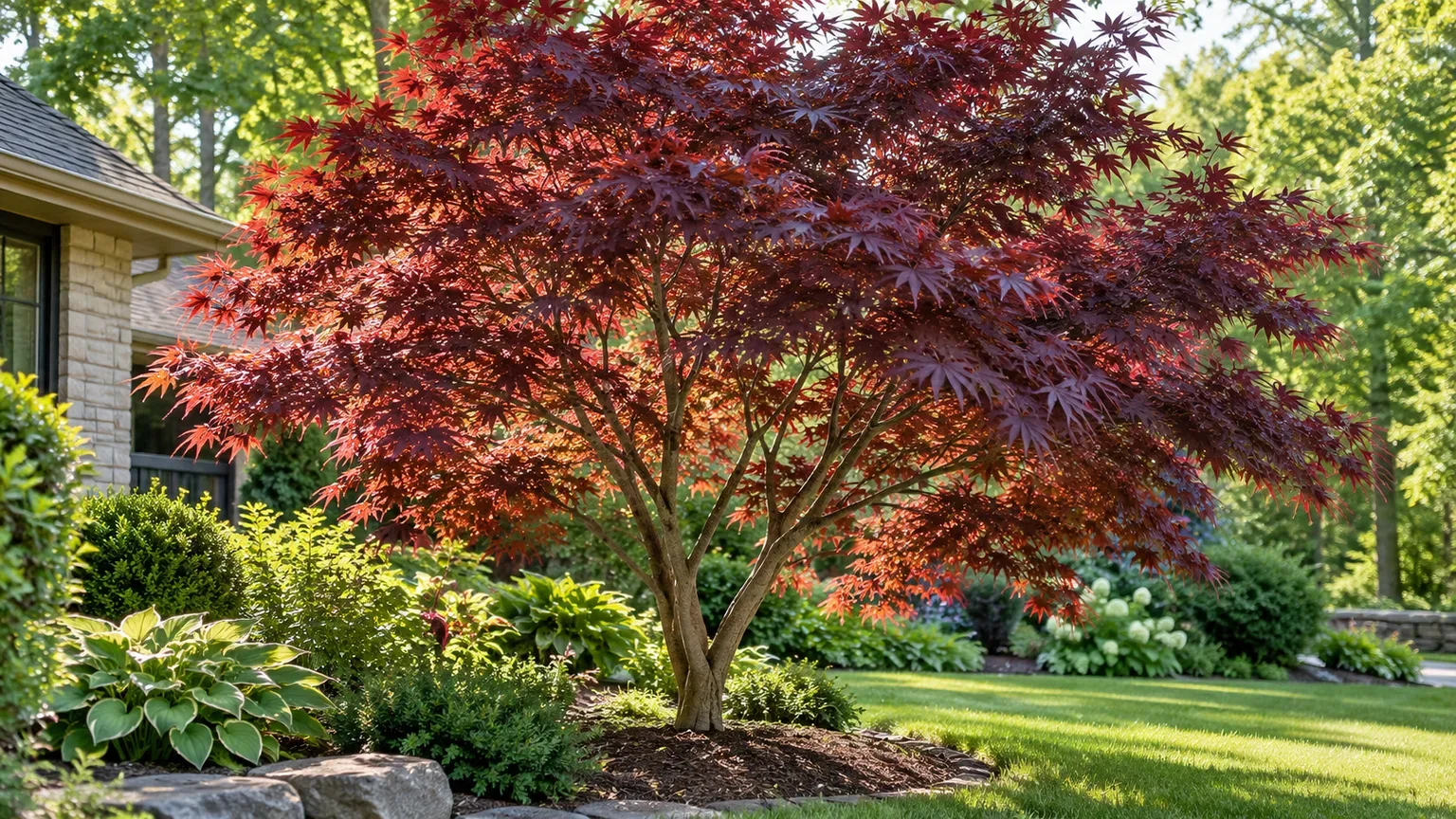
For an upright cultivar, preserve the trunk or trunks that give the tree its natural architecture. Many Japanese maples look best as a multi-stemmed specimen, so do not assume that every tree needs a single central leader. If two stems compete closely or a narrow fork is becoming a concern, the right decision depends on their size, attachment, and the tree’s intended form; a mature co-dominant union may need an arborist’s assessment rather than a quick cut.
Remove branches that cross and rub, grow sharply inward, or disrupt the tree’s outline. Where possible, shorten an overlong branch to an outward-facing lateral rather than cutting every branch to the same length. A few well-spaced scaffold branches usually create a more natural silhouette than repeated limbing-up or thinning from the interior. Utah State University Extension likewise recommends minimal routine pruning once a maple’s early structure has been established.
Prune weeping and laceleaf Japanese maples
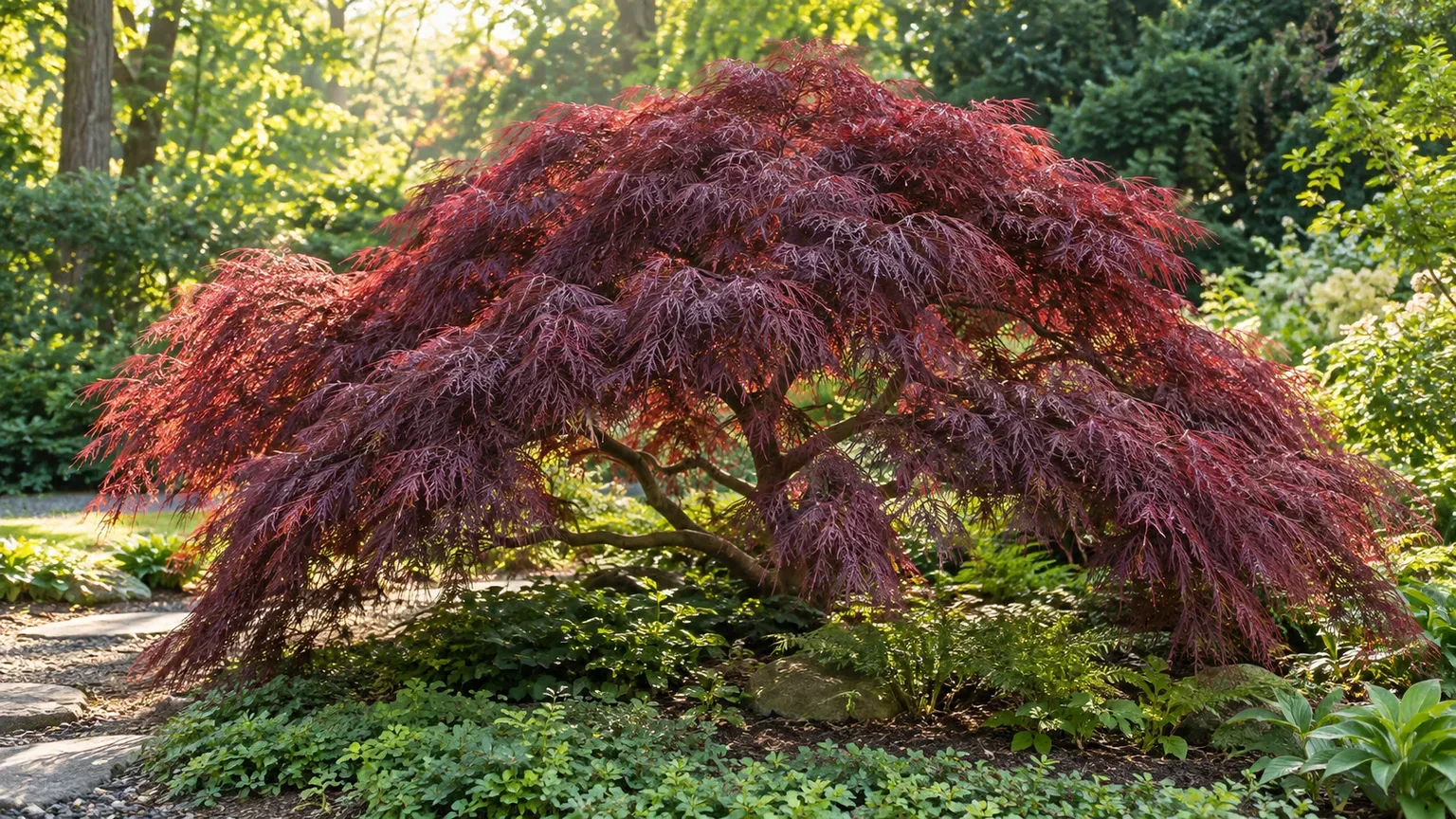
A weeping laceleaf maple needs a different visual check, but not a different rule for healthy cuts. Its canopy should read as a cascading dome or mound, with distinct layers of branches that can be seen from the outside and, where practical, from below. Fine Gardening describes this as a protective veil or “shell” of foliage: the upper branches create a graceful outline while the interior branching remains part of the tree’s winter character.
Begin by removing dead tips and branches that are rubbing, growing sharply upward through the canopy, or dragging where they obstruct a path. Keep the long, arching branches that define the cultivar’s shape. Do not lift the skirt just because the branches are low, and do not clip the outside into a hard ball. A handful of selective cuts can reveal the lace-like branch pattern; too many can leave a bare stem with a small tuft of foliage at the end.
If one branch is longer than you want, follow it back to a healthy side branch and reduce it there. Do not cut every drooping branch at the same imaginary height: the result is a blunt edge that will not match the tree’s natural taper. For a low grafted laceleaf, also watch for upright rootstock shoots emerging from below the graft union; handle those separately from the cultivar’s cascading branches.
Train young trees and remove rootstock shoots
A newly planted or young maple is still establishing roots and building its framework. Remove dead, broken, or badly damaged branches, but resist the urge to raise the canopy or sculpt a finished silhouette immediately. Give the tree a few growing seasons to show its natural branching habit; heavy pruning during establishment can slow growth and make the crown sparse.
When structural training is needed, make small corrections over several years. Keep branches that are well attached and spaced around the trunk, and gradually subordinate a competing shoot only when you can see how the tree is responding. The RHS and Fine Gardening both emphasize allowing Japanese maples to develop their characteristic form rather than forcing an early, rigid shape.
Many named Japanese maple cultivars are grafted onto rootstock. A shoot arising from below the graft union belongs to the rootstock, not the named cultivar, and can eventually dominate the ornamental top. Remove it at its point of origin while it is small, without damaging the trunk or leaving a stub. A shoot arising above the union is part of the grafted cultivar; do not label it a rootstock sucker based only on a difference in leaf size or color. If you cannot locate the graft or are unsure what you are seeing, photograph it and ask a local nursery or arborist before removing a substantial branch.
Set a conservative limit for live growth
A healthy Japanese maple can tolerate selective pruning, but there is no benefit in removing the maximum amount. Fine Gardening advises taking no more than about one-fifth of the crown in a year; general tree guidance from Utah State University Extension uses a similar 20–25 percent ceiling for leaf area. Treat roughly 20 percent as a conservative upper limit, not a target. For a slow-growing, newly planted, drought-stressed, diseased, or recently transplanted maple, remove far less and focus on dead or damaged wood.
A practical way to stay below that limit is to work in stages: remove the few branches that solve the named problem, step back, and estimate the foliage removed against the whole crown. If a renovation would require many large cuts, spread it over multiple seasons or seek professional advice. Dead or broken branches are a separate safety and health issue, but a large hazardous limb should still be evaluated and removed by a qualified person.
Manage size without topping
Pruning can guide a Japanese maple’s outline and modestly reduce a branch’s reach, but it cannot turn a large cultivar into a permanently small tree. If a tree repeatedly outgrows its space, first check the mature size of the cultivar and decide whether the planting location is appropriate. Regularly cutting the top flat or shortening every branch to a common height usually produces an unnatural shape and stimulates dense, fast shoots.
For a limited reduction, choose a lateral branch that can assume the growth direction and make a reduction cut there. Distribute small cuts rather than removing the same side of the canopy or creating a single large gap. Fine Gardening warns that trying to restrict the height of Japanese maples by hard shortening can encourage thin, unruly growth. If height reduction would require removing a major leader or large portions of a mature crown, ask an ISA Certified Arborist whether a staged reduction is possible and whether relocation or replacement is the better long-term choice.
Avoid common pruning mistakes
The most damaging mistake is topping: cutting branches back to arbitrary points or flattening the crown. Large heading cuts leave exposed stubs, disrupt the tree’s shape, and often stimulate vigorous shoots that are weakly attached. Those shoots can grow quickly without solving the size problem. Penn State Extension recommends branch removal and reduction cuts that preserve the natural pruning system instead.
Other common errors are easier to prevent:
- Cutting flush to the trunk: this removes the branch collar. Cut just outside the collar instead.
- Leaving a long stub: trace the branch to a healthy side shoot or its attachment and cut there.
- Removing both rubbing branches by default: usually keep the better-positioned branch and remove or shorten only its competitor.
- Thinning out the interior until the ends look tufted: preserve inner scaffold limbs and distribute foliage through the crown.
- Pruning in heat or on a stressed tree: defer cosmetic work until conditions improve.
- Removing many lower branches at once: this can expose trunk and inner branches to sun and abruptly change the canopy’s balance.
- Confusing a below-graft shoot with a cultivar branch: locate the graft union before cutting.
A clean tool matters, but tool strength is not a reason to make a cut. If the intended branch is larger than you can control, or the tree’s structure is unclear, stop and get advice before creating a wound you cannot undo.
Care for the tree after pruning
A correctly pruned Japanese maple does not need wound paint or a special fertilizer dose. Penn State Extension advises against tree paint or wound dressing, which can interfere with the tree’s natural response. Clear away debris, particularly diseased material, and water according to the tree’s usual needs if the weather is dry; do not compensate for pruning with excessive irrigation or fertilizer.
Check the tree again after it leafs out. A few small shoots near a cut are not automatically a crisis, but vigorous clusters after a hard heading cut can indicate that the tree is reacting to an overly severe cut. Resist the temptation to remove every new shoot at once. Let the tree show which growth is well positioned, then make small corrections during an appropriate season. If a cut reveals a cavity, cracking, extensive dieback, or decay in a major stem, ask an arborist to inspect it.
When to hire an arborist
Call an ISA Certified Arborist for large limbs, branches over a roof or public path, deep cracks, a split union, major deadwood high in the canopy, or any cut that requires a ladder, climbing, chainsaw, or work near utilities. A mature Japanese maple can be costly to replace, and a bad structural cut is difficult to reverse. Penn State Extension recommends leaving climbing and hazardous tree work to qualified professionals who understand tree physiology and safety practices.
Professional input is also useful when the tree has been topped, has several competing leaders, has extensive dieback, or needs a significant size reduction. Ask the arborist to describe the objective and cut types in writing—such as natural crown thinning or staged crown reduction—and avoid proposals that rely on topping or shearing the tree into a ball. A good plan should preserve the cultivar’s natural outline and remove only the branches needed to meet the stated goal.
Conclusion
Prune a Japanese maple only when a specific branch or structural issue gives you a reason. Choose a dormant window for seeing the framework or a mild summer window for judging leafy density, make cuts just outside branch collars or back to suitable lateral branches, and stop well before the crown looks stripped. Upright and weeping cultivars need different visual judgments, but both look best when selective pruning supports the shape they already have.
If the tree is healthy and balanced, let it grow. If correcting it means large cuts, unsafe access, or removing a major leader, bring in an arborist and work toward a staged plan rather than trying to solve years of growth in one afternoon.



