Tree Leaves Calculator
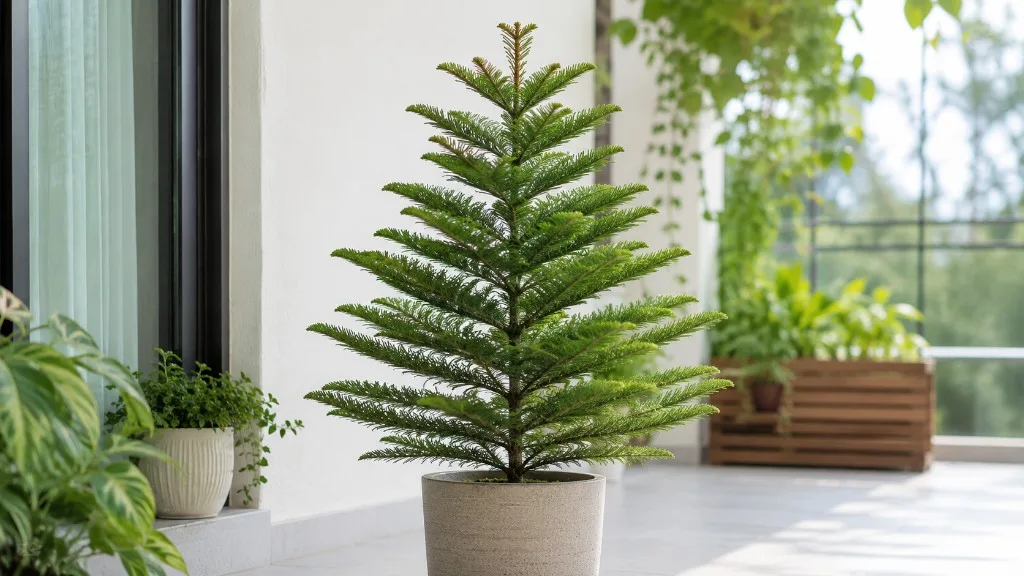
A tree can look simple from the ground: trunk, branches, crown, shade. The leaf count is harder. Nobody is going to climb through a maple and count every blade-shaped piece of canopy by hand, and even a careful photo count breaks down once leaves overlap. The Tree Leaves Calculator gives you a practical estimate from two inputs you can observe: crown diameter and foliage density.
Use the result as a planning number, not a biological census. It can help you compare one tree with another, estimate the rough scale of autumn leaf cleanup, think about shade and habitat, or sanity-check a leaf-litter project before you start bagging, mowing, composting, or mulching. It is strongest when you measure the crown carefully and choose the density band conservatively.
What the calculator estimates
The calculator estimates the number of leaves in a single tree crown by treating the crown as a circular footprint. It asks for crown diameter in feet, converts that to crown area, multiplies by a foliage-density factor, and rounds the result to the nearest 1,000 leaves. That matches the tool’s purpose: fast planning for yard trees, wildlife habitat, biomass thinking, and cleanup preparation.
It does not identify the species, count leaflets separately from compound leaves, estimate total leaf area, calculate dry leaf weight, or replace field measurements used by arborists, foresters, or researchers. Forest science often estimates leaf area and canopy function with allometric equations, crown dimensions, or leaf area index rather than literal leaf counts; U.S. Forest Service research on street trees, for example, used diameter, height, crown width, and related variables to predict tree dimensions and leaf area (USFS street-tree equations).
That distinction matters. A leaf count is useful when the question is human and practical: “How much leaf material am I dealing with?” or “Is this tree in the tens of thousands, hundreds of thousands, or millions of leaves?” A leaf-area estimate is better when the question is physiological, such as transpiration, energy exchange, pollutant removal, or carbon modeling.
The calculator uses this model:
Estimated leaves = crown area x foliage density factor
The crown area is calculated as:
Crown area = pi x (crown diameter / 2)^2
If the crown diameter is 30 feet, the radius is 15 feet. The crown area is about 707 square feet. With the tool’s average density factor of 3,000 leaves per square foot of crown footprint, the estimate becomes about 2,121,000 leaves, rounded to 2,121,000 or to the nearest thousand depending on the display layer.
The density factors in this tool are intentionally broad:
- Sparse: 1,500 leaves per square foot of crown footprint
- Average: 3,000 leaves per square foot of crown footprint
- Dense: 5,000 leaves per square foot of crown footprint
Those factors are not a universal botanical constant. They are a LeafyPixels planning heuristic that converts crown size into a rough leaf count. Real canopies vary because species, shoot architecture, pruning history, stress, age, and season all change how many leaves occupy the same projected crown area.
Crown diameter is easier to estimate than total branch length, number of shoots, or actual leaf area. It also captures the basic scale of the living canopy. A tree with a 50-foot crown has much more leaf-bearing space than a tree with a 12-foot crown, even if the smaller tree looks visually dense.
Forestry and urban-tree tools commonly record crown dimensions because crown size helps describe tree structure, vigor, and ecosystem services. U.S. Forest Service crown-condition methods define crown measurements and use them to evaluate tree condition (USFS crown-condition guide). Urban tree models also use crown width when predicting leaf area and related benefits (USFS tree-size equations).
For a homeowner or gardener, crown diameter has another advantage: you can measure it without special gear. You need a tape, pacing, a measuring wheel, or a careful estimate from the dripline. That makes the calculator more repeatable than a guess such as “large tree” or “medium tree.”
How to measure crown diameter
Stand far enough away to see the full leafy outline. Find the widest spread of the crown from one dripline edge to the opposite dripline edge. The dripline is the ground area roughly below the outer edge of the canopy. Measure that distance in feet.
Most crowns are not perfect circles, so take two measurements when you can: the widest spread and the spread at a right angle to it. Average the two numbers. If a tree is 42 feet wide one way and 30 feet wide the other way, use 36 feet as the crown diameter. This keeps an oval crown from being overestimated by its single longest line.
If the tree is on a slope, measure the horizontal ground distance under the crown rather than the diagonal distance along the slope. If a fence, building, street, or neighboring tree interrupts the crown, measure the actual living crown of the tree you are estimating, not the space the tree might have occupied if it grew freely.
Choosing sparse, average, or dense
Choose “sparse” for a young tree, a newly planted tree, a stressed tree with visible gaps, a tree recovering from storm damage or heavy pruning, or a naturally open canopy. Sparse does not always mean unhealthy. Some species and forms hold leaves in a more open pattern.
Choose “average” for a healthy yard tree in full leaf with a canopy that looks typical for its species and age. If you are unsure, average is usually the right starting point because it avoids the extremes.
Choose “dense” for a crown that casts heavy shade, has few visible gaps, or belongs to a species or growth form with compact branching and abundant foliage. Dense is also reasonable for some evergreens and broadleaf shrubs trained as small trees, but be careful: conifer needles are not directly comparable to broad deciduous leaves, and the calculator is built as a general leaf-count heuristic rather than a needle-count instrument.
The safest workflow is to run two density bands. Try average first, then run sparse or dense as a low/high check. If the result changes your decision, use a range rather than a single number.
Deciduous leaves, compound leaves, and needles
The word “leaf” sounds obvious until you compare an oak, ash, palm, pine, and honey locust. A simple leaf, such as many oak or maple leaves, is counted as one leaf. A compound leaf has multiple leaflets attached to one leaf stalk. In botanical terms, the whole compound structure may be one leaf, while each leaflet looks like a small leaf to a person cleaning a yard.
The calculator is most useful when you define the unit consistently. For leaf cleanup, you may care about visible leaflets because they are what you rake or mulch. For a more botanical estimate, count a compound leaf as one leaf. This is one reason ash and locust estimates can feel strange: their canopies may create many small pieces of leaf litter even when the botanical leaf count is lower.
For conifers, use extra caution. Pine, spruce, fir, cedar, and similar trees retain needles for more than one season and shed a portion over time rather than dropping a full deciduous canopy every autumn. Many conifers keep foliage for multiple years, and needle longevity varies by species and growing conditions; Colorado State University Extension notes that evergreens retain most foliage through winter but do not keep all needles indefinitely (evergreen needle retention).
Worked example: small ornamental tree
Imagine a dogwood, redbud, or Japanese maple with a crown that measures 14 feet across at its widest point and 10 feet across at the perpendicular measurement. Average those two numbers and use 12 feet as the crown diameter.
The radius is 6 feet. Crown area is about 113 square feet. If the tree has an average canopy, multiply 113 by 3,000. The estimate is about 339,000 leaves. If the canopy is open or recently pruned, multiply by 1,500 instead and you get about 170,000 leaves. If it is unusually dense, the 5,000 factor gives about 565,000 leaves.
That range is more useful than pretending the exact answer is 339,292. The tree’s real count depends on species, leaf size, shoot length, damage, water stress, and the point in the growing season. For cleanup, the practical message is that even a small ornamental tree can produce a surprisingly large number of individual leaf pieces.
Worked example: mature shade tree
Now take a mature shade tree with a crown that averages 38 feet across. The radius is 19 feet, so the crown footprint is about 1,134 square feet.
With the sparse factor, the estimate is about 1.7 million leaves. With the average factor, it is about 3.4 million. With the dense factor, it is about 5.7 million. The spread looks wide because density dominates the result once the crown is large.
This is where judgment matters. If the tree is a mature maple with a full crown and no obvious dieback, average may be a good starting point. If it is a drought-stressed tree with thin upper branches, sparse may be closer. If it is a heavily foliated beech or evergreen broadleaf with deep shade below, dense may be defensible.
For a tree this size, a leaf-count estimate can support planning, but it should not be used as a scientific inventory. Researchers often work with leaf area index, dry mass, or species-specific allometry because those measurements connect better to canopy function. Leaf area index describes how much foliage area sits over a ground area and helps researchers monitor water, carbon, and energy exchange (NASA Earth Observatory).
What the result is good for
Use the estimate to compare scale. If one tree comes out near 200,000 leaves and another comes out near 3 million, you have a meaningful difference even if neither number is exact. That can help you decide where to focus cleanup, where to create leaf-mold storage, or which tree contributes most of the shade and habitat in a small yard.
The result can also help with communication. If you are discussing a tree with a landscaper, arborist, neighbor, school garden group, or volunteer crew, a crown-based estimate is clearer than “a lot of leaves.” It gives people a rough order of magnitude.
For garden planning, the estimate pairs naturally with the compost calculator, soil volume calculator, and tree carbon sequestration calculator. Leaf count alone does not tell you compost volume or carbon storage, but it helps you understand canopy scale before you move into those related calculations.
What the result is not good for
Do not use the result to price commercial leaf removal by itself. Labor depends on access, wetness, terrain, equipment, hauling distance, local rates, and whether leaves are loose, chopped, bagged, or mixed with sticks and debris.
Do not use it to diagnose tree health. A low estimate may simply reflect a small crown or an open species. A high estimate does not prove the tree is healthy. If you see dieback, cracks, hanging limbs, fungal fruiting bodies, root disturbance, or sudden canopy thinning, use an ISA Certified Arborist or local extension office rather than a leaf calculator.
Do not use it to compare ecological value across species without more context. A tree with fewer large leaves can still provide meaningful shade. A tree with many small leaves may support different insects, birds, or litter decomposition patterns. Leaf count is one lens, not a full ecological score.
Accuracy limits to keep in mind
The biggest source of error is density selection. Crown diameter is measurable, but density is a judgment. Two people can look at the same tree and choose different bands, especially in partial leaf-out, drought stress, post-pruning recovery, or late-season senescence.
The second source of error is crown shape. The formula treats the crown footprint as a circle. That works reasonably for rounded yard trees. It works less well for columnar trees, street trees with one-sided crowns, trees crowded by buildings, trees growing at woodland edges, and trees with dead sections.
The third source of error is leaf definition. Compound leaves, leaflets, and needles can shift the meaning of the count. For cleanup, define the unit by what you will actually handle. For plant science, define the unit botanically and use species-specific methods when precision matters.
A good way to express the result is as a range: “roughly 1.7 to 3.4 million leaves” or “probably in the low hundreds of thousands.” That is more honest than a single exact number and more useful for real decisions.
Autumn cleanup and leaf litter planning
Leaf count is only one part of cleanup. Wet leaves are heavier, chopped leaves pack differently from whole leaves, and some species break down faster than others. The same number of thin honey locust leaflets will behave differently from broad, leathery magnolia leaves.
Leaving some leaf material in place can benefit soil and wildlife when it is done thoughtfully. University of New Hampshire Extension notes that autumn leaves provide cover for overwintering insects (overwintering insect cover). Extension guidance is more cautious for turf: a thin chopped layer can be acceptable, but heavy mats can shade or smother grass. Iowa State University Extension recommends mowing or mulching leaves when coverage is light and removing leaves when the lawn has more leaves than grass showing (leaf mulching guidance).
For garden beds, chopped leaves are usually easier to manage than whole leaves because they settle more evenly and break down faster. For compost, leaves are a carbon-rich “brown” material that balances nitrogen-rich greens. Penn State Extension describes leaves as useful compost feedstock and notes that shredding speeds decomposition (composting leaves).
Using the estimate for habitat and soil
A tree’s leaves are not just waste. They are part of a nutrient cycle. In forests and less-managed landscapes, leaf litter decomposes into organic matter, protects soil, feeds fungi and microbes, and supports invertebrates. The U.S. Department of Energy describes soil as a living mixture that includes minerals, organic material, air, water, and organisms, which is why leaf inputs matter beyond simple cleanup (DOE soil overview).
That does not mean every leaf should stay exactly where it falls. Thick leaf mats on turf, storm drains, sidewalks, and low-growing evergreen groundcovers can create problems. The practical approach is selective: mow or remove leaves from turf where they would mat, keep some in shrub beds and tree rings, chop leaves before using them as mulch, and avoid piling leaves against trunks.
The calculator helps by showing the scale of the supply. A 12-foot ornamental tree and a 40-foot shade tree do not produce the same management problem or habitat opportunity. Once you know the scale, you can decide whether you need a mower pass, a compost bay, a leaf-mold pile, a municipal pickup plan, or simply a rake and a quiet corner of the yard.
How to sanity-check the estimate
Start with your measurement. If you paced the crown quickly, repeat it with a tape or measuring wheel. If you measured only the widest spread, take the perpendicular spread and average the two. If the tree is lopsided, use an oval average rather than the longest diameter.
Then test density. Run sparse, average, and dense. If all three estimates lead to the same practical decision, the exact density does not matter. If the decision changes, inspect the crown more carefully or treat the result as a low-to-high range.
Finally, compare the result to what you observe during leaf drop. If a tree estimated at millions of leaves produces only a light scattering, the crown may be smaller, sparser, or more compound-leaved than your inputs assumed. If a tree estimated at a few hundred thousand fills many bags, wetness, packing, and leaf size may be driving the workload more than count.
Common mistakes
The most common mistake is measuring trunk size instead of crown size. Trunk diameter and crown diameter are related in many trees, but they are not interchangeable. If you need trunk size for a different calculation, use the tree diameter calculator or DBH basal area calculator. For this tool, measure the leafy crown.
Another mistake is choosing dense because the tree feels large. Size and density are different inputs. A large open oak may have a huge crown and still belong in average or sparse. A small ornamental with a tight canopy may belong in dense.
Do not measure in summer and apply the same result to early spring or late autumn without adjusting your expectations. Many deciduous trees are not in full leaf during shoulder seasons. Storm damage, drought, pests, late frost, and pruning can also change canopy fullness within a single year.
When to ask a professional
Ask a certified arborist or local extension office for help when leaf loss is sudden, severe, or paired with structural symptoms. A calculator can estimate canopy scale, but it cannot inspect roots, identify vascular disease, evaluate pest pressure, or decide whether a tree is hazardous.
Professional input is also worth it when the result affects liability or major expense. If a tree overhangs a roof, public sidewalk, power line, or neighboring property, the important question is not how many leaves it has. The important question is whether the tree is structurally sound and what work, if any, is appropriate.
For ordinary leaf management, you usually do not need professional help. Measure the crown, run a range, decide where leaves should stay, and decide where they should be moved or chopped.
Conclusion
The Tree Leaves Calculator turns an impossible count into a useful estimate. Measure the crown diameter, choose a realistic density band, and read the result as an order-of-magnitude planning number. The answer is best used for comparing trees, planning cleanup, sizing leaf-mold or compost space, and understanding how much canopy a tree is carrying.
The key is humility. Crown area is measurable, but leaf density, crown shape, species habit, and seasonal timing all add uncertainty. Run the calculator more than once, use a range when the decision matters, and bring in a professional when canopy condition or tree safety is the real concern.