5 Reasons to Rake Leaves in Fall for Lawn and Garden
Raking leaves can protect turf and clear paths, but a full cleanup is rarely needed. Use this guide to choose what to rake, mulch, compost, or leave in place.

You do not need to rake every leaf off your property. Rake or mulch leaves where they form a thick, wet blanket over grass, pile up on paths and drains, or conflict with how a space is used. In quieter beds and under shrubs, a light layer can protect soil and shelter wildlife; surplus leaves are useful raw material for compost or leaf mold.
That distinction matters because “rake the yard” is not one job. Turf needs enough light and airflow to stay healthy, while a woodland-style bed can benefit from leaf litter. The most useful fall routine is selective: clear the surfaces that need it, move leaves to places that can use them, and leave an undisturbed patch where that makes sense.
Do You Need to Rake Every Leaf?
No. The decision depends on where the leaves landed, how thickly they cover the ground, and what you want that area to do. A thin scattering that you can still see grass through may be mulched into a lawn.
A dense, soggy mat should be removed or broken up before it lies for weeks. Leaves on sidewalks, steps, driveways, and curb lines deserve attention even when the lawn itself does not.
This approach also resolves the apparent conflict between lawn advice and pollinator advice. Turf can be damaged by a heavy blanket, but leaf litter in a garden bed or tucked-away corner can shelter overwintering insects and return organic matter to soil. Michigan’s Department of Environment, Great Lakes, and Energy describes fallen leaves as habitat for insects, earthworms, and other wildlife, and notes that mulching dense cover can let more light reach turf (Michigan EGLE).
That means you can clear the lawn without clearing every border: decide where habitat is welcome before you start, then avoid disturbing that patch with a rake or blower. A quiet corner under shrubs or along a back fence is often easier to maintain than a whole yard left unmanaged.
1. Keep Thick Leaf Mats From Smothering Grass
Grass needs light and air at the soil surface. A deep layer of intact leaves blocks sunlight, presses down blades as it gets wet, and can leave bare or thin patches by spring.
The risk is greatest in low spots where windblown leaves collect, beneath large deciduous trees, and wherever several weeks of falling leaves go untouched. A patch of lawn beneath a single maple may receive more leaf volume than the rest of the yard combined, so judge the coverage on the ground rather than how many trees you own.
Grass that remains upright and visible through a light scatter is in a different situation from blades pressed flat under a continuous layer. The BBC’s archived autumn lawn guidance likewise warns that a thick layer can smother turf and weaken grass (BBC Gardening autumn lawn care).
You do not have to chase every new leaf. Check the lawn after a windy day or a large drop: if you can still see most of the turf and the leaves are spread loosely, wait or mulch them.
If leaves overlap into a continuous blanket, gather them, mulch them with a mower, or move them to a compost area. Ohio State Extension educator Lee Beers describes the practical trade-off clearly: unmanaged mats can hold moisture over turf, while returning decomposed leaves later can contribute organic matter (Ohio Farm Bureau).
When Mowing Leaves Is Enough
A mulching mower is often the easiest middle ground. Mow when leaves are dry enough to cut cleanly and the lawn is firm underfoot; make one pass, then check whether the fragments have settled between the grass blades.
If broad pieces still cover the surface, make another pass or collect some rather than repeatedly running over a thick pile. University of Minnesota Extension identifies leaf mulching as a way to return leaves to the lawn, and Michigan EGLE notes that shredding dense cover lets more light reach turf.
The right stopping point is visual: fragments should be small and dispersed, with grass visible through them. Avoid mowing wet, matted leaves, which can clump and smear instead of distributing evenly. If the mower clogs, leaves are too deep for a simple mulch pass; rake or blow them into rows first, then mulch manageable amounts or move them elsewhere.
Timing follows conditions more reliably than a date on the calendar: leaves fall at different rates across regions, and a late warm spell can keep some lawns growing after others have slowed. If your lawn is still actively growing, a light mulch pass can be useful; if the grass is dormant, saturated, or frosted, prioritize removing a thick mat without driving equipment over soft turf. Local extension guidance can account for the grass types and fall weather common where you live.
2. Clear Leaves From Paths, Curbs, and Drains
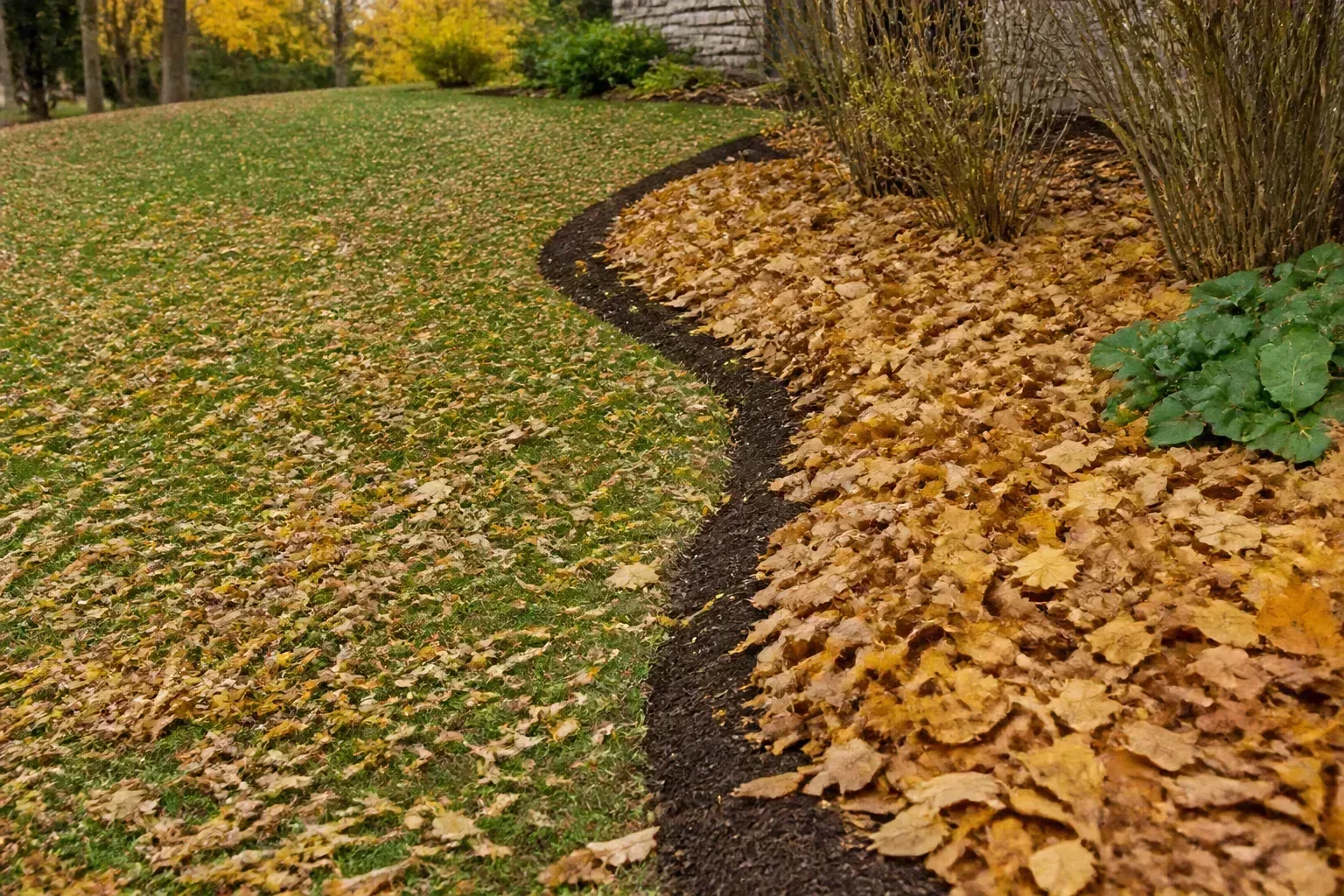
Leaves on hard surfaces create a different problem from leaves in a bed. Wet leaves can become slick underfoot, hide uneven paving, and collect at the low points where rainwater should flow. Clear steps, ramps, frequently used paths, and driveway edges promptly, especially after rain or frost; a broom or rake is usually enough for a small area.
Pay attention to curbs and storm-drain approaches as well. Leaves and other yard debris can wash into waterways, where decomposing organic material adds nutrients such as phosphorus that can contribute to algae growth. Carver County, Minnesota, recommends raking leaves from curbs and sidewalks, keeping them out of streets, and using composting, mulching, or local yard-waste collection instead (Carver County fall leaf and lawn care).
A quick cleanup around a drain is not a reason to strip the whole garden bare. Collect the leaves in a tarp or yard-waste container and relocate them to a bed or compost pile. That small separation protects drainage while keeping the material on site when you have a good place to use it.
Never blow a pile into the street; municipal pickup rules and stormwater guidance differ by location, so check your town’s instructions for collection days and acceptable bags. If a curbside program is scheduled, keep leaves in the location and container your municipality specifies; a loose pile can be scattered by wind or wash into the gutter before pickup. Sweep hard surfaces toward your own collection area, not toward a catch basin, because a storm drain is a direct route to local water rather than a compost system.
3. Put Fallen Leaves to Work as Mulch
Raking can be useful precisely because it lets you move leaves from a place where they cause trouble to a place where they help. Shredded or partly broken-down leaves spread over bare soil can reduce splash erosion, slow moisture loss, and add organic matter as they decay. They are free, locally available mulch, but whole leaves can mat together, so spreading a loose layer or shredding first gives water and air more paths through it.
Use the leaves you have rather than treating them as a precise fertilizer. Their nutrient content varies by tree species and condition, and the main benefit of leaf mulch is soil cover and organic matter over time. The Royal Horticultural Society explains that leaf mold improves soil structure and water-holding capacity; Minnesota Extension also recommends using shredded leaves as a lawn mulch when they can fall between grass blades.
Use a Safe Leaf Ring Around Trees
Shredded leaves can cover the soil beneath trees and shrubs, where bare ground is exposed to temperature swings and drying winds. Keep the layer loose and pull it back from trunks and woody stems so the bark stays exposed. A thick, wet pile packed against a trunk holds moisture against bark and hides the flare where the trunk widens into roots; it is not a better mulch just because it is taller.
Do not build a leaf mound against the trunk or bury low branches and plant crowns. If you have a deep volume of whole leaves, compost or shred them first, or move some to a dedicated pile. A few inches of fluffy shredded material spread broadly is more useful than a compressed, trunk-hugging heap.
Keep Garden Beds Covered Without Smothering Plants
In established ornamental beds, leaves can be left in place if they are loose and not burying evergreen foliage, small plants, or crowns that need air. Under shrubs and along the back of a border, a natural layer can provide winter shelter for insects and gradually break down. In a tidy front bed or around low perennials, rake the leaves aside, shred them, and spread them thinly so plants are not flattened.
Vegetable beds need a little more judgment. A moderate leaf cover can protect exposed soil after harvest, but remove leaves that are visibly diseased or that came from a plant with a serious recurring disease.
If you want to keep leaves for habitat, make a distinct leaf-litter corner or leave some beds lightly covered rather than distributing a heavy, uniform blanket everywhere. In beds with winter-sown seeds, small evergreen groundcovers, or low rosettes, pull leaves away from the plants and leave the open soil covered around them. In an empty bed, a loose blanket is less likely to smother anything and can be raked aside when spring planting begins.
4. Collect Surplus Leaves for Compost or Leaf Mold
A leaf pile can become a useful soil amendment instead of a disposal chore. Composting is the faster, more active option when you mix leaves with nitrogen-rich green material, maintain moisture, and turn the pile from time to time. Leaf mold is a slower, simpler product made mostly from leaves and moisture; it is valued for its texture and moisture-holding capacity more than as a nutrient-rich fertilizer.
Shredding speeds either process because small pieces settle less densely and expose more surface area to decomposers. The RHS says shredded leaves can produce usable leaf mold in roughly six to twelve months, while whole leaves often take longer; exact timing depends on leaf type, moisture, pile size, and climate (RHS guide to making leaf mold). If the pile dries out, moisten it.
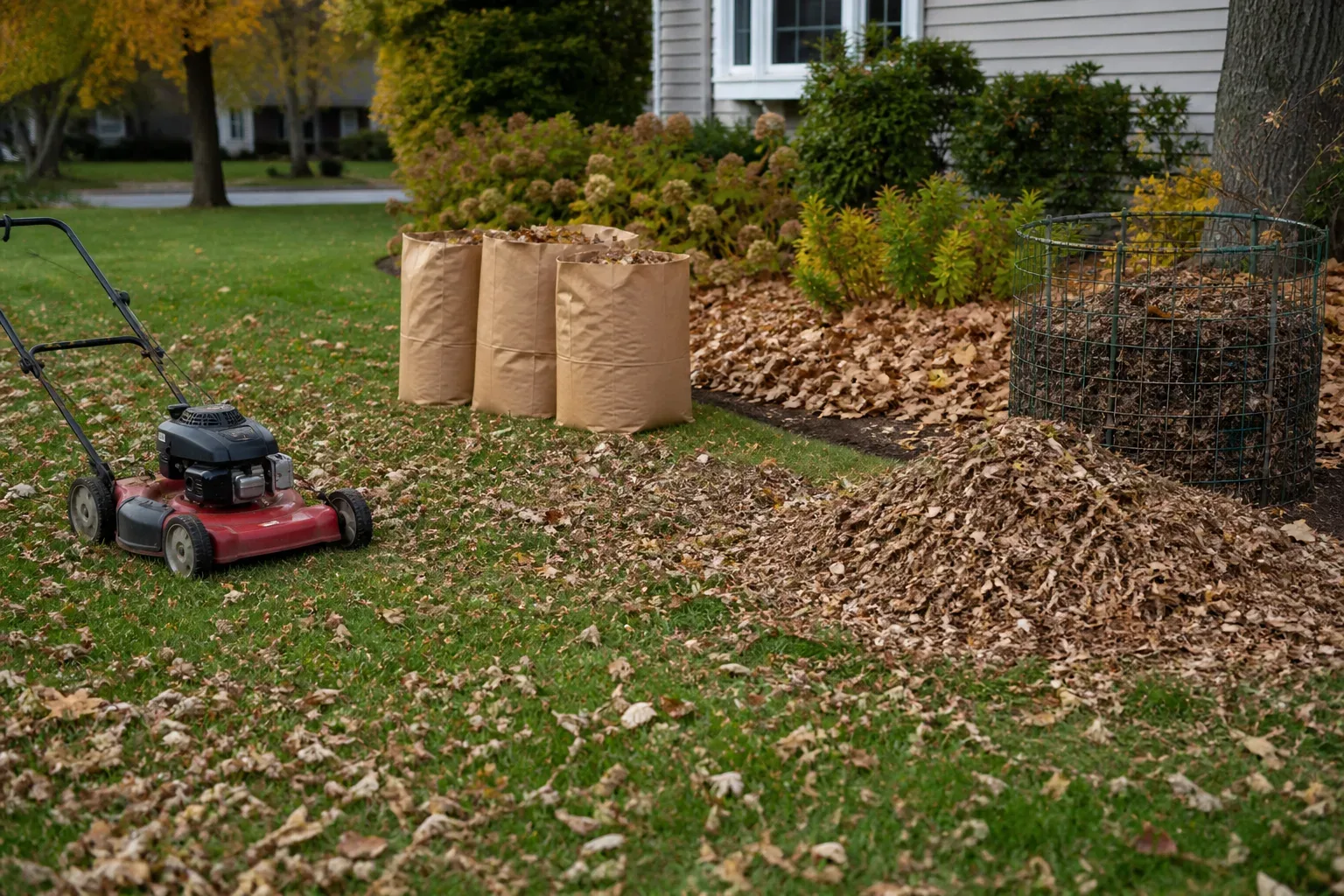
If whole leaves collapse into a wet, airless mass, loosen or shred them. A simple setup is a wire enclosure or ventilated bag placed where it will not block a path; label the pile by season so you do not mistake fresh leaves for finished material. You can start a new pile each fall and use the older one first, which makes the slow process more predictable than waiting for one huge pile to finish all at once.
Leaf Mold and Compost Do Different Jobs
For leaf mold, collect leaves in a ventilated bin or bag with drainage holes, moisten them if they are dry, and let them sit. Check occasionally so the pile stays damp but not waterlogged.
After partial breakdown, the coarse material can work as a surface mulch; after further decomposition, the finer product can be mixed into soil to improve its structure. The RHS and BBC Gardening both describe leaf mold as a slow, leaf-only process, with tougher leaves taking longer than softer ones (BBC Gardening leaf-mold guide).
For active compost, combine leaves with fresh plant trimmings or other suitable nitrogen-rich materials rather than piling up only a huge volume of dry leaves. Keep the pile damp like a wrung-out sponge, allow air to enter, and turn it when you want to speed decomposition.
Follow your local compost program’s rules for what it accepts; some curbside collections require paper bags or prohibit certain materials. If you do not have space to compost at home, many municipalities offer yard-waste pickup or drop-off, though fees and schedules vary.
5. Make the Yard Safer and Easier to Manage
A leaf-free strip can make sense around entries, steps, play areas, and places where people carry groceries or use a mobility aid. Removing leaves from those traffic lanes reduces the chance that a slick layer will hide the walking surface. Clear the areas you actually use, then let the rest of the yard follow a less intensive plan.
A practical order is to clear stairs and ramps first, clear the curb and drain approaches before rain, inspect the lawn for thick mats, and then decide what to do with the remaining leaves. This makes the safety and water-management tasks visible before time goes into cosmetic cleanup.
Appearance and neighborhood rules are also legitimate considerations, even though a spotless lawn is not an ecological requirement. If an association or municipal code sets a cleanup deadline, comply where it applies and ask whether leaves can be moved to a rear bed or compost area. A few intentionally maintained edges can create a tidy look without requiring the entire property to be stripped of leaf litter.
A selective plan can save time too. Gather leaves in batches as they accumulate instead of waiting for a deep wet mat, and keep a tarp nearby to drag leaves rather than repeatedly lifting full bags. The Ohio Farm Bureau article by an OSU Extension educator points out that composting is a practical compromise for people who want a clear lawn but also want to return leaf organic matter to the yard.
Choose a Leaf Strategy by Surface
Use this quick guide before starting. It distinguishes areas to clear from places where leaves can stay or be put to work.
| Surface or situation | Best first move | Why |
|---|---|---|
| Thin leaves spread over actively growing grass | Leave or mulch with a mower | Small fragments can settle between grass blades; check that turf remains visible. |
| Thick or wet leaf mat on turf | Rake, then mulch or compost | A continuous layer blocks light and can press down grass. |
| Steps, sidewalks, ramps, and driveways | Sweep or rake promptly | Wet leaves can make hard surfaces slippery and hide uneven spots. |
| Curbs and storm-drain edges | Remove and follow local yard-waste rules | Keeps leaves from washing into streets and waterways. |
| Established shrub or woodland bed | Leave a loose layer or redistribute leaves | Soil cover and undisturbed litter can be useful where plants are not smothered. |
| Vegetable bed with diseased foliage | Remove suspect material; follow local disposal guidance | Do not spread potentially infected leaves as fresh mulch. |
| Large seasonal surplus | Make leaf mold, compost, or use municipal collection | Keeps useful organic matter out of the trash when local services allow. |
The table is a starting point, not a calendar. A mild, dry autumn with a light leaf fall may need only one or two passes; a wet fall under several mature trees may require more frequent clearing. Check after storms, before heavy rain, and whenever leaves are beginning to form a continuous layer.
Rake With Less Strain and Noise
Choose a flexible leaf rake for broad lawn areas and a narrower rake or broom for corners and hard surfaces. Work in short, manageable sections, pull leaves onto a tarp, and move the tarp to the mulch or compost destination. A leaf blower can help with a large area, but aim it away from streets, drains, neighbors’ open windows, and protected leaf-litter zones; use the lowest setting that moves the leaves you need to clear.
For a smaller lawn, raking dry leaves is often quieter and more controlled than blowing. If you use a mower, remove branches and other debris first, keep the discharge aimed away from paths and beds, and stop if wet leaves clog the deck.
Do not mow on frozen or saturated ground, when wheels can rut the lawn or leaves will not shred cleanly. You can also alternate tasks: mulch a light first drop, rake a later heavy drop, and reserve the final surplus for leaf mold.
Handle Diseased or Contaminated Leaves Carefully
Most ordinary fallen leaves can be mulched, composted, or used to make leaf mold. Treat leaves differently when you know they came from a plant with a persistent foliar disease, a serious pest problem, or chemical contamination. Do not scatter those leaves through healthy beds just because they are organic; keep them separate and ask your local extension office or waste service how to dispose of them safely.
A leaf’s color alone does not diagnose disease, and not every spot or discoloration means the litter is hazardous. Use the history of the plant and the pattern of symptoms: repeated severe disease on the same crop, visible fruiting structures, or a current outbreak are better reasons for caution than one naturally yellowing autumn leaf. Avoid claiming that a backyard pile will heat enough to kill every pathogen unless you can manage and verify its temperature; municipal compost programs may have different processing capacity and accepted-material rules.
Leaf-Cleanup Mistakes to Avoid
Do not rake or blow leaves into the street, storm drain, or a neighbor’s property. That moves the problem and can send nutrients downstream. Collect the pile on your own side of the curb and use an allowed disposal or reuse route.
Do not assume more mulch is always better. Whole wet leaves can form a dense layer over lawn, flatten small perennials, or pack against tree trunks. Shred, thin, or relocate them when you cannot see plants or the soil surface needs air.
Do not burn leaves as a default disposal method. Burning creates smoke and can pose a fire risk; local rules may also prohibit it. Check municipal guidance instead of assuming open burning is permitted.
Do not bag every leaf before deciding where it could help. A small clean lawn does not require removing leaf cover from every bed. Leave a suitable quiet area, use shredded leaves as mulch, and compost the surplus if you can.
Conclusion
Rake leaves in fall where they create a real problem: thick mats on grass, slippery paths, blocked curb lines, or beds where plants are being smothered. Then choose a useful destination for the material—mulch, compost, leaf mold, or an approved local collection site. A tidy traffic lane and a healthy lawn can coexist with a less disturbed garden bed.
The best routine is selective rather than absolute. Keep turf visible, keep drains and walkways clear, leave a safe patch for leaf litter where it fits, and avoid pushing leaves into streets or burning them. You will spend less time hauling away useful organic matter and give each part of the yard the kind of fall cleanup it actually needs.