Why Is My Peace Lily Drooping? 6 Causes and Fixes
A drooping peace lily may be thirsty, waterlogged, chilled, or root-stressed. Check the soil and symptoms first, then use the right recovery steps.
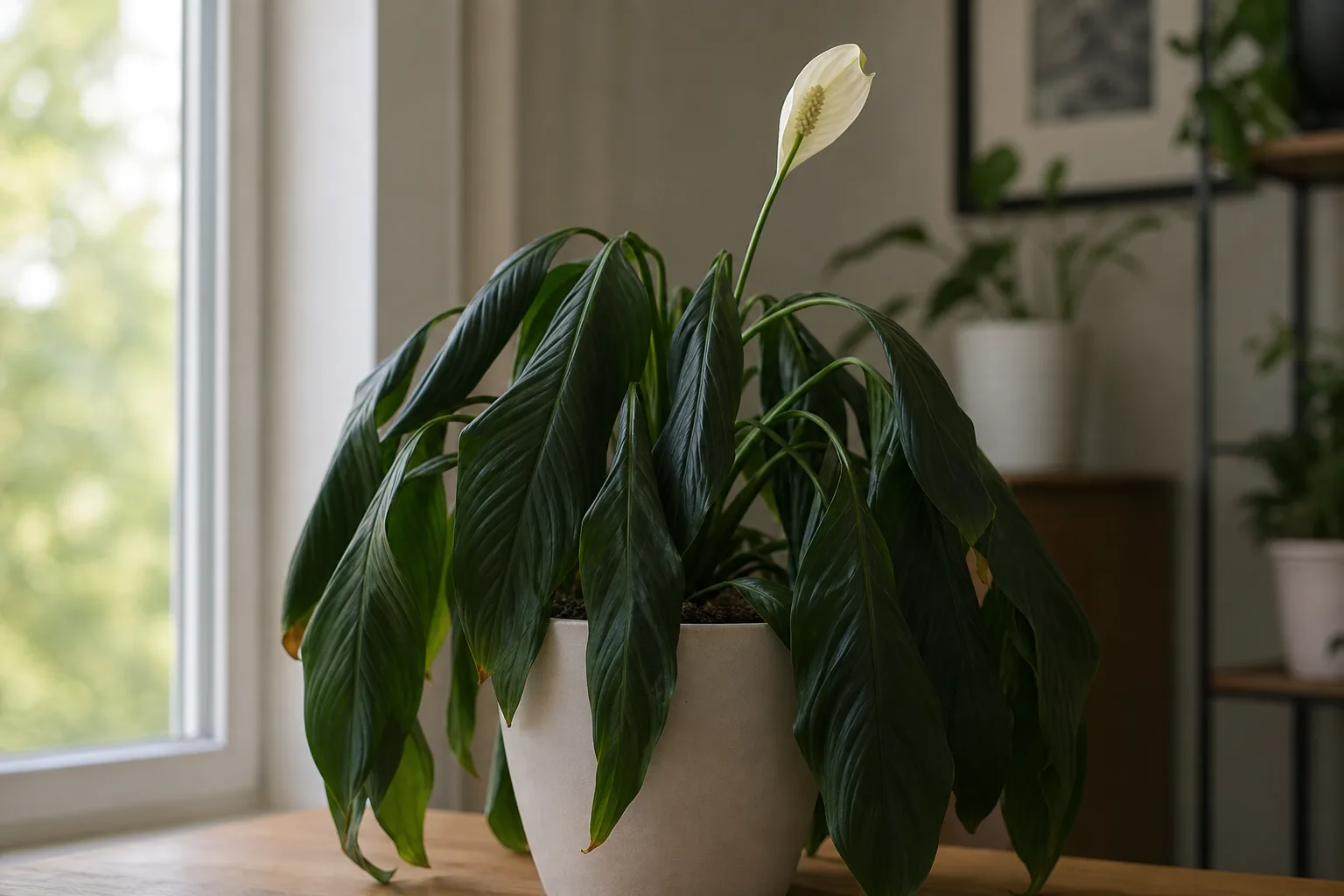
A peace lily can go from upright to dramatically limp in a short time. That does not automatically mean it needs water: dry roots can wilt, but so can roots damaged by soil that stays wet. The quickest way to avoid making the problem worse is to check the potting mix before you reach for the watering can.
Feel the soil a couple of inches below the surface, check whether water can drain out, and think about what changed recently. A plant that wilted after several dry days in a warm room needs a different response from one that has been sitting in wet soil beside a cold window. Drooping is a symptom, not a diagnosis.
Check the soil before you reach for the watering can
Peace lilies (Spathiphyllum) prefer soil that stays lightly and evenly moist, with a little drying between waterings. They do not need to dry to dust, but they also should not sit in a saucer of water. Clemson Cooperative Extension recommends moist, not soggy, potting mix and room-temperature water; it also warns that excess water left beneath the plant can contribute to root rot (Clemson Cooperative Extension).
The visible leaves cannot tell you which side of that line the roots are on. A thirsty plant may wilt because its leaves are losing water faster than the roots can replace it. A plant in saturated mix may wilt because damaged or oxygen-starved roots cannot take up water normally, even when the pot feels heavy.
A three-step diagnosis you can do in two minutes
First, press a finger or a clean wooden skewer into the mix about two inches down. A dry surface can hide damp soil lower in the pot, while a crusted surface can sit above a root ball that has pulled away from the pot and is no longer absorbing water evenly. If a finger cannot reach far enough, feel through a drainage hole or use the pot’s weight as a second clue.
Next, look at drainage. Is the peace lily in a nursery pot with holes, or planted directly into a decorative container? After watering, does water run through, or does it pool on top and remain there? Empty a cachepot or saucer after water drains; water trapped around the pot can keep the root zone wet long after the surface appears dry.
Finally, connect the drooping to a recent event. A missed watering, a move into stronger sun, a cold night, a repot, a fertilizer dose, or a new plant nearby with pests can narrow the diagnosis. One clue is rarely enough, but soil moisture plus timing usually points to the safest first step.
| What you find | More likely explanation | First move |
|---|---|---|
| Mix is dry well below the surface; pot feels light | Underwatering or a dry root ball | Water slowly and thoroughly, then let it drain |
| Mix is wet for days; lower leaves yellow or the pot smells sour | Overwatering, poor drainage, or root damage | Stop adding water; uncover the drainage problem |
| Soil is moderately moist; one side faces a hot window | Direct sun or heat stress | Move it out of direct sun and check for scorch |
| Soil moisture is reasonable; droop followed a cold draft or vent | Temperature or airflow stress | Move it to a stable, warm spot |
| Plant declines slowly; sticky residue, cottony clusters, or scale bumps appear | Pests | Isolate and inspect the plant before treatment |
1. Dry soil or a dry, shrunken root ball
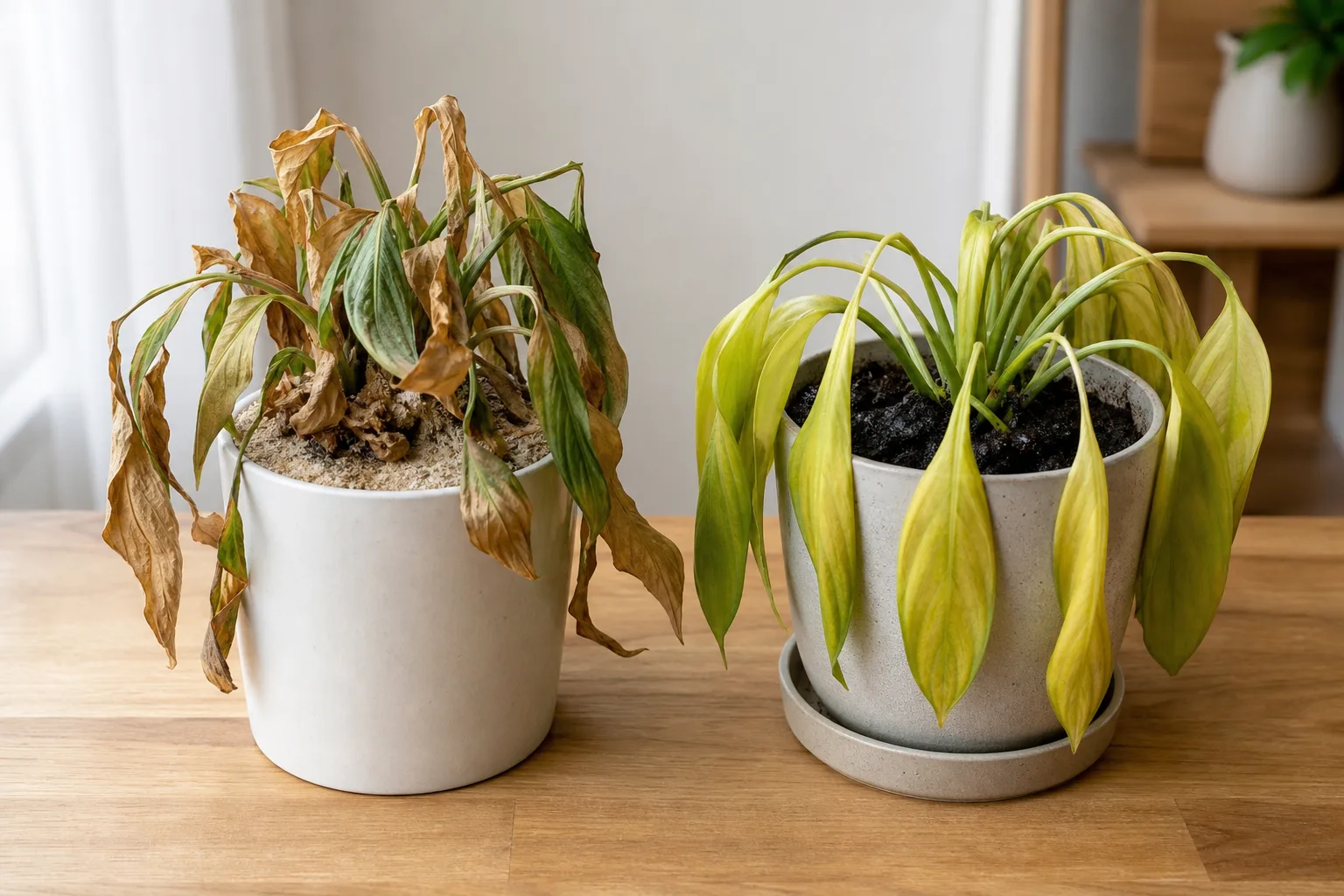
Underwatering is a common reason a peace lily suddenly folds. The pot may have become light, the soil may feel dry below the top layer, and the leaves may hang without a soft, rotten smell coming from the mix. If the potting mix is truly dry, watering is appropriate; the plant is not being “dramatic” in a way that can be safely ignored forever.
Water over the soil surface until excess runs from the drainage holes, then let the container finish draining. If water streams down the gap between the root ball and pot without soaking in, the mix may have become difficult to rewet. In that case, pour a little at a time over the surface, pausing between passes. You can also set the nursery pot in a shallow basin of water briefly so the mix draws moisture upward, then lift it out and let it drain fully. Do not leave the plant soaking for hours.
A dried-out root ball may take longer to rehydrate than loose potting mix. Check it again after the water has had time to move through the container; if the center is still dry, repeat a slow soak rather than repeatedly pouring water onto one corner. A well-watered peace lily often begins to lift in several hours, but the exact pace depends on how dry it became, the room temperature, and the amount of root damage.
Once it recovers, do not use full collapse as the routine watering signal. Clemson and North Carolina Extension both advise keeping the mix moist but not soggy and allowing some drying between waterings (North Carolina Extension Gardener Plant Toolbox). Check the root-zone moisture every few days while you learn how quickly your own pot dries, then gradually space out checks. A small pot in bright, warm conditions can dry much faster than a large plastic pot in a cool room.
2. Waterlogged soil, poor drainage, or damaged roots
Overwatering is about how long the roots remain too wet, not simply whether you poured a generous drink once. If excess water drains away and the mix begins to dry a little between waterings, a thorough soak is usually safer than frequent sips that wet only the top. Trouble starts when water cannot escape, the mix stays saturated, or the plant sits with its drainage holes submerged.
Wet soil can make leaves wilt because it limits the oxygen around roots and damages the fine roots responsible for water uptake. The University of Maryland Extension notes that overwatered plants may show drought-like symptoms, including wilting, even when the medium is wet (University of Maryland Extension). This explains the counterintuitive case: adding water to a limp peace lily may worsen it.
Look for a combination of clues: the pot remains heavy, the soil is damp for many days, lower or older leaves yellow, new growth stalls, or the base of the plant feels soft. A sour smell can support concern about decaying material, but no smell does not rule it out. Likewise, one yellow leaf is not proof of root rot; older leaves naturally age and other stresses can cause yellowing.
Drainage matters more than a decorative layer of gravel inside the container. A pot needs open drainage holes, and the planting mix should let excess water pass through without turning into a dense, airless mass. If the peace lily is in a pot without holes, use a nursery pot with drainage inside the cachepot, then pour off runoff instead of letting the inner pot sit in it. Florida IFAS recommends a moist but freely drained growing medium and warns against allowing Spathiphyllum to stand in water (University of Florida IFAS Extension).
When a root inspection is warranted
Do not pull the plant from its pot every time it droops. Root inspection is reasonable when the soil has stayed wet, drainage is poor, the plant continues declining after you stop watering, or the stems at the base soften. If the mix is drying normally and the plant has a plausible one-time cause such as a missed drink, disturbing the root ball adds stress without answering a useful question.
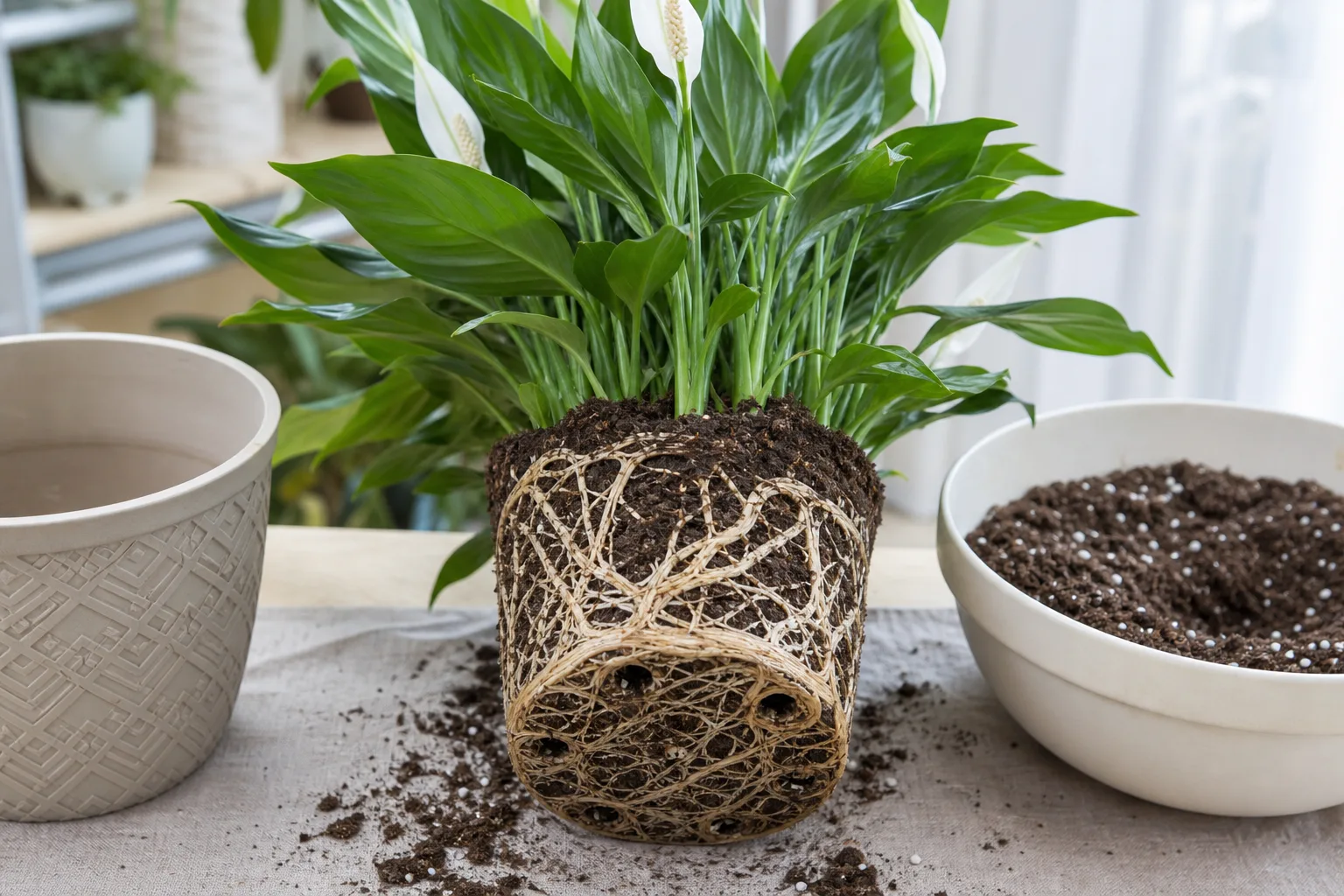
Slide the root ball out gently and look at several areas rather than judging from one dark patch of soil. Healthy roots are generally firm; damaged roots may be soft, dark, hollow, or shed their outer layer when touched. Do not cut roots just because they are brown from potting mix stains. Trim only clearly mushy or dead sections with clean snips, and avoid stripping away every root in an attempt to make the plant “clean.”
If significant root loss is present, use a clean container with drainage and fresh, airy houseplant mix. Choose a pot that fits the remaining root mass rather than upsizing by several inches; an oversized volume of wet mix can prolong the same problem. After repotting, water enough to settle the mix and drain it, then leave the plant in stable indirect light while it adjusts.
3. Direct sun or heat on the leaves
Peace lilies tolerate lower light than many flowering houseplants, but “low-light tolerant” does not mean that every dim corner is ideal. They grow best in bright, indirect light. Direct afternoon sun through glass can heat and scorch leaves, while a nearby radiator or hot window may make the plant lose water faster than its roots can replace it.
Light stress often leaves clues on the exposed side: bleached or tan patches, dry edges, or a plant that droops most during the hottest part of the day. If only one side faces the window, compare that side with the sheltered leaves. A gradual shift to a few feet back from the glass or behind a sheer curtain is usually more useful than moving the plant into a dark hallway.
Too little light more often causes slow, weak growth and fewer flowers than a sudden collapse. North Carolina Extension notes that peace lilies can tolerate low light but should not be placed in direct sun; Clemson similarly warns that direct sunlight can scorch foliage (Clemson Cooperative Extension). If the plant is in a dim place and has been losing vigor for months, move it gradually toward brighter indirect light, then reassess new growth rather than expecting old leaves to reverse damage.
4. Cold drafts, vents, or abrupt temperature shifts
A peace lily near a frequently opened exterior door, cold window, air-conditioning vent, or heater may react to repeated swings even when the room’s thermostat seems comfortable. A plant that was moved outdoors for summer can also struggle if nights cool quickly. Clemson recommends warm daytime conditions and avoiding temperatures below about 60°F; exact tolerance can vary with exposure and how long the chill lasts (Clemson Cooperative Extension).
Move the plant away from the direct path of vents and doors, not necessarily to the warmest spot in the home. A stable room with indirect light is better than a sunny sill that becomes hot by day and cold at night. Do not place it against a radiator to “warm it back up”; hot, dry air can intensify leaf water loss.
Humidity can contribute to crispy edges and faster drying, especially in heated winter rooms, but low humidity alone is less likely than a dry root ball or wet-root damage to explain a sudden full-plant collapse. The Royal Horticultural Society recommends checking several possible stresses, including water, light, and humidity, rather than diagnosing a houseplant from one leaf symptom (Royal Horticultural Society). A room humidifier can help a persistently dry space, but misting is temporary and does not fix a root-zone problem.
5. A serious pest infestation
Mealybugs and scale insects feed by piercing plant tissue and drawing sap. A few insects are unlikely to make a healthy peace lily collapse overnight, but a heavy infestation can weaken growth and compound water or light stress. Gardening Know How likewise describes pest-related wilting as uncommon unless an infestation becomes severe (Gardening Know How). Clemson lists mealybugs, scales, spider mites, and fungus gnats among pests that can affect peace lilies (Clemson Cooperative Extension).
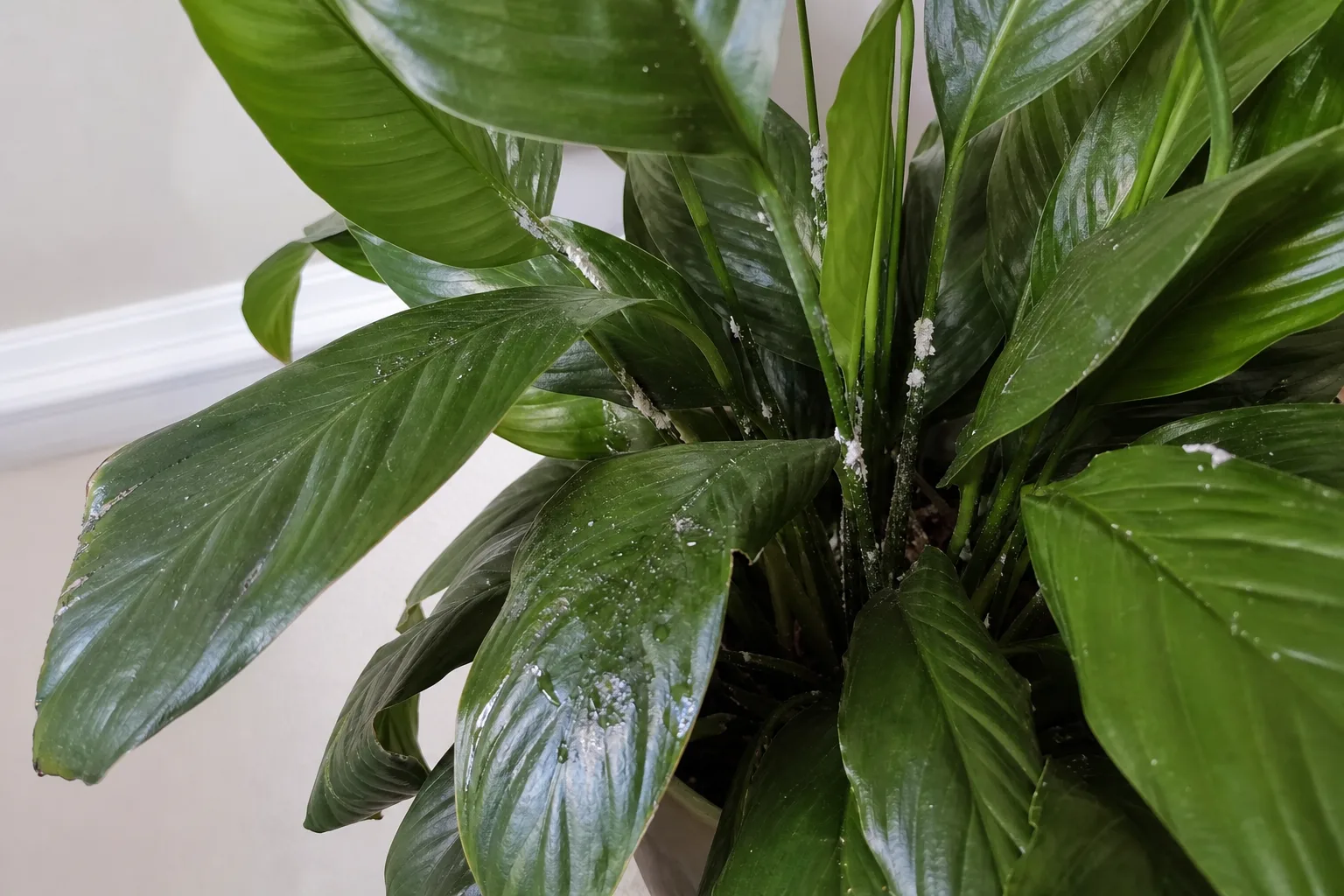
Check where leaves join the crown, along the undersides of leaves, and on the stalks. Mealybugs look like small white cottony clusters; scale can look like fixed tan or brown bumps, sometimes with sticky honeydew nearby. Fine webbing or pale stippling points toward mites. Fungus gnats hovering over damp soil are a separate clue: adults are annoying, but the adult flies themselves are not usually the direct reason a peace lily’s foliage has wilted.
Isolate an infested plant so pests do not spread to nearby houseplants. Remove visible insects and wipe leaves, then follow a product label for any insecticidal soap or other treatment; test a small area first because stressed foliage can react. Recheck weekly because eggs or concealed insects may survive an initial cleaning. Avoid reaching for neem oil or rubbing alcohol as a universal cure; product concentration, plant sensitivity, and pest stage all affect results.
6. Salt buildup, weak growth, or a crowded pot
A nutrient shortage can contribute to weak growth, but fertilizer deficiency is not the first explanation to test when a peace lily suddenly droops. If you fertilize regularly, use concentrated feed, or have hard water, soluble salts can accumulate in the mix and injure root tips. North Carolina Extension cautions that excess fertilizer and salt buildup can burn roots and leaf tips (North Carolina Extension Gardener Plant Toolbox).
Clues include brown tips, a pale crust on the soil or pot rim, slowed growth, or wilting that persists despite reasonable moisture. Do not respond with a stronger fertilizer dose. If the plant drains freely and has no signs of rot, flushing the mix with clean water and allowing it to drain can help move soluble salts out. If drainage is poor or the mix is old and compacted, correct that first; flushing a pot that cannot drain simply adds more water stress.
A root-bound peace lily may wilt again soon after a proper drink because there is little mix left to hold moisture. Roots circling tightly, emerging through drainage holes, or forming a dense mat at the surface support that diagnosis. Clemson recommends repotting when roots circle the surface or grow through drainage holes, using a container only one to two inches larger; peace lilies tolerate being somewhat pot-bound, so a tight-looking root ball alone is not an emergency (Clemson Cooperative Extension).
If the plant has barely grown for months, older leaves are yellowing, and it has not had fresh mix in years, nutrition or depleted potting media may be part of the picture. Feed only during active spring and summer growth, at a conservative dilution and according to the product label. When roots are stressed or the plant is in winter slowdown, stabilize watering and light before considering fertilizer.
How to revive a drooping peace lily today
Choose one corrective action that matches the evidence. If the mix is dry at root depth, water slowly until the whole root ball is moist and excess drains away. If the mix is wet, do not water again; empty the saucer, confirm the pot drains, and let the medium approach a slightly drier state before reassessing.
If the soil moisture is moderate but the plant is next to direct sun, cold air, or a vent, move it to stable bright indirect light. If you see pests, isolate it and begin a measured treatment. If the plant was recently repotted, avoid another round of root disturbance unless the pot is waterlogged or the roots show a clear problem.
Remove only leaves that are fully yellow, brown, or broken, cutting their stalks near the base with clean shears. A leaf that is merely limp but still green may recover and continue functioning. Pruning every drooping leaf removes healthy tissue and makes it harder to judge whether the treatment is working.
The temperature range from the University of Florida IFAS for indoor Spathiphyllum is 75°F to 85°F, while Clemson and South Dakota State give broader household ranges and emphasize avoiding cold conditions. These are horticultural targets, not a demand to keep a home at a narrow setting; prioritize a stable, comfortably warm room and protect the plant from cold drafts (University of Florida IFAS Extension, South Dakota State University Extension).
What recovery should look like—and when it won’t
A thirsty peace lily often shows visible improvement within hours after a thorough drink, although a severely dry plant may take longer. Do not water again just because the leaves have not lifted after 20 minutes. Give the first watering time to move through the root ball, then check whether the center of the mix is actually moist.
Recovery from root damage, prolonged cold, or transplant stress is slower and less predictable. The existing leaves may remain floppy or damaged even after the growing conditions improve; judge success by whether new growth is firm and the decline stops. If the plant continues to worsen over several days, check the roots and drainage again rather than cycling through water, fertilizer, and repotting.
A peace lily may also droop temporarily after division or repotting because fine roots have been disturbed. Keep it out of harsh sun, maintain moderate moisture, and avoid fertilizer while it reestablishes. The Royal Horticultural Society advises evaluating houseplant symptoms across water, light, temperature, and humidity, which is useful when the obvious first fix does not work (Royal Horticultural Society).
Prevent repeat drooping without following a calendar
Check moisture rather than watering every Saturday or copying a schedule from another plant owner. The pot’s size and material, soil structure, room temperature, season, light, and root density all affect how quickly it dries. A terracotta pot near a bright window may need attention far sooner than a large plastic pot in a cool, dim room.
Use a finger, skewer, or the pot’s weight to learn the normal cycle. When the upper couple of inches have started to dry and the deeper mix is no longer wet, water thoroughly and let the container drain. In winter, check less often because lower light and slower growth usually mean water is used more slowly. South Dakota State describes keeping a peace lily evenly moist and flags overwatering as a risk, while the RHS likewise recommends checking compost rather than relying on a rigid interval (South Dakota State University Extension, Royal Horticultural Society).
Keep the plant in bright, indirect light and away from direct airflow. Inspect the undersides of leaves when you dust them; that small habit can catch pests before they become a large infestation. Empty drainage water after each watering, and check the pot once if the mix repeatedly remains wet far longer than expected.
When to repot and what to change
Repot because the plant’s conditions call for it, not because the leaves are drooping today. A pot with no drainage, soil that has collapsed into a dense mass, repeated rapid drying, or roots tightly circling the container are reasons to investigate. Repotting a plant already stressed by cold or drought can stack stress, so correct the immediate issue first unless standing water or severe root damage makes action urgent.
Use a pot with drainage holes that is only modestly larger than the root ball. A container that is much too large contains extra wet mix that the roots cannot use yet, so it may dry slowly and recreate overwatering conditions. Choose a fresh, well-draining indoor mix; gently loosen only the outer circling roots rather than aggressively combing the entire root system.
After repotting, water the mix through and drain it, then keep the plant in consistent indirect light. Do not fertilize immediately to “help it settle”; damaged roots can be more sensitive to concentrated salts. Watch the plant over the following weeks and resume normal feeding only when active growth returns.
Mistakes that make drooping worse
The fastest way to turn a simple wilt into a longer problem is to water before checking the soil. A second common mistake is to let a peace lily swing from bone dry to repeatedly saturated, then interpret each limp leaf as proof that it needs yet another drink. The better rule is to keep it evenly moist, with some drying between waterings.
Avoid treating every drooping plant with fertilizer, repotting, leaf trimming, or a pesticide. Those actions address different problems and can add stress if used without evidence. If the plant is wet and yellowing, more water is wrong; if the roots are intact but the soil is dry, an aggressive root trim is wrong; if there are no pests, spraying is unnecessary.
Do not leave the pot standing in drainage water, and do not rely on pebbles at the bottom of a pot to substitute for drainage holes. A decorative cover pot is fine if the nursery pot can be removed to drain. After watering, tip out excess water and return the plant only when the runoff has stopped.
Conclusion
To diagnose a drooping peace lily, check the root-zone moisture first, then confirm that the pot drains and consider what changed in the plant’s location or care. Dry soil calls for a thorough drink; persistently wet soil calls for less water and a drainage check. Direct sun, cold drafts, heavy pests, fertilizer salts, and a crowded root ball can also contribute, but they leave different clues and need different fixes.
Make one evidence-based change, give the plant time to respond, and avoid stacking treatments. With a stable spot, a draining pot, and watering based on actual soil moisture, most peace lilies are easier to keep upright without waiting for a dramatic wilt to tell you what they need.



